

Google Ads can be a goldmine for real estate investors. But here's the thing - most investors waste thousands of dollars on campaigns that don't convert. They target the wrong keywords, write generic ad copy, and send traffic to pages that don't close deals.
The difference between a profitable Google Ads campaign and a money pit comes down to understanding your market, your audience, and the mechanics of paid search. This guide breaks down exactly how to build campaigns that bring in motivated sellers and serious buyers - without burning through your budget.
Whether you're flipping houses, wholesaling deals, or building a rental portfolio, the strategies here will help you generate consistent leads through paid advertising. Check out our dedicated real estate investor marketing services for specialized PPC solutions.
Understanding the Real Estate Investor's Ad Landscape
Real estate investing has unique challenges when it comes to PPC advertising. You're not selling a product someone can buy with a click. You're looking for people in specific situations - homeowners facing foreclosure, people who inherited properties, landlords tired of dealing with tenants, or buyers hunting for investment opportunities.
This means your Google Ads strategy needs to be different from a typical e-commerce or service business. You're targeting intent and circumstance, not just interest. Someone searching for "sell my house fast" is in a completely different mindset than someone browsing "homes for sale in Austin."
The real estate PPC space is also competitive. In most markets, you're going against other investors, iBuyers, traditional agents, and national "we buy houses" companies. Cost-per-click can run anywhere from $5 to $50 or more depending on your market and keywords. That makes efficiency critical - every click needs to count.
Building Your Keyword Strategy for Real Estate Investing
Your keyword strategy is the foundation of everything. Get this wrong, and you'll spend money attracting the wrong people. Get it right, and you'll have a steady stream of motivated leads.
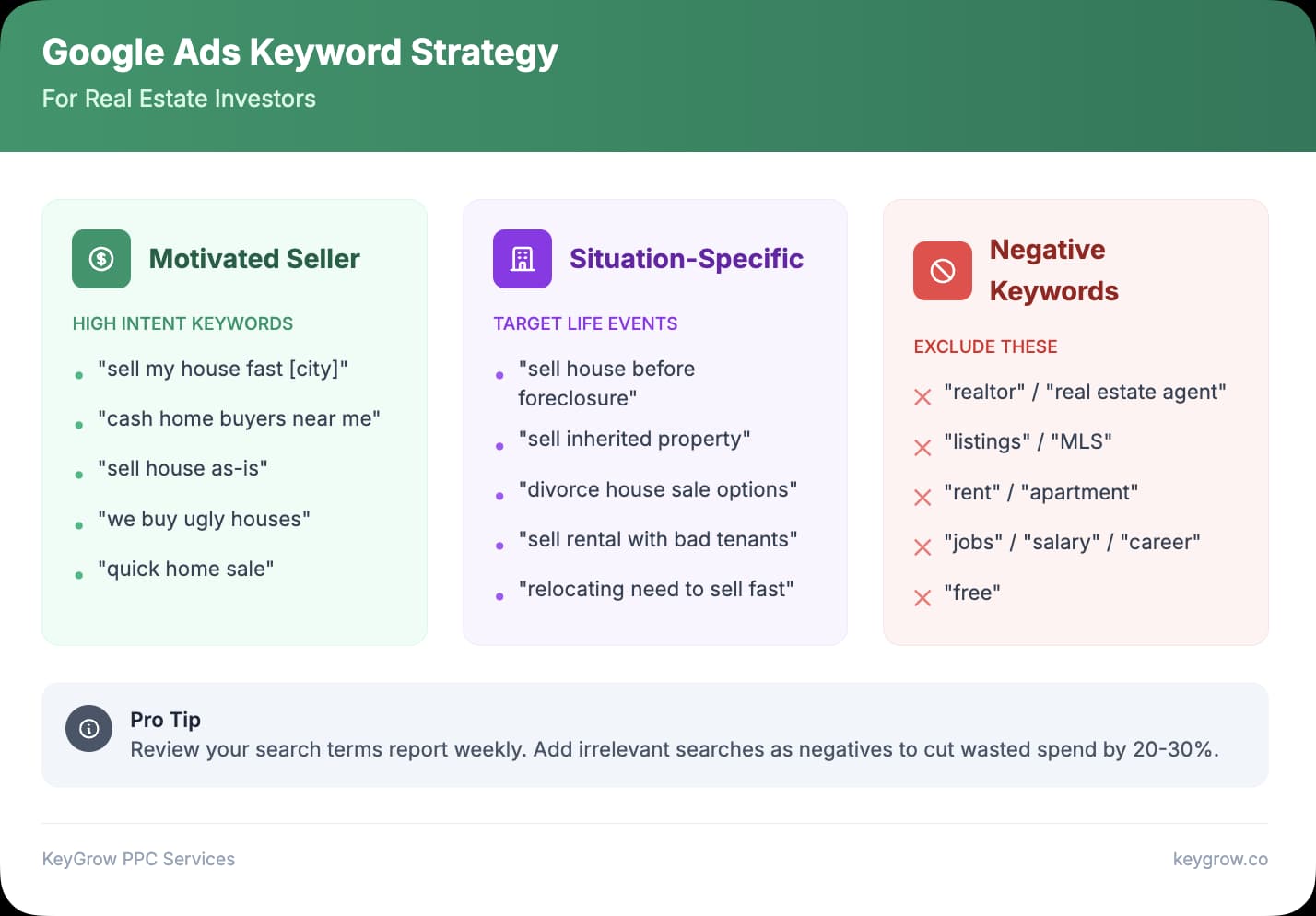
Google Ads Keyword Strategy
Targeting Motivated Seller Keywords
Motivated sellers are the bread and butter for most real estate investors. These are people who need to sell quickly, often below market value, and are willing to work with investors for a fast, hassle-free transaction.
High-intent keywords for motivated sellers include phrases like "sell my house fast [city]," "cash home buyers near me," "sell house as-is," "we buy ugly houses," and "how to sell inherited property quickly." These searches indicate someone actively looking for solutions, not just casually browsing.
You'll also want to target situation-specific keywords. Think about the circumstances that create motivated sellers: foreclosure, divorce, job relocation, inherited property, major repairs needed, problem tenants, or tax liens. Keywords like "sell house before foreclosure," "divorce house sale options," or "sell rental property with bad tenants" attract people in these exact situations.
Keywords for Finding Investment Properties
If you're looking to buy properties through Google Ads - whether for wholesale deals, fix-and-flips, or rentals - you'll need a different keyword approach. Target searches like "distressed properties for sale," "off-market homes [city]," "fixer upper houses," "investment properties for sale," and "wholesale real estate deals."
But be careful here. These keywords can attract other investors rather than actual property owners. Make sure your ad copy and landing pages clearly communicate who you're trying to reach.
Using Negative Keywords to Protect Your Budget
Negative keywords are just as important as the keywords you're targeting. Without them, your ads will show up for searches that have nothing to do with your business.
Common negative keywords for real estate investors include "realtor," "real estate agent," "listings," "MLS," "rent," "apartment," "free," "jobs," "salary," and "career." You'll also want to exclude brand names of competitors if you're not specifically trying to compete for branded searches.
Review your search terms report weekly - especially when launching new campaigns. You'll find searches triggering your ads that you never anticipated, and adding them as negatives will immediately improve your ROI.
Writing Ad Copy That Actually Converts
Your ad copy has to do a lot of heavy lifting in a small space. You've got a few lines of text to grab attention, communicate value, and convince someone to click. Here's how to make every word count.
Leading with Benefits, Not Features
Motivated sellers don't care that you're a "professional home buying company." They care about solving their problem. Lead with what matters to them: fast closing, no repairs needed, no realtor commissions, cash offer, flexible timeline.
Compare these two headlines: "Professional Home Buyers in Dallas" versus "Sell Your House in 7 Days - Cash Offer, No Repairs." The second one immediately tells the searcher exactly what they'll get. It speaks to their situation and offers a clear outcome.
Creating Urgency Without Being Pushy
Urgency works in ad copy, but it needs to feel authentic. Phrases like "Get Your Cash Offer Today" or "Close in As Little as 7 Days" create urgency based on real benefits you provide. Avoid fake scarcity or pressure tactics - motivated sellers are already stressed, and pushy language can drive them away.
Using Location-Specific Copy
Local relevance matters. When someone searches "sell my house fast Phoenix," an ad that specifically mentions Phoenix will outperform a generic national ad. Use location insertion or create separate ad groups for each market you serve.
Include neighborhood names, local landmarks, or regional references when possible. This signals to searchers that you know their area and aren't just another out-of-state operation running ads everywhere.
Testing Multiple Ad Variations
Never run just one ad. Create at least 3-4 variations per ad group testing different headlines, descriptions, and calls to action. Let Google's algorithm find winners, but also analyze the data yourself to understand what messaging resonates.
Test different value propositions: speed versus price versus convenience. Test emotional appeals versus logical appeals. Test questions versus statements. Small changes in copy can produce significant differences in click-through rates and conversion rates.
Structuring Your Campaigns for Maximum Performance
How you organize your Google Ads account affects everything from Quality Score to your ability to optimize. A messy account structure leads to wasted spend and missed opportunities.
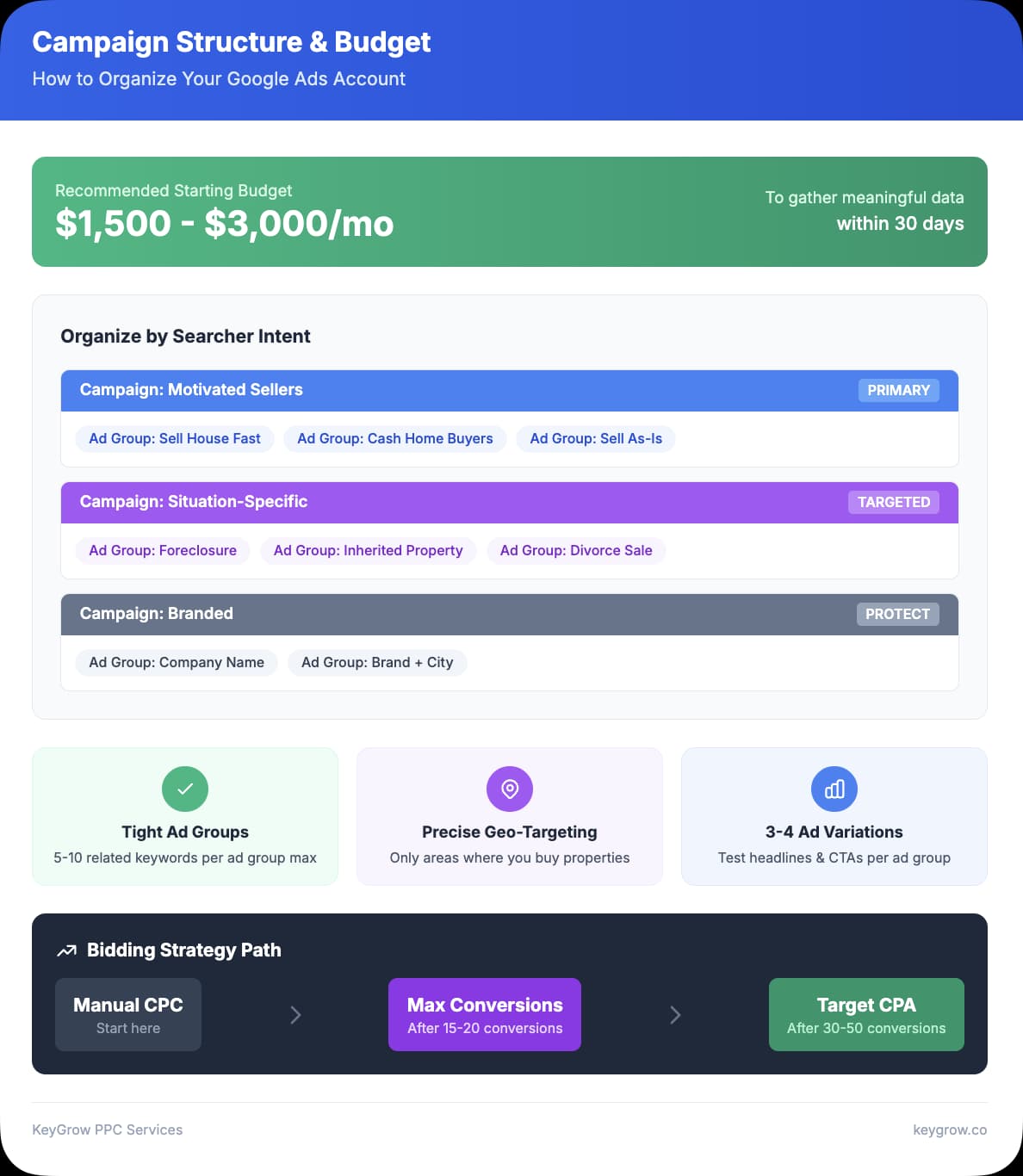
Campaign Structure & Budget
Campaign Organization by Intent
Separate your campaigns by searcher intent. A campaign targeting "sell my house fast" should be separate from one targeting "cash home buyers" or "we buy houses." Even though these might seem similar, the searcher mindset is slightly different, and you'll want different budgets, bids, and ad copy for each.
Consider creating campaigns for branded searches (your company name), competitor searches (other investors or iBuyers in your market), general motivated seller searches, and situation-specific searches (foreclosure, inherited property, etc.).
Ad Group Themes
Within each campaign, organize ad groups around tight keyword themes. Each ad group should contain closely related keywords so your ad copy can be highly relevant to every search. An ad group with 50 unrelated keywords will never perform as well as 10 ad groups with 5 related keywords each.
For example, in a motivated seller campaign, you might have ad groups for "sell house fast," "cash home buyers," "sell house as-is," "quick home sale," and "we buy houses." Each gets tailored ad copy that matches the specific search intent.
Geographic Targeting Decisions
Real estate is local, so your geographic targeting needs to be precise. Target the specific cities, counties, or zip codes where you actually buy properties. Don't waste money showing ads to people in areas you don't serve.
Use radius targeting around your core markets, and consider bid adjustments for high-value areas. If certain neighborhoods consistently produce better deals, increase your bids for those locations. Conversely, reduce bids or exclude areas where you've historically had poor results.
Landing Pages That Convert Clicks into Leads
Getting clicks is only half the battle. If your landing page doesn't convert those clicks into leads, you're throwing money away. The best Google Ads campaigns fail when they send traffic to poorly designed pages.
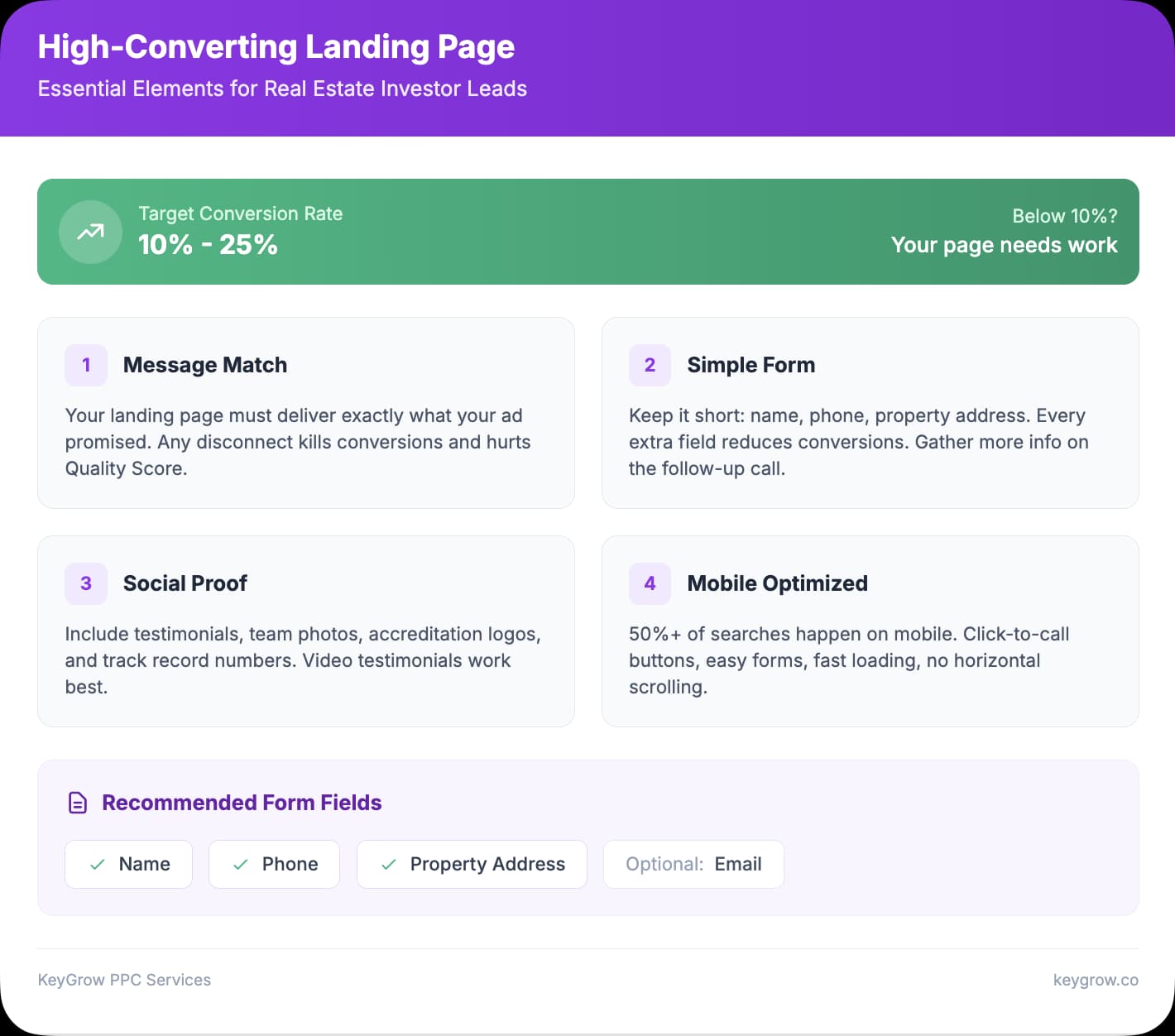
High-Converting Landing Page
Matching Landing Page Content to Ad Promises
Your landing page needs to deliver exactly what your ad promised. If your ad says "Get a Cash Offer in 24 Hours," your landing page better explain how they'll get that offer and include a clear way to request it. Any disconnect between ad and landing page kills conversions and hurts your Quality Score.
Simplifying the Form
For motivated seller leads, keep your form short. Name, phone number, property address, and maybe email. That's it. Every additional field you add reduces conversions. You can gather more information during your follow-up call.
Some investors have success with multi-step forms that feel less overwhelming. Instead of showing all fields at once, break it into 2-3 steps. This psychological trick can increase completion rates because people feel committed after starting.
Building Trust Through Social Proof
Motivated sellers are often skeptical. They've seen "we buy houses" signs and worry about getting scammed or lowballed. Your landing page needs to build trust fast.
Include testimonials from past sellers, photos of you and your team, logos of any associations or accreditations, and numbers that demonstrate your track record ("Over 200 homes purchased in [city]"). Video testimonials work especially well because they're harder to fake.
Mobile Optimization
More than half of real estate searches happen on mobile devices. Your landing page must work flawlessly on phones. This means click-to-call buttons, forms that are easy to fill on small screens, fast loading times, and no horizontal scrolling.
Test your landing page on multiple devices and browsers. What looks perfect on your desktop might be broken on an iPhone. Google also factors mobile experience into Quality Score, so mobile issues hurt both conversions and ad costs.
Bidding Strategies and Budget Management
How you bid and allocate budget can make or break your campaign profitability. Many investors either overbid and blow through budget too quickly, or underbid and never get enough volume to generate deals.
Starting with Manual CPC
When launching new campaigns, start with Manual CPC bidding. This gives you control over exactly what you pay per click while you gather data. Set bids based on what a lead is worth to you, working backward from your deal economics.
For example, if you close 1 deal per 20 leads, and each deal profits $30,000, each lead is worth $1,500. If your landing page converts 10% of clicks to leads, each click is worth $150. You probably wouldn't bid that high, but it gives you a ceiling to work with.
Moving to Smart Bidding
Once you have conversion data - at least 30-50 conversions over 30 days - consider switching to automated bidding strategies like Target CPA or Maximize Conversions. These use machine learning to optimize bids based on likelihood of conversion.
Smart bidding works best when you have consistent conversion volume and accurate conversion tracking. If your conversion data is spotty or your volume is low, stick with manual bidding or Enhanced CPC, which adds a layer of automation while keeping you in control.
Budget Allocation Across Campaigns
Don't spread your budget too thin across too many campaigns. It's better to fully fund your best-performing campaigns than to starve everything equally. Start with your highest-intent keywords and expand as you prove ROI.
Review performance weekly and shift budget toward what's working. If your "sell house fast" campaign is generating leads at $80 each while your "we buy houses" campaign is at $150, move money toward the winner. Be aggressive about cutting what doesn't work.
Tracking and Measuring What Matters
You can't improve what you don't measure. Proper tracking separates investors who profit from PPC from those who just burn cash.
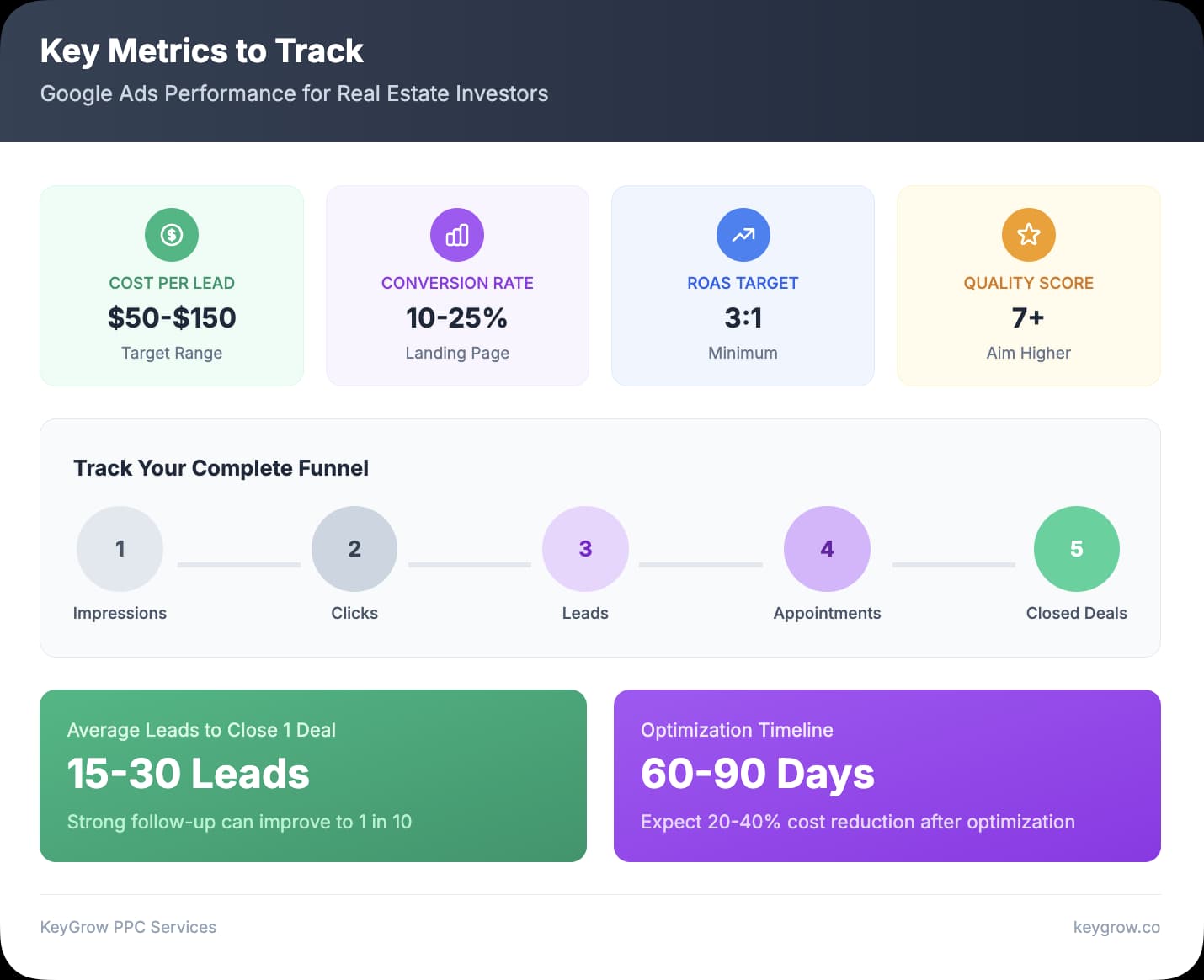
Key Metrics to Track
Setting Up Conversion Tracking
At minimum, track form submissions on your landing page. But don't stop there. Set up call tracking so you know which keywords and ads generate phone calls. Use a tool like CallRail or CallTrackingMetrics to assign unique numbers to your PPC campaigns.
If possible, track all the way through your pipeline. Connect Google Ads data to your CRM so you can see which campaigns generate not just leads, but appointments, offers, and closed deals. This lets you optimize for actual revenue, not just lead volume.
Key Metrics to Monitor
Focus on metrics that tie to business outcomes: cost per lead, cost per appointment, cost per deal, and return on ad spend. Vanity metrics like impressions and clicks matter less than what those clicks produce.
Also watch your Quality Score, which affects how much you pay per click. Improving Quality Score through better ad relevance, landing page experience, and expected click-through rate can dramatically reduce your costs.
Regular Optimization Reviews
Schedule time weekly to review campaign performance. Look at search terms triggering your ads and add irrelevant ones as negatives. Check which ads are underperforming and pause or replace them. Analyze geographic data to see if certain areas are outperforming others.
Monthly, do a deeper analysis. Calculate true ROI including all costs (ad spend, landing page tools, call tracking, your time or team time managing campaigns). Compare performance month-over-month and identify trends.
Common Google Ads Mistakes Real Estate Investors Make
Learning from others' mistakes saves you money. Here are the most common errors investors make with Google Ads - and how to avoid them.
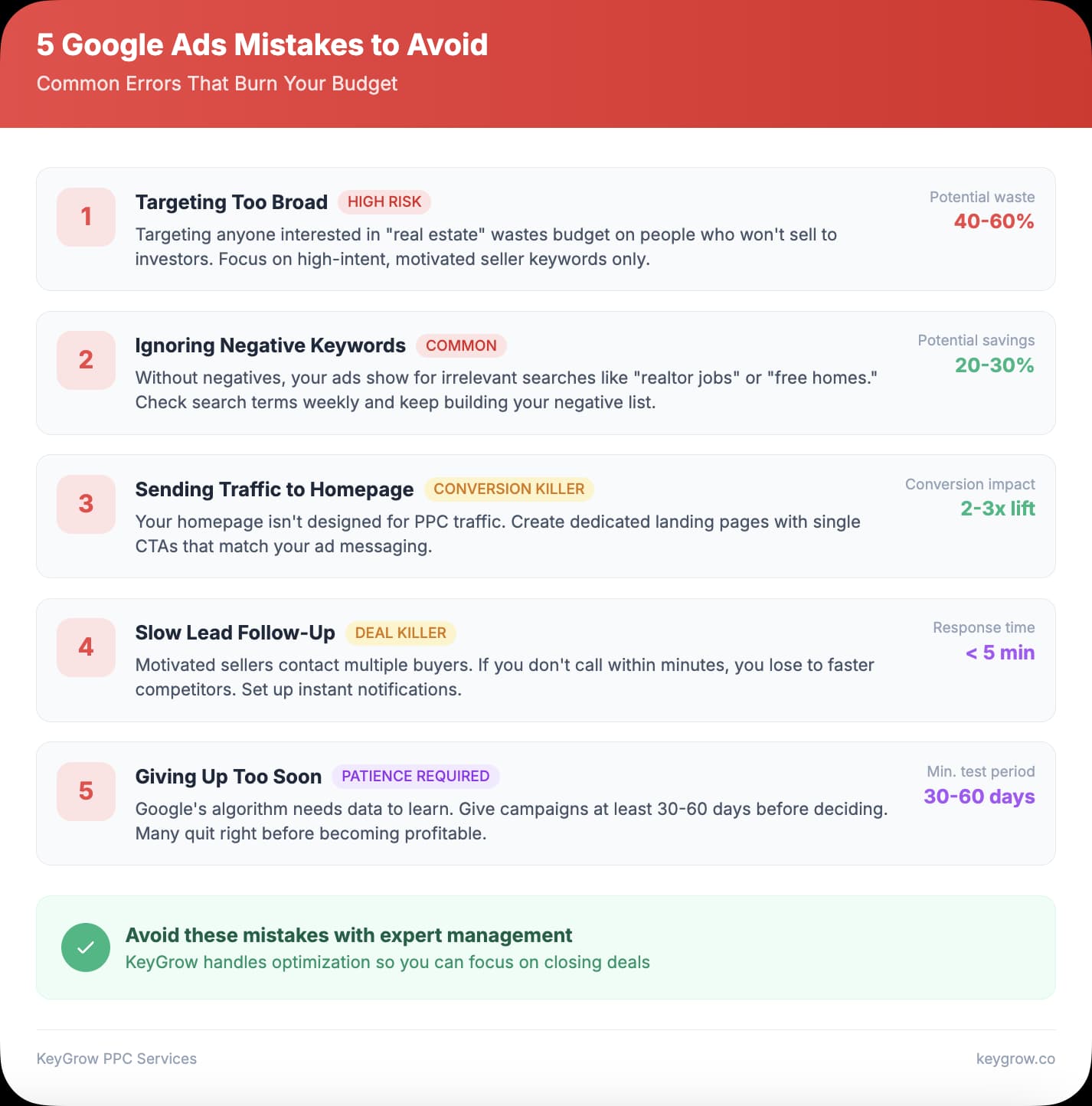
5 Google Ads Mistakes to Avoid
Targeting Too Broad
Some investors try to target anyone interested in real estate. This wastes budget on people who have no intention of selling to an investor. Stay focused on high-intent keywords that signal someone ready to take action.
Ignoring Negative Keywords
Without negative keywords, your ads show up for all sorts of irrelevant searches. Check your search terms report regularly and keep building your negative keyword list. This one action can cut wasted spend by 20-30%.
Sending Traffic to Your Homepage
Your homepage isn't designed to convert PPC traffic. Create dedicated landing pages that match your ad messaging and have a single, clear call to action. This alone can double or triple your conversion rates.
Not Following Up Fast Enough
Speed to lead matters enormously. Motivated sellers are often contacting multiple buyers. If you don't call within minutes of receiving a lead, you might lose them to someone faster. Set up instant notifications and have a system to respond immediately.
Giving Up Too Soon
Google Ads takes time to optimize. The algorithm needs data to learn, and you need data to make informed adjustments. Give campaigns at least 30-60 days of consistent spend before deciding if they work. Many investors quit right before their campaigns would have become profitable.
Advanced Strategies for Scaling Your Campaigns
Once you have profitable campaigns running, it's time to scale. But scaling isn't just about spending more money - it's about expanding reach while maintaining efficiency.
Expanding Geographic Coverage
If you've proven ROI in one market, replicate your approach in new areas. But don't just copy and paste - each market has different competition levels, costs, and seller motivations. Customize your messaging for local relevance.
Adding Display and YouTube Campaigns
Search ads capture people actively looking for solutions. Display and YouTube ads let you reach potential sellers before they start searching. Target audiences like homeowners in your target areas, people researching foreclosure topics, or viewers of real estate investment content.
These channels typically have lower conversion rates than search, but they also have lower costs per click and can build brand awareness that pays off later when those people do start searching.
Remarketing to Past Visitors
Most people don't convert on their first visit to your landing page. Remarketing lets you stay in front of them as they browse other websites or use Google services. Set up remarketing audiences and create campaigns specifically targeting people who visited your site but didn't submit a form.
Remarketing is particularly effective for real estate because selling a home is a big decision. People often need multiple touchpoints before they're ready to take action.
Let KeyGrow Handle Your Google Ads Management
Running profitable Google Ads campaigns takes time, expertise, and constant attention. Between researching keywords, writing ad copy, building landing pages, monitoring performance, and making ongoing optimizations - it's practically a full-time job.
And for most real estate investors, that time is better spent finding deals, negotiating with sellers, and closing transactions.
That's where KeyGrow comes in. Our PPC management services and real estate investor marketing solutions are built specifically for investors like you. We understand the motivated seller market, know which keywords convert, and have tested thousands of ad variations to find what works.
KeyGrow's team handles everything: campaign strategy, keyword research, ad creation, landing page optimization, conversion tracking, and ongoing management. You focus on your business while we focus on filling your pipeline with qualified leads.
Our clients typically see cost-per-lead drop by 30-50% within the first 90 days compared to running campaigns themselves. And because we manage campaigns for investors across multiple markets, we bring insights and benchmarks that help you compete more effectively.
Ready to stop guessing and start getting consistent, high-quality leads from Google Ads? Contact KeyGrow today for a free PPC audit of your current campaigns - or to get started with a done-for-you campaign built to convert.
FAQs
How much should real estate investors spend on Google Ads?
Most real estate investors should start with $1,500 to $3,000 per month to gather meaningful data. Your actual budget depends on your market's competition level and your deal volume goals. In competitive markets like Los Angeles or Miami, expect to spend more. In smaller markets, you can often generate consistent leads for less. The key is spending enough to get statistically significant results within 30 days, then scaling based on performance.
What is a good cost per lead for real estate investors using Google Ads?
A good cost per lead for real estate investors typically ranges from $50 to $150, depending on your market and lead quality. In highly competitive urban markets, costs can reach $200 or more. In smaller markets with less competition, $30 to $75 is achievable. More important than raw cost is the quality of leads and your conversion rate from lead to closed deal. A $150 lead that converts to a $40,000 profit is better than a $50 lead that never closes.
How long does it take for Google Ads to work for real estate investors?
Expect to see initial leads within the first 1-2 weeks of launching campaigns, but true optimization takes 60-90 days. During this period, Google's algorithm learns which users are most likely to convert, and you gather data to refine keywords, ads, and landing pages. Most investors see their cost per lead decrease by 20-40% after the first 90 days of active optimization. Patience and consistent investment during this learning phase are critical.
What are the best keywords for real estate investor Google Ads?
The best-performing keywords for real estate investors include "sell my house fast [city]," "cash home buyers near me," "sell house as-is," "we buy houses [city]," and situation-specific terms like "sell house before foreclosure" or "sell inherited property quickly." These keywords indicate high intent from motivated sellers. Avoid broad terms like "real estate" or "homes for sale" which attract the wrong audience and waste budget.
Should real estate investors use Google Ads or Facebook Ads?
Both platforms work for real estate investors, but they serve different purposes. Google Ads captures people actively searching for solutions right now - ideal for motivated sellers ready to act. Facebook Ads reaches people based on demographics and interests, better for building awareness and reaching sellers before they start searching. Most successful investors use both, with Google Ads driving immediate leads and Facebook nurturing longer-term prospects.
What landing page conversion rate should real estate investors expect?
Real estate investor landing pages should convert between 10% and 25% of visitors into leads. If your conversion rate is below 10%, your landing page needs work - likely the form is too long, the messaging doesn't match your ads, or trust signals are missing. Conversion rates above 25% are excellent and indicate strong message match and compelling offers. Test different headlines, form lengths, and trust elements to continuously improve.
How do I track ROI from Google Ads for real estate investing?
Track ROI by connecting Google Ads to your CRM and measuring the complete funnel: impressions, clicks, leads, appointments, offers, and closed deals. Calculate cost per acquisition at each stage. Use call tracking to attribute phone leads back to specific campaigns. The ultimate metric is return on ad spend (ROAS) - total profit from closed deals divided by total ad spend. Aim for at least 3:1 ROAS, meaning $3 in profit for every $1 spent on ads.
Can I run Google Ads for real estate investing myself?
You can run Google Ads yourself, and many investors do successfully. However, it requires significant time to learn the platform, ongoing attention to manage campaigns, and patience through the learning curve. Most investors find that the time spent managing ads could be better used closing deals. Working with a [specialized real estate investor marketing agency](/industries/real-estate/investors) often delivers better results faster, even after accounting for management fees, because agencies bring expertise and tested strategies from day one.
What is Quality Score and why does it matter for real estate ads?
Quality Score is Google's rating of your ad relevance, landing page experience, and expected click-through rate, measured on a 1-10 scale. Higher Quality Scores mean you pay less per click and get better ad positions. For real estate investors, improving Quality Score can reduce costs by 20-50%. Increase your score by creating tightly themed ad groups, writing ad copy that closely matches keywords, and building landing pages that deliver on your ad promises with fast load times and mobile optimization.
How many leads does it take to close a deal from Google Ads?
On average, real estate investors close 1 deal per 15-30 leads from Google Ads, though this varies significantly based on your follow-up process, offer competitiveness, and market conditions. Strong investors with fast follow-up and compelling offers might close 1 in 10. Investors with slower response times or below-market offers might need 40+ leads per deal. Focus on improving your sales process as much as your ad campaigns - both affect your ultimate ROI.


