


When someone in your city types "divorce lawyer near me" or "personal injury attorney in [your city]," where does your firm show up? If you are not on the first page, those clients are going to firms that worked out Google Ads before you did.
Google Ads for lawyers is the work of bidding on the searches people run when they need legal help, then converting those clicks into signed cases at a price your fee structure can absorb. It is the fastest channel in legal marketing and the most expensive one to get wrong. Organic takes months. Referrals are unpredictable. Billboards charge you for thousands of people who will never need an attorney.
Two things changed in the last year that most law firm advertising advice has not caught up with. Google retired the Guaranteed and Screened badges in favor of a single Google Verified badge, and Local Services Ads are being folded into Google Ads as Performance Max campaigns. Both are covered below, because both change where a firm should be putting its money.
What follows is campaign structure, strategy by practice area, real budget numbers, and the reasons most legal accounts underperform. If you would rather hand it to someone, our law firm PPC management services are built for legal practices.
Why Google Ads works for local law firms
Legal is the most expensive vertical in paid search. "Car accident lawyer" clears $100 a click in major markets, and firms keep paying it year after year.
Because the arithmetic works.
When potential clients need legal help, they search Google. They're not browsing. They're actively looking for a solution to a pressing problem. Someone searching "DUI lawyer Phoenix" at 2 AM probably got pulled over a few hours ago. They need help now, and they'll call one of the first attorneys they find.
Google Ads lets you be that attorney.
Beyond immediate lead generation, consistent visibility in search results builds brand recognition. Even when users don't click your ad, they see your firm's name. Over time, this repeated exposure creates familiarity. When they finally need a lawyer, or when someone asks for a recommendation, your name comes to mind first.
This matters more for a local firm than for a national one. You are not competing against every law firm in the country. You are competing against maybe fifteen firms inside a thirty mile radius, most of whom are running the account their nephew set up. That is a winnable fight, and it is the one our legal marketing services are built around.
Is it Google Ads or Google AdWords?
It is Google Ads. Google renamed AdWords in 2018, and in no industry has the old name held on quite like it has in legal.
You will still see AdWords for lawyers in agency pitches, in CLE session titles, and in the vocabulary of any managing partner who opened an account before 2015. Nothing about the strategy changed with the name, so if that is the phrase you searched, you are in the right place.
What did change is everything underneath it. AdWords was a keyword auction you steered by hand, and the skill was in the bid adjustments. Google Ads is a set of largely automated campaign types where your leverage now sits in conversion data, negative keyword lists, and landing pages. Lawyers who learned the platform a decade ago and stepped away are usually surprised by two things: how little of the old daily work still exists, and how much money the automation can burn when it is fed bad conversion signals. A firm counting every form fill as a conversion, including the ones from people looking for a job, is actively training Google to find more of them.
One thing genuinely has no AdWords equivalent. Local Services Ads did not exist back then, they charge per lead rather than per click, and for several practice areas they now beat search on cost per signed case. They get their own section below.
Which Google Ads campaign types work for lawyers?
Google Ads offers several campaign types. For a local firm, two of them do almost all of the work and two are situational.
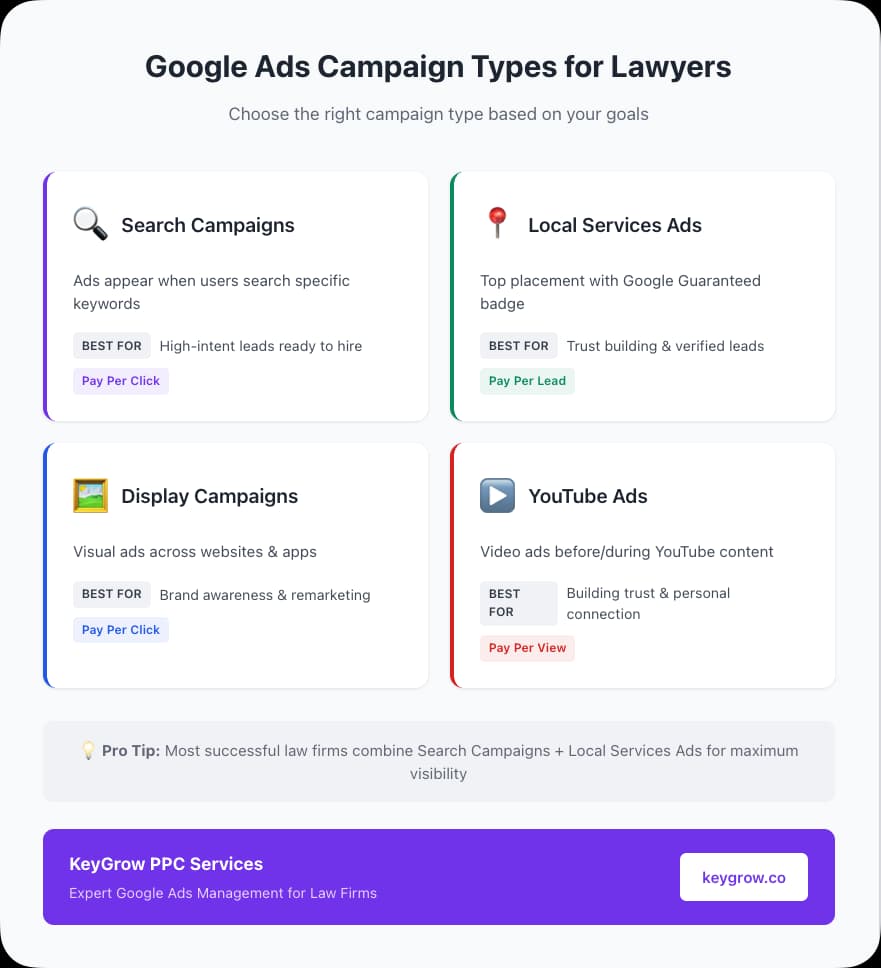
Google Ads Campaign Types for Lawyers
Search campaigns
This is where most of the money goes and most of the cases come from. Somebody types a phrase, your ad appears against it, and you decide which phrases are worth appearing against.
The intent is what makes it work. Someone searching "estate planning attorney near me" has already decided they need one and is now choosing. Compare that to somebody who sees your banner while reading the local news, who has decided nothing at all. You pay more per click for the first person for an obvious reason.
Search also gives you the thing no other campaign type does: a search terms report showing the actual phrases people typed. That report is where the account gets fixed, and most firms have never opened it.
Local Services Ads
Local Services Ads sit above everything else on the page, including your own search ads, and they charge per lead rather than per click. You pay when somebody contacts the firm, not when somebody clicks and leaves.
For most practice areas this is now the first place a firm should spend rather than the last. It is also the part of the platform changing fastest right now, so it has a full section of its own further down.
Display campaigns
Display puts your banner on news sites, blogs and apps across Google's network. Nobody seeing it is looking for a lawyer, which is exactly the problem and exactly the point.
As a way to generate cases directly, it is poor, and firms that judge it that way switch it off within a month. Its real job is remarketing: catching the person who read your DUI page last Tuesday and left without calling. Used that way it is cheap and it works. Used as a cold prospecting channel in legal, it is a donation.
YouTube ads
Almost nobody in legal runs these, which is the argument for them.
Hiring a lawyer is a trust decision made largely on instinct, and thirty seconds of an attorney talking does more for that than any headline. You can target by location, by interest, and by people who have run legal searches. The catch is honest: this only works if you are comfortable on camera. A stiff, over-produced video is worse than no video, and most firms would be better served putting the money into search.
If family law is your area, our guide to Google Ads for family law firms goes deeper on case-type campaigns.
Local Services Ads for law firms, and the change coming in 2026
Local Services Ads are the pay-per-lead unit that sits at the very top of legal search results, above your own search ads. If any part of this article is out of date on the page you read it, it is this part, so check the dates.
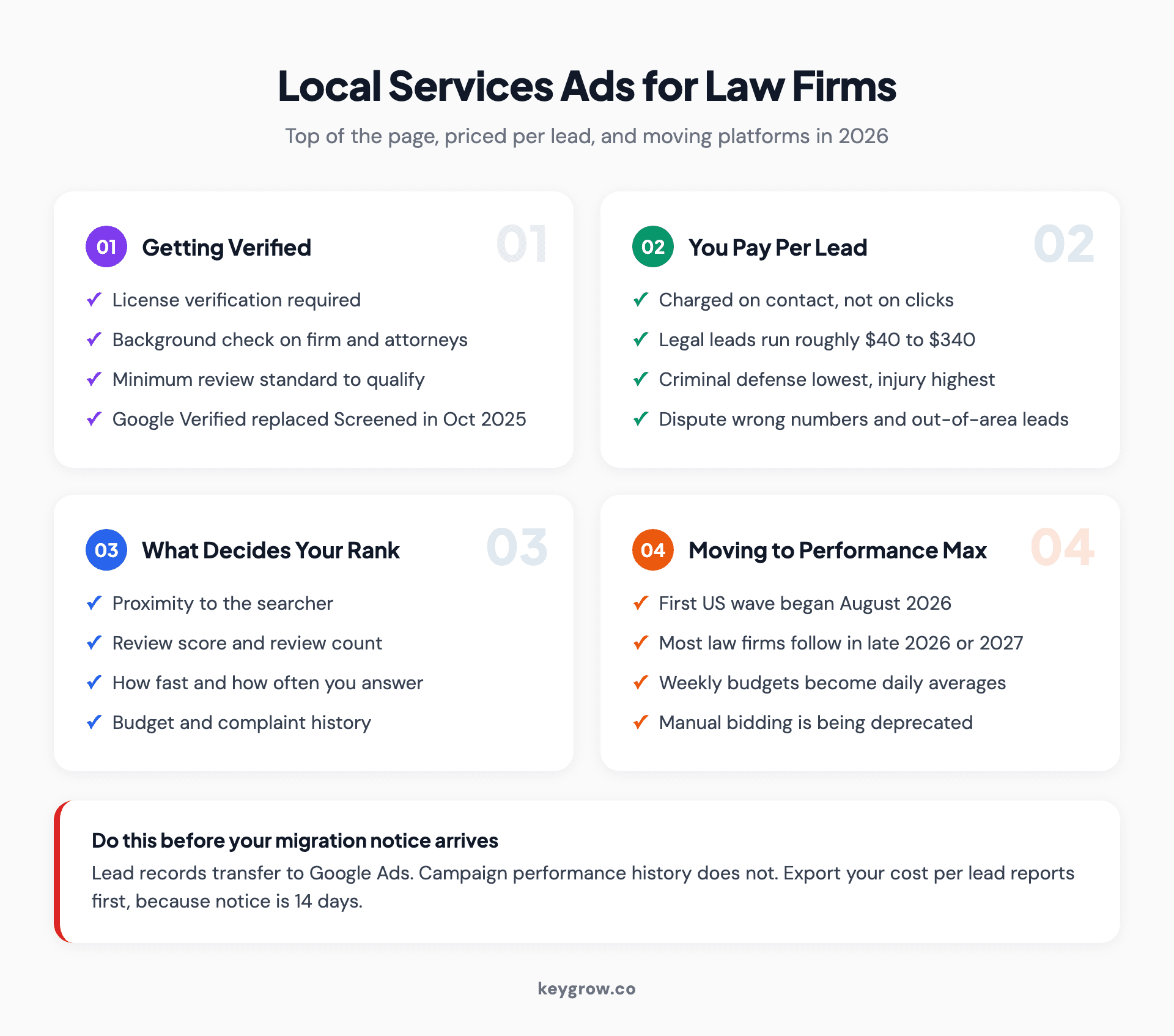
How Local Services Ads work for law firms: screening and verification, pay per lead pricing, what determines ranking, and the 2026 move into Performance Max.
The badge is now Google Verified
Most guides still tell law firms to chase a Google Screened badge, and plenty still say Google Guaranteed, which was never the legal one in the first place. Both are gone. In October 2025 Google folded Screened, Guaranteed and License Verified into a single Google Verified badge, and the money-back guarantee that came attached to the old Guaranteed badge was discontinued with it.
Existing advertisers were moved across automatically. What has not changed is what you have to pass to earn it: license verification, a background check on the firm and on individual attorneys in most states, insurance where the category requires it, and a minimum review standard. That screening is the reason the unit converts. Somebody comparing four firms at eleven at night can see that one of them was checked.
What Local Services Ads cost a law firm
You pay per lead, and legal leads are the most expensive on the platform.
| Practice area | Typical cost per lead | Notes |
|---|---|---|
| Personal injury | $140 to $340 | Widest spread of any category, driven by metro |
| Criminal defense | $70 to $110 | Volume is high and the decision is fast |
| Family law | $80 to $180 | Long consideration window, more repeat contact |
| Estate planning | $50 to $120 | Lower urgency, lower competition |
| Immigration | $40 to $100 | Highly dependent on language targeting |
Those are ranges, not quotes, and your metro moves them more than your practice area does. The number that matters is not the lead price anyway. It is how many of those leads sign, and Local Services Ads leads sign at a noticeably higher rate than search clicks because the person actively chose to contact you rather than landing on a page.
Set a weekly budget as a ceiling and let it run. Firms that throttle the budget every time the lead price ticks up end up with an account that never accumulates the responsiveness history the ranking depends on.
What decides where a firm ranks in Local Services Ads
There is no keyword bidding here, which trips up lawyers coming from search. Ranking is decided by proximity to the searcher, your review score and review count, how fast and how often you answer the phone, your budget, and your complaint history.
Responsiveness is the one most firms lose on and the one they can fix this week. Missed calls hurt. Slow callbacks hurt. A firm that lets Local Services Ads calls roll to voicemail after five is paying for leads and then telling Google it does not want any more of them.
Dispute the bad leads rather than absorbing them. Wrong number, spam, someone outside your service area, someone asking about a practice area you do not handle: all of those are creditable, and firms that never file disputes are quietly paying for traffic they should not be. Set a fifteen minute weekly slot for it.
The Performance Max migration, and what it costs you
This is the part worth putting in the calendar. Google is moving Local Services Ads into the main Google Ads platform as Performance Max campaigns with pay-per-lead goals. Google's migration notice puts the first wave in August 2026 for selected home and storefront services in the US, with service-area businesses and accounts running custom bidding following in late 2026, and everything else including non-US accounts in 2027. Most law firms land in that second or third group.
The placements do not change. Your ads still appear in the same spot on Search and Maps, still keywordless, still priced per lead. What changes is the control panel. Weekly budgets convert to daily averages, manual bidding and vertical-level target CPA are deprecated, and monthly spend gets capped at the daily budget multiplied by 30.4.
The detail to act on now: your historical Local Services Ads performance reports do not come across. Lead records transfer, campaign performance history does not. Export everything before your notice arrives, because you get fourteen days of warning and then a reminder at seven, and a firm that loses two years of cost-per-lead history loses the only benchmark it had for judging what comes next.
Which practice areas should run them
Criminal defense, DUI, and family law get the most out of Local Services Ads, because those searches are urgent, the caller wants a person rather than a website, and the badge does real work at the moment of choosing. Personal injury runs them too, but the lead prices are brutal and the case values carry it.
Estate planning and business law are the weakest fit. Those buyers research for weeks, compare on expertise rather than availability, and are more likely to read a page than to tap a call button. Run search and content for them instead.
How to set up Google Ads for a law firm
This is the order the decisions actually need making, and skipping any of the first three is how firms end up with an expensive account that books nothing.
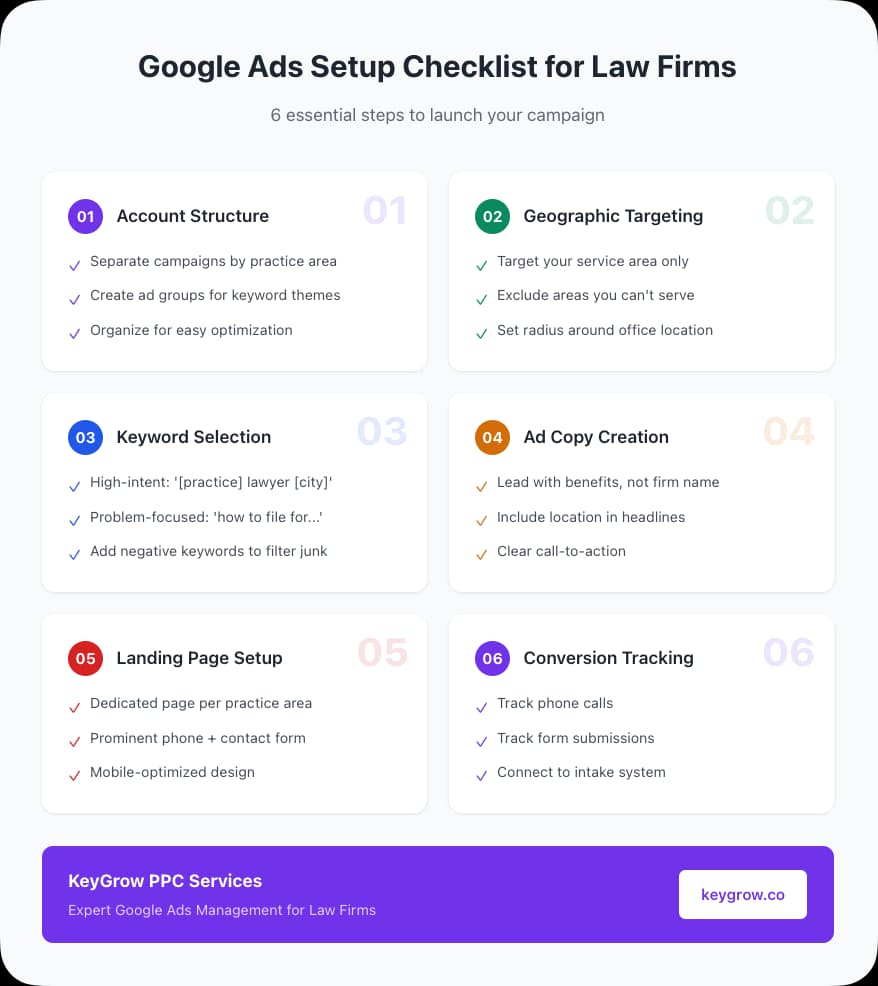
Google Ads Setup Checklist for Law Firms
Account structure
Your account structure sets the foundation for everything else. A clean, organized structure makes optimization easier and improves your Quality Score (which lowers your cost per click).
For most local law firms, organize your account by practice area. Create separate campaigns for personal injury, family law, criminal defense, and whatever other services you offer. Within each campaign, create ad groups around specific keyword themes.
For example, your personal injury campaign might include ad groups for car accidents, slip and fall, medical malpractice, and wrongful death. Each ad group contains closely related keywords and ads specific to that topic.
This structure lets you write highly relevant ads for each keyword group. When someone searches "car accident lawyer," they see an ad specifically about car accident cases, not a generic "personal injury" ad. Relevance improves click-through rates and Quality Score.
Geographic targeting
Geographic targeting is where legal budgets leak quietest. Nobody notices paying for clicks from three states away until they read a search terms report.
Set your location targeting to the specific areas where you practice. This might be your city, county, or a custom radius around your office. Be precise. There's no benefit to showing ads to people outside your service area.
Also consider excluding certain areas. If you practice in a major metro area, exclude surrounding cities with different courts or where you're not licensed. Every click from someone you can't help is wasted money.
Keyword research and selection
Keywords decide when your ads appear, and in a market where a click costs what a click costs in legal, the list is the budget.
Start with the obvious terms potential clients would search: "[practice area] lawyer [city]," "[practice area] attorney near me," "best [practice area] lawyer in [city]." These high-intent keywords signal someone ready to hire an attorney.
Then expand to problem-focused keywords. Someone might search "how to get custody of my child" before they search "custody lawyer." These informational queries represent earlier stages of the client journey. The clicks are usually cheaper, and you can capture potential clients before they start comparing firms.
Use negative keywords to filter out irrelevant searches. Add negatives like "free," "pro bono," "salary," "jobs," and "school." Someone searching "law school admission requirements" isn't looking to hire you. Negative keywords prevent your ads from showing on these searches, saving your budget for qualified leads.
Writing ads that convert
Your ad copy has one job, and it is not getting the most clicks. It is getting the right clicks, because you pay for the wrong ones at the same rate.
Lead with the problem, not the solution. Don't start with your firm name because no one's searching for that. Start with what the searcher wants: "Hurt in a Car Accident?" or "Fighting for Custody?"
Include your location. Local searchers want to know you're nearby. "Dallas Personal Injury Lawyer" or "Serving Fort Worth & Surrounding Areas" signals you're local.
Add a clear call to action. Tell people what to do next: "Call for a Free Consultation," "Get Your Free Case Review," or "Schedule Your Consultation Today."
Use ad extensions to take up more space and provide more information. Location extensions show your address. Call extensions add a clickable phone number. Sitelink extensions let you link to specific practice area pages. The more relevant information you provide, the more qualified your clicks become.
Landing pages
The landing page decides whether a $90 click becomes a consultation or a bounce, which makes it the highest-leverage thing in the account.
Don't send ad traffic to your homepage. Homepages try to serve everyone, which means they're not optimized for any specific search. Instead, create dedicated landing pages for each major practice area or campaign.
If someone clicks an ad for "DUI lawyer Phoenix," they should land on a page specifically about your DUI defense services in Phoenix. The page should answer their immediate questions, establish your expertise, and make it extremely easy to contact you.
Include multiple contact options: phone number (prominently displayed), contact form, live chat if possible. Different people prefer different communication methods. Remove barriers to contact.
Keep the page focused. Don't distract visitors with links to other practice areas, blog posts, or attorney bios. Everything on the page should drive toward one goal: getting them to reach out.
How Google Ads strategy changes by practice area
Legal is not one market. A DUI account and an estate planning account share a platform and almost nothing else, and running them the same way is why so many firms conclude that Google Ads does not work.
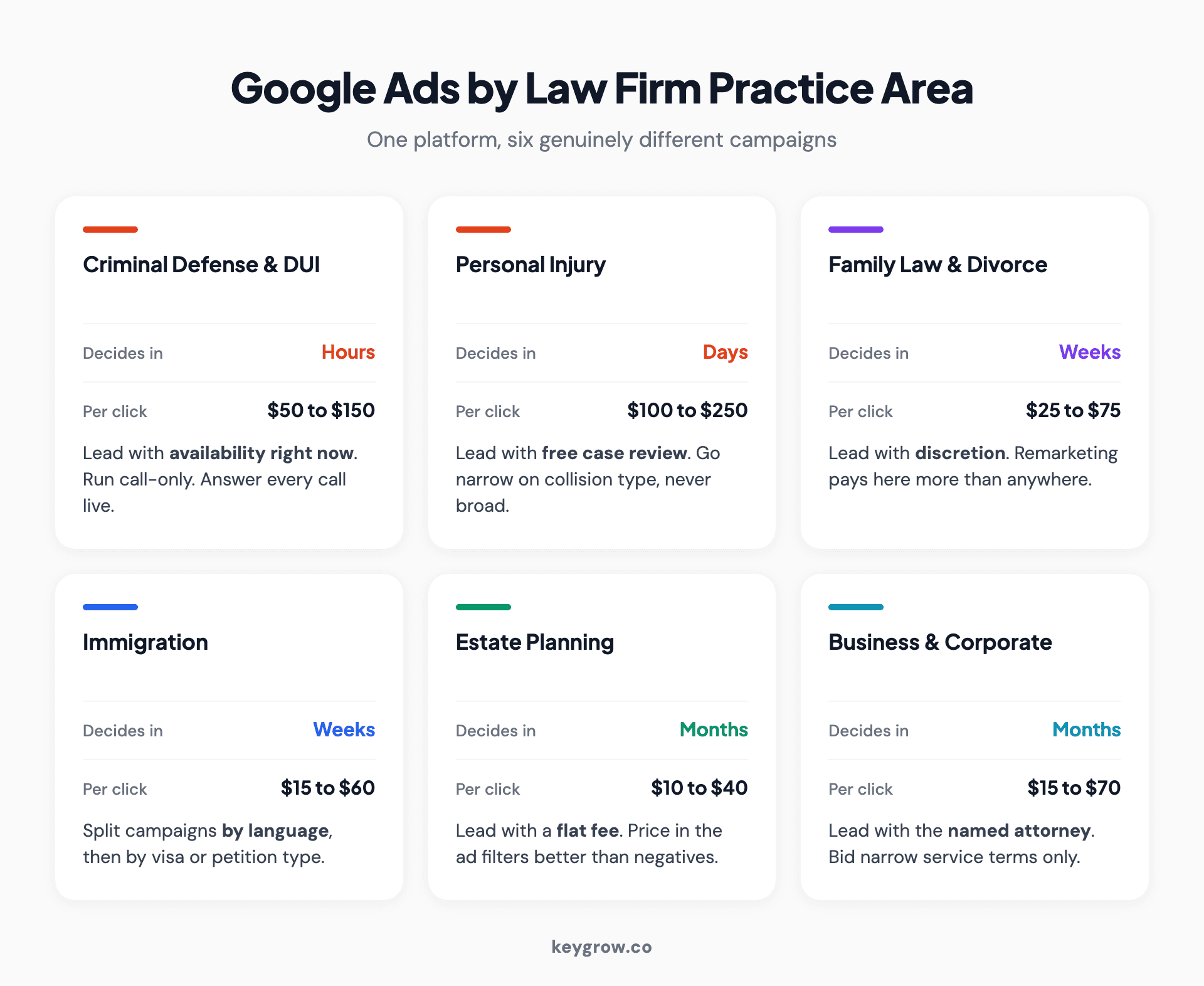
Google Ads strategy by law firm practice area, comparing urgency, click cost, best campaign type and the conversion path for criminal defense, personal injury, family law, immigration, estate planning and business law.
| Practice area | Decision speed | Click cost | Lead with | Main conversion |
|---|---|---|---|---|
| Criminal defense and DUI | Hours | $50 to $150 | Availability now | Phone call |
| Personal injury | Days | $100 to $250 | Free case review | Phone call |
| Family law and divorce | Weeks | $25 to $75 | Discretion and process | Form, then call |
| Immigration | Weeks | $15 to $60 | Language and specific visa type | Form |
| Estate planning | Months | $10 to $40 | Cost clarity | Form or booked seminar |
| Business and corporate | Months | $15 to $70 | Named attorney credentials | Form |
Criminal defense and DUI. Someone searching at two in the morning got arrested a few hours ago, or a family member did. They are not reading your practice page. Run call-only campaigns, put twenty four hour availability in the headline, and answer every call live, because a voicemail loses this client permanently. Ad copy that works here is blunt about the immediate situation rather than about your trial record.
Personal injury. The most expensive auction in legal and the most crowded. New firms should not enter it broadly. Go after specific collision types, commercial vehicle cases, and the geographic pockets national advertisers cover thinly, and pair the paid work with the organic build described in our personal injury lawyer SEO guide, because paid alone in this practice area is a treadmill.
Family law and divorce. Longer consideration, cheaper clicks, and a searcher who is frightened of being judged. Discretion converts better than aggression here. Remarketing genuinely pays because people research for weeks. Our Google Ads for family law firms guide has the case-type campaign structure in detail.
Immigration. Language targeting is the whole game, and most competitors ignore it. Separate campaigns by language, and separate again by visa or petition type, because someone searching about an employment petition and someone searching about asylum have nothing in common except your firm.
Estate planning. Low urgency, low click cost, and the highest tolerance for content-led advertising in legal. Cost transparency in the ad copy filters harder than any negative keyword list. Firms that advertise a flat fee for a simple will convert at multiples of firms that advertise a consultation.
Business and corporate. Small volume, considered buyers, and the one practice area where the named attorney matters more than the firm. Bid on narrow service terms rather than "business lawyer," and send clicks to a page with a real bio on it.
Campaigns that build the brand, not just the case list
Once search is producing consultations, these four add reach for comparatively little money.
Remarketing
Roughly nineteen out of twenty visitors leave your site without contacting anyone. Remarketing is how you get a second attempt at them.
It suits legal better than almost any other industry, because hiring a lawyer is rarely a same-session decision. People read three firms' pages, close the tab, think about it for a week, and then choose. A firm that reappears during that week has a real advantage over the two that vanished. Cap the frequency, though. There is a line between staying visible and following somebody around, and in a practice area like family law crossing it costs you the client.
Competitor targeting
You can bid on searches for your competitors' names. When someone searches for a competing firm, your ad appears alongside (or above) their results.
This tactic is controversial, and you need to be careful with your ad copy. You can't use a competitor's name in your ad text because that's trademark infringement. But you can bid on their name as a keyword and show a general ad for your services.
Is it aggressive? Yes. Does it work? Often. Someone searching for your competitor is clearly in the market for a lawyer. Giving them another option isn't dirty. It's competition.
Branded campaigns
Should you pay for clicks on your own firm name when you already rank first for it? Usually yes, and reluctantly.
The reason is that the firm across town can bid on your name whether you like it or not, and if you are not there they get the top of the page to themselves. Branded clicks are cheap, because you are by definition the most relevant result, and they convert better than anything else in the account, because the person already knows who you are.
Watch the reporting, though. Branded conversions flatter every dashboard they appear on, and an agency reporting a blended cost per lead with branded traffic folded in is showing you a number that means nothing. Ask to see it separated.
Call-only campaigns
Call-only ads skip the website entirely. The person taps the ad and the phone rings.
For criminal defense, bail, and emergency family matters this is the right unit, because somebody searching "DUI lawyer now" wants a human voice, not your practice page. It is also unforgiving in a way normal search is not. There is no landing page doing any persuading, so whoever answers the phone is the entire conversion process. Run these only if you have someone to pick up.
What a law firm Google Ads budget actually looks like
Legal carries the highest cost per click and the highest cost per lead of any industry in search advertising. The last widely published benchmark study put the legal median at $9.21 a click and $111.05 a lead, according to LocaliQ's legal benchmarks, and every 2026 agency dataset we have seen puts it higher again. Both numbers are close to useless for planning your own account, because the spread inside legal is wider than the gap between legal and every other industry.
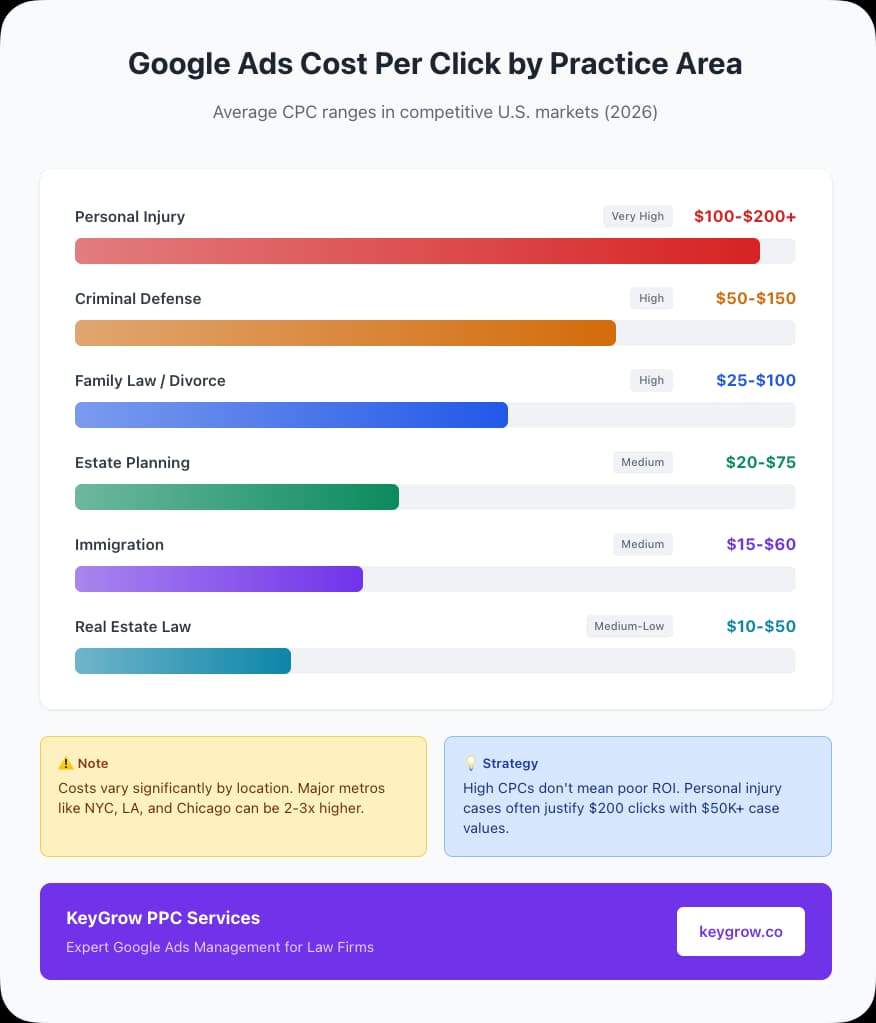
Google Ads Cost Per Click by Practice Area
Monthly budget guidelines for a law firm
The question every managing partner asks first is what a realistic monthly number looks like. Here is the honest version.
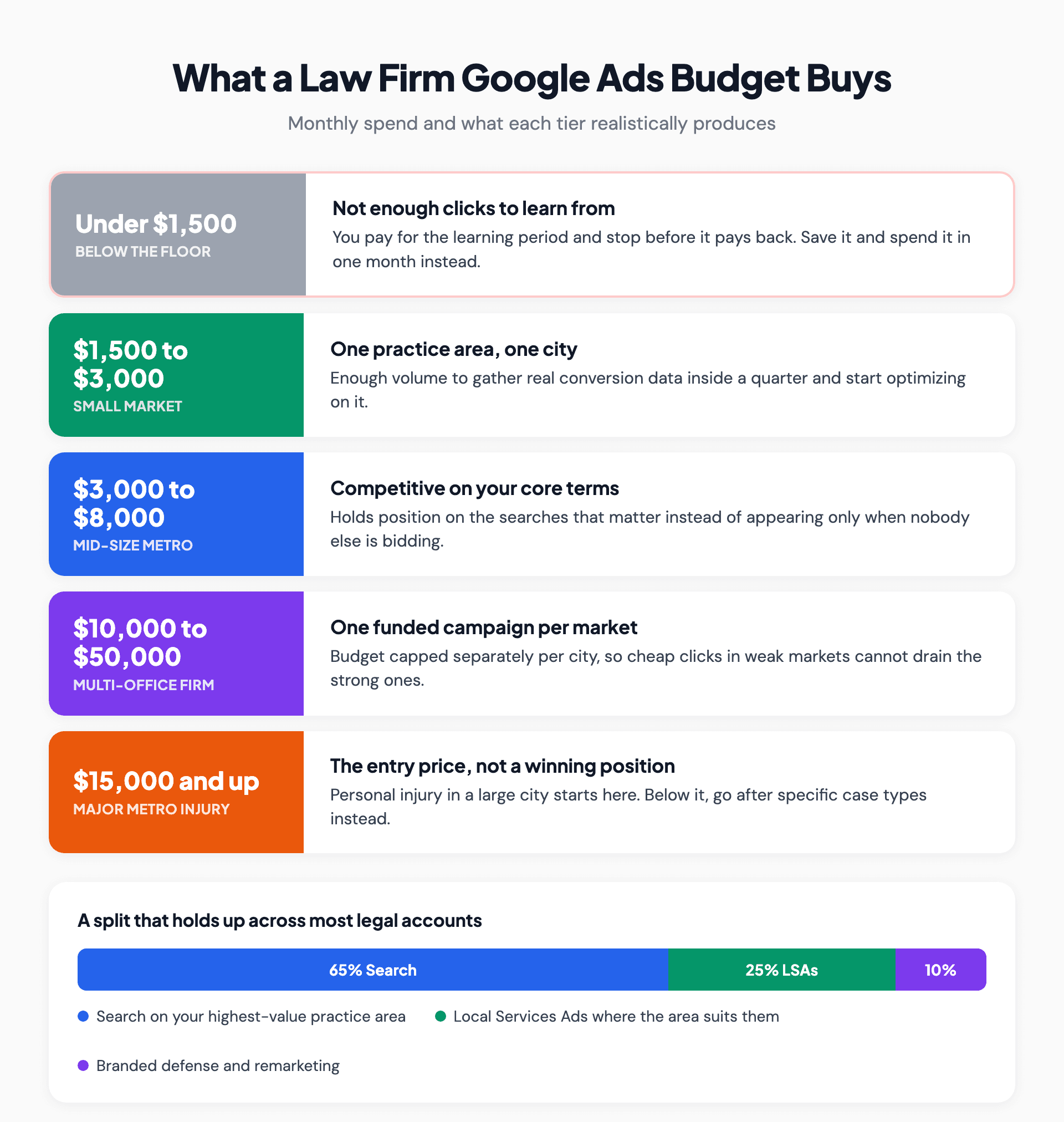
Law firm Google Ads monthly budget tiers by market size and practice area, showing the minimum viable spend, what each tier buys and where budgets are too thin to produce cases.
| Situation | Monthly range | What it realistically buys |
|---|---|---|
| Under $1,500 | Below the floor | Not enough clicks in a quarter to judge anything |
| Small market, one practice area | $1,500 to $3,000 | Enough volume to gather real conversion data |
| Mid-size metro, one practice area | $3,000 to $8,000 | Competitive presence on your core terms |
| Multi-office firm, several areas | $10,000 to $50,000 | One funded campaign per market |
| Major metro, personal injury | $15,000 and up | The entry price, not a competitive position |
| Local Services Ads alongside search | Add $1,500 to $3,000 | Roughly 10 to 30 legal leads |
The floor matters more than the ceiling. Below about $1,500 a month in most legal markets, you will not accumulate enough clicks in a quarter to know whether the campaign works, which means you pay for the learning period and never reach the part that pays you back. Two thousand dollars spent over one month beats the same two thousand dribbled across six.
A rough allocation that holds up: 60 to 70 percent into search on your highest-value practice area, 20 to 30 percent into Local Services Ads if your practice area suits them, and the remainder on branded defense and remarketing. Resist spreading across every practice area you offer. A firm that owns one auction earns more than a firm that shows up eighth in five of them.
Run your own numbers before accepting anyone's benchmark, including these. Our Google Ads budget calculator and ROI calculator will do the arithmetic from your own case values.
Working backward from case value
Start by determining how much a new client is worth to your firm. Calculate your average case value, then work backward to figure out what you can afford to spend acquiring a client.
If your average personal injury case generates $5,000 in fees, and you can afford to spend 20% on acquisition, that's $1,000 per new client. If you convert 5% of leads to clients, you can afford to spend $50 per lead. If clicks cost $50 each and 20% of clickers become leads, you need four clicks per lead. So your target cost per click is around $12.50.
These numbers vary wildly by practice area and market. Criminal defense might convert faster but with smaller case values. Personal injury has massive case values but intense competition and high click costs. Run the math for your specific situation.
Bidding options
| Strategy | What it does | When a law firm should use it |
|---|---|---|
| Manual CPC | You set the maximum bid per click | Launch, while you learn what your market costs |
| Maximize clicks | Buys the most clicks your budget allows | Gathering data only, never as a destination |
| Target CPA | Bids toward a cost per conversion you name | Once you have 30 or so conversions a month |
| Maximize conversions | Chases conversion volume within budget | Steady accounts with honest conversion tracking |
| Target ROAS or value-based | Chases conversion value, not count | When you can assign values to case types |
Two notes for 2026. Enhanced CPC was retired for search and display in 2025, so any account still described as running it is really running manual bidding. And the last row is the one legal firms skip and should not: if a signed truck collision case is worth ten times a signed fender bender, saying so in the account changes which cases the algorithm goes looking for.
Start manual while you learn your own numbers, then move to automated bidding once you have conversion data worth optimizing against. Automated bidding with bad conversion tracking is worse than manual bidding with none.
Quality Score, which is really a discount
Quality Score is Google's rating of how relevant your ads and pages are, and in a market with $90 clicks it is the difference between an affordable account and an impossible one. The same position can cost two firms wildly different amounts.
Three factors determine Quality Score: expected click-through rate, ad relevance, and landing page experience.
Improve expected CTR by writing compelling ads that speak directly to the search query. Test different headlines and descriptions to find what resonates.
Improve ad relevance by tightly grouping keywords and writing specific ads for each group. An ad about "custody lawyers" should appear for custody-related searches, not general family law searches.
Improve landing page experience by creating fast, mobile-friendly pages with content relevant to your ads. The page should deliver on what your ad promised.
Why law firm Google Ads campaigns underperform
When a legal account is spending money without producing signed cases, the cause is almost always on this list rather than something exotic.
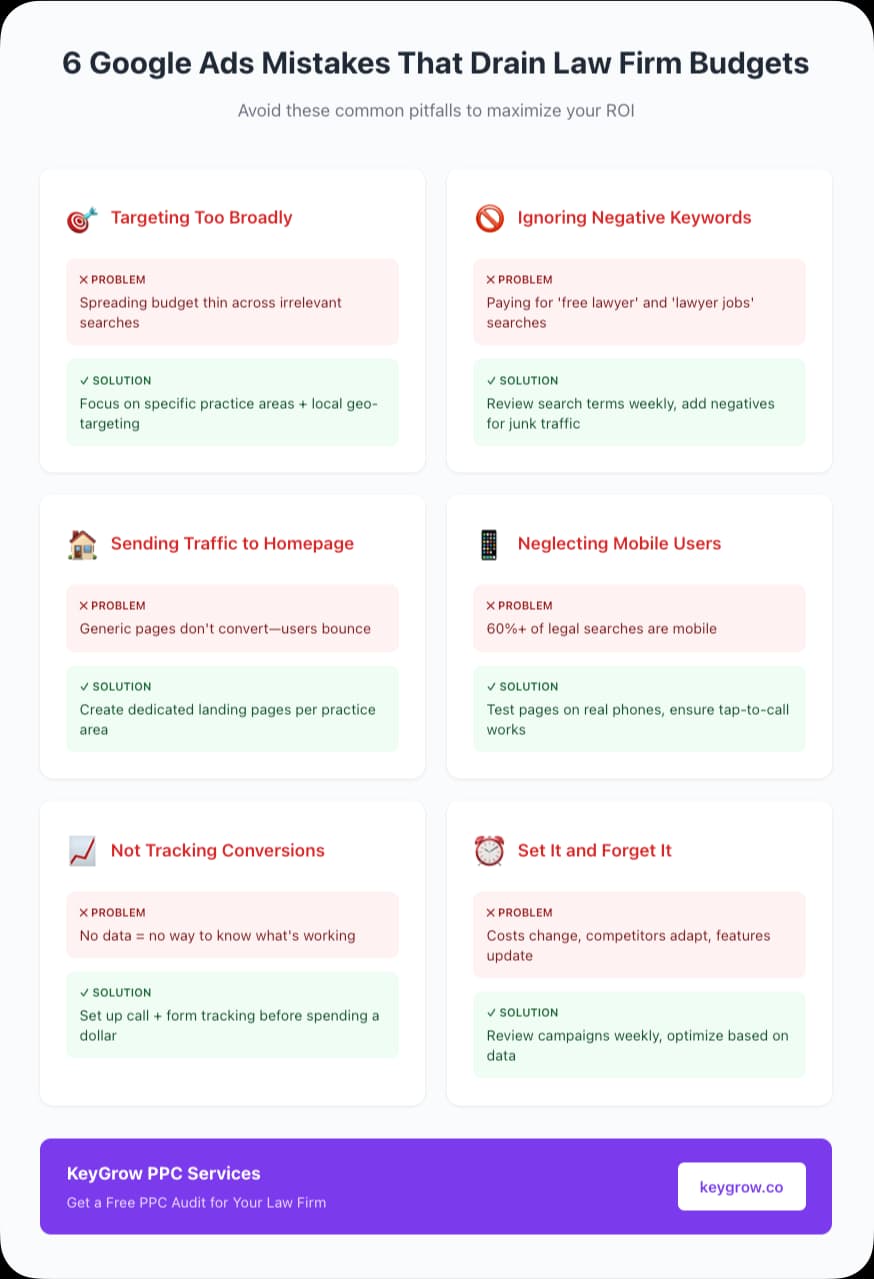
6 Google Ads Mistakes That Drain Law Firm Budgets
Targeting too broadly
Bidding on "lawyer" attracts people looking for patent counsel, entertainment representation, and someone to read a lease. You pay legal rates for all of them.
Narrow it to the practice areas you actually want and the geography you actually serve. Placing first for three phrases beats placing ninth for thirty.
Ignoring negative keywords
Without a negative list your ads run against "criminal lawyer jobs," "free legal advice," "lawyer shows on Netflix" and, in one account we inherited, "how much do lawyers make." Every one of those charges full price.
The fix takes fifteen minutes a week in the search terms report. It is the highest return per minute of anything in a legal account, and it is the task that gets skipped first when nobody is watching.
Sending traffic to the homepage
A homepage is built to serve everybody, which means it persuades nobody in particular. It lists six practice areas, an attorney roster, and a news feed, and the person who just searched for a DUI lawyer has to go hunting.
Build a page per campaign. Ad about DUI defense, page about DUI defense, phone number at the top. This single change moves conversion rates more than anything else on this list.
Neglecting mobile users
The majority of legal searches now happen on a phone, and in urgent practice areas it is not close. Someone standing in a police station car park is not opening a laptop.
Test the pages on a real handset rather than a browser window resized to look like one. Is the number tappable without zooming? Does the form work with a thumb? Does the page load on a bad connection outside a courthouse? Most law firm landing pages fail at least one of those, and the analytics never say so.
Not tracking conversions
Without conversion tracking you are flying blind, and worse than that, so is Google. Automated bidding needs conversion data to aim at, so an account without it is being optimized toward clicks by a system that would happily have optimized toward cases.
Track calls and form submissions at minimum. Track which ones the intake team qualified if you possibly can, because that is the difference between knowing what generated leads and knowing what generated clients.
Setting it and forgetting it
Legal auctions move. A competitor raises a budget, a national advertiser enters your market, Google changes a default while nobody is looking, and the account that was profitable in March is bleeding by June.
Half an hour a week covers it: search terms report, kill what is not converting, check nothing has been auto-applied that you did not agree to. That last one catches more damage than people expect, and it is worth turning auto-apply recommendations off entirely.
Measuring what the ads actually produced
Four numbers tell you whether the account is working. Everything else on the dashboard is context.
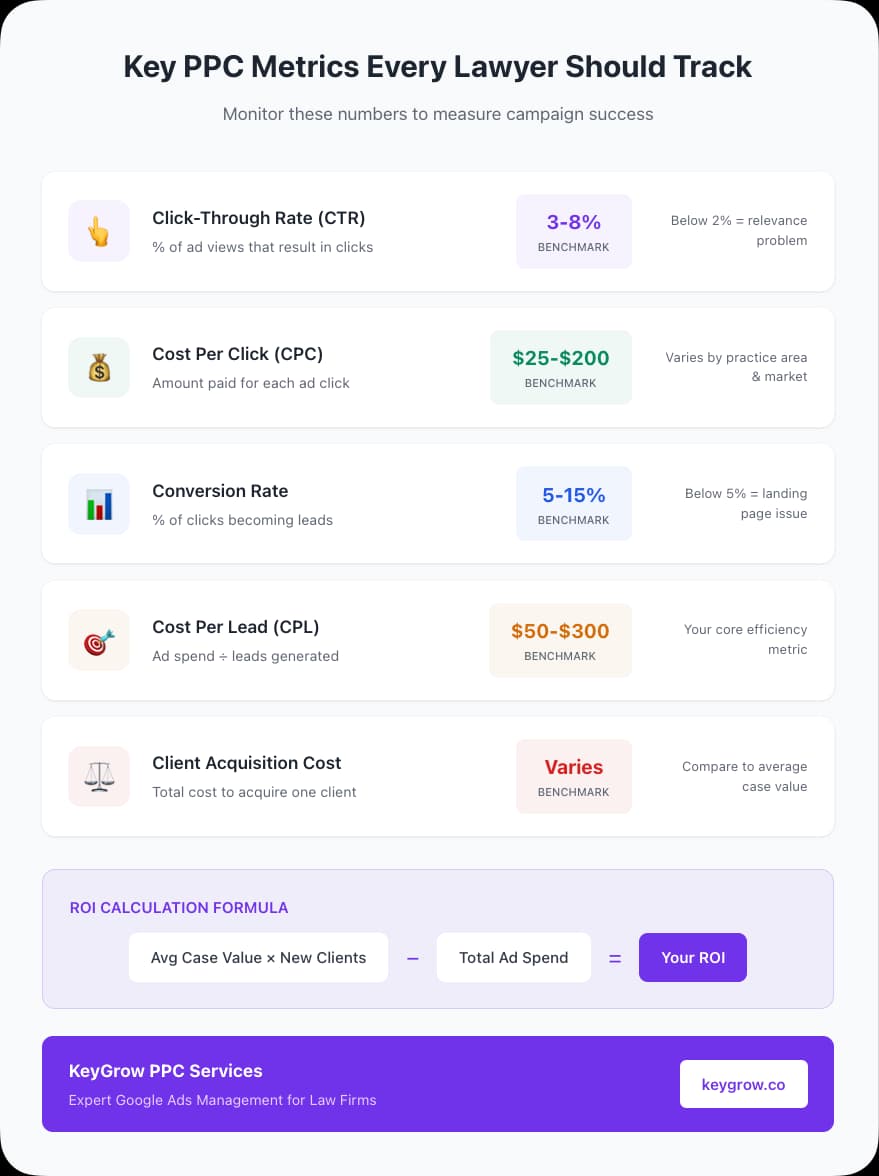
Key PPC Metrics Every Lawyer Should Track
The numbers worth reporting
| Metric | Healthy range in legal | What a bad number means |
|---|---|---|
| Click-through rate | 3 to 8 percent | Below 2 percent, the ads do not match the search |
| Cost per click | $5 to $200 by practice area | Rising fast usually means Quality Score, not competition |
| Conversion rate | 5 to 15 percent | Below 5 percent is a landing page problem, not a traffic one |
| Cost per lead | Compare to your own case value | The single most useful efficiency number you have |
| Cost per signed case | Under 20 percent of average fee | The only number that decides whether this continues |
Two of those deserve a note. Cost per click varies more inside legal than it does between legal and other industries, from around $5 on straightforward matters to $200 and up on contested personal injury keywords, so an industry average tells you very little about your own account.
Cost per signed case is the row most reports leave out, and it is the only one a managing partner should be judging the spend on. A campaign at $120 per lead looks worse than one at $70 until you find out the first signs one case in six and the second signs one in thirty.
Attribution in legal is mostly a phone problem
People do not fill in forms when they have been arrested or rear-ended. They call, frequently outside office hours, and a firm that cannot tell a Local Services Ads call from a search ad call from an organic call is guessing about which half of its marketing works.
Two or three tracked numbers fix this for roughly the cost of a streaming subscription, and it is the cheapest reporting upgrade available to a law firm.
The second layer is what happens after the call. Legal clients touch your firm several times before hiring: they click an ad, leave, see a remarketing ad, come back, read two pages, then phone a week later. Google Ads defaults to last-click attribution, which hands all the credit to that final interaction and quietly undervalues everything that introduced you. Data-driven attribution gives a fairer picture once you have enough conversions to support it.
None of it works without the last mile. If your intake team does not record where each caller came from and whether they signed, you have lead data and no case data, and lead data on its own has ended more good campaigns than bad performance ever has.
Scaling Google Ads across offices, cities or several brands
A single-office firm and a five-office firm have different problems, and the second one is usually solved badly by treating it as five copies of the first.
Start with the account structure. Multiple offices belong in one Google Ads account with one campaign per market, not in separate accounts. Separate accounts fragment your conversion data, and conversion data is the fuel every automated bidding strategy runs on. Three campaigns feeding one account learn faster than three accounts learning alone. The exception is genuinely separate brands, which need separate accounts linked under a manager account so you can still see them together without letting them contaminate each other's signals.
Budget per market rather than per firm. A shared budget across cities drifts toward wherever clicks are cheapest, which is reliably the market where cases are worth least. If Dallas and a rural county share a pot, the rural county will win the auction and lose you money. Cap each market separately and judge each on its own cost per signed case.
Location extensions and separate landing pages per office are not optional at this size. An ad for a market you have no staffed address in will underperform, and it invites the Google Business Profile problems that follow firms who claim offices they do not staff.
For the two or three attorney firm running ads for more than one practice area or under more than one brand, the honest answer is that you probably should not. Splitting a small budget across two brands halves the data each one gets and doubles the management. Pick the one with the better case economics, fund it properly for two quarters, and revisit.
The brand value that compounds while you advertise
The leads are the point. They are not the only return, and the second one is harder to see on a dashboard.
Most people who see your ad do not click it. They register the name and move on. Three years of that in one metro produces a firm whose name arrives unprompted when a neighbor asks who to call, and that referral shows up in your reporting as direct traffic with no source attached. It came from the ads. You will never be able to prove it.
Which is the argument against switching campaigns on and off with cash flow. The firms that own their markets have been visible continuously for years, and the ones that advertise in bursts pay the introduction cost over and over.
It is also the argument for taking the ad copy seriously. A sloppy headline is not a small thing when it is the only impression of your firm that ten thousand people in your county will ever have.
Where this genuinely compounds is alongside organic. Appearing in the ads, the map pack and the organic results on the same page reads as a bigger firm than appearing in one of them, and it costs less than winning any of them outright. Our law firm SEO strategy work covers the organic half, and for personal injury specifically there is personal injury lawyer SEO.
Google Ads best practices for law firms in 2026
Most of this article would have been true three years ago. This section would not, and it is where the money is currently being won and lost.
Feed the automation good conversions or it will go and find you bad ones. This is now the single highest-leverage thing in a legal account. Smart bidding optimizes toward whatever you told it counts, so a firm counting every form submission, including job applications and vendor pitches, is paying Google to find more of them. Count signed consultations and qualified calls over sixty seconds. Nothing else.
Treat Performance Max as a supplement and never as the core. If an agency proposes running your law firm entirely on Performance Max or Smart Campaigns, that is the point to end the meeting. It has no keyword-level visibility and it will spend your budget on brand terms and low-intent traffic while reporting a flattering cost per conversion. Dedicated search campaigns still own the high-intent legal terms.
Use broad match only with a maintained negative keyword list behind it. Broad match plus smart bidding can work in legal now, which was not true in 2022, but only where conversion tracking is honest and the negative keyword list is maintained monthly. Without both it is the fastest way to spend $8,000 on people researching law school.
Assign values to your case types, as above. It is the most underused setting in legal advertising and the one that most directly changes which cases arrive.
Get the Local Services Ads migration into your calendar. It is the only item on this list with a real deadline attached to it, and the reporting history you lose is not recoverable.
Expect informational clicks to keep shrinking. AI Overviews now answer a great deal of the "do I need a lawyer for this" traffic that used to reach firm blogs. That traffic is not coming back, which pushes budget toward the hiring-intent half of the market and makes it worth being the source those systems quote. That is a different discipline, and our answer engine optimization work covers it.
Check your ads against your own state bar rules rather than a generic compliance template. Advertising rules vary by state, they govern testimonials, case results and specialist claims, and the enforcement in some states is active. This is not a marketing decision.
In-house, freelancer or agency: who should run a law firm's Google Ads?
An agency that will not tell you who should not hire it is selling rather than advising, so here is our version.
Run it yourself if you are a solo or two-attorney firm with a budget under about $2,000 a month and more time than money. At that spend, an agency fee of $1,000 leaves half the budget buying clicks, and you would be better off putting the whole amount into the auction and spending two hours a week learning the platform. Claim Local Services Ads, run one tight search campaign on your best practice area, and review the search terms report every Friday. That will beat a thinly funded managed account.
Hire a freelancer when the budget is $2,000 to $5,000 and the problem is time rather than strategy. Good freelance PPC managers in legal charge a few hundred a month and will run a clean account. The risk is continuity, so keep ownership of the Google Ads account itself, always, whoever manages it.
Hire an agency when you are spending above roughly $5,000 a month, running more than one market or practice area, or when the account has plateaued for reasons nobody in the firm can name. At that spend the difference between competent and sloppy management is several times the fee, and it is the plateau that brings most firms to us.
Do not hire anyone yet if intake is broken. A firm whose calls reach voicemail at nine at night is buying leads for its competitors. Fix the phones first. It costs less and it will do more for your case list this quarter than any campaign change.
If that first bracket described you, take the DIY route with our blessing. If the last one did, our PPC advertising for law firms team handles legal accounts across personal injury, family law, criminal defense, estate planning and immigration, month to month, with the account in your name. A free PPC audit will tell you which bracket you are actually in.
FAQs
How much do Google Ads cost for lawyers?
Costs vary more inside legal than between legal and any other industry. Personal injury keywords reach $100 to $250 per click in competitive metros, criminal defense runs roughly $50 to $150, family law $25 to $75, and estate planning can sit under $40. Published benchmarks put the legal median near $9 a click and $111 a lead, but that median hides everything useful. Most firms spend between $2,000 and $10,000 a month, and below about $1,500 the campaign rarely gathers enough data to judge.
Are Google Ads worth it for small law firms?
Yes, but only if you narrow. A small firm will not win a broad auction against a national advertiser, and trying is how small budgets disappear. Pick one practice area, one geography, and a tight keyword list, and you are competing against the handful of local firms bidding on the same thing rather than against everybody. The other requirement is a real budget: below about $1,500 a month you will not gather enough data to know whether it worked.
How long does it take to see results from Google Ads for lawyers?
Clicks and calls arrive within days, which is the whole reason to run paid search. Useful data takes two to four weeks, and stable performance usually two to three months of active management, because that is roughly how long it takes to build the negative keyword list and find out which phrases actually sign cases. Judging an account in week two is the most common mistake in legal advertising, closely followed by never judging it at all.
Should lawyers run Google Ads themselves or hire an agency?
It depends almost entirely on your budget. Below roughly $2,000 a month, run it yourself, because a management fee at that level eats the half of your budget that should be buying clicks. Between $2,000 and $5,000, a freelancer usually makes sense. Above $5,000, or across more than one market or practice area, an agency earns its fee several times over, because at that spend the gap between competent and careless management is larger than the fee itself. Whoever manages it, keep the Google Ads account in your firm's name.
What's the difference between Google Ads and Local Services Ads for lawyers?
Google Ads are pay-per-click adverts in the search results, charged every time somebody clicks whether or not they contact you. Local Services Ads sit above them, carry the Google Verified badge, and charge per lead, so you pay only when somebody actually reaches your firm. Local Services Ads require license verification and a background check. Most firms should run both, because they capture different moments in the same search.
How do I choose the right keywords for my law firm's Google Ads?
Start where the intent is highest and the list is shortest: your practice area plus your city, and the near-me variants. Those cost the most per click and produce the most cases. Problem-focused searches such as "what to do after a car accident" come next, cost far less, and reach people before they start comparing firms. Google's Keyword Planner will give you volumes and cost estimates. The part most firms skip is the negative keyword list, which matters more in legal than the keyword list itself.
What makes a good landing page for lawyer Google Ads?
One practice area per page, the visitor's problem named in the first line, and a phone number they do not have to scroll to find. Add case results or testimonials where your state bar permits them, since proof of competence converts better than claims of it. Strip the navigation so there is nowhere to wander off to. Then load it on a phone on a weak connection, because that is how most of these visitors will actually see it.
Can I target my competitors' names with Google Ads?
Yes, you can bid on competitors' firm names as keywords in Google Ads. However, you cannot use their trademarked name in your ad copy. That violates Google's policies and potentially trademark law. When someone searches a competitor's name, your ad can appear, but it must advertise your own services without mentioning the competitor. This tactic is aggressive but legal and can capture potential clients actively comparing local firms.
How do I track if my Google Ads are generating actual clients?
Conversion tracking in the account covers form submissions and calls, and call tracking numbers tell you which campaign produced which ring. Neither is enough on its own. The step firms skip is the last one: recording in your case management system where each new matter originated and whether it signed. Without that you can calculate cost per lead but not cost per signed case, and only the second number tells you whether the spending is working.
What's a good conversion rate for lawyer Google Ads?
Landing page conversion rates for lawyer advertising typically range from 5-15%, with 10%+ considered strong performance. Conversion rate varies by practice area. Urgent needs like criminal defense often convert higher, while contemplative decisions like estate planning convert lower. Conversion rates also depend on landing page quality, call-to-action clarity, and whether you offer free consultations. If your rate falls below 5%, focus on improving your landing page before increasing ad spend.
What is the difference between Google Ads and Google AdWords for lawyers?
They are the same platform. Google renamed AdWords to Google Ads in 2018, and the old name survives in legal marketing longer than in most industries. If you searched for AdWords for lawyers or law firm AdWords management, everything written about Google Ads applies. What did change underneath the name is that manual bid management has largely given way to automated bidding, which means the quality of your conversion tracking now matters more than any setting you adjust by hand.
What is the Google Verified badge and what happened to Google Screened?
Google Verified is the single trust badge that replaced Google Screened, Google Guaranteed and License Verified in October 2025. Law firms previously earned Google Screened, so any guide still telling you to apply for that badge is out of date. The screening requirements did not change: license verification, background checks on the firm and its attorneys, and a minimum review standard. Existing advertisers were moved to the new badge automatically.
How do Local Services Ads decide which law firm shows first?
There is no keyword bidding. Placement is determined by how close the searcher is to your office, your review score and review volume, how quickly and consistently you answer calls, your budget, and your complaint history. Responsiveness is the factor most firms lose on and the easiest to fix, because unanswered calls signal to Google that you do not want more leads.
How much should a law firm spend on Google Ads per month?
Plan on $1,500 to $3,000 a month in a small market with one practice area, $3,000 to $8,000 in a mid-size metro, and $15,000 or more to enter personal injury in a major city. The floor matters more than the ceiling: below roughly $1,500 a month you will not gather enough clicks in a quarter to judge whether the campaign works, so you pay for the learning period without reaching the part that pays you back.
Why are my law firm's Google Ads not generating cases?
The usual causes, in order of frequency: traffic going to a homepage instead of a practice-area landing page, no negative keyword list, conversion tracking that counts form fills rather than signed consultations, geographic targeting that is too wide, and intake that does not answer the phone. Note that four of those five are outside the Google Ads account. Check the phones and the landing page before touching bids.
Do Google Ads work the same way for solicitors and barristers?
The platform mechanics are identical, and search campaigns, negative keywords and landing page structure all transfer directly. Two things differ. Local Services Ads availability and screening requirements vary by country, so check what is offered in your jurisdiction rather than assuming. And advertising rules for solicitors and barristers are set by your own regulator, which governs claims, comparative advertising and how you may describe your specialisms. The strategy transfers, the compliance does not.
Which practice areas get the best results from Google Ads?
Criminal defense, DUI and personal injury convert fastest, because the searcher has an urgent problem and calls rather than researches. Family law converts well over a longer window and benefits most from remarketing. Estate planning and business law produce the lowest click costs but need content and cost transparency rather than urgency in the ad copy. Immigration performs strongly when campaigns are split by language and petition type, which most competitors do not bother doing.
Where to start if you are starting this week
Three things decide whether this works, and none of them is a bid adjustment.
Answer the phone. It is the least interesting item on the list and the one that costs firms the most cases. Every call that reaches voicemail at nine at night is a case the next firm on the page signed instead, and no amount of campaign work survives that leak.
Pick one practice area and fund it properly. A firm that owns one auction in one city earns more than a firm placing eighth in five of them, and a budget spread thin never gathers enough data to improve.
Track what signed, not what clicked. If your reporting cannot say how many cases came from paid search last month, it is measuring activity rather than results, and activity has ended more good campaigns than bad performance ever has.
Do those three and the rest of this article becomes optimization. Skip them and the rest is decoration. If you want a second opinion on an account that is already running, our PPC services team will look at it, and engagements are month to month.