

Small business owners face a common dilemma when allocating their marketing budget. Should you invest in SEO and wait months for results? Or should you run local PPC campaigns and start generating leads this week?
The honest answer is that both have their place. But if you need customers now - and most small businesses do - local PPC campaigns can drive results faster than SEO in almost every scenario. This isn't about dismissing SEO entirely. It's about understanding which tool solves which problem.
Let's break down why local pay-per-click advertising often makes more sense for small businesses that need immediate traction, and how you can use it effectively without wasting money.
The Speed Problem: Why SEO Takes So Long
Search engine optimization is a long game. There's no way around this reality, despite what some agencies might promise.
When you publish a new page or start optimizing your website, Google needs time to crawl your content, index it, and evaluate how it compares to competitors. This process doesn't happen overnight. For a new website or a business entering a competitive market, you're looking at three to six months before you see meaningful organic traffic. In highly competitive industries, it could take a year or longer.
Here's what typically happens during those months. You publish content. Google crawls it. Your pages start appearing on page three or four of search results. Slowly, as you build backlinks and publish more content, your rankings improve. Eventually, you might reach page one for some keywords.
During this entire period, your SEO investment generates little to no revenue. You're paying for content creation, technical optimization, and link building - all without seeing a return yet.
For a well-funded company, this isn't necessarily a problem. They can afford to invest in SEO while relying on other channels for immediate revenue. But most small businesses don't have that luxury. They need cash flow now, not in six months.
How Local PPC Campaigns Work Differently
Pay-per-click advertising flips this timeline completely. When you launch a local PPC campaign on Google Ads, your ads can appear in search results within hours. Not months. Hours.
The mechanics are straightforward. You create an ad, set your budget, choose your keywords, and define your target area. Google starts showing your ad to people searching for what you offer. When someone clicks, you pay. When they don't click, you don't pay.
For local businesses, this model is particularly effective because you can focus your budget on a specific geographic area. A plumber in Denver doesn't need to compete with plumbers in Chicago or New York. They only need to reach people searching for plumbing services in and around Denver.
This geographic targeting means your advertising dollars stretch further. You're not paying to reach people who could never become customers. Every impression goes to someone in your service area.
Real Numbers: Comparing Timelines and Investment
Let's look at a realistic comparison for a small local business - say, a residential cleaning service in a mid-sized city.
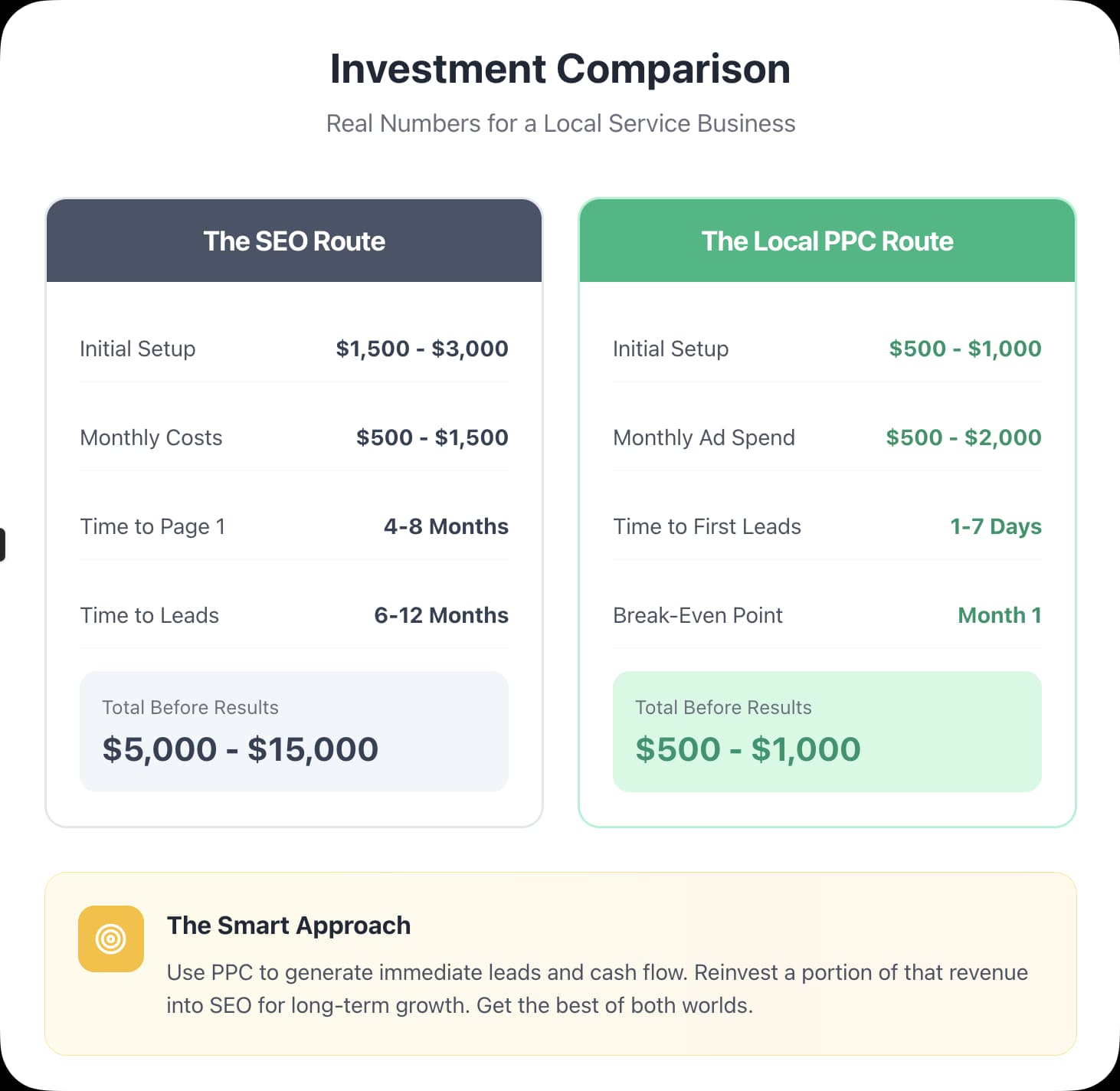
Investment Comparison
The SEO Route
Initial investment: $1,500-$3,000 for website optimization, content creation, and local SEO setup. Monthly ongoing costs: $500-$1,500 for continued content creation and link building. Time to first page rankings for competitive terms: 4-8 months. Time to meaningful lead volume: 6-12 months.
Total investment before seeing significant results: $5,000-$15,000.
The Local PPC Route
Initial investment: $500-$1,000 for campaign setup and ad creation. Monthly ad spend: $500-$2,000 depending on competition. Time to first leads: 1-7 days. Break-even point: Often within the first month if campaigns are managed properly.
The difference is stark. With PPC, you can start generating leads almost immediately. You can test which messages resonate, which services attract the most interest, and which neighborhoods produce the best customers - all within your first few weeks.
Why Local Targeting Changes Everything
National brands competing for broad keywords face brutal competition. The cost per click for terms like "personal injury lawyer" or "insurance quotes" can exceed $50 or even $100.
But local small businesses operate in a different world. When you target "personal injury lawyer Austin Texas" or even more specifically "car accident lawyer South Austin," competition drops significantly. Costs come down. And the people clicking your ads are specifically looking for services in your area.
This local focus creates several advantages. First, you're competing against fewer advertisers, which typically means lower costs per click. Second, the people who see your ads have local intent - they're not just researching, they're often ready to hire. Third, you can tailor your messaging to your specific community.
A roofing company in Tampa can reference recent storms that hit the area. A restaurant in Brooklyn can mention nearby landmarks. A dental practice in Scottsdale can highlight their proximity to specific neighborhoods. This local relevance improves click-through rates and conversion rates.
Understanding the True Cost of Waiting
Many small business owners view SEO as "free" traffic because they don't pay for each click. This framing misses some important costs.
First, there's the direct cost of SEO work - whether you do it yourself or hire someone. Your time has value. If you spend 20 hours per month on SEO activities, that's time not spent on other business activities.
Second, there's opportunity cost. Every month you wait for SEO results is a month where potential customers are finding your competitors instead. If your average customer is worth $500 to your business, and you're missing 20 potential customers per month while waiting for SEO to work, that's $10,000 in lost revenue.
Third, there's the uncertainty factor. SEO results aren't guaranteed. You can invest months of effort and still not achieve the rankings you wanted, especially if competitors are also investing in SEO.
PPC, by contrast, delivers predictable results. You know roughly how much you'll pay per click and can estimate how many clicks convert to customers. This predictability makes planning easier.
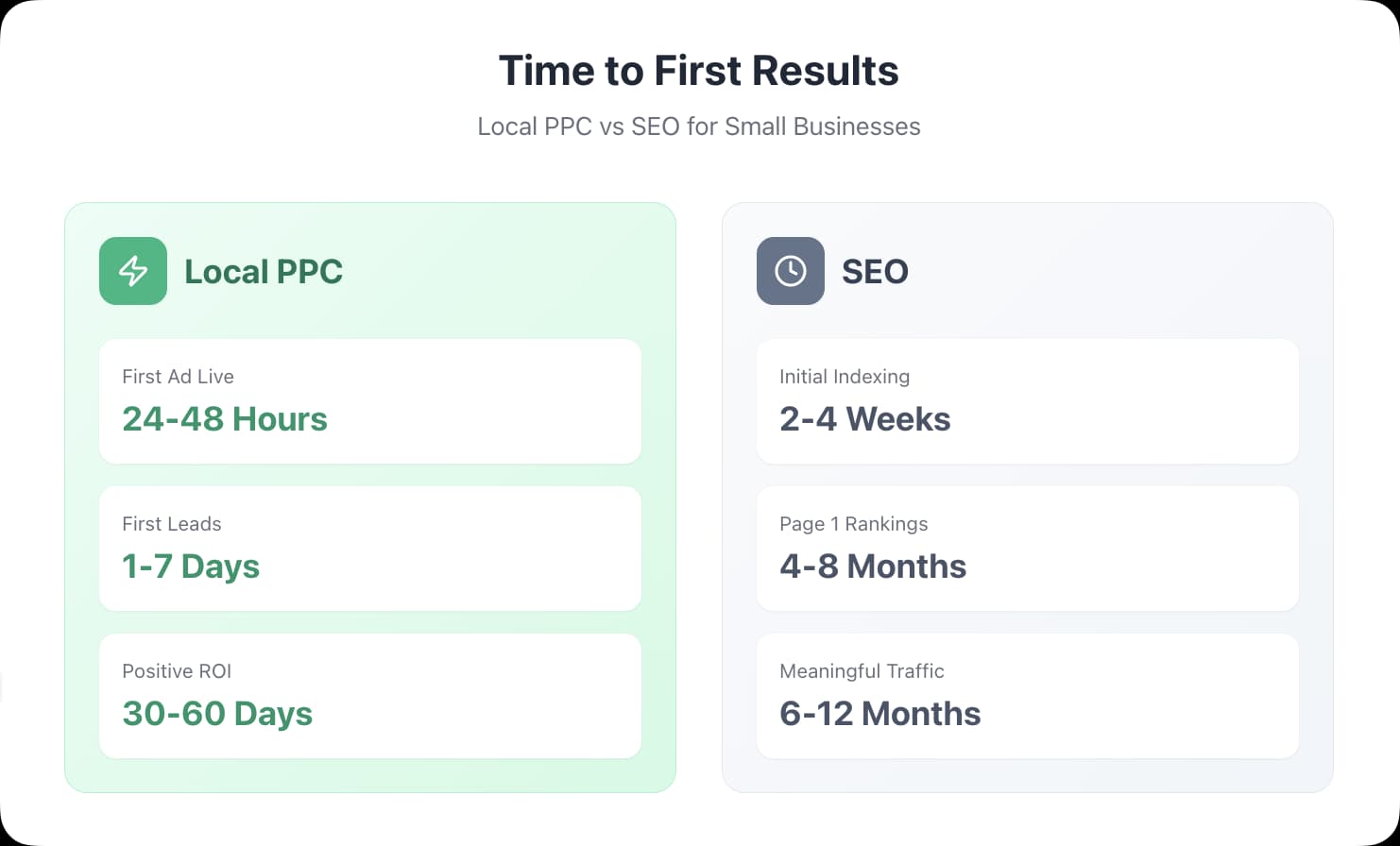
Time to First Results
When SEO Actually Makes Sense for Small Businesses
None of this means you should ignore SEO entirely. For small businesses, SEO becomes valuable once you have stable revenue and can afford to invest in long-term growth.
Here's a practical approach. Use PPC to generate immediate leads and cash flow. Reinvest a portion of that revenue into SEO. Over time, your organic traffic grows while PPC continues to deliver consistent leads.
This hybrid approach gives you the best of both worlds - immediate results plus long-term equity building.
SEO also makes sense for content that answers common questions in your industry. A local HVAC company might publish articles about furnace maintenance, air conditioning efficiency, or common heating problems. This content can rank organically over time and attract customers who are researching before they buy.
But even this content-driven SEO works better when supported by PPC. You can promote your best content through paid search and social advertising, getting immediate visibility while waiting for organic rankings to develop.
Building Effective Local PPC Campaigns
Running a successful local PPC campaign requires attention to several key elements.
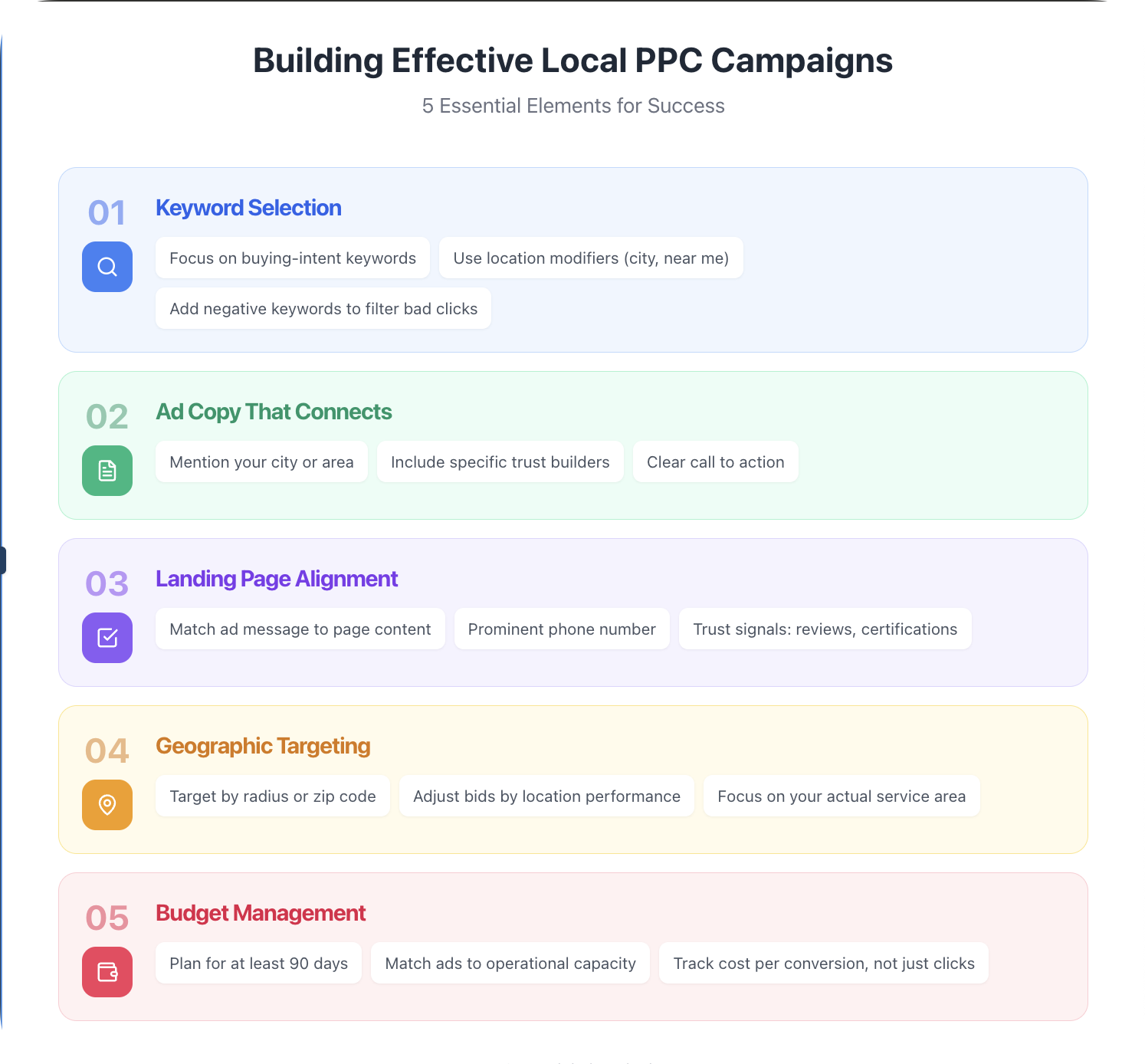
Building Effective Local PPC Campaigns
Keyword Selection
Start with keywords that indicate buying intent. Someone searching "best plumber near me" is closer to hiring than someone searching "how to fix a leaky faucet." Focus your budget on terms where people are actively looking for services, not just information.
Use location modifiers consistently. Include your city, neighborhood names, and "near me" variations. These geographic terms help you reach local searchers while avoiding competition from businesses in other areas.
Don't forget negative keywords - terms you don't want triggering your ads. If you're a high-end residential cleaning service, you might add "cheap" or "free" as negative keywords to avoid clicks from price-sensitive searchers who aren't your target market.
Ad Copy That Connects
Your ads should speak directly to local customers. Mention your city or area. Reference common local concerns. If you're a pest control company in Florida, mentioning termites or humidity issues shows you understand local conditions.
Include specific information that builds trust - years in business, number of local customers served, relevant certifications or guarantees. Vague claims like "best service" mean less than concrete details like "serving Phoenix families for 15 years."
Always include a clear call to action. Tell people exactly what to do next - call for a free estimate, book online, get a quote today. Don't make them guess.
Landing Page Alignment
Your ads and landing pages need to work together. When someone clicks an ad for "emergency AC repair," they should land on a page specifically about emergency AC repair - not your general homepage.
This alignment improves conversion rates because visitors immediately see content relevant to their search. It also improves your quality score in Google Ads, which can lower your cost per click over time.
Make sure your landing pages include your phone number prominently, a clear contact form, and any trust signals like reviews, certifications, or guarantees.
Geographic Targeting Strategies
Google Ads offers several ways to target local audiences. You can target by city, zip code, or radius around your business location. For most local businesses, a radius-based approach works well - you might target everyone within 15 miles of your shop.
Consider adjusting bids based on location. If you know customers in certain neighborhoods tend to spend more or convert at higher rates, you can increase your bids for those areas. Conversely, you can reduce bids for areas that historically perform poorly.
Budget Management
Start with a budget you can sustain for at least 90 days. PPC campaigns need time to gather data and optimize. If you run out of budget after two weeks, you won't have enough information to know what's working.
Set daily budgets that align with your capacity. There's no point generating 50 leads per day if you can only handle 10. Match your advertising to your operational ability to serve customers.
Monitor cost per conversion, not just cost per click. A $5 click that never converts costs more than a $10 click that becomes a $500 customer.
Common Mistakes That Waste PPC Budget
Many small businesses try PPC, see poor results, and conclude that it doesn't work. Usually, the problem isn't PPC itself but how the campaigns were set up.
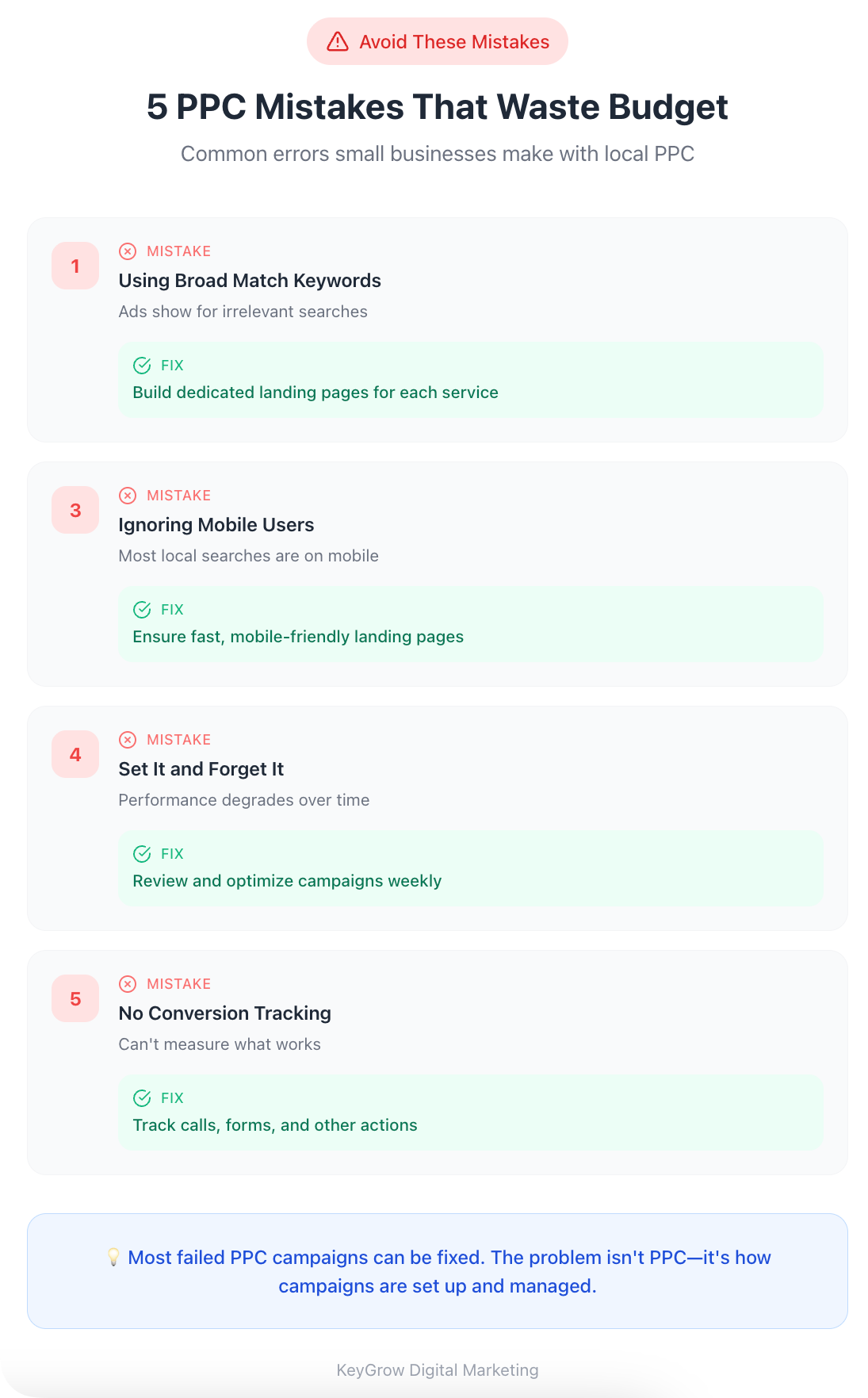
PPC Mistakes That Waste Budget
Using Broad Match Keywords Carelessly
Google's broad match keyword setting can show your ads for a wide range of related searches - many of which won't be relevant. A lawyer bidding on "personal injury help" might have their ad appear for "how to help someone with personal injury at home."
Use phrase match and exact match keywords, especially when starting out. You'll reach fewer people but with much better targeting.
Sending Traffic to Your Homepage
Your homepage serves many purposes and speaks to many audiences. That makes it a poor landing page for specific searches. Build dedicated landing pages for your main services, each optimized to convert visitors who clicked on related ads.
Ignoring Mobile Users
Most local searches happen on mobile devices. If your website loads slowly on phones or is hard to use on small screens, you're wasting money driving traffic there. Make sure your site is mobile-friendly before spending heavily on ads.
Setting and Forgetting
PPC campaigns require ongoing attention. Keywords that performed well last month might become expensive or ineffective. New competitors enter the market. Search patterns change.
Review your campaigns weekly at minimum. Adjust bids, add negative keywords, test new ad variations, and pause underperforming elements.
Not Tracking Conversions
Without conversion tracking, you're guessing at campaign performance. Install tracking that shows which keywords and ads generate phone calls, form submissions, and other valuable actions. This data tells you where to focus your budget.
Measuring Success: Metrics That Matter
Focus on metrics that connect directly to business outcomes.
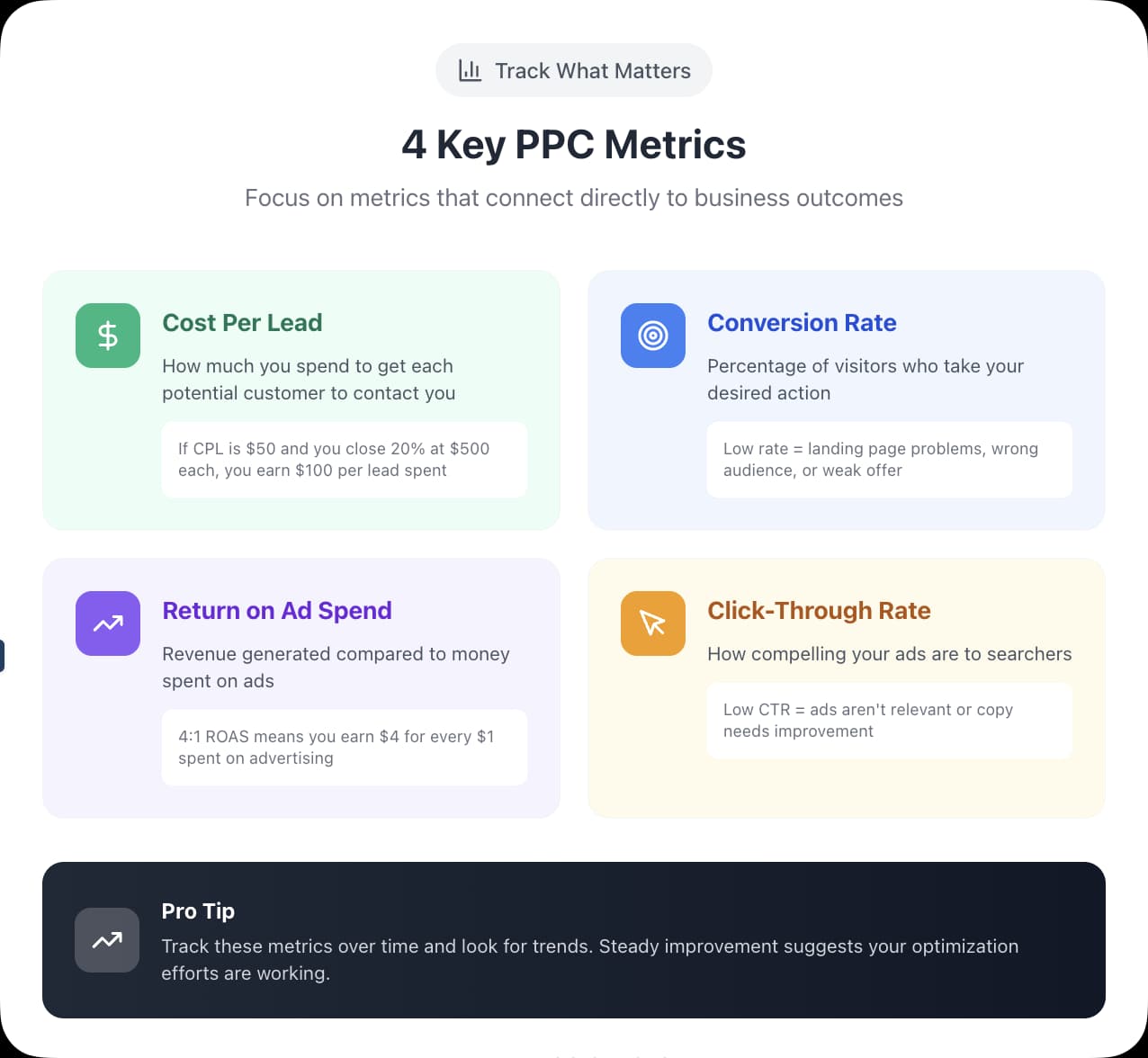
Key PPC Metrics
Cost per lead tells you how much you're spending to get each potential customer to contact you. If your cost per lead is $50 and you convert 20% of leads to customers worth $500, you're earning $100 per lead spent - a solid return.
Conversion rate shows what percentage of website visitors take your desired action. A low conversion rate suggests problems with your landing pages, your offer, or the relevance of your traffic.
Return on ad spend (ROAS) compares revenue generated to money spent on ads. A ROAS of 4:1 means you're earning $4 for every $1 spent on advertising.
Click-through rate (CTR) indicates how compelling your ads are to searchers. Low CTR usually means your ads aren't relevant to the searches triggering them, or your ad copy needs improvement.
Track these metrics over time and look for trends. Steady improvement suggests your optimization efforts are working.
The Competitive Advantage of Speed
In local markets, the business that responds fastest often wins. When a homeowner has a plumbing emergency, they're not going to wait hours for someone to call back. They'll hire the first qualified plumber who picks up the phone.
PPC puts you in front of these ready-to-buy customers at the exact moment they're searching. While your competitor is waiting for their blog post to rank, you're generating leads today.
This speed advantage compounds over time. Early leads become early reviews. Early reviews boost your credibility. Higher credibility improves conversion rates. The business that moves faster pulls ahead.
How KeyGrow Helps Local Businesses Win with PPC
At KeyGrow, we specialize in building PPC campaigns that generate real results for local businesses. We understand that you can't afford to waste money on clicks that don't convert or wait months for your marketing to start working.
Our approach focuses on the metrics that matter - leads, customers, and revenue. We handle the technical details of campaign setup, keyword research, ad creation, and ongoing optimization so you can focus on running your business.
We've helped local businesses across real estate, home services, healthcare, and legal generate consistent leads through strategically managed PPC campaigns. Our team understands local market dynamics and builds campaigns tailored to your specific service area.
Here's what you get when you work with KeyGrow for local PPC management:
If you're ready to start generating leads this week instead of waiting months for SEO results, get started with a free PPC consultation. We'll analyze your market, identify opportunities, and show you what a properly managed local PPC campaign can do for your business.
FAQs
How fast can local PPC campaigns generate leads compared to SEO?
Local PPC campaigns can generate leads within 24 to 48 hours after launch. Once your ads are approved and your campaign goes live, you start appearing in search results immediately. SEO typically takes three to six months to produce meaningful results for most small businesses. Some competitive markets may require 12 months or longer before organic rankings drive significant traffic. PPC eliminates this waiting period entirely.
How much should a small business budget for local PPC advertising?
Most small businesses should start with $500 to $2,000 per month in ad spend, plus management costs if working with an agency. The right budget depends on your market competition, average customer value, and capacity to serve new customers. A good rule is to start conservatively, measure results, and scale spending on campaigns that prove profitable.
Is PPC more expensive than SEO in the long run?
PPC costs money for every click, while organic traffic from SEO is "free" after the initial investment. However, SEO requires ongoing costs for content creation, link building, and technical maintenance. For small businesses, PPC often provides better ROI in the first one to two years because it generates revenue immediately. Many businesses use PPC profits to fund their SEO efforts, eventually benefiting from both channels.
What types of local businesses benefit most from PPC campaigns?
Service-based businesses with high customer values benefit significantly from local PPC. This includes [home services](/industries/home-services) like plumbing, HVAC, and roofing. [Legal](/industries/legal) and [healthcare](/industries/healthcare) practices see strong results. [Real estate](/industries/real-estate) professionals, dental offices, [automotive](/industries/automotive) shops, and restaurants all benefit from local PPC targeting. Any business where customers search online before making a decision can generate leads through local PPC.
Can I run PPC and SEO at the same time?
Yes, running both simultaneously is the recommended approach for most businesses. PPC generates immediate leads and cash flow while SEO builds long-term organic visibility. Data from PPC campaigns can inform your SEO strategy by showing which keywords convert best. Over time, your organic traffic may reduce your dependence on paid advertising, but many successful businesses continue using both channels.
What is a good click-through rate for local PPC ads?
For local service businesses, a click-through rate between 3% and 8% is considered good. Higher CTRs usually indicate relevant keywords and compelling ad copy. Rates below 2% suggest your ads may not match what searchers want or your targeting needs adjustment. CTR varies by industry, so compare your performance to industry benchmarks rather than arbitrary numbers.
How do I know if my local PPC campaign is working?
Track leads and conversions, not just clicks or impressions. Set up conversion tracking for phone calls, form submissions, and any other actions that indicate a potential customer. Calculate your cost per lead by dividing total ad spend by number of leads generated. If your cost per lead is lower than the profit you make from an average customer, your campaign is working.
What's the difference between Google Ads and local service ads?
Google Ads (formerly AdWords) are the standard pay-per-click text ads appearing at the top of search results. Local Service Ads are a separate program available for select service industries. Local Service Ads appear above regular ads, feature a Google Guarantee badge, and charge per lead rather than per click. Eligibility depends on your business type and location.
Why do some PPC campaigns fail for small businesses?
Common reasons include poor keyword selection, sending traffic to generic homepages instead of targeted landing pages, inadequate budget to gather meaningful data, lack of conversion tracking, and failure to optimize campaigns over time. Many businesses also make the mistake of expecting immediate profitability without allowing time for testing and refinement.
How long does it take to see ROI from local PPC?
With proper setup and management, many local businesses see positive return on investment within the first 30 to 60 days. Some campaigns become profitable within the first week. The timeline depends on factors like your customer value, competition level, and conversion rates. Businesses with high-value customers often see faster ROI because fewer conversions are needed to cover ad costs. Ready to start generating local leads faster? [Get started](/get-started) with a free PPC strategy consultation today. We'll show you exactly how local PPC can work for your business. For more strategies on dominating your local market, check out our guide on [PPC for Local Businesses](/blog/ppc-for-local-businesses-to-shine-in-your-community).


