

When someone in your area searches for a product or service you offer, where do they look first? If you said Google, you're right. And if your business isn't showing up in those crucial local searches, you're leaving money on the table - money your competitors are happily scooping up.
That's where PPC for local businesses comes in. Pay-per-click advertising puts your business at the top of search results exactly when potential customers are looking for what you offer. And unlike traditional advertising, you only pay when someone actually clicks on your ad.
But here's the thing: local PPC is a different game than national advertising. The strategies that work for big brands often fall flat for local businesses. Your dry cleaner doesn't need to compete with national chains - you need to win the customers in your zip code.
This guide breaks down everything you need to know about PPC advertising for local businesses. We'll cover the fundamentals, dive into platform-specific strategies, and give you the tools to build campaigns that actually work.
What is PPC Advertising for Local Businesses?
PPC stands for pay-per-click, a digital advertising model where you pay each time someone clicks on your ad. For local businesses, PPC advertising focuses on reaching potential customers within a specific geographic area - your service area.
Think about how people search these days. Someone's AC breaks down in the middle of summer. They grab their phone and search "emergency AC repair near me." With local PPC, your HVAC company can appear at the top of those results, complete with your phone number and a link to schedule service.
The beauty of local PPC is precision. You're not paying to reach people in other states or countries. You're paying to reach the homeowner three blocks away who needs exactly what you offer, right now.
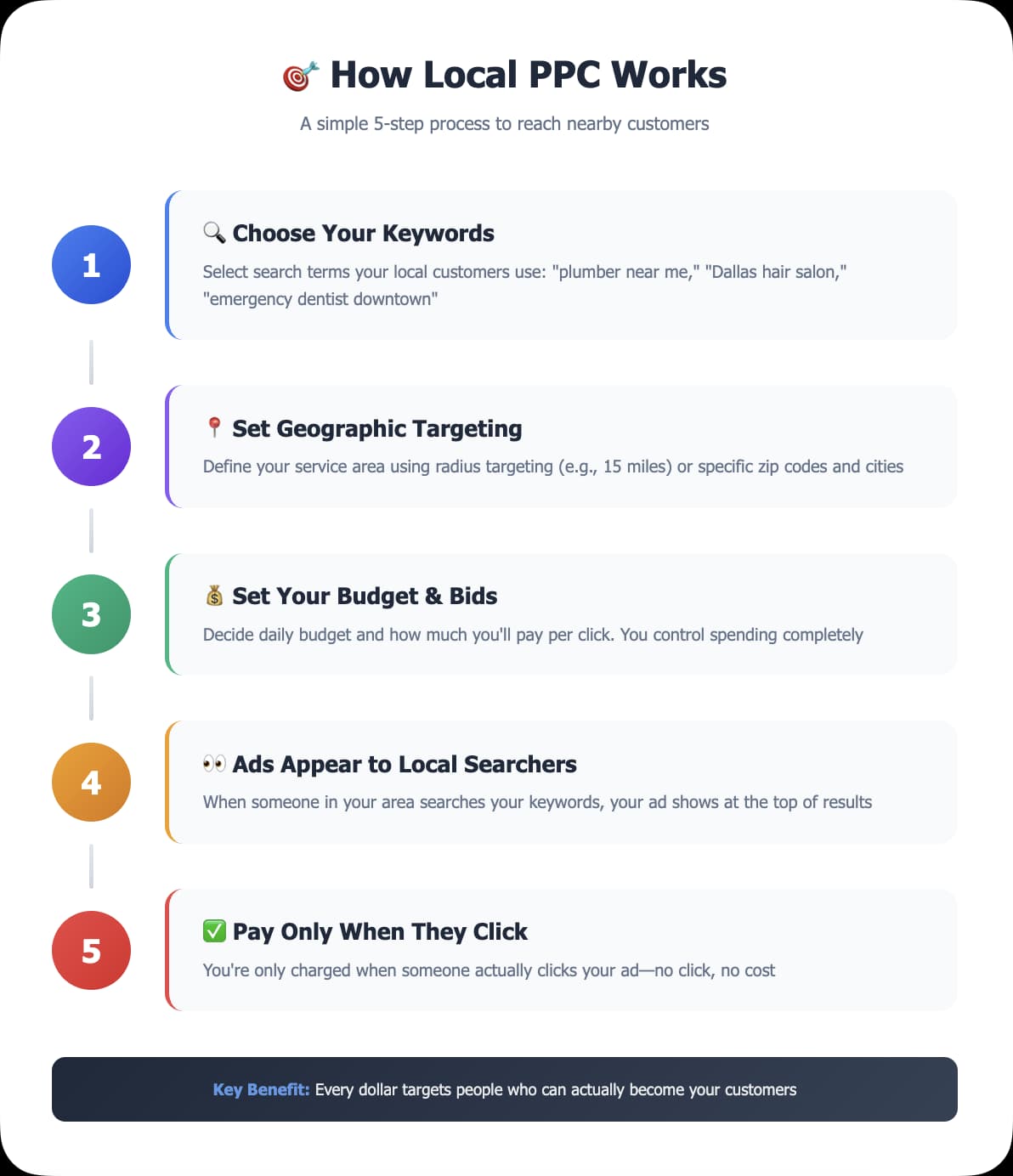
How Local PPC Works
How Local PPC Differs from National Campaigns
National PPC campaigns cast a wide net. Local PPC is more like fishing with a spear. The differences affect everything from keyword strategy to budget allocation:
Geographic targeting is everything. National campaigns might target entire countries. Local campaigns drill down to cities, zip codes, or even a radius around your business location.
Keywords get specific. Instead of bidding on "plumbing," you bid on "plumber in [your city]" or "emergency plumber near [neighborhood]." These location-specific terms cost less and convert better.
Competition is concentrated. You're not competing with every business in your industry - just the ones serving your area. This often means lower costs and better opportunities.
The customer journey is shorter. Someone searching for a local service is usually ready to act. They're not researching a future purchase; they need help now.
Why Local Businesses Need PPC Advertising
Let's be direct: if you're running a local business without PPC advertising, you're probably losing customers to competitors who use it. Here's why PPC has become essential for local business marketing.
Immediate Visibility in Local Searches
SEO is valuable, but it takes months to build rankings. PPC puts you at the top of search results today. For a new business or one entering a new market, this immediate visibility is invaluable.
When a potential customer searches for services in your area, paid ads appear above organic results. That prime real estate matters - research shows that the top three paid ads capture about 40% of all clicks on commercial search queries.
Targeting Customers Ready to Buy
Not all website traffic is equal. The person casually browsing "best pizza toppings" is different from the person searching "pizza delivery near me open now." Local PPC lets you target high-intent searches - the ones that indicate someone is ready to spend money.
This intent-based targeting makes local PPC remarkably efficient. You're not paying to build awareness with people who might buy someday. You're reaching people actively looking for what you sell, often within minutes of making a purchase decision.
Measurable Results and ROI
One of the biggest advantages of PPC over traditional advertising is measurability. With Google Ads, you can track exactly how many people saw your ad, clicked on it, called your business, or visited your store.
This data transforms how you market. Instead of guessing whether your advertising works, you know. You can see which keywords generate calls, which ads drive visits, and exactly how much each customer acquisition costs.
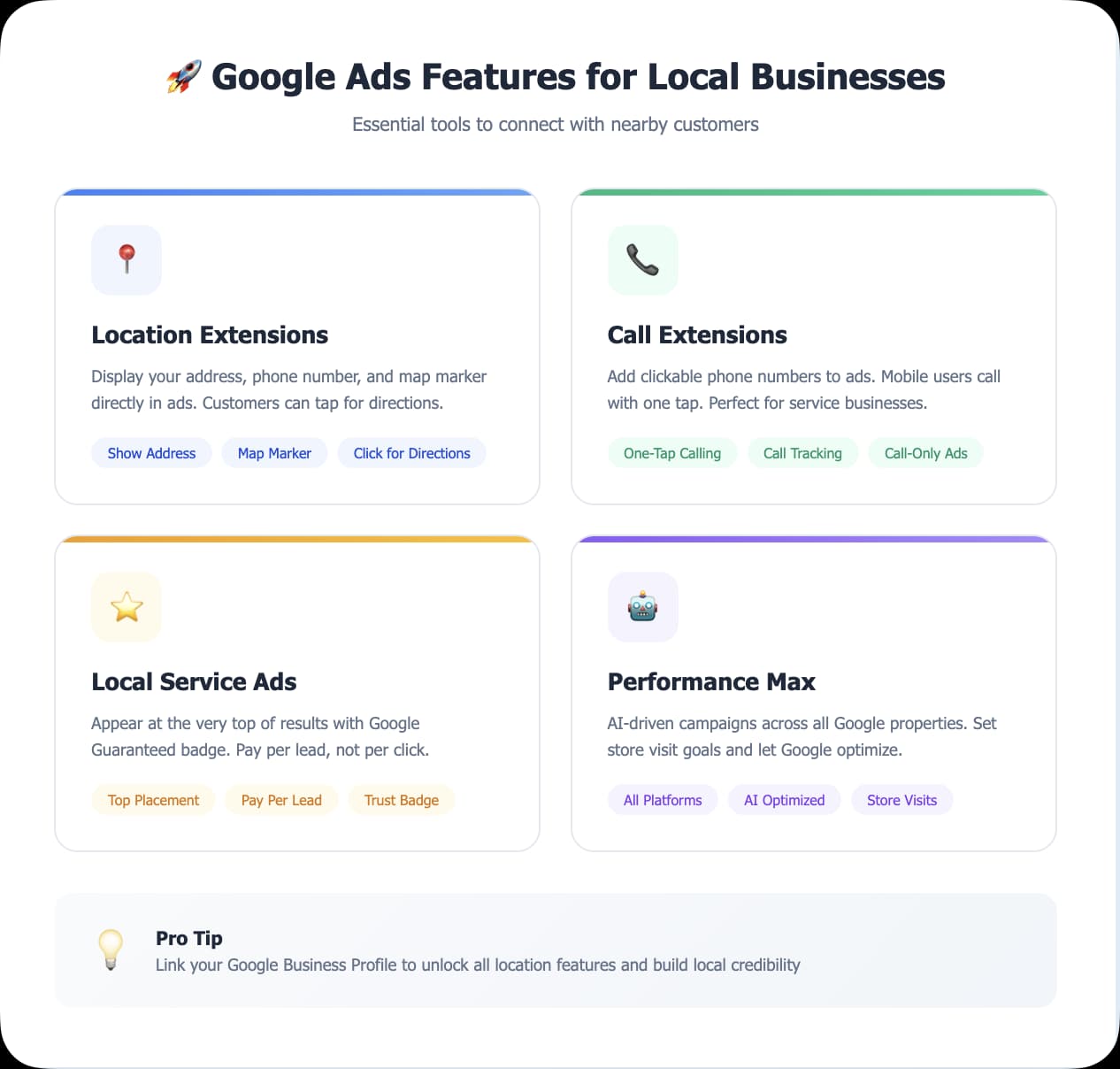
Google Ads Features for Local Businesses
Competitive Advantage
Here's a reality check: your competitors are likely already using PPC. If they're showing up in local searches and you're not, you're handing them business. But the reverse is also true - effective PPC campaigns can help you capture market share from competitors who aren't advertising or aren't advertising well.
Setting Up Your First Local PPC Campaign
Ready to get started? Let's walk through the process of setting up a local PPC campaign that actually works. We'll focus on Google Ads since it dominates local search, though many principles apply to other platforms.
Step 1: Define Your Service Area
Before you write a single ad, you need to define exactly where you want to reach customers. Be realistic about your service area:
Google Ads lets you target by city, zip code, or radius around a location. You can also exclude areas you don't serve. Getting this right prevents wasted spend on clicks from people you can't help.
Step 2: Research Local Keywords
Keyword research for local PPC is different from general keyword research. You need to think like a local customer searching for your services.
Start with your core services, then add local modifiers:
Use Google's Keyword Planner to see search volumes and competition levels. Look for keywords with clear commercial intent - "emergency plumber [city]" is better than "how to fix a leaky faucet."
Don't forget negative keywords. These prevent your ads from showing for irrelevant searches. A personal injury lawyer might add negatives like "free," "DIY," "jobs," and "school" to avoid wasted clicks.
Step 3: Create Compelling Ad Copy
Your ad copy needs to do three things: grab attention, communicate value, and drive action. For local businesses, it also needs to establish local relevance.
Headlines should include:
Descriptions should cover:
Example for a local dental practice:
Step 4: Build Location-Specific Landing Pages
Here's where many local businesses go wrong: they send PPC traffic to their homepage. Don't do this - dedicated landing pages convert significantly better than generic homepages.
Create landing pages specifically for your PPC campaigns. Each page should:
If you serve multiple areas, consider creating landing pages for each location. A page targeting "plumber in [Neighborhood A]" should mention that neighborhood, include relevant testimonials, and show that you understand the area.
Step 5: Set Your Budget and Bidding Strategy
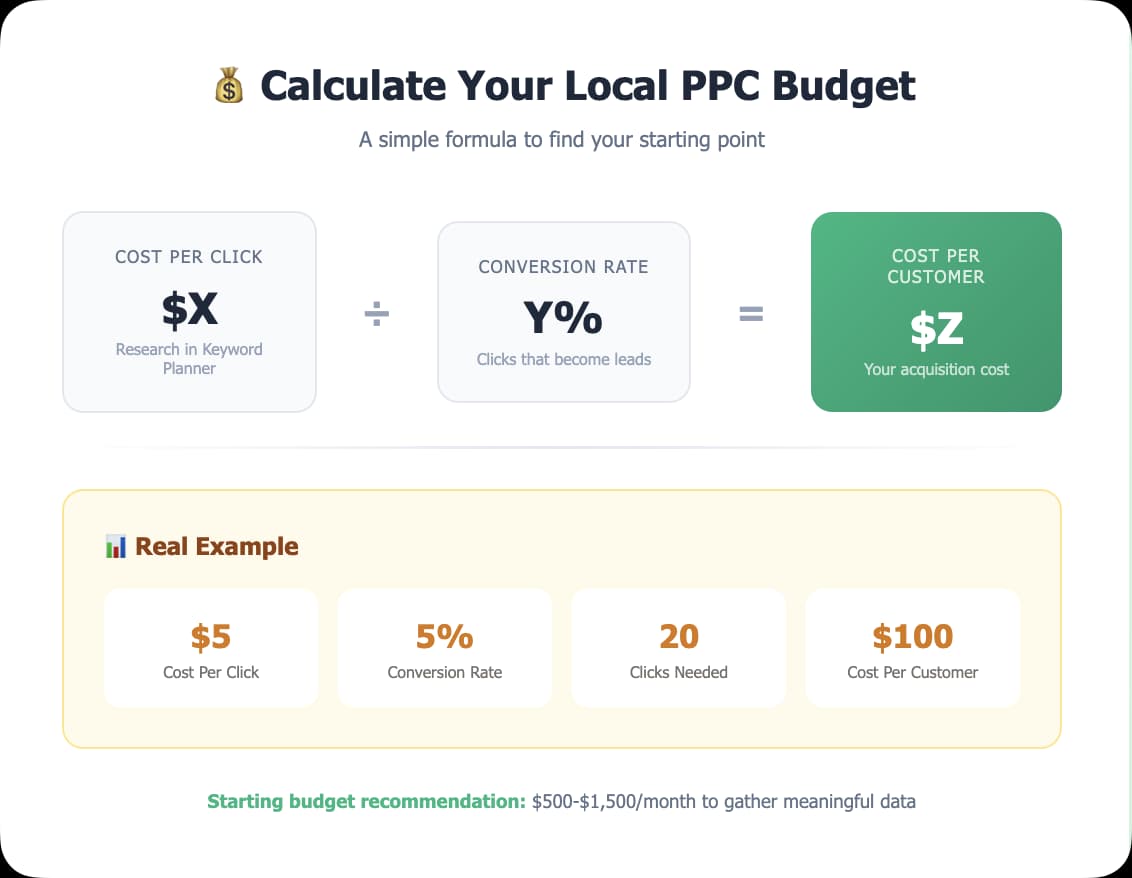
Calculate Your Local PPC Budget
How much should you spend on local PPC? There's no universal answer, but here's a framework:
Start with your customer value. If your average customer is worth $500 and you close 1 in 5 leads, each lead is worth $100. You could afford to pay up to $100 for a lead and break even - though obviously you want to pay less.
Consider your market. Competitive markets with high customer values (like legal services or construction) have higher costs per click. Less competitive markets cost less.
Begin with a test budget. Most local businesses should start with $500-1,500/month to gather enough data for optimization. You need enough clicks to learn what's working.
For bidding strategies, new campaigns often do well with manual CPC bidding, which gives you control while you learn. Once you have conversion data (usually 30+ conversions), you can test automated bidding strategies like Maximize Conversions or Target CPA.
Advanced Local PPC Strategies
Once your basic campaigns are running, these advanced strategies can significantly improve performance.
Geo-Targeting Techniques
Go beyond basic city targeting with these techniques:
Radius targeting: Set up a radius around your business location. This works well for businesses where customers prefer nearby providers.
Location bid adjustments: Bid more for searches from high-value areas. If certain zip codes convert better or have higher-value customers, increase bids for those locations.
Location-specific ad copy: Use ad customizers to dynamically insert location names into your ads based on where the searcher is located.
Exclude underperforming areas: Review your geographic data regularly. If certain areas generate clicks but no conversions, consider excluding them.
Dayparting for Local Businesses
Dayparting means adjusting your bids or ad schedule based on time of day and day of week. This is particularly valuable for local businesses:
Analyze your conversion data by hour and day. You'll often find clear patterns in when your customers search and convert.
Call-Only Campaigns
For many local businesses, phone calls are the primary conversion. Google's call-only campaigns are designed specifically for this.
Instead of showing a traditional ad with a landing page, call-only ads display your phone number prominently. On mobile devices, clicking the ad initiates a phone call directly.
These campaigns work well for:
Track your calls carefully. Use call tracking numbers to measure which keywords and ads generate calls, and record calls (with proper disclosure) to assess lead quality.
Local Services Ads
For certain business categories, Google offers Local Services Ads (LSAs). These appear above regular search ads and include:
LSAs operate on a pay-per-lead model rather than pay-per-click. You only pay when someone contacts you through the ad. Categories include home services (plumbers, electricians, HVAC), professional services (legal, financial advisors), and others.
If your business category qualifies, LSAs can be a valuable addition to your local PPC strategy.
Measuring Local PPC Success
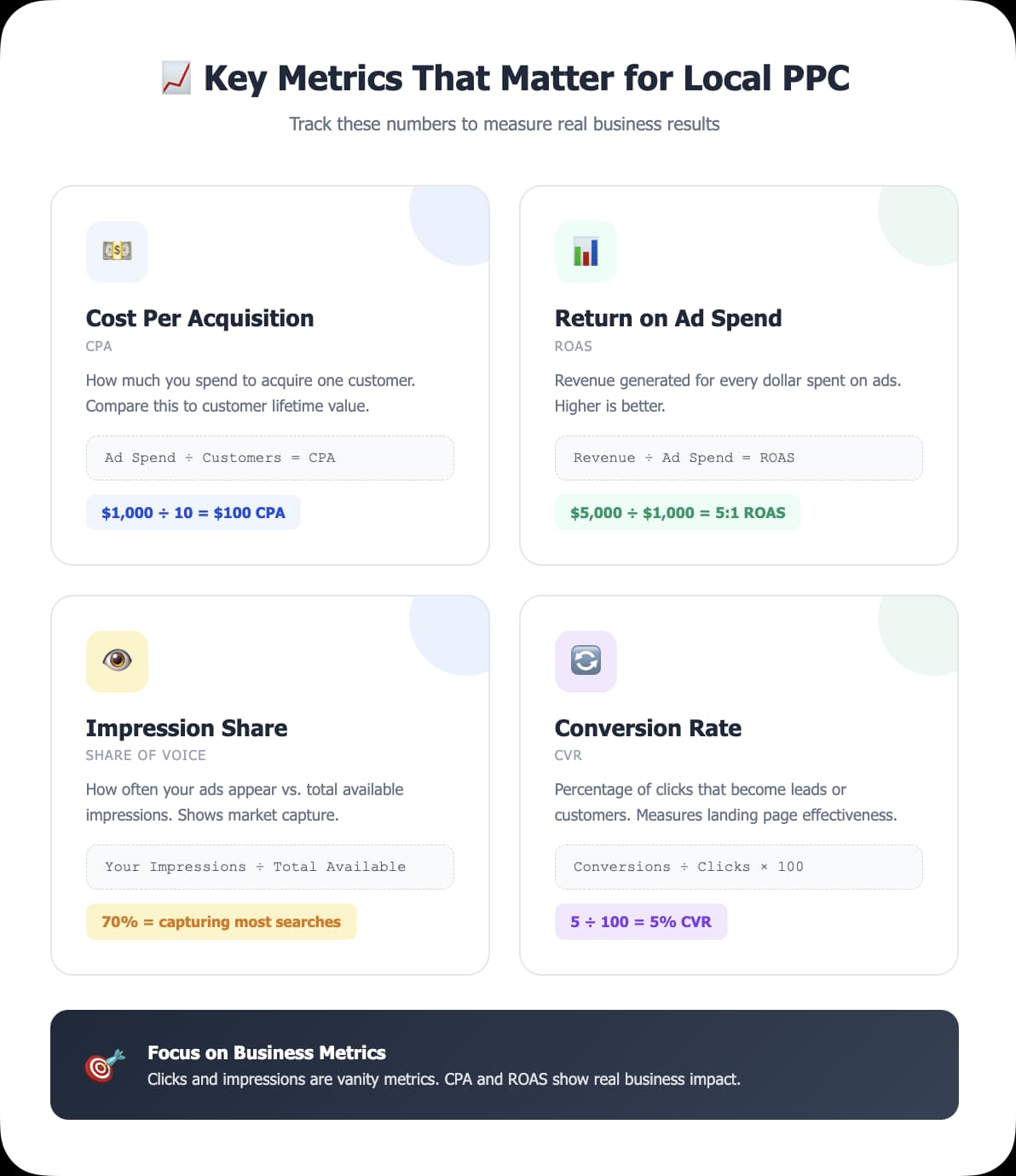
Key Metrics That Matter for Local PPC
What gets measured gets improved. Here are the key metrics to track for local PPC campaigns:
Primary Conversion Metrics
Phone calls: For most local businesses, phone calls are the primary conversion. Track call volume, call duration, and if possible, call outcomes.
Form submissions: If you use contact forms, track submission volume and lead quality.
Direction requests: If you have a physical location, track how many people click for directions in your Google Business Profile.
In-store visits: Google can estimate store visits for businesses with physical locations, though this requires significant click volume to be reliable.
Efficiency Metrics
Cost per click (CPC): What you pay for each ad click. Monitor this to ensure you're not overpaying.
Cost per conversion: What you pay for each lead or conversion. This is the most important efficiency metric.
Conversion rate: The percentage of clicks that convert. Low conversion rates often indicate landing page problems or keyword targeting issues.
Return on ad spend (ROAS): Revenue generated divided by ad spend. This tells you whether your campaigns are profitable.
Quality Metrics
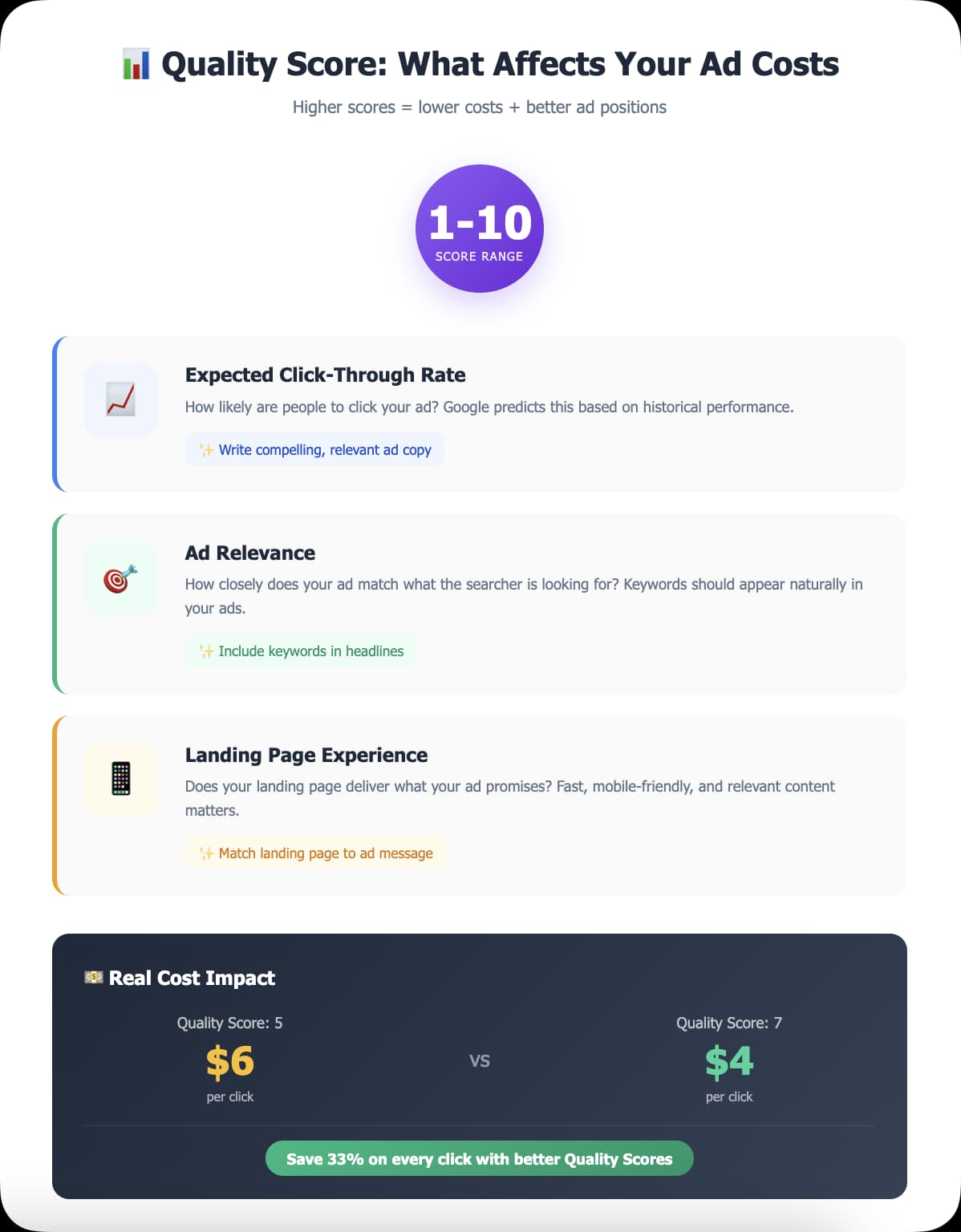
Quality Score: Google's rating of your ad and landing page quality. Higher Quality Scores lead to lower costs and better ad positions.
Click-through rate (CTR): The percentage of people who see your ad and click it. Higher CTRs indicate relevant, compelling ads.
Impression share: The percentage of available impressions your ads capture. Low impression share might indicate budget constraints or bid issues.
Quality Score: What Affects Your Ad Costs
Common Local PPC Mistakes to Avoid
4 Common Local PPC Mistakes to Avoid
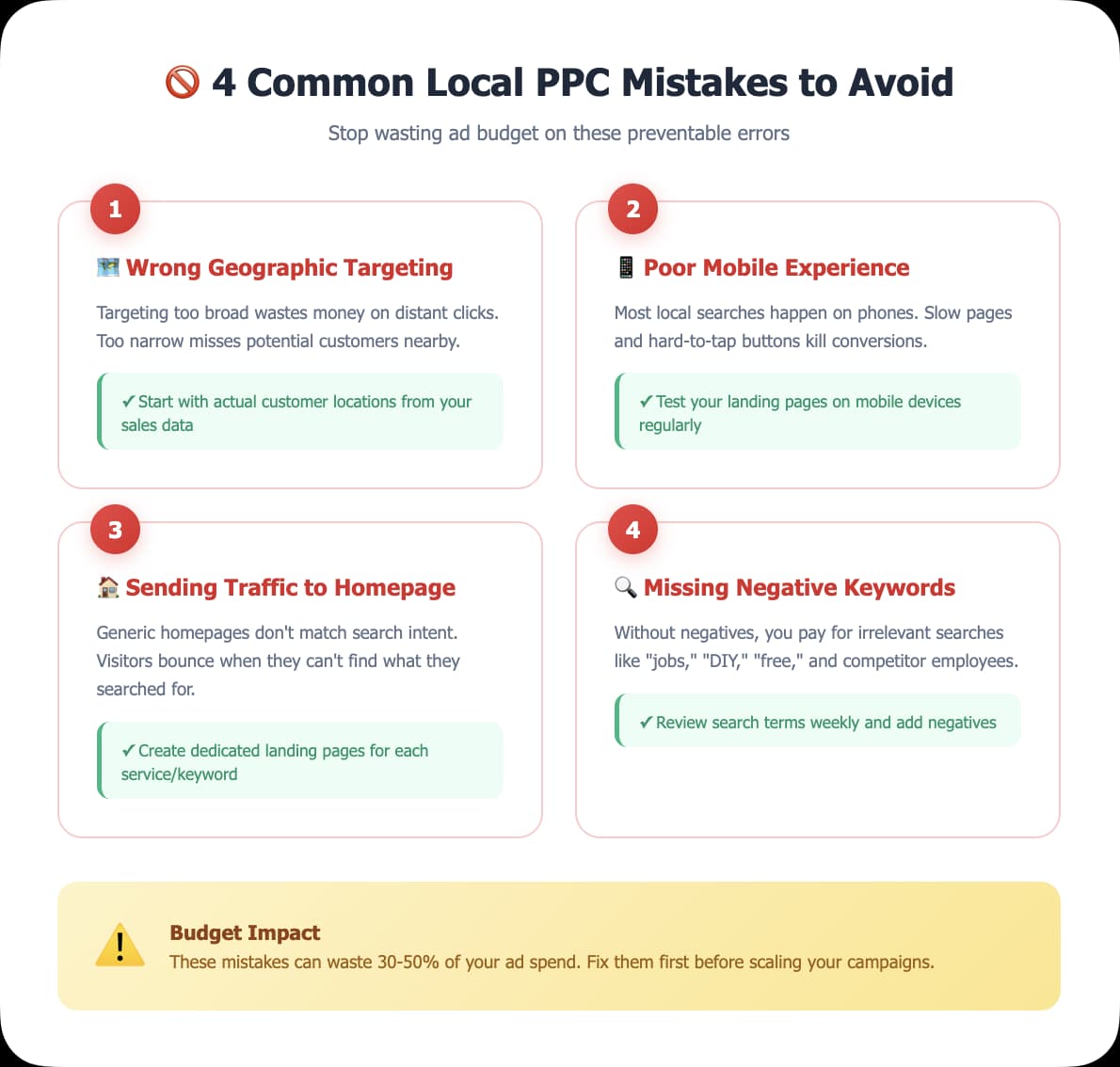
After working with hundreds of local businesses, we've seen the same mistakes repeatedly. Avoid these pitfalls:
Mistake 1: Targeting Too Broadly
Many local businesses set their geographic targeting too wide. If you serve customers within a 15-mile radius, don't target the entire metro area. Every click from outside your service area is wasted budget.
Start narrow and expand based on performance data. It's easier to add areas that work than to identify and exclude areas that don't.
Mistake 2: Ignoring Mobile Users
For local searches, mobile is dominant. Someone searching for "coffee shop near me" is almost certainly on their phone, probably looking for somewhere to go right now.
Ensure your ads are mobile-optimized with click-to-call extensions. Make sure your landing pages load quickly and work perfectly on mobile devices. Consider mobile-specific bid adjustments if mobile traffic converts well.
Mistake 3: Setting and Forgetting
PPC campaigns require ongoing attention. Search patterns change, competitors adjust their strategies, and what worked last month might not work next month.
At minimum, review your campaigns weekly. Check search term reports for new negative keywords. Monitor conversion rates for drops that might indicate problems. Test new ad copy regularly.
Mistake 4: Poor Conversion Tracking
If you're not tracking conversions properly, you're flying blind. You might think your campaigns are failing when they're actually generating calls you're not measuring. Or worse, you might think they're succeeding while wasting money on clicks that never convert.
Set up comprehensive conversion tracking before you spend significant budget. Track phone calls, form submissions, and any other actions that matter to your business.
Integrating PPC with Other Local Marketing
PPC works best as part of a comprehensive local marketing strategy. Here's how it fits with other channels:
PPC and SEO
PPC and SEO complement each other. SEO builds long-term organic visibility while PPC provides immediate presence. Use PPC data to inform SEO priorities - keywords that convert well in PPC are worth pursuing organically.
Some businesses find that appearing in both paid and organic results increases overall click-through rates. The combined presence signals authority and trustworthiness.
PPC and Google Business Profile
Your Google Business Profile (formerly Google My Business) works alongside your PPC campaigns. An optimized profile improves the performance of Local Services Ads and can appear in regular search results alongside your paid ads.
Keep your profile updated with current information, photos, and regular posts. Actively collect and respond to reviews - they affect both your local pack rankings and your PPC ad performance.
PPC and Social Media
While this guide focuses on search PPC, social media advertising can supplement your local strategy. Facebook and Instagram ads offer detailed geographic and demographic targeting.
Social ads work differently than search ads. People on social media aren't actively searching for your services, so these platforms work better for awareness, retargeting, and promoting specific offers.
FAQs
How much should a local business spend on PPC?
Most local businesses should budget $1,000-$3,000 monthly for PPC advertising to see meaningful results. However, the right budget depends on your market, competition, and customer value. Start with enough budget to generate at least 100-200 clicks monthly - this gives you enough data to optimize. Calculate your maximum cost per lead based on customer lifetime value, then work backward to determine a sustainable budget. Some highly competitive local markets (lawyers, contractors) require higher budgets, while less competitive niches can succeed with less.
What's a good click-through rate for local PPC ads?
A good click-through rate (CTR) for local PPC ads is 3-5%, though top-performing campaigns can exceed 8%. CTR varies by industry - emergency services often see higher rates because searchers are motivated to act quickly. If your CTR is below 2%, your ads likely need improvement. Test different headlines, add relevant ad extensions, and ensure your keywords closely match user intent. Remember that CTR affects Quality Score, which influences your costs and ad positions.
How long does it take for local PPC to show results?
You'll see initial traffic within hours of launching a local PPC campaign, but meaningful optimization takes 2-3 months. The first month is about gathering data and making initial adjustments. By month two, you should have enough conversion data to identify winning keywords and ads. Month three and beyond is about refinement and scaling. Don't judge your campaign's success in the first two weeks - PPC requires patience and continuous optimization.
Should I use Google Ads or Facebook Ads for local marketing?
For most local businesses, Google Ads should be your primary PPC platform because it captures people actively searching for your services. Someone searching "dentist near me" has immediate intent - they want a dentist now. Facebook Ads work better for building awareness, promoting specific offers, and retargeting website visitors. The ideal approach uses both platforms: Google Ads for capturing active demand and Facebook Ads for staying top-of-mind with your local audience.
Can I run local PPC myself or should I hire an agency?
You can run local PPC yourself, but it requires time and willingness to learn. Google Ads has become increasingly complex, and mistakes can be costly. If your monthly budget is under $1,000 and you have time to learn, starting yourself is reasonable. Above that budget, or if your time is valuable elsewhere, consider hiring an agency or consultant. A good agency typically saves you money through better optimization and more efficient spending, even after their fees. The ROI often justifies the cost.
What keywords should local businesses target?
Local businesses should target keywords that combine their services with location terms and intent signals. Examples include: "[service] in [city]," "[service] near me," "best [service] [location]," "emergency [service] [city]," and "[service] + [neighborhood]." Prioritize keywords showing buying intent ("hire," "cost," "book," "schedule") over informational queries. Use Google's Keyword Planner to research search volumes and competition. Start with your most profitable services and expand from there.
How do I track phone calls from PPC ads?
Track phone calls using Google Ads call tracking, which assigns a Google forwarding number to your ads. Enable call extensions and call-only ads to capture call conversions. For more detailed tracking, use third-party call tracking software like CallRail or CallTrackingMetrics, which can record calls, track keywords, and integrate with your CRM. Set minimum call duration thresholds (usually 60 seconds) to filter out accidental calls from real conversations.
What's the difference between Google Ads and Local Services Ads?
Google Ads are pay-per-click ads that appear in search results based on keywords you bid on. Local Services Ads (LSAs) are pay-per-lead ads that appear above regular search results for certain service categories. LSAs include a Google Guarantee badge, display your reviews, and only charge when someone contacts you directly. LSAs require a background check and verification process. If your business category qualifies for LSAs, consider running both - they appear in different positions and reach users at different stages of their search.
How do I improve my Quality Score for local ads?
Improve Quality Score by focusing on its three components: expected CTR, ad relevance, and landing page experience. Write compelling, specific ad copy that closely matches your target keywords. Create dedicated landing pages for each ad group with relevant content and fast load times. Ensure your keywords are organized into tightly themed ad groups. Remove underperforming keywords dragging down your account. Higher Quality Scores reduce your costs and improve ad positions - it's one of the most impactful optimizations you can make.
Is PPC worth it for small local businesses?
Yes, PPC is often especially valuable for small local businesses because it levels the playing field. Unlike traditional advertising, you don't need a big budget to compete - you need smart targeting and good ads. PPC lets you appear alongside larger competitors when local customers search for your services. Start with a modest budget focused on your most profitable services and highest-intent keywords. Track your results carefully and scale what works. Many small businesses find that PPC delivers their best return on marketing investment.
Taking the Next Step with Local PPC
Local PPC advertising isn't just for big businesses with big budgets. It's one of the most effective ways for local businesses to reach customers exactly when they're searching for help.
The key is starting smart: define your service area precisely, target high-intent local keywords, create compelling ads that speak to local customers, and track everything so you know what's working.
You don't need a massive budget to see results. You need the right strategy, ongoing optimization, and patience to let your campaigns improve over time.
If managing PPC campaigns sounds overwhelming, you're not alone. Many local business owners don't have the time to learn platform intricacies, monitor campaigns daily, and optimize for maximum performance. That's where working with experts can make sense.
Ready to get started with local PPC? Whether you want to manage campaigns yourself or work with professionals who specialize in local advertising, the important thing is to start. Every day without PPC is a day your competitors are capturing customers who could be yours.
Need expert help with your local PPC campaigns? KeyGrow specializes in PPC management for local businesses. We understand the unique challenges of local advertising and build campaigns that generate real results -get started with a free consultation today.
Want to understand how PPC compares to SEO for your business? Check out our guide on Local PPC vs SEO.


