


The cheapest real estate closings come from people who already know you. The fastest come from paid sources, and they cost the most per closing.
That's the short answer to how to get real estate leads, and the data backs the first half. NAR's 2026 Member Profile found the typical REALTOR earned 28% of their 2025 business from repeat clients and another 22% from referrals by past clients. Buyers point the same way: 43% found their agent through a referral and 18% went back to one they'd used before, per a Virginia REALTORS summary of NAR's 2025 Profile of Home Buyers and Sellers.
Half your business from past clients is lovely after ten years in the job. If you got licensed last spring, it's a statistic about other people. So the scorecard below ranks 12 ways to generate real estate leads on the things you can plan around: cash, weekly hours, the usual wait for a first closing and what tends to go wrong.
The lead source scorecard, ranked
Sources are ranked by what a closing costs you in cash and hours, cheapest first. Tier 1 costs mostly time. Tier 4 buys speed at the highest price.
| Tier | Source | Cash cost | Weekly time (our estimate) | Time to first closing (our estimate) | Main risk |
|---|---|---|---|---|---|
| 1 | Past clients | Low: calls, notes, a yearly event | 1 to 2 hours | 3 to 12 months | Going quiet until they forget your name |
| 1 | Sphere of influence | Low | 1 to 2 hours | 3 to 12 months | Turning friendships into pitches |
| 2 | Google Business Profile and reviews | $0 | About 1 hour | 3 to 9 months | Few reviews, so sellers call someone else |
| 2 | Open houses | Low: signs, sign-in sheet, snacks | 3 to 4 hours per open house | 3 to 6 months | Visitors leave and nobody follows up |
| 2 | Local web pages and SEO | Low cash, many hours | 2 to 4 hours | 9 to 18 months | Quitting before anything ranks |
| 3 | Agent-to-agent referrals | A referral fee at closing, agreed in writing | Under 1 hour | Set by the client's move | Fee terms nobody wrote down |
| 3 | Lenders, builders, attorneys | Low; shared ads split by space | 1 to 2 hours | 4 to 12 months | Anything that looks like paying for referrals |
| 4 | Expired and FSBO sellers | Data lists from about $60 a month | 5 to 10 hours | 2 to 4 months | Do Not Call fines |
| 4 | Farming by mail | $0.26 postage per piece, plus printing | About 1 hour | 9 to 18 months | Stopping before the farm knows your name |
| 4 | Google search ads and Local Services Ads | Your budget; Local Services Ads charge per lead | 2 to 3 hours | 3 to 6 months | Paying for clicks that never become leads |
| 4 | Pay-per-lead and subscription programs | Around $20 to $60 a lead, or $189 to $899 a month and up | 5 to 10 hours of follow-up | 3 to 9 months | Shared leads and long contracts |
| 4 | Pay-at-closing referral programs | Nothing up front, then a 30 to 35% referral fee | 3 to 5 hours | 3 to 9 months | Early-stage leads and a big cut of each deal |
Tier 1 is people who already know you, tier 2 is where buyers and sellers already look, tier 3 is audiences you borrow from other agents, lenders and builders, and tier 4 is attention you pay for in cash or hours.
Cash costs come from USPS, Google and HousingWire's 2026 roundup of lead companies. The hours and timing are our estimates from how each source works, anchored on two medians from NAR's 2025 Profile: buyers searched for 10 weeks, and homes sold after four weeks on the market. Even a lead who's ready today has that search or that listing period ahead, plus the closing.
Every lead runs the same five steps
Each source feeds the same pipeline: lead, conversation, appointment, signed agreement, closing. Your lead-to-closing rate is whatever survives all five.
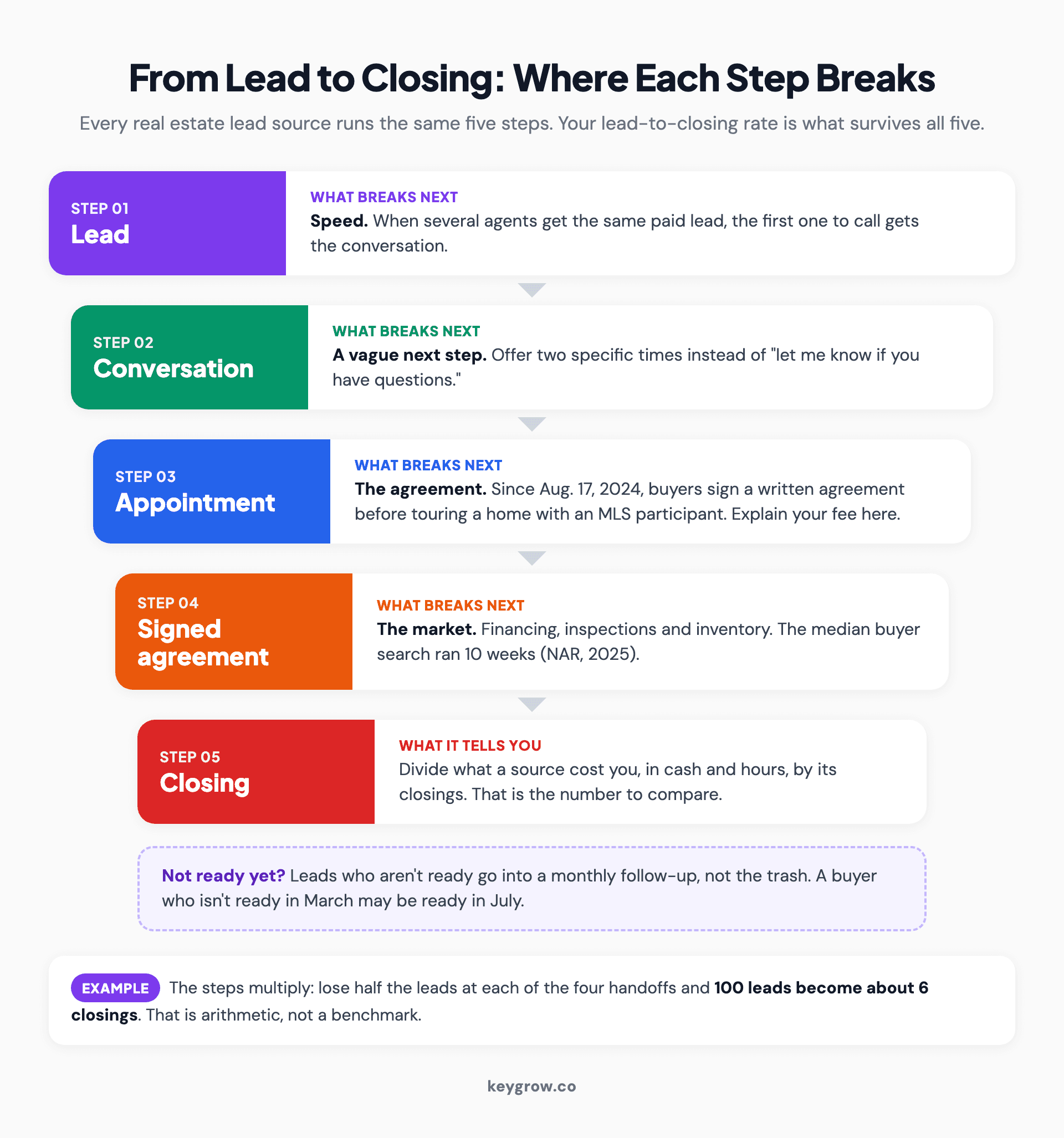
Five-step funnel for real estate leads, from lead to conversation, appointment, signed agreement and closing, showing what usually breaks at each step: a slow first reply, no specific appointment time, a buyer who won't sign the written agreement required before touring since August 2024, and financing or inspection problems before closing, with a monthly follow-up loop for leads who are not ready yet.
The steps multiply. Lose half the leads at each of the four handoffs and 100 leads turn into about six closings. That's arithmetic, not a benchmark, and it shows how much of a lead's value gets decided after it arrives.
Speed breaks the first handoff. If three agents get the same paid lead at 9 p.m., the one who calls at 9:05 gets the conversation. The second handoff needs a specific ask: "Can you do Saturday at 11 or Sunday at 2?" gives a buyer something to agree to, and "let me know if you have questions" doesn't.
Step three changed in 2024. Since August 17 of that year, NAR's settlement rules have required MLS participants working with buyers to get a written agreement before touring a home, in person or live virtual. REALTOR Magazine adds that compensation "remains fully negotiable," so the agreement is now where your fee gets explained. A buyer lead who won't sign isn't a client yet, however many listing alerts they've opened.
The last step belongs to the market: financing, inspections and inventory. Leads who aren't ready go into a monthly follow-up instead of the trash, since a buyer who isn't ready in March may be ready in July.
Tier 1: people who already know you
Past clients and your sphere produce the cheapest closings because the trust already exists. What they cost you is years of steady, unglamorous contact.
Sellers lean on it too. The same Virginia REALTORS summary reports that 66% of sellers found their agent through a referral or used one they'd worked with before. Two out of three people handing over their biggest asset picked an agent they'd used before or one someone recommended.

A man and a woman laughing as they shake hands outside a dark gray house, the kind of easy relationship that past-client referrals come from.
A week of tier 1 work looks like this:
- Keep every past client, and everyone who'd take your call, in one list with a note on how you know them.
- Call five people a week with a reason: a sale on their street, their home's rough value, the number of a good roofer.
- Send a short note each month on what sold near them, with your number on it.
- Ask for referrals by situation. "Who do you know who's outgrowing their place?" is easier to answer than "Know anyone buying?"
- Host one client event a year and tell people to bring a friend.
Instagram Stories do the same job between calls by reminding people, most days, that you sell homes. Our Instagram playbook for agents covers that routine.
The catch is time.
Tier 1 compounds, since every closing adds a past client, and that's also why it can't carry your first year. NAR's 2026 Member Profile puts median gross income at $8,000 for members with two years' experience or less, against $88,500 for those with 16 years or more. New agents need tiers 2 and 3 while the list grows.
Tier 2: where buyers and sellers already look
Your Google Business Profile, open houses and local web pages cost almost nothing in cash. The bill comes in hours, and the online pieces take months.
Start with the profile, which is free. Sellers look you up before they call, and reviews from closed clients are the proof they scan for. Google also requires a verified profile for its Home Listings Ads, covered in tier 4.
Open houses are one of the few places buyers without an agent walk up to you. NAR's consumer guide says someone visiting an open house on their own doesn't need to sign a written buyer agreement; that comes once you start touring homes together. No listings yet? Ask agents in your office if you can host theirs.
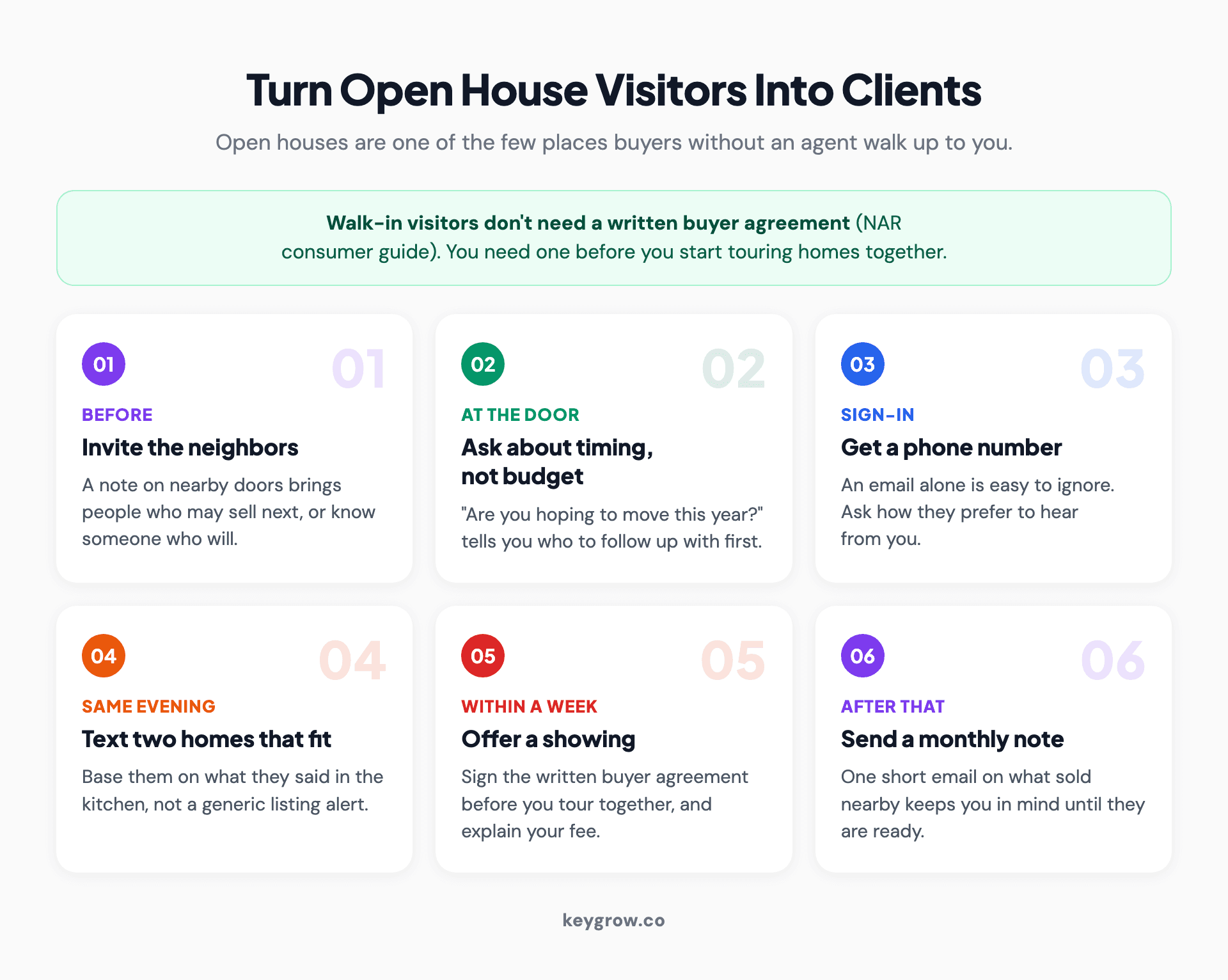
Icon grid of an open house lead plan for real estate agents: before the open house, invite the neighbors; at the door, ask one question about their timeline; on the sign-in, collect a phone number; the same evening, text two homes that fit what they said; within a week, offer a showing, noting that a written buyer agreement is needed before touring together; after that, add them to a monthly market note.
Local web pages are the slow lane: a page per neighborhood, a monthly note on what sold and plain answers to the questions sellers ask you. Expect six months or more before they bring calls, and closings after that. Our guide to digital marketing for real estate covers the website and SEO side.
Tier 3: borrow someone else's audience
Other agents, lenders and builders already talk to your future clients. You're borrowing their trust, so expect to pay in referral fees or favors.
Agent-to-agent referrals run on relocation. A client moving across the country needs an agent at the other end, and agents in your feeder markets have clients moving toward you. RESPA, the federal anti-kickback law for real estate settlements, carves out referral payments between real estate agents and brokers, so agree on the fee in writing before anyone picks up the phone.
Lenders work differently. A loan officer meets pre-approved buyers, some before they've chosen an agent, but RESPA bars giving or taking anything of value for referrals tied to a federally related mortgage. Joint advertising is allowed when each side pays its share. NAR's RESPA FAQ says a full-page newspaper ad split half and half, with each firm paying half, appears to comply, and it quotes HUD's warning that paying less than a pro rata share could be a violation.

Wood roof trusses going up on a new home against a clear blue sky, the kind of project that puts a builder's sales office in front of buyers before many of them have an agent.
Builders set their own rules about buyer's agents, so ask each sales office how it registers you before your buyer walks in. Estate and divorce attorneys, financial planners and property managers also meet sellers early. Earn those introductions by being useful, and keep money out of them.
Tier 4: paid attention is fast and priced to match
Paid sources start conversations fastest. The speed costs cash or hours, sometimes both, and cold calling comes with federal rules attached.
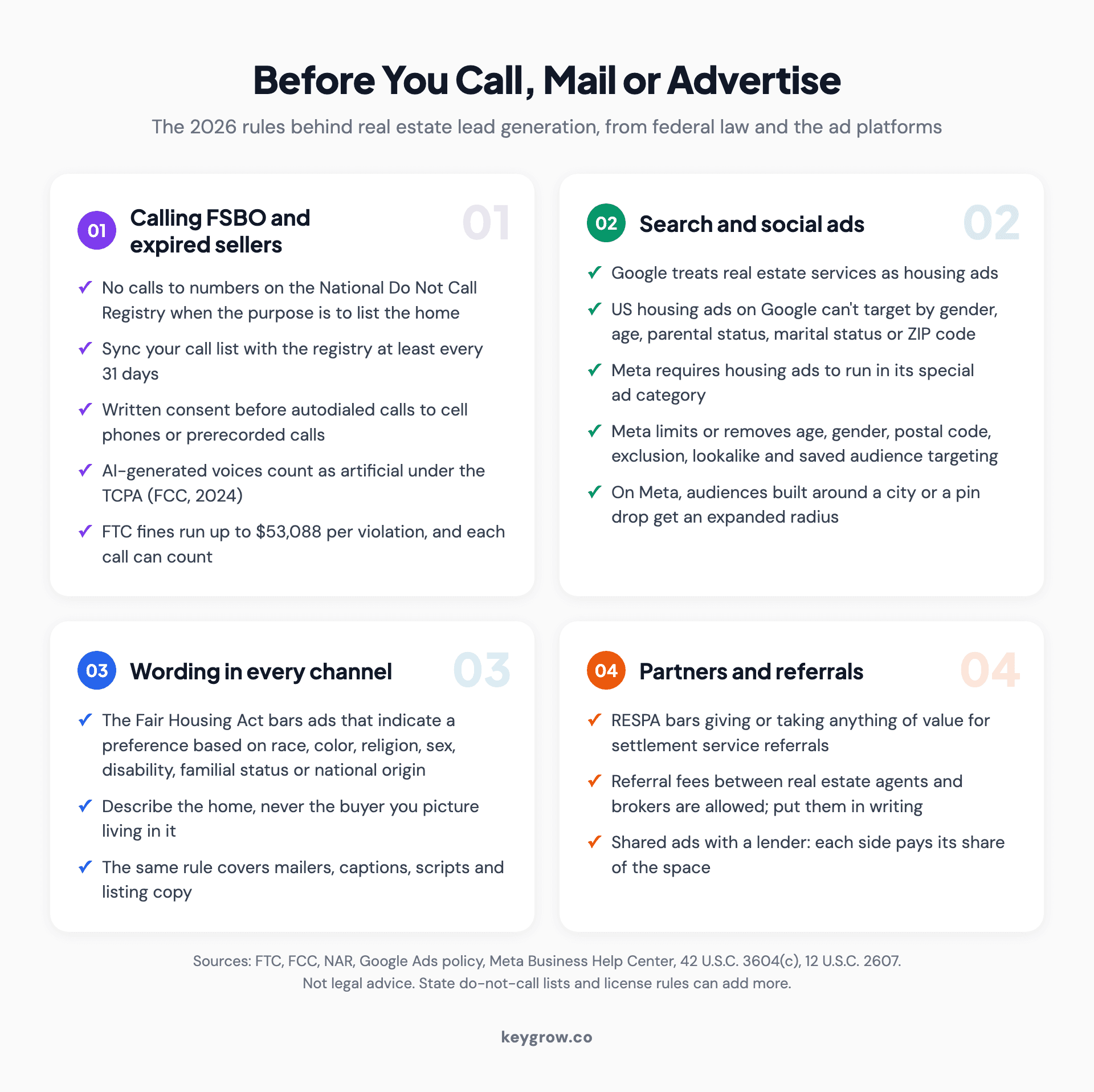
Checklist of 2026 rules for real estate lead generation in four cards: calling FSBO and expired sellers (no calls to Do Not Call numbers to solicit a listing, check the registry every 31 days, written consent for autodialed, prerecorded or AI-voice calls), advertising (Google bars gender, age, parental status, marital status and ZIP code targeting for US housing ads, and Meta's housing category limits age, gender and postal code targeting), wording (describe the home, not the buyer, under the Fair Housing Act), and partners (no payments for referrals under RESPA, shared ads split by each side's share).
Expired and FSBO sellers
Expired listings are sellers who wanted to sell and didn't. FSBO sellers are trying without you, and NAR's 2025 Profile found that 60% of them knew their buyer, which caps what a cold call can do. The calling rule is plain: NAR's telemarketing guidance says you may not call an FSBO or expired seller whose number is on the National Do Not Call Registry if the purpose is to list the home.
Telemarketers have to sync their lists with the registry at least every 31 days, and the FTC lists fines of up to $53,088 per violation, with each call able to count as one. Autodialed telemarketing calls to cell phones and prerecorded calls need express written consent. Since February 2024, the FCC has treated AI-generated voices as artificial under the TCPA.
So an AI dialer doesn't get you around any of this.
Farming by mail
Mail is the opposite: legal, slow and cheap per piece. USPS Every Door Direct Mail retail drops cost $0.26 a piece in postage, with no permit, for 200 to 5,000 pieces per ZIP code a day. A 500-home farm mailed monthly comes to $130 per drop and $1,560 a year before printing. Budget for 12 drops before you judge it.
Search ads and Local Services Ads
Google search ads reach people typing "sell my house" or "realtor near me" that day, and you pay per click. Local Services Ads charge per lead instead. Agents who opt into the Buyer's agent or Seller's agent job types also get Home Listings Ads, which can show listings to people searching "homes for sale near me" on a phone. Google began moving Local Services Ads into Google Ads in phases in August 2026, starting with some home and storefront services, and says advertisers still pay only for valid leads.
Whichever you run, Google classes real estate services as housing ads, so US campaigns can't target by gender, age, parental status, marital status or ZIP code. Our list of the Google Ads mistakes agents make covers the expensive ones.
Paid lead programs
HousingWire's 2026 roundup puts one large portal's leads at around $20 to $60 each, depending on ZIP code and home price, and lists subscription platforms with starting prices from $189 to $899 a month, several with six-month or annual minimums. Its pay-at-closing pick charges nothing up front, then takes a 30 to 35% referral fee from your gross commission on each deal it sends. Several programs in the roundup don't make leads exclusive, so you're racing other agents to the first call.
Paid social follows the same logic inside tighter limits. Meta makes housing ads run in a special ad category, and for advertisers reaching the US it limits or removes targeting by age, gender and postal code, along with exclusions, lookalike audiences and saved audiences.
One rule covers every channel in this post. The Fair Housing Act makes it unlawful to publish any notice, statement or ad about selling a home that indicates a preference based on race, color, religion, sex, disability, familial status or national origin. Describe the home, never the buyer you picture living in it.
What does a closing cost you?
Divide cost per lead by your lead-to-closing rate. The answer is your cash cost per closing, and it's the only price worth comparing between sources.
Here's that math on two paid sources. The $40 lead sits mid-range in the $20 to $60 HousingWire reports. The closing rates and the 15 minutes of follow-up per lead are illustrations, so swap in your own from your CRM.
| Source A | Source B | |
|---|---|---|
| Cost per lead | $40 | $100 |
| Lead-to-closing rate (illustration) | 1% | 4% |
| Leads to work per closing | 100 | 25 |
| Follow-up time per closing, at 15 minutes a lead (illustration) | 25 hours | About 6 hours |
| Cash cost per closing | $4,000 | $2,500 |
The cheaper lead costs 60% more per closing and eats four times the follow-up. Set the result beside what one closing nets you after your split, fees and any referral fee. Since the 2024 settlement, that number varies too much from deal to deal for us to assume one.
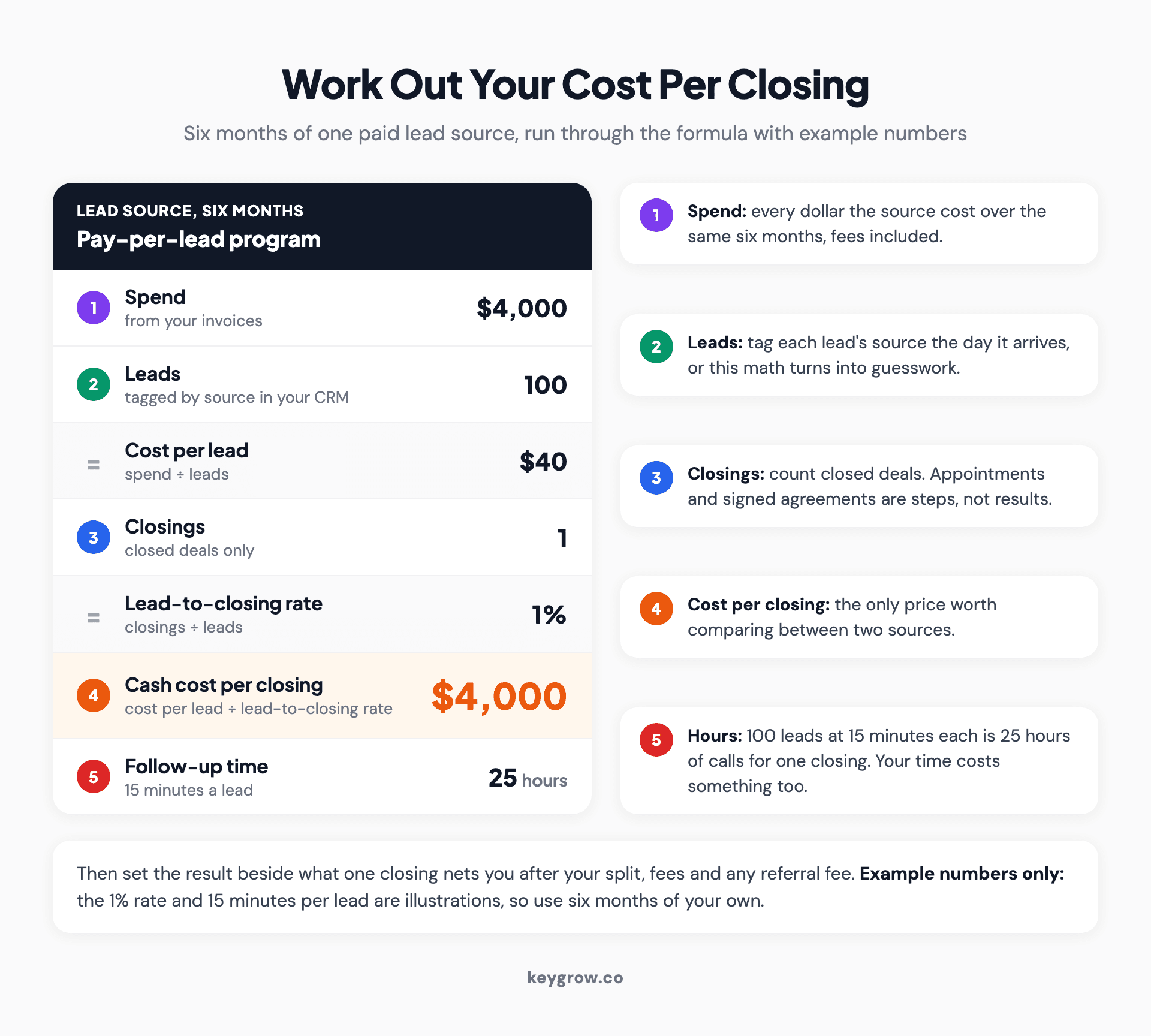
Annotated calculator showing how to work out cost per closing for one real estate lead source over six months, with example numbers: $4,000 spent and 100 leads give a $40 cost per lead, one closing gives a 1 percent lead-to-closing rate, so the cash cost per closing is $4,000, plus 25 hours of follow-up at 15 minutes a lead, with notes on where each number comes from.
Lead quality moves that number faster than budget does, which is why more traffic is the wrong fix for bad lead quality. A cash home buyer came to us drowning in junk leads. Instead of buying more clicks, we added negative keywords, tightened match types and wrote qualifying language into the ads, so people who weren't selling had a reason to scroll past. Serious leads rose 600% between December and January without a bigger budget, and cost per lead fell from $313 to $124.
That client was an investor, not an agent, but "sell my house" searches respond to the same filters, and our Google Ads guide for real estate investors walks through them.
When should you skip paid leads?
Skip them if you can't call back within the hour, or if the contract would outlast the test that tells you your closing rate.

A woman on a phone call at her desk, taking notes in a notebook beside an open laptop, the follow-up work that decides whether a paid lead becomes a client.
A paid lead that waits until tomorrow is mostly a gift to the agent who called tonight. If you show homes all day and nobody covers your phone, fix that before you buy anything. A six-month minimum is a bet on follow-up you haven't measured, so run tiers 1 and 2 for a few months first and learn your own conversion rates.
And if past clients, referrals and open houses already keep you at your goal, you don't need to buy leads at all.
You don't need an agency like ours either.
FAQs
How do new real estate agents get leads?
Start with your sphere, then add a source that doesn't depend on past clients, such as hosting open houses for other agents' listings or swapping referrals with agents in other markets. NAR's 2026 Member Profile puts median gross income at $8,000 for members with two years or less experience, so plan for a slow first year. Add paid leads once you can return every call within the hour.
What are the best ways to get real estate leads?
For cost per closing, the best are past clients and their referrals. The typical REALTOR earned 28% of their 2025 business from repeat clients and 22% from referrals, according to NAR's 2026 Member Profile. For speed, paid sources win, at a higher price per closing.
Are paid real estate leads worth it?
They are when your cash cost per closing, meaning cost per lead divided by your lead-to-closing rate, sits well below what a closing nets you. Measure that rate on a short test before you sign a six-month or annual contract. Shared leads favor whoever calls back first.
How much do real estate leads cost?
HousingWire's 2026 roundup puts one large portal at around $20 to $60 per lead, subscription platforms at $189 to $899 a month and up, and a pay-at-closing program at a 30 to 35% referral fee on your gross commission. Google's Local Services Ads charge per lead. A mailed farm costs $0.26 a piece in USPS postage for Every Door Direct Mail retail drops.
Can you call FSBO and expired listings?
Yes, unless the number is on the National Do Not Call Registry and you're calling to list the home, which NAR's guidance says you may not do. Check your list against the registry at least every 31 days. Get written consent before you use an autodialer, a prerecorded message or an AI voice.
How fast can you get real estate leads?
Paid sources can produce conversations within days of launch, but closings take months. NAR's 2025 Profile puts the median buyer search at 10 weeks, and that comes before the closing itself.
Pick two sources and give them a year
Twelve real estate lead generation ideas are too many to run at once. Choose one source from tier 1 and one from any other tier. Write down what each costs in cash and hours, then track every lead to a closing or a dead end for 12 months. A year covers a full selling season, plus the 10-week searches that run past it.
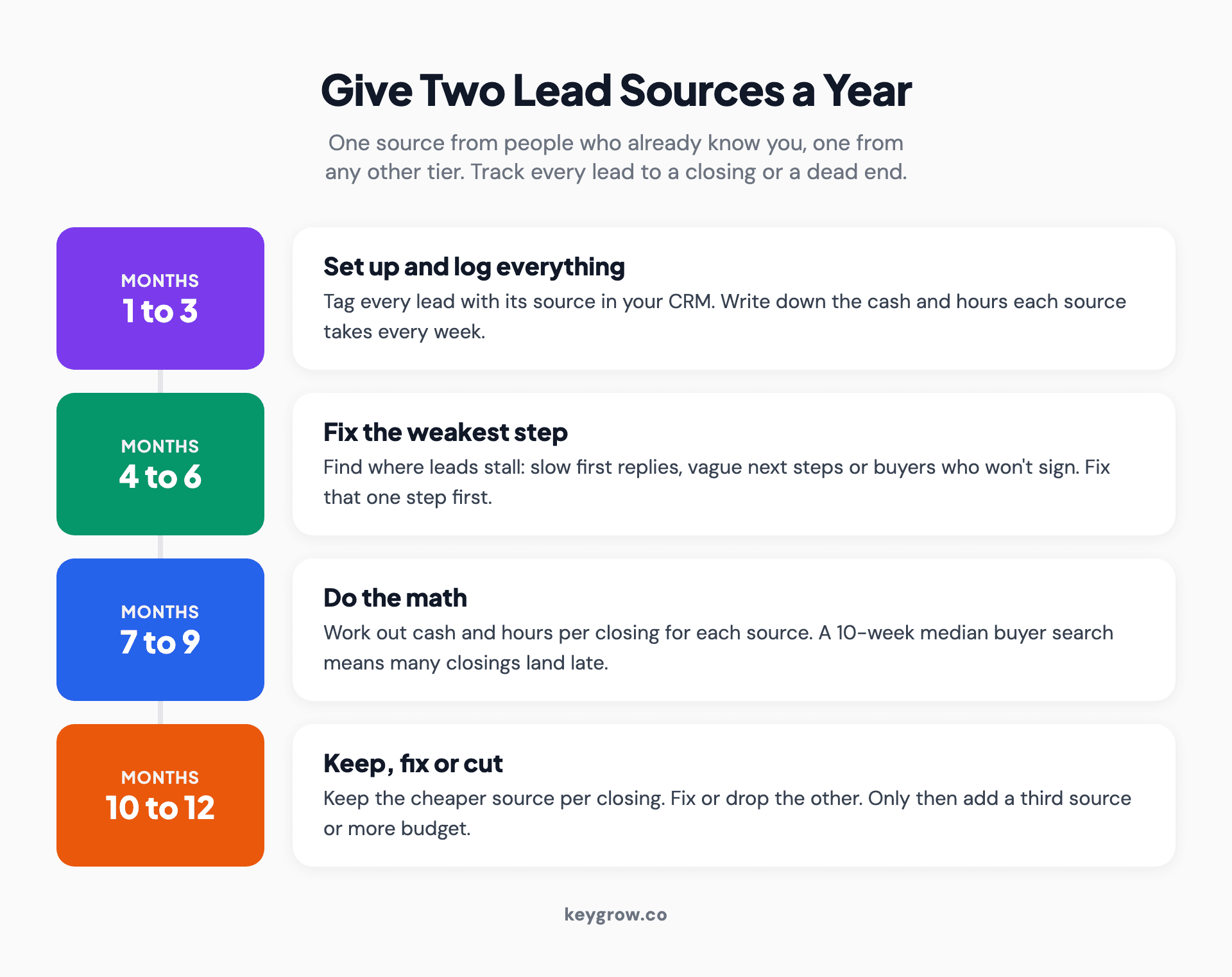
Timeline of a 12-month test of two real estate lead sources: months 1 to 3, set up tracking and log every lead's source; months 4 to 6, fix the weakest step in the funnel; months 7 to 9, work out cash and hours per closing for each source; months 10 to 12, keep the cheaper source, cut or fix the other, and only then add a third.
At month 12, divide what each source cost you, in cash and hours, by its closings, and keep the cheaper one. Then add a third source, or put more money and hours into the winner.
If search ads or local SEO is one of your two, our team runs both for real estate agents, month to month.