

You post twelve photos of a new listing. By morning the post has a few dozen likes, mostly from other agents, your lender and your cousin. Nobody asks to see the house.
Then a 40-second Reel you shot on the walk to a showing, past the coffee shop and the park, gets three messages. One asks what a three-bedroom goes for on that block. That person is a buyer.
Instagram marketing for real estate agents works when your posts start conversations with local buyers and sellers.
The plan, in the order that works
Set up the profile first, build the content habit second, fix DMs and your link third, and only then spend money. Measure from day one.
Most agents run it backwards. They boost a listing on day one, send the clicks to a homepage with nine menu items, then judge the channel on a week of reach numbers. Done in order, each step makes the next one cheaper.
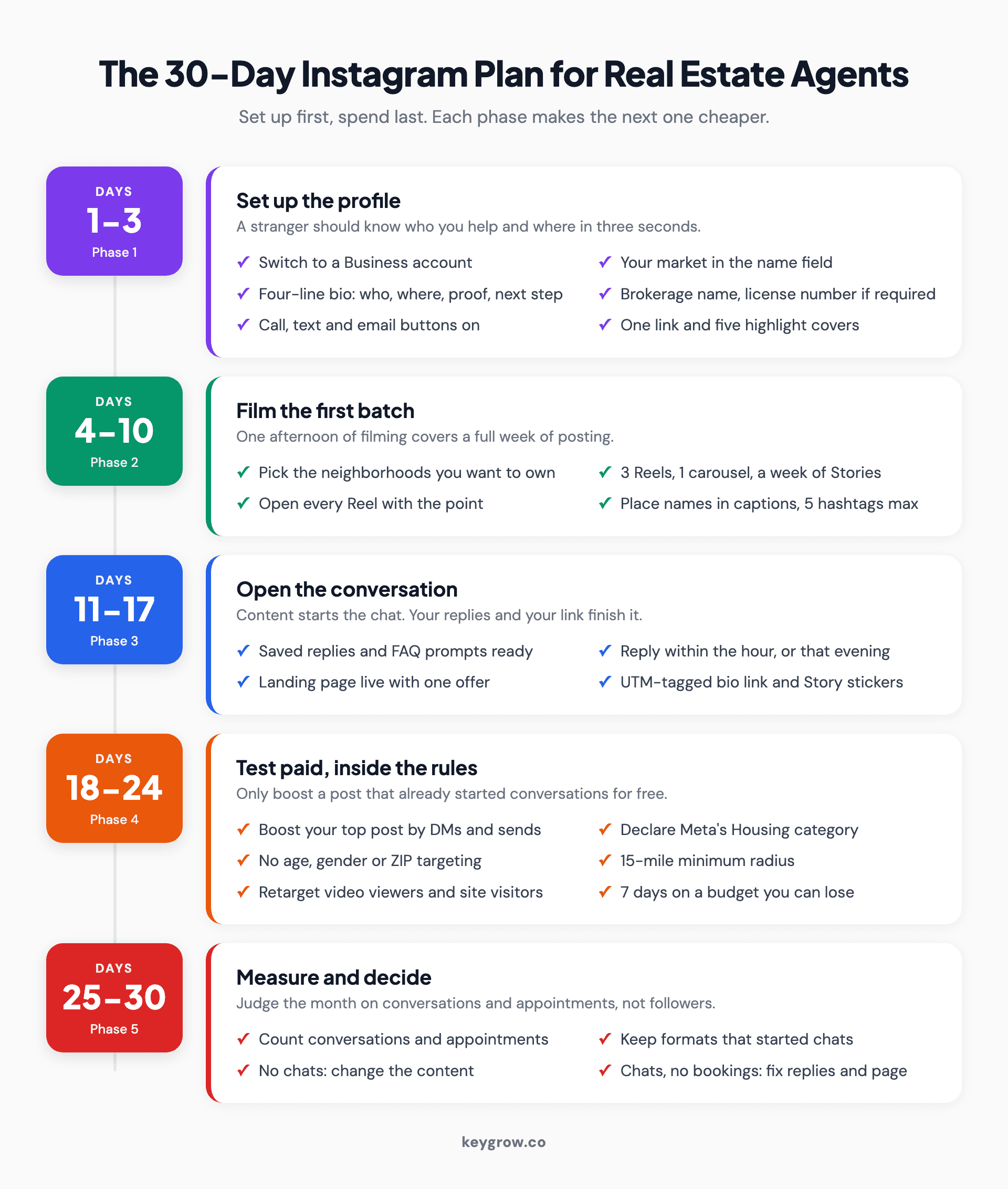
Timeline of a 30-day Instagram plan for real estate agents: days 1 to 3 set up the profile, days 4 to 10 film the first content batch, days 11 to 17 set up DM replies and the landing page, days 18 to 24 boost the best post in Meta's Housing category, and days 25 to 30 count conversations and appointments.
Step 1: Build a profile a stranger understands in three seconds
Use a professional account, put your market in the name field, write a bio that says who you help and where, and add one link.
Switch to a professional account and pick Business over Creator. Business comes with Insights, contact buttons and access to ads. The catch is a smaller library of tracks cleared for commercial use, which matters less than a strong opening.
Your name field is searchable. Instagram matches search text against usernames, bios, captions and places, and its own advice is to use a fitting profile name and include locations in your bio. "Your Name | Tampa Realtor" shows up when someone types "Tampa realtor." (Use "Realtor" only if you are an NAR member; "Real Estate Agent" works for everyone.)
The bio gets four short lines: who you help, where, one line of proof, and the next step. Something like "First-time buyers and move-up sellers in South Tampa / Born and raised in Seminole Heights / DM 'HOMES' for this week's list." Add your brokerage name, plus a license number if your state requires one.
Turn on the call, text and email buttons for people who would rather not DM. You can add up to five links, but only the first appears in the bio itself, so make that your landing page. Add highlight covers for Buyers, Sellers, Neighborhoods, Sold and Reviews, since strangers read them before your feed. Use the same headshot as on your signs and website, so people recognize you.
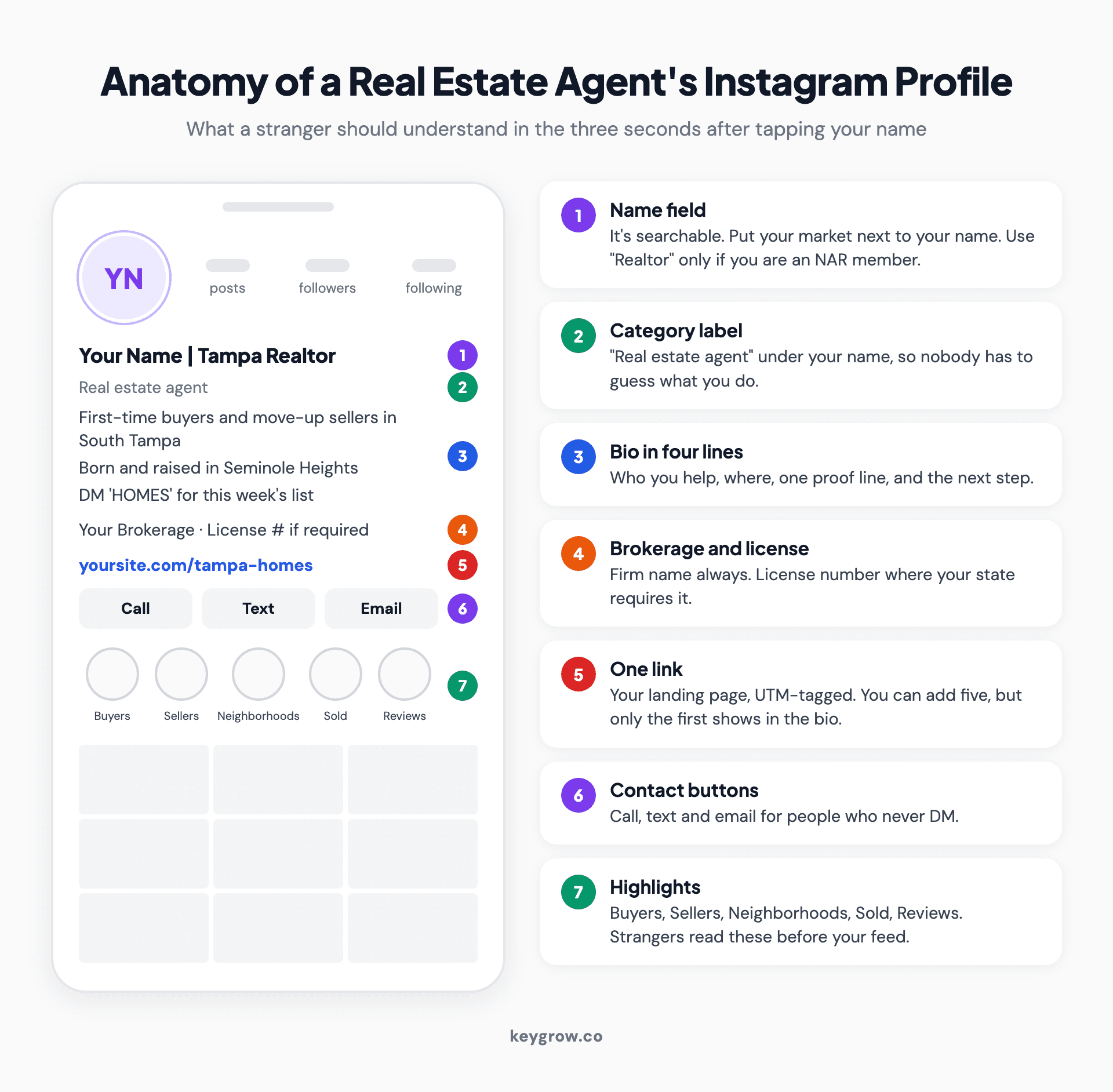
Annotated mockup of a real estate agent's Instagram profile showing a searchable name field with the market, a four-line bio covering who, where, proof and next step, the brokerage name and license number, call, text and email buttons, one link to a landing page, and five highlight covers.
Since July 10, 2025, public posts from professional accounts can show up in Google and other search engines, and the setting is on by default for adult accounts. Leave it on.
Step 2: Post five kinds of content, and only one is listings
Listings speak to the few people shopping this week. Neighborhood guides, market updates, answers to common questions and behind-the-scenes posts reach everyone else.
So make one post in five a listing. The rest give followers a reason to keep watching until they, or someone they know, start looking.

A person photographing a bright living room with a smartphone, the kind of quick interior shot an agent can turn into a listing carousel.
Five content types carry most agent accounts:
1. Listings, told as a story. A carousel in tour order, a caption about living there (the morning light, the walk to the park) and a clear next step. Just-sold posts work the same way, with the seller's permission.
2. Neighborhood guides. A street walk, or what a typical budget buys on each side of town. Locals send these to each other. Tag the shops you feature.
3. Market updates. One MLS number per post in plain English, like days on market in your ZIP this month and what it means for spring sellers.
4. Answers to the questions you hear every week. Can I sell before I buy? What does earnest money do? Each one is a Reel.
5. Behind the scenes. Inspection day, staging, open house setup, the late-night offer. It shows the work clients pay you for, which listing photos never do. A client's short review from closing day fits here too, posted with their written permission and saved to your Reviews highlight.
Write captions the way people search: the neighborhood, the street, the style of home and the price band. Instagram search and now Google both read caption text. Add a location tag too. Since December 2025, Instagram caps every post and Reel at five hashtags, though plenty of real estate advice still says ten to fifteen. Pick five that name places.
Step 3: Make Reels people send to a friend
Reels are how strangers find you. Instagram weighs watch time, likes and sends, and sends matter more when the viewer doesn't follow you yet.
In January 2025, Instagram head Adam Mosseri named the ranking signals that matter most: average watch time, likes per reach and sends per reach. For an agent, a send is the best outcome on the platform, because it usually travels with a message like "we should look here."
The Reels that get sent answer a question a local person already has:

A woman holding a smartphone upright to photograph the front of a brick house, framing the shot vertically the way Reels are filmed.
The first two seconds matter more than production, so open with the point: the price, or the question. Film vertically, add on-screen captions for people watching with the sound off, keep most Reels under a minute, and get in the shot yourself. Trial reels, where your account has them, go to non-followers first. Test a hook there before your sphere sees it.
A walkthrough that works as a Reel also works as a YouTube Short and, once proven, as a paid video, which our guide to YouTube ads for small businesses covers.
Stories are for the people who already follow you
Reels find new people. Stories remind past clients, neighbors and friends, every day, that you sell homes and are good at it.
A big share of agent business is referral business, and your sphere refers whoever they thought of last. Post three to five frames on most days: the 7am showing, a poll ("bigger yard or shorter commute?"), a countdown before an open house, and once a week a link sticker to your landing page. Every reply lands in your DMs, which is the point.
Save the good ones to highlights and let the rest expire.
A weekly calendar you can keep for a year
Three or four feed posts a week plus Stories on most days beats daily posting that stops in March.
You have a job, which is why consistency beats volume. Batched, this rhythm takes about two hours of filming and editing, and Meta Business Suite or Instagram's built-in scheduler can publish it for you.
| Day | What to post | Format | Example |
|---|---|---|---|
| Monday | Neighborhood or market update | Reel | What sold on one street last month, and why |
| Tuesday | Poll or question sticker | Stories | "Bigger yard or shorter commute?" |
| Wednesday | Listing or just-sold story | Carousel | Eight photos in tour order |
| Thursday | A buyer or seller question | Reel | "Can I sell before I buy?" |
| Friday | Behind the scenes | Stories | Inspection day, staging, a late offer |
| Saturday | Open house or neighborhood walk | Stories or Live | Countdown sticker, then a live walkthrough |
| Sunday | Batch filming | None | Shoot next week's Reels in one trip |
If that's too much, drop to two Reels a week and keep the Stories. Replying to messages is the one thing you can't cut.
Step 4: Treat every DM like a phone lead
A DM is a lead who picked the least awkward way to reach you. Reply the same day, ask one question, then offer a call.
People who would never fill out a form will happily type "how much is this one?" at 10pm. If that message waits until Thursday, they ask the next agent whose Reel they saw. This is where Instagram leads usually die, and content has nothing to do with it.
Run every conversation the same way:
1. Reply within the hour during working hours and the same evening otherwise, with an away message covering nights.
2. Answer their question first, then ask one back: "Are you hoping to move in the next few months, or keeping an eye on the area?"
3. Qualify lightly: timeline, area, and whether they're buying or selling. Three questions at most, spread across the chat.
4. Offer two specific times for a call or a showing. "Tuesday at 5 or Wednesday at noon?" is easier to say yes to than "let me know when you're free."
5. Log it in your CRM with Instagram as the source and the post that started it, or you can't measure anything later.
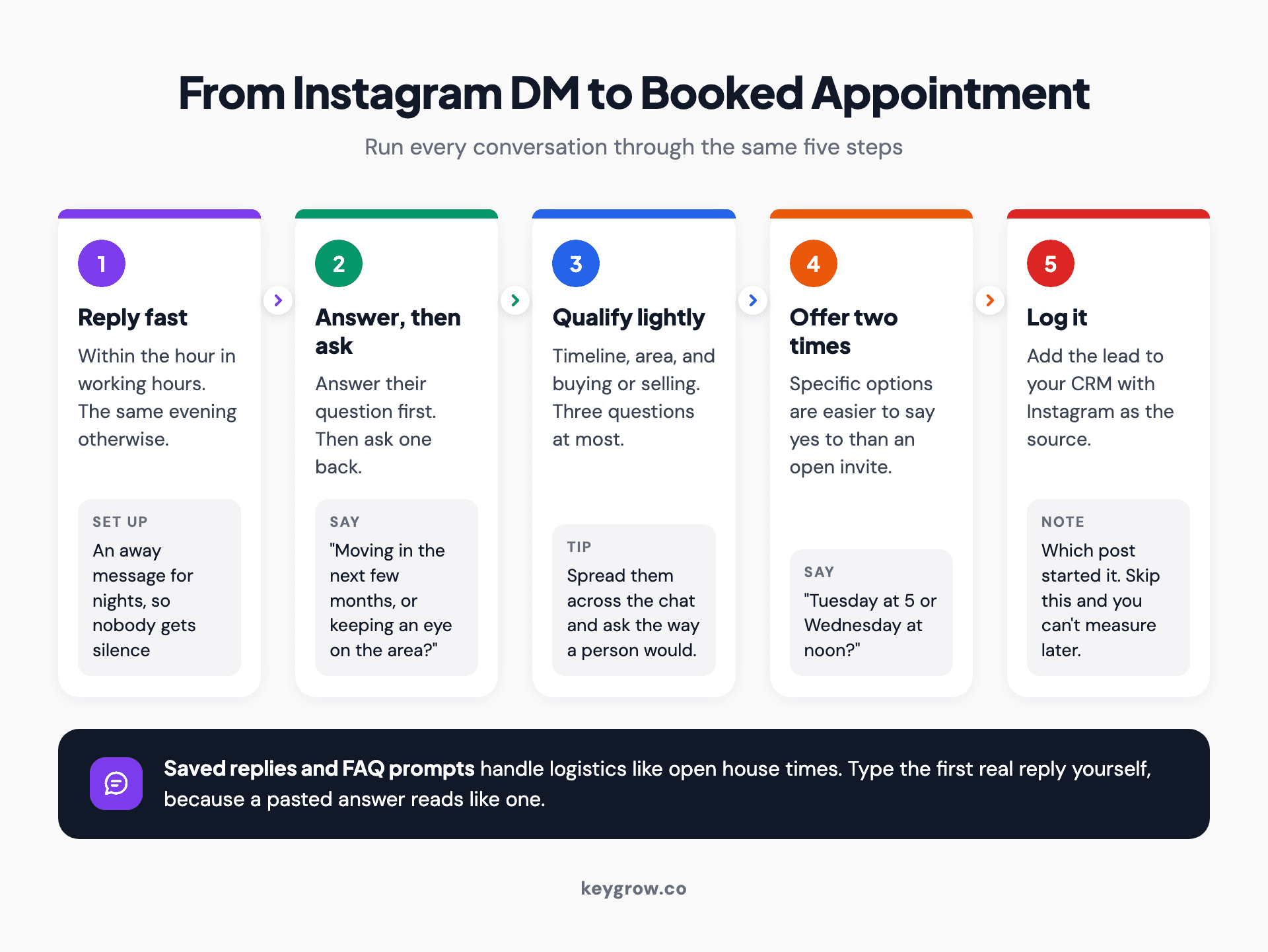
Five-step flow for turning an Instagram DM into an appointment: reply within the hour, answer then ask one question, qualify on timeline, area and buy or sell, offer two specific times, and log the lead in the CRM with Instagram as the source.
Professional accounts can store saved replies and set FAQ prompts that appear when someone opens a chat. Use them for logistics like open house times. Never use one for the first real reply, because a pasted answer to "is this still available?" reads like one.
Comments count too. When someone types "price?" under a listing, answer in public the same day, then offer the details in a DM. And spend ten minutes a day leaving real comments on local businesses' posts, so neighbors see your name outside your own feed.
Step 5: Point the bio link at a page built for one job
Your bio link should open a fast mobile page with one offer and one form, not your homepage or a list of nine links.
Every post that works ends in "link in bio." A homepage with a menu and a search bar makes someone on a phone work out what to do next, and plenty of them leave.
Build one page per offer: a home value request for sellers, a "tell me what you're looking for" form or a neighborhood guide for buyers. Give it a headline that matches the post they came from, as few form fields as you can live with (or a multi-step form that asks one thing at a time), tap-to-call, a line of proof and your brokerage name. Nothing else should be clickable.
We have seen this work on paid traffic. A real estate pre-qualification service was sending ad clicks to a homepage full of distractions. We rebuilt it as a single page with a multi-step form, and the conversion rate rose 85% in four weeks. Those clicks came from search ads, not Instagram, but a thumb on a phone behaves the same way wherever the link came from. Our team builds landing pages for real estate agents if you would rather not.
Tag the bio link with UTM parameters (utm_source=instagram, utm_medium=social, utm_campaign=bio) so your analytics credit Instagram, and point Story link stickers at the same page.
Step 6: Boost what already works, inside Meta's housing rules
Pay to promote only posts that already started conversations for free. Listing and open house ads must run in Meta's Housing category, which limits targeting.
Boosting a Reel from the app is Meta advertising, the same as a campaign in Ads Manager, and the Housing special ad category covers any home for sale or rent. Undeclared housing ads can get rejected, and repeat problems can restrict the ad account.
Per Meta's own announcement, housing advertisers can't target by age, gender or ZIP code, or by options tied to protected classes. The civil rights settlement behind those changes also set a 15-mile minimum radius around any address or city center, and lookalike audiences are off the table. Retargeting your own audiences (video viewers, landing page visitors, your contact list) is the main lever left, and a good one.
Several guides ranking for this topic still tell agents to target buyers by demographics or income. You can't do that with a US listing ad. Build for a broad audience and let the creative do the filtering: a Reel about condos near downtown pulls condo buyers without you selecting anyone.
For a first test, boost the post that drew the most DMs and sends in the last two weeks, even if another got more likes. Give it seven days and a budget you can afford to lose, optimized for messages or landing page visits. Judge it on conversations started and the cost of each. Reach is not a result.
Fair housing and disclosure rules apply to every post
The Fair Housing Act covers captions as well as ads. Describe the home, not the people you picture buying it, and show your brokerage name.
Under 42 U.S.C. 3604(c), it is unlawful to publish any notice, statement or advertisement about selling or renting a dwelling that "indicates any preference, limitation, or discrimination" based on race, color, religion, sex, handicap, familial status or national origin. A caption is a statement. So is a voiceover, and so is the text on screen. Many states and cities add protected classes of their own.
The risk lives in throwaway lines like "Perfect for a young family," "Ideal for empty nesters" or "Great for professionals." Each one describes a buyer instead of a house. "Four bedrooms, a fenced yard, two blocks from the park" says everything the first caption meant without saying who should live there.
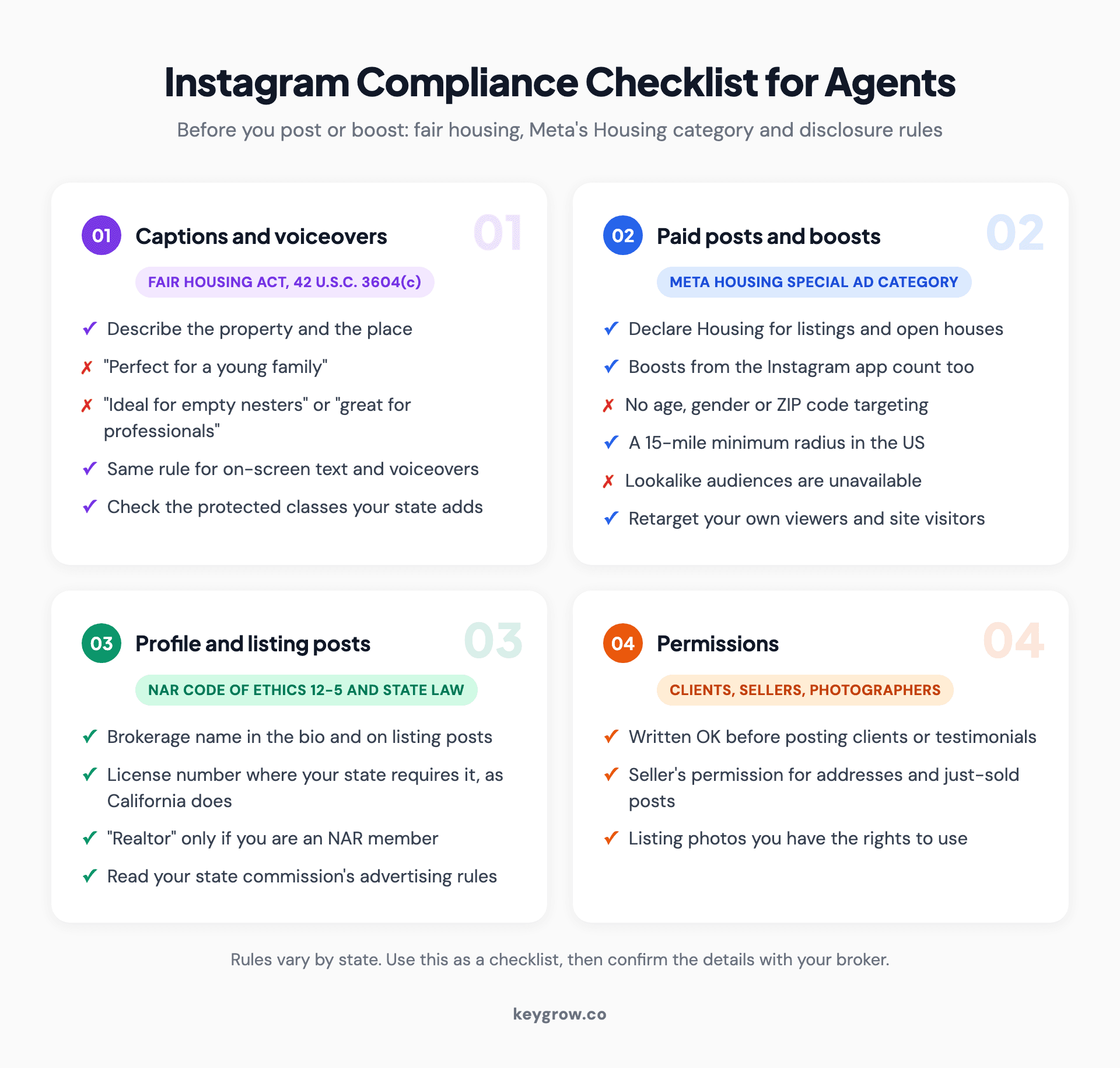
Checklist grid for real estate agents before posting or boosting on Instagram: captions that describe the property rather than the buyer, paid posts declared in Meta's Housing category with no age, gender or ZIP targeting and a 15-mile minimum radius, a profile that shows the brokerage name and license number where required, and written permission for client photos and testimonials.
In September 2025, HUD withdrew its 2024 guidance on how the Fair Housing Act applies to advertising on digital platforms. The statute is unchanged, and Meta still requires the Housing category.
Brokerage disclosure is the other rule agents trip on. NAR's Code of Ethics (Standard of Practice 12-5) requires REALTORS to disclose their firm's name "in a reasonable and readily apparent manner" when they advertise in any medium. State license law often asks for more. California's Department of Real Estate, for example, applies its first-point-of-contact rules to social media, which means your license number and your responsible broker's name. Your state commission's advertising rules take ten minutes to read, so read them before anyone files a complaint.
How do you know Instagram is working?
Count local conversations, booked appointments and closings sourced to Instagram in your CRM. Followers and likes tell you very little about income.
Vanity-metric reporting is the industry's biggest scam, and social media is where it is easiest to run. Follower counts drift upward almost by themselves, and reach looks impressive in a chart. Neither has ever paid a mortgage.
Here's the reality: a large share of an agent's business comes from people who already know them. NAR's 2025 Profile of Home Buyers and Sellers found that 43% of buyers used an agent they found through a referral, per a Virginia REALTORS summary. A follower three states away who likes your kitchen Reels won't hire you or send anyone your way.
Open every monthly report with these numbers:
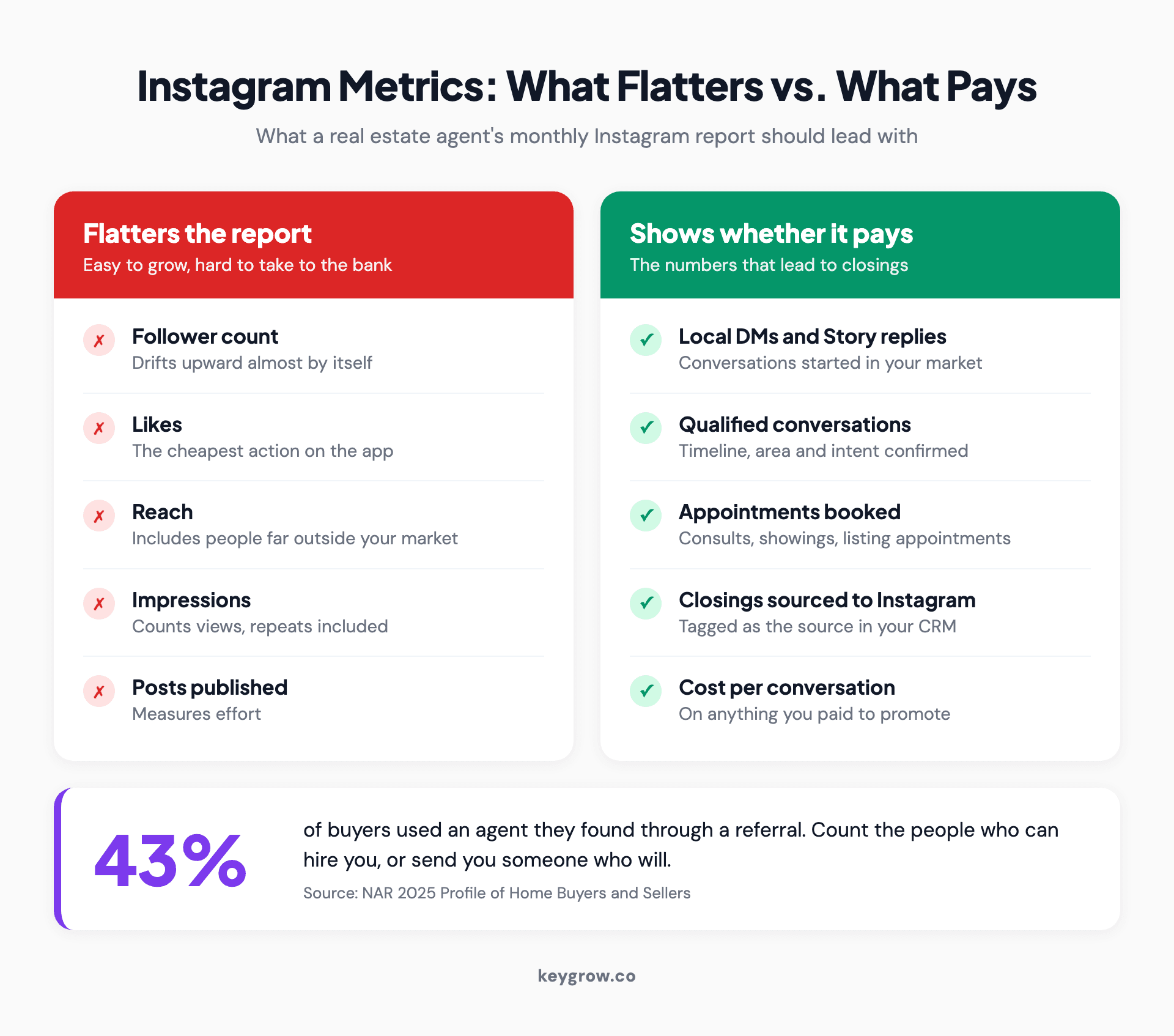
Comparison cards of Instagram metrics for real estate agents: followers, likes, reach, impressions and post count flatter a report, while local DMs, qualified conversations, booked appointments, closings sourced to Instagram and cost per conversation show whether it pays, alongside NAR's 2025 finding that 43% of buyers found their agent through a referral.
Instagram Insights is for diagnosis: sends and saves show which posts deserve a sequel or a boost. Judge the channel itself on conversations and appointments over 90 days, because one month is too small a sample.
When Instagram is the wrong channel
If you can't post steadily for 90 days, or your clients simply aren't on Instagram, your hours will pay back better somewhere else.
An account that goes quiet in week five looks worse than no account, and those hours would do more as calls to past clients. The same goes for niches where buyers aren't scrolling Reels, like rural land, commercial property, or a seller base that answers the phone but never opens the app.
If you need appointments this month, the person typing "realtor near me" into Google is further along than anyone watching a kitchen tour, and search ads or a well-kept Google Business Profile reach them faster. Our guide to digital marketing for real estate shows where Instagram fits alongside search and your website.
You may not need help at all. One agent with a phone and two spare hours a week can run this whole playbook. Bring in a team when those hours are worth more than the fee, or when you are 90 days in and still can't tell what's working.
FAQs
Is Instagram good for real estate agents?
Yes, if your clients are on Instagram and you can post steadily for 90 days. Reels reach local people who don't follow you yet, and Stories keep past clients thinking of you. For appointments this month, search ads work faster.
How often should real estate agents post on Instagram?
Three or four feed posts a week, mostly Reels, plus Stories on most days is a pace most agents can hold. Two useful Reels a week for a year will do more than daily posting for a month.
Do hashtags still matter for real estate posts on Instagram?
Less than they used to. Since December 2025, Instagram caps each post and Reel at five hashtags, and search leans on the words in your captions, bio and name field.
Can real estate agents get leads from Instagram?
Yes, mostly through DMs and the link in your bio. Expect warm conversations more than form fills, so reply fast and tag each one in your CRM.
Should real estate agents run Instagram ads?
Yes, once a post has started conversations for free. Listing and open house ads must run in Meta's Housing special ad category, which removes age, gender and ZIP code targeting and requires a radius of at least 15 miles in the US. You can still retarget people who watched your videos or visited your landing page.
Should I use my personal account or start a new one for real estate?
Convert your personal account to a professional one if it already holds your local friends, neighbors and past clients, because referrals come from that sphere. Start fresh only if your feed has posts you would not want a client to see.
Your first thirty days
Don't hold your first posts for the landing page. If it isn't ready, point the link at a short contact form and swap the real page in during week two.
On day 30, count conversations started, conversations qualified, appointments booked, and anything under contract. Zero conversations means the content needs to change. Conversations that go nowhere point at your replies or your landing page. If both are working, you have found the post worth putting money behind.
If you would rather someone else ran the filming and the ads, our social media marketing runs month to month. Or tell us about your market, and we will tell you honestly whether Instagram is where your next client is.


