


The boosted listing post is the Facebook ad agents run most, and it's mostly an ad for the agent. In the US, a just-listed ad has to reach everyone within at least 15 miles of the house. Very few of those people are shopping for that house. A lot of them own one.
That's the honest starting point for Facebook ads for real estate. Meta's Housing rules stop agents and brokers from aiming at buyers by age, ZIP code or lookalike audience, so the platform is weak at finding the one buyer for one listing. It's good at starting conversations with homeowners nearby and with people who already watched your videos or visited your site. Build the campaign for that job, call every lead within the hour, and judge it by what a signed listing costs.
Below is the build in seven steps, with annotated ad examples you can adapt and the two ad sets to launch first. It's written for agents and brokerages. If you buy houses rather than list them, our motivated seller Facebook ads walkthrough covers that campaign.
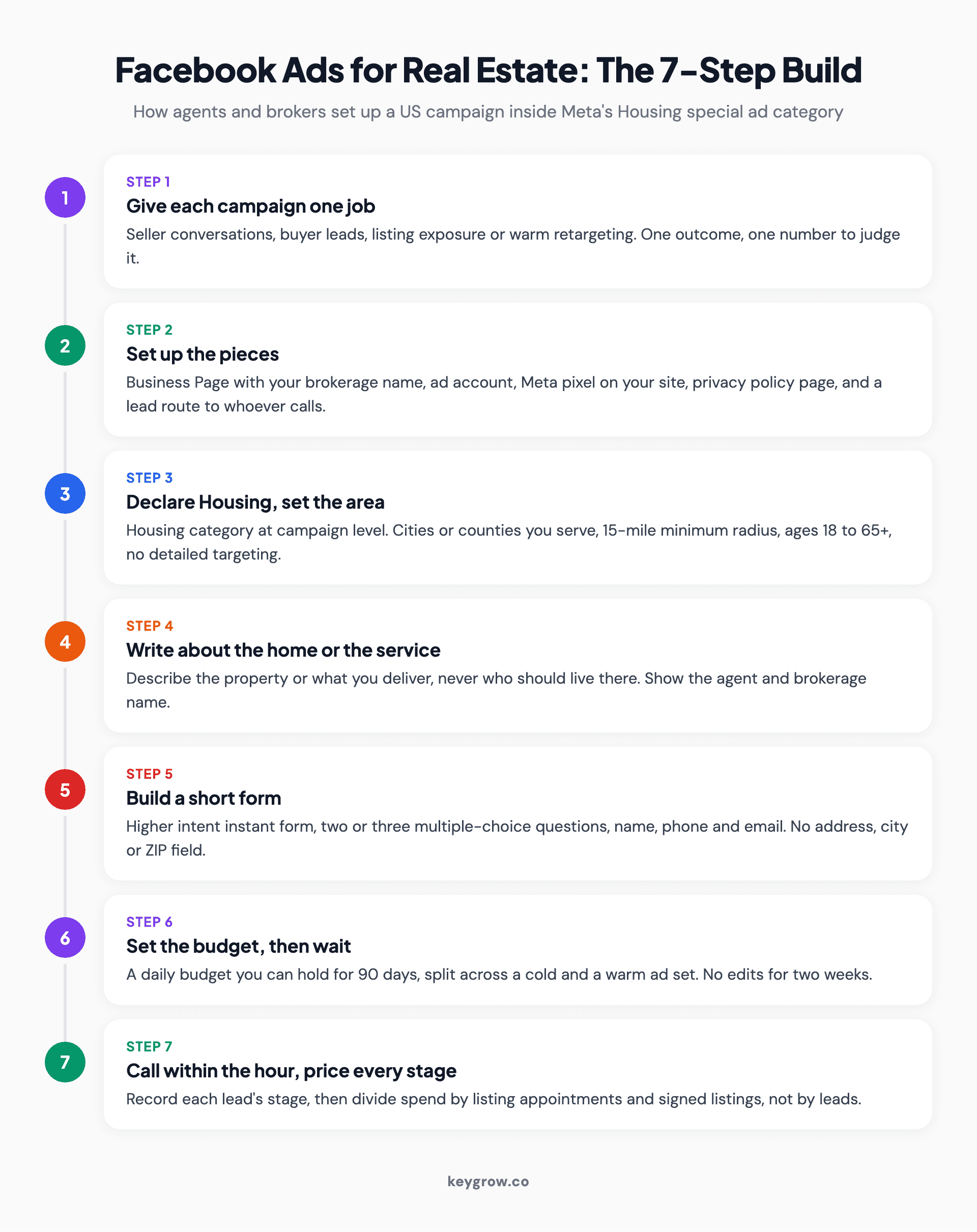
Seven-step process for building Facebook ads for real estate agents and brokers in 2026: give each campaign one job, set up the Page, ad account, pixel and privacy policy, declare the Housing special ad category with a city or county area and a 15-mile minimum radius, write ads that describe the home or the service, build a short instant form with no address field, set a daily budget and leave it for two weeks, then call every lead within the hour and price each stage up to a signed listing.
What can a real estate ad on Facebook still target?
Location, broad interests from Meta's approved list and your own custom audiences. Age, gender, ZIP codes, exclusions and lookalikes are off the table for US housing ads.
Facebook ads for real estate are paid placements on Facebook, Instagram and Meta's other apps that promote a listing, an open house or an agent's services. In the US, all of them run in Meta's Housing special ad category, and that category sets the audience rules.
According to Meta's developer documentation, ages are fixed at 18 through 65+, and you can't choose a gender. Any city, address or dropped pin has to cover at least a 15-mile radius in the US and Canada. ZIP codes and neighborhoods aren't supported, and location exclusions aren't either. Behavior and demographic targeting are not permitted, interests must come from an approved list, lookalike audiences are unavailable and saved audiences get removed. Custom audiences still work, with customer lists checked for eligibility.
Several pages ranking for this keyword still give advice that a US housing campaign can't follow:
| Advice you'll still find | What a US housing campaign allows |
|---|---|
| Target a 1 to 3 mile radius around the open house | 15-mile minimum radius around any point |
| Target ages 28 to 55 for first-time buyers | Ages 18 to 65+, fixed |
| Build a lookalike of past clients | Lookalikes unavailable |
| Target veterans or likely movers | Behavior and demographic targeting not permitted |
| Exclude renters or certain ZIP codes | No exclusions of any kind |
| Retarget site visitors and video viewers | Still allowed through custom audiences |

Aerial view of a suburban neighborhood with rows of houses and curving streets, the kind of area a 15-mile Housing radius around one listing covers many times over.
So the targeting won't sort people for you. Your ad copy and your form have to, and the rest of this build is about those.
Step 1: Give each campaign one job
Pick one outcome per campaign, match the objective to it, and decide up front which number will judge it. Mixed jobs produce numbers you can't read.
The common real estate jobs map to Meta's objectives like this:
| Job | Objective | Where the lead happens | Judge it by |
|---|---|---|---|
| Seller conversations | Leads | Higher intent instant form | Cost per listing appointment |
| Buyer leads | Leads or Traffic | Landing page with listing alerts | Cost per buyer consultation |
| Just listed and open house | Traffic or Awareness | Listing page | Showings, plus seller leads it surfaces |
| Warm retargeting | Leads | Instant form | Cost per appointment |
| Agent recruiting (brokers) | Leads, declared as Employment | Instant form or careers page | Cost per recruiting interview |
The listing row is the one agents get wrong. A just-listed ad still earns its keep: your seller sees their home marketed, and some buyers will click. But most of the people it reaches within 15 miles are homeowners, and some of them are wondering what their own place would sell for. Write the ad with them in mind too (Step 4 shows how). If you mostly want to boost posts that already do well, our Instagram marketing for real estate agents playbook covers that side.
Recruiting is the odd one out. A job ad for agents isn't a housing ad. It belongs in Meta's Employment special ad category, which carries its own audience limits.
Step 2: Set up the pieces before the campaign
You need a business Page, an ad account, the Meta pixel on your site, a privacy policy URL and a plan for where leads land. Set these up once and every later campaign is faster.
- A business Page that shows your brokerage name. NAR's Standard of Practice 12-5 asks REALTORS to disclose their firm's name in any advertising, and many state license laws add a license number. Check your state commission's advertising rules.
- An ad account inside a business portfolio, with a payment method attached.
- The Meta pixel on your website and any landing pages. Without it, you can't build the site-visitor audience Step 3 relies on.
- A privacy policy page. Instant forms require a link to one.
- A lead route. A CRM integration, or at minimum email or text alerts to whoever calls the leads.
Brokers have one extra decision: who owns the assets. Keep the business portfolio, the Page and the pixel under the brokerage and give agents access as people or partners. Video viewers and site visitors build up into audiences over months. When an agent leaves, those audiences should stay with the firm.
Step 3: Declare Housing and set the audience
Turn on the Housing category when you create the campaign, pick the cities or counties you serve, and leave detailed targeting empty. Put warm custom audiences in a separate ad set.
At campaign level, switch on special ad categories, choose Housing and confirm the country. Meta may reject a housing ad that isn't declared, and repeated problems can restrict the ad account. If you're unsure whether something counts, declare it. Home valuations, buyer guides and agent services all promote a housing opportunity or service.
Then build two ad sets:
- Cold ad set. Location set to the cities or counties you actually work in. Age and gender stay at Meta's locked defaults. No detailed targeting at all. A broad audience lets Meta find the people who respond to the ad, and the ad copy decides who that is.
- Warm ad set. Custom audiences only: people who watched at least half of one of your videos, engaged with your Page, or visited your site in the last 30 to 60 days. This is the closest thing to targeting you have left, and it's often the cheapest lead in the account.
Brokers with several offices often want one ad set per office. That only works if each ad set produces leads every week. Meta says an ad set usually needs about 50 results in a week to leave its learning phase, which a local seller campaign rarely reaches. With a modest budget, one cold ad set covering every office area learns faster, and the ad copy can name the towns.
Step 4: Write the ad about the home or the service
Describe the property, the neighborhood's features or what you'll do for the reader. Never describe who should live there, and show your brokerage name.
The Fair Housing Act's advertising section, 42 U.S.C. 3604(c), makes it unlawful to publish an ad about selling or renting a dwelling that indicates a preference based on race, color, religion, sex, handicap, familial status or national origin. Lines like "safe street for raising kids," "perfect for retirees" or "great bachelor pad" each describe a person, not a house. Meta's ad policies add their own rule against copy that asserts or implies the viewer's personal attributes, so "Struggling with your mortgage?" fails too.
The three ads below follow both rules.
Ad 1, the seller conversation (cold ad set). "Thinking about selling in [City] in the next year? I'll send you a written price range for your house, based on what sold near you in the last 90 days, plus what buyers in your price band are asking about right now. No listing agreement and no pressure. [Name], [Brokerage]." Headline: Get a price range for your house. Button: Learn more.
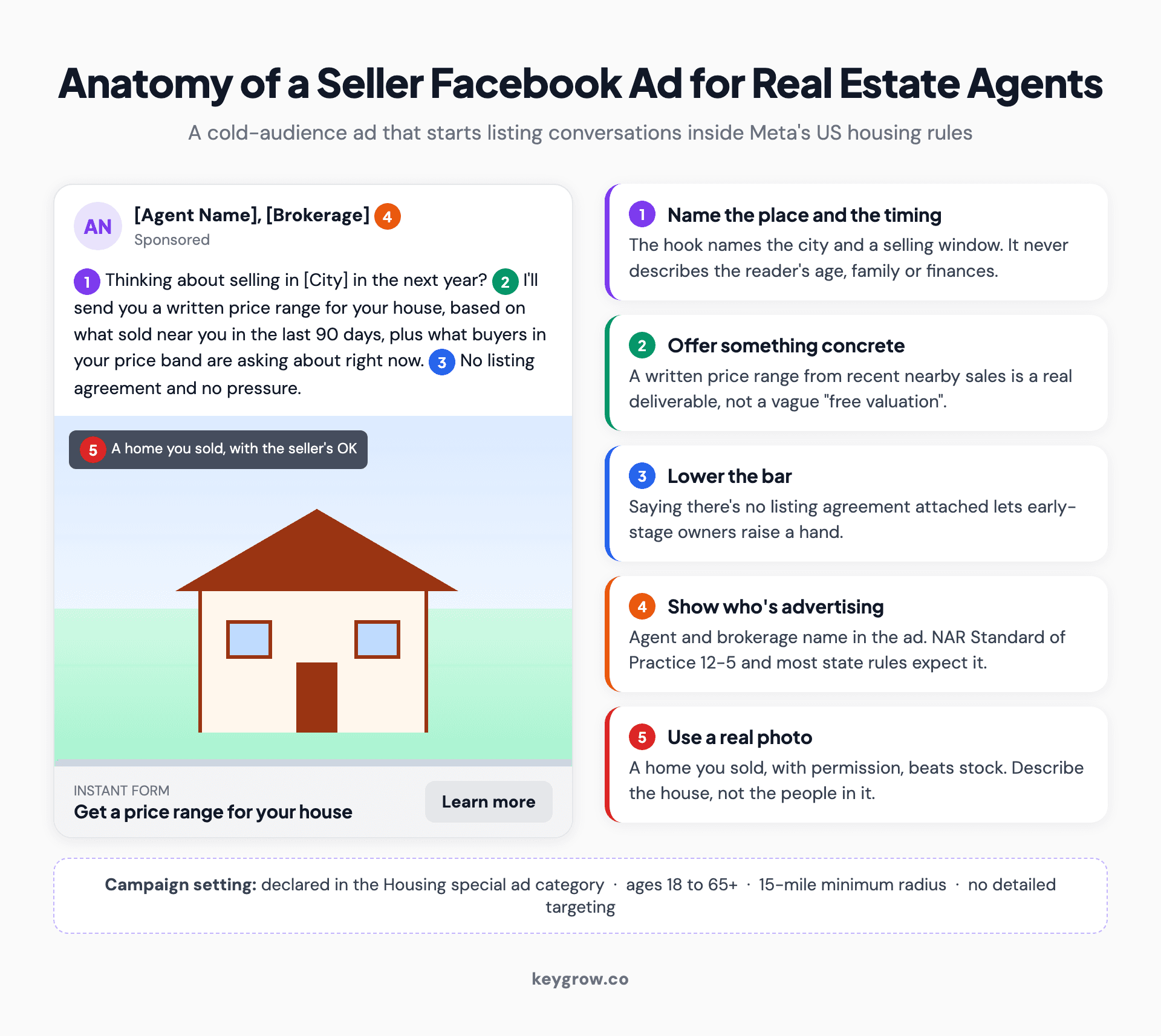
Annotated mock-up of a real estate seller Facebook ad: the first line names the city and the timeframe without describing the reader, the offer is a concrete written price range based on recent nearby sales, the line removing commitment lowers the bar, the agent and brokerage names satisfy disclosure rules, the photo is a home the agent sold with the seller's permission, and the ad is declared in the Housing special ad category.
Ad 2, the just-listed ad written for the neighbors (cold ad set). "Just listed on Maple Avenue: 3 bedrooms, 2 baths, new roof in 2024, fenced yard, $415,000. Open house Saturday, 11 to 2. Live nearby and wondering what your place would list for? This one's a good benchmark, and I'm happy to walk you through how we priced it. [Name], [Brokerage]." Headline: Open house Saturday, 11 to 2. Button: Learn more, to the listing page.
The address, price and features are illustrations. Get your seller's written OK to advertise the listing, ideally in the listing agreement.
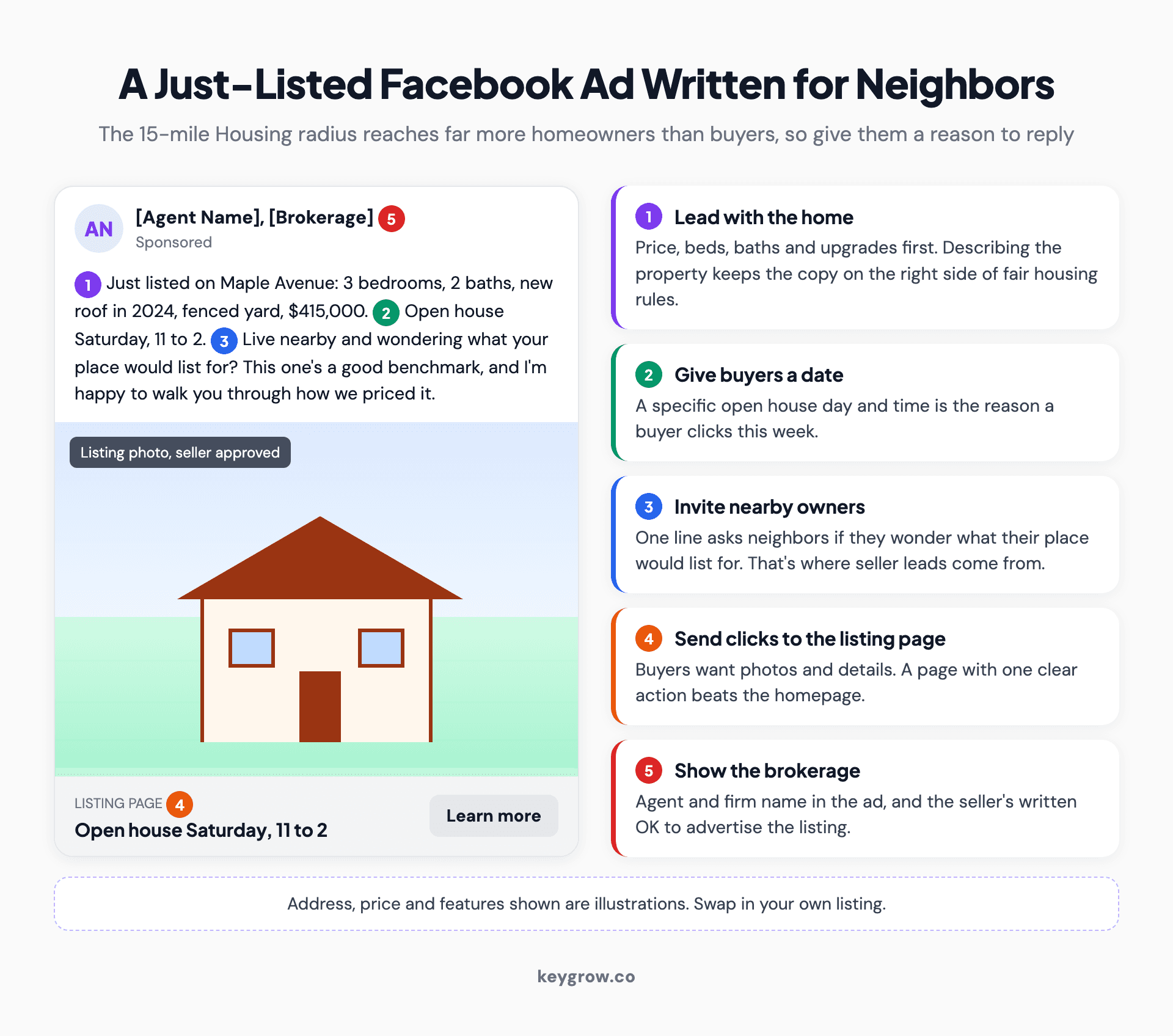
Annotated mock-up of a just-listed Facebook ad for real estate written for neighbors as well as buyers: price, beds, baths and upgrades lead the copy so it describes the home, the open house date and time give buyers a reason to act, a second line invites nearby owners to ask how the home was priced, the button goes to the listing page, and the brokerage name appears in the ad.
Ad 3, the warm retargeting video (warm ad set). A 45-second clip, you to camera: "Three things I check before I price a house in [Neighborhood]." Talk about recent sales, condition and timing. Headline: Book a 15-minute pricing call. Button: Book now, to the same short form. These viewers already know your face, so the ad can ask for more.
For other formats that suit a local business, like carousels and review cards, see these examples of Facebook ads.
Step 5: Build the form, and leave the address out
Use a Higher intent instant form with two or three multiple-choice questions and name, phone and email. US housing forms can't ask for the property address.
Meta's lead ads rules for housing ads based in or aimed at the US or Canada bar fields for age, gender, marital status and location information, including street address, city and ZIP code. Custom questions can't recreate them. At least one guide ranking for this keyword lists the property address as the first field on a seller form. That form breaks Meta's rule.
Use these questions instead:
- When are you thinking of selling? In the next 3 months / 3 to 6 months / 6 to 12 months / Just curious.
- Will you also be buying a home? Yes, nearby / Yes, elsewhere / No / Not sure yet.
- Is your home listed with an agent right now? No / Yes.
Question 2 matters for agents. A seller who's also buying nearby could be two transactions. Point "Yes" on question 3 at a polite closing screen with conditional logic. Someone under contract with another agent should talk to that agent. Meta notes that conditional logic can raise cost per lead, and that's a trade worth making here.
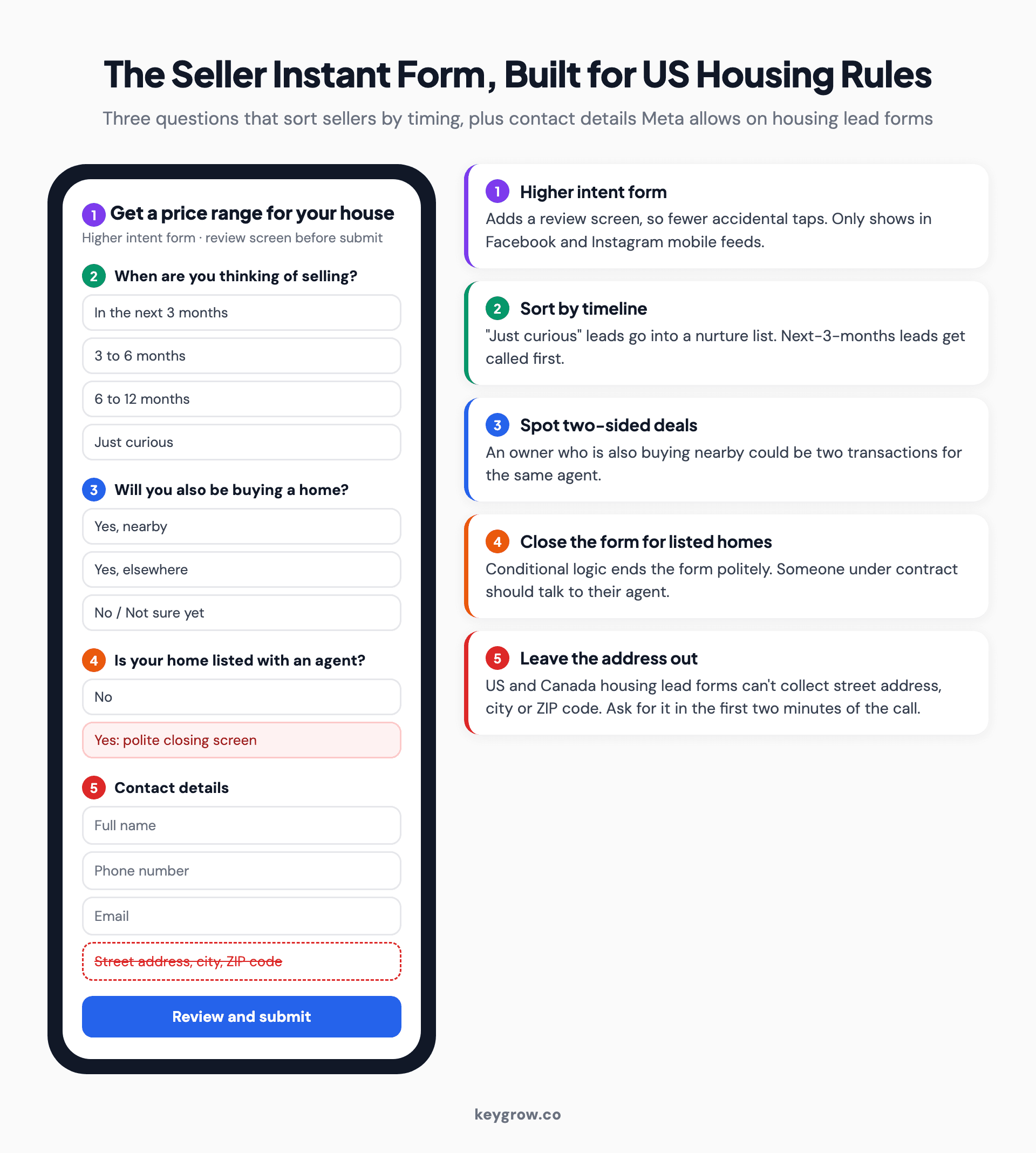
Phone-screen mock-up of a real estate seller instant form under Meta's US housing rules, with annotations: a Higher intent form with a review screen, three multiple-choice questions on selling timeline, whether the owner is also buying, and whether the home is already listed with a polite close for listed homes, contact fields limited to name, phone and email, and a note that street address, city and ZIP code fields are not allowed on US housing lead forms, so the address is collected on the first call.
For a home-value offer, you get the address in the first two minutes of the call. You'd be asking for it anyway.
When a landing page beats the instant form
Buyers are different. A buyer lead wants listings, and an instant form can't show them. Send buyer ads to a landing page with saved-search sign-up and one clear action, not your homepage and not a search page with 40 filters. Tag each ad's link with our UTM builder so the CRM knows which ad started the conversation.
The page matters more than most agents expect. Qualify Before You Buy, a real estate pre-qualification business, was sending paid search traffic to a homepage full of distractions. We built a single-focus landing page with a five-step form, and its conversion rate rose 85% within 4 weeks while bounce rate fell 40%. That was Google traffic, not Facebook, but a buyer tapping through from Instagram has even less patience.
Step 6: Set the budget, then leave it alone for two weeks
Start with one Leads campaign at a daily budget you can hold for 90 days, split between the cold and warm ad sets. Don't edit it in the first two weeks.
Here is our worked example. Every number in it is an assumption to swap for yours. An agent in a mid-size metro sets $40 a day, about $1,200 a month: $28 to the cold ad set and $12 to the warm one. Each ad set has its own budget, so the warm audience isn't starved by the bigger one.
For a benchmark, LocaliQ's 2026 data puts real estate leads campaigns at a $1.27 cost per click, a 9.95% conversion rate and $13.74 per lead, against $27.39 per lead across all industries. That category lumps together every kind of real estate advertiser, and a Higher intent form with three questions asks more of people than a newsletter sign-up. Our example plans on $30 per seller lead.
At 40 leads a month, the ad sets will show "Learning limited" in Ads Manager. That's normal for a local campaign. Every significant edit restarts learning, so batch your changes and make them once a week at most.
Step 7: Call within the hour, then price every stage
Call each lead during the same hour, record its stage in a CRM or spreadsheet, and divide spend by signed listings, not by leads.
A Facebook lead filled out a form between other things on their phone. An hour later, you're a stranger. Call while the ad is running, text once if nobody answers, then try twice more over the next two days. On the call, get the address, the timeline in their words and whether they're also buying.
Then record every lead's stage the same day: not reached, not selling, nurturing, listing appointment, listing signed, closed. Once you have enough volume, those stages can go back to Meta as quality signals, which our guide to Facebook ads for leads explains.
Here's 90 days of the worked example, every rate an assumption:
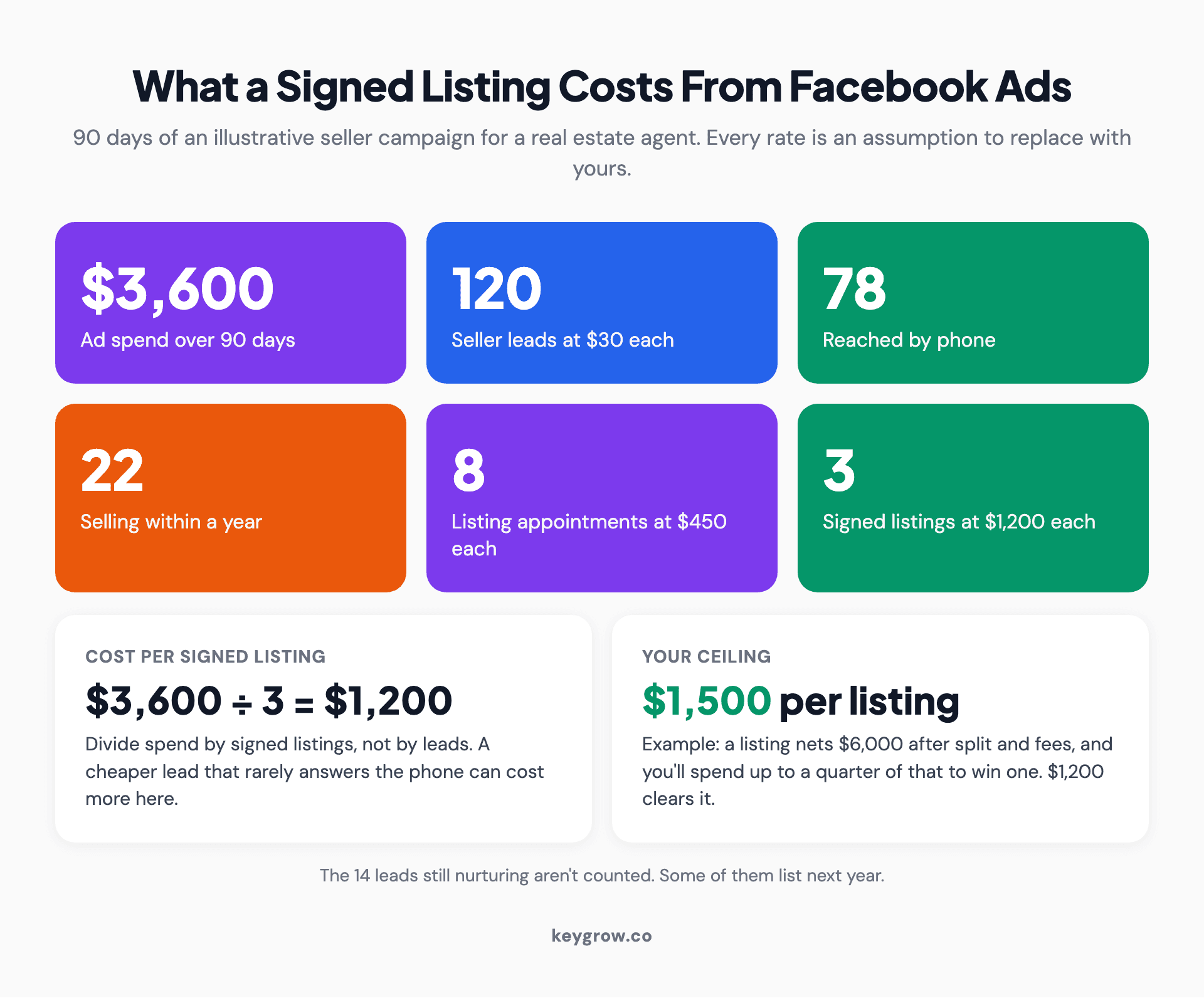
Ninety days of an illustrative real estate Facebook ad campaign shown as a stat strip: $3,600 in ad spend, 120 seller leads at $30 each, 78 reached by phone, 22 with a selling timeline under a year, 8 listing appointments at $450 each, and 3 signed listings at $1,200 each, compared against a ceiling of $1,500 per signed listing.
$3,600 buys 120 leads. The agent reaches 78, and 22 of those plan to sell within a year. Eight book a listing appointment and three sign. That's $30 per lead, $450 per appointment and $1,200 per signed listing.
Is that good? Set your own ceiling. Take what a listing nets you after your split and fees, and decide what share you'll spend to win one. If a listing nets $6,000 and you'll spend up to a quarter of that, the ceiling is $1,500, and this campaign clears it. The 14 nurturing leads aren't counted at all, and some of them will list next year.
If a monthly report on your Facebook ads opens with reach and engagement, ask why. Reach is mostly what a boosted listing buys, and it doesn't pay a commission. A $13.74 lead, the LocaliQ average, can still cost more per signed listing than a $30 one if fewer of them pick up the phone. The only number worth comparing is spend divided by signed listings.
Running Facebook ads as a brokerage
Own the ad assets centrally, give agents ad sets rather than their own accounts, keep recruiting under Employment, and only use catalog ads if you have a listings feed.

A residential street lined with tall leafy trees and brick houses set back behind lawns, the kind of market area a brokerage covers with one Housing ad set across several offices.
A brokerage running ads for 15 agents has problems a solo agent never meets. The first is identity. Run agent-branded ads as separate ads or ad sets inside the brokerage's account, with the agent and the firm name in each one. The agent gets the face time and the brokerage keeps the audiences.
Listing volume is the second. Meta's Advantage+ catalog ads for real estate pull listings from a home listing catalog and match them to people who viewed similar homes on your site. They earn the setup time for a brokerage with a steady listings feed and real site traffic. A solo agent with five active listings should skip them.
Recruiting ads run under Employment, not Housing, so give them their own campaign.
Then there's co-marketing. If a lender or title partner chips in on ads, RESPA Section 8 generally requires each side to pay its fair share of the cost. Check with your compliance lead before you split a single invoice.
We cover the brokerage setup in more detail on our page for social media marketing for brokerages.
When Facebook ads are the wrong spend
Skip paid Facebook if nobody can call within the hour, your sphere doesn't know you sell homes yet, or you only want listings in two small neighborhoods.
Start with the people who already know you. A new agent with 300 contacts who haven't heard the news should tell them first. It costs nothing and it often beats any cold ad, which is why our ranking of how to get real estate leads puts your own network in tier one.
If leads wait until the evening for a call back, you're paying for forms. Fix the follow-up first.
A tiny farm is a bad fit too. Want listings in two subdivisions and nowhere else? The 15-mile minimum spends most of the budget on people outside them, and mail will do better.
And if you need buyers who are ready this month, people searching "homes for sale in [City]" are further along than people scrolling a feed. Search ads catch them. For that goal, real estate agent PPC is usually the better first spend.
You don't need an agency to run any of this. One campaign, two ad sets, one form and a spreadsheet will carry a solo agent who answers the phone. Get help when the creative needs refreshing every few weeks and you don't have the hours, or when you need each signed listing traced back to the ad that started it.
FAQs
Do Facebook ads work for real estate agents?
Yes, when they're built to start conversations with homeowners and warm audiences rather than to find one buyer for one listing. US housing ads can't target by age, ZIP code or lookalike, so the copy, the form and a call within the hour do the sorting. Judge them by cost per signed listing.
How much should a real estate agent spend on Facebook ads?
Set the budget from your ceiling per signed listing, not from a monthly habit. A common test is $30 to $50 a day held for 90 days, since real estate leads take weeks to turn into appointments. Spend less than that and you may wait months for enough leads to judge.
Can you target home buyers by age, income or ZIP code on Facebook?
Not in the US. Housing ads fix age at 18 to 65+, remove gender choice, ZIP codes, exclusions and lookalikes, and widen any city or pin to at least a 15-mile radius. Behavior and demographic targeting are not permitted, so income-based targeting is gone too. Custom audiences of your own site visitors and video viewers still work.
Do real estate agents have to use the Housing special ad category?
Yes, for any ad promoting a home for sale or rent, or a real estate service, that is based in or aimed at the US. Meta may reject an undeclared housing ad, and repeated problems can restrict the ad account. Agent recruiting ads go under Employment instead.
What is the best Facebook ad for real estate agents?
For new business, a seller conversation ad that offers something concrete, like a written price range based on recent nearby sales, sent to a short instant form. For warm audiences, a short video of you answering a pricing question. Listing ads are worth running for your seller, but write them so neighbors who own homes have a reason to reach out too.
Should agents boost listing posts or build campaigns in Ads Manager?
Boosting is fine for a quick listing push, and it still has to run in the Housing category. For leads, build a campaign in Ads Manager, because it gives you the Leads objective, instant forms with qualifying questions, separate budgets for cold and warm ad sets, and cleaner reporting.
Launch the first two ad sets
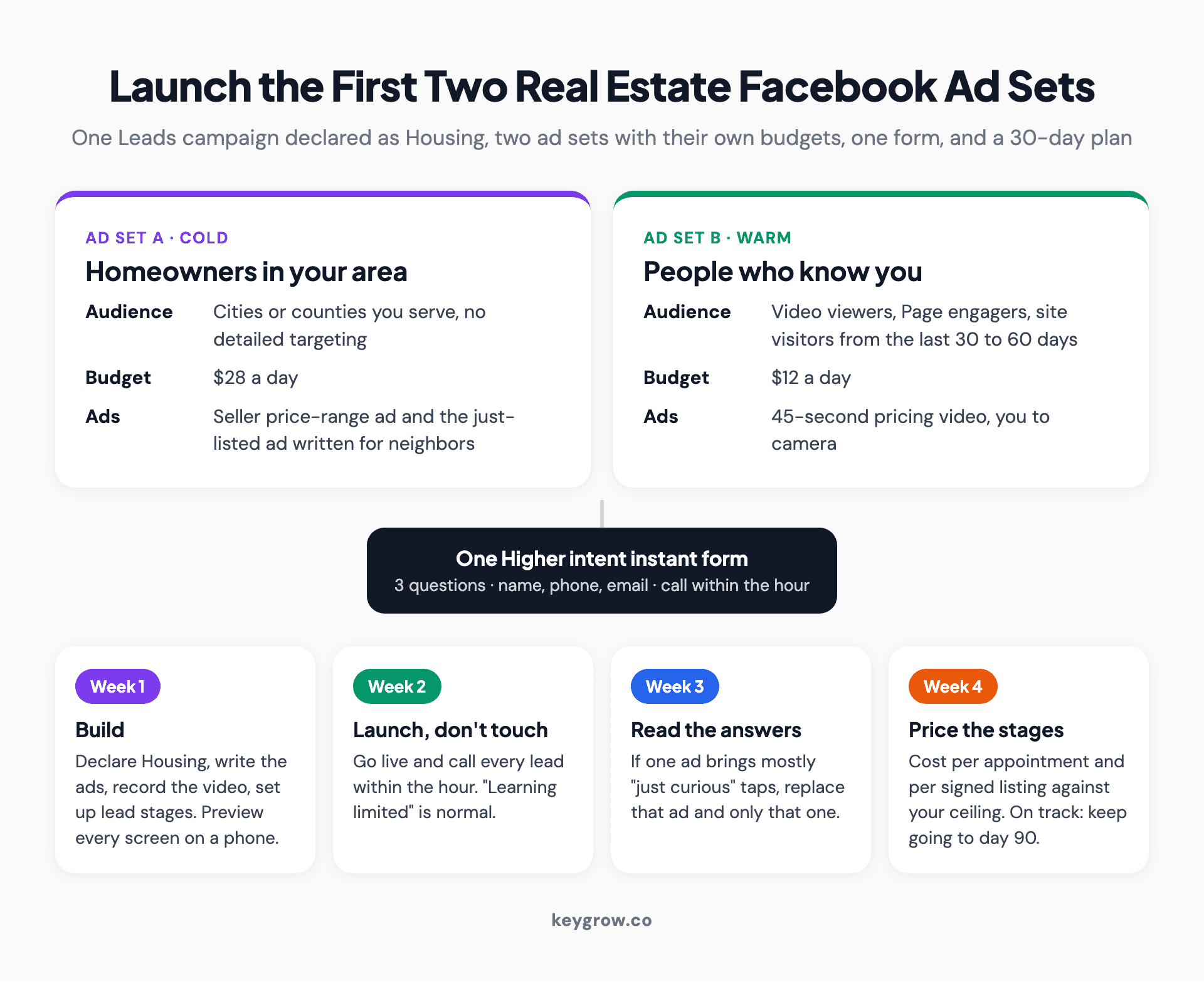
Thirty-day launch plan for the first two real estate Facebook ad sets: ad set A is cold, covering the cities served at $28 a day with the seller conversation ad and the just-listed ad, ad set B is warm, covering video viewers, Page engagers and site visitors at $12 a day with a pricing video, both feeding one Higher intent form; week 1 build and preview everything, week 2 launch and call every lead within the hour without editing, week 3 read the form answers and swap at most one ad, and week 4 price each stage against your ceiling per signed listing.
In week one, declare Housing, build the Higher intent form, write the seller ad and the just-listed ad for the cold ad set, record a 45-second pricing video for the warm one, and set up your lead stages. Preview every ad and form screen on your phone.
In week two, launch at $28 and $12 a day and call every lead within the hour. Leave the settings alone, however much "Learning limited" bothers you.
In week three, read the answers to question 1. If one ad brings mostly "just curious" taps, replace that ad and only that one.
At the end of week four, price each stage against your ceiling. If you're on track, keep going to day 90. If you aren't, fix the offer or the follow-up before you add budget.
If you'd rather hand it off, our team runs Facebook ads for real estate agents inside Meta's housing rules and reports on signed listings, month-to-month.