


The best examples of Facebook ads for a small business are not the famous ones. They are plain ads that do one job: show the result, put a face on the business, name one offer, or answer the question that stops someone from getting in touch. Below are eight of those patterns, each drawn as a labelled mock-up, with what Meta's own guidance says about why it works and a fill-in-the-blank version you can copy.
Most lists of Facebook ad examples fail a local business in three ways. The examples come from national brands with production crews and nine-figure budgets, which is useful if you also have a celebrity on retainer. Most of them show no results at all, so you are looking at a nice picture and taking someone's word that it worked. And many of the screenshots are years old, from before Reels, before 4:5 became the Feed standard, and before Meta changed how ads are built.
So every example here is an illustrative mock-up of a pattern, not a real ad, and none of them comes with invented results. The local businesses in them are placeholders. What carries over is the structure, and the structure is what you can steal.
What every Facebook ad example below has in common
Every ad that works has a clear page name, a first line that earns the next second, one focal point, a headline that states the offer, and a button that matches the next step.
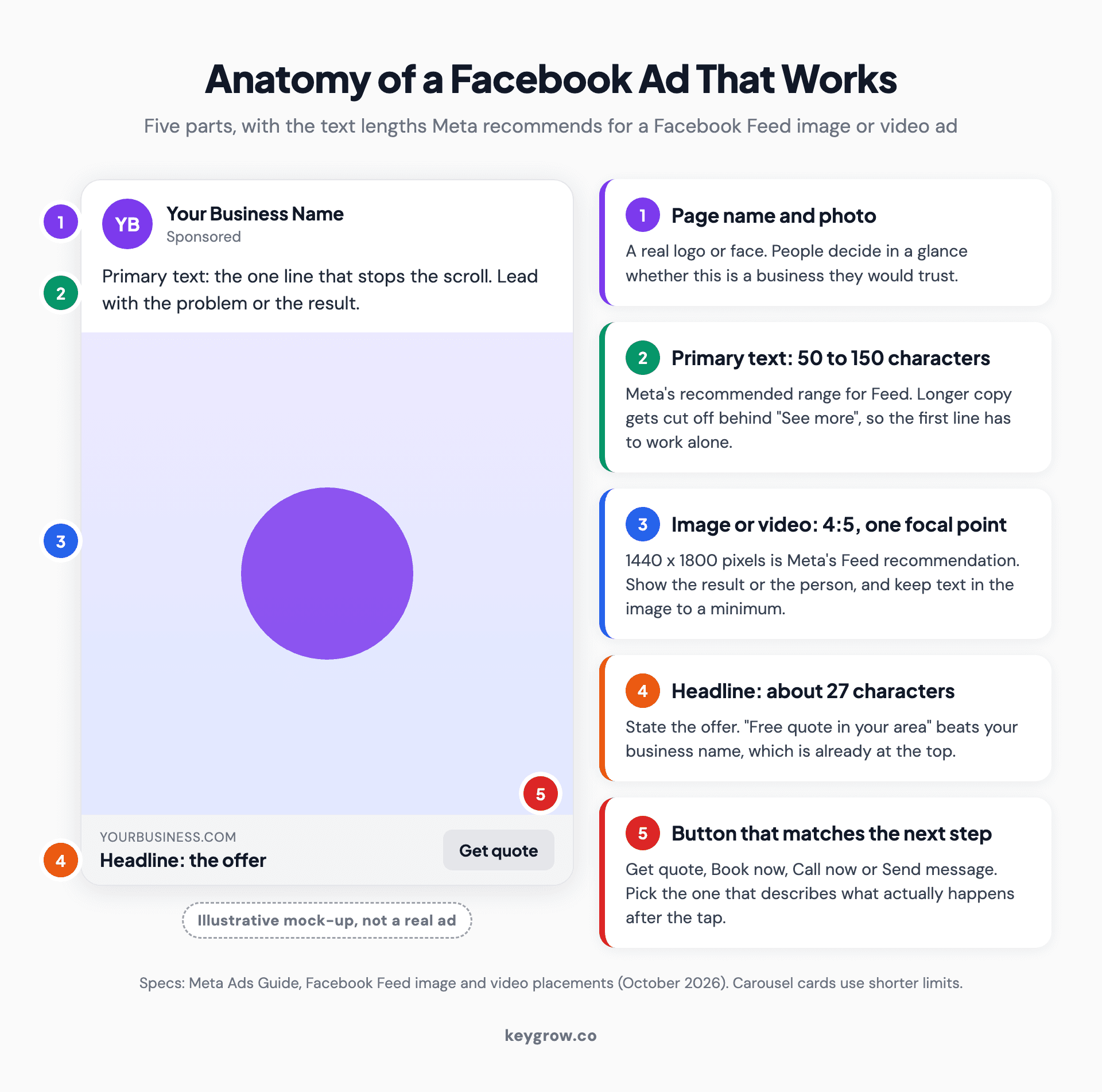
Annotated mock-up of a Facebook Feed ad with five numbered parts: page name and photo, primary text of 50 to 150 characters, a 4:5 image or video with one focal point at 1440 x 1800 pixels, a headline of about 27 characters that states the offer, and a call-to-action button such as Get quote that matches what happens after the tap.
The numbers come from Meta. For a Facebook Feed image ad, the Meta Ads Guide recommends primary text of 50 to 150 characters, a headline of 27 characters, and a 4:5 image at 1440 x 1800 pixels. Carousel cards get even less room: 80 characters of primary text and a 20-character headline per card.
The button list is longer than most people realize. Meta's call-to-action options include Get quote, Call now, Book now, Send message and Request time, alongside the generic Learn more. Pick the one that describes what happens after the tap. "Learn more" is the default for a reason, and the reason is that nobody had to think about it.
1. Before-and-after carousel
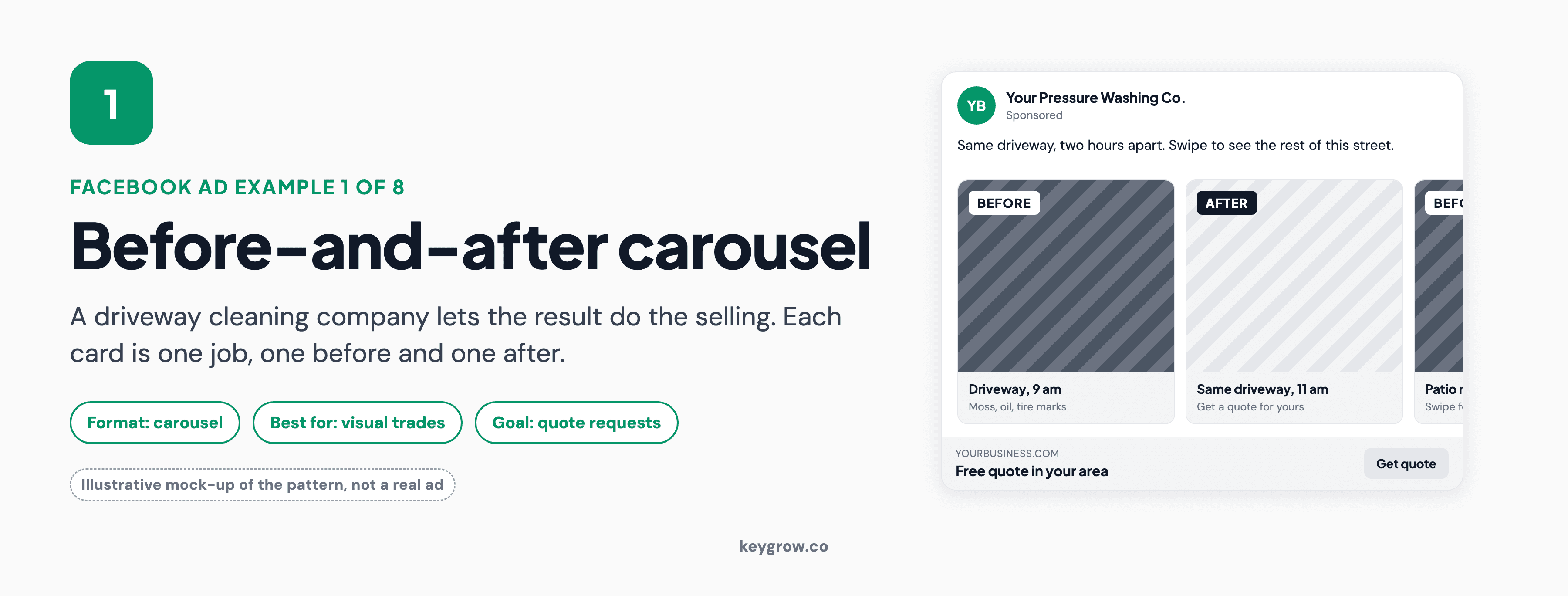
Facebook ad example 1 of 8, before-and-after carousel: an illustrative mock-up of a pressure washing company's carousel ad with a before card of a stained driveway, an after card of the same driveway two hours later, and a Get quote button.
A driveway cleaning company posts one job per card: the stained driveway at 9 am, the same driveway at 11 am, then the patio next door. The primary text is one line, "Same driveway, two hours apart."
It works because the viewer does not have to imagine anything. Meta's carousel format allows up to 10 images or videos in one ad, each with its own link, and Meta suggests it for showing details of a single service or a story that develops card by card. One setting matters here. Meta can reorder carousel cards by performance, and its own carousel page tells you to switch that off when the order tells a story. An "after" shown before the "before" is just a nice photo of concrete.
Where it breaks: staged or edited photos. People in your town know what a clean driveway looks like, and a filtered one reads as fake. Shoot both photos on the same phone, from the same spot, in similar light.
2. Owner-to-camera video
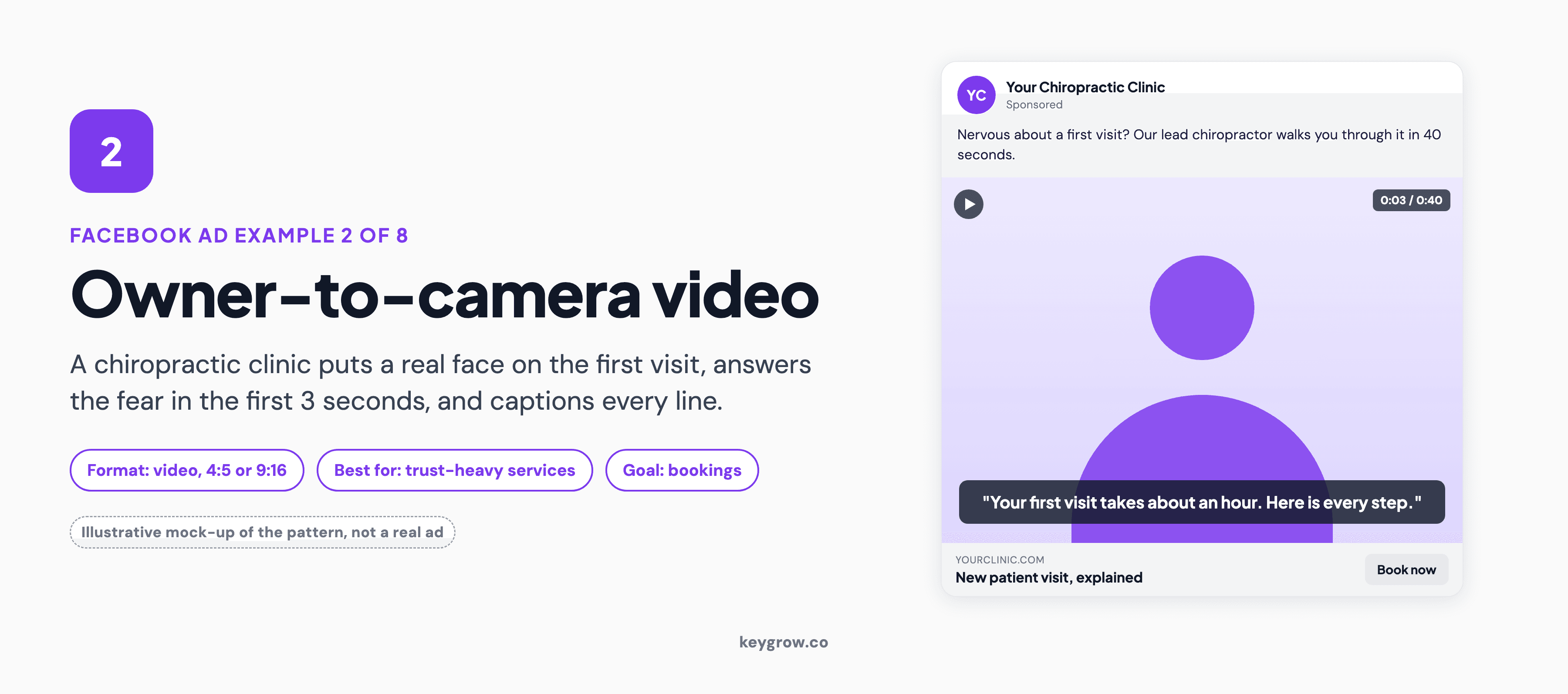
Facebook ad example 2 of 8, owner-to-camera video: an illustrative mock-up of a chiropractic clinic's video ad where the lead chiropractor explains the first visit, with a caption on screen in the first 3 seconds and a Book now button.
A chiropractic clinic films its lead chiropractor explaining, in 40 seconds, what happens at a first visit. The opening line on screen is the fear itself: nervous about a first visit?
This is the pattern Meta keeps pointing small businesses toward. Its creative tips for video include "put a face to your business," "highlight your message in the first 3 seconds," and "skip expensive production." The Ads Guide marks captions and sound as optional but recommended. Do both, and caption every line for anyone scrolling with the sound off.
It suits any service where a stranger meets you in person: clinics, law offices, home services where someone comes inside. People book faster when they have already heard you talk.
It falls apart when the script is read off a screen. Write three bullet points, not a paragraph, and film it until it sounds like you explaining it to a patient. Four takes is normal.
3. One-offer photo ad
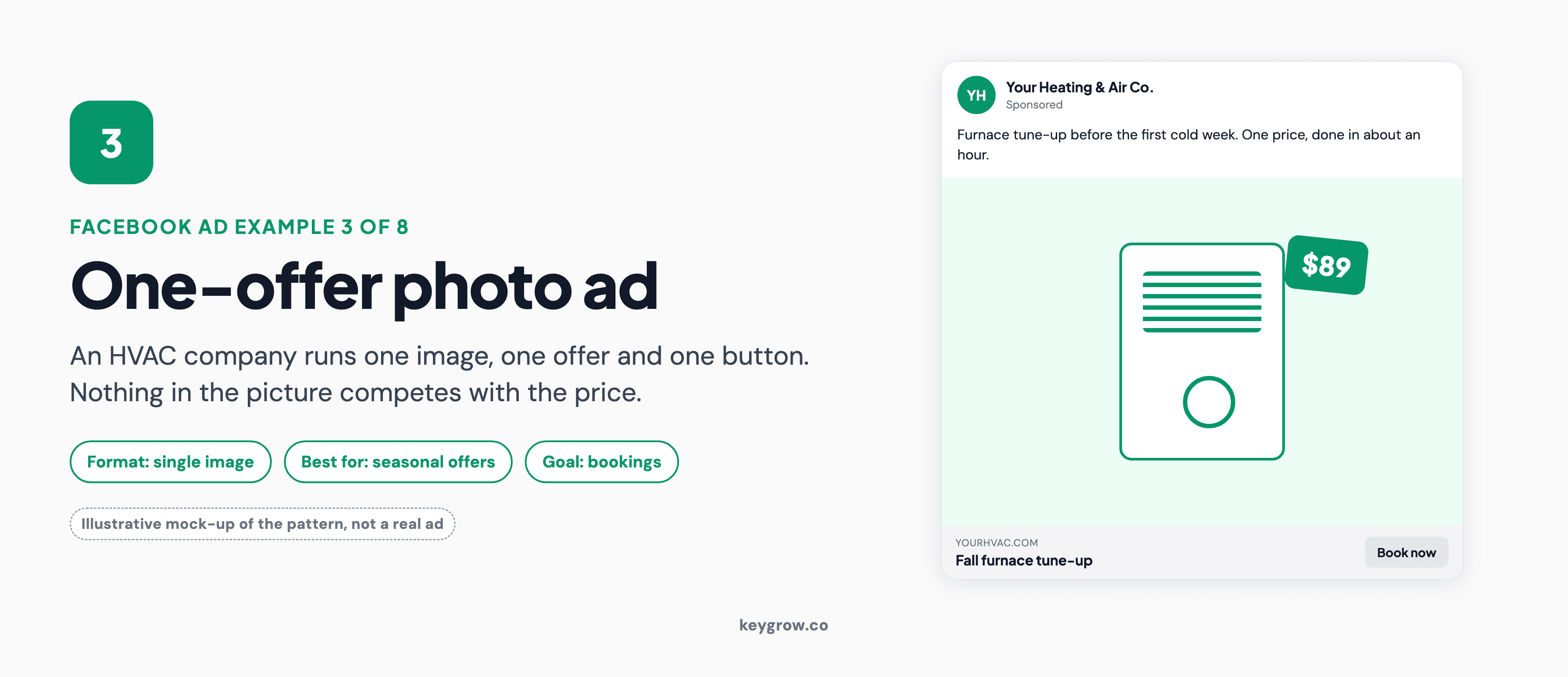
Facebook ad example 3 of 8, one-offer photo ad: an illustrative mock-up of an HVAC company's single image ad showing one furnace and one price tag for a fall tune-up, with a Book now button.
An HVAC company runs a single image with one furnace and one price for a fall tune-up. The text names the deadline (before the first cold week) and the time it takes. That's it.
Meta's best practices for photo ads say to have a single focal point and to keep text in the image short. Meta goes further than style advice here: it says too much copy is distracting and can lead to your ad being shown to fewer people. If you need to say four things, Meta's own suggestion is a carousel or a video instead.
This is the workhorse for seasonal services with a fixed price: tune-ups, gutter cleaning, a first exam, a spring cleanup. The price in the mock-up is a placeholder, so use your real one and keep it visible on the page the ad links to.
The usual mistake is a discount with no reason. "20% off" on its own looks like a business that needs the work. "Before the first cold week" gives the offer a reason to exist.
4. Review card ad
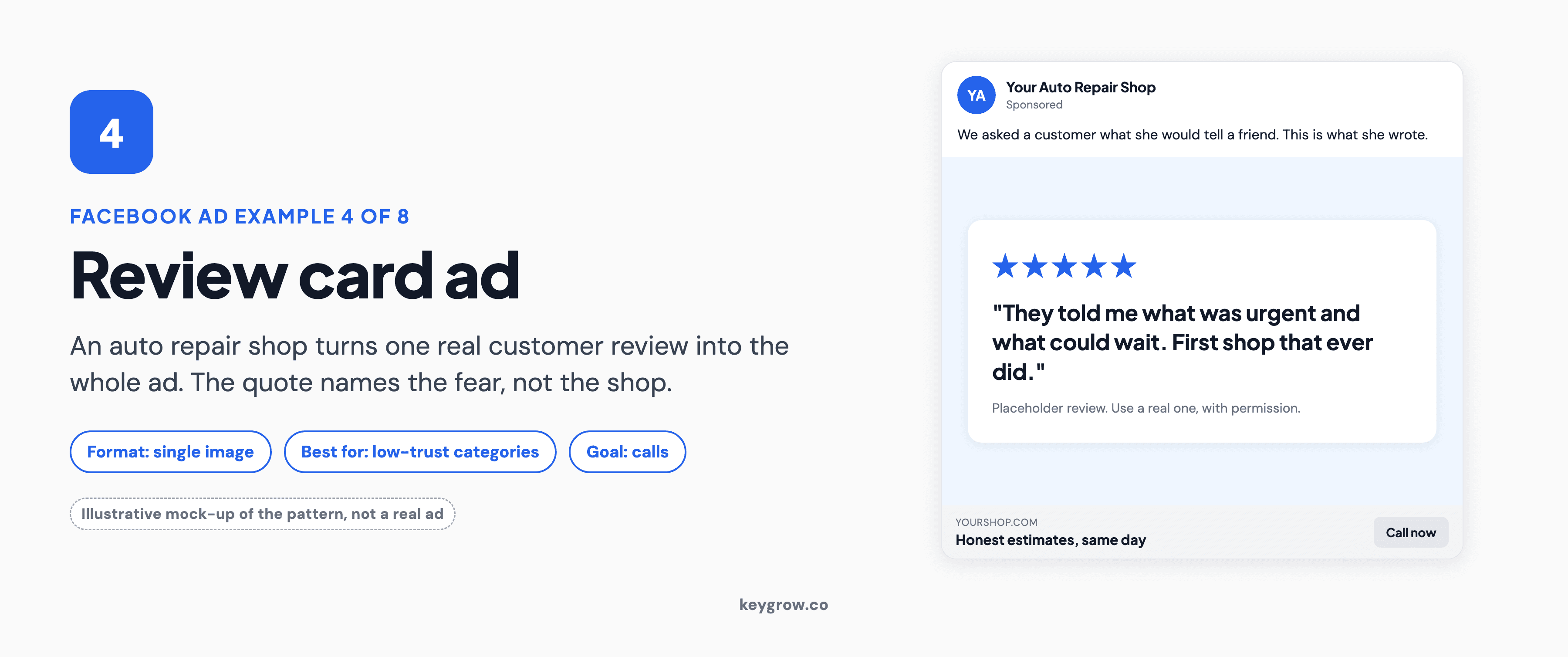
Facebook ad example 4 of 8, review card ad: an illustrative mock-up of an auto repair shop's image ad built from one five-star customer review about honest estimates, marked as a placeholder, with a Call now button.
An auto repair shop takes one real customer review and makes it the whole image: "They told me what was urgent and what could wait." The primary text explains where it came from.
The quote does the selling because it names the fear (being upsold) instead of praising the shop. Pick reviews that describe what was different, not reviews that just say "great service." Meta's photo guidance also says to show people benefiting from what you sell rather than the product alone, and a customer's own words are the closest a still image gets to that.
Two rules. Use real reviews only, with the customer's permission, and never edit the wording beyond trimming. Some professions also have their own rules on testimonials, so a law firm or medical practice should check its licensing rules before running one.
Where it breaks: a collage of six reviews in small type. One review, big enough to read on a phone, beats a wall of stars.
5. Lead ad with a filter question
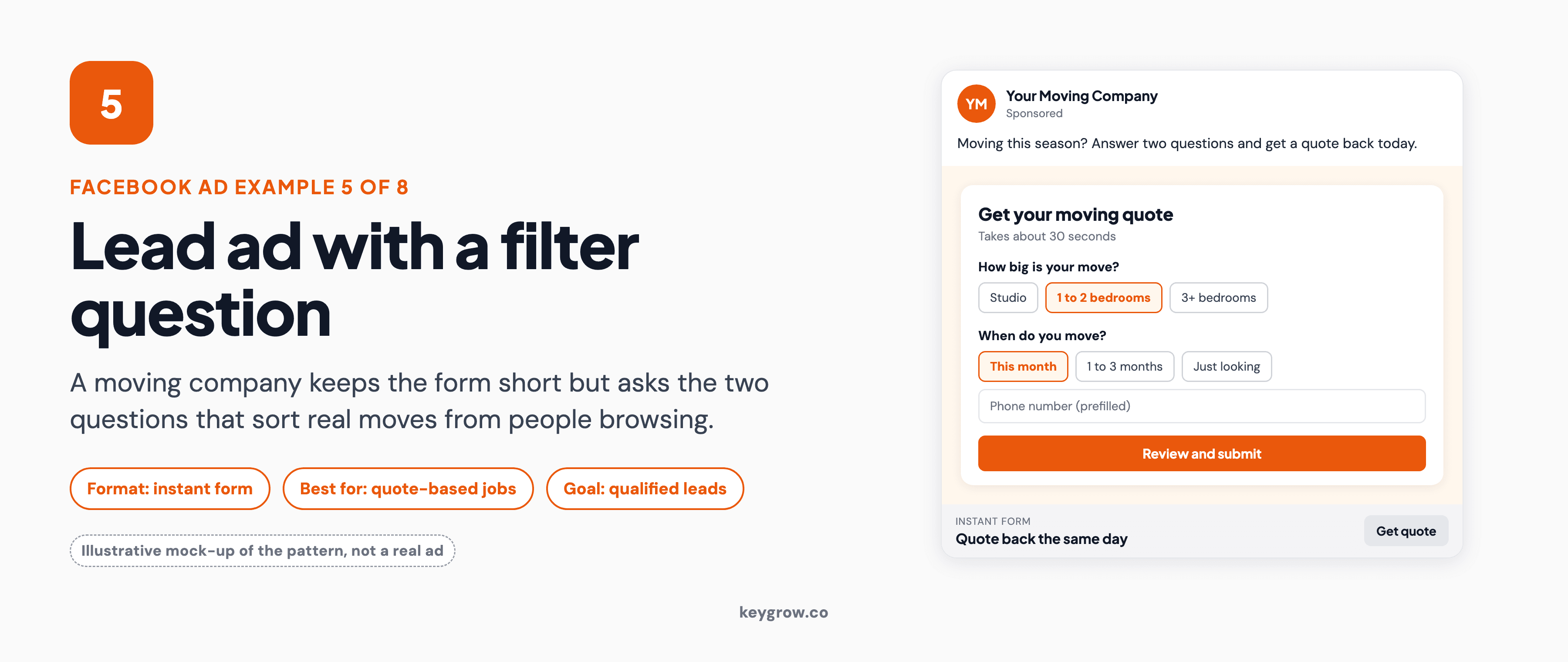
Facebook ad example 5 of 8, lead ad with a filter question: an illustrative mock-up of a moving company's instant form asking how big the move is and when it happens, including a just looking option, with a Get quote button.
A moving company uses an instant form so nobody has to leave Facebook, but adds two questions: how big is the move, and when. One of the timing answers is "Just looking."
That option is the point. A prefilled form takes seconds to send, which is why cheap leads are often the ones that never answer the phone. The filter questions let the person who is three months out say so, and tell you who to call first. Meta's Higher intent form type adds a review screen before submitting, which slows the casual tappers down a little more.
We cover the full setup, form types and the math on what a lead is worth in our guide to Facebook ads for leads.
Don't stretch it to six questions. Every field you add costs leads. Two questions that change who you call first are enough.
6. Message-us ad
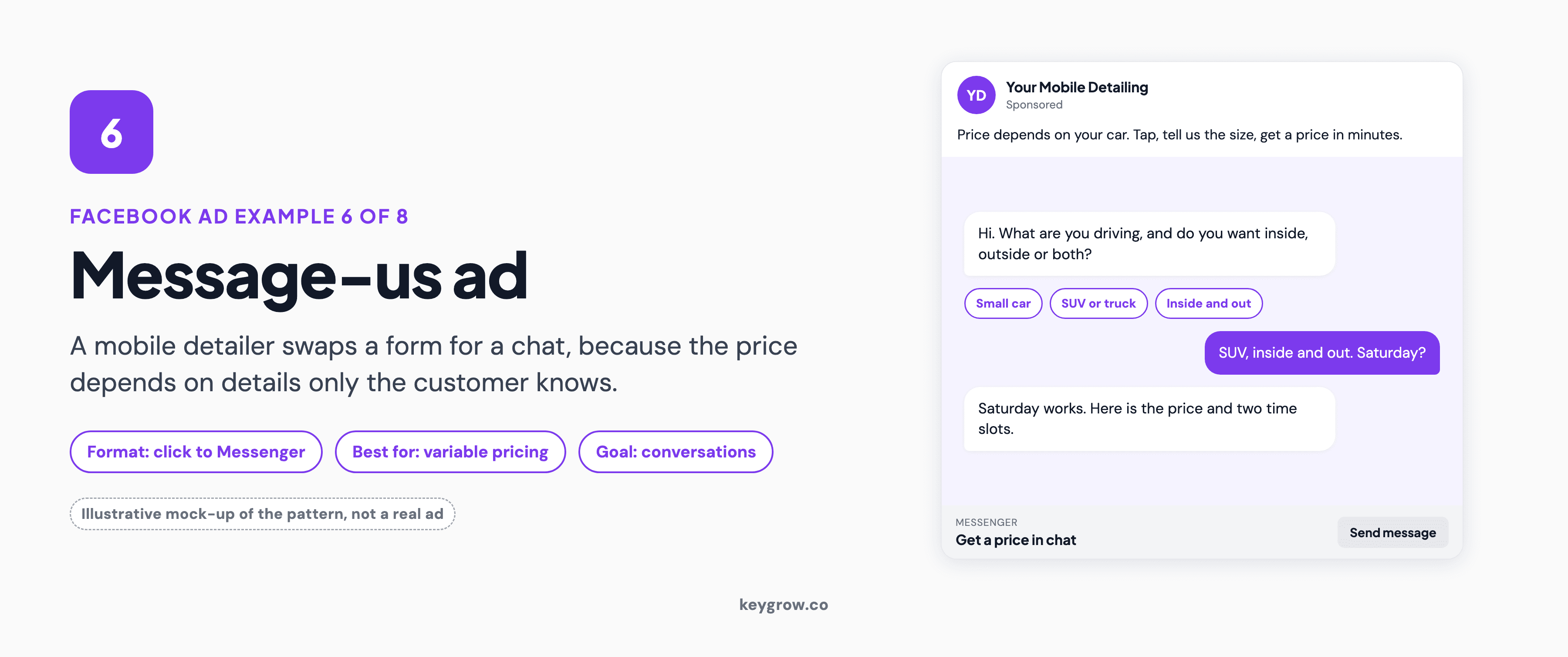
Facebook ad example 6 of 8, message-us ad: an illustrative mock-up of a mobile car detailing business's click-to-Messenger ad where the customer picks a vehicle size and gets a price and time slots in chat, with a Send message button.
A mobile detailer runs an ad with the Send message button. The primary text admits what most service businesses hide: the price depends on your car. Tap, say what you drive, get a price.
For businesses with variable pricing, a chat beats a form because the customer can give the details that set the price, and you can answer with a number instead of "we'll be in touch." It also feels lower stakes to the person sending it. Asking a question is easier than requesting a quote.
The catch is speed. A message ad is a promise that someone replies while the person is still on their phone. If your inbox gets checked at the end of the day, use a form instead, or set up an instant reply that asks the first question for you.
The version that fails is the auto-reply that says "Thanks for reaching out, we'll get back to you soon." That is a form with extra steps.
7. Phone-shot vertical video
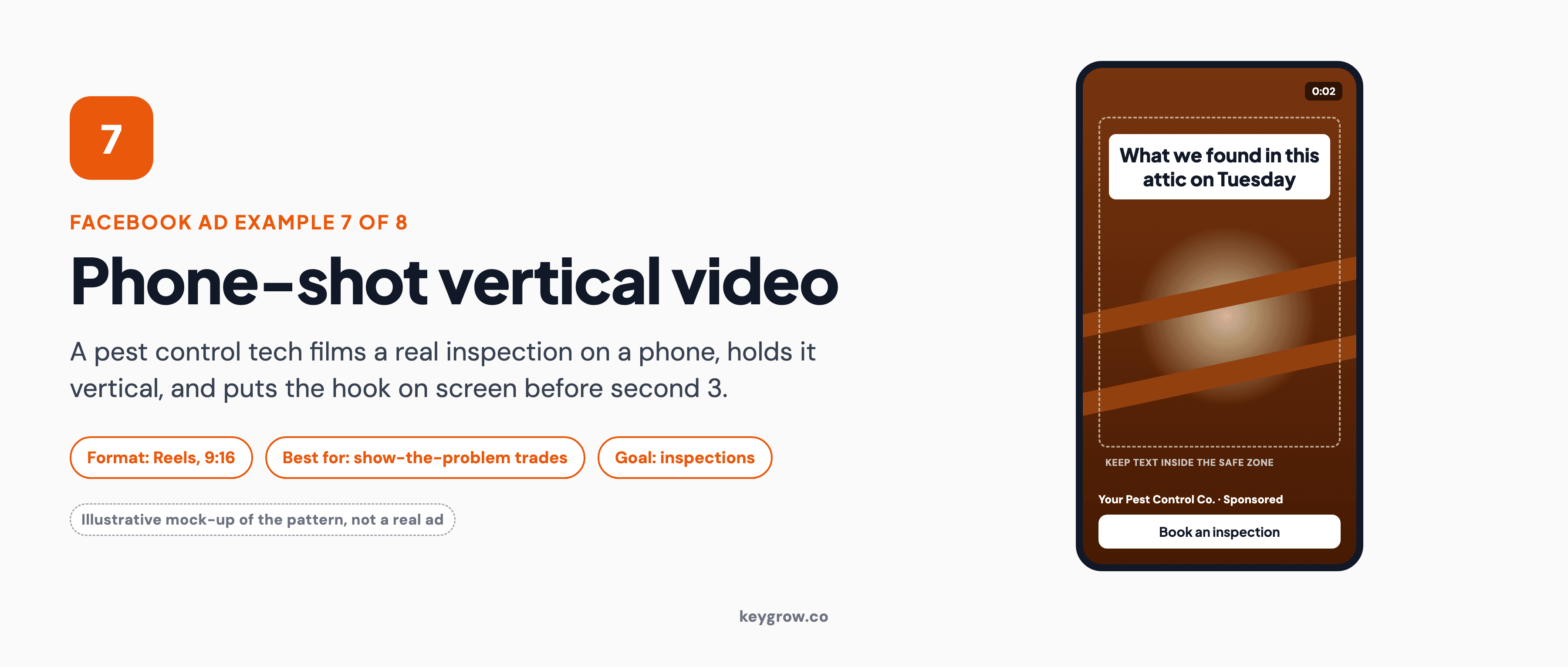
Facebook ad example 7 of 8, phone-shot vertical video: an illustrative mock-up of a pest control company's 9:16 Reels ad filmed in an attic, with the hook "What we found in this attic on Tuesday" inside the safe zone before second 3 and a Book an inspection button.
A pest control tech films a real attic inspection on a phone, held upright. The words on screen in the first two seconds: "What we found in this attic on Tuesday."
Meta's creative tips read like a description of this ad: film vertically, include sound, place key information within the safe zones, and highlight your message in the first 3 seconds. The safe zone matters more than people expect. In Reels, the bottom of the screen is covered by the page name, the caption and the button, so a hook placed there disappears.
Rough footage is fine here, and often better. It looks like the posts around it, which is the whole idea. A polished studio video in a Reels feed announces itself as an ad before anyone hears a word.
This one goes wrong when you show something gruesome for shock value, or film a customer's home they did not agree to put in an ad. Get written permission, keep addresses and faces out, and show the problem without making the homeowner the joke.
8. Retargeting ad that answers the objection
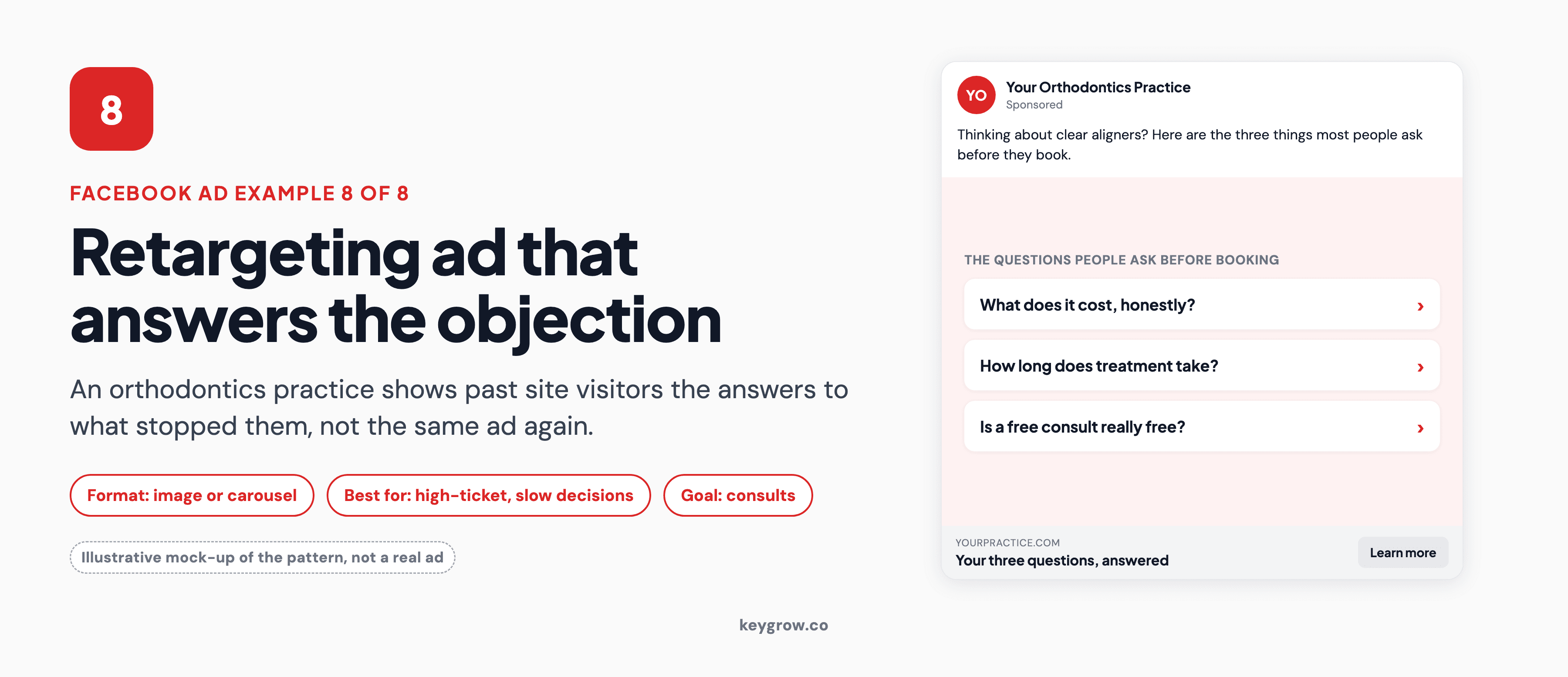
Facebook ad example 8 of 8, retargeting ad that answers the objection: an illustrative mock-up of an orthodontics practice's ad shown to past site visitors listing the three questions people ask before booking, about cost, treatment time and the free consult, with a Learn more button.
An orthodontics practice shows people who visited its clear aligner page an ad listing the three questions most people ask before booking: what it costs, how long it takes, and whether the free consult is really free. Each answer is on the page the ad links to.
Retargeting usually shows the same ad again, louder. That rarely fixes anything, because the first ad already worked well enough to get the visit. Something else stopped them, and on a high-ticket service it is usually price, time or trust. Answer that.
Watch the wording. Meta's personal attributes policy bars ads that assert or imply things about the viewer, including health and medical conditions, and it gives "Do you have diabetes?" as an example of what's not allowed. "You looked at aligners on our site" or "Struggling with crooked teeth?" both point at the person. "Thinking about clear aligners?" points at the topic. The same goes for finances, age and the other listed attributes, so it applies well beyond healthcare.
Which pattern should you run first?
Start from the doubt that stops a stranger from contacting you today, and run the pattern built to remove it.
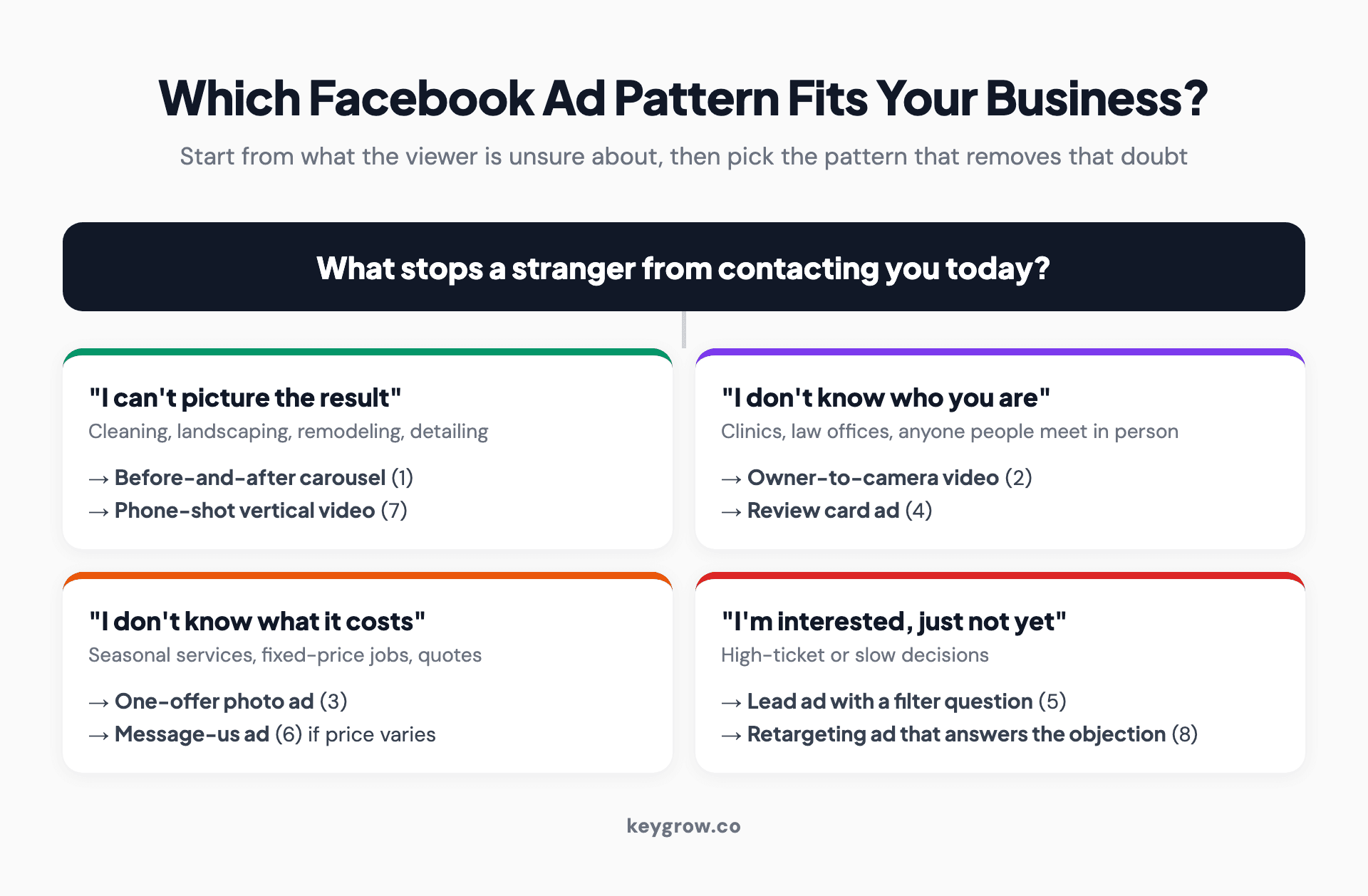
Decision flow for choosing a Facebook ad pattern based on what stops a stranger from contacting you: can't picture the result leads to the before-and-after carousel or phone-shot video, don't know who you are leads to the owner-to-camera video or review card, don't know what it costs leads to the one-offer photo ad or message-us ad, and interested but not yet leads to the lead ad with a filter question or the retargeting ad.
A pressure washer's biggest problem is that people cannot picture their own driveway clean, so pattern 1 goes first. A new clinic's problem is that nobody knows who works there, so pattern 2. A business with good reviews and a trust-heavy category, like auto repair, starts with pattern 4.
Run two patterns at once rather than eight. Meta's general tips include adopting a testing strategy and expanding on what's already working, and two ads give you a readable comparison on a small budget. Eight ads on $20 a day give you eight inconclusive results.
Judge them by cost per booked job, not likes. A comment section full of praise for your driveway photos pays nothing. If you're still deciding whether Facebook should get the budget at all, our Google Ads vs Facebook Ads breakdown works that out first.
One ad, rewritten
The fastest way to see why these patterns work is to rebuild a typical small-business ad using them.
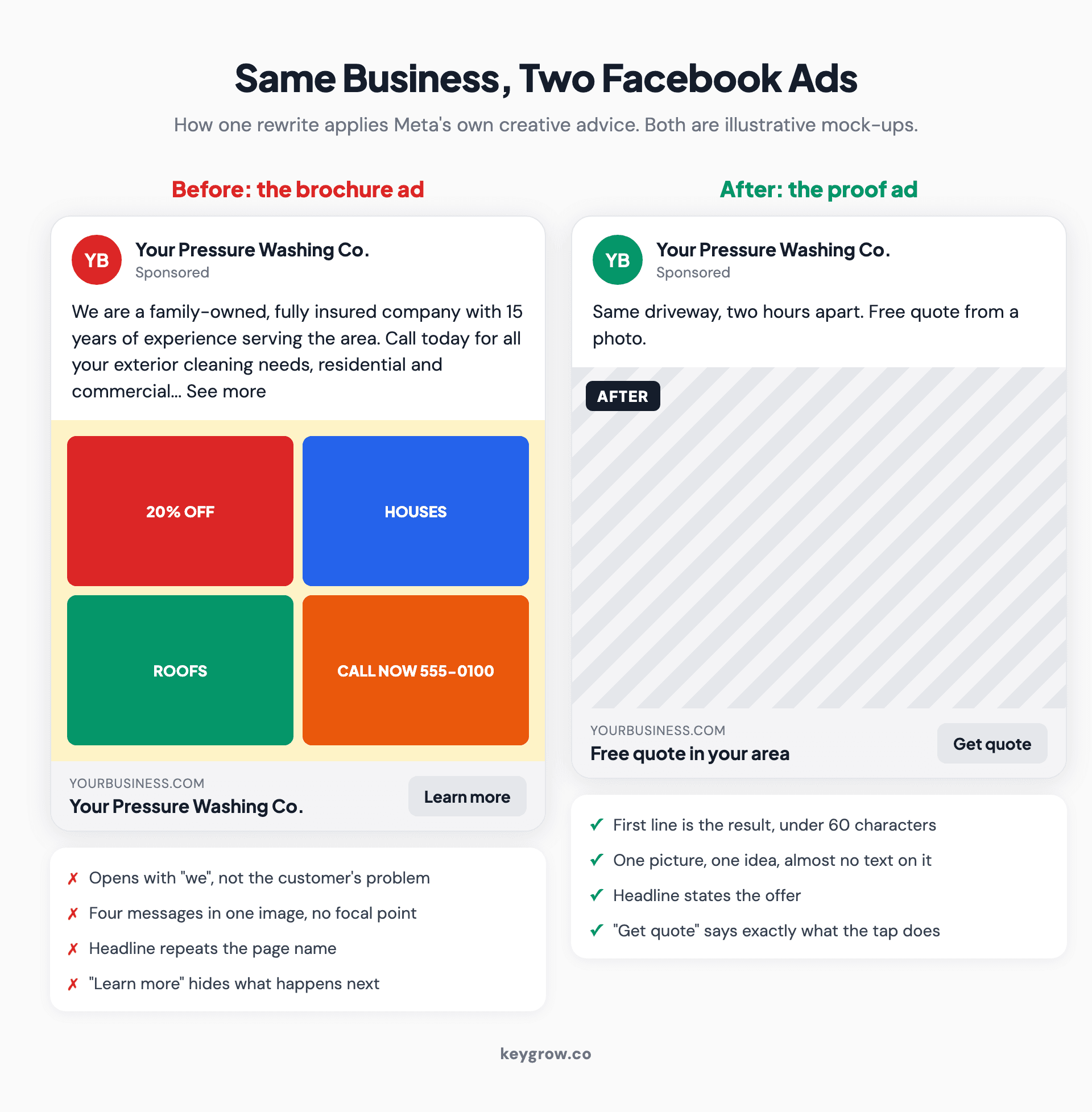
Side-by-side mock-ups of the same pressure washing company's Facebook ad: the before version opens with "we are a family-owned company", crams four messages into one image, repeats the page name as the headline and uses a Learn more button, while the after version opens with "Same driveway, two hours apart", shows one after photo, states the offer as the headline and uses a Get quote button.
The before version is what most business pages run when they boost a post. It opens with "we," lists credentials nobody asked about, and crams four messages into one image. The headline repeats the business name, which is already at the top of the ad. The button says Learn more, which hides what happens next.
The after version changes four things, and none of them costs money. The first line is the result. The image has one idea. The headline states the offer. The button says Get quote.
The ad is only half the job
An ad gets the tap. What happens after the tap decides whether you get a customer.
Sending paid clicks to your homepage is the most expensive default in paid advertising. One of our clients, a mobile car detailing business, was paying around $100 per booking from Google Ads with every click landing on the homepage. We pointed the traffic at a dedicated booking page and rebuilt the campaign. Cost per conversion dropped to $22 between August and December 2022. That was search, not Facebook, but the logic carries straight over: a before-and-after carousel that lands on a generic homepage throws away the momentum the ad built.
Match the page to the ad. If the ad shows a driveway and says "free quote from a photo," the page should show more driveways and a form that takes a photo. We go deeper on this in landing page vs homepage.
Where to find real ads to study
Meta's Ad Library is a free, public search of the ads running across Facebook and Instagram, so you can see what any Page is advertising right now.

A woman sitting on her living room floor recording a video on a smartphone mounted on a tripod, the kind of low-cost setup that works for owner-to-camera and phone-shot Facebook ads.
Search for businesses like yours in other cities and look for ads that have been running for months. You see the ad, not its results, so use the run time as a rough signal. An ad that keeps running is usually one the owner thinks is working, which tells you more than any curated gallery. Note the patterns, not the wording. Copying another business's ad word for word is lazy, and if they notice, it gets awkward fast.
You do not need an agency or a production budget for any of the eight patterns above. A phone, a free afternoon and your real photos and reviews will cover a single-location business. Hire help when you can't keep up with new creative, since Meta ads wear out as the same people see them again, or when you need the tracking and landing pages to know which ads booked jobs.
FAQs
What makes a good Facebook ad?
A good Facebook ad has one focal point, a first line that names a problem or result, a headline that states the offer, and a button that matches the next step. For Feed ads, Meta recommends primary text of 50 to 150 characters and a headline of about 27 characters. Judge it by cost per booked job, not by likes or comments.
What are the main types of Facebook ads?
The main formats are single image, video, carousel and collection, plus instant form lead ads and ads that open a chat in Messenger or WhatsApp. Carousels hold up to 10 images or videos, each with its own link. For a local business, single image, video, carousel and instant form cover almost everything.
Where can I see real Facebook ads from other businesses?
Meta's Ad Library shows the active ads of any Facebook Page, and it is free to search. Search for businesses like yours in other cities and note which ads have been running for a long time. Long-running ads are usually the ones the advertiser believes are working.
How long should Facebook ad copy be?
Meta recommends 50 to 150 characters of primary text for Facebook Feed image and video ads, and about 27 characters for the headline. Longer text is allowed but gets cut off behind See more, so the first line has to work on its own. Carousel cards have tighter limits, around 80 characters of primary text and 20 for the headline.
Do Facebook ads work for small local businesses?
They can, especially for services people can see, like cleaning, remodeling and detailing, and for businesses where trust decides the sale. They work best when the ad leads to a fast reply or a page that matches the ad. If people already search for what you sell, compare Facebook against search ads before choosing where the budget goes.
Should a Facebook ad have text in the image?
Keep it minimal. Meta says too much copy in an image is distracting and can lead to your ad being shown to fewer people, and it recommends a single focal point. Put the message in the primary text and headline, and let the image show the result, the person or the product.
Steal these patterns
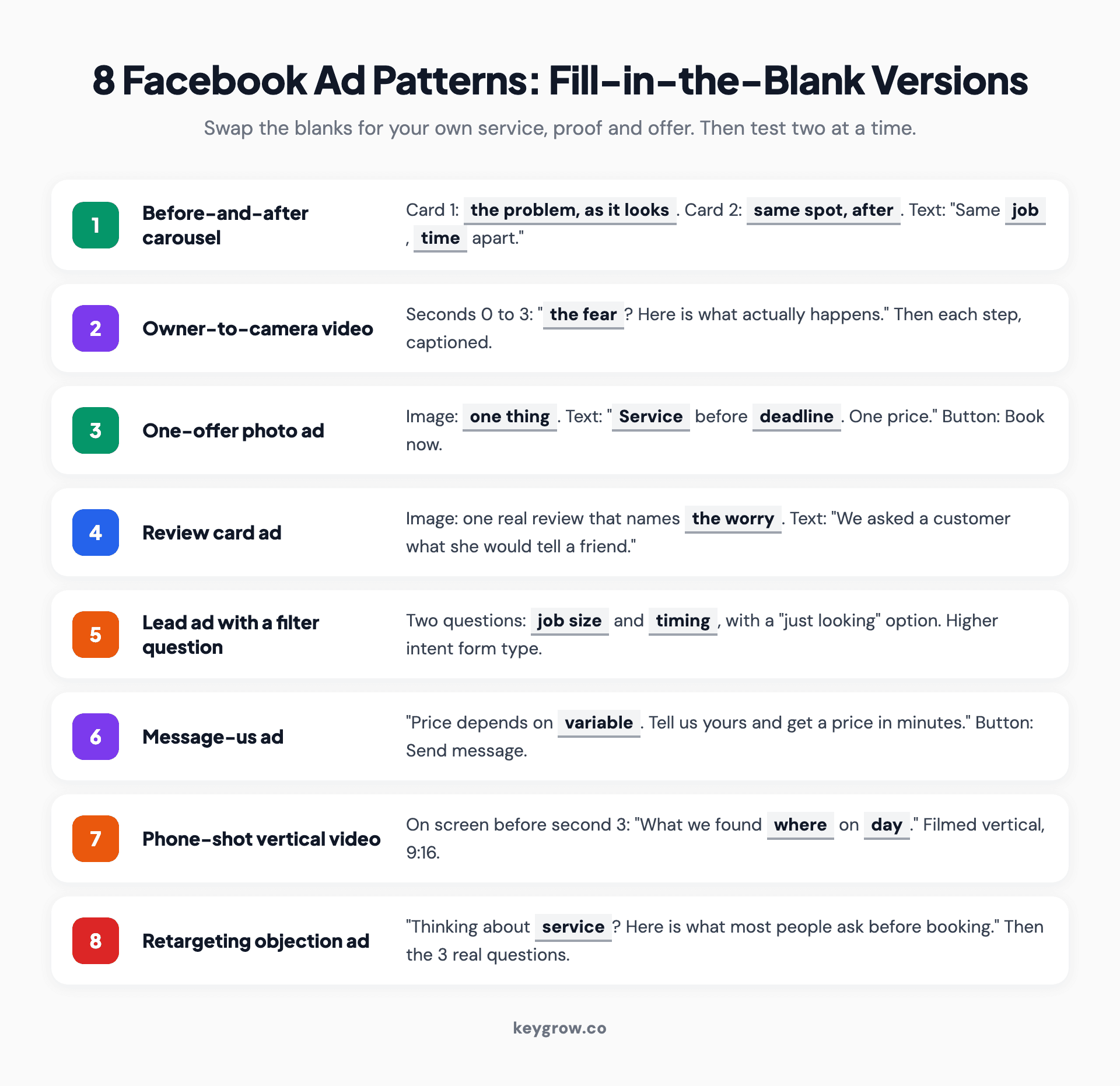
Fill-in-the-blank versions of eight Facebook ad patterns: before-and-after carousel, owner-to-camera video, one-offer photo ad, review card ad, lead ad with a filter question, message-us ad, phone-shot vertical video and retargeting objection ad, each with a short template to swap in your own service, proof and offer.
Save the graphic above and fill in the blanks for your own business. Pick the two patterns that match the doubt your customers have, shoot them on a phone this week, and run them side by side for long enough to see which one books more jobs. Then make a new version of the winner before the old one wears out.
If you'd rather have someone build, test and track these for you, our social media advertising team runs Facebook and Instagram campaigns for local businesses on cost per booked job, month-to-month.