

Your homepage and your landing page are not two versions of the same thing competing for the job. The landing page vs homepage question is really a routing question: which page should this visitor arrive on, given where they came from and how much they already know about you.
Here is the rule that holds up almost every time. If you paid for the click, send it to a landing page. If the visitor found you on their own, send them to the homepage.
The reason is structural, not stylistic. A homepage has to serve every visitor at once, so it cannot be built to close any single one of them. A landing page serves one visitor with one intent, so it can.
The difference, side by side
A homepage orients. A landing page closes. Everything else follows from those two jobs.
| Homepage | Landing page | |
|---|---|---|
| Job | Orient a stranger | Complete one action |
| Audience | Everyone who shows up | One segment with one intent |
| Navigation | Full menu, footer, sidebar | Stripped back or removed |
| Calls to action | Several, competing for attention | One, repeated |
| Usual traffic | Branded search, direct, referral | Paid clicks, email, campaign links |
| Judged by | Where people go next | Conversion rate on the one goal |
| Rebuilt | Every few years | Every campaign cycle |
That last row matters more than people expect. A homepage is a permanent structure and gets treated like one, which is why changing it involves three opinions and a meeting. A landing page is disposable by design. You build it for a campaign, measure it, and replace it when the campaign changes.
What your homepage is actually for
Your homepage answers three questions in about eight seconds: what is this company, is it for someone like me, and where do I go next.

A laptop open on a desk displaying a company website homepage.
That is a navigation job, not a closing job. Someone lands there from a referral, a business card, a branded search, a review site. They do not share one intent. One is checking whether you are a real company before calling. One is looking for pricing. One is trying to remember if you cover their suburb.
Judging a homepage by its conversion rate is like judging a hallway by how many people sit down in it. The useful homepage metrics are whether people find the page they were looking for and whether they get there in one click or four. Assisted conversions tell you more than direct ones.
This is also why homepage redesigns so rarely move revenue. The page was never the bottleneck. If your organic traffic is flat and your ads are expensive, the homepage is the last place to look.
What a landing page is actually for
A landing page exists to complete one action from one audience. That is the whole definition. It is not a visual style and it is not a page length.
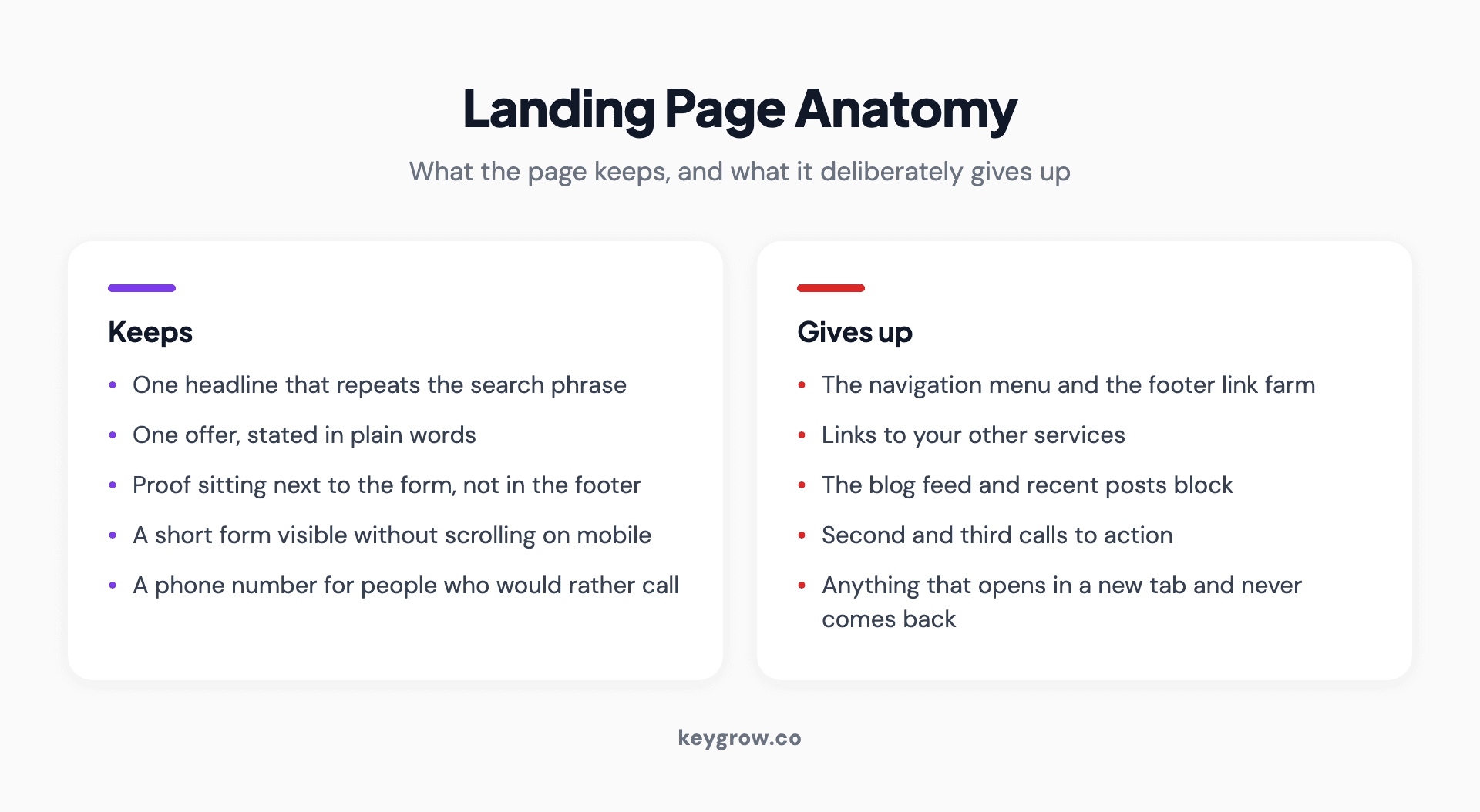
Two-column breakdown of what a landing page keeps and what it removes compared with a homepage.
People get this wrong in both directions. Some assume a landing page has to be short, so they cut the proof a cautious buyer needed and wonder why nobody converts. Others build a nine-section page with a menu, three offers and a blog feed, then call it a landing page because it was built in a landing page tool.
The test is simpler than either. Read the page and count the things a visitor could reasonably do next. If the answer is one, it is a landing page. If the answer is nine, you built a website page with a form on it.
Length follows the decision, not the format. A $79 product needs less convincing than a $12,000 roof replacement. Match the page to the size of the commitment you are asking for.
Route by traffic source, not by preference
Most guides get vague right here, because the honest answer is that neither page wins in general. The right destination depends on the channel the visitor came through, and that varies more than the page type ever does.
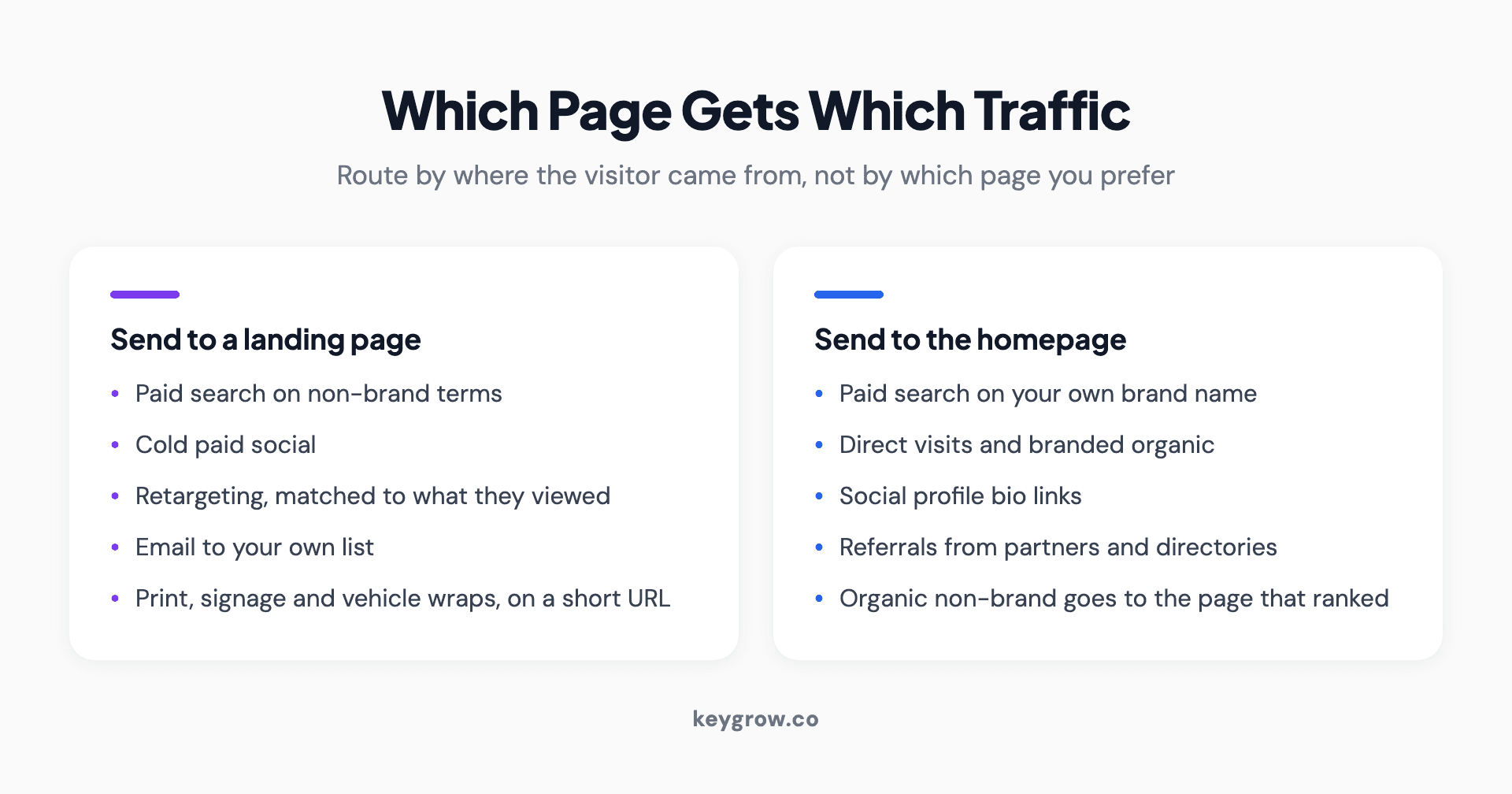
Two columns sorting traffic sources into landing page destinations and homepage destinations.
| Where they came from | Send them to | Why |
|---|---|---|
| Paid search, non-brand | Landing page | They searched a problem, not you. Match the page to the search. |
| Paid search, your brand name | Homepage | They already decided to look you up. Do not make it weird. |
| Cold paid social | Landing page | No intent yet, so the page has to build all of it. |
| Retargeting | Landing page for the thing they viewed | Continue the conversation, do not restart it. |
| Email to your own list | Landing page | One email, one offer, one page. |
| Organic, non-brand query | The page that ranked | It already answered the query. Sending them home undoes that. |
| Direct and branded organic | Homepage | They typed your name. They want the real site. |
| Social profile bio | Homepage | Mixed intent, and the link rarely changes. |
| Print, signage, vehicle wrap | Landing page on a short URL | You can measure it, and only it. |
Two rows in that table are the ones people argue with. Branded paid search going to the homepage feels wrong to anyone who just learned landing pages convert better, but someone typing your company name is already sold on looking you up, and a stripped page with no About link reads as suspicious to them. Organic non-brand traffic going to the ranking page rather than a dedicated landing page trips people up too. If Google sent someone to your guide on emergency repairs, that guide is the landing page for that visit.
What the homepage default actually costs
Sending ad traffic to your homepage is the most expensive default in paid search, and it is expensive in a way that never shows up as a line item.
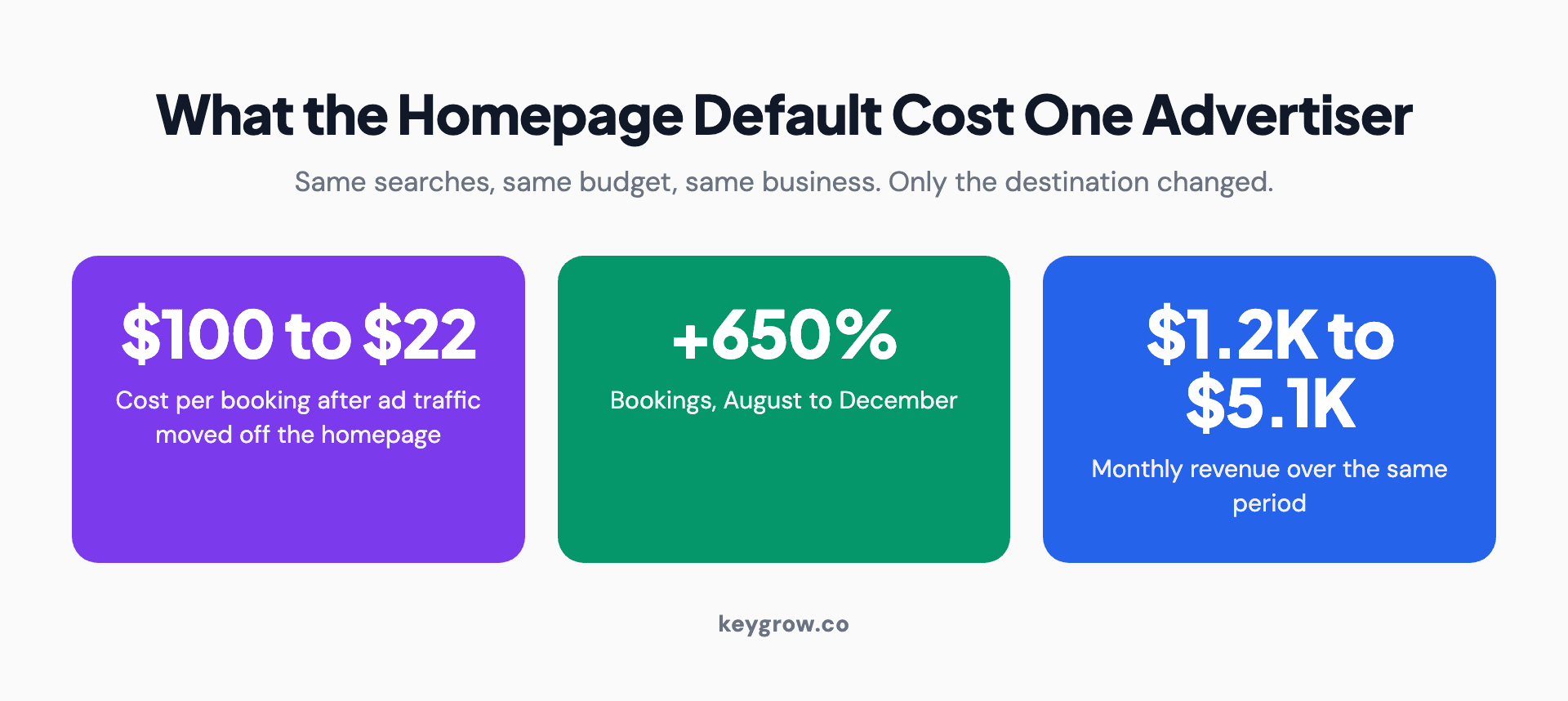
Cost per conversion, booking volume and revenue before and after moving ad traffic off the homepage.
Take a mobile car detailing account we inherited, where every booking was costing roughly $100 in ad spend. The campaigns themselves were not broken. Tight keywords, sensible ads, a budget in proportion to the business. What nobody had questioned was the destination. Somebody typing interior detailing near me arrived on a homepage that opened with a general introduction to the company, then a services menu, then an about section, then three separate ways to make contact. Plenty to read. Nothing to do.
We restructured the account and gave every click one destination: a single page whose only purpose was booking a detail. The numbers moved inside a quarter. Bookings were up 650 percent. Monthly revenue climbed from $1.2K to $5.1K. And the $100 booking became a $22 booking, on the same spend, between August and December.
Nothing about the traffic changed. Same searches, same budget, same business, same ads. The page had been doing all of the damage, quietly, for months.
Run the arithmetic on your own account before you decide this does not apply to you. Take your monthly ad spend, divide by your leads, and then ask what that number would be at half the cost per lead. For a business spending $3,000 a month at $120 per lead, the gap between 25 leads and 50 leads is not a marketing improvement. It is a different year.
Median landing page conversion rates sit around 6.6 percent across industries according to Unbounce's benchmark data, drawn from 41,000 pages and 57 million conversions. Homepages taking paid traffic rarely get close, because they were never asked to.
When the homepage is the right destination
Now the part the landing page software companies leave out. Sometimes the homepage is correct, and building a second page is a waste of a weekend.
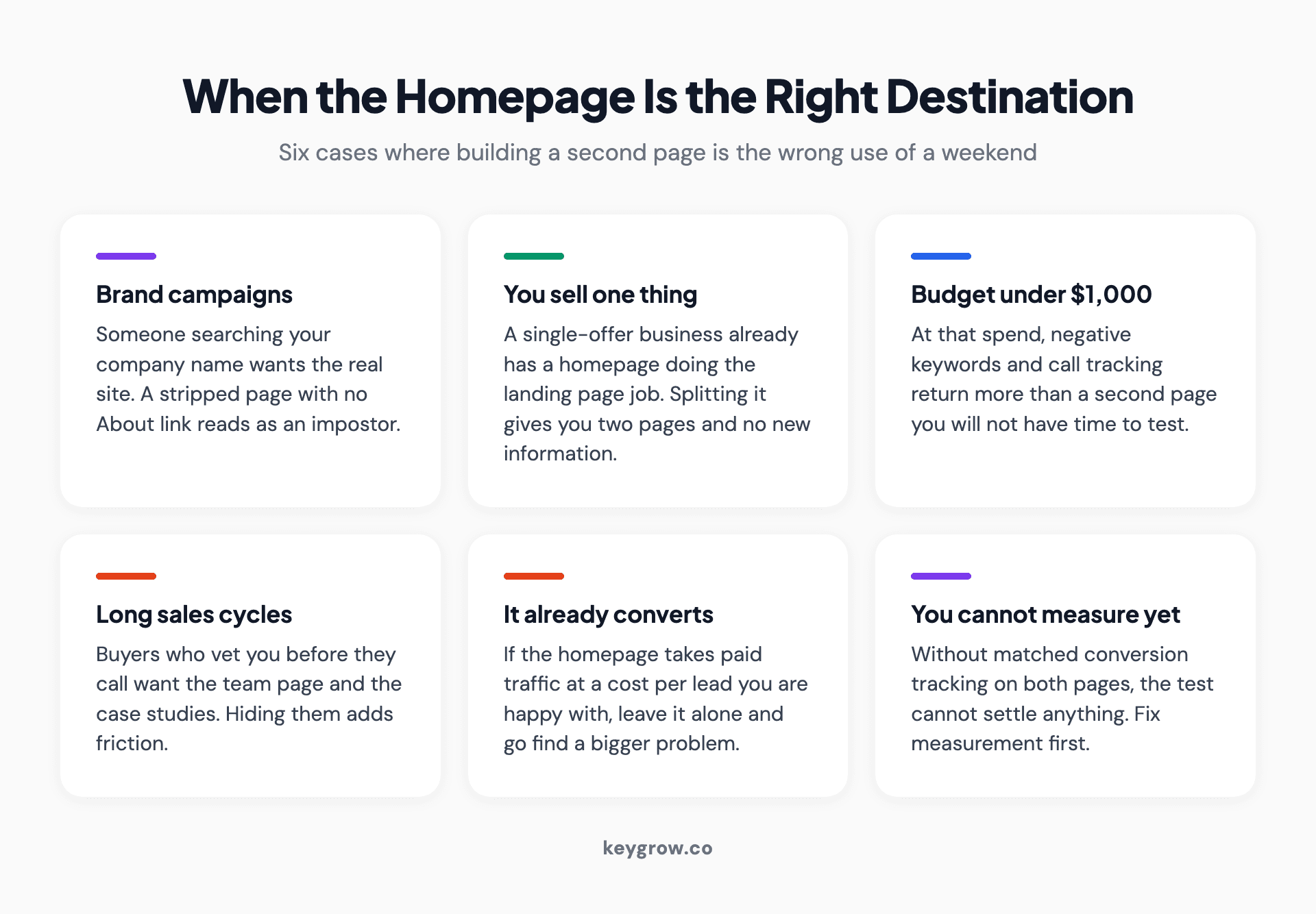
Six situations where the homepage is the better destination: brand campaigns, single-offer businesses, budgets under $1,000, long sales cycles, homepages that already convert, and accounts without matched tracking.
Your campaign is a brand campaign. Someone searching your company name wants the real website. A stripped page with no phone number in the header and no About link looks like an impostor.
You sell one thing. A single-service business with one offer already has a homepage that functions as a landing page. Splitting it in two gives you two pages to maintain and no new information.
Your budget is under roughly $1,000 a month. At that spend, the hours you would put into building and testing a second page are better spent on negative keywords and call tracking. Fix the waste first, then build the page.
Your buyer is going to vet you anyway. In high-consideration work, commercial contracts, anything with a long sales cycle, the buyer wants to see the team page and the case studies before they fill in a form. A page that hides all of that adds friction rather than removing it.
Your homepage already converts. Some do. If your homepage is taking paid traffic at a cost per lead you are happy with, leave it alone and go find a bigger problem. We turn down work on this basis regularly, and it is a reasonable thing to expect from anyone you hire.
You cannot measure the difference yet. If conversions are not tracked properly on both pages, building the second one just gives you two numbers you do not trust. Fix the tracking, run a month, then decide with data instead of a hunch.
Can a landing page be your homepage?
Yes, and for a certain shape of business it is the better build. A single-offer business, a new service launching before the full site exists, a local operator whose entire pitch is one phone call: for all of those, one focused page beats a five page site nobody reads.

A single-location business owner standing outside their storefront.
It breaks at a predictable point. The moment you add a second service with a different buyer, one page has to sell both, and it starts making the same compromises a homepage makes. That is the signal to split: not traffic volume, not revenue, the arrival of a second audience.
Worth knowing before you commit: a one-page site has less surface area for organic search, because you have one URL competing for every query instead of one page per topic. If organic matters to you at all, plan for the split early. We covered how that plays out in our post on whether landing pages help SEO.
What changes when you build the landing page
Building the landing page is mostly subtraction. That surprises people who expect to be adding persuasion.
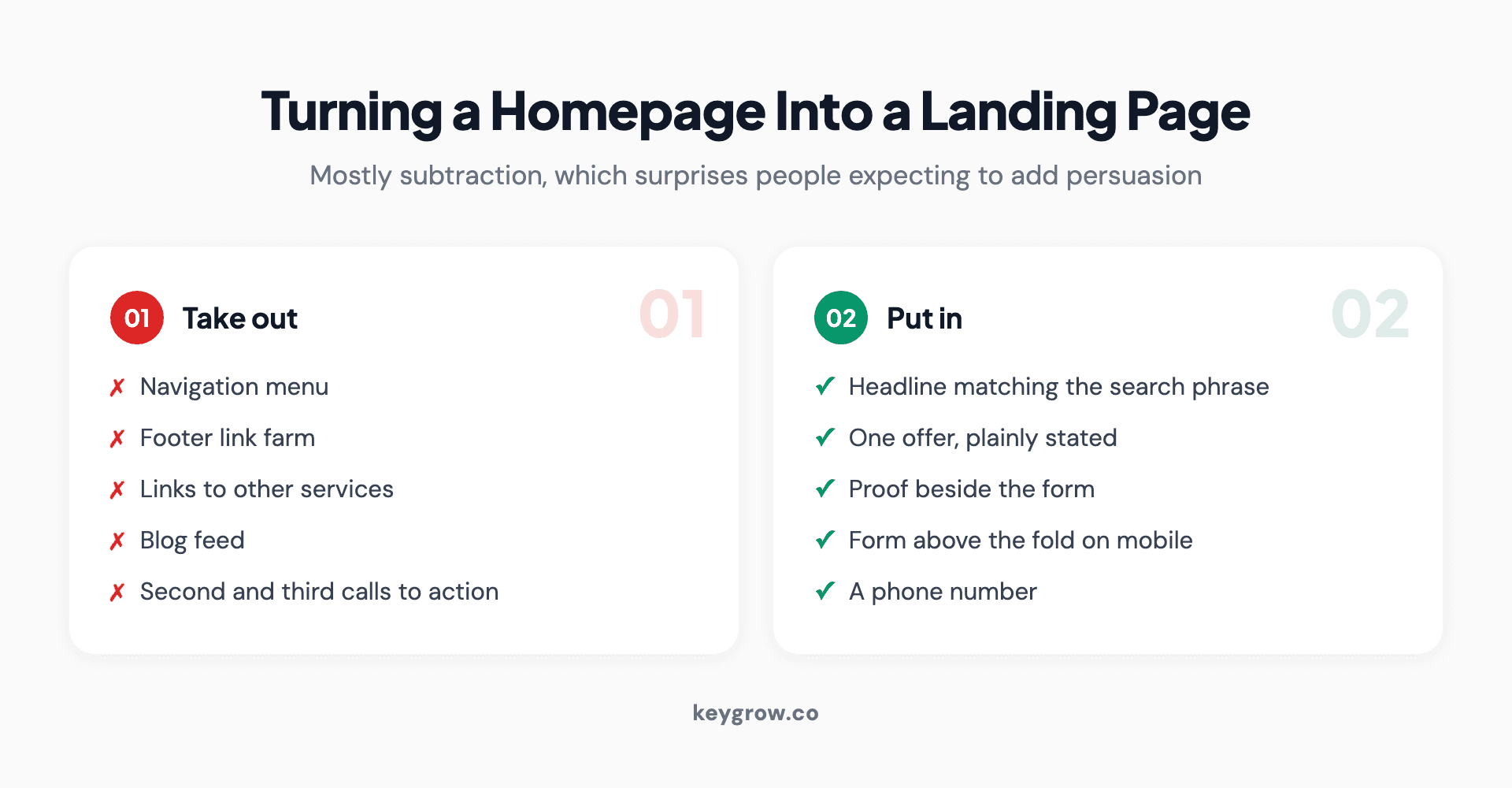
Two cards listing what to remove from a page and what to add when converting a homepage into a landing page.
Take out: the navigation menu, the footer link farm, links to other services, the blog feed, the second and third calls to action, anything that opens in a new tab and does not come back.
Put in: a headline that repeats the phrase they searched, one offer stated plainly, proof near the form rather than at the bottom, the form itself above the fold on mobile, and a phone number for people who would rather call than type.
Message match is the part that carries the most weight and gets the least attention. If the ad said emergency drain cleaning and the page headline says Welcome to our family business, you have broken the connection in the first second. The headline should read like the answer to the search.
Google treats this as a ranking input on the ad side too. Google Ads Help defines landing page experience as how relevant and useful the page is to people who click the ad, though the same documentation is careful to say Quality Score is a diagnostic tool rather than an input in the auction itself. Read it as a signal about the user, not a number to game.
The mistakes that make a landing page lose to the homepage
A badly built landing page really can perform worse than the homepage it replaced. When that happens, it is usually one of five things.
The headline does not match the ad, so the visitor arrives half-convinced they clicked the wrong result. The form asks for eleven fields when three would do, and every extra field is a reason to close the tab. There is no proof anywhere on the page: no reviews, no photos of finished work, nothing that reads as a company with employees. The page takes six seconds to paint on a phone because somebody put a full-width background video above the fold. Or the page removed the navigation and forgot to replace the trust that navigation was carrying.
Worth adding a sixth, because it is the one that costs the most and gets blamed on the page: the offer itself was never the problem the visitor had. A page selling free consultations to people searching for a price is a well-built page answering the wrong question. No amount of layout work fixes that.

A phone on a desk showing a slow-loading web page.
That last one is the subtle one. Stripping the menu works because it removes exits, not because it removes information. If the About page was the thing convincing people you exist, cutting the link does not solve anything. Put the proof on the page instead.
How to tell which page is actually winning
Do not take any of this on faith. Test it, and test it in a way that will survive an argument.
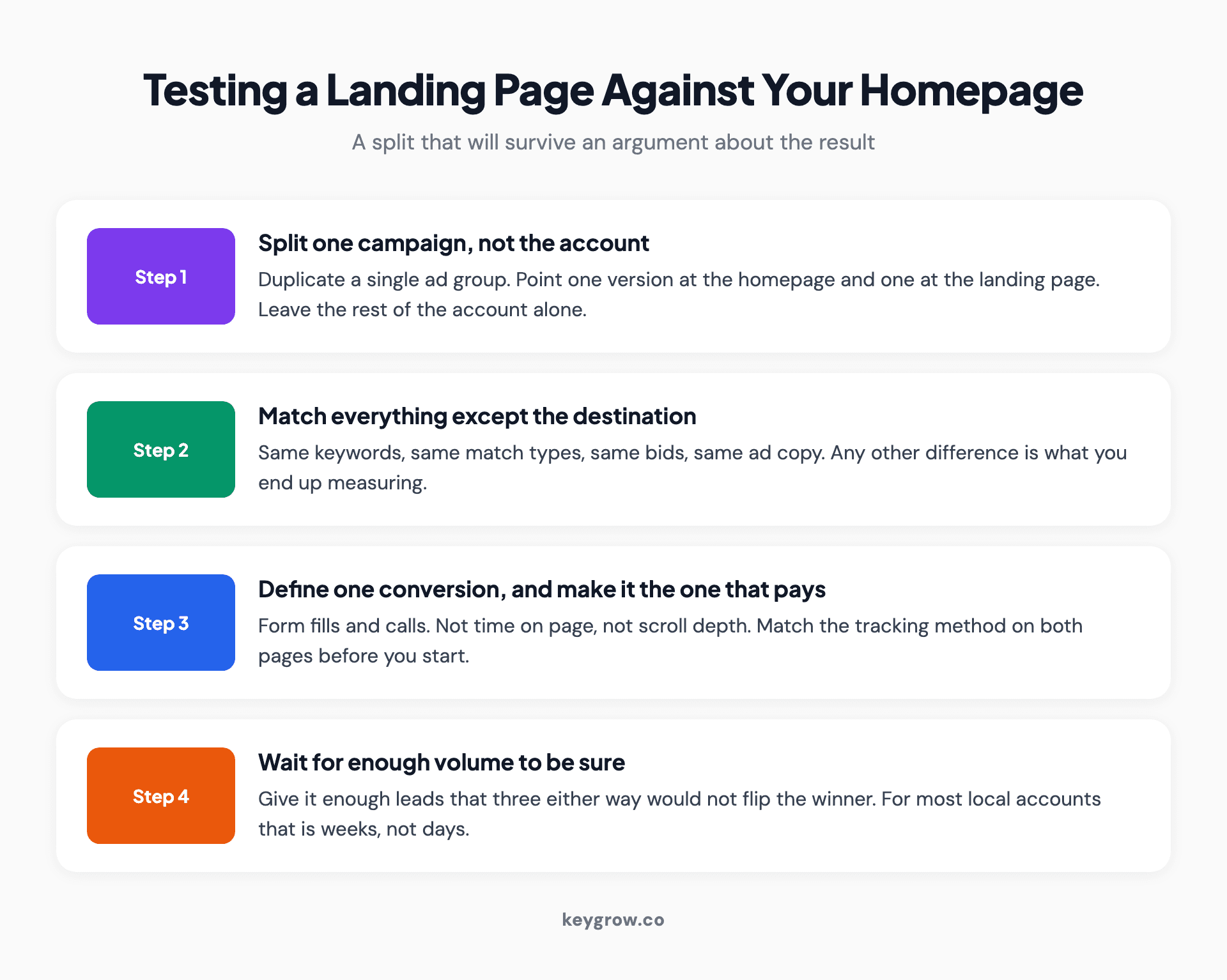
Four-step method for testing a landing page against a homepage: split the campaign, match the terms, define one conversion, and wait for enough data.
Split one campaign, not the account. Duplicate an ad group, point one version at the homepage and one at the landing page, and keep everything else identical: same keywords, same match types, same bids, same ad copy. If the two versions differ in any other way, you are measuring that difference instead.
Define the conversion before you start, and make it the one that pays you. Form fills and calls, not time on page. Then wait. The mistake we see most often is calling a winner at 40 clicks and 3 conversions, which tells you almost nothing. Give it enough volume that a handful of leads either way would not flip the result, which for most local accounts means a few weeks rather than a few days.
One warning about tracking. If the homepage conversion is counted through a different method than the landing page conversion, say one uses a form plugin and the other uses a thank you page, the test is already broken. Match the tracking before you match anything else. Our guide to lowering cost per click in Google Ads covers the account side of the same problem.
FAQs
What is the main difference between a landing page and a homepage?
A homepage introduces your whole business and sends visitors to the right section. A landing page asks one audience to take one action and removes everything else. The homepage is built for people who arrived with different reasons; the landing page is built for people who all arrived with the same one.
Can my homepage work as a landing page?
For a single-offer business, yes. If you sell one service to one type of customer, your homepage can carry one headline, one offer and one form, which is what a landing page is. It stops working when you add a second service with a different buyer, because the page then has to compromise between two audiences.
Do I need a landing page if my homepage already converts well?
No. If your homepage is taking paid traffic at a cost per lead you are happy with, that is a solved problem. Build the landing page when you have a specific campaign that needs its own message, or when your cost per lead has drifted higher than your close rate can support.
How long does it take to build a landing page?
A focused page on an existing site is usually a few days of work rather than a few weeks, because you are reusing the brand, the tracking and the hosting. Most of the time goes into the copy and the offer, not the build. Budget more time if you also need new photography or a new form workflow.
Which page should my social media bio link to?
Your homepage, in most cases. Bio traffic arrives with mixed intent and the link rarely changes, so a page that can route people is more useful than one that pushes a single offer. Swap it to a landing page temporarily when you are running a specific campaign and the bio link is part of it.
Does having landing pages hurt my homepage's rankings?
Not if the pages target different queries. Problems start when you create several near-identical pages aimed at the same search, because Google then has to choose between them and often picks none. Keep paid landing pages out of the index and give organic pages distinct topics.
Start with the traffic, not the page
The question is never really which page type is better. It is which page this visitor deserves, and the answer comes from where they came from. Paid clicks and email get a landing page built for one action. Branded searches, direct visits and organic results get the page that already answers them.
If your ads currently point at the homepage, that is the first thing to change and it is usually the cheapest. Our PPC management work starts with that routing question before anything gets rebuilt, and if you want a second opinion on where your traffic is landing, tell us what you are running.


