


Should your Google Ads landing page link to your website landing page? This question is really two questions, so here are both answers up front. (If what you actually want to settle is which page your ads point at, start with landing page vs homepage and come back here for the linking rules.) First: for lead generation, send ad traffic to a dedicated landing page, not your homepage or a generic service page; reserve website destinations for brand campaigns and ecommerce browsing. Second: that landing page should live on your main domain (Google's ad policies effectively require it), it should drop the full navigation menu, and it should keep exactly a handful of links back to your site: a clickable logo and the footer trust links. Sealed completely shut reads as scammy. Wide open leaks conversions.
The rest of this post is the evidence, the one Google policy nobody cites, and the tracking mistake that quietly ruins most attempts to test any of this.
Two questions hiding in one
People asking this are usually deciding two things at once: where the ad click should land, and how connected that page should be to the rest of the site. They have different answers, and mixing them up produces the two classic failures: ads dumped on a homepage that converts nobody, and orphaned landing pages on strange domains that Google disapproves and visitors distrust.
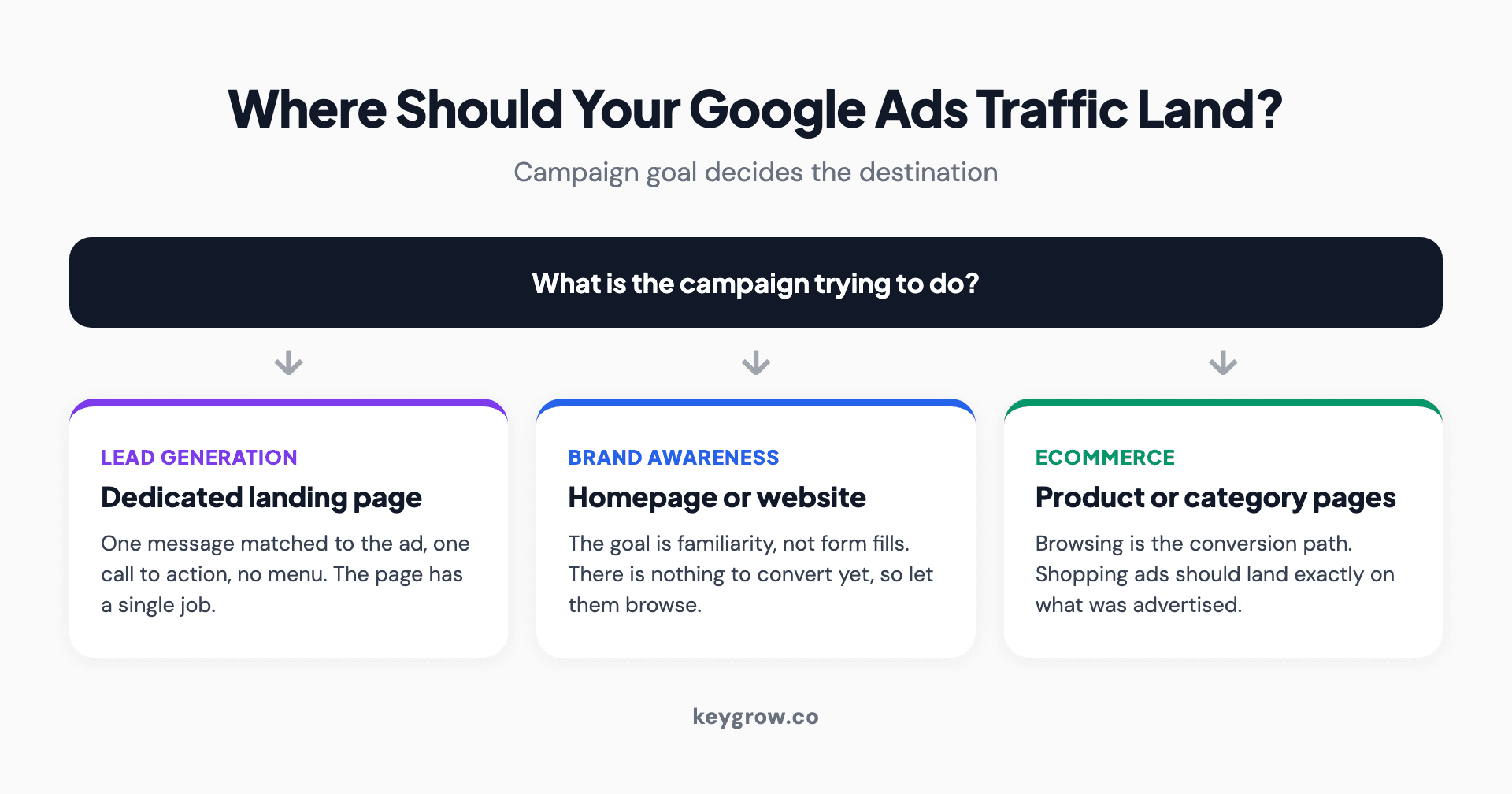
Decision flow for where Google Ads traffic should land: lead generation and direct response campaigns go to a dedicated landing page, brand awareness campaigns go to the homepage or website, and ecommerce product ads go to product or category pages.
Campaign goal decides the destination. Everything below assumes the most common case, lead generation, and flags where the advice changes.
Why dedicated pages win for lead generation
Two mechanisms, both boring and both decisive. Message match: the ad is a promise and the page is its fulfillment, so a page whose headline mirrors the ad copy converts strangers who arrived mid-thought. Attention ratio: every link that is not the call to action is an exit ramp, and a website page carries dozens of them. A landing page carries one job.
The best controlled data on this is HubSpot's test of removing navigation menus: conversions on mid-funnel pages lifted 16 to 28 percent, while top-of-funnel pages barely moved. For context on what "good" looks like, the median landing page converts 6.6 percent of visitors across industries, per Unbounce's benchmarks built on 41,000 pages. Honest caveat: clean homepage-versus-landing-page split tests are rare in the wild, which is why the unsourced "landing pages convert 5x better" claims floating around this topic should make you suspicious.
Our own sharpest example: a mobile detailing client was paying about $100 per booking, sending every ad click to their homepage. Same ads pointed at a dedicated booking page took the cost to $22, bookings grew 650 percent, and monthly revenue went from $1.2K to $5.1K between August and December. Sending ad traffic to your homepage is the most expensive default in PPC. The ad is half the job; the page is the other half.
When your website is the right destination
Three cases. Brand awareness campaigns, where the goal is familiarity rather than form fills, can land on the homepage; there is nothing to "convert" yet. Ecommerce, where Shopping and product ads should hit product or category pages, because browsing is the conversion path. And genuinely high-consideration research purchases, where a visitor may need your about page, case studies, and pricing before acting; even then, a small conversion-focused microsite usually beats the full site.
If the click costs money and the goal is a lead, the default stays: dedicated page.
The domain rule almost every guide skips
Your landing page must live on your own domain. This is not a best practice; it is Google's destination policy. The domain in your display URL has to match the domain of your final URL, and redirects that carry the click to a different domain are prohibited. Google Ads Help adds that every URL in an ad group has to use the same domain.
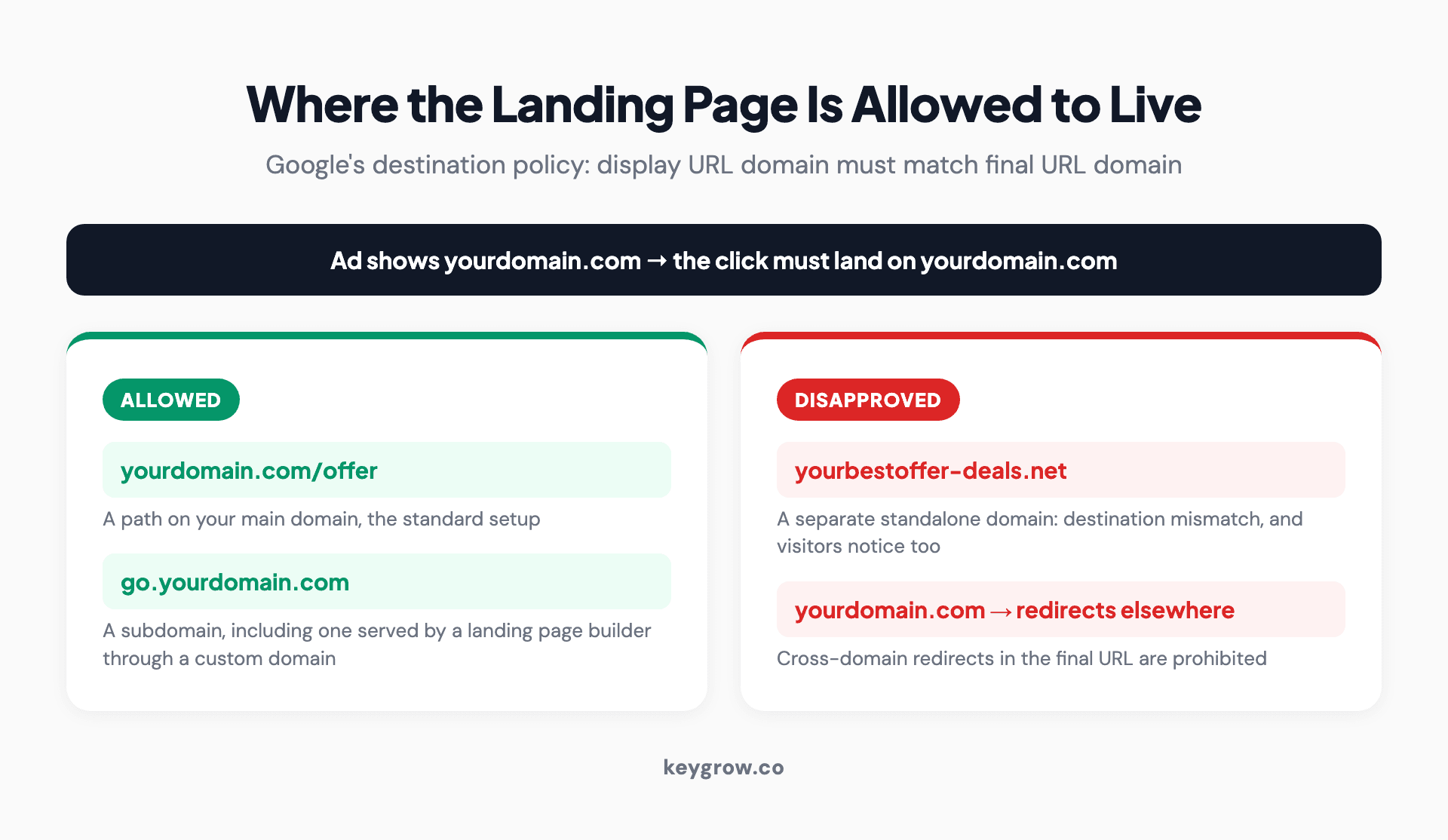
Google's domain-match rule for ad landing pages: yourdomain.com/offer and a CNAME subdomain like go.yourdomain.com are allowed, while a separate standalone domain or a cross-domain redirect triggers a destination mismatch disapproval.
In practice: a page at yourdomain.com/offer is fine, and so is a landing page builder serving a subdomain like go.yourdomain.com through a custom domain setup. A separate bargain-bin domain with your offer on it risks a destination mismatch disapproval, and even when it survives review, visitors notice the URL does not match the business. So the answer to "should the landing page be on my website's domain" is yes, structurally connected, whatever you decide about visible links.
How many links back to your site? Five.
Strip the navigation menu, then keep the links that build trust instead of leaking attention.
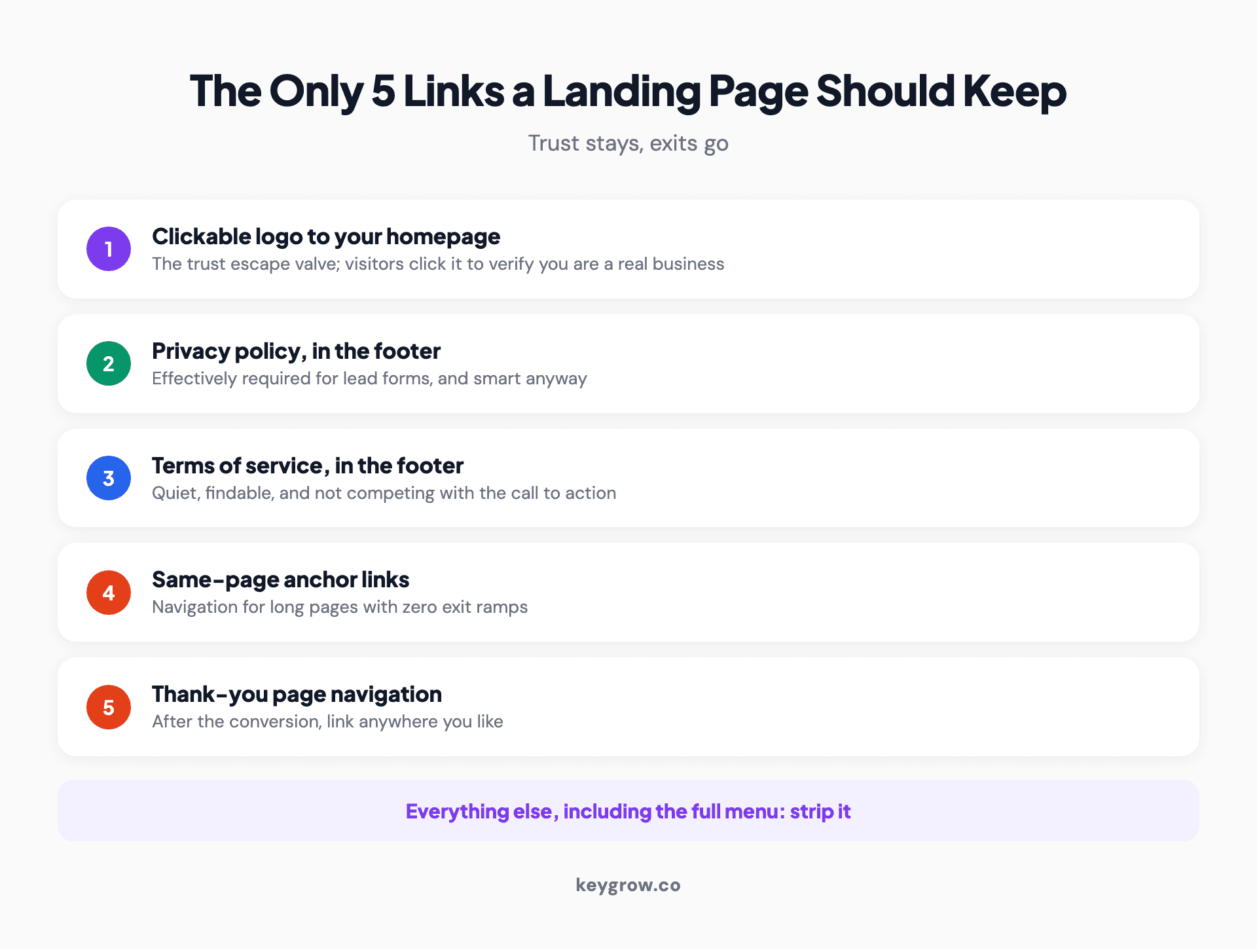
The only five links a Google Ads landing page should keep: a clickable logo to the homepage, privacy policy in the footer, terms of service in the footer, same-page anchor links for scrolling, and navigation on the thank-you page after conversion.
The clickable logo is the trust escape valve: a meaningful share of visitors click it purely to verify you are real, and if it goes nowhere they hit the back button and land in a competitor's ad instead. Footer privacy and terms links are effectively mandatory for lead forms, both for Google's transparency expectations and for anyone reading your form before giving up a phone number. Anchor links that scroll down the same page give long pages "navigation" without exits. And once someone converts, the thank-you page can link anywhere it likes.
Placement is the real rule. A quiet footer link and a bold header menu are different animals, and only one of them competes with your call to action.

A designer sketching website wireframes on paper, working out what stays and what gets cut from a landing page
The Quality Score tension, resolved honestly
Here is the apparent contradiction: Google's landing page experience guidance rewards "easy navigation," while every conversion optimizer strips navigation. Both are right, because Google does not mean menus. It means the visitor who clicked an ad for drain repair lands on drain repair, finds what was promised without hunting, and is not trapped. Relevant original content, transparency, ease of use, and load speed are the four things Google actually judges.
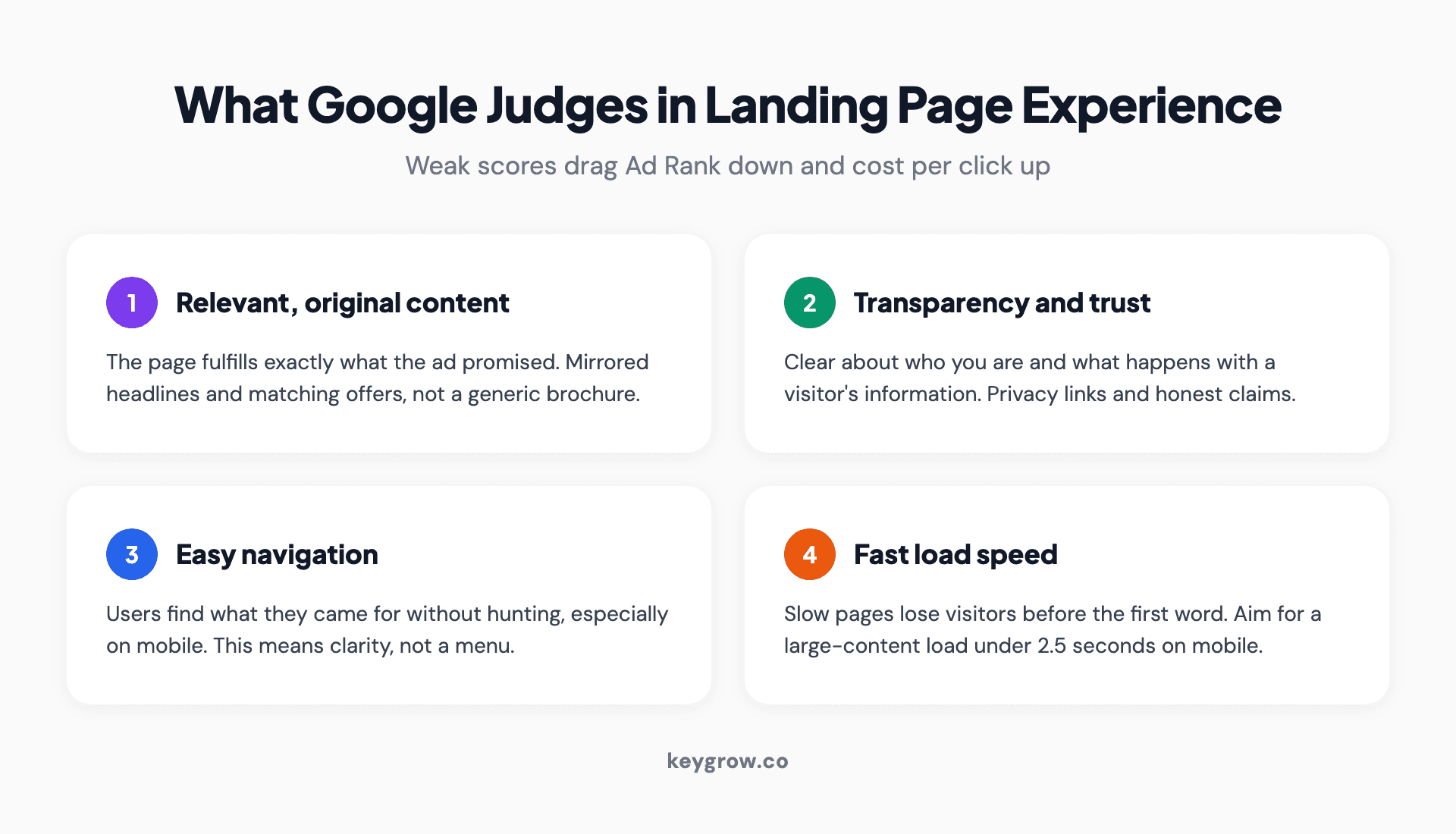
The four factors in Google Ads landing page experience: relevant and original content that fulfills the ad's promise, transparency and trustworthiness, easy navigation especially on mobile, and fast load speed, each feeding Quality Score and your cost per click.
A focused page with a mirrored headline, anchor links, a working logo, and a fast mobile load satisfies every one of those while carrying no menu at all. And the stakes are financial: weak landing page experience drags Ad Rank down and cost per click up, so the page is an economics lever, not just a design preference. Removing your nav links does not directly move Quality Score in either direction; slow, thin, or mismatched pages are what hurt it.
The tracking mistake that skews every test
If a visitor leaves your landing page through the logo, browses the site, and converts on your contact page, that conversion still belongs to the ad, but you will only see it if your Google tag and conversion actions run site-wide. Accounts that track only the landing page's thank-you step silently undercount linked pages, which biases every "sealed versus linked" comparison toward sealed. Retargeting audiences have the same dependency: tags on one page build very small lists.

A web analytics dashboard on a monitor showing pageview graphs and conversion metrics during a tracking audit
Two SEO housekeeping rules complete the setup. Noindex dedicated paid pages and keep them out of your sitemap, so they never compete with your organic pages or read as doorway pages. And keep your PPC landing page and your SEO service page as separate URLs even when they target the same keyword; a page built to rank and a page built to convert paid clicks are structurally opposed, which we unpack in what an SEO landing page is.
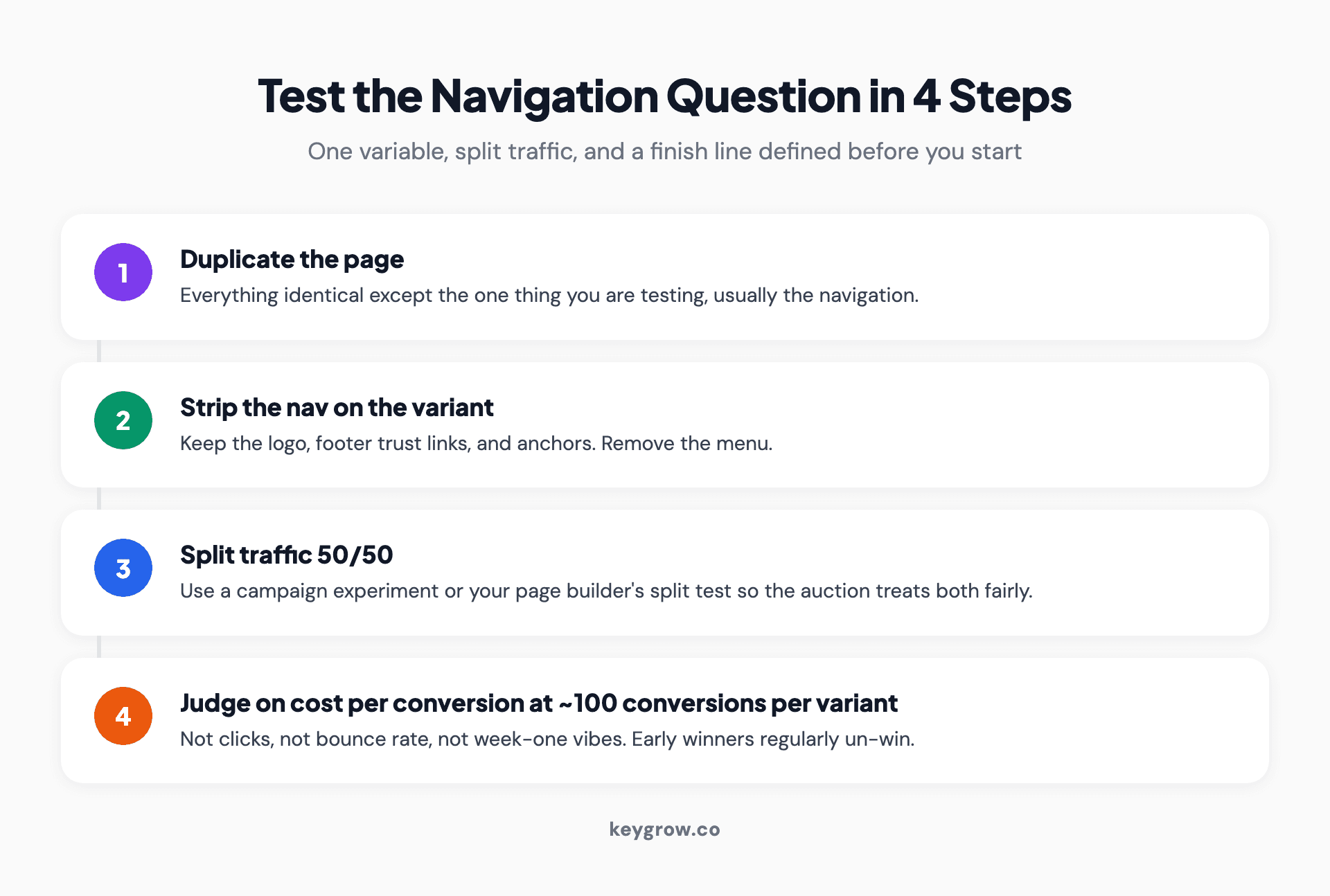
Four steps to test landing page navigation with Google Ads: duplicate the page, strip the navigation on the variant while keeping the logo and footer trust links, split traffic 50/50 with a campaign experiment, and judge on cost per conversion after about 100 conversions per variant.
When you do test, test properly: duplicate the page, change one thing (the nav, usually), split traffic with a campaign experiment, and judge on cost per conversion after roughly 100 conversions per variant. Calling tests earlier than that is how "winners" un-win a month later; our guide to how long PPC takes covers fair testing windows in detail.
FAQs
Should Google Ads go to a landing page or my homepage?
For lead generation, a dedicated landing page. Homepages carry navigation, competing messages, and no single call to action, and controlled tests show focused pages convert meaningfully better. Homepages are defensible for brand awareness campaigns; product and category pages are right for ecommerce.
Can a Google Ads landing page be on a different domain than my website?
Not a separate domain, no. Google's destination requirements say the display URL domain must match the final URL domain and prohibit cross-domain redirects. A page on your main domain or on a subdomain of it, including one served by a landing page builder, satisfies the policy.
Should a PPC landing page have a navigation menu?
No. Removing the menu lifted mid-funnel conversions 16 to 28 percent in HubSpot's testing. Keep a clickable logo, footer privacy and terms links, and same-page anchor links; that preserves trust and usability without offering exits that compete with the call to action.
Does my landing page affect Google Ads Quality Score?
Yes, through the landing page experience component. Google judges relevance to the ad, originality, transparency, ease of use, and speed. Links to your site do not directly change the score either way; slow pages and content that does not match the ad are what drag it, and your cost per click, in the wrong direction.
Is it OK if my landing page does not link to my site at all?
It works for emergency and high-intent local services, where the visitor wants a phone number, not a tour. For anything considered, a fully sealed page reads as untrustworthy; people click logos to verify businesses are real, and a dead logo sends them back to the search results.
Can I run Google Ads without a website?
You need a working destination that meets Google's policies, but it does not have to be a traditional multi-page site. A single landing page on a domain you own qualifies, which is a common setup for new local businesses running their first campaigns.
The short version
Send lead-gen clicks to a dedicated page on your own domain. Strip the menu, keep the logo and the footer trust links, mirror the ad in the headline, and make the tag site-wide so your test data tells the truth. The homepage is for brand campaigns, product pages are for ecommerce, and the $100-per-booking version of this mistake is optional.
We build landing pages and run the campaigns that feed them as one system, month-to-month. If your ads currently land on the homepage, tell us about your business and we will show you what the same clicks could cost with a page built for them.