


Here is how choosing the wrong agency usually ends. A practice pays a few thousand a month for "Google Ads management" with no idea how much reaches Google and how much stays with the agency. Nobody at the practice can log into the ad account. The monthly report is a PDF of impressions. And when the owner finally decides to leave, the account, its history, and its data turn out to belong to the agency. Two years of spend, starting over from zero.
Every part of that story is preventable in the first sales call. Here is how to choose a dental Google Ads agency in one paragraph: verify dental results stated as cost per lead and booked appointments, confirm the ad account will live under your ownership, get the ad spend and management fee split in writing, insist on per-service campaigns with dedicated landing pages, and check that call and form tracking actually confirms bookings. Prefer month-to-month terms. Walk away from anyone who guarantees patient numbers or quotes one bundled price.
The rest is the detail that makes each check hard to fake, plus the cost benchmarks the sales calls will not volunteer.
Run every agency through this checklist
Seven checks, all verifiable before you sign. An agency that passes all seven is rare and worth paying. An agency that fails two or more is a rebrand of the story above.
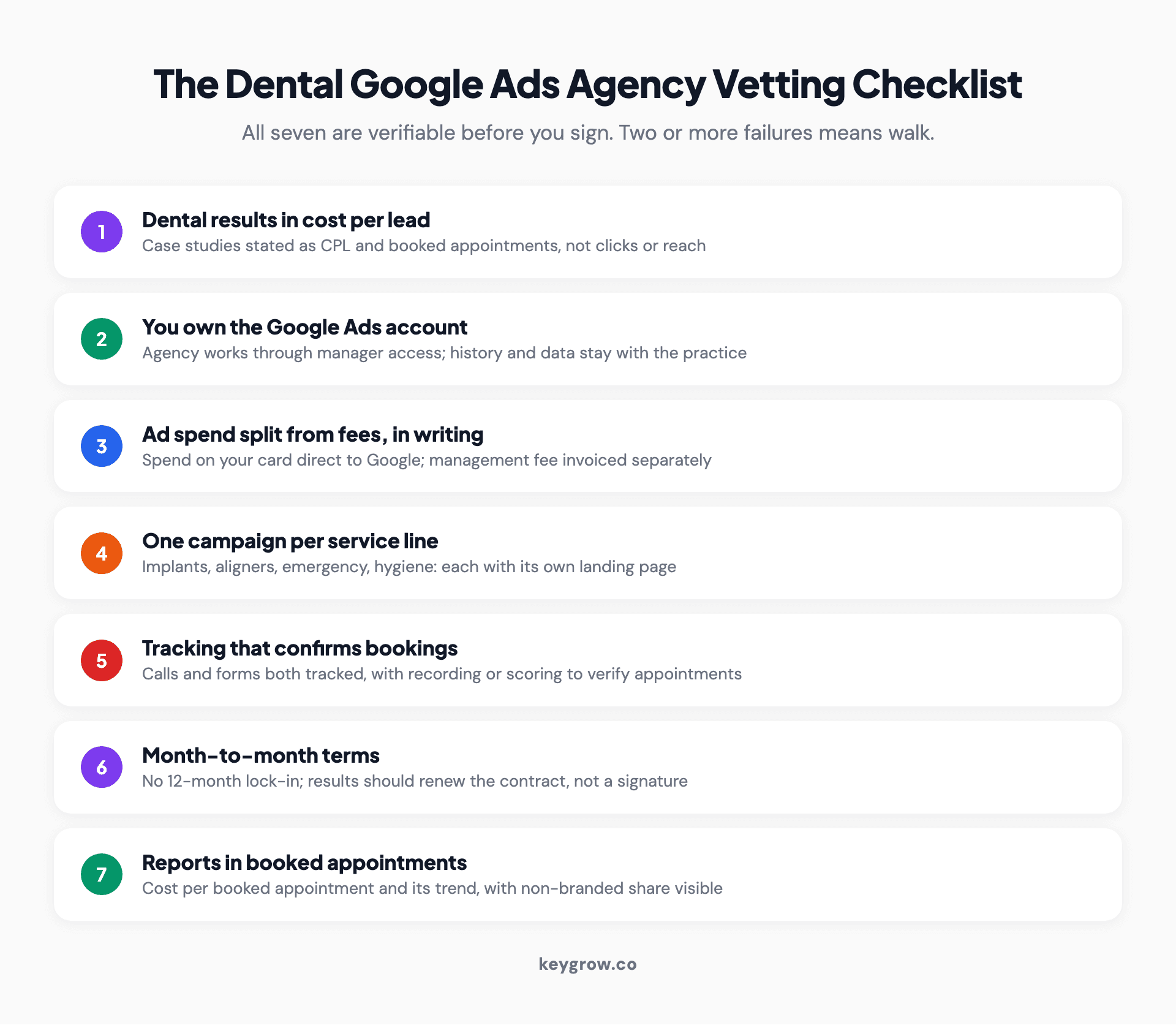
Seven-point vetting checklist for a dental Google Ads agency: dental-specific results in cost per lead, the practice owns the ad account, ad spend split from fees in writing, one campaign per service line, call and form tracking that confirms bookings, month-to-month contract, and reporting in booked appointments rather than clicks.
The checks work because each one is hard to counterfeit. Anyone can say "we know dental." Producing a case study with cost per booked appointment, showing you the account structure they would build for implants versus hygiene, and explaining how they confirm a phone call became a patient takes actual dental campaign history.
Specialization matters more here than in most industries. Dental demand is seasonal, service economics vary wildly (an implant case is worth many times a cleaning), and the highest-intent searches are local and urgent. An agency that knows what "emergency dentist near me" is worth in your city will out-buy a generalist from day one, and the same vetting logic for any PPC agency applies beyond dental. If you are also weighing organic search against paid, our comparison of SEO vs Google Ads for dentists covers when each channel earns the budget.
Judge them on booked appointments, not clicks
Every number an agency shows you should reduce to one question: what does a booked appointment cost, and is that number falling? Clicks, impressions, and clickthrough rates are activity. Appointments are revenue.
The 2026 benchmarks give you the yardstick. Dental search clicks average $8.00 and dental search leads average $72.97 at a 10.67 percent conversion rate, per LocaliQ's benchmarks. A lead is not a patient, though. If your front desk books roughly half of leads, your real cost per booked appointment lands near $146. Against the lifetime value of a dental patient, that math works, which is why the channel is competitive and clicks cost $8 in the first place.
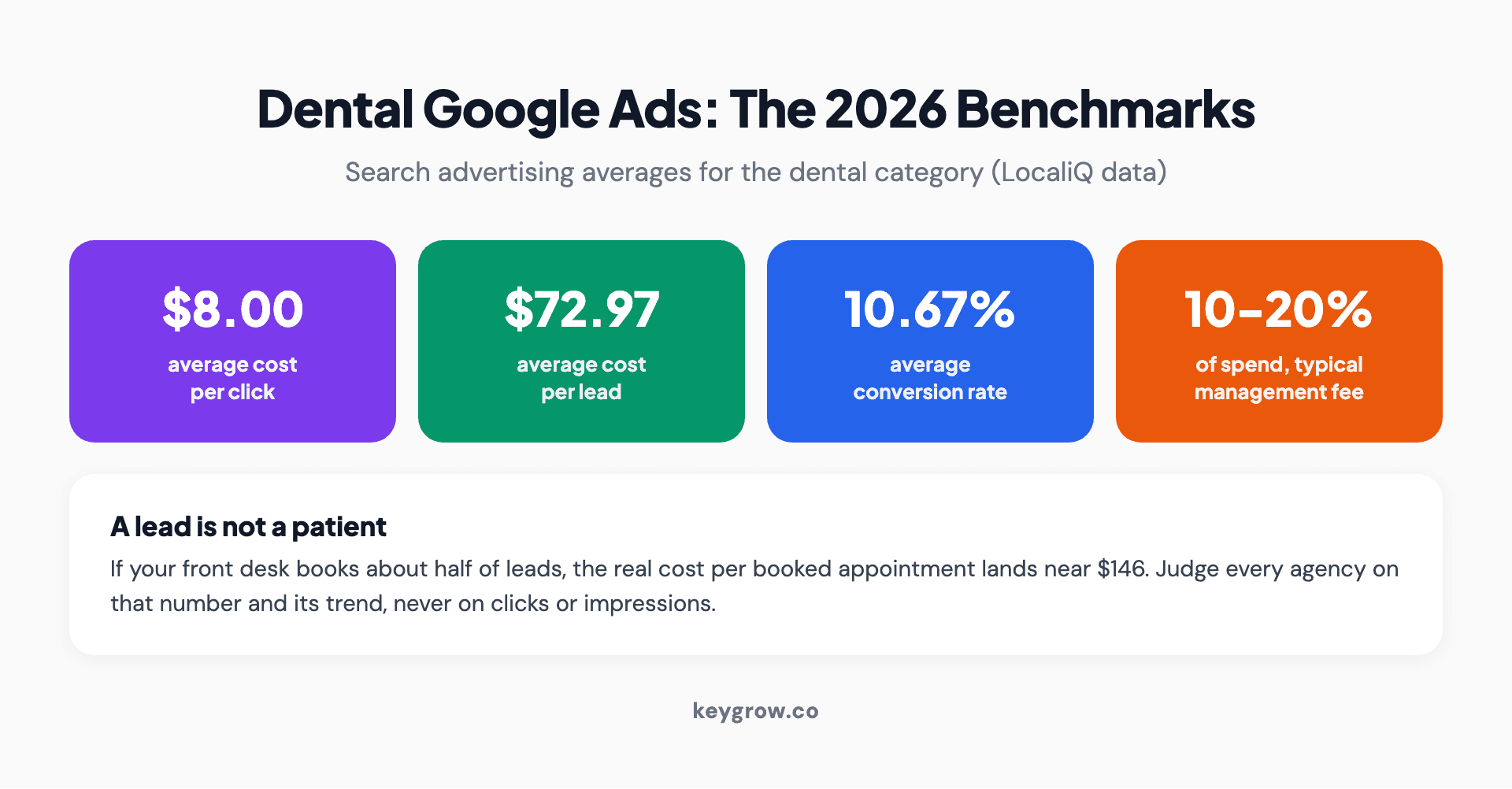
Dental Google Ads cost benchmarks for 2026: $8.00 average cost per click, $72.97 average cost per lead, 10.67 percent average conversion rate, and a typical management fee of 10 to 20 percent of ad spend.
Use the benchmarks in vetting: ask each agency what cost per lead their dental accounts actually run. A specialist answers in seconds with numbers in a plausible range. A generalist changes the subject to reach and branding.
One padding trick to know before you read any case study: branded search. Buying clicks on the practice's own name is cheap and converts brilliantly, because those people were already coming. An agency that leans on branded campaigns can report gorgeous averages while generating few genuinely new patients. Ask what share of reported conversions came from non-branded searches.
Make the money legible before anything else
The fee structure tells you more about an agency than its portfolio. The standard models are 10 to 20 percent of monthly ad spend, or a flat fee, typically starting around $500 to $750 a month for small practices and running to $2,500 or more for larger accounts, per one 2026 pricing guide. Both are legitimate. Each has an incentive problem worth naming: percent-of-spend rewards the agency for talking you into bigger budgets, and a suspiciously cheap flat fee usually means a templated account nobody looks at after launch.
The non-negotiable is separation. Your ad spend should go on your own card, directly to Google, with the management fee invoiced separately. A single bundled price exists to hide margin. You should be able to open the account any day and see exactly what Google charged.

A dentist talking a patient through options in a modern dental practice
For what the total budget should look like against your market and services, our full breakdown of Google Ads costs for dentists covers spend levels by practice type.
Own the account, or you are renting your own growth
The Google Ads account must live under your practice's ownership, with the agency working through manager access. This is the single highest-stakes line in the contract, and the one most owners never think to check.
Here is what walks out the door if the agency owns the account and you leave: the campaign history, the Quality Score history that keeps your clicks cheaper than a fresh account's, every conversion the account ever recorded, and the remarketing audiences built from your traffic. That loss is precisely what makes firing a bad agency feel impossible, and some agencies structure it that way on purpose.
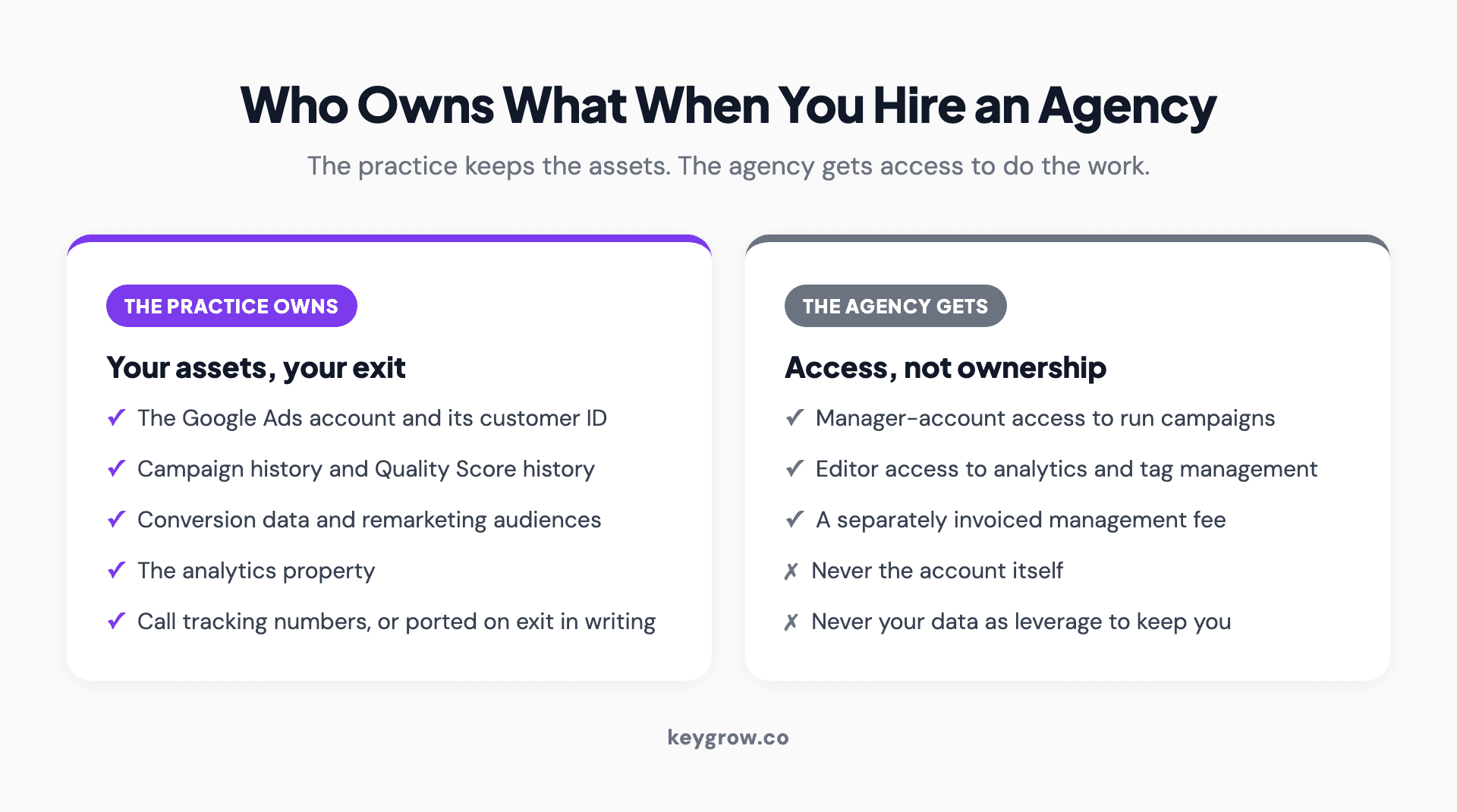
Who should own what in a dental Google Ads engagement: the Google Ads account, the analytics property, the campaign history and conversion data, and the call tracking numbers all belong to the practice; the agency gets manager access to do the work.
The same goes for your analytics property and your call tracking numbers (or at minimum a written commitment that numbers port to you on exit). The agency needs working access, not ownership. Any pushback on this point is a red flag with its own section below.
The Google Partner badge is a floor, not a differentiator
Almost every agency site wears the Google Partner badge, and almost every "how to choose" guide treats it as proof of quality. Here is what it actually requires, per Google's Partner criteria: a 70 percent optimization score across managed accounts, at least $10,000 of ad spend under management every 90 days, and half the agency's strategists holding Google certifications.
Two of those measure spend volume and test-taking. The third, optimization score, partly measures how readily the agency accepts Google's own automated recommendations, which are written to serve Google's revenue as much as yours. So read the badge as a floor: this agency is real, spends real money, and passed the exams. It says nothing about whether they will manage your account in your interest. The discovery call questions below will.
Ask about HIPAA before they pitch you remarketing
Dental practices are covered entities, and ad tracking is where marketing quietly collides with health privacy law. Regulators have moved on tracking pixels that tie website visitors to health services, and Google's own policy already prohibits personalizing ads based on health conditions, one of the reasons healthcare PPC carries risks other industries never face.
A serious dental agency should be able to answer three questions without flinching. How is call tracking handled when recordings may contain patient information (the right answer involves a business associate agreement with the call tracking vendor). What patient data, if any, feeds the ad platforms. And why they will not build remarketing audiences from appointment or treatment pages. An agency that pitches aggressive retargeting to a dental practice without raising any of this has not worked in healthcare long enough to be trusted with your account.
Five red flags that end the conversation
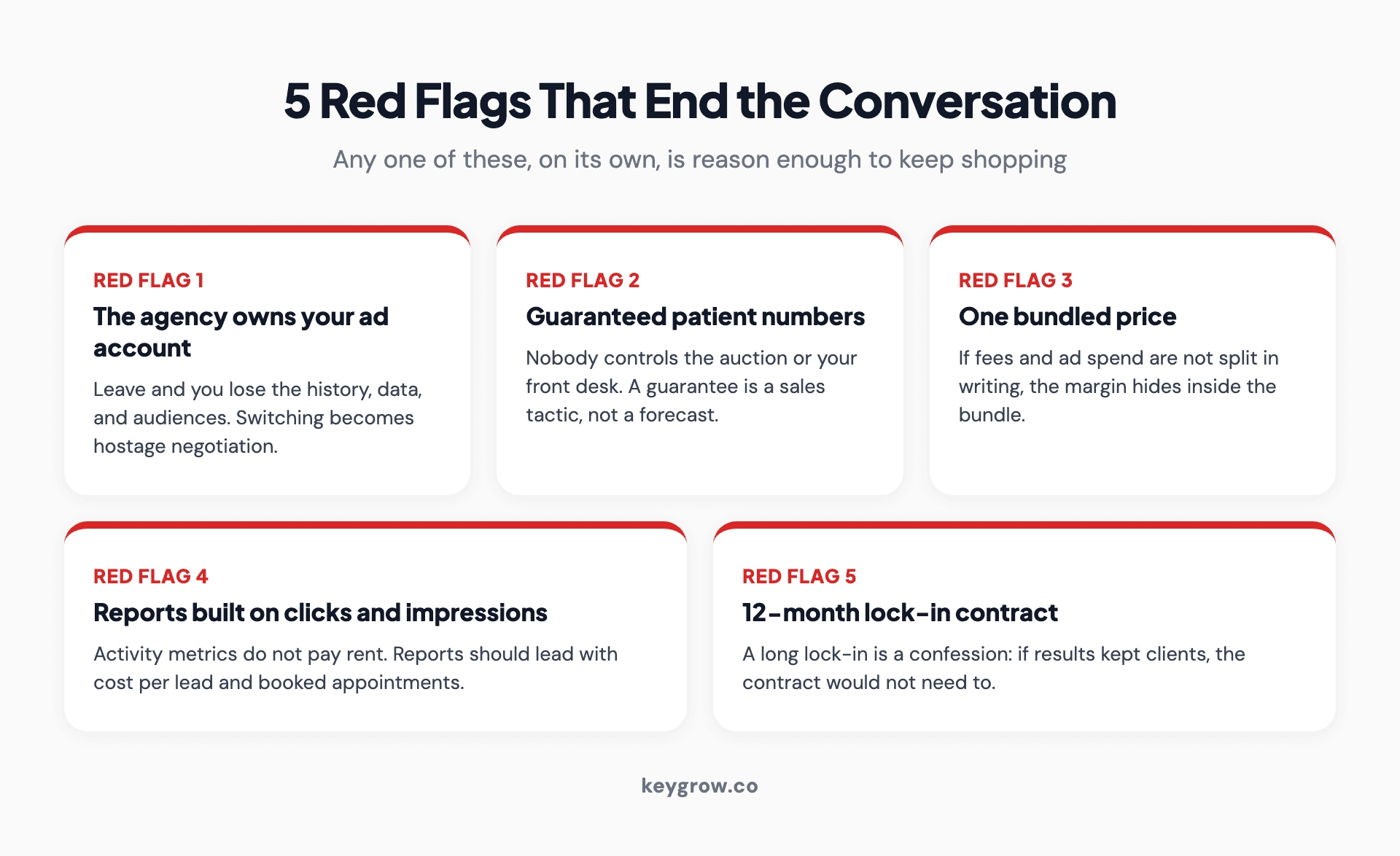
Five red flags when choosing a dental Google Ads agency: the agency owns your ad account, guaranteed new-patient numbers, one bundled price with no ad spend breakdown, reports built on clicks and impressions, and a 12-month lock-in contract.
The agency owns the ad account. Guaranteed patient numbers (nobody controls the auction or your front desk; a guarantee is a sales tactic, not a forecast). One bundled price with no spend breakdown. Reporting built on impressions and clicks. And the 12-month lock-in contract.
That last one deserves its sentence: a long lock-in is a confession. If an agency needs a contract to keep you, the results are not doing it. We run month-to-month, cancel anytime, precisely because the alternative lets an agency get paid for months after it has stopped earning it.
The discovery call: five questions and the answers you want
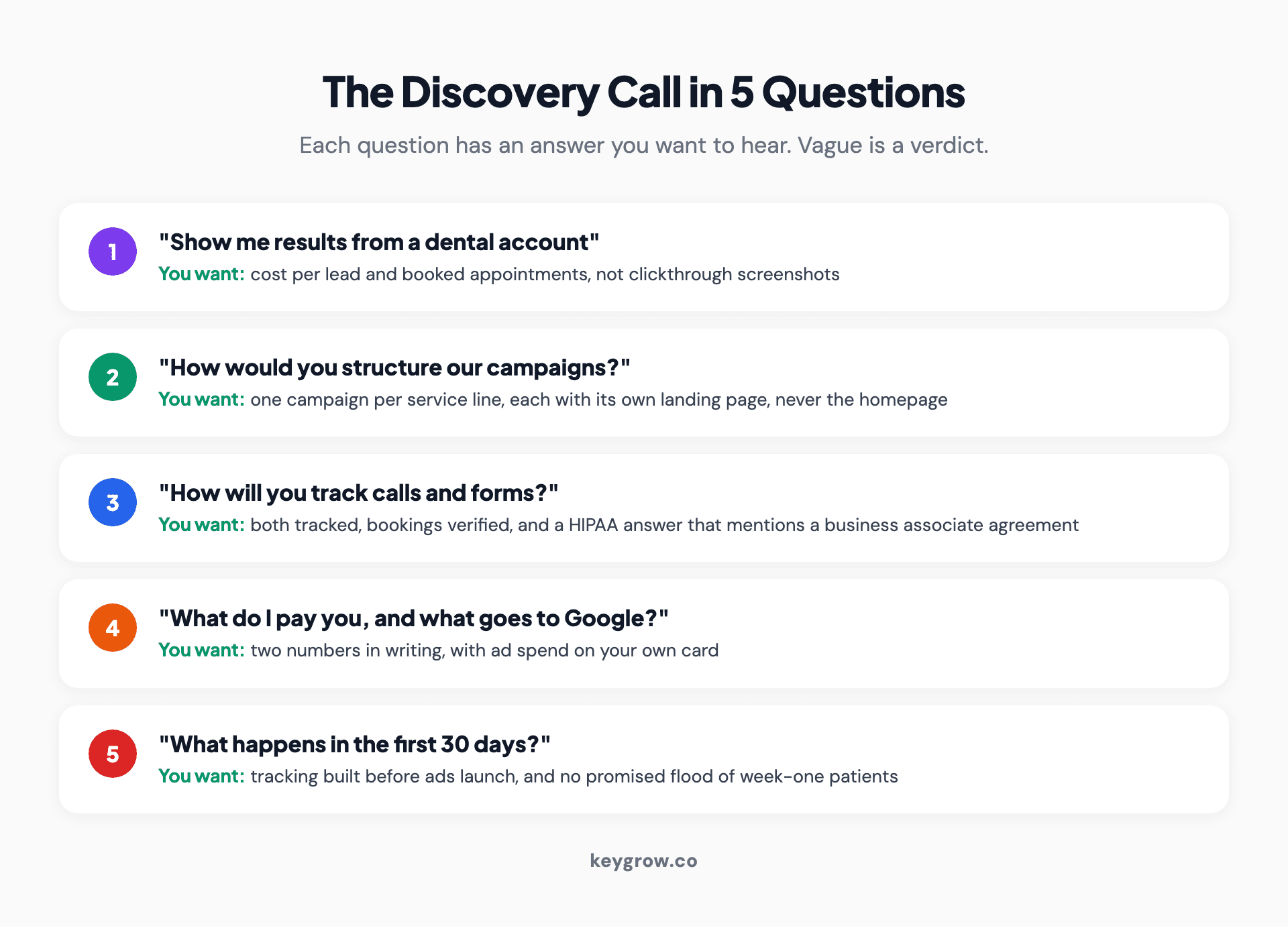
The five discovery call questions for a dental Google Ads agency, each with the answer you want to hear: dental results with cost per lead data, a per-service campaign plan, tracking for both calls and forms, a clear fee versus spend split, and a concrete first-30-days roadmap.
- "Show me results from a dental account." You want cost per lead and booked-appointment numbers, not screenshots of clickthrough rates.
- "How would you structure our campaigns?" You want one campaign per service line, each with its own landing page. If the plan sends traffic to your homepage, the call is over.
- "How will you track calls and forms?" You want both tracked, with call recording or scoring that confirms bookings, and a HIPAA answer that mentions a business associate agreement.
- "What do I pay you, and what goes to Google?" You want two numbers, in writing, with spend on your card.
- "What happens in the first 30 days?" You want tracking built before ads launch. Anyone promising a flood of patients in week one is guessing at your expense.
A bonus filter that separates specialists from template shops in one question: ask when they would recommend Local Services Ads instead of, or alongside, search campaigns. Dental emergencies are exactly the pay-per-lead territory where Local Services Ads can beat standard search, and an agency that has never thought about it is running the same playbook it runs for everyone.
FAQs
How much do agencies charge to manage Google Ads for dentists?
Most charge 10 to 20 percent of monthly ad spend or a flat fee, typically starting around $500 to $750 per month for small practices and scaling up with account size, on top of your ad budget. Be cautious at the extremes: very cheap flat fees usually buy a templated account, and bundled single prices hide the split between fees and actual ad spend.
Should I own my Google Ads account or should the agency?
You should own it, with the agency working through manager access. If the agency owns the account, you lose the campaign history, Quality Score history, conversion data, and remarketing audiences the day you leave, which makes switching agencies far more expensive than it should be.
How long does it take to see results from dental Google Ads?
Leads typically start within the first few weeks, since paid ads do not have SEO's ramp-up time. Give a new agency one clean 90-day window after conversion tracking is live, then judge the trend in cost per booked appointment month over month.
Does a Google Partner badge matter when choosing an agency?
Treat it as a minimum bar, not a differentiator. The badge confirms real spend under management, certified staff, and a 70 percent optimization score, but optimization score partly rewards accepting Google's automated recommendations. It proves the agency is legitimate, not that it will manage your budget in your interest.
How do I know if my current agency is working?
Ask for your cost per booked appointment and its three-month trend, then check what share of conversions came from non-branded searches. If reports lead with impressions and clicks, or most conversions turn out to be people searching your practice's own name, the account is coasting.
How much should a dentist spend on Google Ads?
It depends on your market and services, but with dental clicks averaging $8.00, meaningful data requires enough budget for a few clicks a day at minimum, and competitive metro markets require more. Size the budget to the service lines you want to grow, starting with your highest-value ones.
What to do next
Shortlist two or three agencies (our ranking of the best dental marketing agencies is one starting point), put all of them through the five discovery questions, and score what you hear against the checklist. The right agency will survive every question comfortably, because specialists get asked these things all the time. The wrong one will get vague exactly where this guide told you to look.
And if you would rather skip the shortlist: we run Google Ads for dental and local practices month-to-month, your account stays yours, and the first thing we build is the tracking that proves whether we deserve month two. Tell us about your practice and we will show you the math before you spend anything.