
Most dentists running a practice today face the same marketing question: should the budget go toward SEO, Google Ads, or both? The answer depends on the practice's stage, location, competition, and how fast new patients need to come through the door.
This guide breaks down SEO vs Google Ads for dentists in plain terms. It covers cost, speed, lead quality, ROI, and the real-world situations where each channel wins. By the end, the right choice for any specific dental practice should be clear.
What Is SEO for Dentists?
SEO (Search Engine Optimization) is the work of getting a dental website to show up in Google's organic, unpaid results when someone searches for things like "dentist near me," "Invisalign in Austin," or "emergency root canal." It includes on-page content, technical fixes, local SEO signals, Google Business Profile optimization, and earning links from other websites.
Done well, SEO for dental clinics builds a steady stream of patient inquiries that doesn't disappear when the marketing budget pauses. Done badly, it eats months of effort with nothing to show for it.
The trade-off is time. Most dental SEO campaigns take three to six months before traffic starts climbing, and nine to twelve months before the practice sees serious lead flow. But once rankings stick, they keep producing patients at a much lower cost per lead than paid ads.
What Are Google Ads for Dentists?
Google Ads is the paid side of search, the tool most people mean when they say SEM or PPC. The practice bids on keywords like "cosmetic dentist Dallas" or "dental implants near me," and Google places the practice at the top of search results, above the organic listings. Each click costs money, whether the visitor books an appointment or not.
For dentists, Google Ads for dental practices typically run on a search-based campaign structure: targeted keywords, geo-fenced to the practice's service area, with ads pointing to high-converting landing pages. Some practices also run Local Service Ads (LSAs), which charge per qualified lead instead of per click.
The biggest advantage is speed. A new Google Ads campaign can produce phone calls and appointment bookings within hours of launch. The biggest drawback is that the leads stop the moment the budget stops.
SEO vs Google Ads for Dentists: At-a-Glance Comparison
| Factor | SEO for Dentists | Google Ads for Dentists |
|---|---|---|
| Time to first results | 3 to 6 months | Same day |
| Cost structure | Upfront investment, lower long-term | Pay per click, ongoing |
| Average cost per lead | $25 to $60 (after ramp-up) | $50 to $84 |
| Lead quality | High (intent-driven) | High (intent-driven) |
| Stops when budget stops | No | Yes |
| Compounds over time | Yes | No |
| Predictable monthly volume | Less predictable early on | Highly predictable |
| Best for | Long-term growth, established practices | Fast results, new practices, promotions |
| Dependency risk | Algorithm updates | Bid increases, account suspensions |
| Trust signal for patients | Higher (organic placement) | Lower (labeled "Sponsored") |
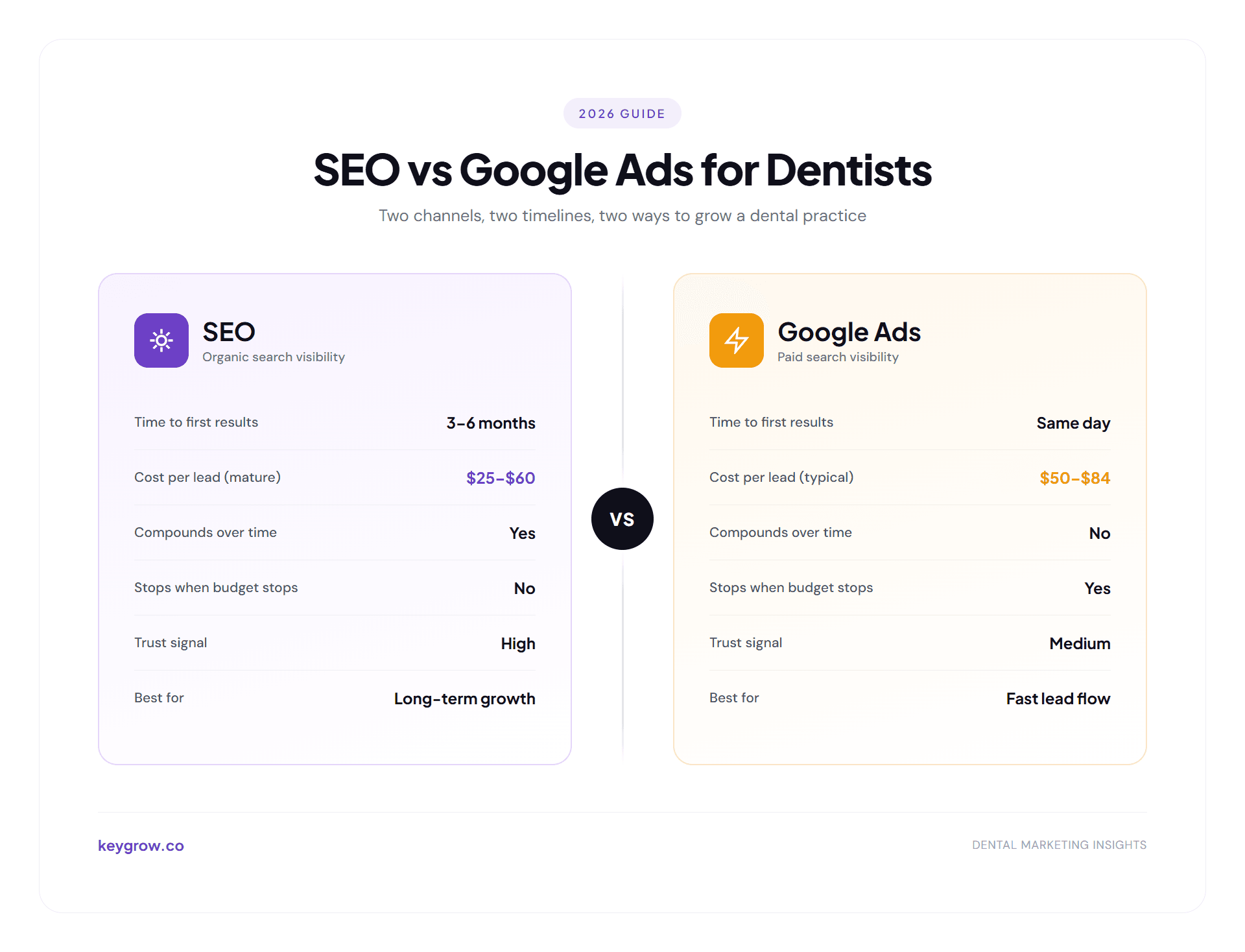
Side-by-side comparison of SEO and Google Ads for dentists showing time to results, cost per lead, compounding behavior, and trust signals
This table covers the headline differences. The next sections go deeper.
Time to Results: The Most Important Difference
Speed is where these two channels separate sharply.
Google Ads delivers traffic the same day a campaign goes live. A cosmetic dental practice can be running a fully-targeted campaign by 9 a.m. and getting calls by lunchtime. For practices that just opened, are entering a new market, or need to fill a calendar gap quickly, this is the only channel that does that job.
SEO works on a different timeline. Most dental practices see meaningful organic traffic growth around month four, with month-over-month compounding from month six onward. By month twelve, well-executed SEO often outproduces a paid campaign at a fraction of the long-term cost.
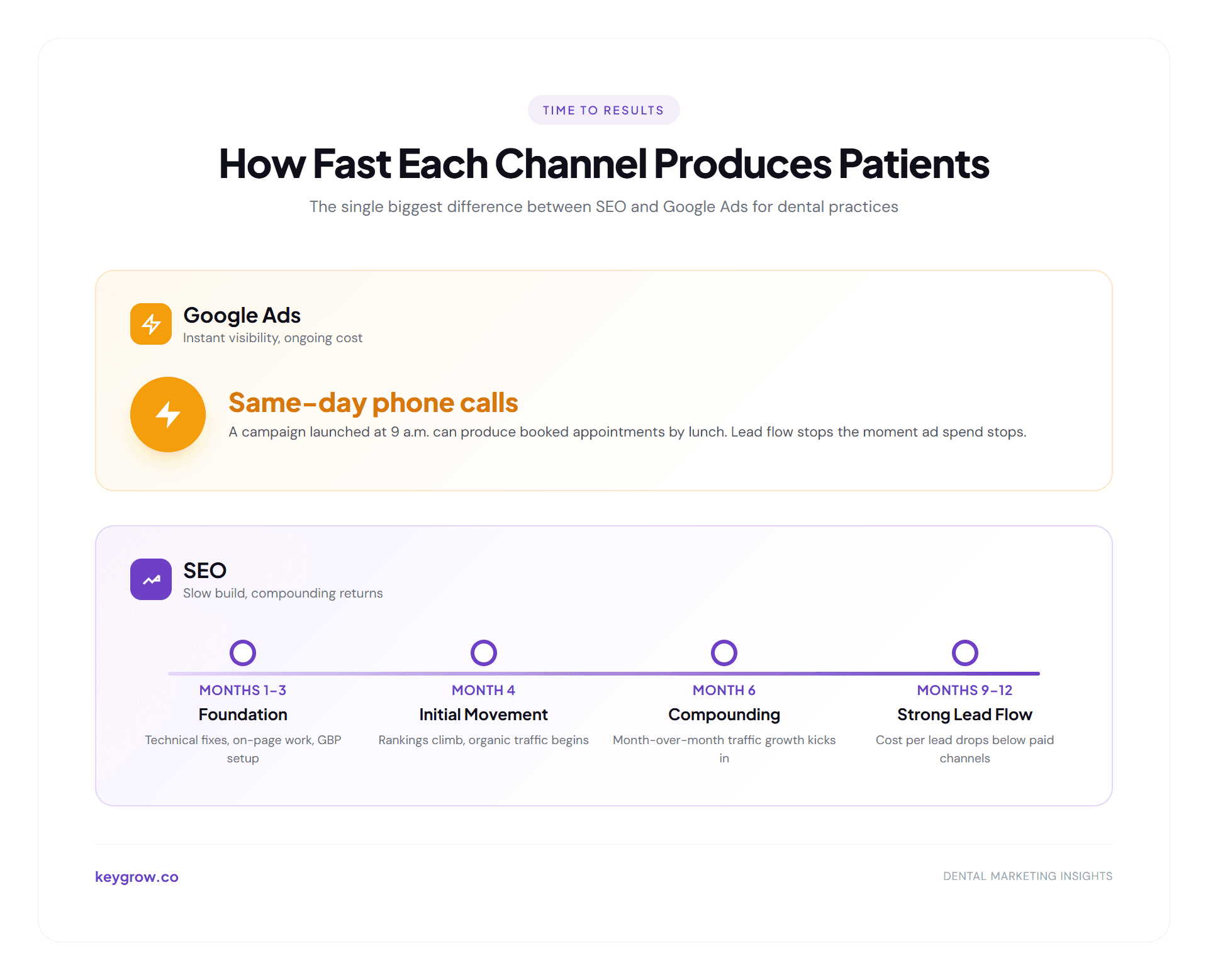
Visual timeline comparing same-day Google Ads results with the 3 to 12 month SEO ramp-up phases for dental practices
If the practice cannot wait six months, SEO alone is the wrong answer. If the practice is willing to invest in long-term visibility while also running ads, SEO becomes the smarter half of the strategy.
Cost Comparison: What Dentists Actually Spend
The costs of dental marketing vary widely, but the benchmarks are well-documented in 2026.
Google Ads Cost for Dentists
Google Ads in the dental industry is one of the more expensive ad markets. Average CPCs run around $7.85, with high-intent procedures pushing much higher:
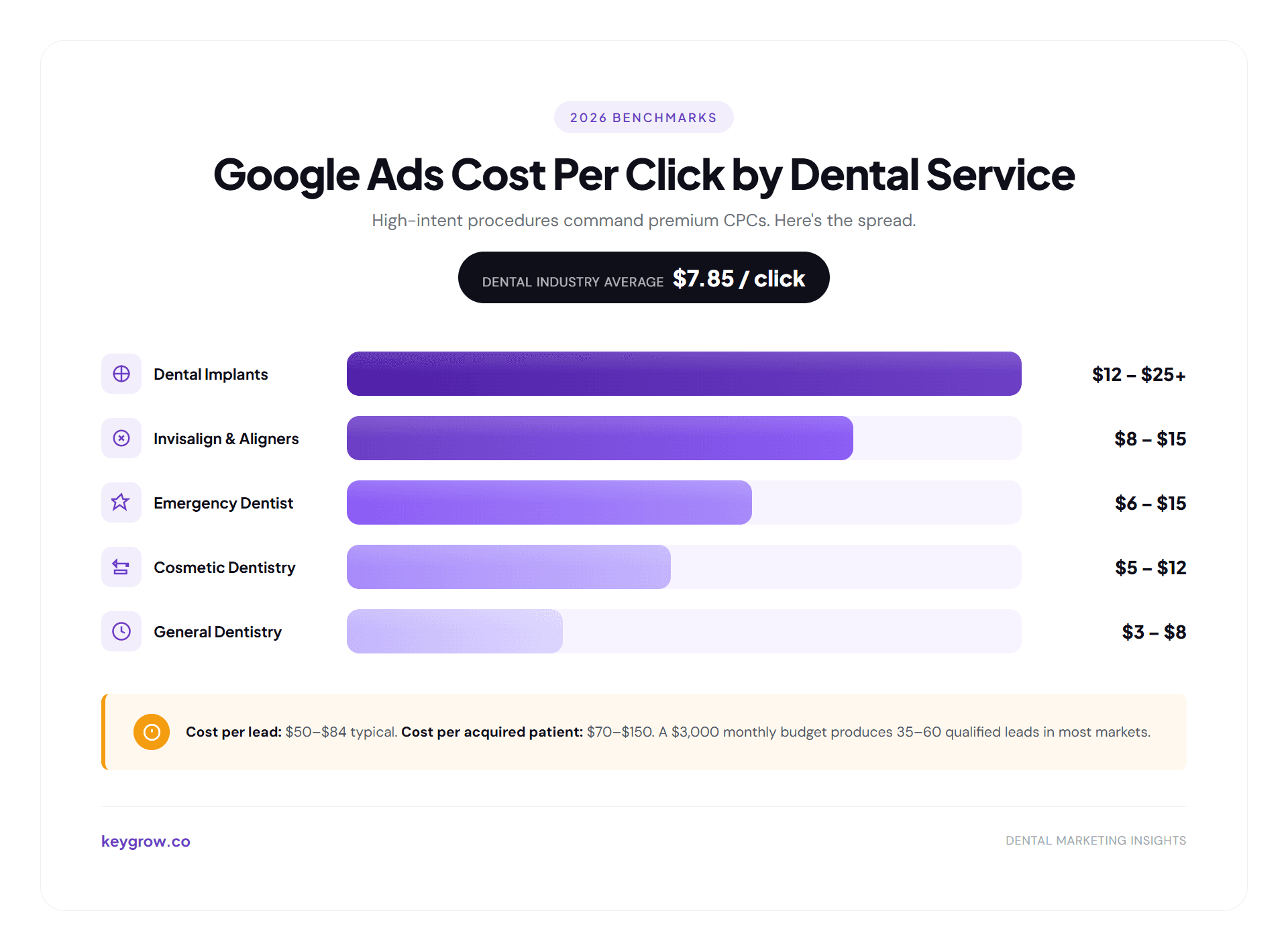
Google Ads cost per click ranges by dental service: dental implants $12 to $25, Invisalign $8 to $15, emergency dentist $6 to $15, cosmetic $5 to $12, general dentistry $3 to $8
Cost per lead lands between $50 and $84 for most practices, and cost per acquired patient between $70 and $150. A practice spending $3,000 a month can realistically generate 35 to 60 qualified leads, depending on the market and conversion rates.
For a deeper breakdown, the Google Ads cost guide for dentists covers the math by service type, location, and budget tier. Practices that want to model their own ROI before committing budget can use the Google Ads ROI calculator and the Google Ads budget calculator.
SEO Cost for Dentists
SEO doesn't have a per-click price. Practices either invest in an in-house effort or hire an agency. Typical monthly retainers in 2026 fall into three brackets:
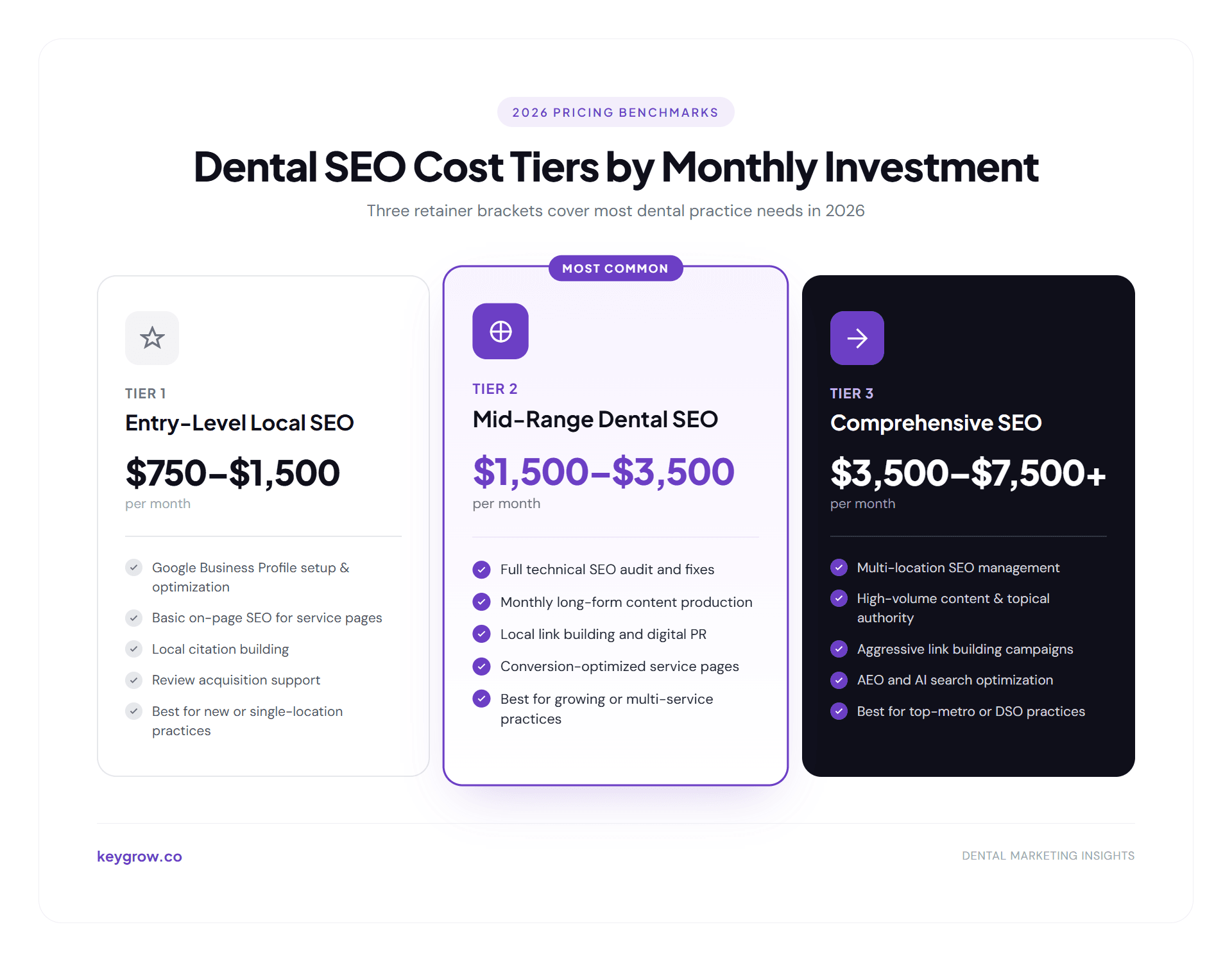
Three-tier dental SEO pricing brackets showing entry-level local SEO at $750 to $1,500, mid-range dental SEO at $1,500 to $3,500, and comprehensive SEO at $3,500 to $7,500 plus per month
The first six months feel expensive because traffic is still building. From month seven onward, most practices see their cost per lead drop below $40, and by year two it can fall under $25 for established sites. SEO doesn't hit a ceiling the way Google Ads does, where every additional lead costs roughly the same.
Lead Quality: Are SEO Leads or Google Ads Leads Better?
Both channels capture high-intent searches. Someone typing "best dentist for veneers near me" wants to book an appointment, not browse for fun. So in raw intent, SEO and Google Ads both deliver strong leads.
The differences are subtler:
For high-ticket procedures like full-mouth implants or full smile makeovers, SEO often produces better-qualified leads because patients self-educate before contacting the practice. For urgent care like emergency dental visits, Google Ads dominates because patients aren't reading blog posts. They're calling the first practice that answers.
Long-Term Value and Compounding
This is where SEO pulls ahead, and it's the strongest argument against treating Google Ads as a permanent solution.
Every Google Ads click is a transaction. The practice pays, the click happens, the lead either converts or doesn't, and the next click costs the same. The marketing spend produces nothing that keeps working tomorrow.
SEO works the opposite way. A blog post that ranks for "is Invisalign worth it" today will keep ranking next year, and the year after, with minor maintenance. Service pages that earn local rankings keep producing inquiries even if the marketing budget shrinks. Every link, every page, every review compounds.
Practices that invest in dental SEO for two to three years often reach a point where they can throttle paid spend during slow seasons because organic traffic carries the calendar.
When SEO Wins for Dentists
SEO is the better primary channel when:
If most of those apply, SEO will outperform paid ads on a five-year cost basis by a wide margin.
When Google Ads Wins for Dentists
Google Ads is the better primary channel when:
Most new practices use Google Ads as a primary channel for the first 12 to 18 months, then shift the mix toward SEO as organic traffic builds.
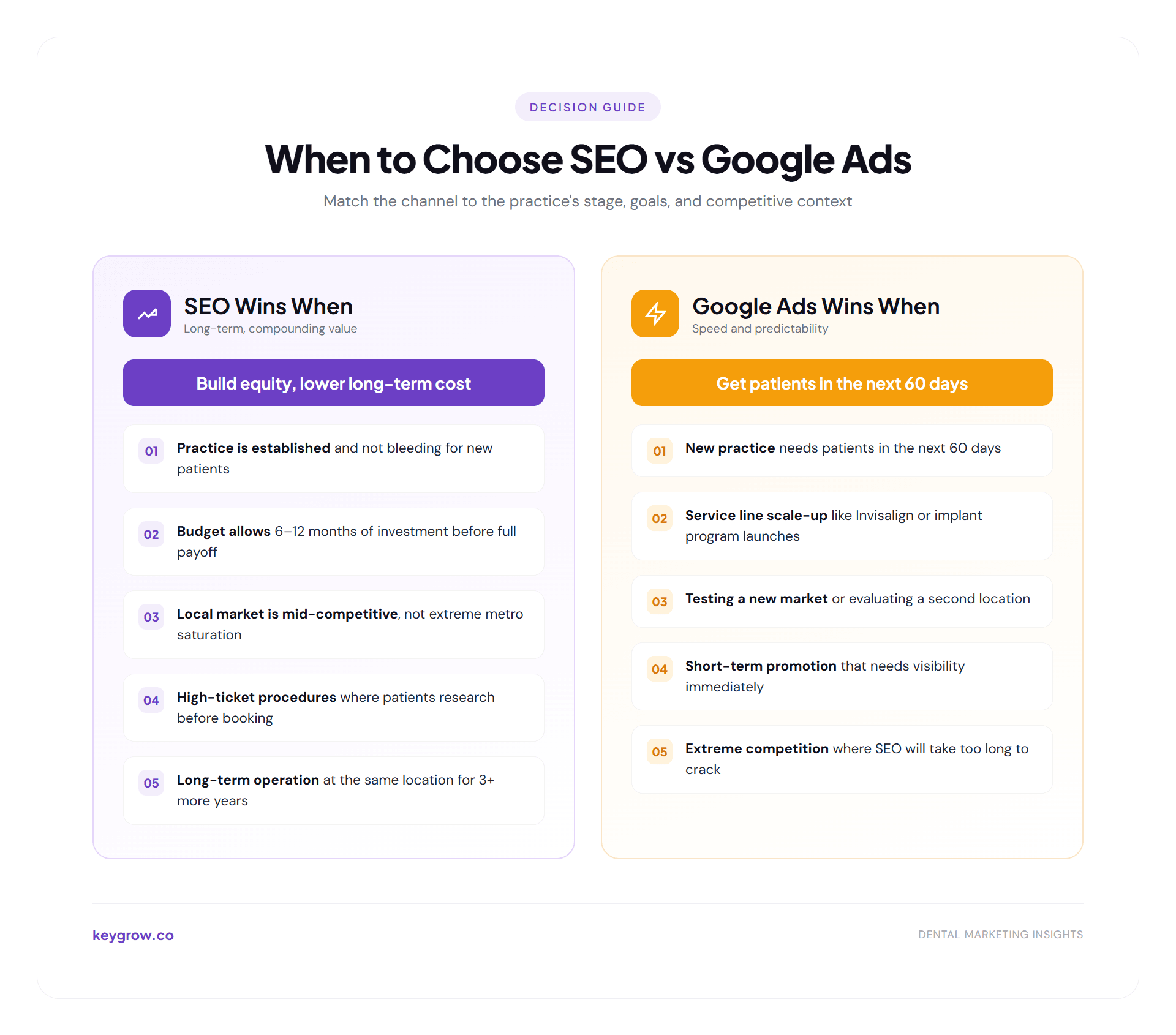
Decision matrix showing the top scenarios when SEO wins versus when Google Ads wins for dental practices
The Smarter Answer: Combine SEO and Google Ads
The honest answer to "SEO or Google Ads" for most dentists is: both, but in shifting proportions over time.
In year one, the budget might lean 70% Google Ads, 30% SEO. The ads keep the practice's calendar full while SEO builds. By year two, the split often flips to 50/50 as organic leads start replacing paid ones. By year three, many practices run 60% to 70% SEO with Google Ads filling specific gaps (implant promos, new service launches, slow months).
The two channels also reinforce each other. Practices running both see:
This is why most experienced agencies offering dentist marketing services recommend a layered strategy rather than picking one channel and ignoring the other. A deeper look at the trade-off between paid speed and organic compounding is covered in the local PPC vs SEO comparison for small businesses.
Local SEO: The Most Underused Lever for Dentists
A specific subset of SEO deserves its own section because it directly competes with Google Ads for local clicks: local SEO.
When a patient searches "dentist near me," Google shows three things in this order:
1. Google Ads (top of page)
2. The Local Pack (Google Maps results, three listings)
3. Organic results (websites)
Local SEO targets that middle band, the Local Pack. Practices that rank in the Map Pack get a huge share of clicks without paying per click. The work involves:
For most dental practices, ranking in the Map Pack is more valuable than ranking #1 in organic results, and it costs a fraction of what Google Ads does. Practices that ignore local SEO and pour everything into Google Ads are leaving the highest-converting traffic on the table.
AEO: The Channel Reshaping Dental Search in 2026
There's a third channel worth mentioning because it now shapes how the SEO vs Google Ads conversation plays out.
Patients increasingly use AI tools (ChatGPT, Gemini, Perplexity, Google AI Overviews) to ask dental questions. "What's the best dentist for veneers in Phoenix?" "Is sedation dentistry safe?" "How much do dental implants cost in Texas?" These searches don't always go through Google's traditional results. They get answered by AI directly.
Answer Engine Optimization (AEO) is the work of getting cited inside those AI answers. It involves structuring content for AI extraction, building topical authority, using structured data, and creating clear FAQ-style content that AI tools can pull from confidently.
For dentists, AEO services for dental practices are quickly becoming a third leg of the marketing stool. Practices that get cited by AI for high-intent dental questions show up in front of patients before they ever click an ad or browse organic results.
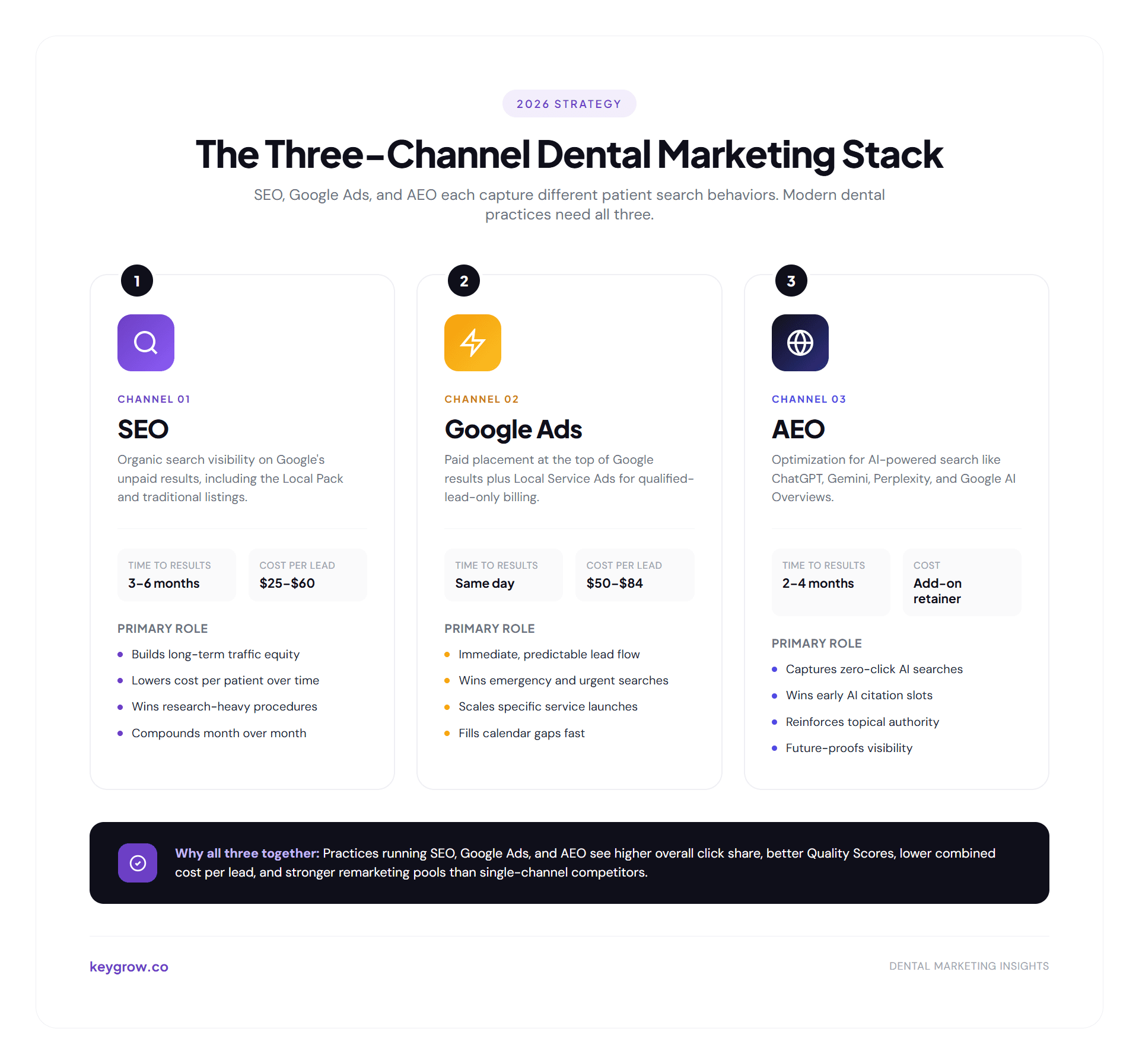
Three-pillar dental marketing strategy showing SEO, Google Ads, and AEO channels with time to results, cost per lead, and primary role for each
This doesn't replace SEO or Google Ads. It complements both. But ignoring AEO in 2026 is similar to ignoring local SEO in 2018: the early movers will lock in long-term advantages.
Common Mistakes Dentists Make with SEO
Most dental SEO failures come from the same handful of mistakes:
Targeting only generic keywords. "Dentist" alone is impossible to rank for. Practices win by targeting specific service plus location terms ("Invisalign provider in [city]," "pediatric dentist in [neighborhood]").
Ignoring local signals. Skipping Google Business Profile optimization, neglecting reviews, or leaving inconsistent NAP (Name, Address, Phone) data across the web kills local rankings.
Thin service pages. A 200-word page on "dental implants" won't rank against competitors with 1,500-word, well-structured pages.
No content strategy. Practices that publish a blog post once a quarter rarely build topical authority. SEO rewards consistent, in-depth content over time.
Hiring cheap SEO providers. Dental SEO has specific compliance and trust requirements. Generic SEO providers often cause more harm than good with low-quality link building or thin AI-generated content.
Common Mistakes Dentists Make with Google Ads
The paid side has its own common failure points:
Sending traffic to the homepage. Homepages are designed for general browsing, not conversion. Each ad campaign needs a dedicated landing page focused on the specific service.
Bidding on broad match keywords without negatives. Without a strong negative keyword list, the practice pays for clicks from people searching "dental school," "dentist jobs," or "dentist salary."
Wrong bidding strategy. Many dentists start with Manual CPC, which is fine, but switching too quickly to Maximize Conversions before the account has data leads to wasted spend. The progression should generally be Manual CPC, then Maximize Conversions once the account has 30+ conversions, then Target CPA when there's enough data to support it.
No conversion tracking. Running Google Ads without proper call tracking, form tracking, and offline conversion data means the practice can't tell which keywords actually produce patients.
Ignoring Quality Score. Low Quality Scores inflate CPCs by 100% to 400%. Most dental practices could cut their ad spend in half by improving landing page experience and ad relevance.
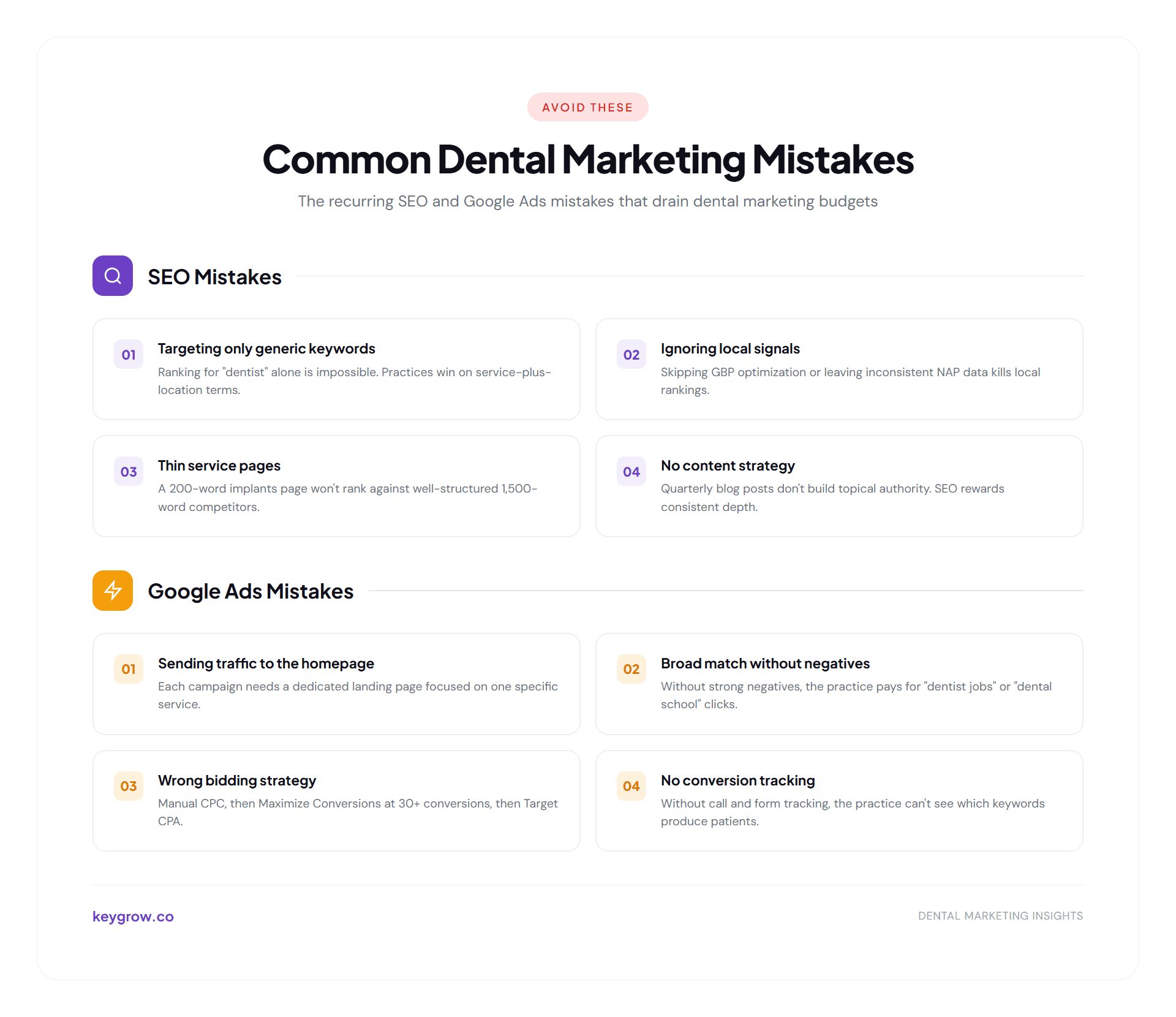
Common dental marketing mistakes covering four SEO mistakes including generic keywords and thin service pages, plus four Google Ads mistakes including homepage traffic and broken bidding strategies
How to Decide: A Practical Framework
Here's the simplest way for a dentist to decide where to put the next marketing dollar:
If the practice is less than 18 months old: Start with Google Ads as the primary channel and begin foundational SEO (Google Business Profile, basic local SEO, on-page content). Budget split: 70% ads, 30% SEO.
If the practice is 18 months to 5 years old: Run both channels at meaningful scale. SEO should now be producing measurable organic traffic, and Google Ads should be optimized for specific high-margin services. Budget split: 50/50.
If the practice is 5+ years old: SEO should be the primary growth lever, with Google Ads used surgically for new services, slow months, or specific competitive battles. Add AEO to the mix. Budget split: 60% SEO + AEO, 40% ads.
If the practice operates in extreme competition (top 20 metros): Both channels need significant investment, and the timeline shifts. Even established practices should keep Google Ads at 40% to 50% of budget because organic competition is brutal.
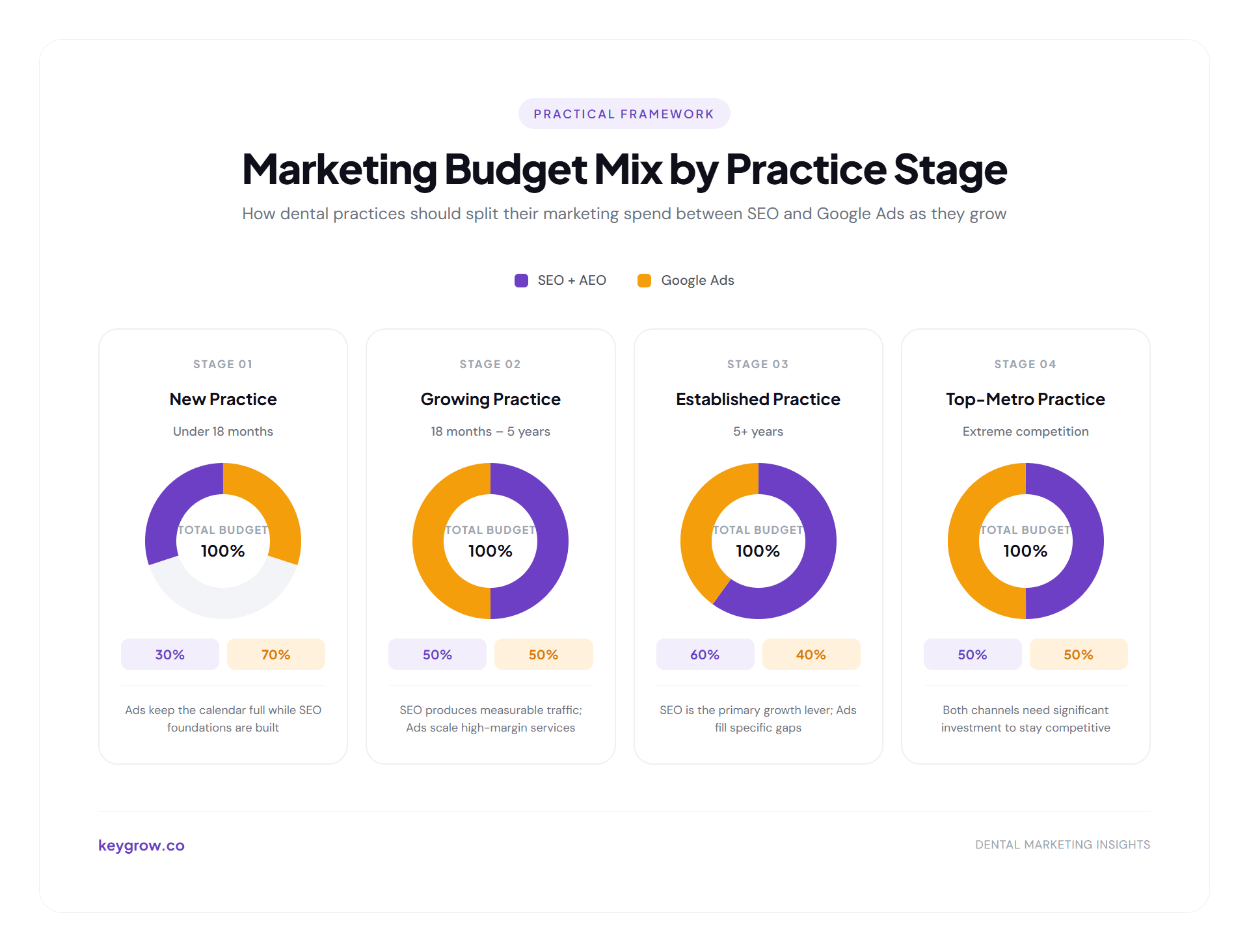
Marketing budget allocation by dental practice stage: new practice 30/70 SEO to Ads, growing practice 50/50, established 60/40, and top-metro 50/50
This framework isn't rigid. Specific service mix, geography, and growth goals all shift the answer. Practices building out a conversion-optimized dental website alongside paid and organic search tend to see the strongest results regardless of stage.
Why Many Dentists Work with Specialized Marketing Agencies
Running both SEO and Google Ads well is a full-time job. It also requires real expertise in dental-specific keyword research, healthcare marketing compliance, conversion-optimized landing pages, and analytics setup. Most practice owners try to handle it themselves at first, then hire a generalist agency, then eventually move to a specialist.
KeyGrow is one of the agencies that focuses specifically on dental practices, offering integrated SEO, PPC, AEO, and website development under one roof. Working with a dental-focused agency means the team already understands the procedure economics, the average cost per acquisition for different services, the keyword landscape, and the patient journey. That shaves months off the learning curve and avoids the common money-burning mistakes outlined earlier.
For practices comparing options, the top digital marketing agencies for dentists breakdown gives a useful starting point.
Bottom Line: SEO vs Google Ads for Dentists
The short version:
The dentists who treat this as an either/or question usually lose. The ones who build a layered strategy, paid for speed, organic for long-term equity, and AEO for the new AI search wave, are the ones who dominate their local markets in 2026 and beyond.
FAQs
Is SEO or Google Ads better for a new dental practice?
Google Ads is better for new dental practices because it produces leads the same day a campaign launches. SEO takes three to six months to gain traction. New practices should start with Google Ads as the primary channel while building SEO foundations in parallel, then shift more budget to SEO once the practice has 12 to 18 months of operating history.
How much should a dentist spend on Google Ads per month?
Most dental practices spend $1,500 to $5,000 per month on Google Ads, with $3,000 being a common starting point in mid-sized markets. Practices in competitive metros or targeting high-ticket services like dental implants often spend $5,000 to $10,000 per month. Below $1,500, ad spend is usually too thin to produce meaningful data or consistent leads.
How long does dental SEO take to work?
Dental SEO typically shows initial movement in three to four months, meaningful traffic growth by month six, and strong lead flow by months nine to twelve. Practices in less competitive markets can see results faster. Highly competitive metros like Los Angeles or New York may need 12 to 18 months before SEO produces a strong cost per lead compared to Google Ads.
What's the average cost per lead for dental SEO vs Google Ads?
After SEO matures, cost per lead typically falls between $25 and $60. Google Ads cost per lead for dentists usually runs $50 to $84, depending on the service and location. SEO has a higher upfront cost but a lower steady-state cost. Google Ads has a flat ongoing cost that doesn't decrease over time without major optimization.
Do dentists need both SEO and Google Ads?
Most dental practices benefit from running both. Google Ads provides immediate, predictable lead flow. SEO builds long-term organic visibility that lowers the overall marketing cost per patient over time. Practices that combine both channels usually see better total search visibility, lower combined cost per lead, and stronger competitive positioning in their local market.
What is local SEO for dentists?
Local SEO for dentists is the process of optimizing a dental practice to appear in location-based searches like "dentist near me" and in the Google Maps Local Pack. It includes Google Business Profile optimization, review generation, local citations, location-based content, and geo-targeted on-page SEO. Local SEO is often the highest-ROI channel for dental practices.
Is dental SEO worth the investment?
Dental SEO is worth the investment for any practice planning to operate in the same location for three or more years. The cost per lead drops significantly after the first 12 months, and organic rankings continue producing patients without ongoing per-click costs. Practices in highly competitive markets may need a larger upfront investment but typically see compounding returns.
Can a dentist run Google Ads without an agency?
A dentist can run Google Ads without an agency, but most practices waste 30% to 50% of their budget in the first six months due to common mistakes like broad keyword targeting, weak landing pages, and incorrect bidding strategies. Agencies that specialize in dental PPC typically charge $500 to $2,500 per month and usually pay for themselves through better cost per acquisition.
Which dental services are most expensive on Google Ads?
Dental implants are the most expensive dental keywords on Google Ads, with cost per click running $12 to $25 or higher in competitive markets. Cosmetic dentistry, Invisalign, and emergency dentistry also command premium CPCs. General dentistry and pediatric dentistry tend to have lower CPCs in the $3 to $8 range, making them more cost-effective for budget-conscious practices.
Does AEO replace SEO for dental practices?
AEO does not replace SEO. It complements it. SEO targets traditional Google search results, while AEO targets AI-powered search tools like ChatGPT, Perplexity, and Google AI Overviews. Both channels rely on similar foundations (quality content, structured data, topical authority) but require different optimization tactics. Dental practices in 2026 should invest in both to capture patients across all search behaviors.


