
Google Ads cost for dentists averages $7.85 per click in the United States, with most practices spending between $1,500 and $5,000 per month depending on their location, competition, and the services they promote. But cost per click is only part of the story. The real question is what those clicks return in revenue, and whether the math works for a specific practice.
This guide breaks down every cost variable a dental practice needs to understand before investing in paid search. From average benchmarks by service type to budget recommendations by practice size, this is a complete reference for any dentist evaluating Google Ads as a patient acquisition channel.
Why Dentists Should Invest in Google Ads
When someone types "dentist near me" or "emergency tooth extraction" into Google, they are not browsing. They are looking for a provider and are often ready to book. That intent is what makes Google Ads so effective for dental practices.
Unlike traditional advertising like billboards, direct mail, and radio, paid search advertising lets a practice appear at the exact moment a potential patient is searching for treatment. And every click, call, and form submission can be tracked, which makes it possible to calculate the actual cost of acquiring each new patient.
A few reasons paid search stands out for dental clinics:
For most dental practices, Google Ads is the fastest path to new patient inquiries. SEO builds long-term visibility, but ads generate calls and appointments within days of launching a campaign.
How Google Ads Works for Dental Practices
Google Ads operates on an auction-based model. When a potential patient searches for a keyword like "dental implants near me," Google runs an instant auction among all advertisers bidding on that phrase. The ads that win appear at the top of the search results page.
But it is not a pure highest-bidder-wins system. Google also factors in ad relevance and landing page quality through something called Quality Score. A practice with highly relevant ads and a well-designed landing page can pay less per click than a competitor with a higher bid but a lower Quality Score.
Search Ads vs. Display Ads vs. Local Service Ads
Search Ads show up when someone actively searches for a dental service. These are the most common and typically most effective type of ad for dentists. The practice pays each time someone clicks.
Display Ads appear on websites across Google's display network, including news sites, blogs, and apps. These are better for brand awareness and remarketing than for direct patient acquisition. The cost per click is usually lower, but so is the conversion rate.
Local Service Ads (LSAs) appear above traditional search ads and operate on a pay-per-lead model rather than pay-per-click. For dentists, LSAs typically cost $106 to $119 per lead depending on the city. They also come with a "Google Screened" badge, which builds trust. LSAs work best alongside traditional search campaigns, not as a replacement.
Keyword Intent in Dental Marketing
Not all dental keywords are equal. A search for "how to floss properly" signals curiosity. A search for "emergency dentist open now" signals someone who needs treatment today.
High-intent keywords like "dentist accepting new patients," "dental implants [city]," and "teeth whitening near me" cost more per click, but convert at a much higher rate. Low-intent keywords like "dental care tips" attract traffic that rarely books an appointment.
Structuring campaigns around intent is one of the most important decisions in dental PPC strategy. Spending on the wrong keywords is the fastest way to waste an ad budget.
Average Google Ads Cost for Dentists
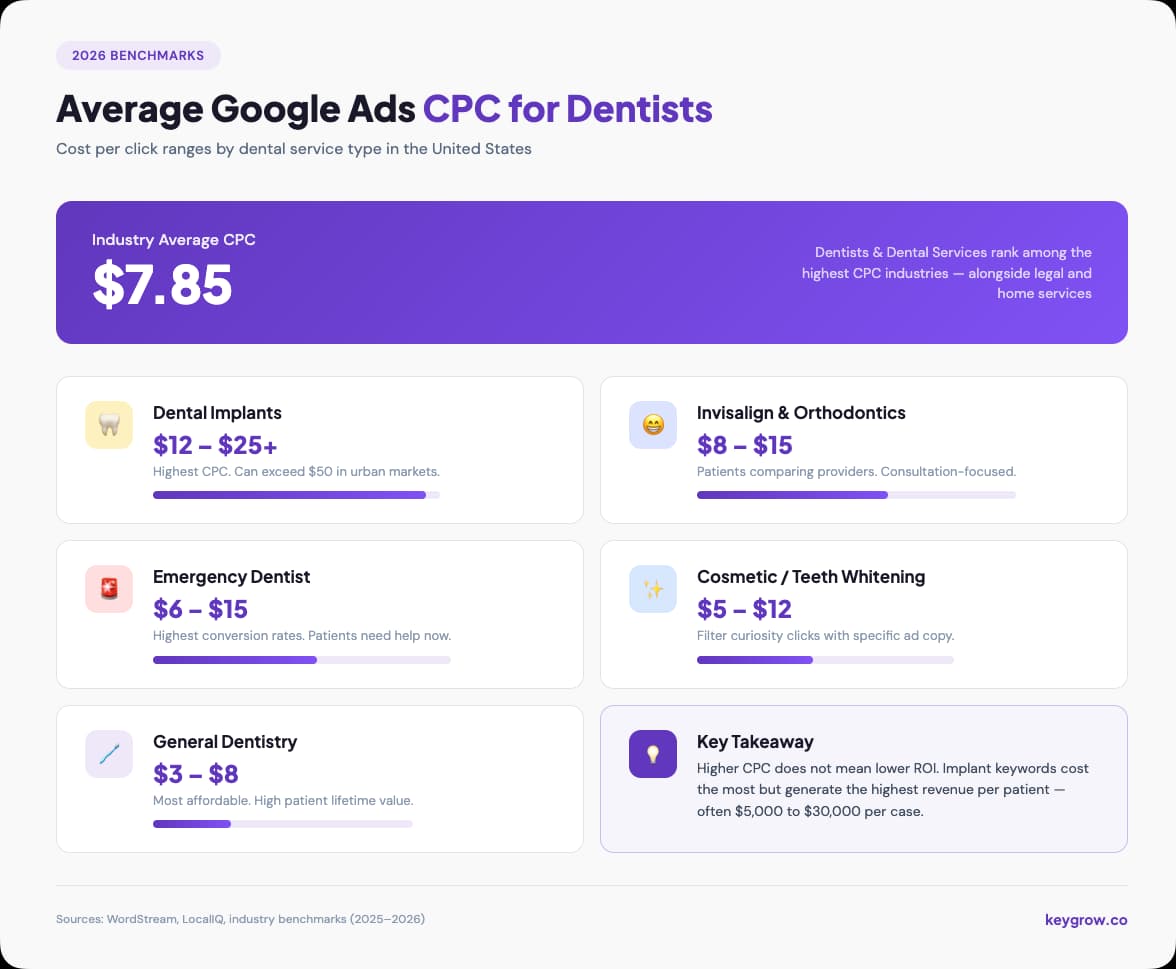
Average Google Ads CPC for dental services with implant, emergency, cosmetic, Invisalign, and general dentistry CPC ranges
Here are the key benchmarks for dental Google Ads in 2026, based on industry data:
Cost Per Click (CPC) Benchmarks
The average cost per click for dental ads in the U.S. sits around $7.85. But that figure varies widely depending on keyword type and location:
CPCs in major metro areas (New York, Los Angeles, Chicago) can run 30–60% higher than rural or suburban markets.
Cost Per Lead (CPL)
The average cost per lead for dental Google Ads falls between $50 and $84, depending on how well campaigns are optimized. Cost per lead measures how much it costs to generate a phone call, form submission, or chat inquiry, regardless of whether that lead actually books an appointment.
Well-optimized campaigns consistently hit CPLs 20–30% below the industry average. Poorly managed campaigns can push CPLs above $113.
Cost Per New Patient
The actual cost of converting a click into a booked, seated patient typically falls between $70 and $150 for general dental services. For specialty procedures like implants, veneers, or full-arch restorations, cost per acquisition can reach $200–$400, which is still highly profitable given the revenue per case.
Monthly Budget Ranges
| Market Type | Monthly Ad Spend | Expected Clicks | Estimated Leads |
|---|---|---|---|
| Small town / low competition | $1,500–$2,000 | 190–255 | 19–26 |
| Mid-size city / moderate competition | $2,500–$3,500 | 320–445 | 32–45 |
| Major metro / high competition | $4,000–$7,000+ | 510–890 | 50–89 |
*Estimates assume the industry average CPC of $7.85 and a 10% conversion rate. Actual results depend on campaign quality, landing pages, and call handling.*
Factors That Affect Google Ads Cost for Dentists
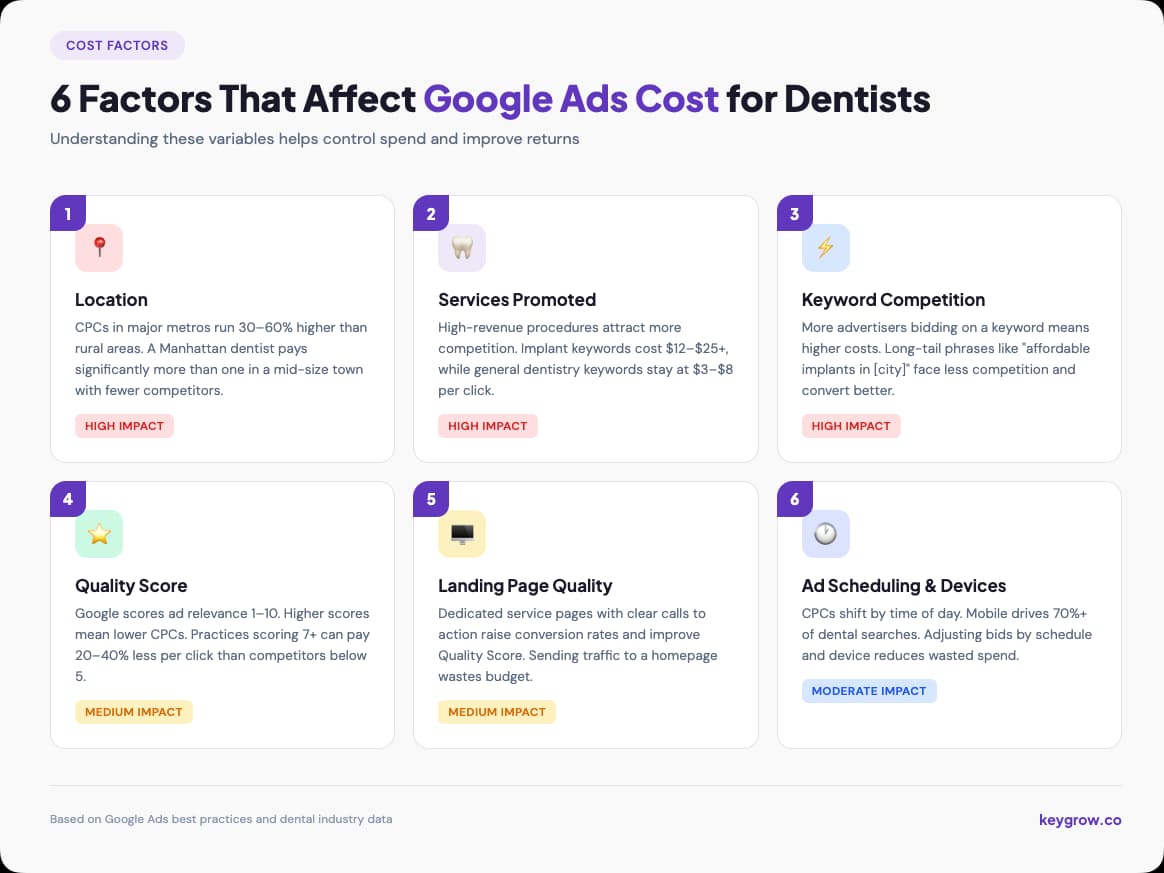
Six key factors that affect Google Ads cost for dentists including location, services promoted, keyword competition, Quality Score, landing page quality, and ad scheduling
Location
This is the single biggest cost variable. A dentist in Manhattan is competing against dozens of other practices, DSO chains, and national advertisers, all bidding on the same keywords. A dentist in a mid-size town might face three or four competitors. That difference directly affects CPC.
Type of Dental Services Promoted
High-revenue procedures attract more competition and higher CPCs. Implant keywords consistently cost the most. General dentistry and cleaning-related keywords cost the least. This is not a problem. It is a reflection of patient lifetime value. A single implant case can generate $5,000 to $30,000 in revenue, so paying $200 to acquire that patient is still a strong return.
Keyword Competition and Bidding
The more advertisers bidding on a keyword, the higher the CPC. Broad keywords like "dentist" are expensive because everyone targets them. Long-tail keywords like "affordable dental implants in [city]" face less competition and often convert better.
Quality Score
Google assigns each keyword a Quality Score from 1 to 10 based on three factors: expected click-through rate, ad relevance, and landing page experience. A higher Quality Score means lower CPCs. Practices with relevant ad copy, tightly themed ad groups, and fast, mobile-friendly landing pages consistently pay less per click than competitors with sloppy account structures.
Landing Page Experience
Sending ad traffic to a homepage is one of the most common and expensive mistakes in dental PPC. A dedicated landing page for each service, complete with a clear call to action, phone number, and trust signals (reviews, certifications), increases conversion rates and improves Quality Score.
This is where dental website development plays a direct role in ad performance. A poorly built site does not just lose patients. It raises advertising costs.
Ad Scheduling and Device Targeting
CPCs fluctuate throughout the day. Peak business hours often have higher competition and costs. Mobile devices account for over 70% of dental searches, and mobile users tend to convert faster, especially for emergency and same-day appointment searches. Adjusting bids by time of day and device type is a standard optimization that reduces wasted spend.
Cost Breakdown by Dental Service
Each dental service attracts different keyword costs, competition levels, and patient values. Here is what to expect:
Dental Implants
Implant keywords are the most expensive in dental PPC, averaging $12–$25 per click in suburban U.S. markets and reaching $50+ per click in competitive urban areas. But implant patients are also the most valuable. A single case can be worth $5,000 to $30,000. Even at a $200–$400 cost per acquisition, the ROI is strong.
Implant campaigns need their own dedicated ad groups, landing pages, and negative keyword lists. Running implant keywords inside a general dentistry campaign is a fast way to burn budget.
Invisalign and Orthodontics
Invisalign keywords typically cost $8–$15 per click. Patients searching for Invisalign are usually comparing providers and want to know about cost, timeline, and whether they are candidates. Ad copy that addresses these questions, paired with landing pages that make scheduling a consultation feel low-commitment, tend to perform best.
Teeth Whitening
Whitening keywords are more affordable, generally falling between $5–$10 per click. But conversion rates can be lower because some searchers are looking for at-home solutions rather than in-office treatment. Filtering intent through ad copy ("professional teeth whitening" vs. "teeth whitening") helps reduce wasted clicks.
Emergency Dentist
Emergency keywords cost $6–$15 per click and tend to have the highest conversion rates of any dental search category. People searching for an emergency dentist are in pain and need help now. They are not comparison shopping. Fast, mobile-optimized landing pages with a prominent phone number are critical here.
General Dentistry
Keywords related to cleanings, checkups, and routine care are the most affordable at $3–$8 per click. While the revenue per visit is lower than specialty procedures, general patients have high lifetime value. A patient who comes in for a cleaning may return for years and eventually need crowns, implants, or cosmetic work.
Google Ads Budget Recommendations for Dentists
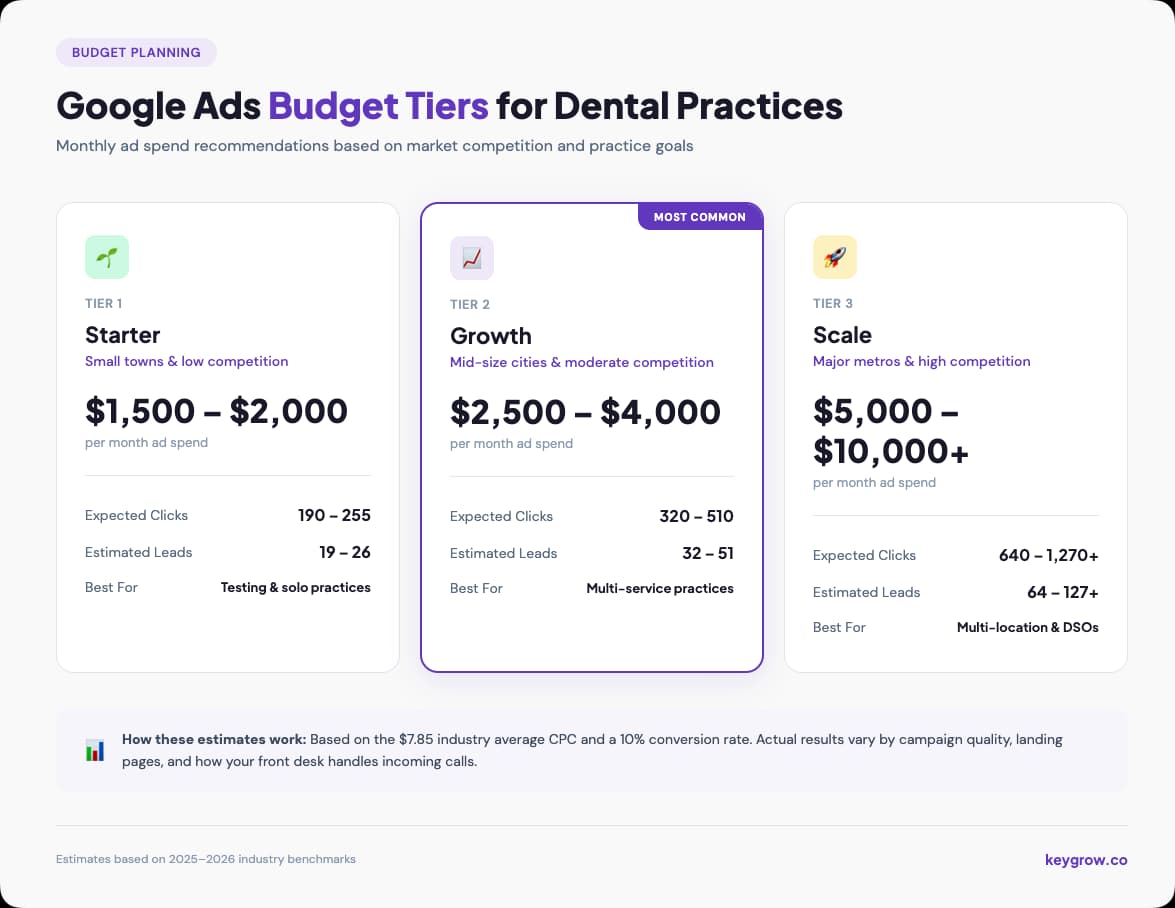
Three-tier budget guide for dental Google Ads showing starter, growth, and scale monthly budgets with expected clicks and leads
Beginner Budget ($1,500–$2,000/Month)
Best for practices in smaller markets or those testing Google Ads for the first time. At this budget, focus on a narrow set of high-intent keywords, tight geographic targeting (5–10 mile radius), and one or two core service campaigns. Do not spread this budget across too many ad groups.
Growth Budget ($2,500–$4,000/Month)
This range works for most mid-market practices. It provides enough click volume to gather meaningful data, test different ad copy, and run campaigns for multiple service lines. At $3,000/month with a $7.85 average CPC, a practice can expect roughly 380 clicks and 35–40 leads per month.
High-Growth Budget ($5,000–$10,000+/Month)
Practices in competitive metro areas or multi-location groups typically need this budget to maintain visibility across high-value keywords. At this level, it is possible to run dedicated campaigns for implants, cosmetic services, emergency care, and general dentistry simultaneously, each with its own landing page and conversion tracking.
ROI of Google Ads for Dentists
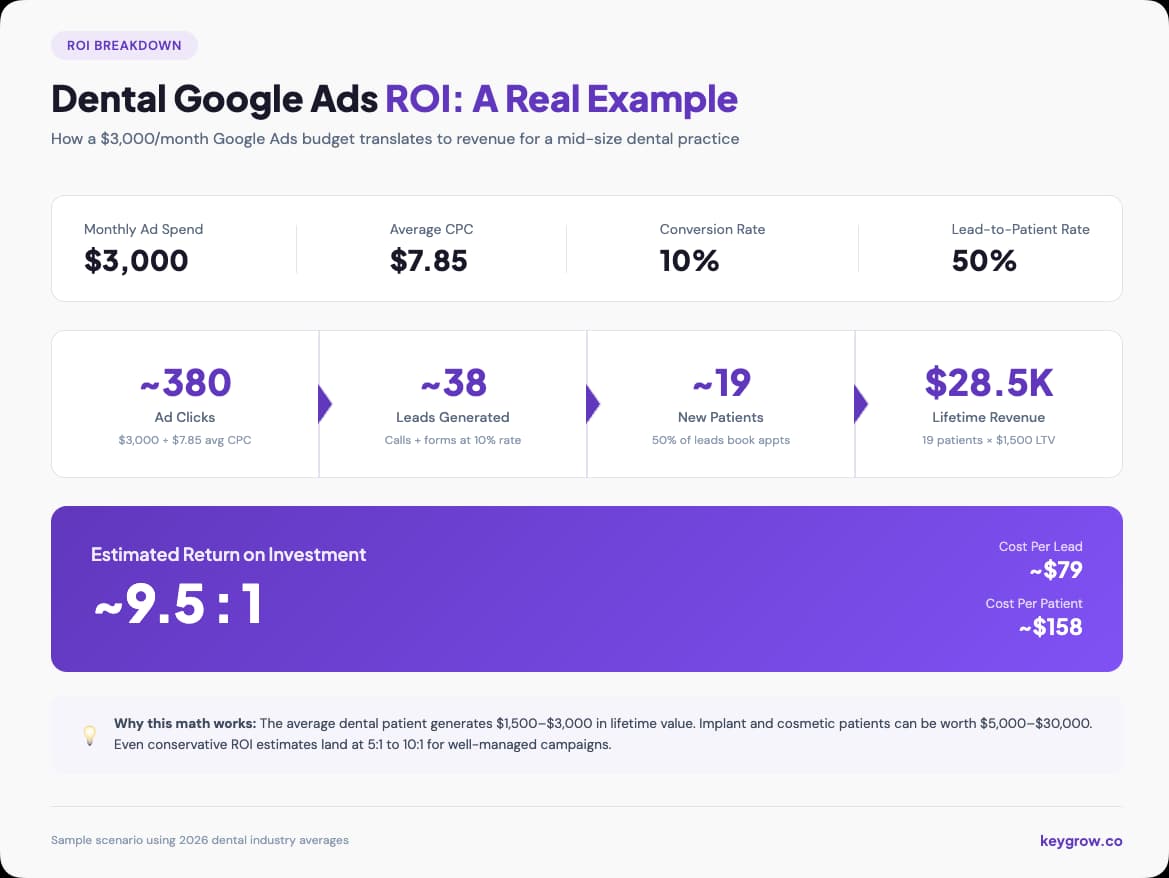
ROI funnel showing how a $3,000 monthly dental Google Ads budget converts to 380 clicks, 38 leads, 19 new patients, and $28,500 in lifetime revenue
The Lifetime Value Equation
The average dental patient is worth between $1,500 and $3,000 over their lifetime, including routine visits, restorations, and referrals. Implant and cosmetic patients can be worth $5,000 to $30,000 per case.
If the average cost to acquire a new general patient through Google Ads is $100, and that patient generates $2,000 in revenue over time, the return is 20:1. Even conservative estimates put the ROI of well-managed dental campaigns at 5:1 to 10:1.
Cost vs. Revenue: A Simple Example
Consider a practice spending $3,000/month on Google Ads:
Those numbers shift based on conversion rates, patient value, and how well the front desk handles incoming leads. But the math typically works in favor of a well-run campaign.
How to Reduce Google Ads Costs for Dentists
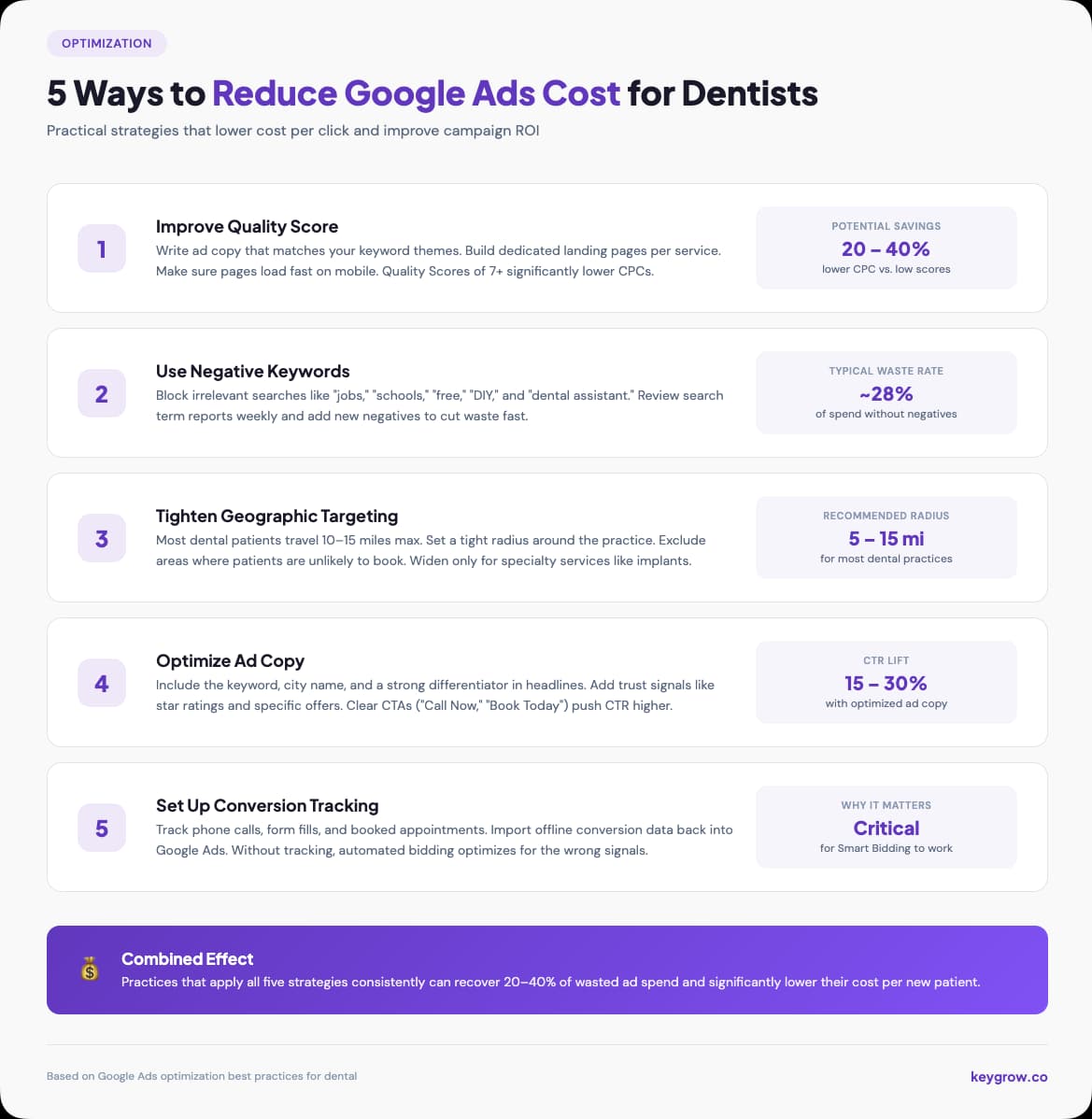
Five strategies to reduce dental Google Ads costs including improving Quality Score, using negative keywords, geo-targeting, ad copy optimization, and conversion tracking
Improve Quality Score
Higher Quality Scores mean lower CPCs. Write ad copy that closely matches the keywords in each ad group. Build dedicated landing pages for each service. Make sure pages load quickly on mobile.
Use Negative Keywords
Negative keywords prevent ads from showing for irrelevant searches. Common negative keywords for dental practices include "jobs," "schools," "free," "DIY," "how to become," and "dental assistant." Reviewing search term reports weekly and adding new negatives is one of the fastest ways to cut waste.
Tighten Geographic Targeting
Most dental patients travel no more than 10–15 miles for routine care. Setting a tight radius around the practice location, while excluding areas where patients are unlikely to visit, reduces wasted clicks. For specialty services like implants, the radius can be wider since patients are willing to travel farther.
Optimize Ad Copy
Ad headlines should include the target keyword, the city or area name, and a clear value proposition (e.g., "Same-Day Appointments," "4.9★ Google Rating," "Sedation Available"). Strong calls to action like "Call Now" or "Book Online Today" push click-through rates higher.
Set Up Conversion Tracking
Without conversion tracking, there is no way to know which keywords, ads, or campaigns are actually producing patients. At a minimum, track phone calls, form submissions, and online booking confirmations. Import offline conversion data (actual booked appointments) back into Google Ads for smarter automated bidding.
Common Mistakes Dentists Make with Google Ads
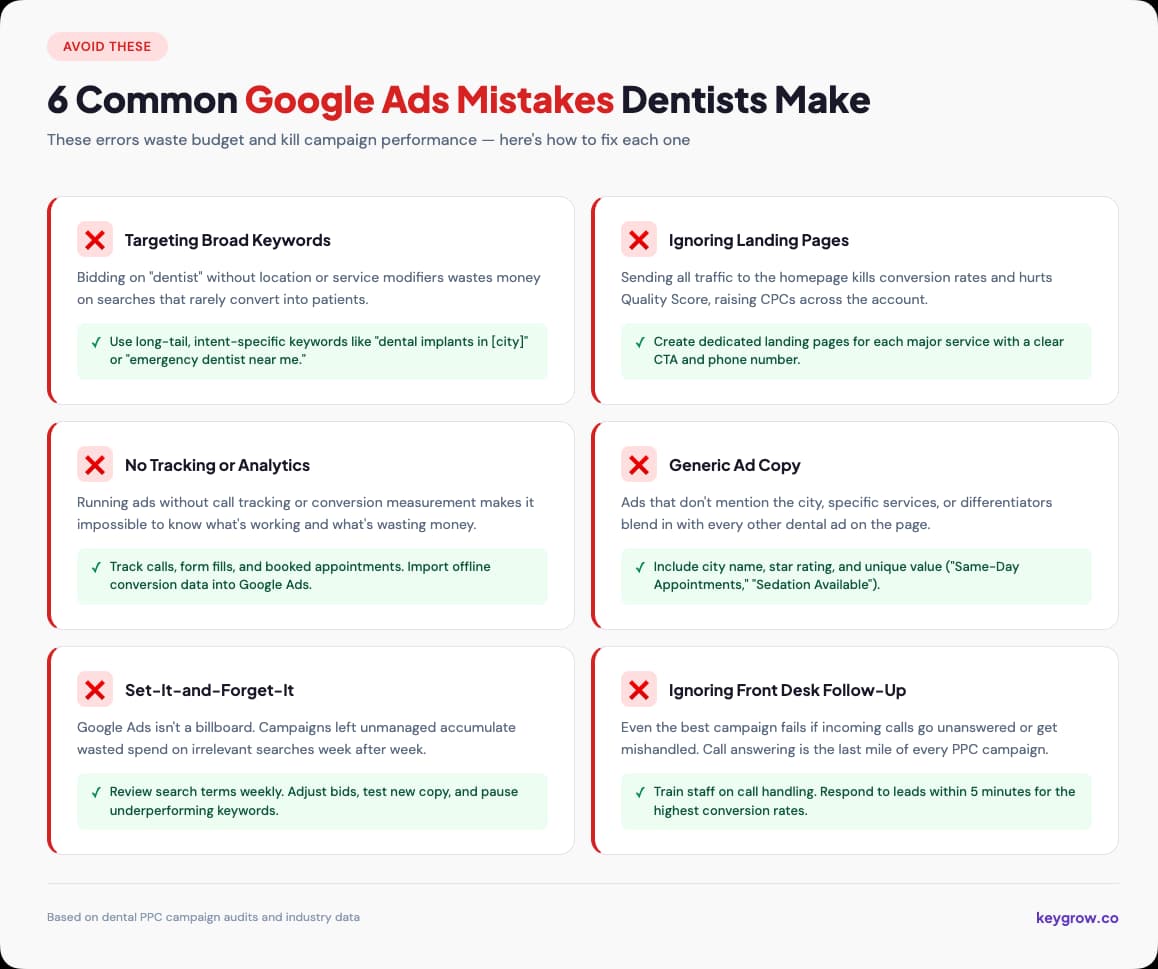
Six common Google Ads mistakes dentists make including broad keywords, ignoring landing pages, no tracking, generic ad copy, and set-it-and-forget-it management with fixes
Targeting broad keywords. Bidding on "dentist" without modifiers wastes money on searches that rarely convert. Long-tail, intent-specific keywords always perform better.
Ignoring landing pages. Sending all ad traffic to the homepage kills conversion rates. Every major service should have its own landing page with a clear call to action.
No tracking or analytics. Running ads without call tracking or conversion measurement is flying blind. There is no way to optimize what cannot be measured.
Poor ad creatives. Generic ad copy that does not mention the city, specific services, or any differentiator blends into the background. Patients need a reason to click on one ad over another.
Set-it-and-forget-it management. Google Ads is not a billboard. Campaigns need weekly attention: reviewing search terms, adjusting bids, testing new ad copy, and pausing underperforming keywords.
Not accounting for front desk performance. Even the best campaign fails if incoming calls go unanswered or get handled poorly. Call answering is the last mile of every Google Ads campaign.
Google Ads vs. SEO for Dentists: Cost Comparison
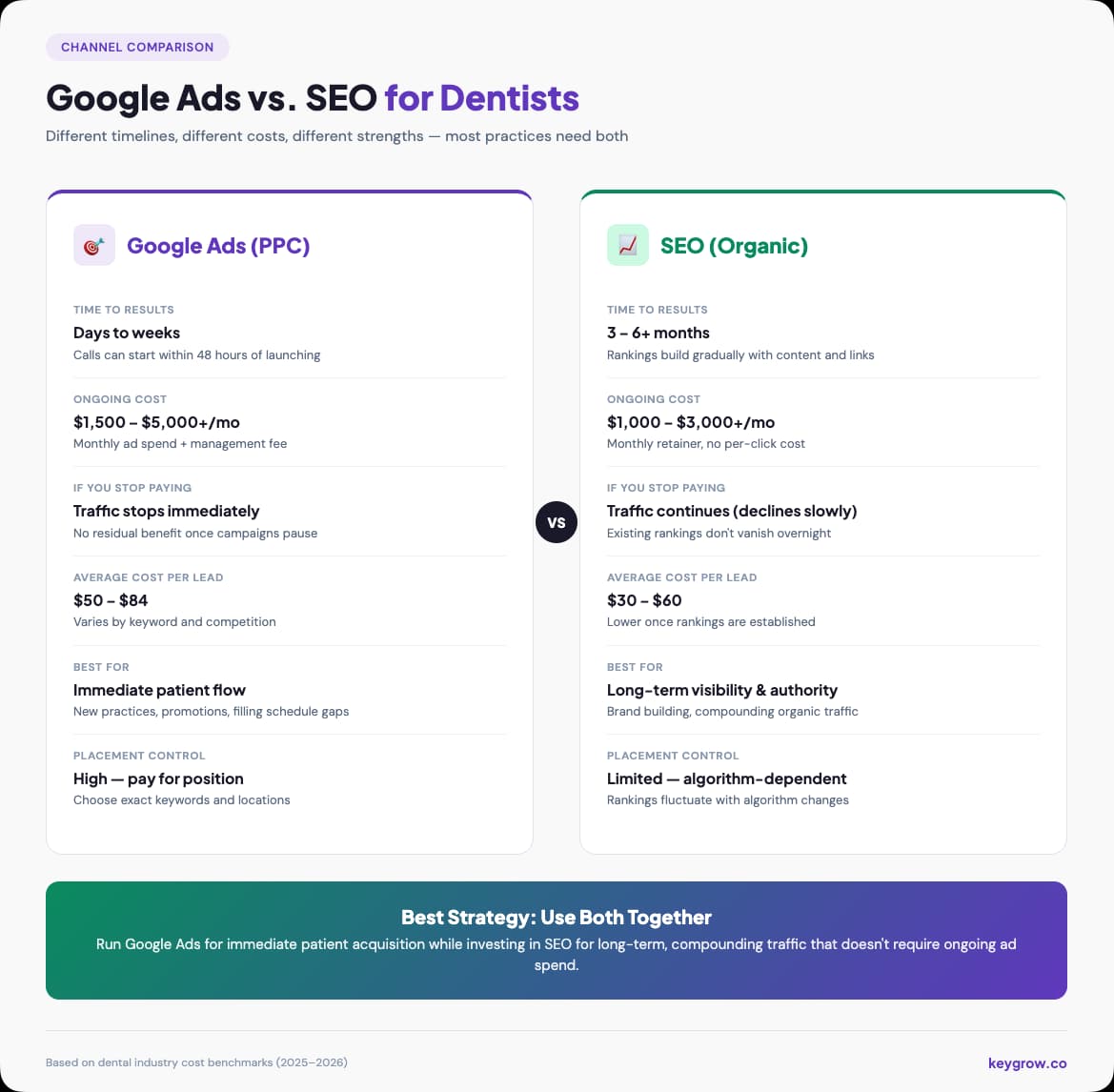
Side-by-side visual comparison of Google Ads and SEO for dentists covering time to results, ongoing cost, cost per lead, and best use cases
Both channels have a role, but they serve different purposes and timelines.
| Factor | Google Ads | SEO |
|---|---|---|
| Time to results | Days to weeks | 3–6 months (typically longer) |
| Ongoing cost | Monthly ad spend + management | Monthly retainer, no per-click cost |
| Traffic after stopping | Stops immediately | Continues generating traffic |
| Cost per lead (typical) | $50–$84 | $30–$60 (once ranking) |
| Best for | Immediate patient flow, new practices, promotions | Long-term visibility, brand authority |
| Control over placement | High (pay for position) | Limited (depends on algorithm) |
For most practices, the ideal approach is to run Google Ads for immediate patient acquisition while investing in dental SEO for long-term, compounding traffic that does not require ongoing ad spend. A detailed breakdown of how these two channels interact is covered in this comparison of local PPC and SEO for small businesses.
Answer engine optimization is also increasingly relevant. As Google's AI Overviews and other AI search tools pull answers directly from web content, practices that structure their content for these formats gain additional visibility without paying per click.
Should Dentists Hire an Agency or Run Ads Themselves?
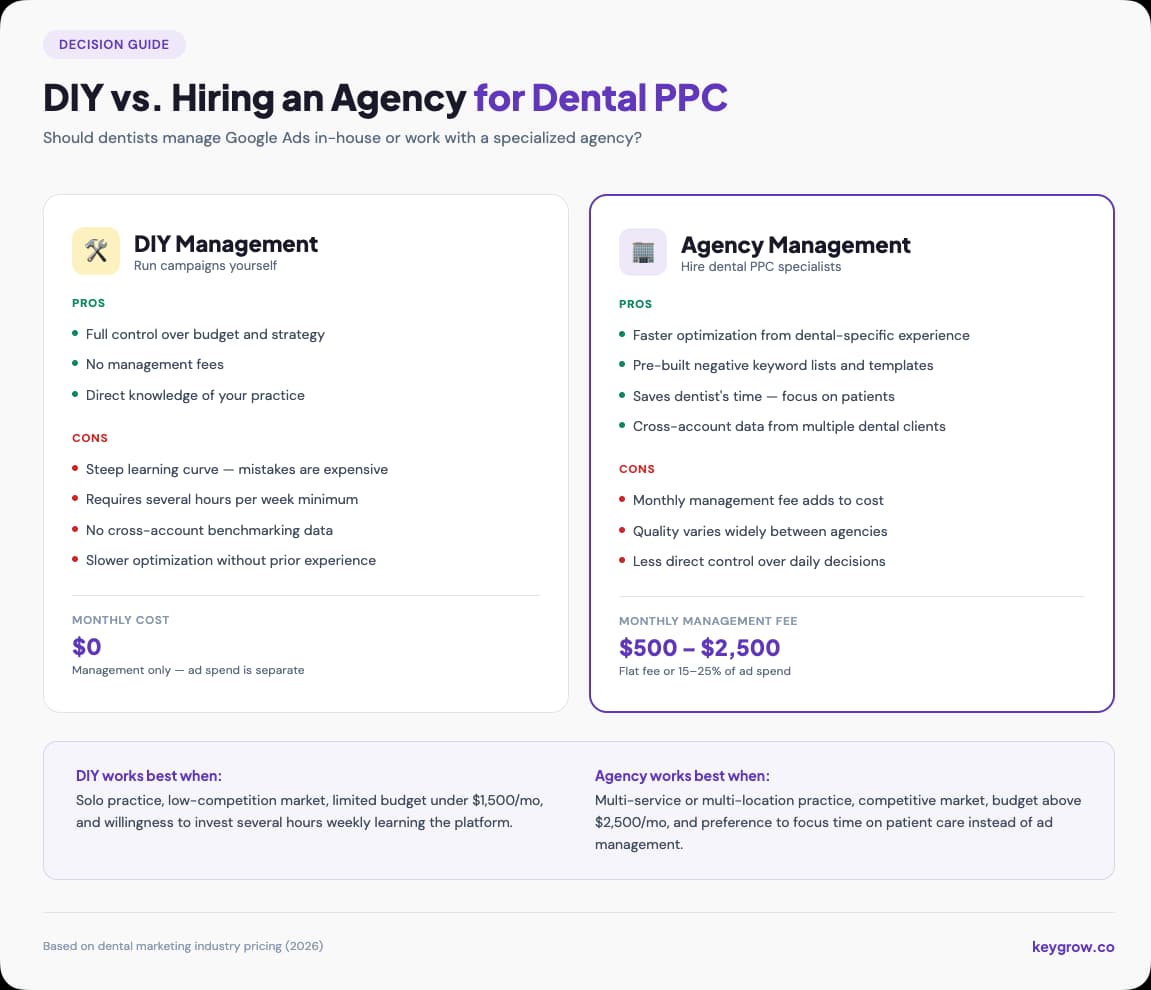
Decision guide comparing DIY management versus hiring an agency for dental PPC with pros, cons, monthly costs, and best-fit scenarios
DIY Google Ads
Running campaigns in-house is possible, especially for simple, single-location practices in low-competition markets. Google's interface is accessible, and there is plenty of learning material available.
But the learning curve is steep, and mistakes are expensive. Mismanaged keyword targeting, poor landing pages, or incorrect bid settings can waste thousands of dollars before a dentist realizes something is wrong. Time is also a factor. Managing campaigns properly requires several hours per week.
Hiring an Agency
A specialized dental marketing agency understands keyword intent in the dental space, knows which landing page structures convert, and can optimize campaigns faster based on experience across multiple dental accounts.
Typical agency pricing for dental PPC management:
Agencies that specialize in healthcare PPC tend to deliver better results than generalist firms because they already have benchmarks, negative keyword lists, and landing page templates built for the dental vertical.
Sample Budget Scenario: A Mid-Size Dental Practice
Here is a realistic example for a general and cosmetic dental practice in a mid-size U.S. city:
Monthly ad spend: $3,000
Management fee: $750 (flat fee agency)
Total monthly investment: $3,750
Campaign allocation:
Expected results (based on industry averages):
This is a simplified model. Actual results depend on ad quality, landing page performance, call handling, and patient retention. But it illustrates why the math works for most practices, even at moderate budgets.
Working with KeyGrow for Dental Google Ads
For practices that want professional PPC management built specifically for dentists, KeyGrow is worth evaluating. KeyGrow specializes in paid search and digital marketing for healthcare providers, including dental practices of all sizes.
Their approach includes campaign structuring by service type, dedicated landing page strategy, conversion tracking setup, and ongoing optimization, all grounded in healthcare industry experience. KeyGrow also offers SEO, answer engine optimization, and website development as part of a broader dental marketing strategy.
If choosing an agency feels overwhelming, this list of the top dental marketing agencies for 2026 breaks down the options. Ready to evaluate your own practice? Get started with KeyGrow for a tailored Google Ads plan.
FAQs
How much should a dentist spend on Google Ads?
Most dental practices spend between $1,500 and $5,000 per month on Google Ads. Practices in competitive metro areas often need $3,000 or more to maintain visibility across high-value service keywords. Smaller markets can start at $1,500/month and still generate consistent patient leads.
What is a good cost per click for dental keywords?
The industry average CPC for dental ads is around $7.85 in the United States. General dentistry keywords average $3–$8, while specialty keywords like dental implants can reach $12–$25 or more. A "good" CPC depends on the conversion rate and the value of each patient.
Are Google Ads worth it for dentists?
Yes, for most practices. A well-managed Google Ads campaign typically returns $5 to $10 for every $1 spent, based on patient lifetime value. The key is proper campaign structure, relevant landing pages, and consistent optimization.
How long before a dentist sees results from Google Ads?
Calls and form submissions can start within days of launching a campaign. But meaningful data for optimization takes 2–4 weeks. Most campaigns reach consistent, optimized performance after about 90 days of active management and refinement.
What is the average cost per lead for dental Google Ads?
The average cost per lead for dental advertising falls between $50 and $84, depending on location, keyword competition, and campaign optimization. Well-managed campaigns can push CPL below $60. Poorly managed ones may exceed $113.
How much do dental implant ads cost on Google?
Dental implant keywords average $12–$25 per click in suburban markets and can exceed $50 in highly competitive urban areas. Cost per acquisition for an implant patient typically ranges from $200–$400, but with case values of $5,000–$30,000, the ROI remains strong.
Should dentists manage Google Ads themselves or hire an agency?
DIY management works for simple campaigns in low-competition markets, but most practices benefit from agency expertise. Agencies bring established keyword lists, tested landing page frameworks, and cross-account optimization insights. Management fees typically range from $500–$2,500/month.
What is a good conversion rate for dental Google Ads?
The industry average conversion rate for dental ads is around 10%, meaning roughly 1 in 10 clicks results in a phone call or form submission. Top-performing campaigns achieve 12–15% conversion rates through optimized landing pages, call tracking, and tightly targeted keywords.
How does Quality Score affect dental ad costs?
Quality Score directly impacts CPC. A higher Quality Score, which is based on ad relevance, expected click-through rate, and landing page experience, lowers the price paid per click. Practices with Quality Scores of 7+ can pay 20–40% less per click than competitors with scores below 5.
Can small dental practices compete on Google Ads?
Absolutely. Smaller markets have lower CPCs and less competition. A practice spending $1,500/month in a small town can dominate local search results. Tight geographic targeting, a focused keyword list, and strong landing pages help smaller budgets punch above their weight.


