


How long does PPC take? Your ads can be live and collecting clicks within a day or two. Working is a different question. The learning phase runs one to two weeks, readable performance data takes one to three months, and consistent, profitable results typically arrive between months three and six. Amazon, Google, or Microsoft, the arc is roughly the same.
Here is the part every version of that answer leaves out: the clock is not measured in months. It is measured in conversions. A campaign that banks conversions quickly can stabilize in weeks, and a campaign that starves can sit in limbo for a year. Which means your timeline is partly a choice, and you can calculate it before you spend a dollar. This post shows the math, the week-by-week arc, and the edits that accidentally restart the whole clock.
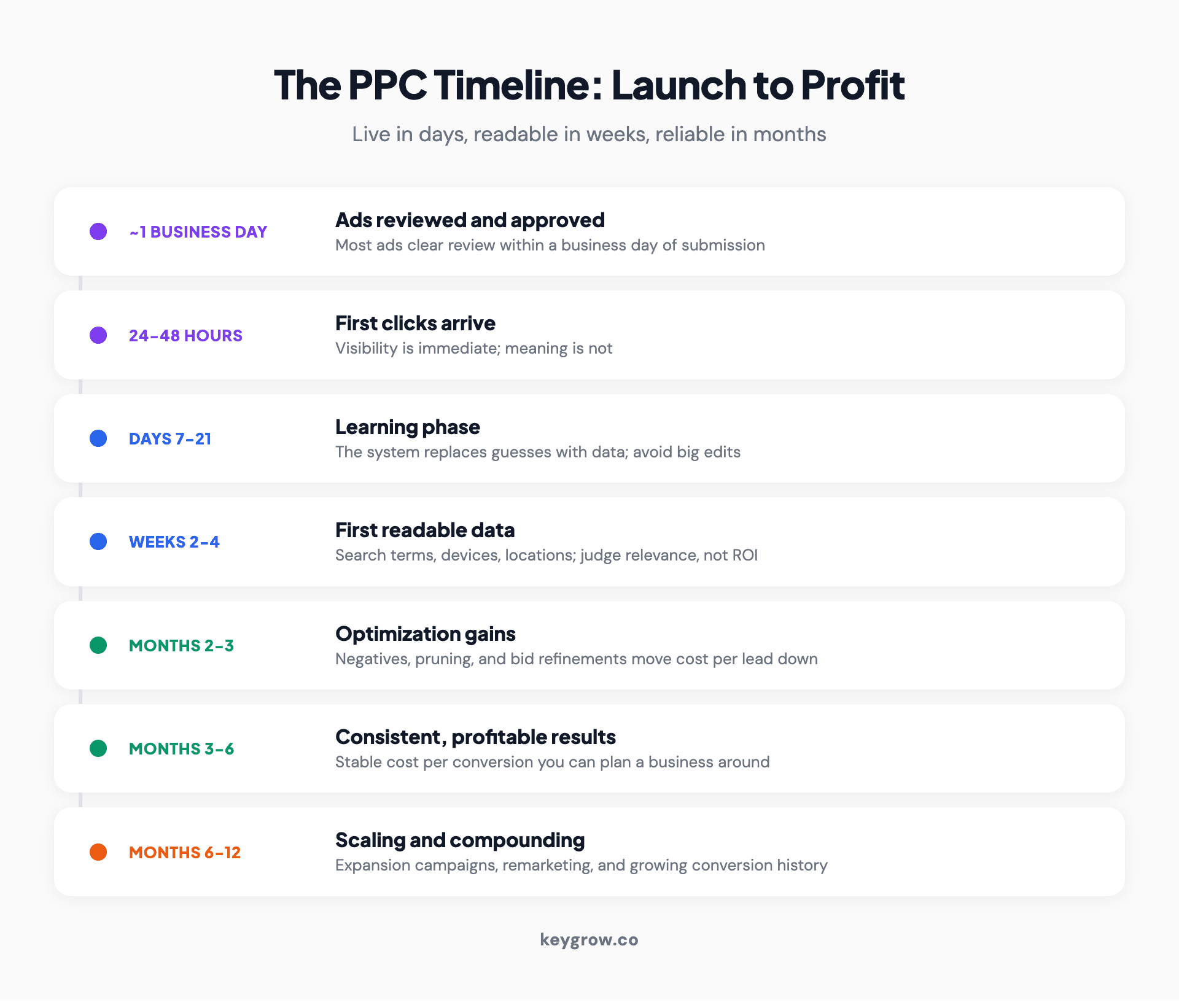
The full PPC results timeline from launch to profit: ads approved in about one business day, first clicks within 24 to 48 hours, a learning phase of 7 to 14 days, first readable data in weeks two to four, optimization gains through months two and three, consistent profitable results between months three and six, and scaling from month six onward.
A new campaign starts out guessing
Ad platforms rank and price ads on predicted performance: how likely your ad is to be clicked, how relevant it is, how well your landing page matches. A brand-new campaign has no history, so the system predicts from nothing and prices you cautiously. Every day the campaign runs, real data replaces guesses.
That is the whole reason PPC "takes time." The auction does not warm up to you emotionally. It just has more evidence about you at month three than at hour three, and the evidence compounds: better predictions earn better positions at lower costs, which buy more data, which sharpen the predictions again.
The clock runs on conversions, not months
Google's automated bidding needs conversion volume before it can optimize. A stronger click-through rate helps that engine along and lowers your cost per click, which is why a good Google Ads CTR matters even here. Google's guidance sets the floor at 15 conversions in the past 30 days before Target ROAS bidding can even switch on, and in practice accounts stabilize once they bank something closer to 50 a month, the working target most practitioners aim for. So the real question behind "how long does PPC take" is: how fast does your budget buy conversions?
The arithmetic: conversions per day = (daily budget / cost per click) x conversion rate. Using the 2026 averages of $5.42 per click and an 8.18 percent conversion rate from WordStream's benchmarks, three budgets tell three very different stories.
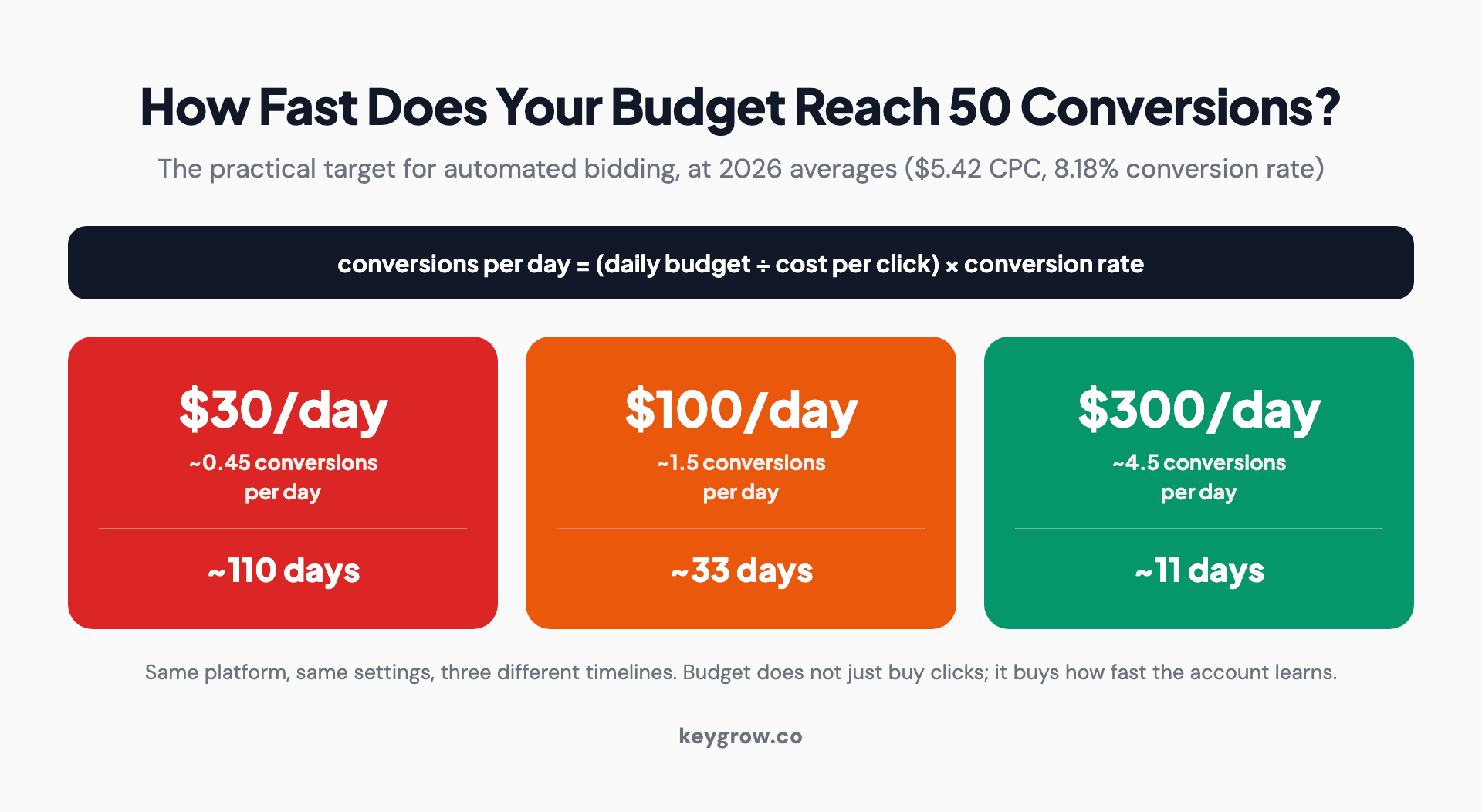
The 50-conversion math at three budgets, using 2026 averages of $5.42 cost per click and 8.18 percent conversion rate: $30 a day produces about 0.45 conversions daily and takes roughly 110 days to reach 50 conversions, $100 a day produces about 1.5 daily and takes around 33 days, $300 a day produces about 4.5 daily and gets there in roughly 11 days.
At $30 a day you bank about 0.45 conversions daily, so the practical 50-a-month target is more than three months away, and the campaign may never properly feed automated bidding. At $100 a day you reach it in about a month. At $300 a day, under two weeks. Same platform, same settings, three different timelines, and none of it is mysterious. Run your own numbers through our Google Ads budget calculator before you set expectations.
If your budget puts you in the slow lane, you have honest options: optimize toward a higher-volume action earlier in the funnel (calls or form starts instead of closed sales), consolidate campaigns so conversion data pools in one place instead of fragmenting across five, or simply accept a longer runway and judge the account on leading indicators.
The learning phase, and how people accidentally restart it
Whenever you launch or significantly change a campaign, Google enters a learning period while the system recalibrates. Per Google's documentation, it can last up to three weeks or one to two conversion cycles, depending on conversion volume, cycle length, and bid strategy. Give the system a week or so after any significant change before you judge what it did.
The trap is that learning restarts on more than launches. Google's own docs list bid strategy switches, bid strategy setting changes, and composition changes (campaigns, ad groups, or keywords added or removed). Practitioners consistently observe two more: large budget swings and edits to conversion actions.
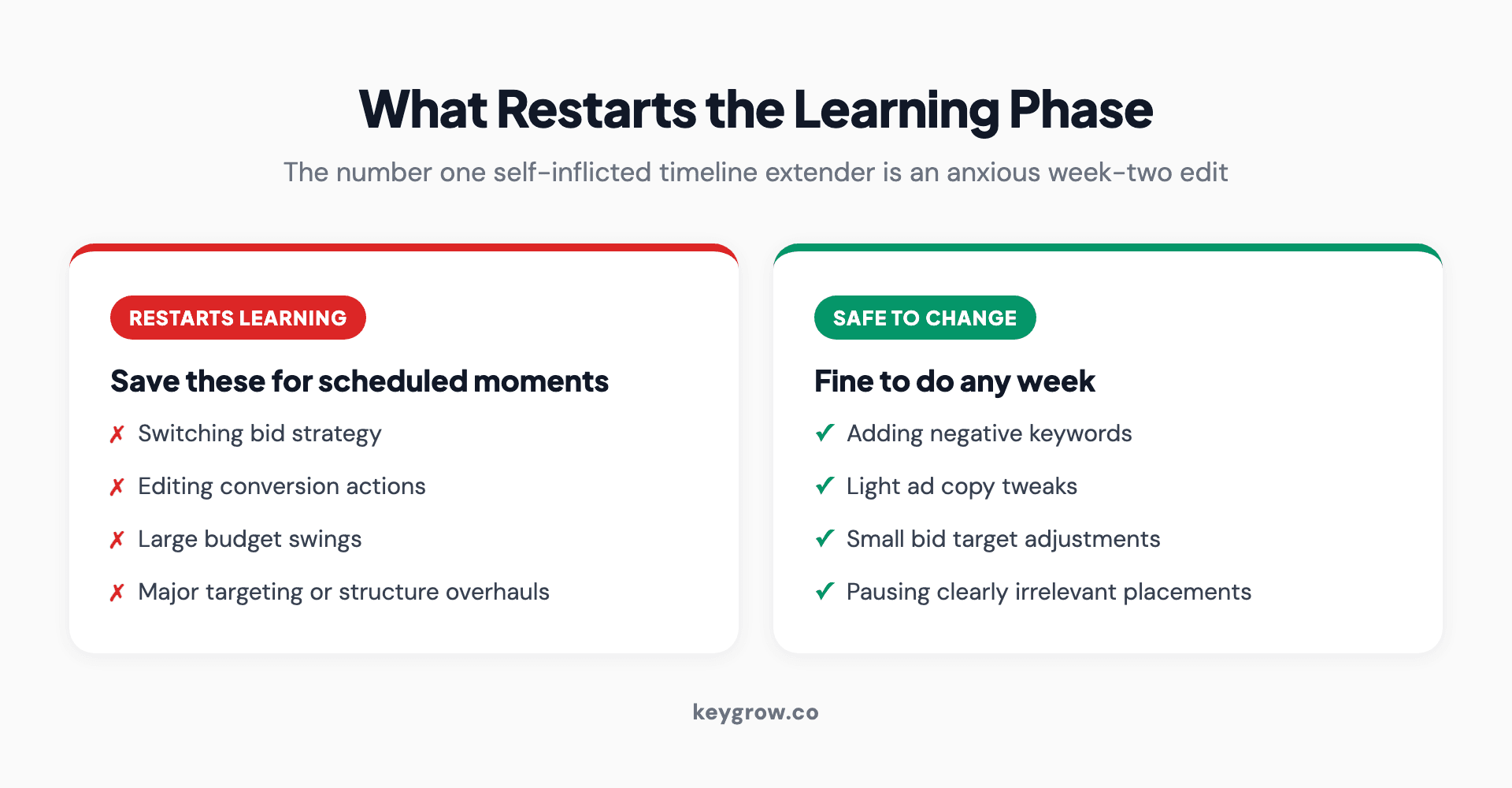
What resets the Google Ads learning phase versus what is safe to change: resets include switching bid strategy, editing conversion actions, large budget swings, and major targeting overhauls; safe changes include adding negative keywords, minor ad copy tweaks, and small bid target adjustments.
This is the number one self-inflicted timeline extender we see in audits: an anxious week-two edit that quietly restarts a two-week clock, followed by another edit two weeks later. Six months of that and an account has been "learning" half its life. Add negative keywords freely, tweak ad copy lightly, nudge bid targets gently. Save the structural surgery for scheduled moments, and then leave the account alone on purpose.
Your first 30 days, week by week
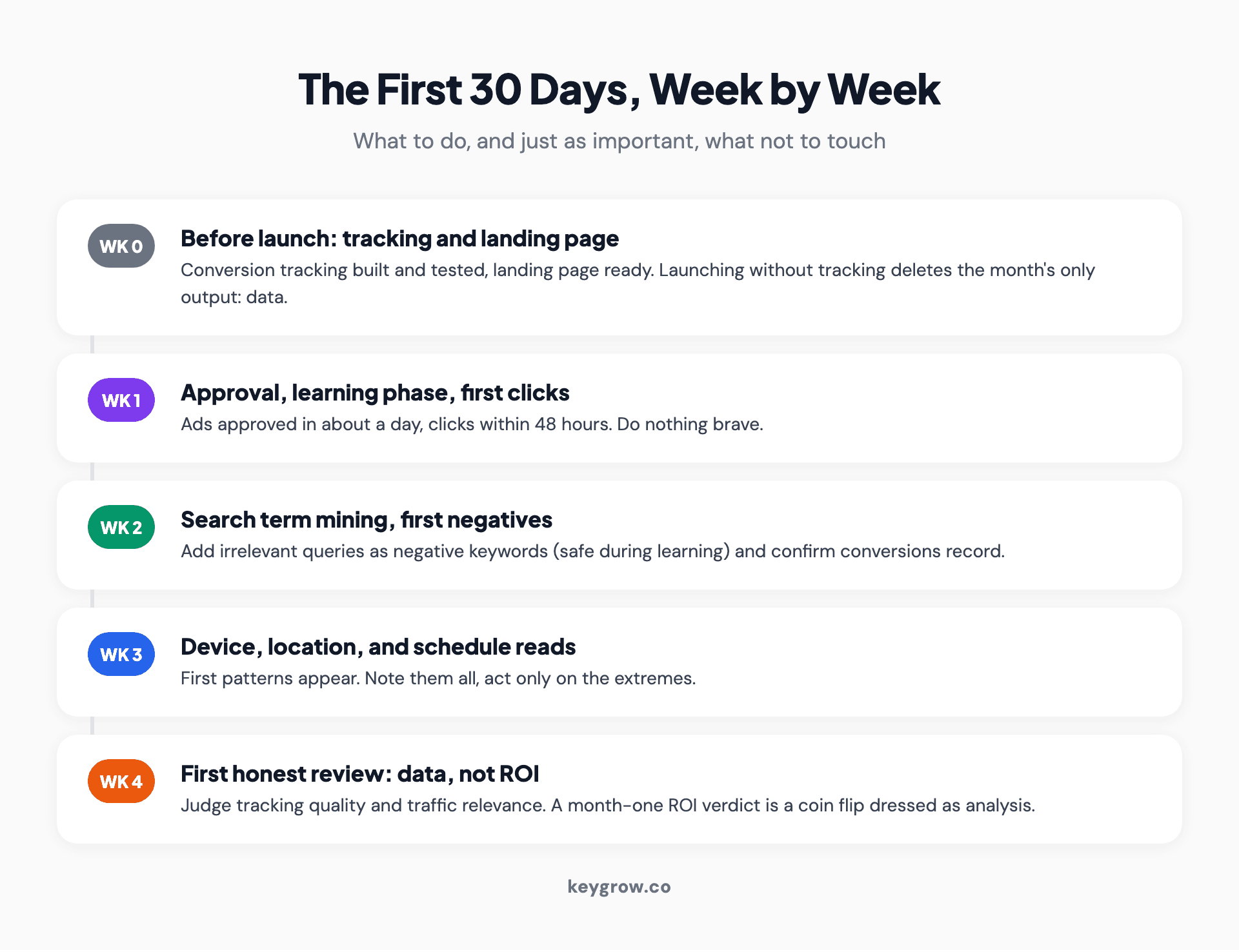
The first 30 days of a PPC campaign week by week: week zero is conversion tracking and landing page work before launch, week one is ad approval, the learning phase, and first clicks, week two is search term mining and first negative keywords, week three is device, location, and schedule reads, and week four is the first honest performance review of data rather than ROI.
Week 0, before launch. Conversion tracking built and tested, landing page ready. Launching without tracking does not save time; it deletes the only data the next month was supposed to produce.
Week 1. Most ads clear review within one business day, first clicks arrive within 24 to 48 hours, and the learning phase begins. Do nothing brave.
Week 2. Open the search terms report. Add the irrelevant queries as negatives (safe during learning), and confirm conversions are recording.
Week 3. First readable patterns: devices, locations, schedules. Note them; act on the extremes only.
Week 4. The first honest review. Judge data quality and traffic relevance, not return on investment. A month-one ROI verdict is a coin flip dressed as analysis.
One honest asterisk on speed: accounts with history move faster than cold starts. An eviction law firm came to us already running ads, getting one conversion a week at $240. We rebuilt the landing page around one clear action and restructured the campaigns, and within a week it was at 21 weekly conversions at $31.79 each. That speed was possible because the account had months of data to relearn from and the bottleneck was the page, not the auction. Cold starts do not get that shortcut.

An open monthly planner on a desk, the realistic unit of time for judging a new PPC campaign
Months one to three: what optimization actually looks like
Month one is collection. Launch a little broader than feels comfortable, because narrow targeting starves the account of the data you are paying to gather. Resist the ROI question.
Month two is refinement. Cut the keywords with plenty of impressions and no conversions, grow the negative list weekly, and adjust for the device and location patterns that held up. This is where cost per conversion usually makes its first real move down.
Month three is testing and expansion. A/B test ad copy, mine the search terms report for new keyword themes, and scale what has proven itself. Run tests to a conversion count, not a calendar date; at typical small-business volume a fair test needs two to four weeks minimum. By the end of month three you should know your real cost per lead, which keywords earn their spend, and what to do next month. That is what "PPC takes three months" actually means: three months of working, not waiting.
Business model bends the curve. Ecommerce reads results fastest because purchases happen in hours. B2B and SaaS read slowest, because a 60-day sales cycle delays the feedback loop by definition; the fix is importing your CRM's closed-deal conversions so the system learns from revenue, not just form fills, which is the crux of whether PPC works for B2B. Paid social typically matures a month or two behind search. And if you are weighing paid against organic timelines, our breakdown of PPC vs SEO ranking covers why the channels move at such different speeds.
Speed it up, or call it: the day-30 and day-90 rules
You cannot skip the learning phase, but five choices shorten the road: tracking live before day one, a budget sized to the conversion math above, a landing page fixed before spend scales, hands off mid-learning, and consolidated campaigns that pool data. Nothing on that list is glamorous. All of it beats waiting.
Then hold two honest checkpoints.
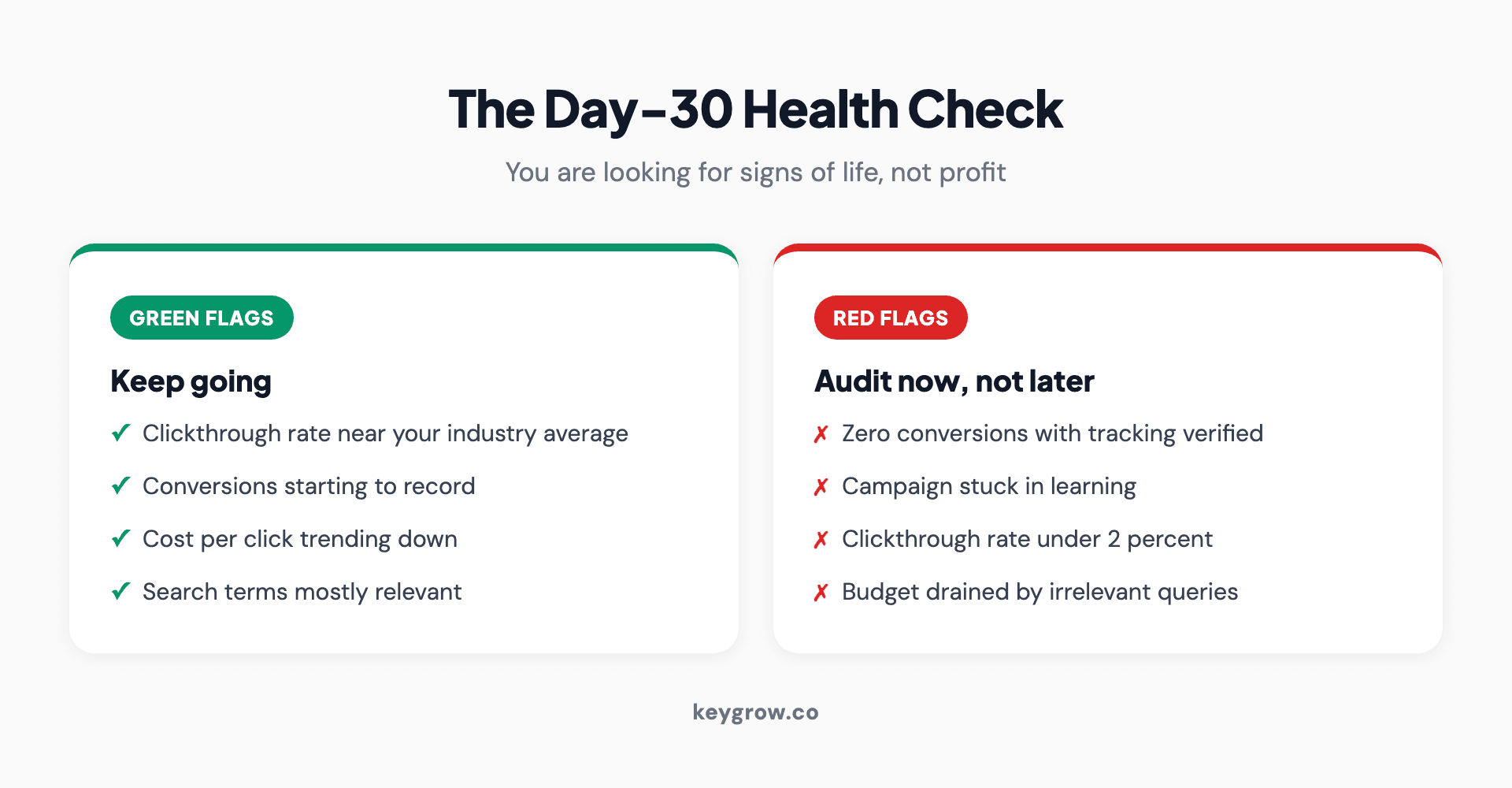
Day-30 health check for a new PPC campaign, green flags versus red flags: green includes clickthrough rate near the industry average, conversions starting to record, cost per click trending down, and mostly relevant search terms; red includes zero conversions with verified tracking, a campaign stuck in learning, clickthrough under 2 percent, and budget drained by irrelevant queries.
Day 30: you are looking for signs of life, not profit. Clickthrough near your industry's average, conversions trickling, search terms mostly relevant. Red flags: zero conversions with tracking verified, clickthrough rates under 2 percent, or a budget eaten by junk queries.
Day 90: with verified tracking and still zero conversions, stop waiting. The problem is almost never patience at that point; it is the offer, the landing page, or the traffic quality, and each is auditable this week. More months of the same spend is not a strategy, and neither is more budget on an account that cannot convert the budget it has.
That second checkpoint is where a good agency earns its fee and a bad one asks for more time. If you want a second set of eyes at either milestone, our PPC management is month-to-month and starts with the audit, or tell us about your business and we will run the conversion math for your market before you commit to anything.
FAQs
How long does it take for PPC to work?
Ads go live within a day or two, but expect one to two weeks of learning phase, one to three months for readable performance data, and three to six months for consistently profitable results. The biggest lever is conversion volume: better-funded campaigns in reasonable-CPC markets stabilize much faster.
How long is the Google Ads learning phase?
Typically about one to two weeks, and up to three weeks for low-volume accounts or long conversion cycles. Google advises waiting 7 to 10 days after significant changes before judging performance, because the system needs time to recalibrate.
Does editing a campaign reset the learning phase?
Some edits do. Switching bid strategies, editing conversion actions, large budget changes, and major targeting overhauls restart learning. Adding negative keywords, light ad copy changes, and small bid target adjustments are generally safe to make at any time.
Can PPC deliver results in the first week?
You will usually see clicks within 48 hours and sometimes early conversions in week one, especially on high-intent keywords. Treat them as encouraging noise rather than proof; performance in the learning phase is not representative of what the optimized campaign will do.
How long should a PPC campaign run before judging it?
Give a new campaign 90 days with verified conversion tracking before a final verdict, with honest checkpoints at day 30 and day 60. Judge early weeks on data quality and traffic relevance, and reserve the return-on-investment verdict for month three.
How long should PPC A/B tests run?
Until each variant has enough conversions to compare, not until a calendar date. At typical small-business volume that means at least two to four weeks per test. Ending tests on impressions or gut feel is how accounts end up optimized for coincidence.