


How is ranking different when comparing PPC vs SEO? One is rented, one is earned. A paid position is decided in a real-time auction that reruns every single time someone searches, and it disappears the day you stop paying. An organic position is assigned by algorithms weighing hundreds of signals over months, cannot be bought at any price, and keeps working after you stop pushing.
Same results page, two completely separate ranking systems that do not talk to each other. Most of the comparisons you will find online get the mechanics of at least one side wrong, usually by teaching an Ad Rank formula Google retired years ago. So here is how each system actually decides who shows up where, and what that means for your budget.
Two ranking systems on one results page
| PPC (paid) ranking | SEO (organic) ranking | |
|---|---|---|
| Decided by | A live auction on every search | Algorithms scoring hundreds of signals |
| Time to reach the top | Hours after launch | Months, often longer |
| What moves it | Bid, ad quality, assets, context | Content, links, technical health, experience |
| Stability | Recalculated every search | Relatively stable, re-evaluated continuously |
| Cost structure | Pay per click, forever | Front-loaded work, compounding returns |
| When you stop | Visibility ends immediately | Positions persist, then decay slowly |
The rest of this post unpacks that table row by row, because the mechanics are where most comparisons go wrong and where the practical decisions live.
PPC ranking: an auction that reruns on every search
When someone searches, Google runs an instant auction among eligible ads and scores each one with Ad Rank. Per Google's documentation, six factors go in: your bid, the auction-time quality of your ad and landing page, Ad Rank thresholds, how competitive the auction is, the context of the search (location, device, time), and the expected impact of your ad assets.
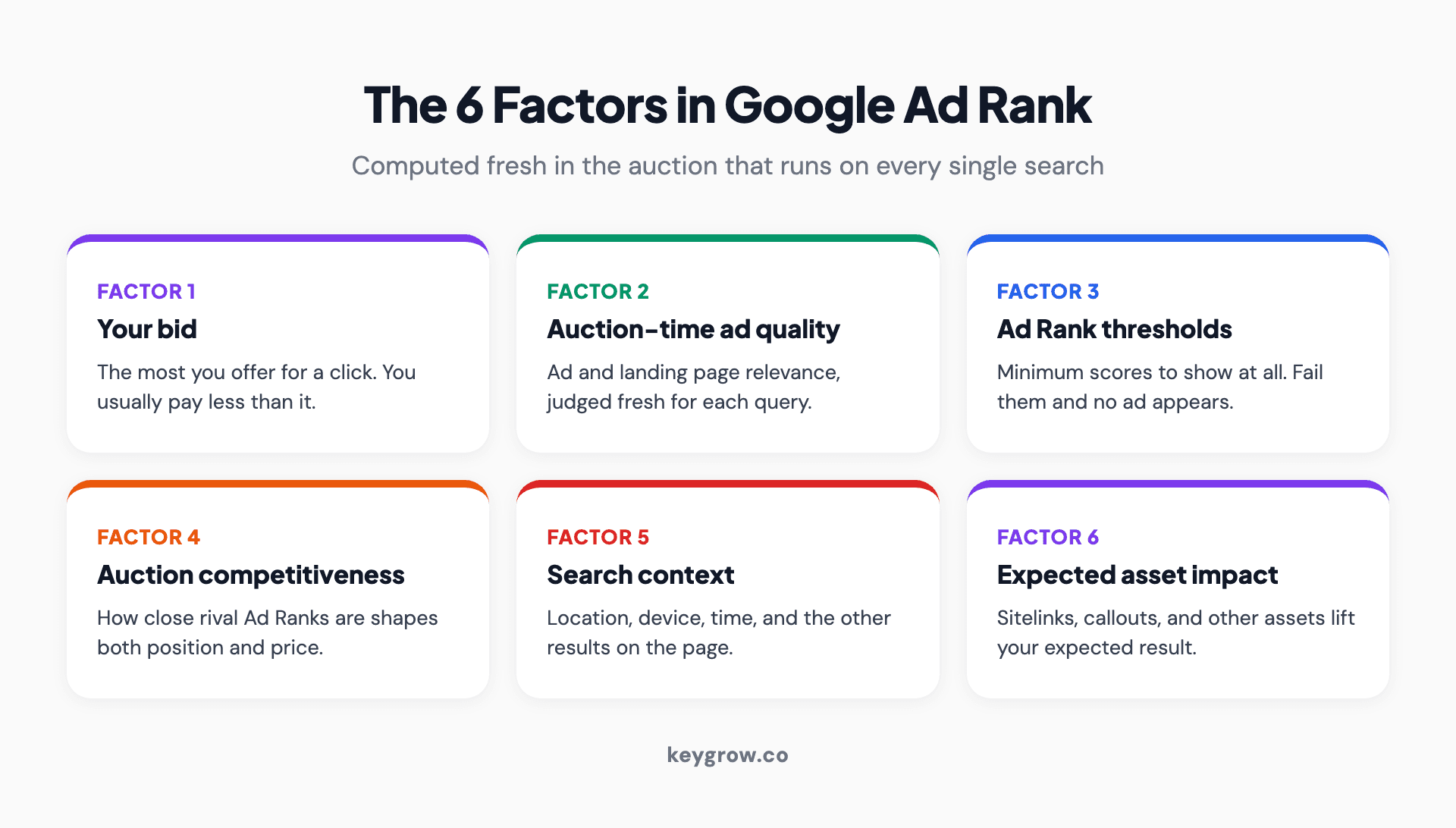
The six factors Google uses to calculate Ad Rank at auction time: your bid, auction-time ad and landing page quality, Ad Rank thresholds, competitiveness of the auction, the search context including location and device, and the expected impact of ad assets and formats.
Notice what that list does to the folklore version, "Ad Rank equals bid times Quality Score." Three consequences follow from the real system:
- The highest bid does not guarantee the top slot. An advertiser with better auction-time quality can outrank you and pay less per click doing it. Quality is a discount.
- Sometimes no ad shows at all. Ad Rank thresholds are minimum scores an ad must clear; with weak ads or thin relevance, Google would rather show nothing than serve junk above organic results.
- Your paid "position" is not a position. The auction reruns per search, so paid rank is a probability shaped by context. Your ad can show at the top for one search, below the organic results for the next, and not at all for a third.
Quality Score, the 1 to 10 number in your account, is the diagnostic version of the quality inputs: expected clickthrough rate, ad relevance, and landing page experience. It is the lever most accounts underuse, and it is why account structure matters as much as budget (we covered how keyword bloat wrecks it separately).
SEO ranking: earned, and re-earned continuously
Organic positions cannot be bought. Google's ranking systems evaluate pages against hundreds of signals, and the families that matter are stable: content relevance and quality, links from other sites, technical crawlability, page experience, and freshness where the query demands it.
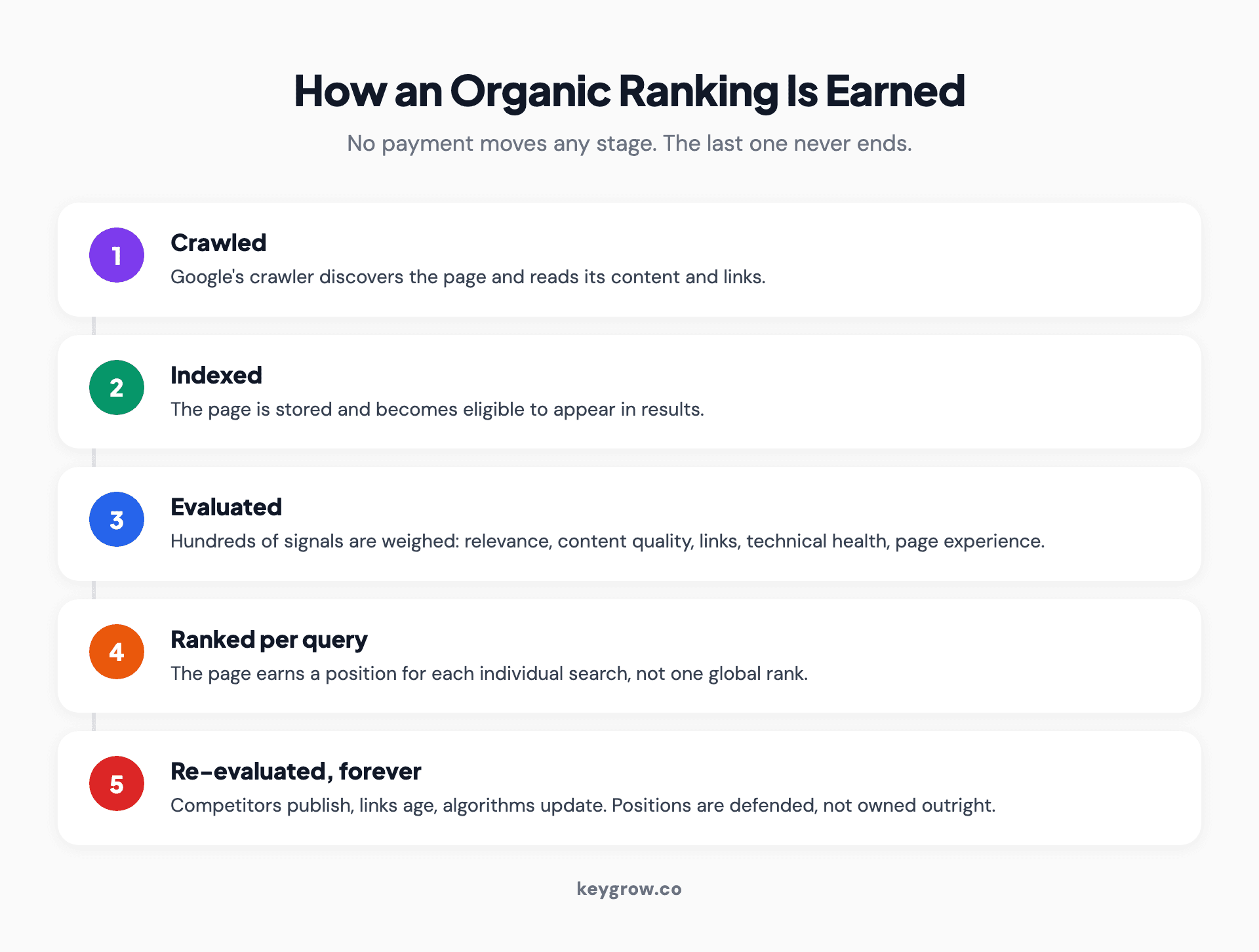
How a page earns an organic ranking in five stages: the page gets crawled, gets indexed, is evaluated for relevance, content quality, links, and page experience, gets ranked for each individual query, and is then continuously re-evaluated as algorithms and competitors change.
The stage most people forget is the last one. An organic ranking is never finished; it is re-evaluated as competitors publish, links age, and algorithms update. That cuts both ways: you can lose a position you stopped defending, and you can inherit one from a competitor who did.
The trade for that maintenance burden is durability. Nothing about an organic position meters your traffic per click. Rank once, and the clicks that follow have no marginal cost, which is what people mean when they call SEO traffic "free." It is not free. The content, links, and upkeep are real costs. The difference is cost structure: front-loaded and compounding, instead of per-click and perpetual.

A laptop screen showing search performance graphs trending upward during an SEO review
Speed: hours versus months, honestly
A funded PPC campaign can hold a top-of-page slot the same day it launches. SEO cannot do that at any budget. Initial organic movement typically takes three to six months, and the top of competitive results is older than most people think: the average page ranking number one is about five years old, and only 1.74 percent of newly published pages reach the top ten within a year, per Ahrefs' study.
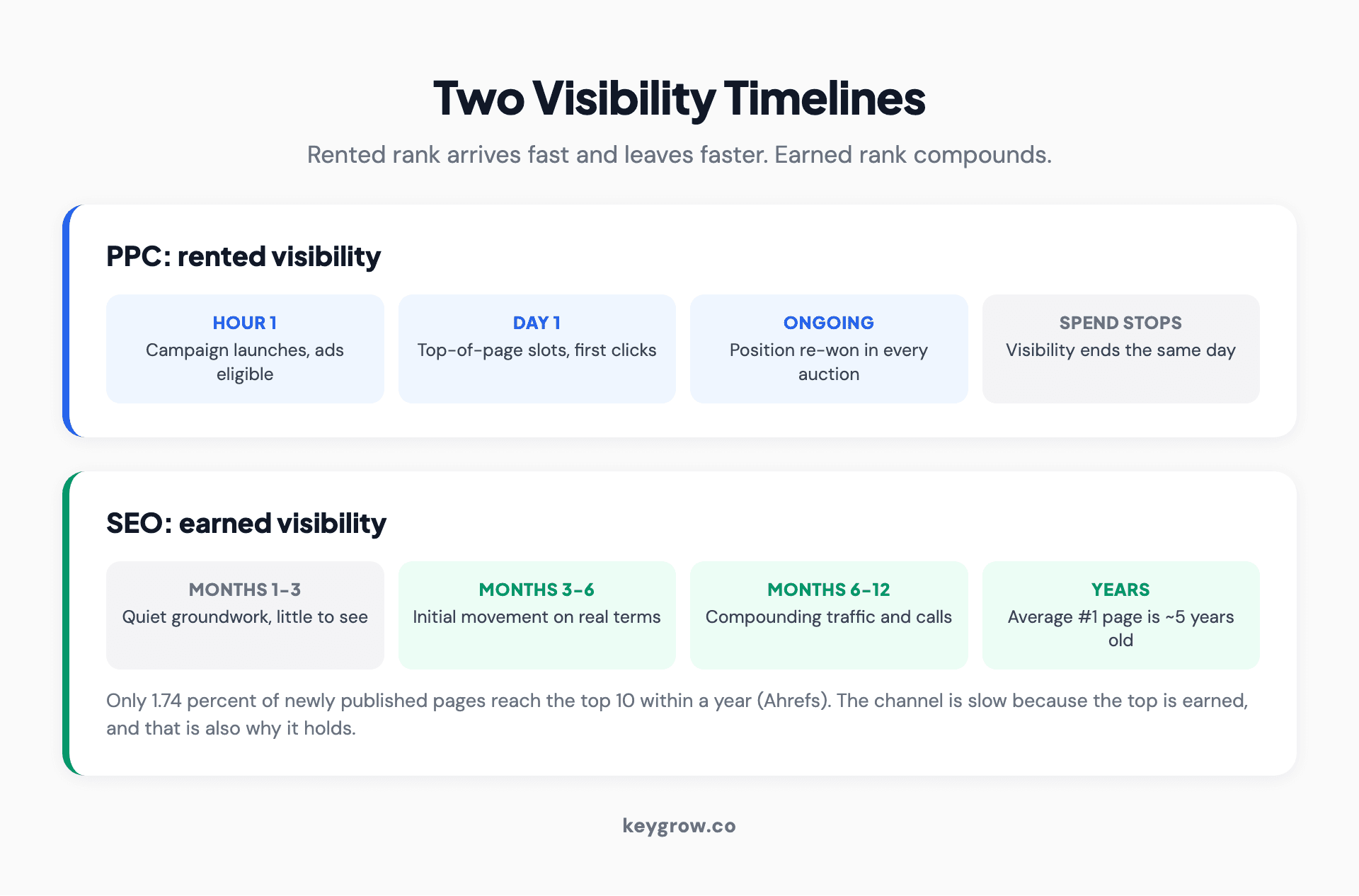
Two visibility timelines compared: a PPC campaign is live at the top of search results within hours of launch and disappears the day spend stops, while SEO shows initial movement around months three to six and compounds afterward, with the average number one page about five years old.
We watched this arc with a doctor's practice in Dubai that committed to SEO for a full year. Months one through three looked unimpressive on the surface. By month twelve, organic traffic had grown 1,519 percent and the practice was taking 130+ patient calls a month. That is the shape of the channel: the payoff is real and it is back-loaded. Our longer piece on why SEO takes so long walks through what happens in those quiet early months.
The click gap: what "ranking first" is actually worth
Position is not the prize; clicks are. And the two systems' top positions are not worth remotely the same. The number one organic result earns a 39.8 percent clickthrough rate against 2.1 percent for the top paid ad, an 18x gap at the same visual position, per First Page Sage.
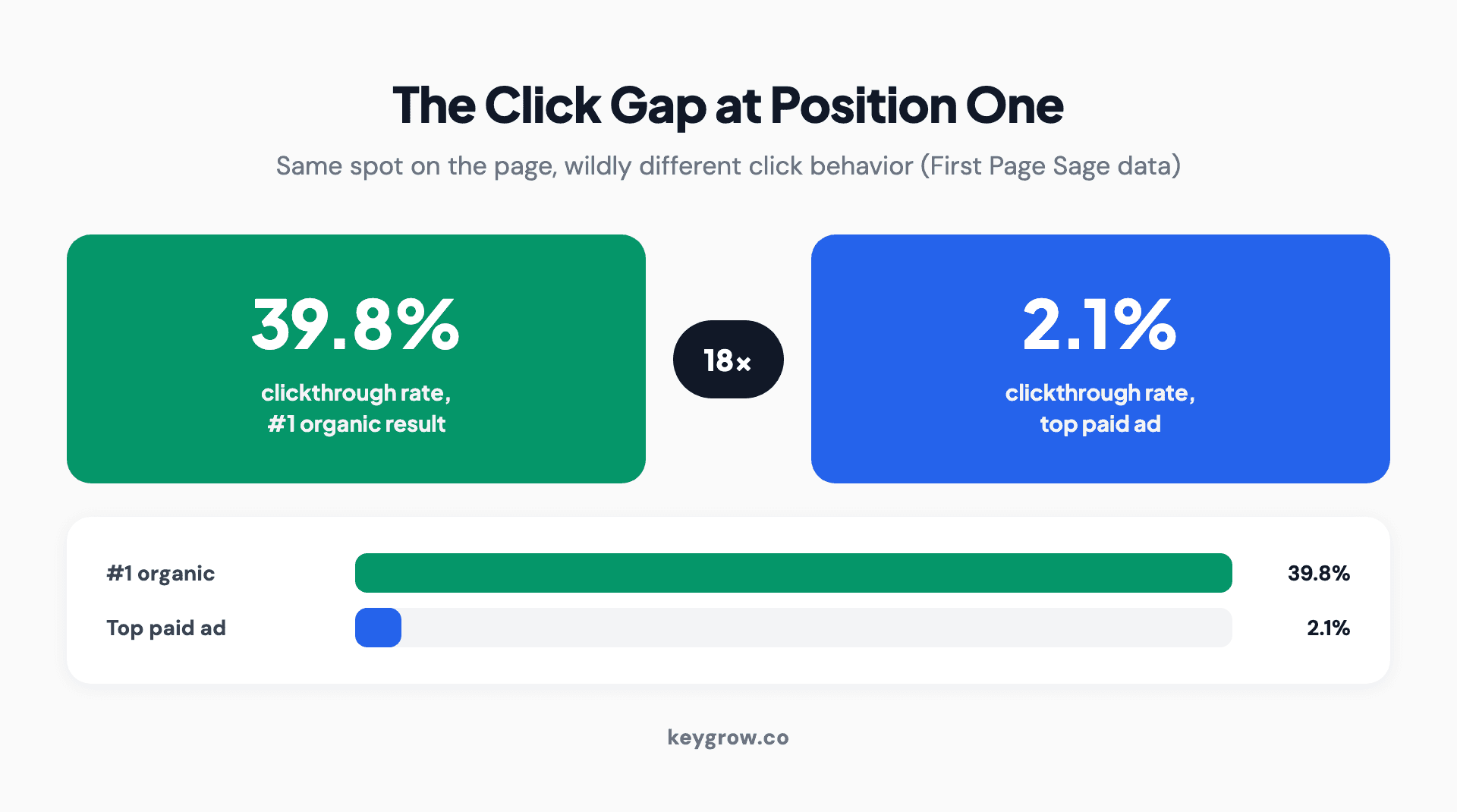
The click gap between paid and organic search: the number one organic result earns a 39.8 percent clickthrough rate, the top paid ad earns 2.1 percent, an 18x difference at the same visual position on the results page.
People have learned where the ads are, and most scroll past them. That does not make ads bad economics (the 2.1 percent who click skew heavily commercial), but it should reset expectations about what a top ad slot buys.
One more 2026 reality the older comparisons miss: on queries where an AI Overview appears, both channels lose. Click-through studies on affected queries show steep drops for organic and paid alike, because the answer gets consumed on the results page itself. It is the latest chapter in a squeeze that started when Google removed right-side ads in 2016. Whichever channel you fund, an answer-first content strategy is now part of defending the click.
Is PPC or SEO more measurable and quantifiable?
PPC is more measurable, and it is not close. The platform reports spend, clicks, cost, and conversions per keyword, in one place, with same-day feedback. You can know by Friday whether Tuesday's change worked. SEO measurement is fuzzier by nature: Search Console reports averaged positions, keyword-level visitor data disappeared years ago, and the feedback loop on any change runs weeks to months.
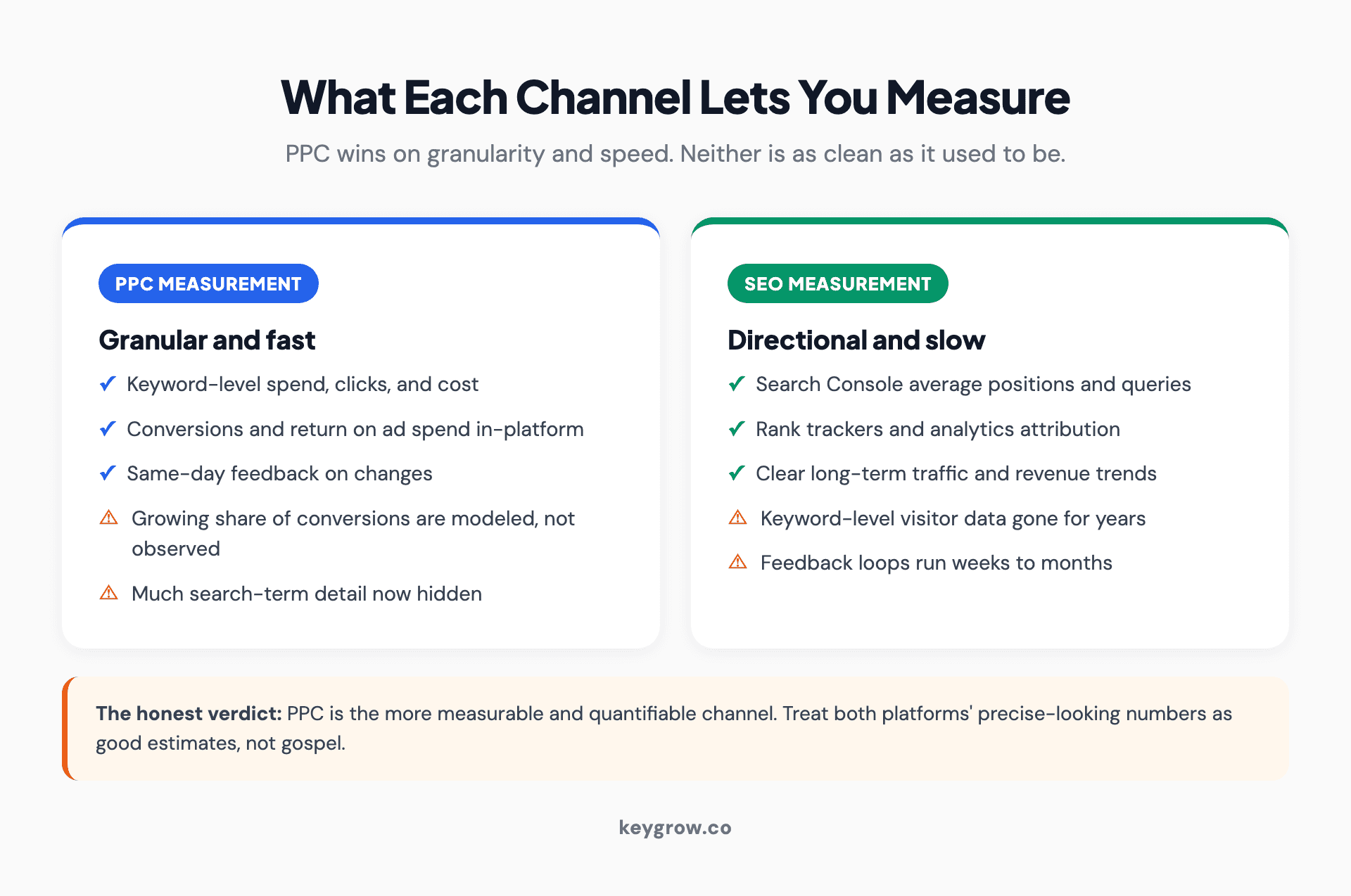
What each channel lets you measure: PPC offers keyword-level spend, cost per conversion, return on ad spend, and same-day feedback inside one platform, while SEO measurement relies on Search Console average positions, rank trackers, and analytics attribution with feedback loops that run weeks to months.
The honest footnote almost nobody adds: PPC measurement is not what it was either. Privacy rules and consent banners mean a growing share of reported conversions are modeled rather than observed, and much of the search-term detail is hidden. Paid measurement is still the sharper tool. It is just no longer a perfectly sharp one, and any agency reporting your numbers as gospel down to the decimal is overselling the instrument.
Does running ads improve your organic rankings?
No. Google has said repeatedly that the systems are separate, and spending more on ads does not move an organic position. What ads can do is indirect: the search terms report tells you which queries actually convert (worth targeting organically), and steady ad exposure lifts branded searches, which help organic performance in their own right. We wrote up the honest version of those crossover effects in how PPC can help SEO.
Which system deserves your next dollar?
The decision usually falls out of two questions: how soon do you need leads, and how expensive are your clicks.

A Google search results page open in a browser, the page where the paid and organic ranking systems meet
Pick PPC first when you need pipeline this month, you are launching something new, or you are testing offers and pages before committing to content. Pick SEO first when your niche's CPCs are punishing, you can hold a 6 to 12 month horizon, or you already produce content nobody is optimizing. Run both when the budget allows, and split by intent: buy the transactional searches while you earn the informational ones, then feed each channel's data to the other. For local businesses specifically, our comparison of local PPC vs SEO goes deeper on sequencing.
SEO rewards patience disproportionately: it is a compounding asset, not a campaign. It looks unimpressive for the first quarter and embarrassingly good after a year, and businesses that quit at month three pay for the hard part and leave before the payout.
FAQs
What is the main difference between PPC and SEO ranking?
PPC positions are decided by a real-time auction using your bid, ad quality, and search context, recalculated on every search. Organic positions are assigned by ranking algorithms evaluating content, links, and technical signals over time, and no payment can influence them. Paid visibility is rented; organic visibility is earned.
Is PPC or SEO more measurable?
PPC. It reports cost, clicks, and conversions per keyword in one platform with same-day feedback, while SEO relies on averaged positions and slower, fuzzier attribution. We unpack that split in is PPC or SEO more measurable. The gap has narrowed slightly as privacy rules push paid platforms toward modeled conversions, but paid remains the more quantifiable channel.
How does Ad Rank actually work?
Google scores every eligible ad at auction time using six factors: bid, ad and landing page quality, Ad Rank thresholds, auction competitiveness, search context, and expected impact of ad assets. Higher quality can beat a higher bid, and ads that fail the threshold do not show at all.
Does running Google Ads improve organic rankings?
No, the systems are separate and ad spend cannot buy organic positions. Indirectly, ads can help an SEO program by revealing which search terms convert and by increasing branded searches, but pausing ads does not make organic rankings drop.
How long does SEO take compared to PPC?
PPC can put you at the top of results within hours of launching a funded campaign. SEO typically shows initial movement in three to six months, and competitive number one positions often take years to earn, which is why the two channels suit different timelines.
Do ads always appear above the organic results?
No. Depending on Ad Rank and the query, ads can show above organic results, below them, or not at all. Google uses minimum thresholds, so a weak auction can produce a results page with no ads even when advertisers are bidding.
If you remember one thing
Paid rank is a per-search auction you can win today and must win again every search after. Organic rank is a slow-earned asset that keeps paying after the work is done. Neither is the better system; they are different financial instruments, and the businesses that grow cheapest usually hold both.
We run SEO and Google Ads under one roof, month-to-month, which keeps us honest about which one your next dollar belongs in. If you want that math run on your market, tell us about your business.