

SEO outsourcing is paying someone outside your business, a freelancer, an agency, or a white-label provider, to run some or all of your search engine optimization instead of doing it in-house. That is what is seo outsourcing in one sentence: you keep the goal of ranking and getting found, and you hand the execution to people who do this for a living. It exists because SEO is a wide set of skills (technical fixes, content, links, local profiles, AI search visibility) and most businesses do not have all of them on payroll. Outsourcing buys the skill without the salary.
This post is the definition, not the manual. If you already know you want to outsource and you want the step-by-step process for choosing and onboarding a partner, we wrote that separately in how to outsource SEO. Here we stay on the what: the delivery models, what should and should not leave your hands, the honest trade-offs, and the cases where outsourcing is the wrong call.
One thing to settle up front. Outsourcing SEO is not the same as abdicating it. The businesses that get burned are usually the ones that handed over the whole thing, strategy and all, then stopped paying attention. The ones that win treat the partner as an extension of their team and keep a hand on the wheel.
What is SEO outsourcing?
SEO outsourcing is delegating your search optimization work to an external specialist while your business keeps ownership of the strategy and the outcomes. You pay for execution and expertise. You do not pay to make the decisions disappear.
The market is large and growing, which tells you it is a normal way to buy SEO, not a fringe one. The SEO services market is worth about USD 74.9 billion in 2025 and is projected to reach USD 83.98 billion in 2026, growing at a 12.12 percent annual rate through 2031, according to Mordor Intelligence. And it is not just big companies buying. Small and medium enterprises accounted for 58.40 percent of those billings in 2025, the single largest client segment in that report. Outsourced SEO is overwhelmingly a small-business purchase.
It also helps to separate outsourcing from consulting (a consultant advises, you execute). Most outsourced SEO is ongoing: a monthly engagement where the partner keeps doing the work and reporting results. For the full picture of what that work involves, what SEO companies really do walks through the tasks behind the invoice.

A freelancer working alone at a laptop in a home office, representing the solo specialist model for outsourcing SEO tasks.
What are the SEO outsourcing models: freelancer, agency, and white-label?
There are three external models for outsourcing SEO, plus the in-house option you are choosing against: a solo freelancer, a full agency, and a white-label provider who does the work behind another company's brand. Each fits a different size of business, budget, and tolerance for managing the relationship.
Freelancer. A single specialist, usually contracted by the hour or by project. The upside is cost and direct contact: you talk to the person doing the work, with no account-management markup. The downside is bandwidth and breadth. One person cannot be a technical SEO, a writer, a link builder, and a local specialist at once, and if they get sick or land a bigger client, your work stalls. Freelancers suit a focused need (a one-time audit, ongoing content, a single skill gap) more than running an entire program.
Agency. A team that covers the full range of SEO skills under one roof and one contract. You get breadth, redundancy (no single point of failure), and usually proper reporting. You pay more for it, and you are one of several clients, so the question to ask is how much senior attention your account gets versus how much goes to a junior. The best agencies specialise; one that already knows your industry will out-execute a generalist from day one.
White-label. The model most owners have never heard of and have probably been served by without knowing. A white-label provider does the SEO work but delivers it under someone else's brand, usually another agency's. So the agency you hired may not be doing your work at all; a wholesale partner behind them is. There is nothing inherently wrong with it (it is how a lot of agencies scale), but you should know whether it is happening. We explain it in full in what is white-label SEO, and it is worth understanding before you sign with any agency.
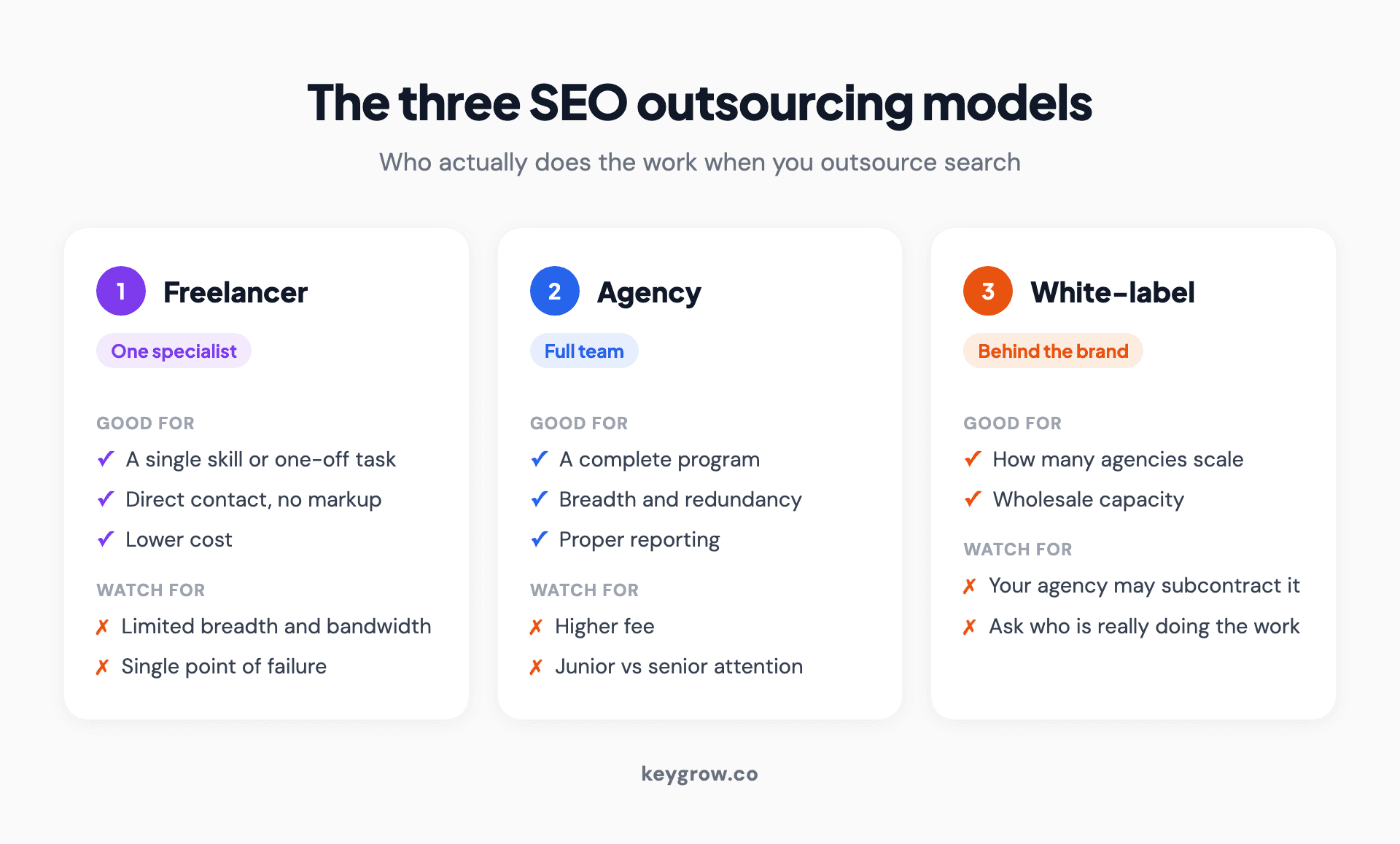
Three SEO outsourcing models compared as cards: a solo freelancer for focused single-skill work, a full-service agency for breadth and redundancy, and a white-label provider delivering work under another brand.
So which is the default? For most small and mid-sized businesses that want a full program rather than one task, an agency is the practical choice, because SEO is too broad for one freelancer and white-label happens behind the scenes. But a freelancer is the right call more often than agencies admit, and we will get to exactly when.
What gets outsourced (and what should never leave your hands)?
Almost any SEO task can be outsourced: technical audits, on-page optimization, content writing, link building, local SEO, and reporting all travel well to an outside team. What should never leave your hands is the strategy and your brand voice, the decisions about who you serve, what you sell, and how you sound.
Outsource the execution. These are the things an external specialist genuinely does better and faster than you will:
Keep the strategy and the voice. Hand these over completely and you end up with a generic site that ranks for the wrong things and sounds like nobody:
I will be blunt, because most pages on this topic never draw the line. The most common way outsourced SEO goes wrong is a business handing over strategy along with execution, then wondering why the content reads like it was written for any company in any industry. SEO is a compounding asset built on your specific expertise. Outsource the hands, not the brain. If you want the deeper argument, what organic SEO services actually include covers it.
Outsourced vs in-house SEO: which one fits your business?
Outsourced SEO fits businesses that need a range of skills without the cost and management of a full hire. In-house SEO fits businesses with enough sustained search volume and content work to keep a specialist busy and embedded. The deciding factors are cost, control, and how much SEO work you genuinely have.
The cost gap is the part people underestimate. An in-house SEO specialist in the US costs roughly USD 74,500 per year in salary, before benefits, tools, and management, per Hire With Near. And that is one person with one skill set. To match an agency's breadth in-house, you are hiring two or three people. For most small and mid-sized businesses, that math does not work, which is why 58.40 percent of the market is them buying it from outside.
Here is the comparison side by side.
| Factor | Outsourced | In-house |
|---|---|---|
| Cost | Monthly fee, scalable up or down | Salary plus benefits, tools, overhead |
| Breadth of skill | Full team across all disciplines | Limited to who you can afford |
| Business knowledge | Has to be taught | Deep, lives with the brand daily |
| Speed to start | Days to weeks | Weeks to months of hiring |
| Control | Requires active management | Direct and immediate |
| Risk if it ends | Switch partners | Re-hire, lose institutional knowledge |
Outsource when you need breadth and do not have enough work to justify a salary. Hire in-house when SEO is core to your revenue and the volume would keep a full-timer busy. Plenty of larger businesses do both: an in-house lead who owns strategy plus outsourced hands for execution.
What are the real pros and cons of outsourcing SEO?
The real pros are lower cost than hiring, immediate access to a full skill set, and faster results from people who do this daily. The real cons are less control, a learning curve while the partner gets to know your business, and the risk of hiring a bad one. Both lists are true at once.
The case for outsourcing:
The honest costs:
The trade-off is worth naming plainly: you swap some control for a lot of capability. For most businesses that is a good trade. For a few it is not, which is the next section.
When does outsourcing SEO actually make sense, and when does it not?
Outsourcing makes sense when the opportunity cost of your own time beats the fee, when you lack the in-house skills, and when SEO is a real channel for your business. It does not make sense when you have time and a single simple site, when you cannot fund at least six months, or when you are not willing to stay involved.
Outsource when:
Do not outsource yet when:
That budget point deserves a number, because it is the most expensive mistake we see. SEO is a compounding asset, not a quick campaign. Our strongest organic case study, a doctor's practice in Dubai, took a full 12 months of consistent technical fixes, content, and authority building to reach 1,519 percent organic traffic growth and 130-plus patient calls a month. Months one through three looked unremarkable. The clients who quit at month three pay for the slow foundation and leave right before it pays off. If you cannot commit to the timeline, do not start.
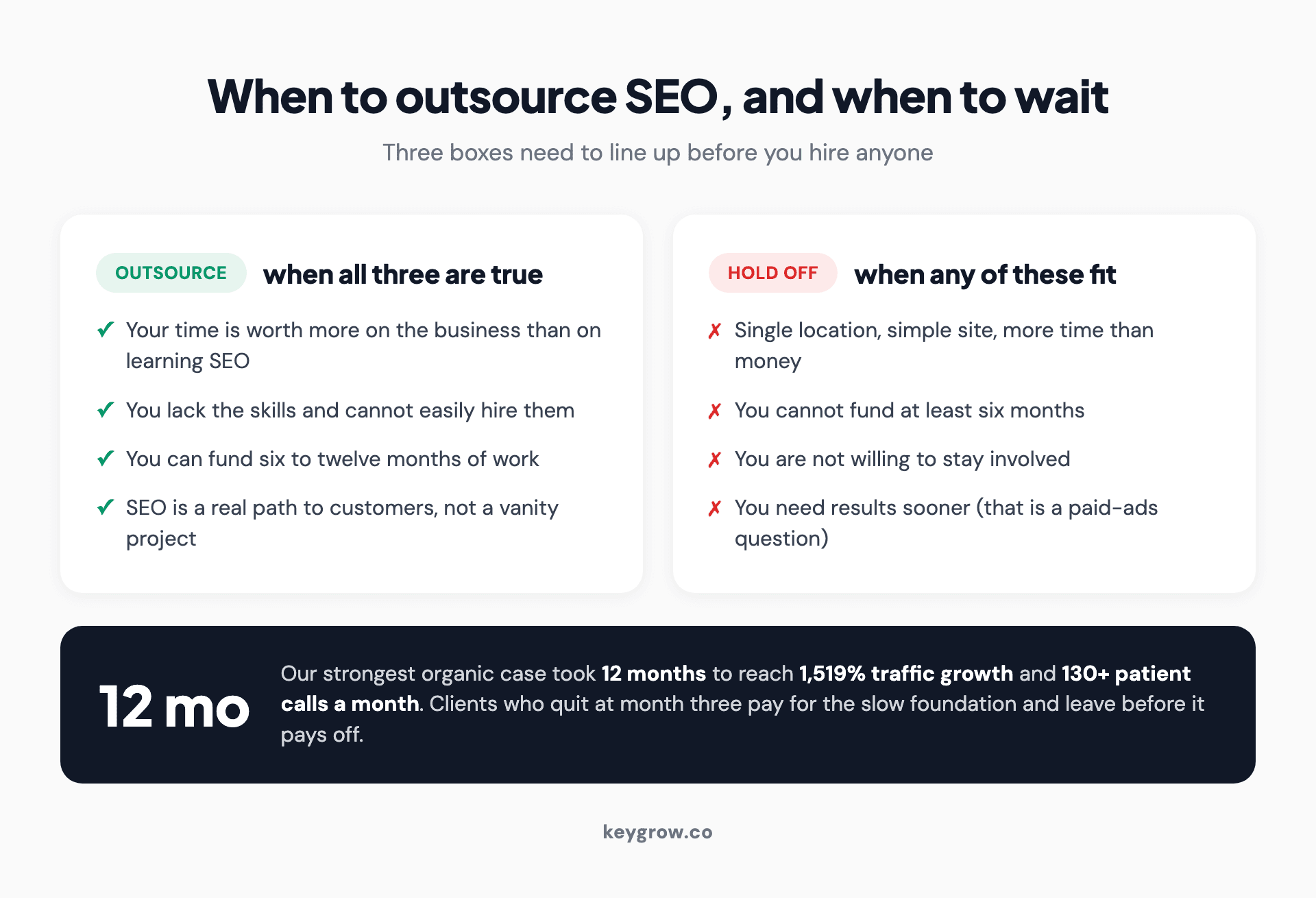
Decision split for when to outsource SEO: outsource when your time is scarce, you lack the skills, and you can fund six to twelve months; hold off when you have time, a simple site, or under six months of budget.
How much does it cost to outsource SEO in 2026?
Outsourcing SEO in 2026 ranges widely by model: freelancers and small projects sit at the low end, full-service agencies in the middle, and enterprise programs at the top. Price tracks scope, and the cheapest option usually costs the most in wasted months.
We do not publish flat pricing in a blog post, because anyone who quotes a number before seeing your site and your market is guessing. But here is how the cost structure works by model.
| Model | Typical billing | Best for |
|---|---|---|
| Freelancer | Hourly or per project | A single skill or one-off task |
| Small agency | Monthly retainer | Small and mid-sized full programs |
| Full-service agency | Monthly retainer, higher | Competitive markets, multi-channel |
| Offshore or nearshore team | Lower monthly | Cost-sensitive execution at volume |
One number worth sitting with on the offshore question: comparable SEO talent in Latin America costs about USD 33,000 per year versus that USD 74,500 US in-house salary, per the same Hire With Near data. That gap is why a lot of cheaper outsourced SEO exists, and it is not automatically bad. The thing to watch is not the country, it is whether anyone competent is checking the output.
Here is our position, and it is not what an agency usually says: cheap SEO that produces spammy links or thin content is the most expensive option you can buy, because you pay for it twice, once in fees and again in the cleanup. The question is not "what is the cheapest" but "what scope do I need and who can deliver it well."

A business owner comparing agency proposals and pricing on paper at a desk, weighing the cost of outsourcing SEO against the scope of work.
Does outsourcing SEO change now that AI search is reshaping rankings?
Yes, AI search changes what you should outsource, but not whether you should. The skills now include answer engine optimization (getting cited by ChatGPT and AI Overviews), not just ranking blue links. That broader skill set is exactly what most businesses cannot build in-house, which makes outsourcing more relevant, not less.
The question has shifted from "how do I rank" to "how do I become the source the AI quotes." ChatGPT cites only about 15 percent of the pages it retrieves, and roughly 44 percent of those citations come from the first third of a page. A partner still optimizing the way they did in 2020 will leave you invisible in the channels that are growing.
So when you vet a partner now, ask what they are doing about AI search, not just rankings. A blank stare is a red flag. The teams worth hiring have already folded AI search into how they structure content and measure visibility. Our playbook on AI search optimization shows what that work involves, so you can tell a partner who gets it from one who is bluffing.
The bottom line: AI search makes the skill set wider and harder to keep current, which is the strongest argument for outsourcing there has ever been. Staying current alone is now beyond most in-house generalists.
What to take from all this
SEO outsourcing is handing your search execution to an external freelancer, agency, or white-label partner while you keep the strategy and the voice. Pick the model that fits your size and budget, outsource the hands and never the brain, and only start if you can stay involved and fund the timeline. When all three line up, it is one of the better marketing investments a small business can make. When they do not, a decent partner will tell you so before you sign.
If you have decided outsourcing is right and want the step-by-step, how to outsource SEO is the next read. If you want a partner who is month-to-month, cancel anytime, and will tell you straight when you are not a fit, you can talk to our team. No lock-in, no page-one-in-30-days promises.
FAQs
Is it worth outsourcing SEO?
For most small and mid-sized businesses, yes, because hiring a full in-house team is far more expensive and SEO needs a range of skills few owners have. It is worth it when the opportunity cost of your own time beats the fee and you can commit to at least six to twelve months. It is not worth it if you have a simple site, plenty of time, and a budget too small to fund the full timeline.
What is the difference between outsourcing SEO and white-label SEO?
Outsourcing SEO is you, the business, hiring an outside provider to do your SEO. White-label SEO is an agency hiring a wholesale provider to do client work under the agency's own brand, so the client may not know the work is subcontracted. From your seat as the owner, white-label is something happening behind your agency, while outsourcing is the decision to hire that agency or freelancer in the first place.
Can you outsource SEO to another country safely?
Yes, plenty of strong SEO work comes from distributed and offshore teams, and the cost can be significantly lower. The risk is not the country, it is the quality: cheap work that produces spammy links or thin content damages your site. Vet the actual output, ask for examples and references, and make sure someone competent reviews the work wherever it is done.
What SEO tasks should you never outsource?
You should never fully outsource your strategy and brand voice: the decisions about who you serve, what you sell, what claims you stand behind, and how you sound. Technical work, content production, link building, and reporting all travel well to an outside team. But no external partner knows your business like you do, so keep final approval and the core direction in-house.
Is it cheaper to outsource SEO or hire in-house?
For most businesses, outsourcing is cheaper than hiring in-house. An in-house SEO specialist in the US costs roughly USD 74,500 a year in salary alone, before benefits, tools, and management, and that is one person with one skill set. An outsourced team gives you the full range of SEO skills for a monthly fee, which is why small and medium enterprises make up the majority of the SEO market.
How do you know if outsourced SEO is actually working?
Judge outsourced SEO on business outcomes, not vanity metrics. Leads, calls, booked jobs, and revenue from organic traffic are what matter, not impressions and rankings alone. Expect the first quarter to look slow, since SEO compounds over months, and ask your partner for reporting that ties their work to real results rather than activity. If the report leads with impressions, ask why.
Should a small business outsource SEO or do it themselves?
Many small businesses should start by doing the basics themselves, claiming their Google Business Profile, gathering reviews, and fixing obvious on-page issues, before paying anyone. Outsource once the opportunity cost of your time outweighs the fee, or once you hit a ceiling those basics cannot push past. A single-location business with more time than money often does not need an agency yet.
What is the difference between an SEO freelancer and an SEO agency?
A freelancer is one specialist, usually cheaper and more direct, best for a focused task or single skill. An agency is a team covering the full range of SEO disciplines with redundancy and proper reporting, better for a complete program but more expensive. So match the choice to whether you need one skill or a whole program.


