

The way to combine SEO and PPC for SaaS lead generation is to let paid search answer in six weeks the question organic search would take a year to answer: which search terms actually produce demo requests. Then you build organic pages around the winners and stop renting those clicks forever.
That is the loop. The rest of this post is detail.
What you will also read, on most pages covering this, is a promise that running both channels together drops customer acquisition cost by some neat double-digit percentage. That figure tends to appear without a source, which usually means it has been passed between blog posts rather than measured. The benchmark data is messier than the promise, and in one important case it points the other way. We will get to it.

A marketing team working through channel planning around a laptop at a shared table.
The loop that does the work
Paid search buys query data in weeks. Organic turns the profitable queries into assets you stop paying for. Each channel funds the next move of the other.
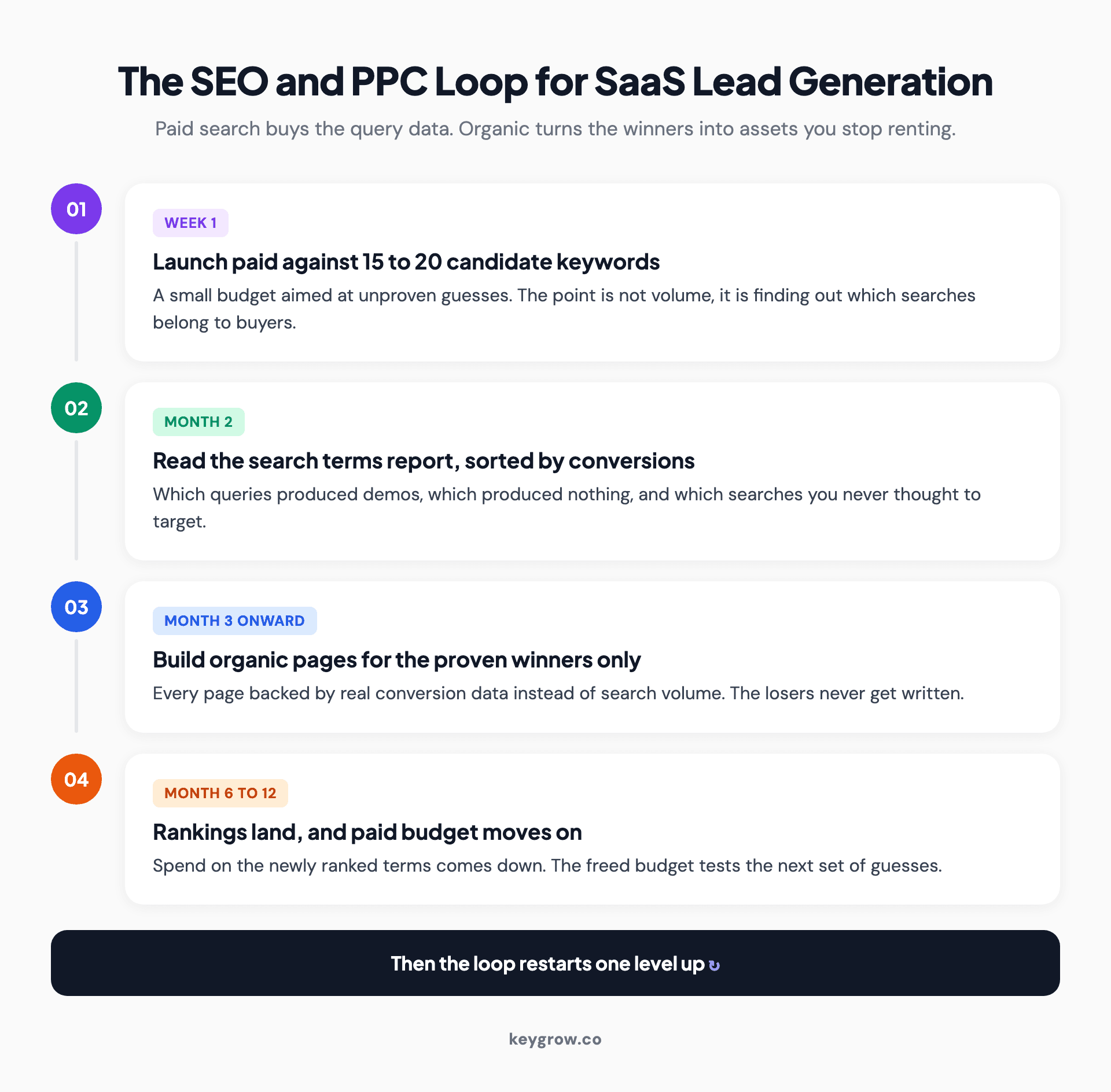
Four step cycle showing paid search buying keyword data in weeks, organic pages built only for the proven winners, and freed budget testing the next set of guesses.
Run it in order and it looks like this. You launch a small paid campaign against a set of guesses. Within a month or two the search terms report tells you which of those guesses converted into trials or demos, which converted into nothing, and which searches you never thought of. Google's own search terms report documentation describes this second use explicitly, as a source of ideas for content and landing pages, not just for negative keywords.
Now you have a ranked list of queries with real conversion data behind them. That list is your content brief. You write the organic pages for the terms that converted, and you skip the ones that looked good in a keyword tool and died on contact with buyers.
Six to twelve months later those pages rank. Paid spend on those exact terms can come down, and the freed budget goes into testing the next set of guesses. The loop restarts one level up.
Most teams break this by running the two channels in separate meetings with separate spreadsheets, which is how you end up with an SEO roadmap built entirely from search volume and a paid account full of keywords nobody has looked at since launch.
Why SaaS search behaves differently
SaaS breaks the standard advice in four specific ways, and every one of them changes how you split the channels.
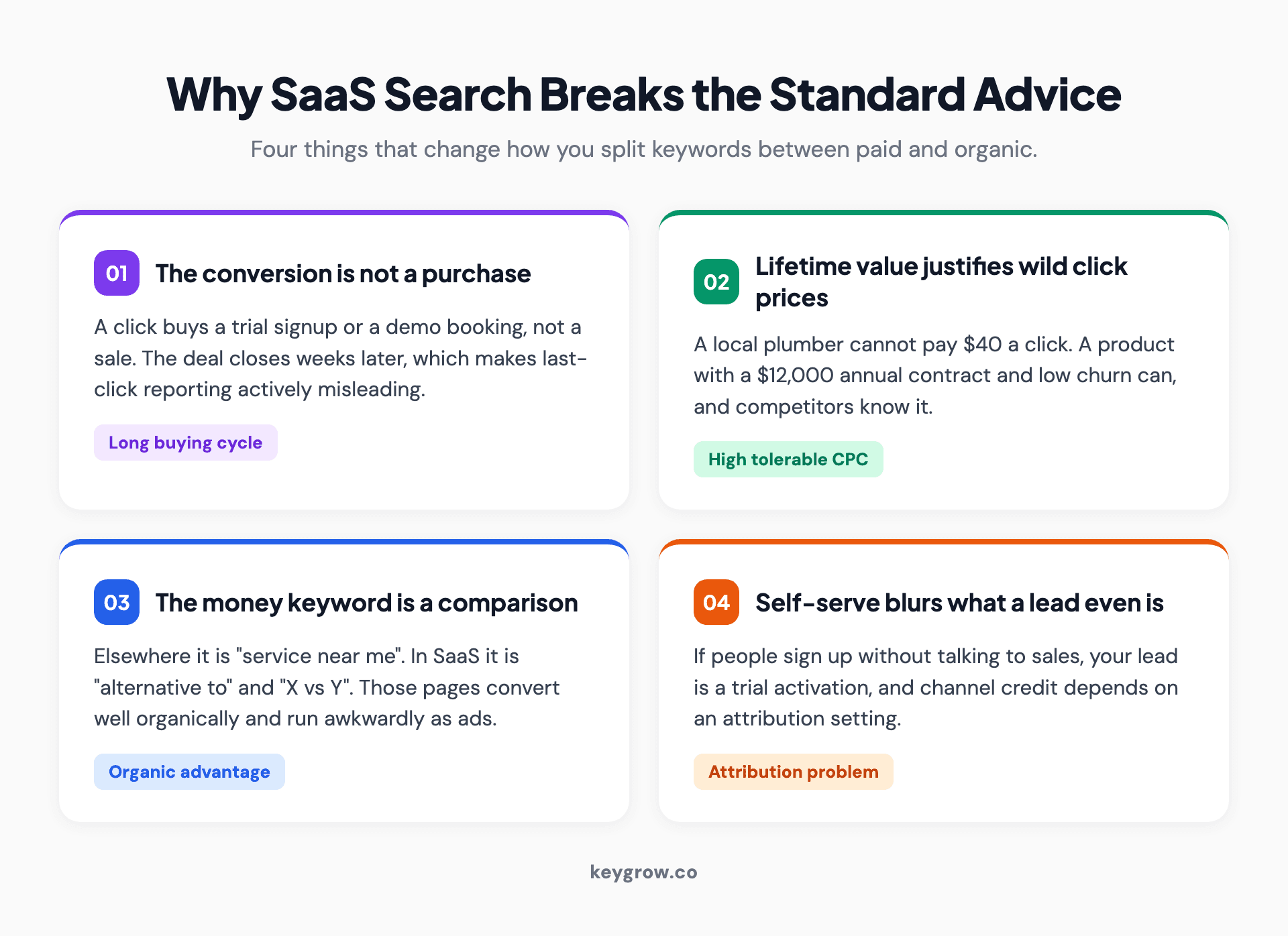
Four cards explaining why SaaS search differs: the conversion is a trial not a purchase, lifetime value justifies high click prices, comparison pages are the money keyword, and self-serve signup blurs attribution.
The buying cycle is long and the conversion is not a purchase. Someone clicking a paid ad for project management software is not buying today. They are starting a trial, booking a demo, or reading a comparison page. Your paid campaign is buying an entry into a process that finishes weeks later, which makes last-click reporting actively misleading.
Lifetime value justifies clicks that would be insane elsewhere. A local plumber cannot pay $40 a click. A SaaS product with a $12,000 annual contract and low churn can, and competitors know it, which is why category terms get expensive.
The highest-intent content is comparison content. In most industries the money keyword is "[service] near me". In SaaS it is "[competitor] alternative" and "[tool A] vs [tool B]". Those pages convert well organically and they are awkward to run as ads.
And self-serve products blur the lead entirely. If people sign up without talking to sales, your "lead" is a trial activation, and the channel that gets credit depends on an attribution setting rather than on reality.
Start with paid, then let organic take over
If you are choosing where to start, start with paid. Not because it is better, but because it answers questions faster and organic cannot tell you anything useful for two quarters.

Close up of a screen showing campaign performance numbers being reviewed during a paid search test.
A modest paid budget against fifteen or twenty candidate keywords will, inside two months, produce a list of which terms generate demo requests and roughly what each one costs. That is research you can act on. The equivalent SEO experiment costs the same money and reports back next year.
Then invert it as the data arrives. Terms that convert and are winnable organically move to the content roadmap. Terms that convert but sit behind twelve competitors with better domains stay on paid indefinitely, which is a legitimate outcome rather than a failure. Terms that do not convert leave both lists.
The mistake to avoid here is treating the first month of paid data as conclusive. SaaS cycles run long enough that a keyword can look dead at four weeks and produce two closed deals at week nine. Four conversions is an anecdote, and a lot of keyword decisions get made on three. Give any keyword at least one full sales cycle before you cut it.
Which keywords to buy and which to earn
Split them on two questions: can you realistically rank for it, and does the click convert now or later.
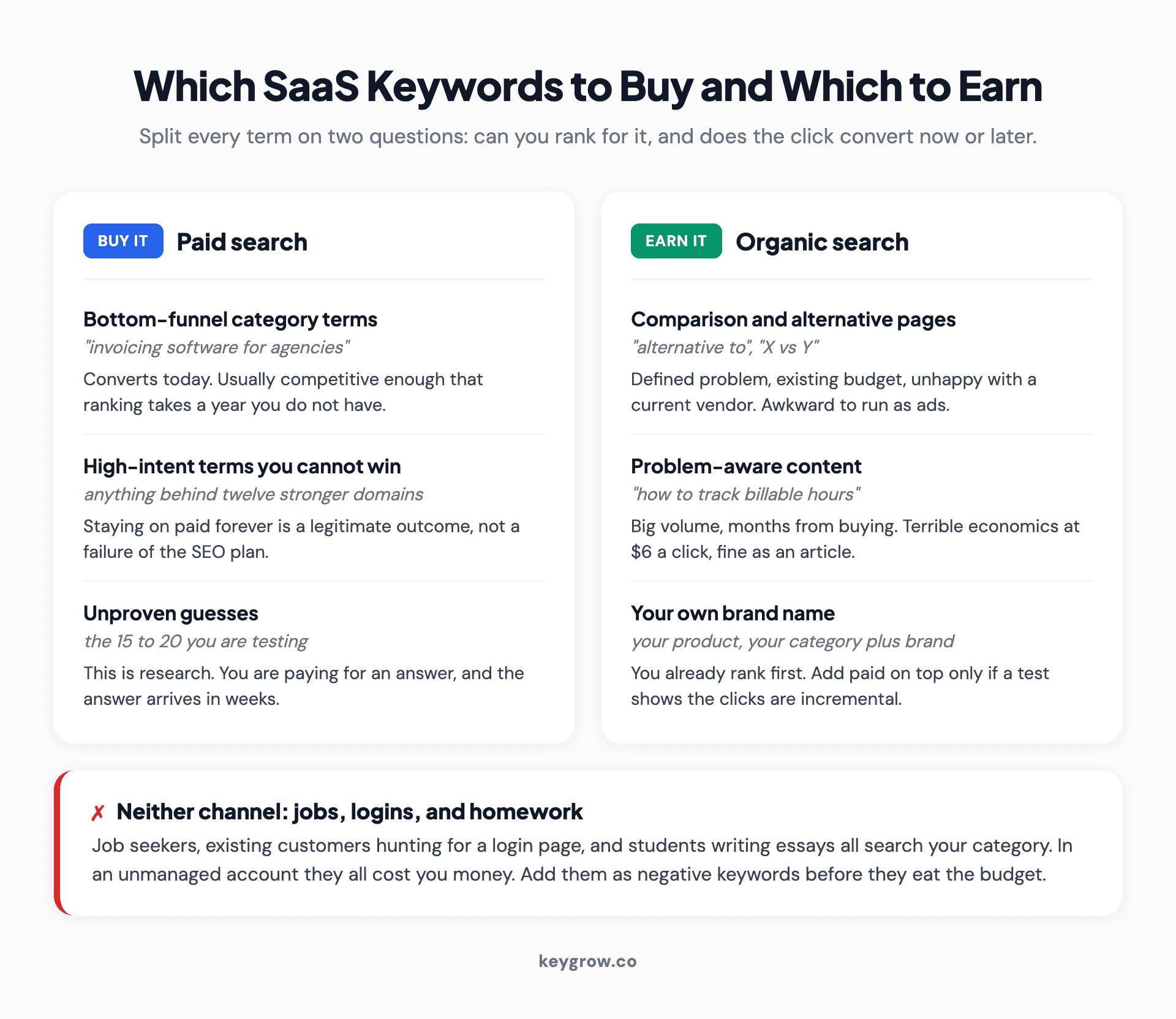
Two column breakdown of which SaaS keywords to buy with paid search and which to earn organically, plus the job and login searches that belong in neither channel.
| Keyword type | Example shape | Channel | Why |
|---|---|---|---|
| Bottom-funnel category | "invoicing software for agencies" | Paid first, organic later | Converts now, usually competitive enough that ranking takes a year |
| Competitor comparison | "[tool] alternative", "X vs Y" | Organic | Converts well, and ads against competitor terms get expensive and awkward |
| Problem-aware | "how to track billable hours" | Organic | High volume, low immediate intent, terrible economics as a paid click |
| Branded | your product name | Mostly organic, some paid | You already rank first; see the next section |
| Jobs and careers | "[your product] careers" | Neither | Add as a negative keyword before it eats budget |
The row people get wrong is problem-aware content. It reads like an obvious paid opportunity because the volume is large. It is not. Someone searching how to track billable hours is months from buying anything, and paying $6 a click to reach them at that stage is how SaaS accounts quietly develop a cost per acquisition nobody wants to present at a board meeting. Write the article, capture the email, and let nurture do the rest.
The last row costs more accounts than it should. Job seekers, existing customers looking for a login, and students writing essays all search your category, and in an unmanaged account they all cost you money. Reviewing search terms weekly is dull work, and in accounts that have never had it done it typically recovers 20 to 30 percent of the budget.
The CAC claim you should not believe
Combining channels does not automatically lower acquisition cost, and the most-cited benchmark set suggests plain SEO can cost more per customer than paid search does.
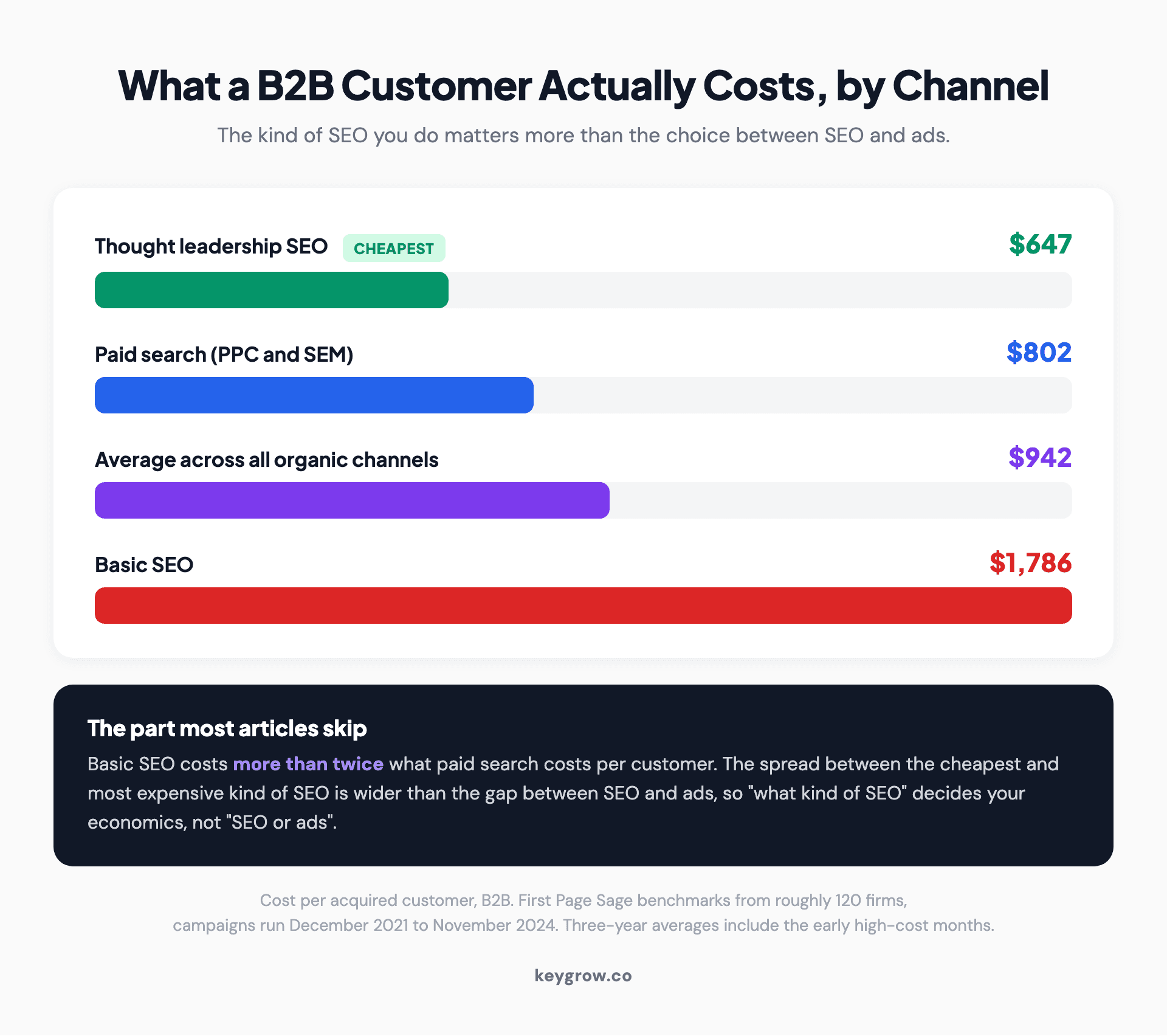
Bar chart of B2B cost per acquired customer by channel: thought leadership SEO at $647, paid search at $802, all organic averaging $942, and basic SEO at $1,786.
First Page Sage publishes B2B acquisition cost by channel from roughly 120 firms, covering campaigns run between December 2021 and November 2024. Their B2B figure for PPC and SEM is $802 per customer. Their figure for basic SEO is $1,786, more than twice as much. Thought leadership SEO comes in at $647, the cheapest search channel on the list.
The paid side of that number is set by your own economics rather than by a benchmark, and there is a worked model for it in Google Ads for SaaS.
Sit with that spread for a second. The gap between the cheapest and most expensive kind of SEO is larger than the gap between SEO and paid. Which means "should we do SEO or ads" is close to the wrong question, and "what kind of SEO" is the one that decides your economics.
SEO is a compounding asset, not a campaign, and the numbers only work if you treat it as one. Basic SEO, meaning thin service pages and keyword-shaped posts published on a schedule, is an expensive way to buy customers. Four posts a month, filed and never opened again, is a content calendar rather than a strategy. The version that beats paid search is the one where you publish things a practitioner would actually cite. Businesses that quit at month three pay for the hard part and leave before the payout.
Two honest caveats on that data. It comes from one agency's client set rather than a census, and a three-year average includes the early months when acquisition cost is always at its worst. Treat it as a directional signal rather than gospel. It is still better evidence than an unsourced round number.
Should you keep bidding on terms you already rank for?
Sometimes. The reflex answer of "always defend your brand" is right more often than not, and in most accounts the question gets settled by whoever says it with the most confidence rather than by anything resembling data. It is worth actually testing.
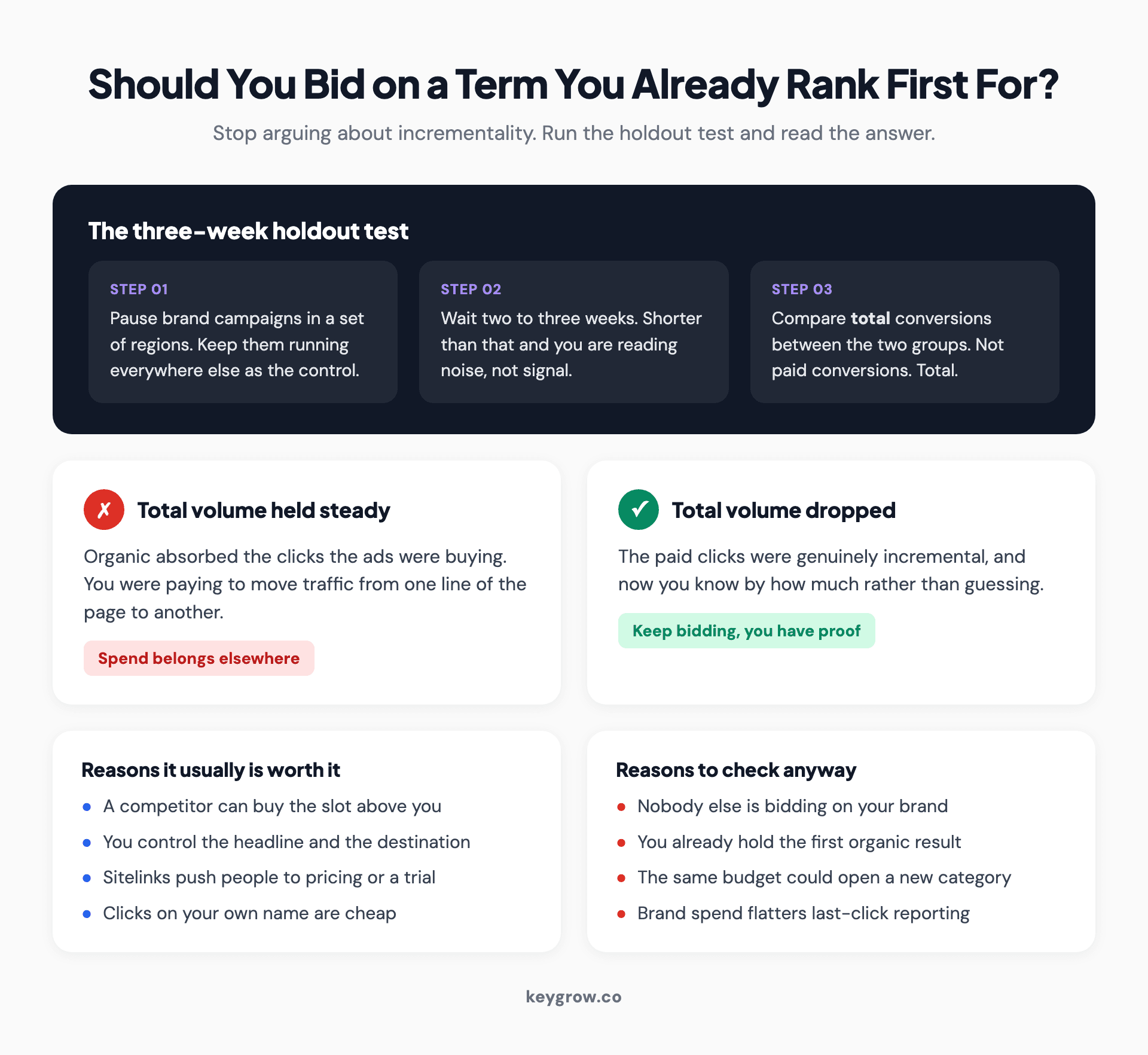
Three step holdout test for brand keyword bidding, showing what it means if total conversions hold steady versus drop when brand ads are paused.
The case for bidding on your own brand name is that a competitor can buy that slot, that the ad gives you control over the headline and the destination, and that sitelinks let you push people toward pricing or a trial instead of your homepage. Brand clicks are usually cheap because your quality score on your own name is high.
The case against is incrementality. If you rank first organically and no competitor is bidding, a meaningful share of those paid clicks would have been free clicks. You are paying to move traffic from one line of the page to another.
You can settle this rather than argue about it. Pause brand campaigns in a set of regions for two to three weeks, keep them running elsewhere, and compare total conversions rather than paid conversions. If total volume holds steady with brand ads off, the spend was not incremental. If it drops, it was, and now you know by how much.
Non-branded terms where you rank in the top three are the more interesting case. Holding both slots gives you more of the page, which matters more on mobile and more when an AI summary sits above everything. There is a real argument for it. There is also a real argument that the money would do more in a category where you have no organic presence at all. Test it the same way.
What to measure when a lead touches both channels
Measure the pipeline, not the click. A SaaS lead that reads two organic articles, leaves, comes back on an ad, and books a demo three weeks later is one lead that both channels earned.
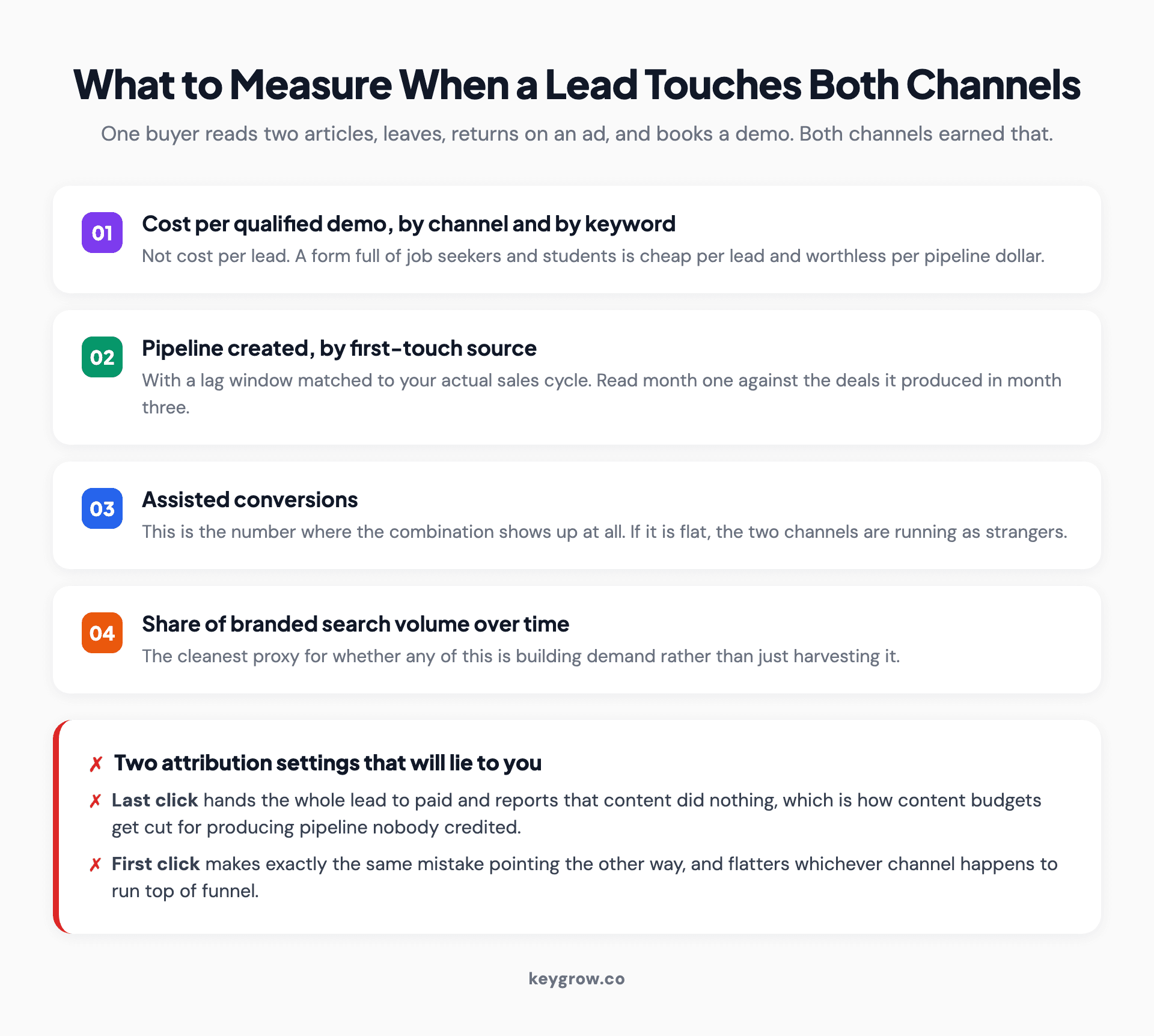
Four metrics to track across SEO and PPC together, with a warning that last click and first click attribution both misreport which channel earned the lead.
Last-click attribution hands that entire lead to paid and tells you organic did nothing, which is how content budgets get cut for producing pipeline nobody credited them with. First-click flips the same error the other way.
The practical setup is unglamorous. Pass the source into your CRM at signup and keep it on the record through to closed-won, so you can look at revenue by first touch and by last touch and read the gap between them. Then track a small number of things that actually move:
The lead quality point deserves its own note, because more traffic is the usual reflex and usually the wrong fix. A cash home buyer we work with, not a SaaS company, was drowning in junk leads. The fix was not a bigger budget. It was negative keywords, tighter match types, and qualifying language in the ad copy itself, which took serious leads up 600 percent between December and January on the same spend. Filtering beat volume. The same holds for SaaS demo requests, where a form full of students and job applicants looks like success in the lead count and like nothing at all in pipeline.
When running both is the wrong call
Do not run both if you have not found product-market fit yet, or if your total monthly marketing budget is under a few thousand dollars.
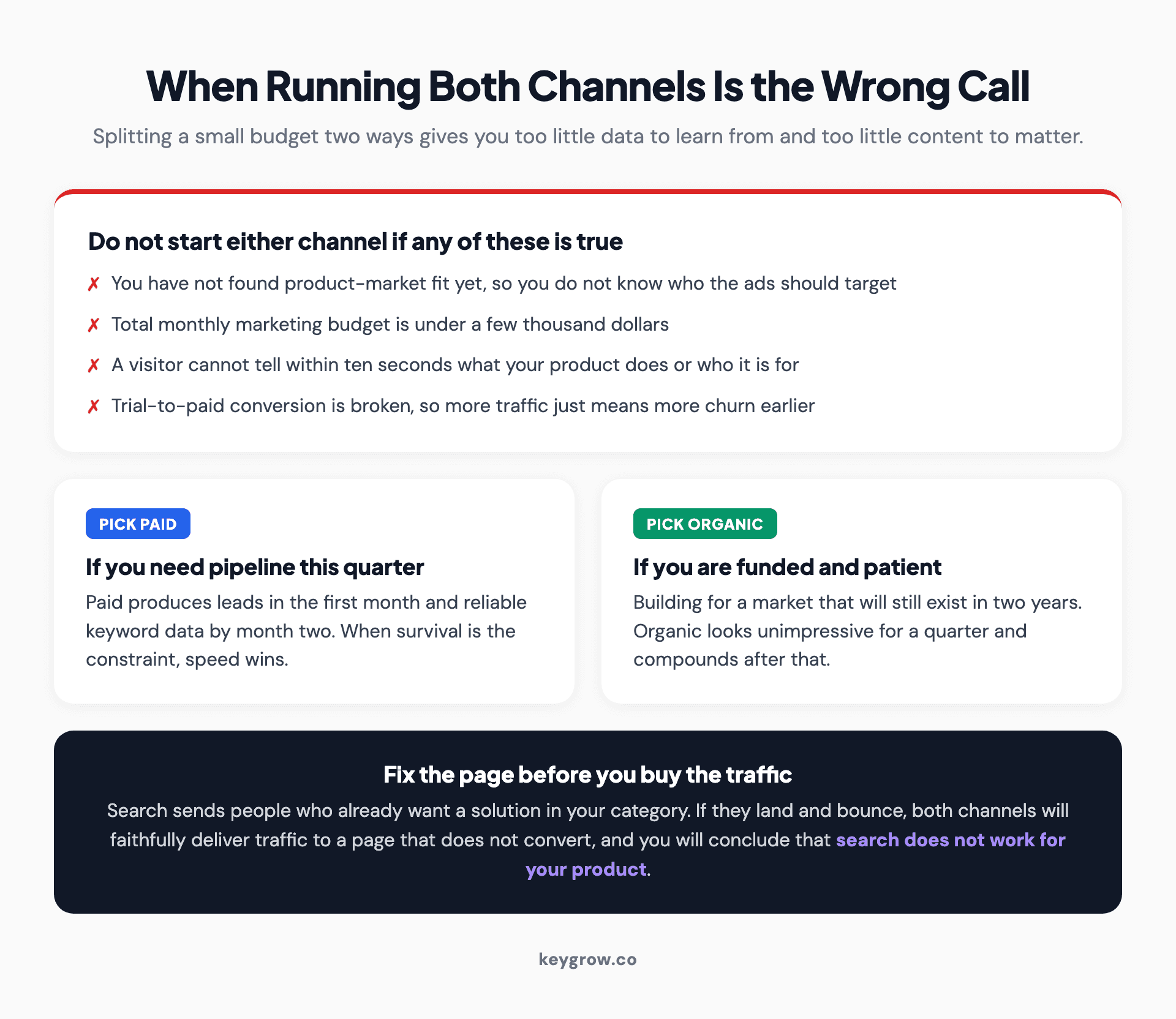
Checklist of conditions where running SEO and PPC together is the wrong call, with guidance on picking paid for near-term pipeline or organic when funded and patient.
Split a small budget across two channels and you get a paid account with too little data to learn from and a content program too slow to matter. Pick one. If you need pipeline this quarter to survive, that is paid. If you are funded, patient, and building for a market that will still exist in two years, that is organic.
Do not start either one if your positioning is unclear or your trial-to-paid conversion is broken. Search sends people who already want a solution to your category. If they arrive and cannot tell within ten seconds what you do or who it is for, both channels will faithfully deliver traffic to a page that does not convert, and you will conclude that search does not work for your product.
We turn away this exact profile fairly often, because the honest recommendation is to fix the product page and the onboarding first. That work is cheaper than either channel and it raises the ceiling on both.
FAQs
Should a SaaS company do SEO or PPC first?
Paid search first, in most cases. It returns usable conversion data on specific keywords within about two months, whereas organic takes two to three quarters to tell you anything. Use the paid data to decide what content to build, then let organic take over the terms you can realistically rank for.
Does combining SEO and PPC actually lower customer acquisition cost?
Not automatically. Published B2B benchmarks show basic SEO can cost more per customer than paid search does, while high-quality thought leadership content costs less than both. The saving comes from letting paid data direct your content spend so you stop writing pages that were never going to convert, not from running two channels at once.
Should I bid on my own brand name if I already rank first?
Usually yes, but test it rather than assume. Pause brand campaigns in some regions for two to three weeks and compare total conversions, not just paid conversions. If overall volume holds steady without the ads, those clicks were not incremental and the budget belongs elsewhere.
How much should a SaaS company budget for paid search to get useful data?
Enough to generate a few hundred clicks across your candidate keywords within about two months, which depends entirely on your cost per click. In competitive B2B categories where clicks run into the tens of dollars, a budget too small to reach that threshold will produce noise rather than a decision.
Which SaaS keywords convert best organically?
Comparison and alternative pages. Someone searching for an alternative to a specific tool has a defined problem, a budget, and an existing vendor they are unhappy with. Those pages are difficult to run as ads and they tend to convert at several times the rate of top-of-funnel content.
How do I stop paid and organic from cannibalizing each other?
Share one keyword list between both teams and assign every term to a channel with a reason attached. Cannibalization is rarely a real problem in SaaS; the far more common failure is the two channels working from separate lists and neither one learning anything from the other.
How long before the combination shows results?
Paid produces leads in the first month and reliable keyword-level data by month two. Organic pages built from that data typically take six to twelve months to rank and convert. Anyone promising organic results faster than that is either targeting terms nobody searches or about to damage your domain.
Where to start on Monday
Open your search terms report and sort by conversions. Not clicks, not impressions, conversions. The list you are looking at is your content roadmap, and it is better than any keyword tool output because every row on it has already proven someone with a problem typed it and then acted.
If you have no paid data at all, that is the first thing to buy. Fifteen candidate keywords, a small budget, two months, and a landing page that says clearly what your product does. The answer you get is worth more than a year of guessing.
If you would rather not run that experiment yourself, our PPC management and SEO teams do it as a single engagement rather than two, mostly because separating them is how the data stops flowing between them. We are month to month, so the arrangement has to keep earning its place.
Worth reading next if this is your patch: our take on why both channels belong together, a practical guide to B2B PPC budgeting, and the argument over which channel is easier to measure.


