


PPC is the more immediately measurable and quantifiable of the two. Ad spend and results live inside the same system, conversions report within a day or so, and you can trace a dollar spent to a click, a lead, and often a sale. SEO is measurable too, but its payoff arrives on a delay and is harder to attribute cleanly, because organic works upstream of the final click and compounds over months. So the honest verdict is: PPC wins on measurement speed and clarity, SEO wins on long-run value, and in 2026 PPC's tracking edge is smaller than it used to be.
That last clause is the part almost every article on this question ignores. The old story, PPC is perfectly trackable and SEO is a black box, was more true in 2019 than it is now. Privacy changes have blurred both. Let me walk through why PPC still measures faster, why SEO measures slower but is not unmeasurable, and how to read each one honestly today.
What "measurable and quantifiable" actually means
Before comparing, it helps to define the thing. Measurable marketing lets you connect spend to outcome with reasonable confidence, quickly, and repeatably.
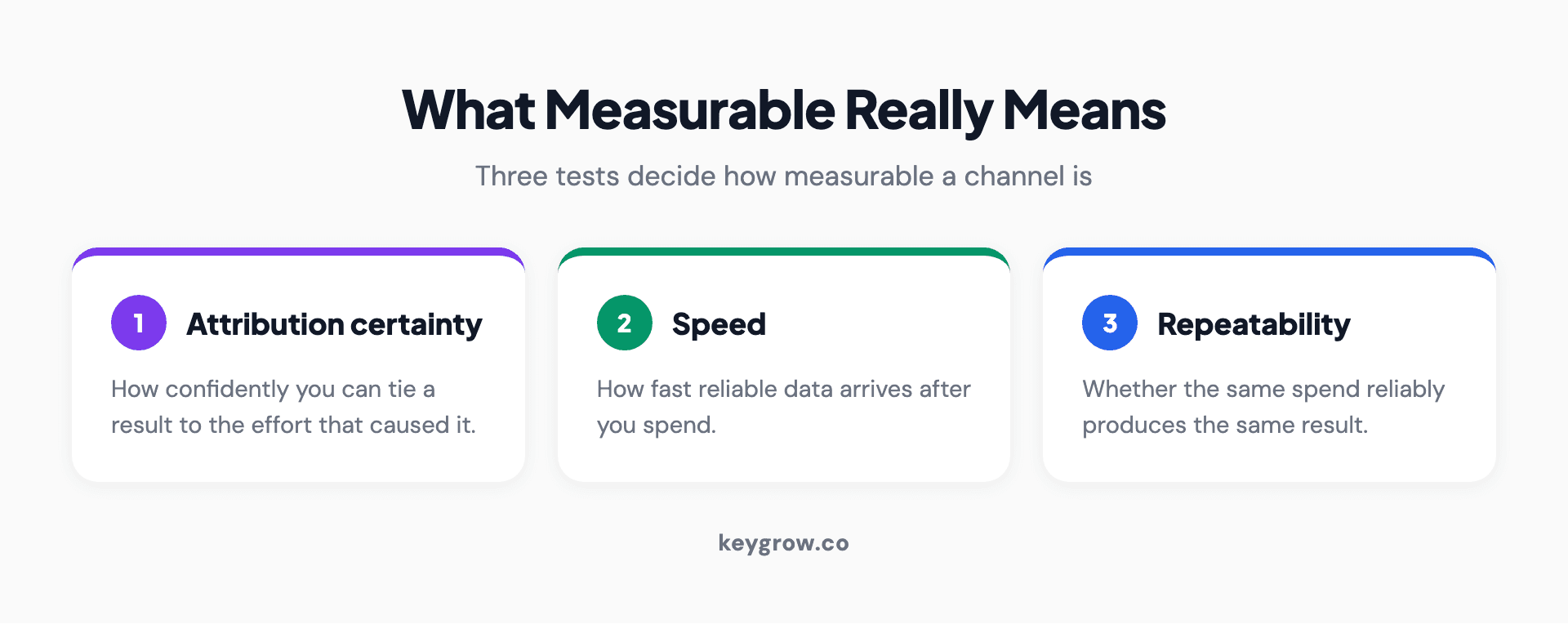
The three tests that decide how measurable a marketing channel is: attribution certainty, how confidently you can tie a result to the effort that caused it; speed, how fast reliable data arrives; and repeatability, whether the same spend reliably produces the same result.
Three qualities decide how measurable a channel is. Attribution certainty is how confidently you can tie a result to the effort that caused it. Speed is how fast reliable data arrives. Repeatability is whether the same spend reliably produces the same result. PPC scores high on all three. SEO scores lower on each, not because it does nothing, but because its cause and effect are separated by time and buried inside a journey that touches many pages. Keep those three tests in mind, because the whole comparison runs through them.
An example makes the gap concrete. Spend $500 on Search ads today and by tomorrow you can say it produced 40 clicks, 6 leads, and 2 sales at a known cost each. Spend the same $500 on a piece of content today and you may not know what it earned until it ranks in three months, gets found, and quietly feeds a sale that a branded search closes and takes the credit for. Same money, two completely different measurement timelines.
Why PPC is easier to measure
PPC is easier to measure because the spend and the result sit in one place and the feedback loop is short. You launch a campaign and see data the same day.
Inside Google Ads you watch impressions, clicks, cost per click, conversions, cost per conversion, and return on ad spend update in near real time. Every click carries an identifier, so a conversion can be traced back to the exact keyword and ad that produced it, and once you measure what a lead is worth over its lifetime, the same loop tells you exactly what you can afford to pay. Spend one dollar, get a number back, adjust tomorrow. That tight loop is why PPC is the channel you can prove to a skeptical owner in a week, and it is a real advantage when you need answers fast. It is also why PPC gets more credit than it sometimes deserves, a point we come back to.
Why SEO is still measurable, just slower
SEO is measurable, but its signals lag and scatter. You can absolutely quantify organic performance; you just cannot do it same-day, and you cannot always prove which effort caused which result.
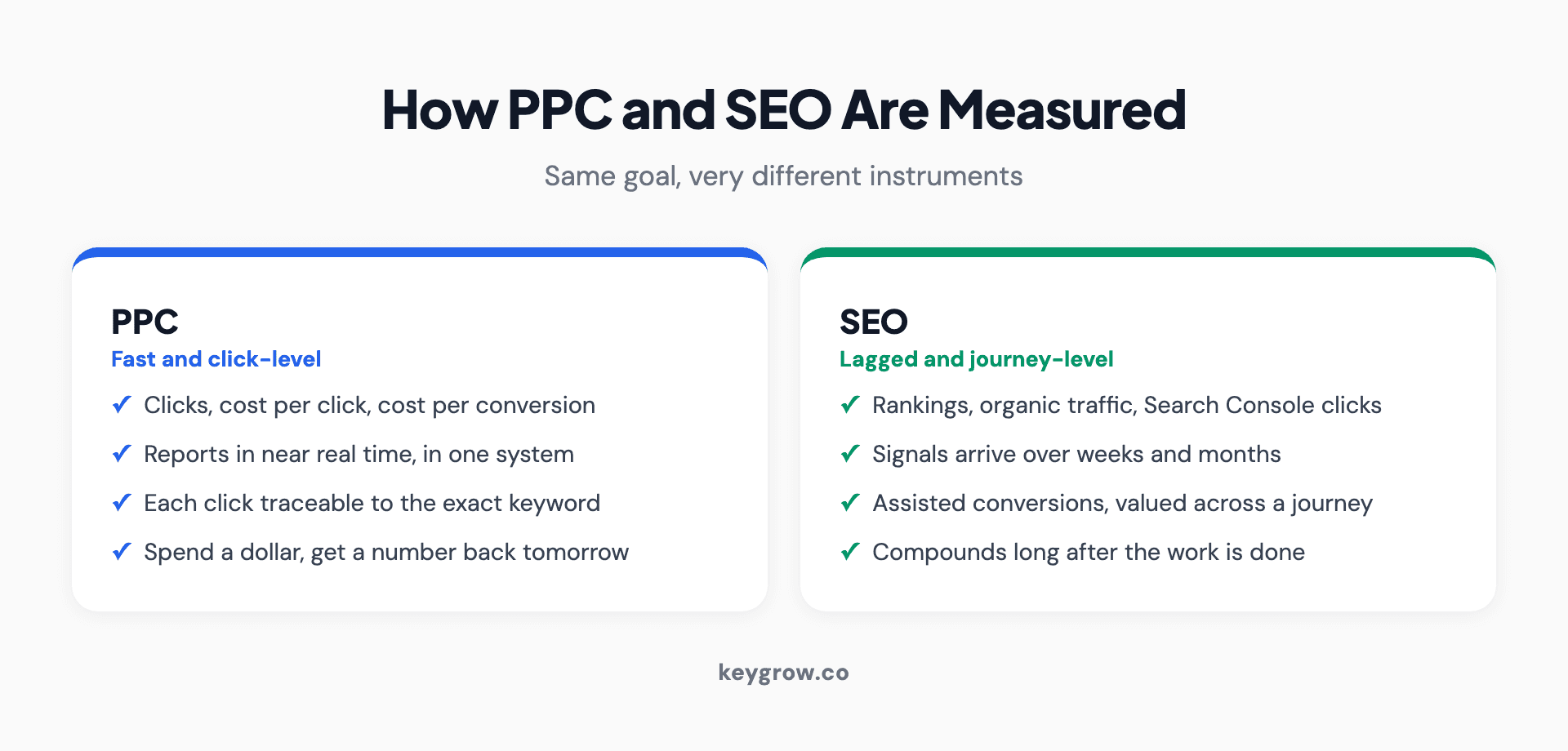
How SEO is measured versus how PPC is measured: PPC reports clicks, cost per click, and cost per conversion in near real time inside one system, while SEO tracks rankings, organic traffic, and Search Console impressions and clicks that arrive on a delay and compound over months.
For SEO you track rankings, organic traffic, and the impressions and clicks in Google Search Console, alongside assisted conversions and eventually revenue from organic sessions. The complication is time. A page published today might rank in three months and pay off across the year that follows, so the effort and the result live in different quarters. Organic also works early in the journey, when someone is researching, then a branded search or a direct visit closes the deal weeks later and collects the last-click credit. The value was real; the attribution just handed the trophy to a different channel. A medical practice we worked with in Dubai committed to SEO for a full year: months one through three looked unremarkable, and by month twelve organic traffic had grown 1,519 percent with 130-plus patient calls a month. Every part of that was measurable. None of it was measurable in week one. SEO is a compounding asset, not a campaign, and measuring it at month three guarantees a wrong answer.
Side by side on the things that matter
Set them against the three tests and one more, cost of the data itself, and the trade-off gets concrete.
| What you are measuring | PPC | SEO |
|---|---|---|
| Speed of reliable data | Hours to days | Weeks to months |
| Attribution certainty | High, click-level | Moderate, journey-level |
| Cost-per-result clarity | Direct and immediate | Real but lagged |
| Repeatability | High, spend to scale | Lower, compounds over time |
| Ongoing cost | Stops when spend stops | Compounds after the work |
Read the table honestly and neither channel wins outright. PPC is the better measuring instrument. SEO is often the better investment. Those are two different questions, and confusing them is the most expensive mistake in this whole debate.
The 2026 reality: PPC's measurement edge has shrunk
Here is what the other guides get wrong. They describe PPC tracking as if it were still flawless. It is not, and the gap between the two channels has narrowed.
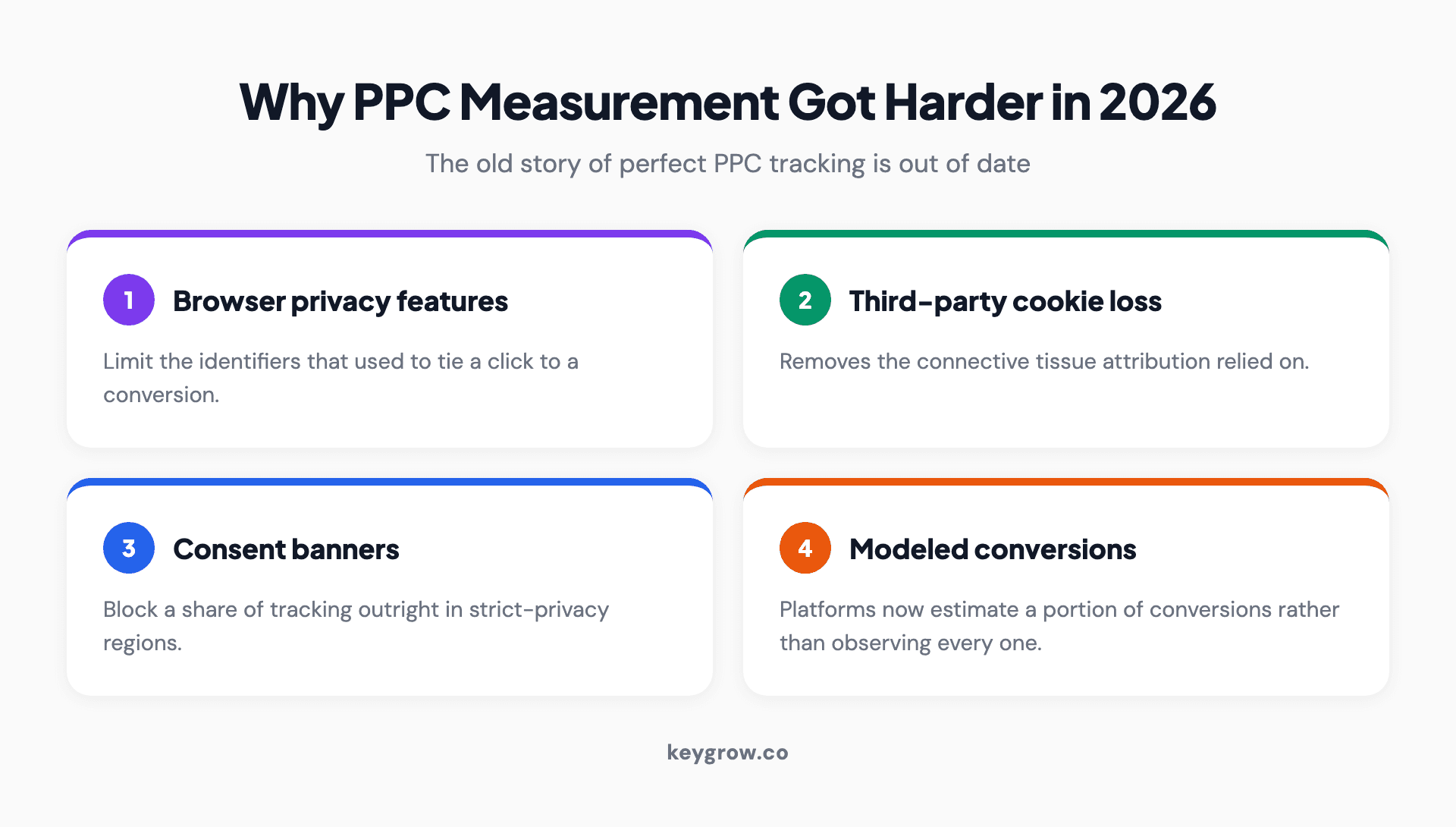
Why PPC measurement got harder in 2026: privacy features and cookie loss strip click identifiers, consent banners block a share of tracking, and platforms increasingly report modeled or estimated conversions rather than directly observed ones, so PPC now estimates more than it used to.
Browser privacy features, the loss of third-party cookies, consent banners, and stripped click identifiers all mean the ad platforms increasingly rely on modeled conversions rather than observing every one directly. A meaningful share of conversions is now estimated and filled in statistically, and in strict-privacy regions a chunk of analytics data is blocked outright by consent choices, which Google fills back in through Consent Mode modeling. Server-side tracking can recover some of what is lost, but the era of one-to-one, cookie-perfect PPC attribution is over. PPC is still more measurable than SEO. It is just no longer the flawless instrument the comparison usually assumes, and pretending otherwise leads to overconfidence in the exact numbers.
Measurable is not the same as valuable
This is the trap. Because PPC reports cleaner data, budgets drift toward it, and SEO gets starved of credit for work it genuinely did. Clean measurement is not proof of superior value.
Last-click attribution sees the final touch and nothing before it. So the PPC ad that caught someone already sold gets the credit, while the organic article that first taught them about the problem gets none. Spend follows the data, the data favors the last click, and the last click favors PPC. That feedback loop can quietly defund the channel doing the early, invisible work. The fix is not to distrust measurement; it is to measure both channels honestly and resist the pull toward whichever one simply reports itself more loudly. We go deeper on this in how to measure SEO ROI.
How to measure each one honestly in 2026
The goal is a fair read on both, which takes a little more than opening one dashboard.
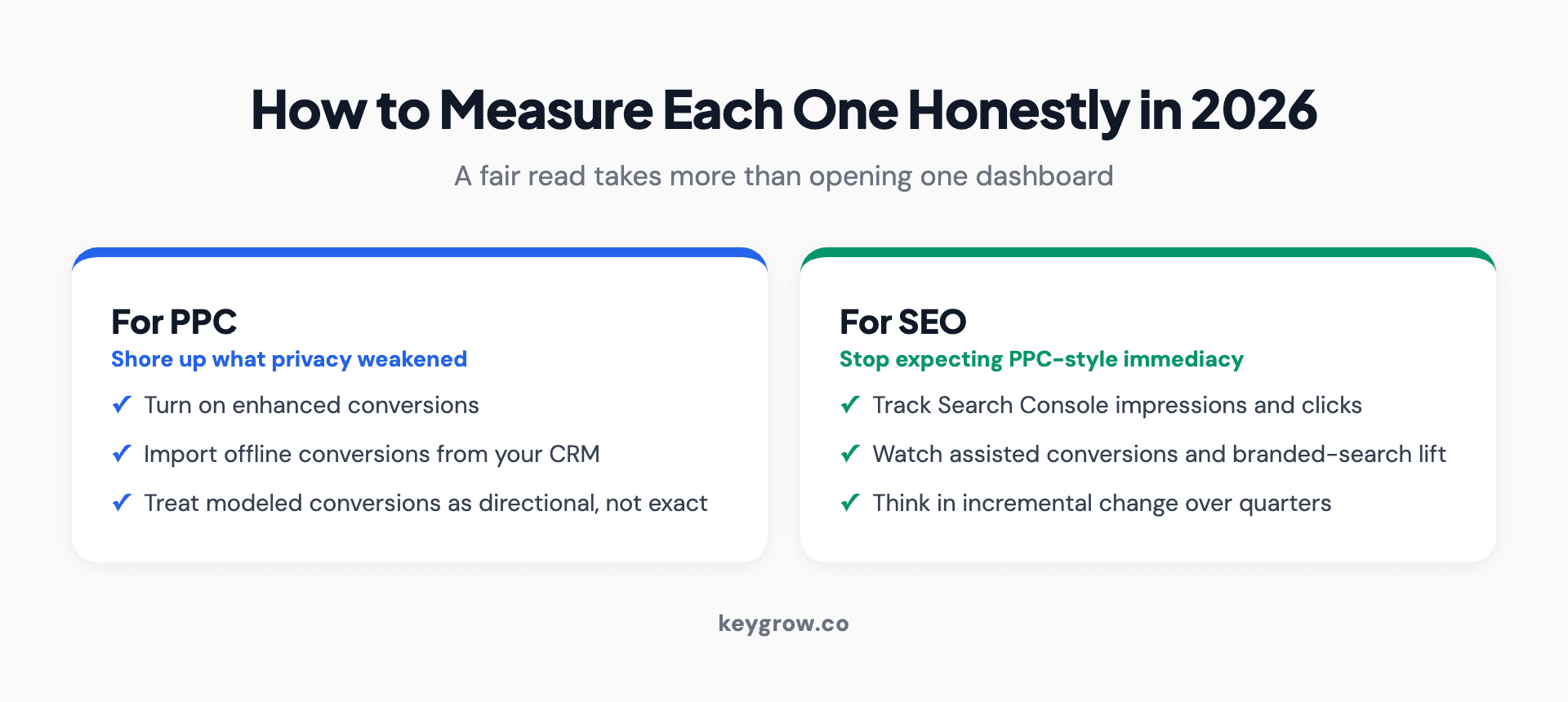
How to measure PPC and SEO honestly in 2026: for PPC, turn on enhanced conversions, import offline conversions from your CRM, and treat modeled conversions as directional; for SEO, track Search Console impressions and clicks, assisted conversions, and branded-search lift, and judge results over quarters rather than days.
For PPC, strengthen what privacy weakened: turn on enhanced conversions, import offline conversions from your CRM so real sales flow back to the campaign, and accept modeled conversions as directional rather than exact. For SEO, stop expecting PPC-style immediacy. Watch Search Console for impressions and clicks, track assisted conversions and branded-search lift, and think in terms of incremental change over quarters, using the methods in how to track SEO. Run both and you get the fullest picture: PPC to prove and scale quickly, SEO to compound, and the overlap between them read through the ranking differences rather than a single last-click report. Our SEO and PPC work is built around measuring each on its own honest terms.
FAQs
Is PPC more measurable than SEO?
Yes, PPC is more immediately measurable. Spend and results sit in one system, conversions report within a day or so, and each click can be traced to the keyword that produced it. SEO is measurable too, but on a delay and with less direct attribution, because organic works upstream of the final click and compounds over months.
Can SEO ROI actually be measured?
Yes. You measure it through organic traffic, rankings, Search Console impressions and clicks, assisted conversions, and revenue from organic sessions, valued over time. The difficulty is not that SEO is unmeasurable; it is that the results lag the work and often get last-click credit assigned to a later touch, so you must measure it across quarters, not days.
Which gives better ROI, SEO or PPC?
PPC gives faster, clearer ROI data; SEO tends to give higher long-run returns because the traffic keeps coming after the work stops, while PPC leads stop the moment spending stops. They answer different needs, which is why many businesses run both: PPC for immediate, provable results and SEO for compounding value.
Has privacy really made PPC harder to measure?
Yes. Cookie loss, browser privacy features, consent banners, and stripped click identifiers mean ad platforms now model a share of conversions rather than observe every one. PPC is still more measurable than SEO, but its attribution is no longer the flawless one-to-one tracking it was several years ago.
Is a more measurable channel always the better one?
No. Measurability and value are separate questions. PPC reports itself more cleanly, which can bias budgets toward it and starve SEO of credit for early-journey work last-click attribution never sees. The better channel depends on your goals and timeline, not on which one produces tidier reports.
Should I use SEO or PPC first?
If you need provable results quickly, start with PPC, since it delivers measurable traffic within days. If you are building a durable asset and can wait a quarter or two, invest in SEO. Most businesses eventually run both, using PPC to learn fast and SEO to compound what works.
Which one you can measure, and which one pays
PPC is more measurable and quantifiable, full stop, because spend and outcome share a system and the data arrives fast. But that is a statement about the measuring instrument, not the investment. SEO measures slower and attributes messier while often returning more over time, and in 2026 privacy changes have quietly narrowed PPC's tracking advantage. The businesses that get this right measure both channels on their own honest terms and refuse to let the tidier dashboard decide the budget.
If you want a clear read on what each channel is actually doing for your revenue, not just which one reports the prettiest numbers, tell us about your business and we will measure both the honest way.