

To measure SEO ROI, you total what you spend on SEO, count the conversions organic search brings in, assign each one a dollar value, and run the formula: ROI equals the value of organic conversions minus your SEO cost, divided by your SEO cost, times 100. The honest part most guides skip is that you have to do this over months, not weeks, and accept that attribution will never be perfect.
That sounds simple, and the math is. The hard part is assigning a real dollar value to a lead and not fooling yourself with a number measured too early. This guide walks the whole calculation with a worked example, shows which metrics map to money, and is honest about where the measurement gets fuzzy.
What is SEO ROI, and what is the formula?
SEO ROI is the return you earn on your SEO spend, in dollars. The formula is the value of your organic conversions minus your SEO cost, divided by your SEO cost, times 100. A result of 200 percent means every dollar returned three: your dollar back plus two more.
That is the whole equation. Everything else in this guide is about getting two numbers right: what you really spent, and what the organic conversions were worth. Get those honest and the ROI figure is defensible. Guess at them and you get a number that means nothing.
Step 1: Total your real SEO investment
Add up everything SEO costs you, not just the agency invoice. That means agency or freelancer fees, tools, content production, link building, and the time your own team spends on it.
This is where most people understate the denominator and inflate the ROI. A complete SEO cost includes the obvious line items and the hidden ones:
If you only count the agency fee and ignore the 10 hours a week your marketer spends on SEO, your ROI will look better than it is. Count the real cost. An honest denominator is the difference between a number you can take to a budget meeting and one that falls apart under the first question.
Step 2: Track your organic conversions
Measure the conversions that come specifically from organic search: leads, calls, form fills, bookings, or sales. You pull these from Google Analytics and Search Console, filtered to the organic channel, which is exactly the tracking our guide to tracking SEO sets up.
The key word is conversions, not visits. Traffic is not the goal and never was. You want the count of people who arrived from organic search and did something worth money: submitted a form, called, booked, or bought. Set those up as conversions in GA4, segment to organic, and make sure phone calls are tracked too, since for a lot of local and service businesses the phone is the main conversion and it is the one most often missed.
Step 3: Assign a dollar value to each conversion
For an online store this is easy: the transaction value is the value. For a lead-generation business, value each lead by multiplying your close rate by your average deal value, or by using your cost per lead from paid channels as a floor.
This is the step that separates a real ROI number from a guess. If organic brought you 100 leads, those leads are not worth nothing and they are not all worth a full sale. Say you close 20 percent of leads and your average customer is worth $3,000. Each lead is worth 0.20 times $3,000, or $600. That is the number you plug in, and it is one you can defend because it comes from your own books, not an industry average.
Step 4: Put it together, with a worked example
Run the numbers end to end and you get a defensible ROI. Here is a full example for a lead-generation business, the kind of math you can copy into a spreadsheet.
Say you run a law firm and spend $2,500 a month on SEO, or $30,000 for the year. Over that year, organic search brings in 240 qualified leads. You close 20 percent of them, which is 48 new clients, and your average case is worth $3,500. That is 48 times $3,500, or $168,000 in revenue traceable to organic search. Now the formula:
ROI equals 168,000 minus 30,000, divided by 30,000, times 100, which is 460 percent.
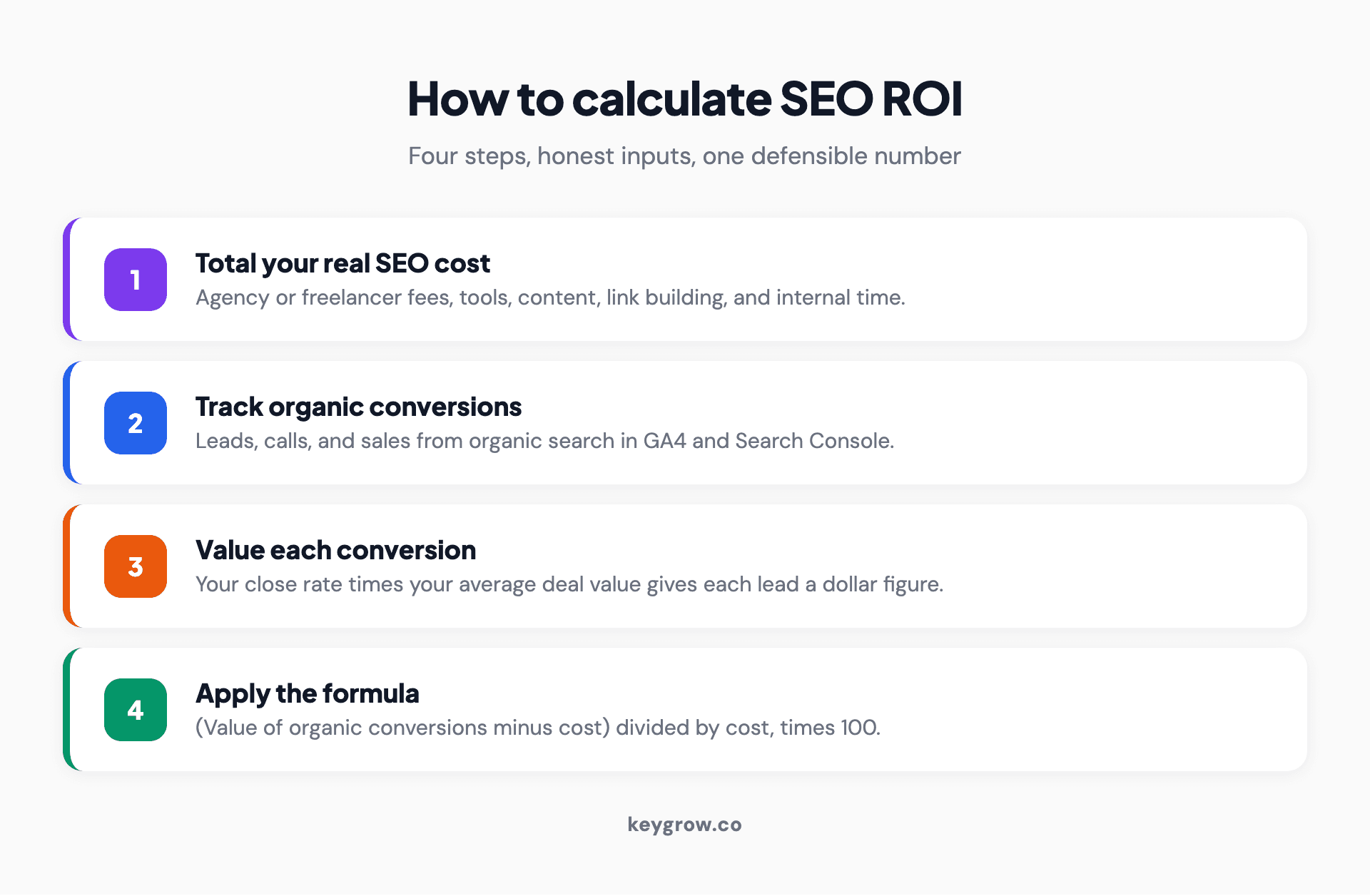
Infographic showing the four steps to calculate SEO ROI as a numbered flow: step one total your real SEO investment including tools and internal time, step two track organic conversions in Google Analytics and Search Console, step three assign a dollar value to each conversion using close rate times average deal value, and step four apply the formula, value of organic conversions minus cost, divided by cost, times 100.
If you want to be conservative, use gross profit instead of revenue, or discount the lead value for the share of deals SEO did not fully cause. The method does not change. What changes is how honest you are with the inputs.
The metrics that map to money, and the ones that do not
Measure SEO on metrics that connect to revenue: leads, calls, booked deals, and cost per organic lead. Rankings, impressions, and sessions are diagnostics, not results. They tell you whether the work is progressing, not whether it paid.
This is the single most common way SEO ROI gets faked. A report full of ranking screenshots and impression charts looks like progress and proves nothing, which is the exact warning in our guide on whether your SEO company is working. Here is the line to hold.
| Maps to money (measure these) | Vanity metrics (do not lead with these) |
|---|---|
| Organic leads and form submissions | Keyword rankings |
| Phone calls from organic search | Impressions |
| Booked revenue and closed deals | Sessions and pageviews |
| Cost per organic lead | Bounce rate on its own |
Rankings and impressions still matter as leading indicators: they move before the revenue does, so they are how you know the work is heading the right way. Just never report them as the outcome.
Why measuring too early gives you the wrong answer
The biggest mistake in measuring SEO ROI is doing it too soon. SEO takes months to produce results and years to mature, so a calculation run at month three will almost always show a loss, because the costs are in but the returns have barely started.
The data is clear on the lag. Ahrefs found, from 3,680 poll responses, that SEO typically takes three to six months to show results, and separately that the average number one page in Google is about five years old. The return is not linear either. SEO firm First Page Sage, in its e-commerce ROI report, found SEO returns climb from about 2.6 times at 12 months to 5.2 times at 36 or more months as the content keeps earning.
Here is the opinion worth keeping: judging SEO ROI at month three guarantees a wrong answer. The asset compounds, so you measure it on the timescale it works on, which is the same reason our guide on why SEO takes so long exists. Set the expectation up front, track the leading indicators in the meantime, and calculate the real ROI once the channel has had a fair run.
There is also the attribution problem. Last-click reporting hands all the credit to the final click, which undercounts organic search, since a customer often finds you in organic, leaves, and returns later through a different channel to convert. Google Analytics 4 offers a data-driven attribution model that weighs both converting and non-converting paths, instead of giving all the credit to the last click. The practical fix is to separate branded from non-branded organic, so you credit SEO for the commercial searches it won rather than for people who were always going to type your name.
What counts as a good SEO ROI?
A good SEO ROI is generally far higher than paid channels over time, because organic traffic keeps converting after you stop paying for each click. Reported averages vary widely by industry, and most published figures come from agencies, so treat them as direction, not promises.
For context, First Page Sage puts average three-year SEO ROI at 317 percent for eCommerce and 1,389 percent for real estate, from its own client data. The reason organic tends to win the long game is structural: BrightEdge found organic search drives 53 percent of all trackable website traffic, with organic and paid search together at 68 percent, so paid is roughly 15 percent. You stop paying for ads and the traffic stops; you stop paying for SEO and the rankings you earned keep working for a while.
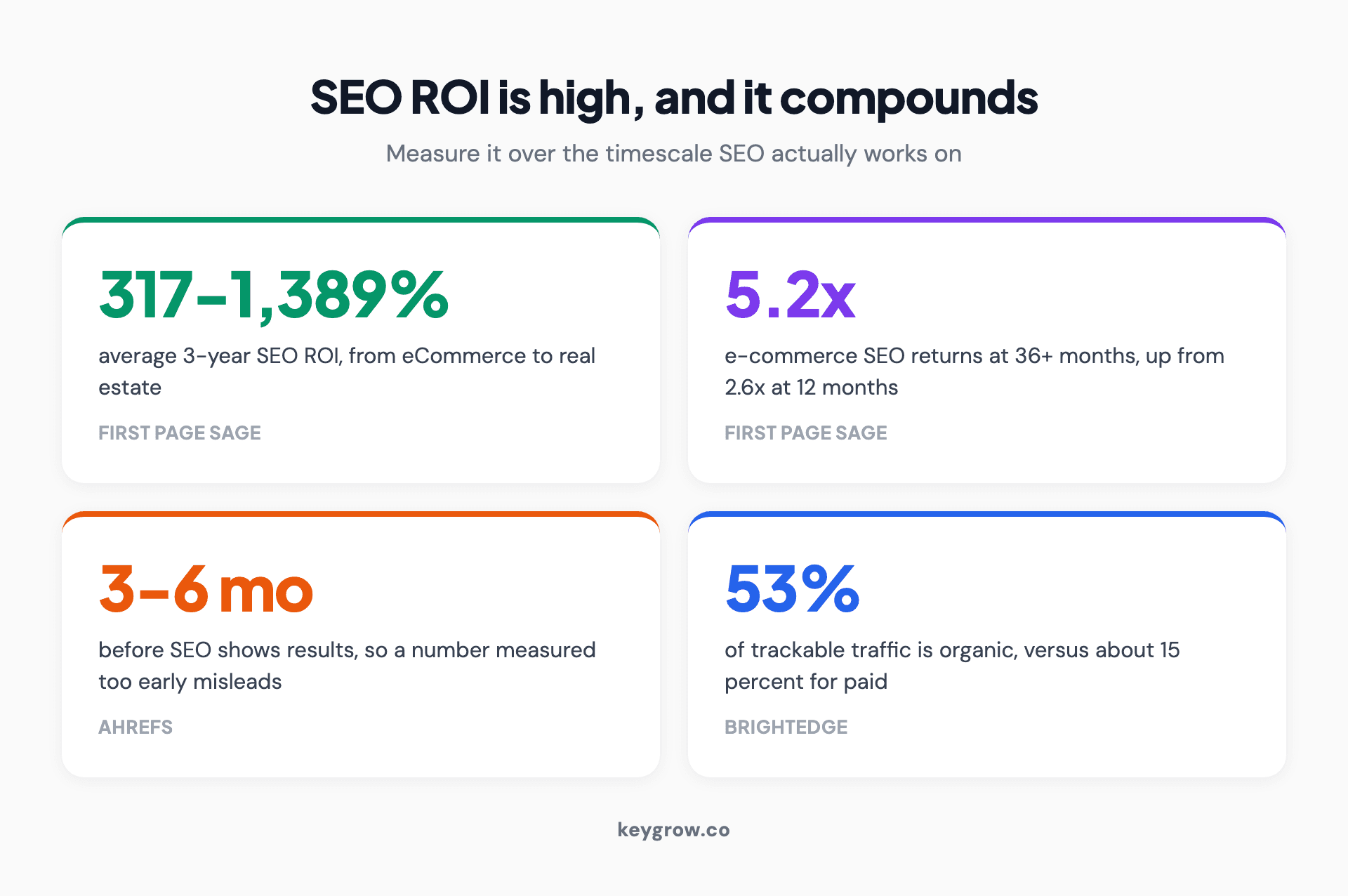
Infographic stat panel on SEO ROI over time, showing four figures: average three-year SEO ROI from 317 percent for eCommerce to 1,389 percent for real estate, e-commerce SEO returns climbing from 2.6 times at 12 months to 5.2 times at 36 or more months, three to six months before SEO shows results, and organic search driving 53 percent of trackable traffic with paid at roughly 15 percent.
The honest caveat: those headline percentages are agency figures from their own campaigns, not independent studies, so the real benchmark that matters is your own. Calculate yours with the steps above and compare it to what the same money returns in paid, not to a number on a marketing page.
Can you measure SEO ROI yourself?
Yes. You do not need an agency or expensive software to measure SEO ROI. Google Analytics, Search Console, and your own close rate and deal value are enough to build the calculation in a spreadsheet.
This is worth saying plainly, because measuring ROI is often sold as something only the agency can do. It is not. Track organic conversions in GA4, multiply your lead count by your close rate and average deal value, total your real SEO costs, and run the formula. A business owner with an afternoon can produce a defensible number. The reason to bring in help is to improve the ROI, not to calculate it, and you should always keep the ability to check the math yourself, which is also how you keep an agency honest, the way our piece on whether SEO services are worth it lays out.
FAQs
How do you calculate SEO ROI?
Use the formula: the value of your organic conversions minus your SEO cost, divided by your SEO cost, times 100. Total every SEO cost including tools and internal time, count the conversions from organic search, and assign each a dollar value using your close rate and average deal value. The result is your ROI as a percentage.
How long does it take to see a return on SEO?
Usually three to six months for early results and a year or more for meaningful ROI. SEO compounds rather than switching on, and the average number one page in Google is about five years old. A return calculated at month three will look negative because the costs are in but the gains have barely begun, so measure over a longer window.
What is a good SEO ROI?
A good SEO ROI is higher than what the same budget returns in paid channels, and it grows over time. Published averages range widely by industry and mostly come from agencies, so use them as direction only. The benchmark that matters is your own number compared against your paid channels, not a figure on a marketing page.
How do you assign a dollar value to organic leads that are not direct sales?
Multiply your close rate by your average deal value. If you close 20 percent of leads and your average customer is worth $3,000, each lead is worth $600. Alternatively, use your cost per lead from paid channels as a floor value. Both give you a defensible number drawn from your own data rather than a guess.
Is SEO ROI higher than paid search ROI?
Over time, usually yes, because organic traffic keeps converting after you stop paying, while paid traffic stops the moment the budget does. Agency reports generally show organic ROI outpacing paid over a multi-year window, though those are self-reported figures. Paid search wins on speed; SEO wins on the long-run, compounding return.
Can I measure SEO ROI myself without an agency or expensive tools?
Yes. Google Analytics and Search Console are free, and the rest of the inputs, your close rate, average deal value, and SEO costs, come from your own records. Build the calculation in a spreadsheet. You bring in help to improve the ROI, not to compute it, and keeping the math yourself is how you hold any agency accountable.
Why is SEO ROI so hard to measure accurately?
Because of timing and attribution. SEO returns lag the spend by months, so early numbers mislead. And last-click reporting undercounts organic, since people often discover you in search and convert later through another channel. Separating branded from non-branded organic and measuring over a long enough window are the fixes that get you close.
Should I count branded organic traffic in my SEO ROI?
Be careful with it. People searching your brand name were often already coming to you, so crediting SEO for those conversions inflates your ROI. Separate branded from non-branded organic and focus your ROI measurement on the commercial, non-branded searches that SEO genuinely won. That gives you the real return on the work.
The short version
To measure SEO ROI, total your real SEO cost, count organic conversions, value each one with your close rate and average deal value, and run the formula: value minus cost, divided by cost, times 100. The math is easy. The discipline is in honest inputs and honest timing, since a number measured at month three, or built on rankings instead of revenue, tells you nothing.
Do it over months, separate branded from commercial searches, and compare your result against what the same budget returns in paid. You can run the whole thing yourself in a spreadsheet. If you would rather have the number built and the ROI improved at the same time, that is what our SEO team does. Tell us about your business and we will show you the math, not a rankings screenshot.


