


Email marketing and PPC advertising compare like a savings account and a paid loan. Email markets to an audience you own, at almost no cost per send, and pays back the most over time. PPC rents attention from people who have never heard of you, charges per click, and delivers results the day you switch it on. One is cheap and slow to build; the other is fast and metered. Most businesses need both, for different jobs.
| Dimension | Email marketing | PPC advertising |
|---|---|---|
| Audience | Owned, people who opted in | Rented, from the ad platform |
| Cost model | Per send or list size, very low | Per click or impression |
| Speed to results | Slow, you need a list first | Immediate |
| Typical ROI | Up to about $36 per $1 (Litmus) | Roughly $2 per $1 in ad revenue |
| Best at | Retention, nurture, repeat sales | Acquisition, reaching new demand |
| Stops working when | Your list decays or lands in spam | You stop paying |
The core difference: owned versus rented
Everything else follows from one fact. With email, you own the audience. With PPC, you rent it.
An email list is an asset on your books. Once someone subscribes, reaching them again costs almost nothing, and no algorithm change can take them away. PPC is the opposite: the platform owns the audience, you pay for each visit, and the traffic stops the instant your card declines. Neither is better. They are different kinds of thing. The mistake is treating a rented channel like an owned one, pouring money into clicks without ever capturing the visitor so you can reach them for free next time.
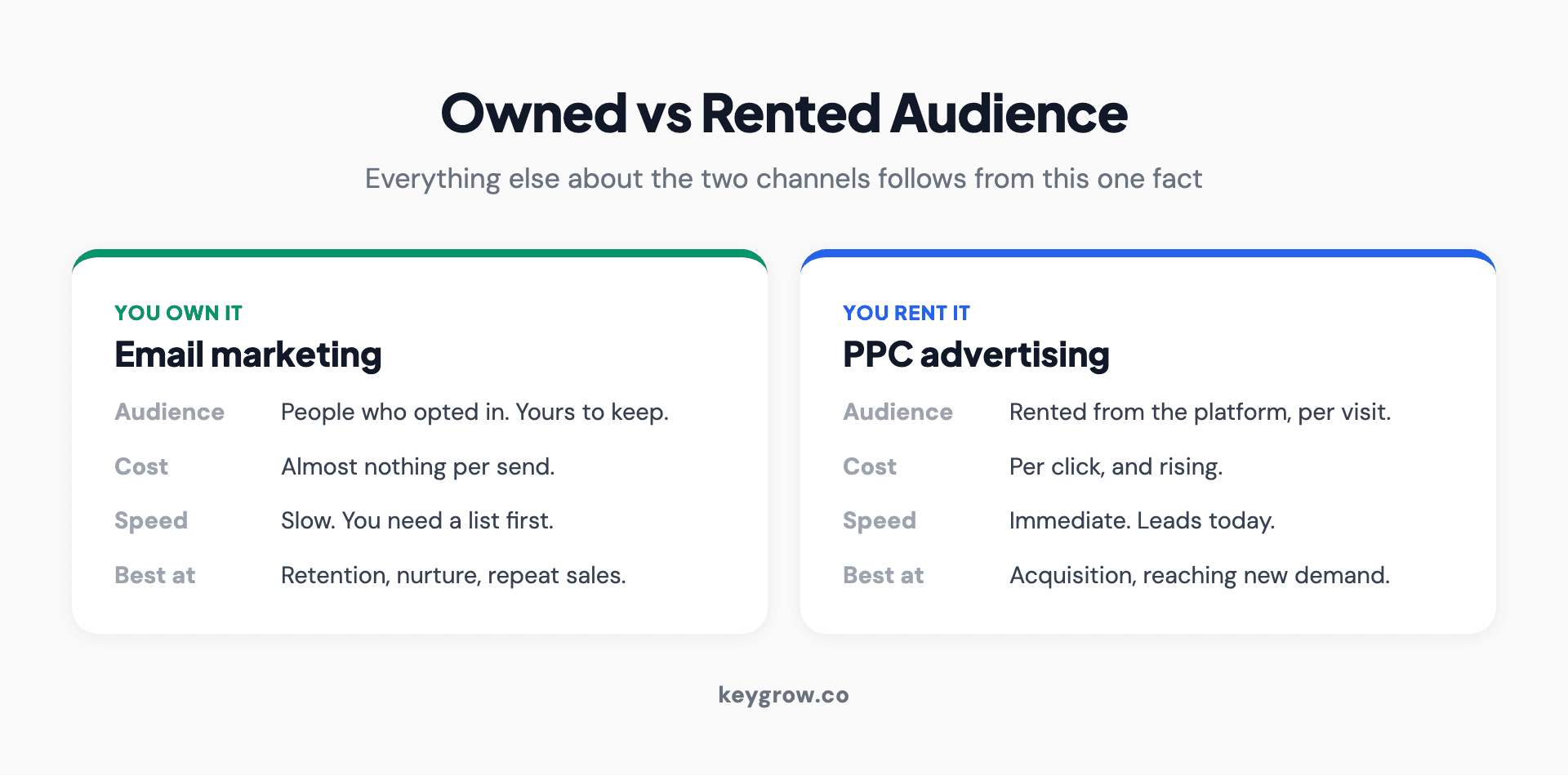
Two-panel comparison of an owned email audience versus a rented PPC audience across cost, speed, and what each channel is best at.
Cost: how you pay, and what you get back
This is where the two look most different on paper and most similar in practice.
Email is the ROI champion by a wide margin. Litmus puts the return as high as about $36 for every $1 spent, and because the cost of one more send is close to zero, that ratio holds as you scale. PPC returns roughly $2 in revenue for every $1 in ad spend on average, an estimate from Google's economic impact research. That gap looks brutal until you remember email only works once you have a list, and building the list is often what PPC paid for.
Conversion rates tell a subtler story than the ROI gap suggests. In Ruler Analytics data across millions of conversions, paid search converts at about 5.4 percent and email at about 4.9 percent. They are close, and paid search slightly edges email here. So email does not win because it converts far better. It wins because reaching your own list costs a fraction of buying a click. The efficiency is in the cost, not the conversion rate.
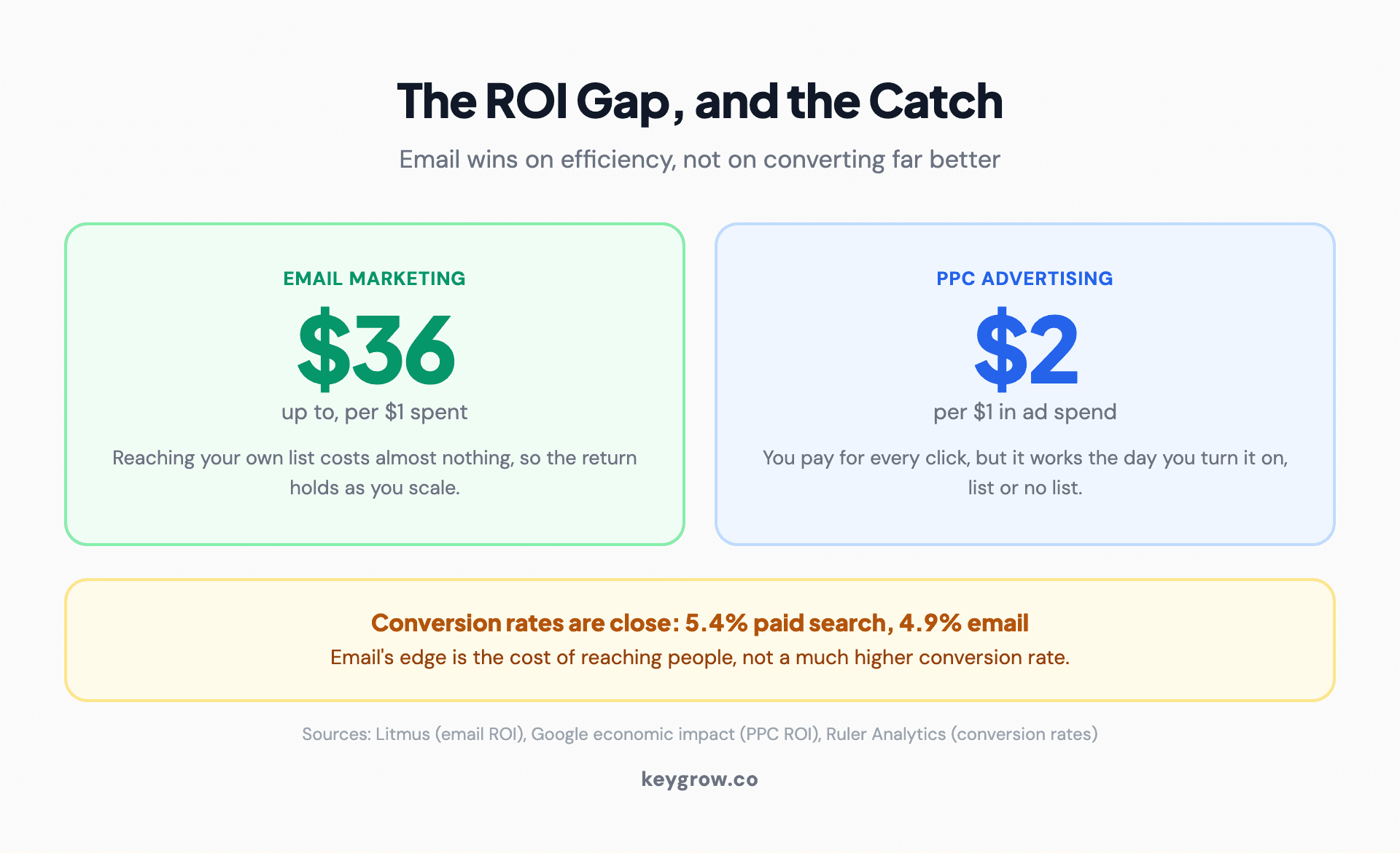
Two stat cards on ROI: email returns up to about 36 dollars per dollar spent and PPC about 2 dollars per dollar, with conversion rates close at 5.4 and 4.9 percent.
Speed: one is instant, one needs a runway
If you launched a business today, PPC could send you a lead this afternoon. Email could not, because you have no one to email yet.
That is the practical split. PPC buys demand that already exists; someone searching "emergency plumber" is ready now, and you can be in front of them within hours. Email compounds: it does little in week one and a great deal in year two, once the list is large and warm. Judging email by its first month, or PPC by its lifetime cost, is how businesses pick the wrong one for the moment they are in.
What quietly breaks each channel
The brochures skip this part, and it is the most useful section. Each channel has a hidden failure mode.

An email inbox open on a laptop, where deliverability quietly decides whether email marketing reaches anyone.
Email breaks on deliverability. Land in the spam folder, let your list go stale, or buy addresses instead of earning them, and your open rates quietly collapse while your reports still show "sent." List decay is real; a chunk of any list goes cold every year. The channel is cheap, but only if the inbox actually receives you.
PPC breaks on cost and access. CPCs climb as more competitors bid, an account suspension can pull your traffic to zero overnight with little warning, and the whole thing stops the moment you stop paying. There is no equity built. You are renting, and rent goes up. This is also why email has a real 2026 advantage: it is untouched by the loss of third-party cookies, while paid targeting keeps getting harder to rent.
The real answer: they do different jobs
Framed as a fight, this comparison has no winner. Framed as a sequence, both win.
The pattern that works: use PPC to acquire, capture the email, nurture and retain with email, then retarget the gaps with PPC. A paid click brings a stranger to your site. A form captures their email so the next touch is free. Email nurtures them to a sale and back for repeat business. PPC retargets the ones who drifted. Run that loop and PPC's high cost per click is an acquisition investment that email pays back for years. They are not competitors. They are the front and back halves of the same funnel, which is the same logic behind running PPC and other channels together.
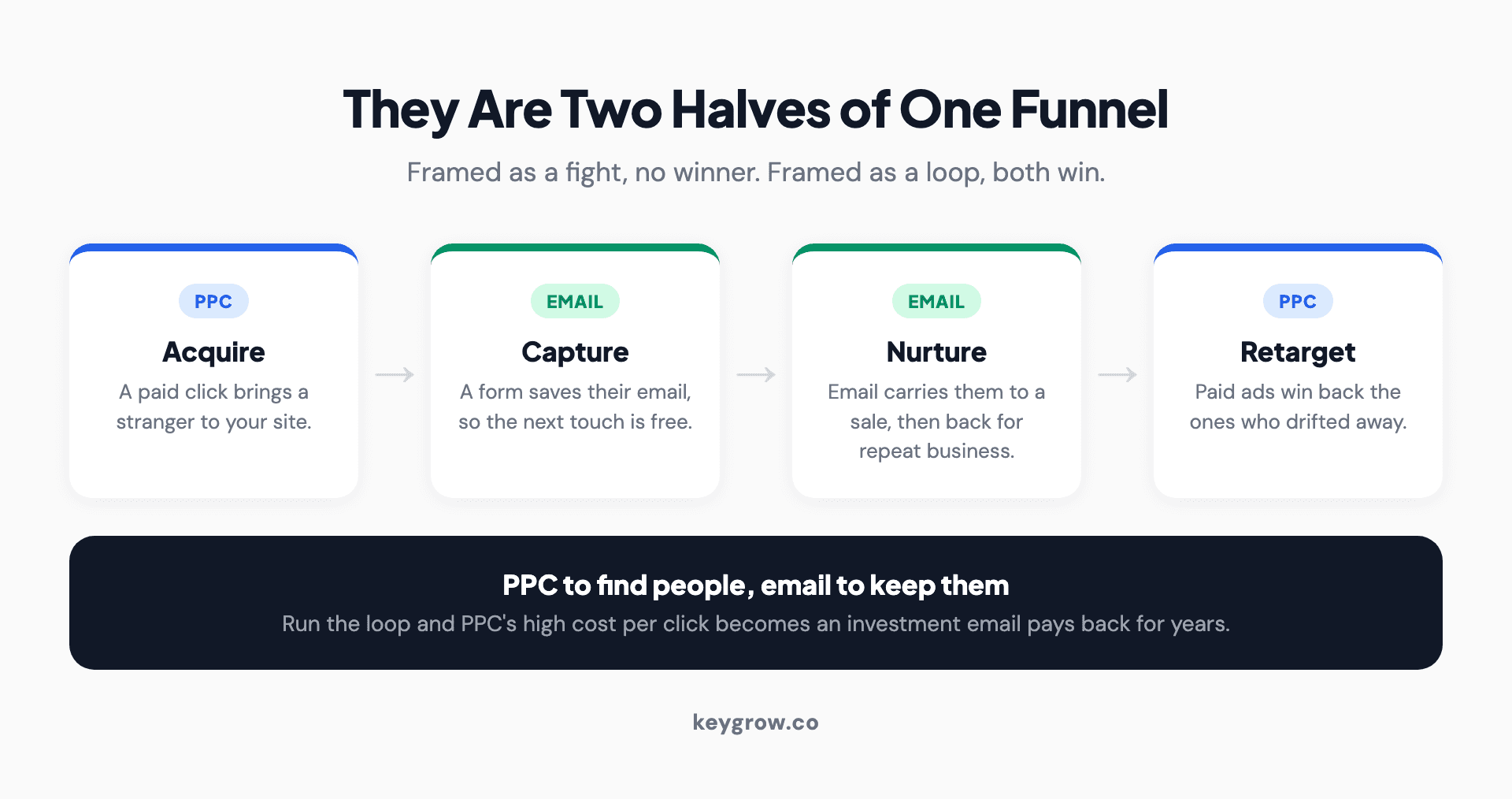
A four-step loop showing PPC and email as two halves of one funnel: acquire with PPC, capture the email, nurture with email, then retarget with PPC.
When to prioritize each
If you have to lead with one, let the situation decide.
Lead with PPC when you need results now, have no list yet, are launching something, or sell to demand people are actively searching for. It is the fastest way to turn budget into leads, which is why we cover whether PPC is worth it as its own question. Lead with email when you have an audience to reach, sell things people buy more than once, and want to defend your margins from rising ad costs. The honest default for most businesses with any repeat purchase: run PPC to fill the top of the funnel and email to own everything after the first sale.
How to split the budget when you run both
If you are running both, the split should follow where you are, not a fixed ratio. A business with no list yet should tilt heavily toward PPC, spend to acquire, and pour most of the early effort into capturing emails so the cheaper channel has fuel. A business with a large, engaged list can shift the balance the other way, leaning on email for revenue and using PPC more surgically to acquire and to retarget. There is no universal percentage, and any guide that hands you one without asking about your list size is guessing.
Measure each without fooling yourself
The channels lie in different directions, so measure each on its own terms. PPC flatters itself on last-click reports, taking credit for sales that email nurtured to the finish. Email flatters itself by counting opens and clicks that never became revenue. Judge both on the number that matters, cost per acquisition and the revenue behind it, and run the occasional controlled test, a holdout region or a paused segment, to see what each channel actually adds on top of the other. The honest scoreboard is not clicks or opens. It is customers acquired, what they cost, and what they are worth over time, which for anything with repeat purchase is where email quietly earns its keep. This is the same discipline behind judging any channel by pipeline rather than vanity metrics, and it applies whether you sell to online shoppers or to a slow B2B buyer.
FAQs
What is the difference between PPC and email marketing?
PPC advertising pays a platform to show your ads to people you do not yet have a relationship with, charged per click, with instant results. Email marketing sends messages to an audience that has opted in, at very low cost, and pays off most over time. PPC rents a cold audience; email markets to one you own.
Which has better ROI, email marketing or PPC?
Email marketing typically shows a much higher ROI, around $36 per $1 spent, because reaching your own list costs almost nothing. PPC averages closer to $2 in revenue per $1 of ad spend. The catch is that email only works once you have built a list, which is often what PPC was paying to do.
Which converts better, email or paid search?
They are closer than most people assume. Recent benchmark data puts paid search around 5.4 percent and email around 4.9 percent, with paid search slightly ahead. Email's advantage over PPC is cost efficiency, not a dramatically higher conversion rate, since reaching subscribers is far cheaper than buying clicks.
Is email marketing cheaper than PPC?
Yes, per contact reached. Sending to an existing list costs a fraction of buying a click, which is why email's ROI runs so high. The hidden cost is building and maintaining the list in the first place, plus keeping deliverability healthy so your messages actually reach the inbox.
Can you use email marketing and PPC together?
Yes, and that is usually the best approach. Use PPC to acquire new visitors, capture their email on the way through, nurture and retain them with email, then retarget the ones who did not convert with PPC. Run as a loop, the two cover acquisition and retention instead of competing.
Where this leaves you
Stop asking which one wins. Email and PPC do different jobs, and the businesses that grow fastest run both: PPC to find people, email to keep them. If you only have budget for one right now, start with the channel that matches your moment, then build the other as soon as you can.
If you want help deciding where your next dollar does the most, whether that is a paid campaign or a better use of the list you already have, our paid search team and social and content side look at the whole funnel, not just the channel we happen to sell. Tell us where you are on the get started page.