

Start with Google Ads if you need customers in the next 90 days, start SEO the moment your ads prove which keywords convert, and plan to run both once the budget allows. That's the short answer to whether you need SEO or Google Ads first, and it holds for most businesses most of the time.
The honest longer answer depends on three variables almost nobody frames it around: your cash runway, what a customer is worth to you, and how competitive your market already is. This guide works through all three, with the budget thresholds and the month-by-month sequencing plan the usual comparison posts leave out.
The short answer, by situation
| Your situation | Start with |
|---|---|
| New business, needs revenue now | Google Ads |
| Under $1,000/month total marketing budget | Neither yet (see the free layer below) |
| Established site, strong margins, patient capital | SEO, with a small ads test |
| Local service business in a small market | Google Business Profile first, then ads |
| Proven offer, $2,500+/month budget | Ads now, SEO within 90 days |
| Seven-figure revenue, still no organic presence | Both, immediately |
The rest of this post explains where those lines come from and what to do after you pick.
This is really a cash-flow question, not a marketing question
The two channels don't differ mainly in quality of traffic. They differ in when the traffic arrives.
Google Ads can put you in front of buyers the day your campaign goes live. Across all industries, the 2026 averages run $5.42 per click and $66.69 per lead, per LocaliQ's benchmarks. Expensive, but immediate and roughly linear: money in, leads out, this week.
SEO's payoff curve is the opposite. Only 1.74 percent of newly published pages reach Google's top 10 within a year, and 72.9 percent of the pages holding top-10 spots are more than three years old, per Ahrefs' ranking study. The prize for waiting is real: the top three organic results collect 54.4 percent of all clicks, per Backlinko's analysis of four million search results, and those clicks arrive without a per-click invoice.
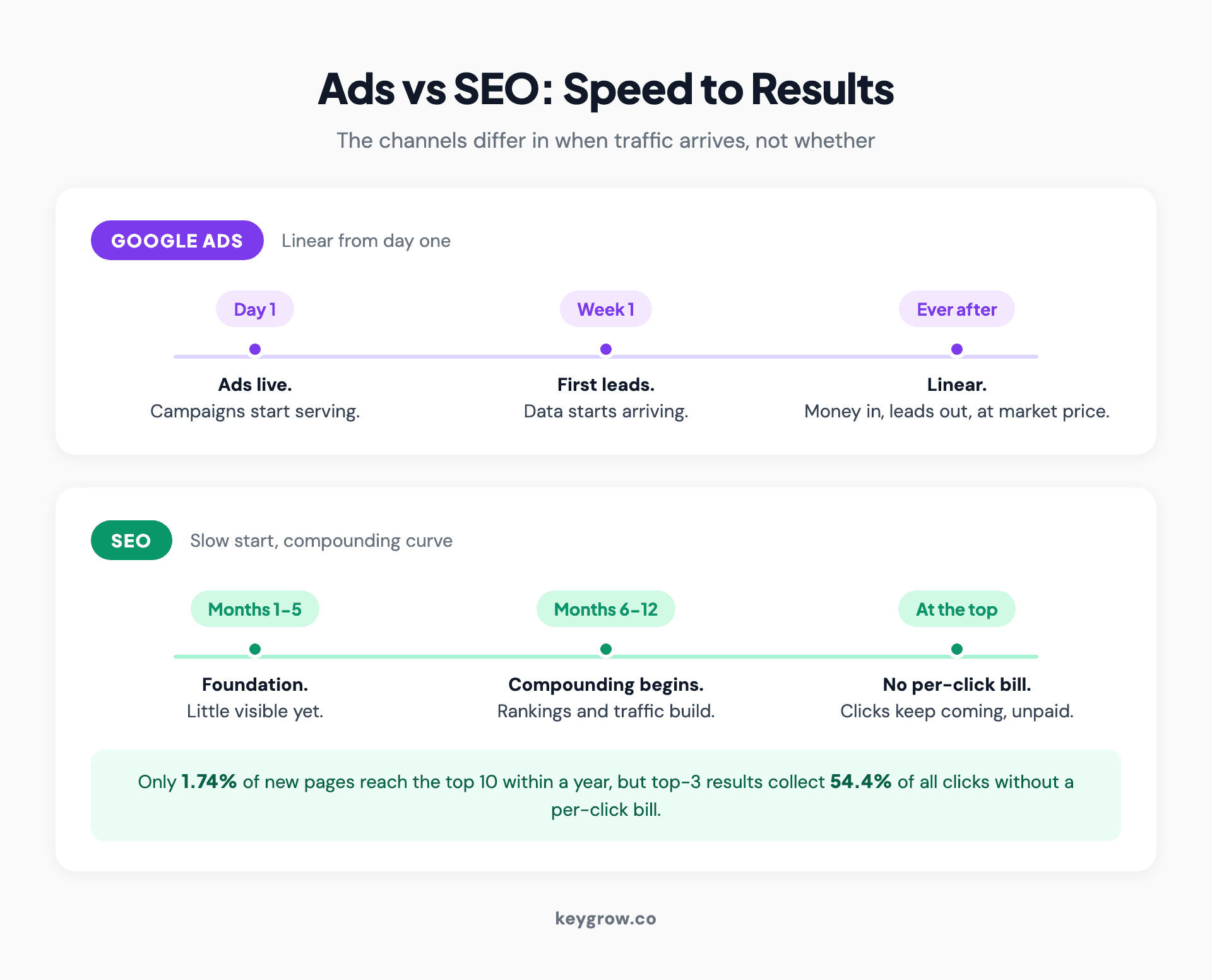
Side-by-side timeline showing Google Ads producing leads within days while SEO compounds toward cheaper leads over six to twelve months.
So the real question is brutal and simple: can your business afford to wait six to twelve months for its marketing to work? If the answer is no, the sequencing decision is already made, and no comparison table changes it.
What starting with ads buys you beyond the leads
Here's the argument for ads-first that the comparison posts never make: 90 days of Google Ads is the cheapest SEO research you will ever buy.
SEO forces you to bet months of work on specific keywords before you know whether they produce customers. Ads remove the guesswork. Within two or three months of running search campaigns you learn, with receipts, which keywords drive leads rather than just traffic, which pages convert those clicks and at what rate, what a lead costs you at market price, and which offers and headlines people actually respond to.
Every one of those findings de-risks the SEO investment that follows. Instead of guessing that "kitchen remodeling contractor" is the money keyword, you know it converts at 9 percent from paid traffic, so ranking for it organically is worth six months of effort. Instead of building twenty pages and hoping, you build the five that paid data already validated.
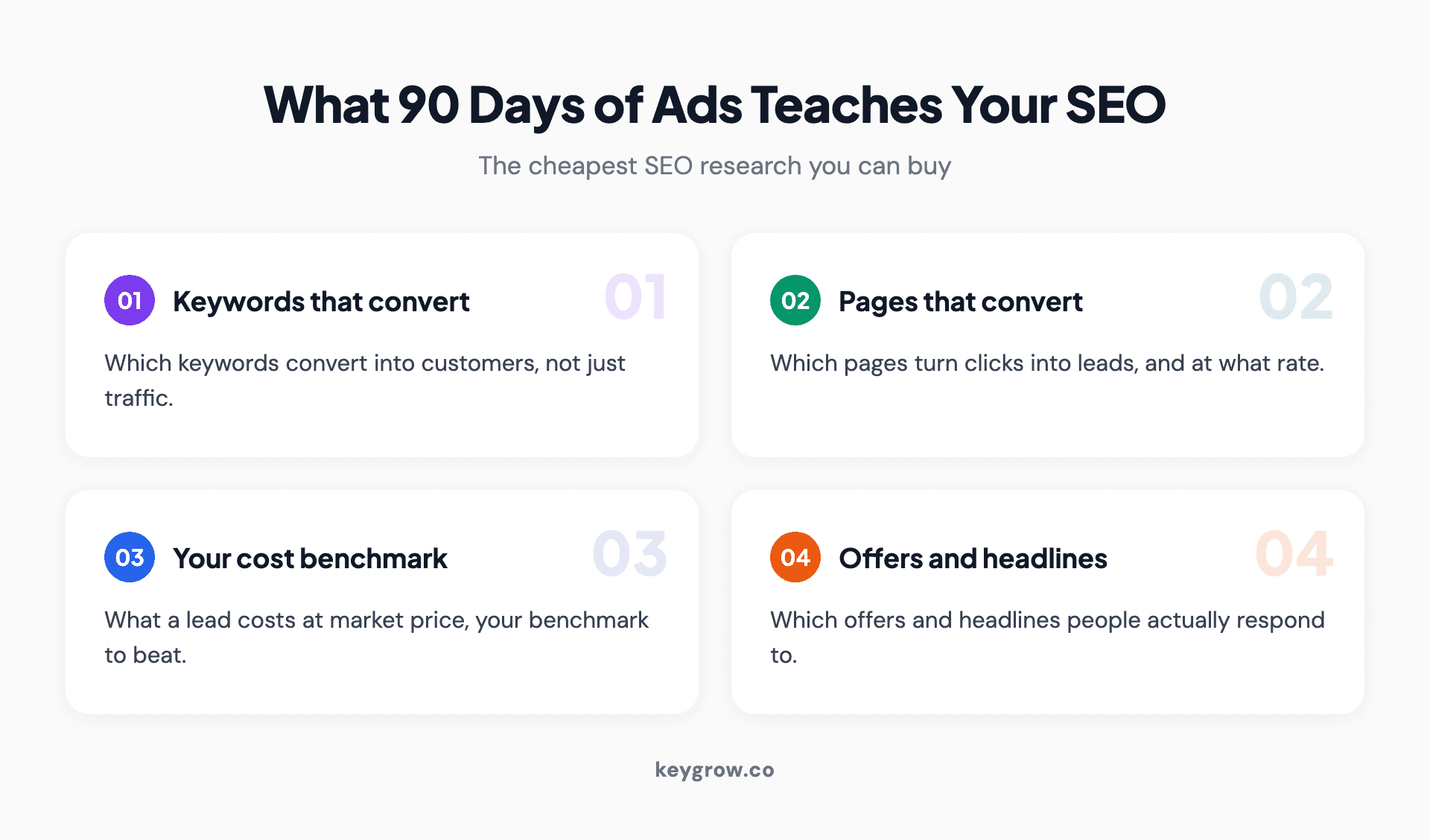
Four things a 90-day Google Ads test teaches you before you commit months to SEO: converting keywords, page conversion rates, true cost per lead, and winning offers.
We sequence it this way for most new clients, and it's also why the "SEO versus ads" framing misleads people. The channels aren't rivals, one is a data source for the other. We've written more on how the two reinforce each other when run together.
The free layer that comes before either
Before you spend the first dollar on either channel, there's homework that outperforms both per hour invested, and an agency that skips this conversation is selling you something.

Open sign hanging in the glass door of a small local business that hasn't claimed its free Google visibility yet.
Claim and complete your Google Business Profile. Collect reviews from your happiest customers, steadily, not in one suspicious burst. Make sure your site loads fast on a phone, says what you do and where, and has a working way to contact you. For a single-location business with more time than money, this free layer often produces more calls than the first thousand dollars of ad spend would, and every later channel builds on it.
If that describes you, do this first and revisit the paid-versus-organic question in a quarter. That's not us being coy, it's the order of operations we'd use with our own money.
The dollar thresholds nobody publishes
Vague advice like "start with ads if you need speed" fails at the moment of decision because it never names numbers. Here's how we'd actually allocate at different budget levels. Treat these as starting points to argue with, not laws.

Two colleagues working through a marketing budget decision at an office whiteboard.
Under $1,000 a month, all-in. Don't split it and don't burn it on clicks yet. Work the free layer above, and put remaining effort into DIY SEO basics on your site. Management fees and minimum viable click volume both eat too much at this level.
$1,000 to $2,500 a month. Pick one channel and fund it properly rather than doing both badly. Default to ads for the speed and the data, unless you're in a low-competition local niche where a modest SEO investment can rank you in months rather than years.
$2,500 to $5,000 a month. Ads carry the lead flow while a starter SEO engagement begins on the keywords your ads have already proven. This is the range where the sequencing strategy in the next section becomes affordable.
$5,000 and up. Run both as a system: ads for immediate volume and testing, SEO compounding underneath, budget shifting toward organic as it matures. At this level the question stops being either/or entirely.
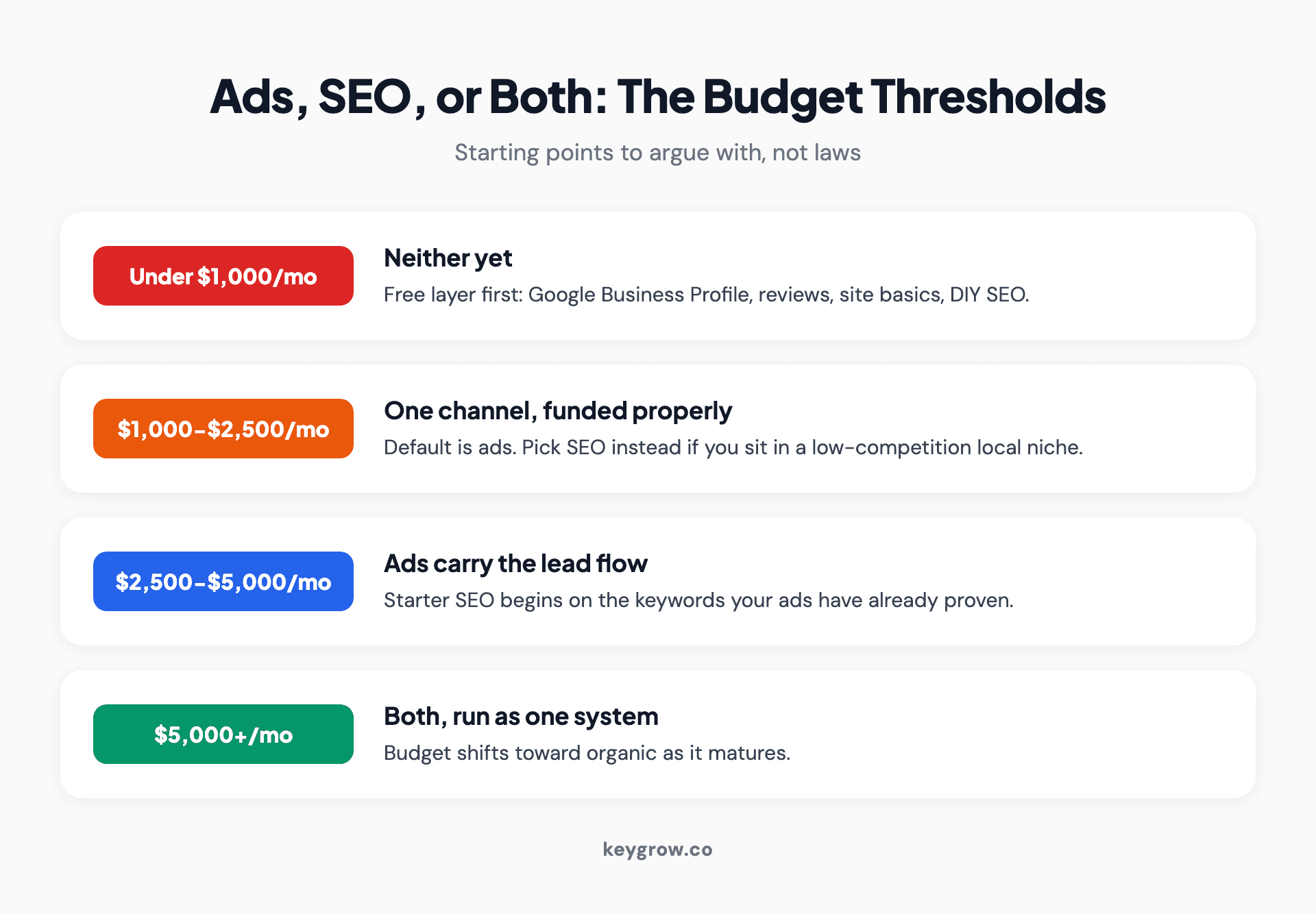
Budget threshold tiers showing what to fund at under $1,000, $1,000 to $2,500, $2,500 to $5,000, and $5,000+ per month of marketing spend.
The 12-month sequencing plan
"First" implies "then what," and no ranking page answers the then-what. Here's the sequence we run, month by month.
Months 1-2: launch ads, wire the tracking. Conversion tracking before scale, always. Small keyword set, tight ad groups, dedicated landing pages. Expect to pay tuition: your first-month cost per lead will be your worst.
Month 3: read the data, start SEO. By now the search terms report has told you which queries convert. SEO work begins here, targeted at those proven keywords, while ads keep paying the bills. If you're weighing timelines, we've broken down how long PPC takes to hit its stride separately.
Months 4-6: content and technical work compound quietly. This stretch tests your patience. Organic traffic moves little while the foundation goes in, and ads still generate nearly all leads. This is where businesses quit SEO three months into a twelve-month curve, pay for the hard part, and leave before the payout.
Months 7-9: organic starts contributing. Rankings arrive on the early targets. Blended cost per lead starts drifting down as free clicks dilute paid ones.
Months 10-12: the crossover. Organic leads now cost you effectively the marginal price of content, while paid leads still cost market rate. Shift budget at the margin: keep ads on the keywords where they're profitable, let organic carry the terms it now owns, and point freed budget at expansion.
A doctor's practice in Dubai ran this patient version of the play with us on the SEO side: months one through three looked unimpressive on the surface, and by month twelve organic traffic had grown 1,519 percent with the practice taking 130+ patient calls a month. SEO is a compounding asset, not a campaign. It looks unimpressive for a quarter and embarrassingly good after a year, and the businesses that quit at month three fund the hard part without collecting the payout.
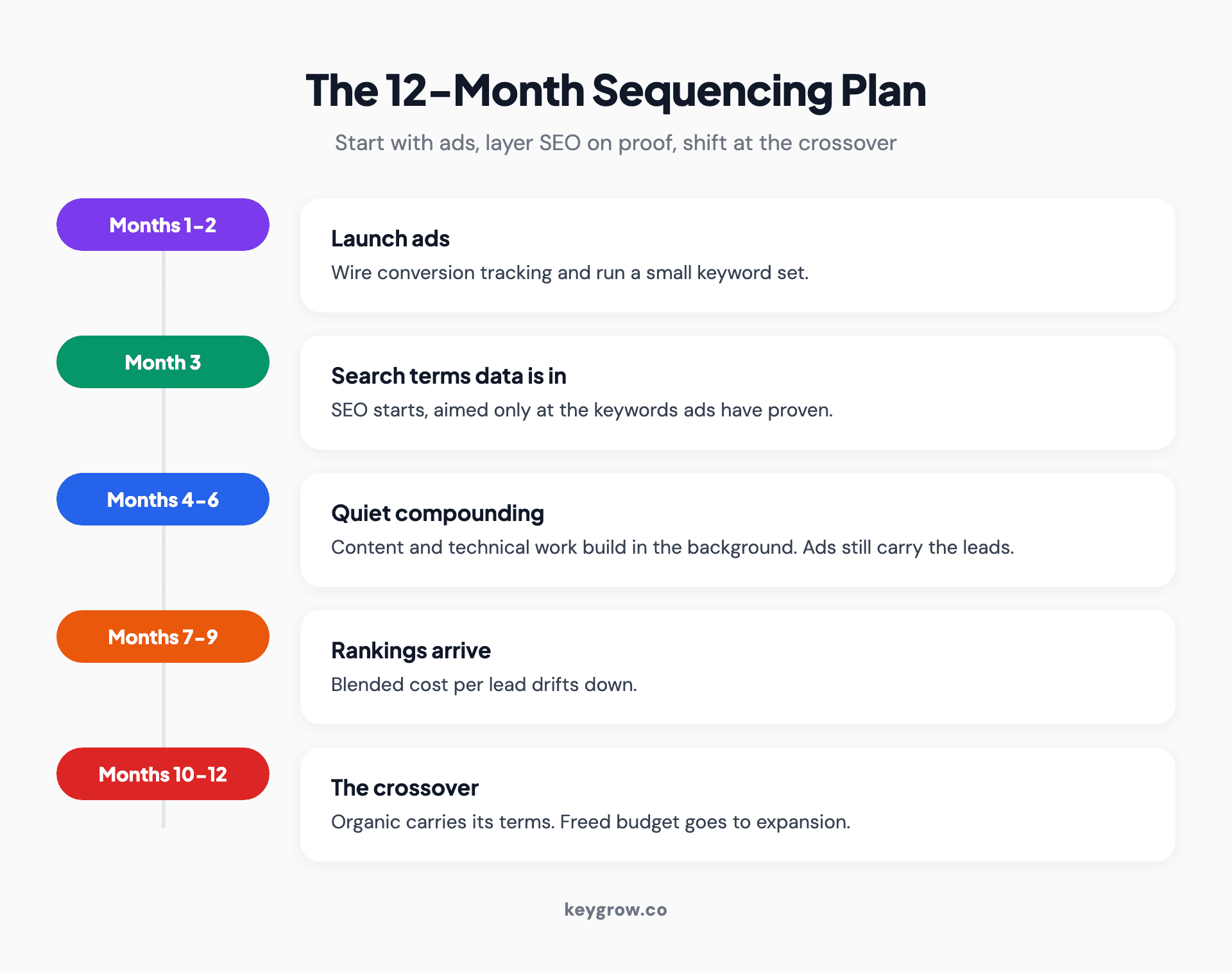
Twelve-month sequencing timeline for layering SEO onto a running Google Ads account, from tracking setup through the organic cost-per-lead crossover.
When the order flips: SEO first
Ads-first is the default, not a rule. Four situations reverse it.
Your margins can't clear market CPCs. If competitors with deeper intake operations have bid your keywords past your break-even, buying clicks is a slow bleed. Build organic instead and let them pay the auction tax.
You already have authority. An established site with years of content and links can rank for new terms in weeks. The 72.9 percent stat cuts both ways: if yours is one of the old, trusted sites, SEO's usual waiting cost mostly disappears.
You're in a genuinely low-competition local market. When page one for "your service + your town" is thin directories and abandoned blogs, a few months of focused local SEO takes it, and then you own it rent-free.
Your buyers research for months before buying. Long consideration cycles reward the educational content SEO produces, and a comparison of speed between local PPC and SEO matters less when no one buys quickly anyway.
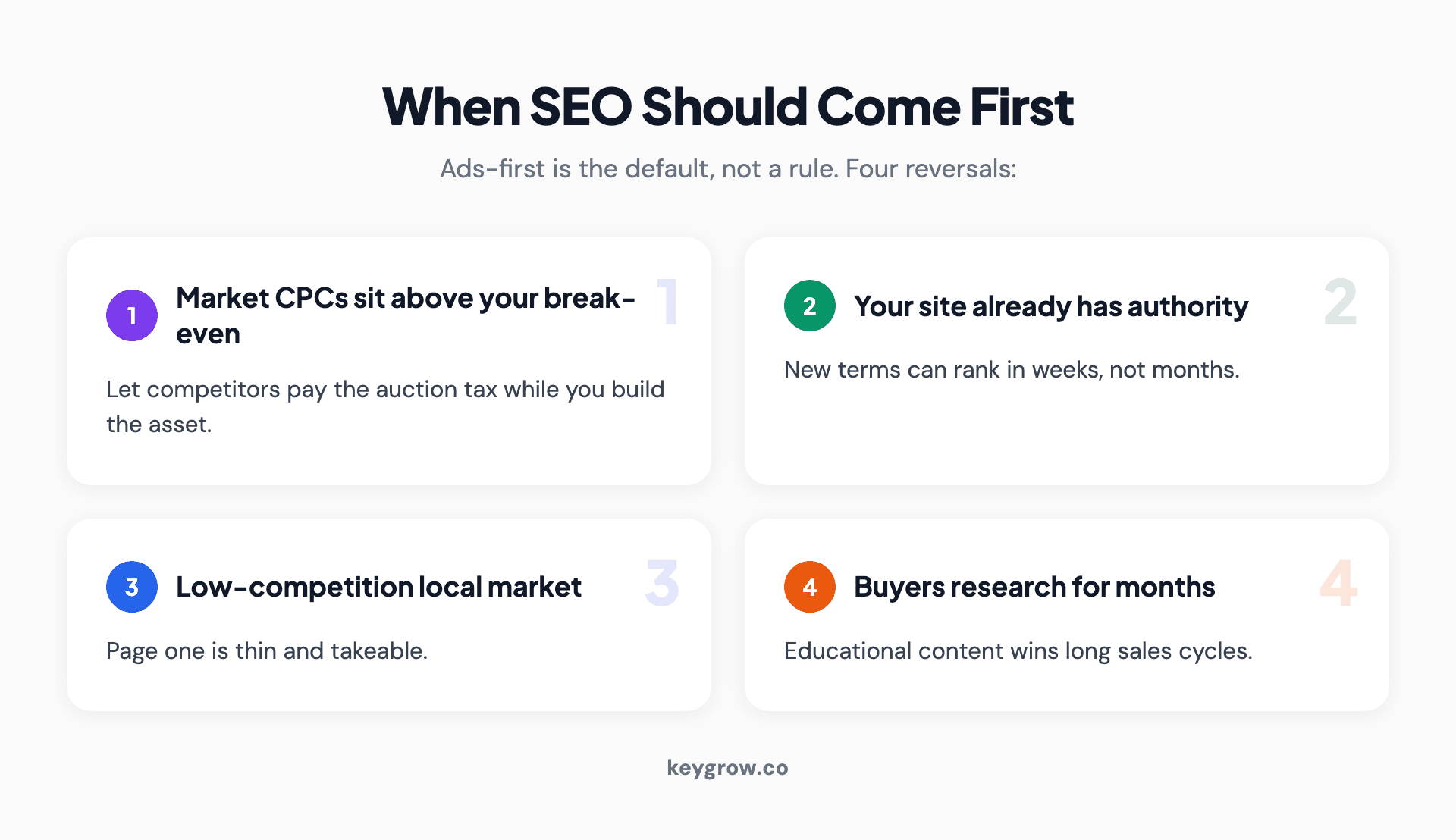
Checklist of the four situations where SEO should come before Google Ads: unaffordable CPCs, existing site authority, low-competition local markets, and long research cycles.
Does running Google Ads help your SEO rankings?
No, not directly. Google has said for years that ad spend does not influence organic rankings, and we've never seen credible evidence otherwise. The auction and the organic algorithm are separate systems.
The help is indirect but real: ads generate the keyword and conversion data that makes your SEO targeting smarter, ad landing pages double as testing grounds for the pages you'll later rank, and paired listings mean you occupy more of the page when both show. Buying ads to "boost rankings" is a myth. Buying ads to know what's worth ranking for is just good sequencing.
FAQs
Is Google Ads better than SEO?
Neither is better; they solve different problems on different clocks. Google Ads buys immediate, linear, per-click traffic that stops when the budget does. SEO builds slower, compounding traffic you stop paying market rate for. Businesses that treat them as rivals usually end up overpaying on one; the strong setups sequence them and eventually run both.
Should a small business start with SEO or Google Ads?
Start with Google Ads if you need customers within the next quarter and your budget can buy meaningful click volume, roughly $1,000 a month or more in ad spend. Start with SEO if you have a long runway, an established site, or a low-competition local market. Below that budget, complete your Google Business Profile and site basics before funding either channel.
How long does SEO take to show results?
Meaningful organic results typically take six to twelve months, and the data backs the long end: only 1.74 percent of new pages reach the top 10 within a year, and most top-ranking pages are over three years old. Early signals like improved local visibility can arrive in two to three months. Anyone promising page one in 30 days is a red flag.
Can I run Google Ads without doing SEO?
Yes, and many businesses profitably do. The trade-off is that your lead flow stops the day your budget does, and you pay market rate for every lead forever. Ads without SEO is a treadmill you can run indefinitely, it just never gets cheaper.
Can you do Google Ads and SEO at the same time?
Yes, and once budget allows roughly $2,500 or more a month it's usually the strongest setup: ads deliver leads and keyword data now, SEO compounds toward cheaper leads later, and each channel's data improves the other. The either/or framing only really applies to constrained budgets.
Which is more cost-effective, SEO or Google Ads?
Over a multi-year horizon SEO usually wins, because mature organic traffic costs the marginal price of content while every paid click bills at market rate. Over a 90-day horizon Google Ads wins, because SEO produces little that fast. Cost-effectiveness depends entirely on the window you measure.
What if a competitor outranks me on both paid and organic?
Take their auction and their rankings separately. In paid, check Auction Insights to see where they overlap you, and compete on Quality Score and landing pages rather than raw bids. In organic, target the specific keywords where their pages are thin. Competitors strong in both channels still have weak individual keywords, and that's where you start.
Our take
If you're asking which comes first, you're probably early, budget-constrained, or both, and in that spot the sequence that works is boring: free layer, then ads for cash flow and data, then SEO aimed at what the ads proved, then both. The mistake isn't picking the wrong first channel. It's treating "first" as permanent, staying on the paid treadmill for years, and never building the asset that would have made the treadmill optional.
If you want a second opinion on your specific numbers, our team runs both PPC and SEO and will tell you plainly which order fits your budget, including when the answer is "neither yet." Start here.


