

Here is the answer most pricing pages bury under a thousand words: how much does Google SEO cost depends entirely on who you hire, because Google itself charges nothing. There is no fee to appear in the organic results. The money you spend on SEO goes to a freelancer, a consultant, or an agency for the work of making your site rank, not to Google. For a small or mid-sized business in 2026, that work usually runs somewhere between 500 and 5,000 dollars a month, with most owners landing in the 500 to 1,500 range for a real, ongoing program.
That number swings hard based on your market, your competition, and what you actually need done. A single-location plumber in a quiet town and a regional law firm fighting twenty other firms for the same keyword are not buying the same thing, and they should not pay the same price. So the useful question is not "what does SEO cost" in the abstract. It is "what does SEO cost for a business my size, in my market, that wants the result I want", and then "what do I actually get for that number".
That is what this guide does. We answer the literal question first, then map every price band to what a small business genuinely receives at that number, using the 2026 pricing data and Google's own guidance rather than vague ranges that conveniently end at "contact us for a quote". If you run a larger operation with multiple sites or a dedicated marketing team, the math is different, and we cover that separately in our breakdown of enterprise SEO pricing. This post stays at the small-business and general level.
Does Google charge for SEO?
No. Google does not charge anything to rank in organic search, and it never has. SEO cost is purely the price of the labour and tools needed to earn those rankings, paid to whoever does the work, not to Google.
This trips people up because Google Ads sits right at the top of the same results page, and ads absolutely cost money per click. Organic results, the blue links below the ads, are free to appear in. Nobody at Google sends you an invoice for ranking first. What you pay for is the work that gets you there: technical fixes, content, links, and the ongoing attention that keeps you there as competitors push back.
Worth saying clearly, because some agencies imply otherwise: there is no paid shortcut into the organic results, no "Google partner" status that buys you rankings. Google states plainly that no one can guarantee a number-one ranking and warns businesses to be wary of anyone who claims a special relationship with the company. You can read that in Google Search Central. If a salesperson tells you their Google connection gets you ranked, that is your cue to leave.
So when we talk about SEO cost for the rest of this post, we mean one thing: what you pay a human or a team to do the work. Google is free. The expertise is not.
How much does Google SEO cost in 2026? The quick ranges
For most small and mid-sized businesses, SEO costs between 500 and 5,000 dollars a month, with the single most common monthly retainer falling in the 501 to 1,000 dollar band. Hourly work runs roughly 75 to 175 dollars an hour, and one-off projects like an audit start around 100 dollars and climb from there.
Those are not made-up numbers. Ahrefs surveyed 439 SEO service providers in their 2026 pricing study, and the Ahrefs survey found that 78.2 percent of providers charge a monthly retainer, making it the dominant model by a wide margin. Within those retainers, 20.4 percent of respondents named 501 to 1,000 dollars a month as their most common price point, more than any other band.
Here is how the headline ranges break down by provider type and pricing model, so you can see where your situation lands before anyone quotes you.

A small business owner at a checkout counter taking a card and mobile payment from a customer
| Pricing model | Freelancer | Consultant | Agency |
|---|---|---|---|
| Average monthly retainer | 1,348.63 | 3,250 | 3,209 |
| Average hourly rate | 71.59 | 171.18 | 98.90 |
| Typical small-site audit | 101 to 750 | 101 to 750 | 101 to 750 |
A few things jump out. Consultants charge the most per hour but are often the cheapest way to buy strategy if you have an internal team to execute. Freelancers are the lowest-cost retainer on average, which suits very small businesses. Agencies sit in the middle on hourly but bring a full team, which is why their retainers cluster higher once the scope grows. None of these is "right". They map to different needs, which is the next section.
The three ways SEO is priced: monthly retainer, hourly, and per-project
SEO is priced three ways: a monthly retainer for ongoing work, an hourly rate for ad-hoc help, or a fixed project fee for a defined deliverable like an audit or a site migration. Most ongoing programs use a retainer because SEO is continuous, not a one-time fix.
The retainer is the default for a reason. SEO is not a thing you install and walk away from; it is maintenance plus offence, every month, while competitors do the same. A retainer covers a recurring bundle of work: technical fixes, new and updated content, link building, and reporting. The Ahrefs data showing 78.2 percent of providers on retainers reflects that reality. This is the model you want if you are committing to organic as a channel.
Hourly suits a narrow case: you have someone in-house who can do the work, but you want expert direction or a second opinion. You pay 75 to 175 dollars an hour for strategy, a review, or troubleshooting, and your team executes. It is the cheapest way to access senior brains if you have hands to do the doing. It is a terrible way to buy a full program, because the meter is always running and nobody owns the outcome.
Per-project pricing fits a defined, finite deliverable. The clearest example is an audit. Small-site audits typically run 101 to 750 dollars, while a deep enterprise-level audit can reach 5,000 to 10,000, according to OuterBox. Site migrations, one-time technical cleanups, and a single content build also fit here. You pay once, you get a deliverable, the engagement ends. If you only need an audit, do not let anyone talk you into a 12-month retainer to get one.
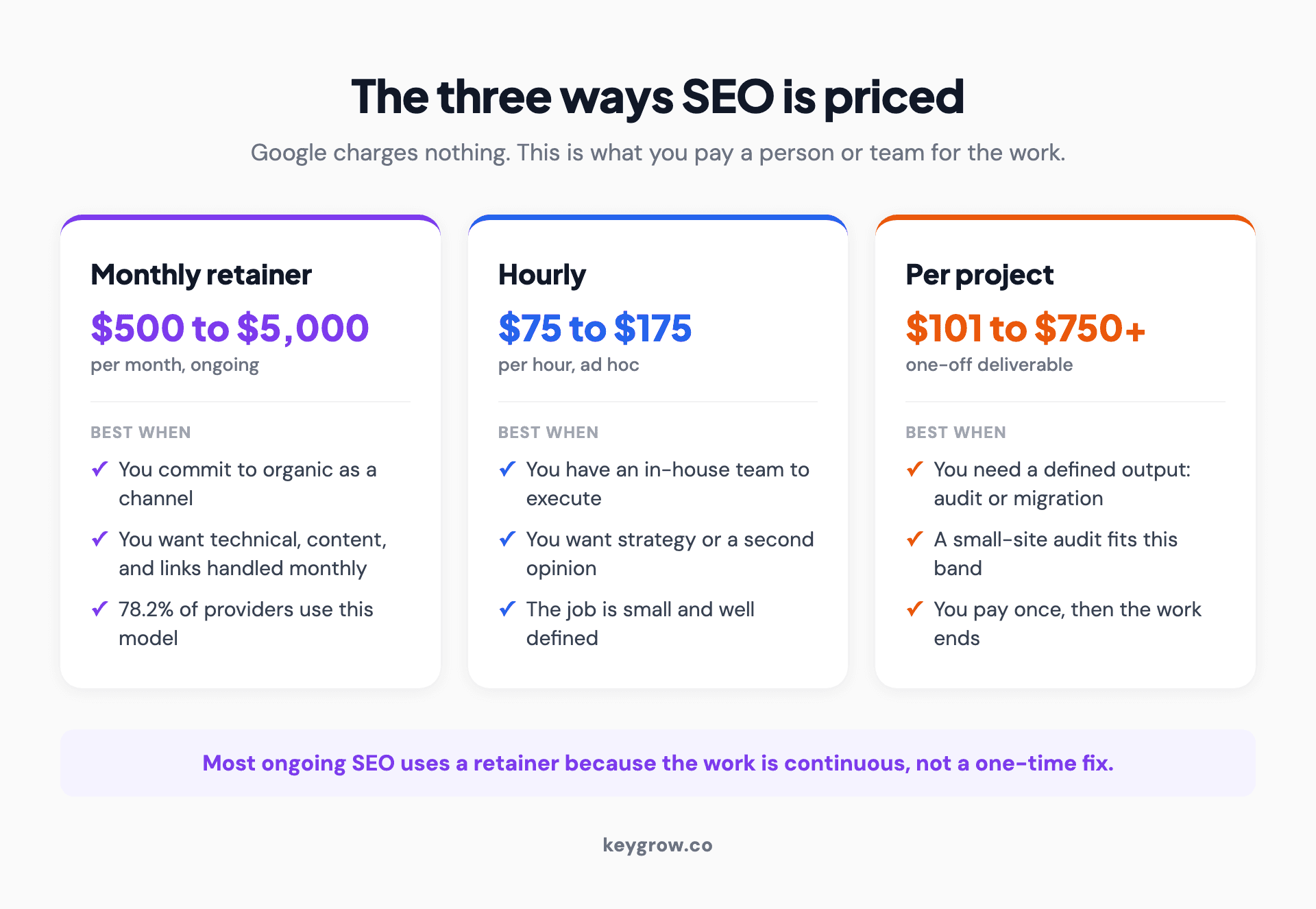
Three-card layout comparing the monthly retainer, hourly, and per-project SEO pricing models with typical price ranges and the situation each one fits best
One opinion worth stating here, backed by a number: a 12-month lock-in contract is a confession. If an agency needs to chain you in to keep your business, the results are not doing it for them. We work month-to-month, cancel anytime, because we would rather earn the next invoice than enforce one. The retainer model is fine. The lock-in attached to it is the part to push back on.
What does SEO cost by business size and competition?
SEO cost rises with two things: how big and complex your site is, and how hard the keywords you want are to rank for. A one-location service business in a low-competition niche can see results from a few hundred dollars a month, while a multi-location or high-competition business often needs 2,500 dollars a month or more to compete.
Competition is the bigger lever, and it is the one most pricing guides skip. Ranking for "emergency plumber" in a town of 8,000 people is a fundamentally cheaper job than ranking for "personal injury lawyer" in a major metro, where dozens of well-funded firms have been building authority for a decade. Same word count of work on the page, wildly different effort to actually move. The harder the keyword, the more content and links it takes, and content and links are where the money goes.
Site size matters too. A five-page brochure site needs far less technical work than a 2,000-page online store with product variants, filters, and duplicate-content risks. More pages means more to audit, more to optimise, and more that can break. That is part of why ecommerce and large sites trend toward the higher bands.
Here is a rough map of where businesses tend to land, treating it as a starting point and not a quote.
What you actually get at each price band, from zero to 5,000 a month
What you get scales with what you pay, and the jump from cheap SEO to real SEO is mostly in the depth of work: thin keyword tweaks at the bottom, full technical, content, and link programs at the top. Below is what each band buys in practice, not in brochure language.
Most pricing pages list prices and stop. The number means nothing without knowing what arrives for it. So here is the honest version of each band.
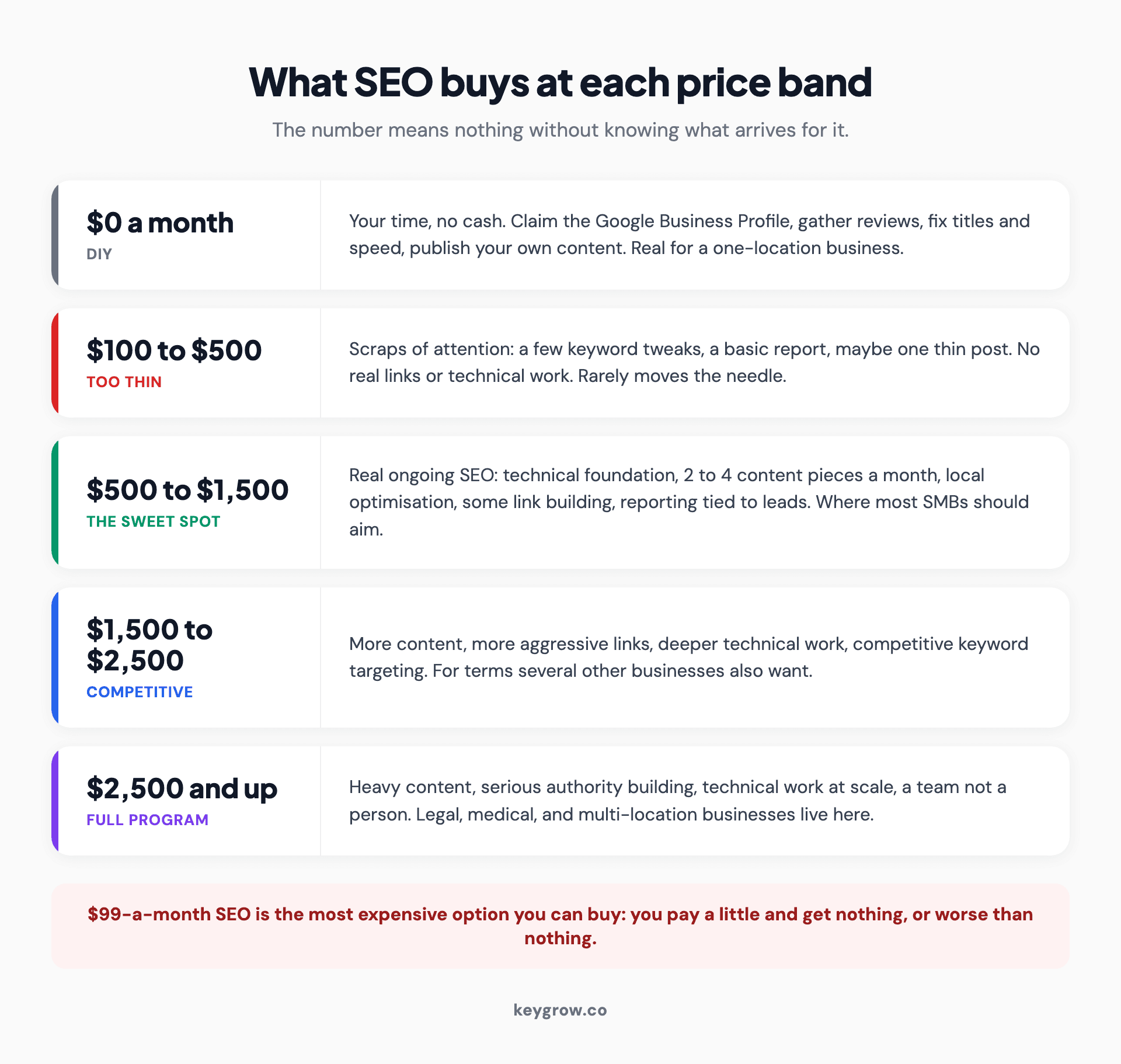
Five stacked cards showing what SEO buys at each monthly price band from zero dollars DIY up to over 2,500 dollars a month, with the real deliverables at each level
0 dollars (DIY). Your time, no cash. You claim and optimise your Google Business Profile, gather reviews, fix your title tags and page speed, and publish content yourself. Genuinely viable for a single-location business with more time than money. The ceiling is your own bandwidth and skill. Our piece on whether you can do SEO yourself is honest about where DIY runs out of road.
100 to 500 dollars a month. At this band you are buying scraps of someone's attention: a few keyword changes, a basic monthly report, maybe one thin blog post. No real link building, no deep technical work. For a non-competitive niche it might nudge things. For most it is too little to move the needle, and we explain why just below.
500 to 1,500 dollars a month. The first band where ongoing SEO is real. You get a proper technical foundation, a content cadence (two to four pieces a month), local optimisation, some link building, and reporting that ties to leads. This is where the most common 501 to 1,000 dollar retainer lives, and where most small businesses should aim.
1,500 to 2,500 dollars a month. More content, more aggressive link building, deeper technical work, and competitive keyword targeting. The right band if you are fighting for terms several other businesses also want.
2,500 dollars a month and up. Full programs for competitive niches and larger sites: heavy content production, serious authority building, technical work at scale, and a team rather than one person. Legal, medical, and multi-location businesses tend to live here.
Why 99-a-month SEO is the most expensive option you can buy
Cheap SEO at 99 to 300 dollars a month is the most expensive option because it almost never produces results, so every dollar is wasted, and the worst providers actively damage your site with spammy links you then pay more to clean up. You pay little and get nothing, or worse than nothing.
Run the math. Real SEO involves technical work, original content, and earned links, and a content writer alone costs more than 99 dollars for a single decent article. So what is a provider doing for 99 dollars a month across, say, fifty clients? Automated reports, a few low-quality directory submissions, and mass-produced spun content. None of it ranks. Some of it earns your site a manual penalty from Google, which is its own expensive problem to dig out of.
This is where Google's anti-guarantee guidance matters most. The cheap providers are also the ones most likely to promise page one in 30 days, because the pitch is the product; there is no actual SEO behind it. Google says outright that no one can guarantee rankings. Anyone making that promise at a bargain price is selling you a story.
The honest comparison is not 99 dollars versus 1,000 dollars. It is 99 dollars for zero results versus 1,000 dollars for results that compound. Twelve months of cheap SEO is 1,188 dollars spent on nothing, plus the opportunity cost of a year not ranking, plus possible cleanup. The bargain is the expensive choice. If you cannot afford real SEO yet, DIY the basics for free instead. That actually works.
How to set an SEO budget you can actually sustain
Set your SEO budget by working backward from what a customer is worth to you, not forward from what you can spare. If one new client is worth 2,000 dollars and SEO brings you four a month, a 1,500 dollar retainer is cheap. If a customer is worth 50 dollars, the math is harder and you should think carefully.

A glass jar full of coins with a small green plant growing out of the top, a metaphor for a budget that compounds over time
The fatal budgeting mistake is quitting at month three. SEO is a compounding asset, not a campaign. It looks unimpressive for the first quarter and embarrassingly good after a year. A doctor's practice in Dubai we worked with committed to a full year: months one through three looked flat on the surface, but by month twelve organic traffic had grown 1,519 percent and the practice was fielding 130-plus patient calls a month. Same site, same client, no shortcuts. The businesses that quit at month three pay for the hard part and leave right before the payout.
So budget for the runway, not the first invoice. A sustainable plan looks like this:
1. Pick a monthly number you can pay for 9 to 12 months without flinching. A smaller retainer you can sustain beats a bigger one you cancel at month four.
2. Tie it to customer value. Cost per lead and revenue, not rankings, are the numbers that justify the spend. Our guide to measuring SEO ROI shows how to track that properly.
3. Expect the curve. Local results often start landing around the timeline local SEO takes, and stronger organic compounding shows up later.
4. Reassess at six months, not three. By month six you should see direction. If there is no movement at all, that is a real conversation to have with your provider.
When paying for SEO is the wrong move for your business
Paying for SEO is the wrong move when you cannot fund it for at least 9 to 12 months, when your customers do not search for what you sell, or when your basics are unclaimed and DIY would get you most of the way for free. SEO is a long game, and a short runway burns money.
This is the part most agencies will not tell you, so here it is plainly. Do not hire us, or anyone, if any of these are true:
We turn away businesses we cannot help, because selling a retainer to a bad fit costs you money now and costs us a sour relationship later. If SEO is right for you, it is one of the best returns in marketing. If it is not, we would rather say so up front.
The bottom line on SEO pricing
Google charges nothing for SEO. What you pay is the cost of the work, and for most small and mid-sized businesses that is 500 to 5,000 dollars a month, with the 500 to 1,500 band fitting the majority. Avoid 99-dollar SEO entirely; it is the priciest thing in this whole post because it returns nothing. Budget for a year, tie the spend to customer value, and DIY the basics if a retainer is not realistic yet.
If your search demand is mostly within driving distance, the pricing works differently and the ranges are lower. Our guide to local SEO pricing covers that, including how to read a quote as a number of hours.
If you want a straight answer on what your specific site and market would actually need, tell us about your business and we will give you a number, not a sales script.
FAQs
Does Google charge anything for SEO?
No. Google does not charge any fee to rank in organic search. The cost of SEO is purely what you pay a freelancer, consultant, or agency for the work of optimising your site. Google Ads costs money per click, but the organic results below the ads are free to appear in.
How much should a small business spend on SEO per month?
Most small businesses should budget 500 to 1,500 dollars a month for a real, ongoing SEO program, which is where the most common retainer band sits. Below roughly 500 dollars you rarely get enough work to move rankings. The right number depends on your competition and what a customer is worth to you.
Why is SEO so expensive?
SEO costs what it does because it takes skilled, ongoing labour: technical fixes, original content, earned links, and monthly attention while competitors push back. A single decent article costs more than the entire monthly fee of a cheap provider. You are paying for expertise and continuous work, not a one-time setup.
Is cheap SEO at 99 to 300 dollars a month worth it?
Almost never. At that price a provider cannot afford to do real work, so you typically get automated reports and spun content that does not rank, and sometimes spammy links that harm your site. It is the most expensive option because every dollar is wasted. If money is tight, DIY the basics for free instead.
Is it better to pay hourly, monthly, or per project for SEO?
A monthly retainer fits ongoing SEO, which is most businesses, because the work is continuous. Hourly suits buying strategy when you have an in-house team to execute. Per-project pricing fits a defined deliverable like an audit or a migration. Match the model to the need, and never accept a long retainer just to get a one-off audit.
Can I do SEO myself instead of paying for it?
Yes, especially if you run a single-location business with more time than money. You can claim and optimise your Google Business Profile, gather reviews, fix title tags and page speed, and publish content yourself. The limit is your own time and skill, and DIY tends to run out of road once competition rises or the site grows.
How long before SEO pays for itself?
Plan for a 9 to 12 month runway before SEO clearly pays off, because it compounds rather than spikes. The first quarter usually looks flat, with stronger results landing later. One practice we worked with took twelve months to grow organic traffic 1,519 percent. Budget for the long game or do not start.
Can an SEO agency guarantee I rank on Google?
No, and any agency that promises a number-one ranking is a red flag. Google states clearly that no one can guarantee rankings and warns against providers claiming a special relationship with the company. Real SEO improves your odds and compounds over time, but guarantees of a specific position are a sales tactic, not a deliverable.


