

Hiring an SEO company is worth it when you have a proven offer, enough margin per customer to survive a payback period of several months, and no one in-house with the time or skill to do the work well. It is not worth it when your budget is under about a thousand dollars a month, you need customers in the next 30 days, or you have not yet proven people will buy what you sell. SEO is a compounding investment, not a quick fix, so the real question is whether your business is in a position to wait for it to compound.
Most guides on this question are written by SEO agencies, so they arrive at "yes, almost always." This one is written by one too, and we still turn away businesses we cannot help. Below is the actual math: what an SEO company does, what it costs across every option, how to calculate your own break-even, and the specific situations where you should keep your money and do it yourself.
What an SEO company actually does for the money
An SEO company handles the technical, content, and authority work that makes a site rank and earn traffic: fixing what search engines struggle to crawl, building pages that answer what people search, earning links and citations, and reporting on what it all produces. You are paying for a system, not a single task.
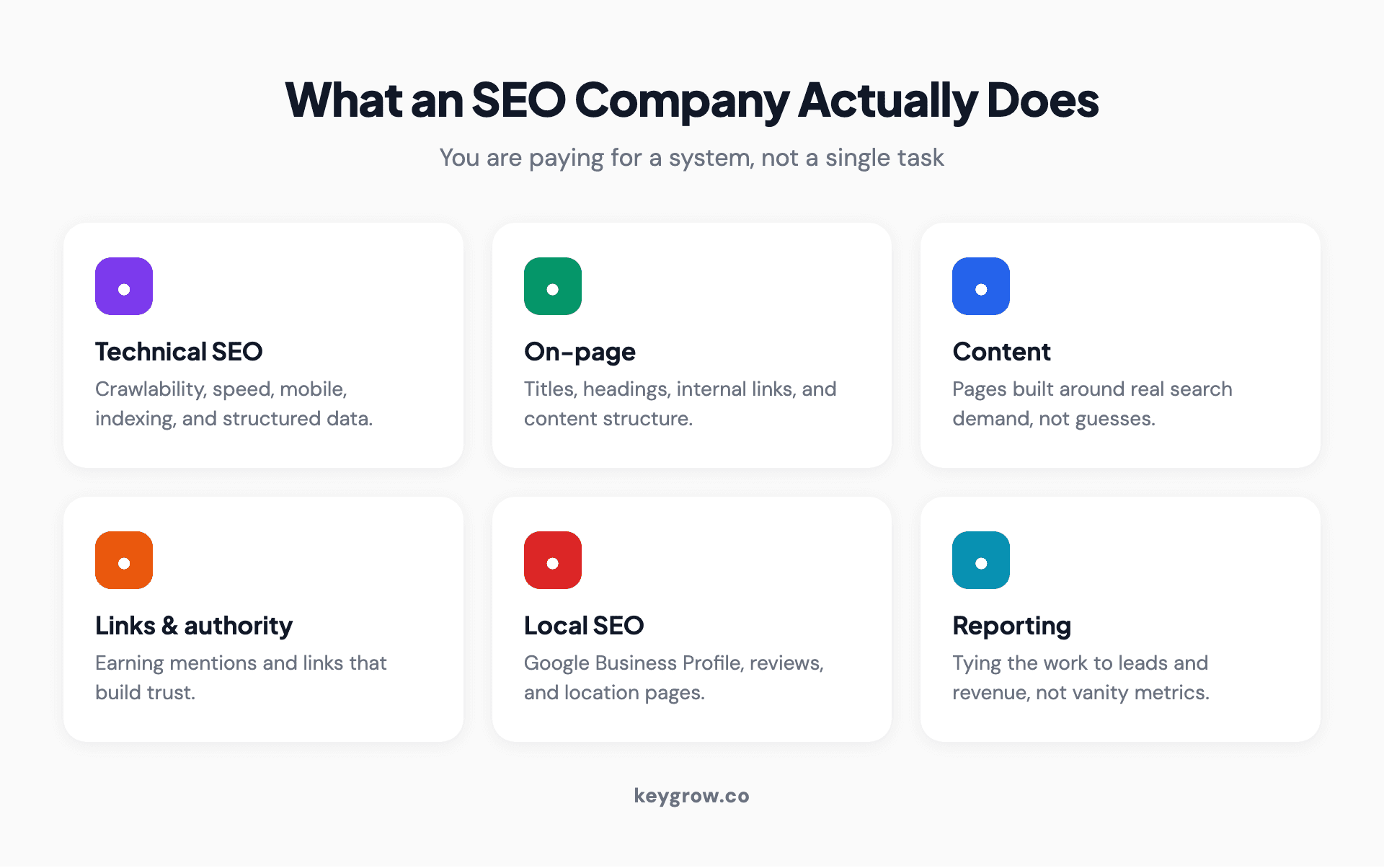
What an SEO company actually does: technical fixes for crawling and speed, on-page optimization, content built around real search demand, link and citation building, local and Google Business Profile work, and reporting tied to leads and revenue.
The work usually spans six areas:
The value is in doing all six consistently, in the right order, over time. That is also why it is hard to do well on the side of a full-time job.
What it costs, across every option
SEO costs range from about $400 a month to do it yourself in tools, to roughly $1,350 a month for a freelancer, to $1,500 to $5,000-plus for an agency, to $7,500 or more a month for a fully loaded in-house hire. The right number depends on which path fits your situation, not on which is cheapest.
Here is the honest cost of each path, drawn from industry pricing data:
| Path | Typical cost | What you get | Best when |
|---|---|---|---|
| DIY | ~$400+/month in tools, plus your time | Full control, real learning, slow going | Budget is tight and you have time to learn |
| Freelancer | ~$1,350/month average | One specialist, flexible, variable coverage | You need one gap filled and can manage it |
| Agency | ~$1,500-$5,000+/month | A full team across all six areas | You want the whole system handled |
| In-house hire | ~$7,500-$10,800/month fully loaded | Dedicated focus, deep on your business | You have the volume to keep them busy |
A few specifics behind those ranges. Per Ahrefs' pricing survey of 439 providers, the most common monthly retainer is $501 to $1,000, and the average retainer runs about $3,209 for agencies and $1,348 for freelancers. A DIY tool stack starts around $130 a month for an entry all-in-one platform and reaches $400-plus once you add everything. And an in-house hire is the number most people underestimate: a mid-level SEO salary of $65,000 to $95,000 becomes roughly $7,500 to $10,800 a month once you add benefits, tools, and management time. In-house is rarely the cheapest option for a small business, despite feeling like it should be. If cost is the sticking point, our guide on how much Google SEO costs breaks the models down further.
The break-even math nobody shows you
Whether SEO is worth it comes down to one calculation: divide the monthly cost by your profit per customer, and that is how many new customers a month it has to bring to pay for itself. If that number looks easy to clear, it is probably worth it. If it looks impossible, it is not, at least not yet.
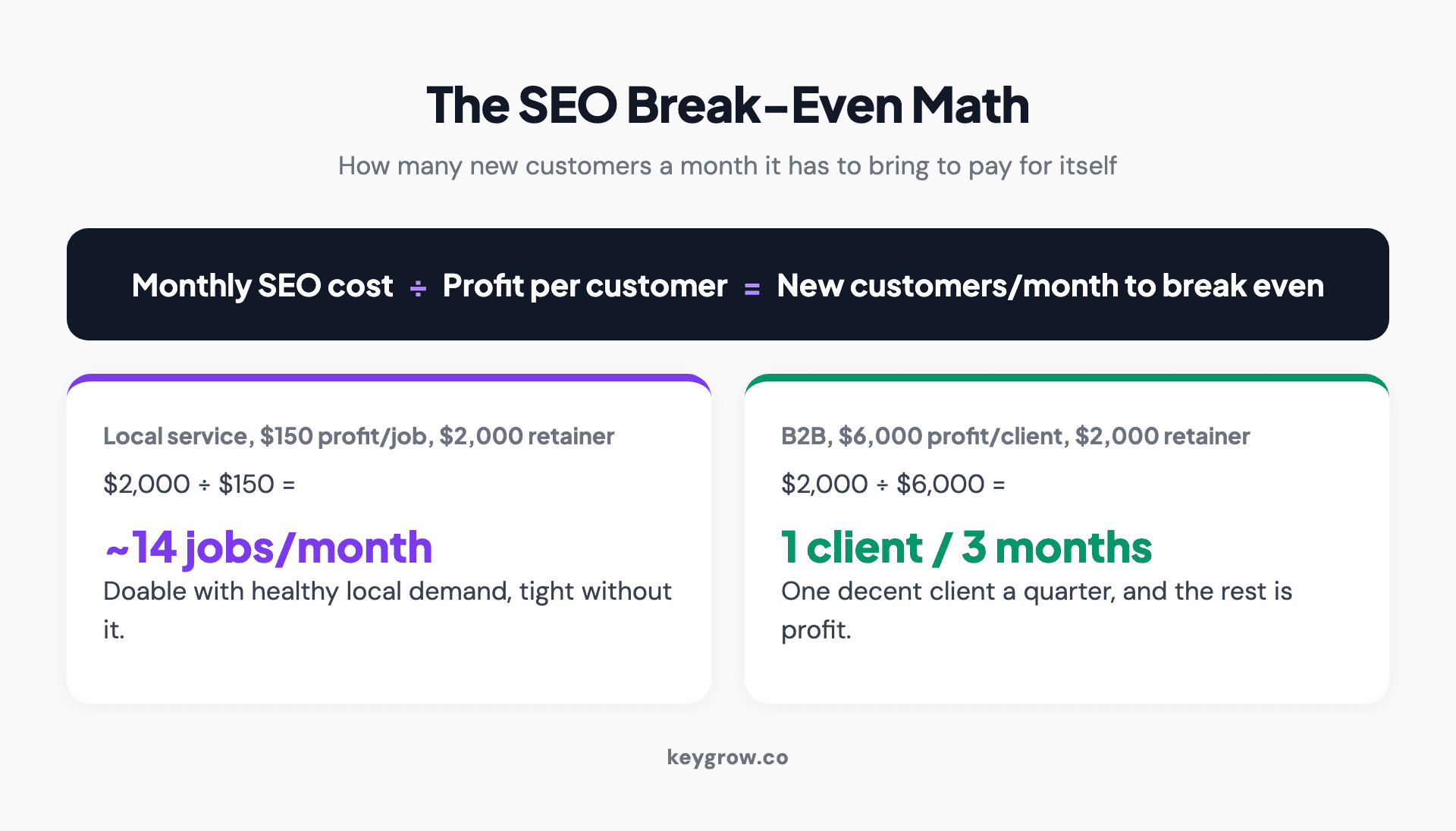
The SEO break-even formula: monthly SEO cost divided by profit per customer equals the new customers per month needed to break even, shown for a 150-dollar local job versus a 6,000-dollar B2B client.
Run it with two very different businesses on a $2,000-a-month retainer:
Same retainer, completely different verdict. The higher your profit per customer, the more obviously SEO pays, which is why it is such a strong fit for legal, medical, B2B, and high-ticket services, and a harder call for low-margin, one-time-purchase businesses. Do this math with your own numbers before you sign anything. If you do not know your profit per customer or your close rate, that is the first thing to fix, because without them any "is it worth it" answer is a guess.
The real ROI and how long it takes
SEO delivers strong returns, but on a delay. Industry data puts positive ROI at 6 to 12 months in, with the biggest gains in years two and three. Anyone promising page one in 30 days is either targeting keywords nobody searches or about to damage your site.
The upside is real when you wait for it. First Page Sage's data puts SEO ROI between roughly 317 percent for e-commerce and 1,389 percent for real estate, with break-even landing anywhere from about 5 months in construction to 14 months in legal. The pattern is always the same shape: unimpressive for the first quarter, respectable by month six, and compounding after a year.
We watched this play out with a doctor's practice in Dubai that committed to SEO for a full year. Months one through three looked quiet. By month twelve, organic traffic had grown 1,519 percent and the practice was taking more than 130 patient calls a month, on the same site, with no shortcuts. That is the trade SEO asks you to make: patience now for an asset that keeps paying later. If a fast timeline is non-negotiable, paid ads are the better tool, and our comparison of why SEO takes so long explains the mechanism.
DIY, freelancer, in-house, or agency?
The four paths are not better or worse, they fit different situations. DIY suits a tight budget with time to learn. A freelancer fills one gap. An agency handles the whole system. An in-house hire makes sense once you have enough work to keep a full-time person busy.
Match the path to your reality:
Many businesses end up hybrid: an agency or freelancer doing the specialist work while someone internal owns the relationship and the content. There is no single right answer, only the one that fits your budget, your time, and how much work there is to do.
When you should NOT hire an SEO company
Do not hire an SEO company if your budget is under about $1,000 a month, you need customers this month, your offer is not proven yet, or your margins cannot survive a months-long payback. In each case there is a better use of the money right now.
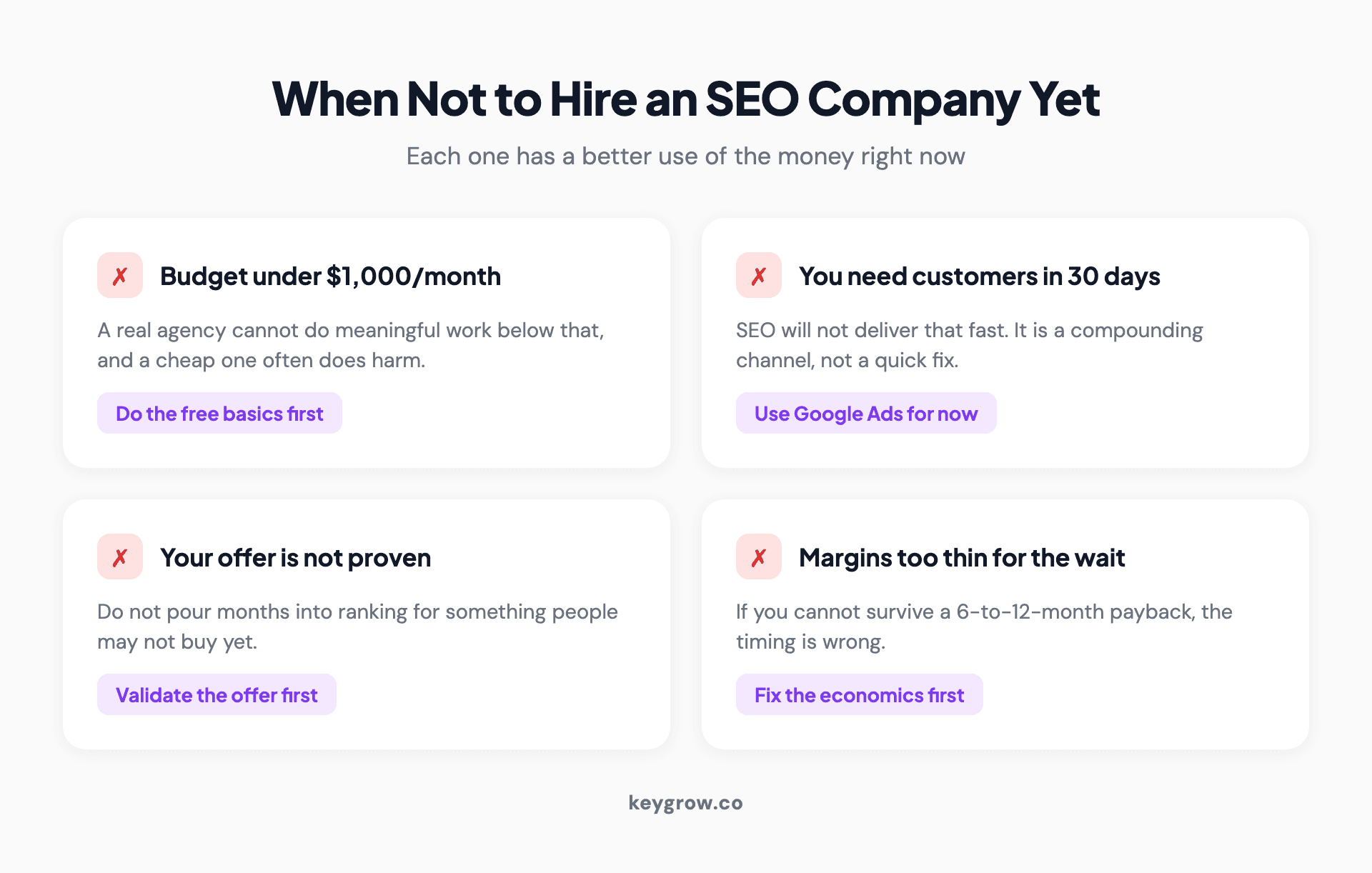
When not to hire an SEO company yet: a budget under a thousand a month, needing customers within 30 days, an unproven offer, or margins too thin to survive a long payback, each with what to do instead.
The honest disqualifiers, and what to do instead:
An agency that will not tell you when you are a bad fit is selling, not consulting. If any of these describes you, the most valuable thing an honest SEO company can do is tell you to wait.
A decision matrix by business type and budget
To make it concrete, here is where most businesses land based on type and monthly budget. Use it as a starting point, not a rule.
| Business type | Under $1k/mo | $1k-$3k/mo | $3k-$10k/mo |
|---|---|---|---|
| Local single-location | DIY the basics | Freelancer or local agency | Full agency, likely overkill |
| Multi-location / regional | DIY plus one-off audit | Agency | Agency |
| E-commerce | DIY plus tools | Freelancer or agency | Agency |
| B2B / national / SaaS | Not yet, validate first | Agency | Agency, possibly + in-house lead |
The pattern: under $1,000 a month, do the fundamentals yourself and revisit later. In the $1,000 to $3,000 range, a freelancer or a focused agency is usually the best value. Above $3,000, an agency running the full system, and eventually a hybrid with someone internal, tends to win.
How to vet one, and the red flags
Vet an SEO company by asking what they will actually do, how they report, and whether they lock you into a long contract. The biggest red flag is a guarantee of specific rankings, which no one can honestly promise.
Google publishes its own guidance on choosing an SEO, and the warning signs it lists are still the right ones: anyone guaranteeing number-one rankings, anyone vague about their methods, anyone who contacts you out of the blue with a too-good pitch. Beyond that, look at how they report. A real report leads with leads and revenue, not impressions and rankings that do not pay rent.
One more, from our own bias: 12-month lock-in contracts are a confession. If an agency needs a contract to keep you, the results are not doing it. We work month-to-month, cancel anytime, because an account that could fire us next month keeps us honest. When you evaluate a company, ask why the contract length is what it is, and treat a hard lock-in as a reason to look closer. Our guide on choosing a good SEO company has the full list of questions to ask.
How to tell it is working once you have hired
Judge a new SEO engagement on leading indicators for the first few months and lagging ones after that. Early on, look for technical fixes shipped, content published, and keywords starting to move. Later, look for traffic, leads, and revenue.
The mistake is expecting revenue in month two and panicking when it is not there. In the first 90 days, a working engagement shows up as activity and small signals: pages getting indexed, issues fixed, rankings inching up, impressions rising in Search Console. Traffic and leads follow, usually from month four or five onward. If you are six months in with no movement on either the leading or the lagging signals, that is a real problem worth confronting, and our guide on telling if your SEO company is working shows exactly what to check.
FAQs
How much does it cost to hire an SEO company per month?
Most agency retainers fall between about $1,500 and $5,000 a month, with the single most common band being $501 to $1,000 and the average around $3,200. Freelancers average closer to $1,350 a month. The right number depends on your market's competitiveness and how much work the site needs, so treat these as ranges and ask any company to tie its price to a specific scope.
Is hiring an SEO company worth it for a small business?
It is worth it when you have a proven offer, enough profit per customer to absorb a payback of several months, and no one in-house to do the work well. It is not worth it if your budget is under about $1,000 a month, you need customers immediately, or your offer is unproven. Run the break-even math on your own numbers before deciding.
How long before hiring an SEO company pays off?
Expect 6 to 12 months to positive ROI, with the biggest returns in years two and three. Industry break-even ranges from about 5 months in low-competition niches to 14 months in competitive ones like legal. Anyone promising results in 30 days is a warning sign, not a good deal.
Can I just do SEO myself instead?
Yes, for the basics, especially a single-location local business. Claim your Google Business Profile, gather reviews, fix obvious technical issues, and publish useful content. DIY breaks down on the ongoing, specialized work like technical audits and link building, and on the time it takes. Hire help when the opportunity cost of your hours beats the fee.
Is it worth hiring an SEO company with AI Overviews reducing clicks?
Yes, arguably more so. AI answers still pull from content that ranks and carries authority, so the technical, content, and authority work an SEO company does is what makes you eligible to be cited. The goal shifts from only earning clicks to also becoming the source AI engines quote, but the underlying work is the same foundation.
What are the red flags of a bad SEO company?
Guarantees of specific rankings, vagueness about methods, unsolicited cold pitches, reports that lead with vanity metrics instead of leads and revenue, and long lock-in contracts. Google's own guidance flags the guarantee and the vagueness; the vanity-metric reporting and the lock-in are industry tells worth walking away from.
The bottom line
Hiring an SEO company is worth it when your business can afford to wait a few months for a compounding return and cannot do the work well itself. Run the break-even math, be honest about your timeline and your margins, and if the numbers are not there yet, do the free basics and revisit later. The right answer is sometimes "not yet," and a good agency will tell you so.
If you want that honest read on your specific situation, that is the conversation we would rather have than a hard sell. Bring your profit per customer and your goals to the get started page, or see how our SEO service works, and we will tell you whether hiring anyone, us included, is worth it right now.


