

What do SEO companies really do? A real one does a defined set of work: technical fixes, on-page optimization, content, link building and digital PR, local SEO, and analytics with honest reporting. All of it aims at one outcome, more qualified traffic that turns into leads. Most of the mystery around the industry is marketing. The work itself is concrete, and you should know exactly what you are paying for.
That last part matters because SEO is one of the few services where the buyer often cannot see the work happening. That gap is where bad agencies live. So here is the plain version: what good SEO companies deliver, what they charge, what the bad ones do behind the scenes, and when you would be better off not hiring one at all.
What does an SEO company do day to day?
An SEO company improves how your site ranks in search by working across six areas: technical health, on-page content, content creation, off-page authority, local presence, and measurement. Day to day, that is research, fixes, writing, outreach, and reporting, in rotation.
None of it is magic. Think of an SEO company as a maintenance and growth crew for your visibility in search. Some of the work is one-time setup, a lot of it is ongoing, and the best agencies are transparent about which is which. Below is what each of the six areas involves.
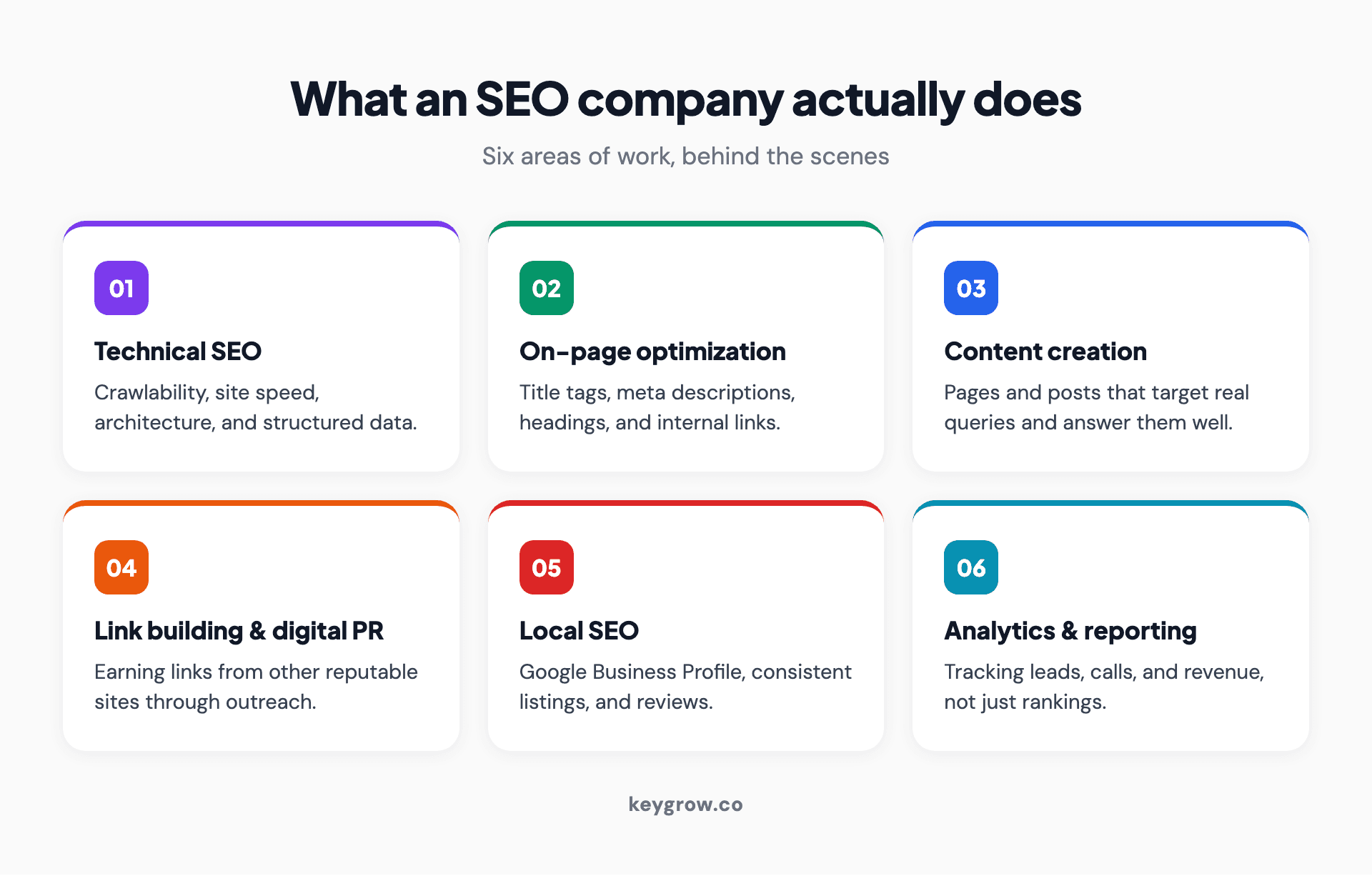
Infographic showing the six things an SEO company does, as an icon grid: technical SEO for site health and speed, on-page optimization of titles and content, content creation aligned to search intent, off-page link building and digital PR, local SEO for Google Business Profile and reviews, and analytics with honest reporting on leads and revenue.
The real deliverables, by category
The work breaks into six buckets, and a good agency touches most of them every month. Here is what each one means in practice, with no jargon.
Month one versus ongoing: what are you paying for over time?
In month one, a good SEO company front-loads strategy: an audit, keyword and competitor research, a content plan, and the first round of technical fixes. From month two on, you are paying for ongoing execution: content, links, maintenance, and reporting.
This is the question that confuses most buyers. SEO is a retainer because the work never really finishes, but the shape of it changes. Month one is heavy on diagnosis and planning. The months after are a steady cadence of producing content, earning links, fixing what breaks, and adjusting based on what the data shows. If an agency cannot tell you what month one looks like versus month six, that is a problem.
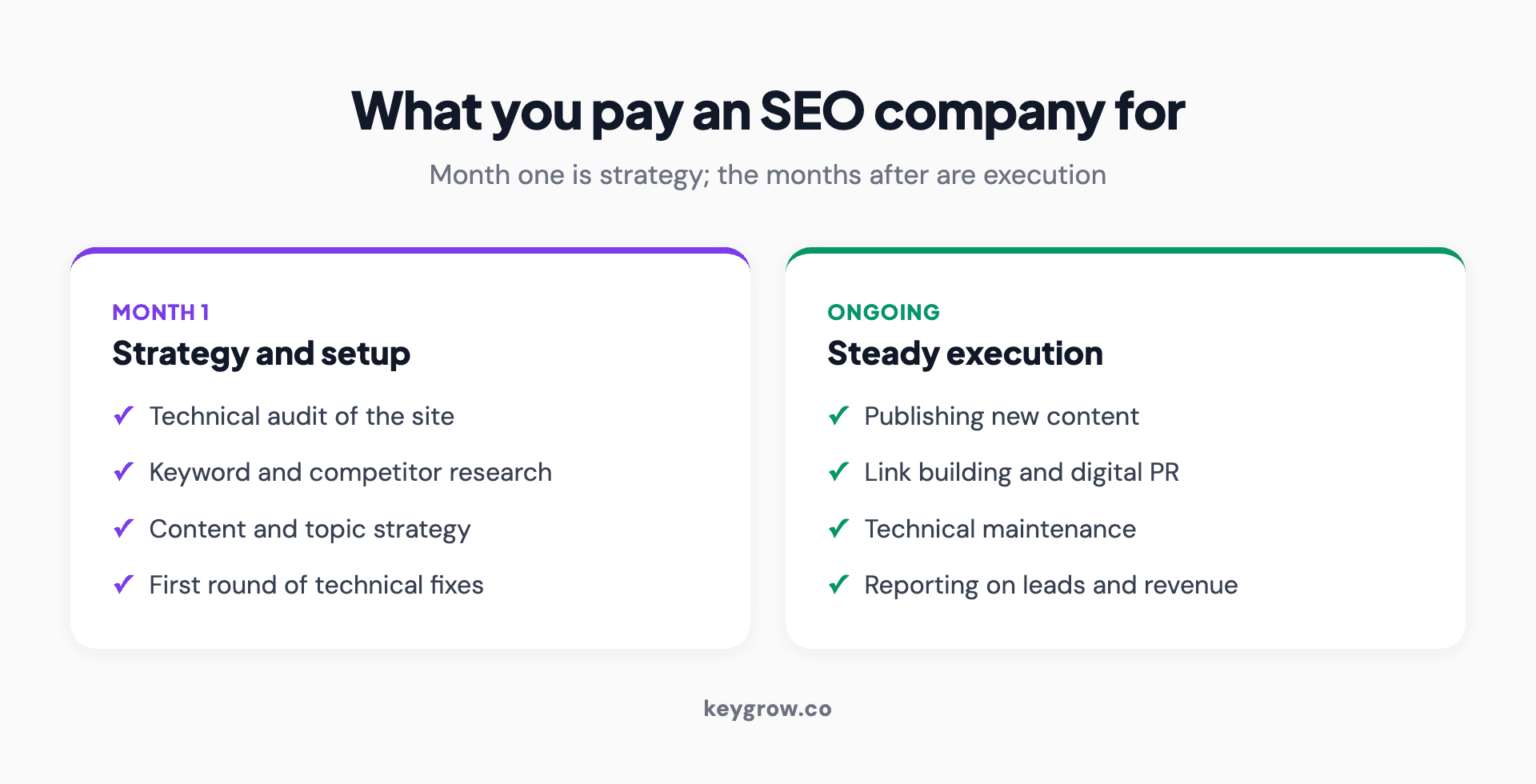
Infographic comparing what an SEO company delivers in month one versus on an ongoing basis. Month one: technical audit, keyword and competitor research, content strategy, and first technical fixes. Ongoing: publishing content, link building and digital PR, technical maintenance, and monthly reporting on leads and revenue.
How do SEO companies charge?
Most SEO companies charge a monthly retainer, with hourly and project-based pricing as alternatives. Agencies cost more than freelancers because they bring a team across all six areas, while a freelancer or in-house hire covers fewer.
The market gives rough anchors. BrightLocal found agencies typically receive about $2,043 per client per month, at a median rate of $100 an hour, while freelancers receive around $1,228 per client per month at a median of $75 an hour. Those are averages, not quotes, and the right number depends on your competition and goals. We do not publish a flat price for the same reason: a credible scope follows the situation, not a tier on a pricing page.
| Option | Typical cost | Best for |
|---|---|---|
| Agency | Around $2,043/month average | Businesses wanting a full team across all six areas |
| Freelancer | Around $1,228/month average | Smaller scopes, one or two focus areas |
| In-house | A salary plus tools | Larger companies with steady, full-time SEO needs |
One thing to insist on regardless of who you hire: month-to-month terms, or at least the freedom to leave if it is not working. We run our SEO month-to-month, cancel anytime, because a long lock-in contract tends to protect the agency, not you.
Why do businesses hire SEO companies at all?
Businesses hire SEO companies because organic search is the largest source of trackable traffic for most sites, and ranking well is slow, technical work that is hard to do alongside running a business. Done right, it compounds into a channel that keeps paying.
The case is in the numbers. BrightEdge found that organic search drives 53 percent of all trackable website traffic, more than any other channel, and HubSpot reports that marketers rank their website, blog, and SEO as their top ROI-generating channel, cited by 27 percent of them, ahead of paid social. Visibility at the top matters too: Backlinko's click-through study found the number one result earns about 27.6 percent of clicks. For most businesses, that traffic is too large to ignore and too involved to do well in spare hours, which is the honest reason agencies exist.
What do bad SEO companies do? The red flags
Bad SEO companies sell the appearance of work instead of the work. The classic move is to buy cheap links in bulk, pump out thin content to look busy, and bury the lack of results under vanity-metric reports that never mention leads or revenue.
Knowing the failure modes is how you avoid them:
If you want the deeper version of spotting a struggling provider, that is the whole job of our guide on whether your SEO company is working.
When you do not need an SEO agency
You do not need an SEO agency if you are very early-stage with no budget for content, if you run an ultra-local business with simple needs, or if you have the time to handle the basics yourself first. Plenty of businesses are better served by DIY for a while.
This is the part most agencies will not say out loud. If you are a one-location business, you can claim your Google Business Profile, gather reviews, fix your obvious site issues, and write your core pages without paying anyone. That covers a lot of ground. Hire an agency when the opportunity cost of your time beats the fee, when competition gets serious, or when the technical and link-building work moves past what you can self-teach. The flip side is real too: DIY has a ceiling, and trying to scale it alone is where it tends to break, which is the subject of why DIY SEO can fail. The honest answer is to start with whichever fits your stage, and to read our take on whether SEO services are worth it before you sign anything.
One more model worth knowing: some "agencies" do not do the work at all but resell another company's, which is the white label SEO arrangement. It is not inherently bad, but you should know whether the team on the call is the team doing the work.
Do SEO companies handle AI search now?
Good ones do. In 2026, the deliverable set has expanded to include answer engine optimization: structuring content so it can be cited by AI Overviews, ChatGPT, and other answer engines, in addition to being ranked by Google.
This is the newest line item, and it is a useful test of whether an agency is current. The fundamentals overlap with classic SEO, crawlable content, clear structure, genuine authority, but the goal widens from ranking to being the source an AI quotes. An agency that has never mentioned AI search is working from an older playbook. Our guide to AI search optimization covers what that work involves.
FAQs
What does an SEO company do day to day?
It runs research, technical fixes, content writing, link outreach, and reporting in rotation. On a given day that might mean auditing pages, optimizing title tags, publishing content, pitching a site for a backlink, and pulling a performance report. The work spans technical health, on-page, content, off-page authority, local SEO, and analytics.
How much does it cost to hire an SEO company per month?
It varies by competition and scope, but BrightLocal found agencies average about $2,043 per client per month and freelancers about $1,228. Those are averages, not quotes. Be cautious of very cheap fixed-price packages, since real content and link building cannot be done well at bargain rates without cutting corners that backfire.
How long does it take to see results from an SEO company?
Usually three to six months for early signs and a year for full traction, because SEO compounds rather than switches on. Anyone promising page one in 30 days is a red flag. A good agency sets this expectation up front and shows leading indicators, like indexed pages and ranking movement, before the revenue follows.
How do SEO companies charge: retainer, hourly, or project-based?
Most charge a monthly retainer, because SEO is ongoing work rather than a one-time fix. Hourly pricing exists for consulting or smaller scopes, and project-based pricing suits defined jobs like a migration or a one-time audit. Whichever the model, insist on month-to-month terms or a clear exit rather than a long lock-in.
What questions should I ask an SEO company before hiring them?
Ask what month one looks like versus ongoing, how they report and which metrics they lead with, whether you keep your accounts and content if you leave, whether the work is done in-house or resold, and what their contract terms are. Honest answers to those five separate the consultants from the salespeople.
What are the red flags of a bad or black-hat SEO company?
Reports built on vanity metrics instead of leads and revenue, promises of fast rankings, cheap bulk link building, churned thin content, long lock-in contracts, and refusing you access to your own analytics. Any one of these is a warning. Two or more is a reason to walk.
Should I hire an SEO agency, a freelancer, or do SEO in-house?
An agency suits businesses wanting a full team across every area. A freelancer fits smaller, focused scopes. In-house makes sense for larger companies with steady, full-time needs. Many businesses start by doing the basics themselves, then hire an agency once competition and technical complexity outgrow what they can manage alone.
How do SEO companies measure success and report on it?
A good one measures success by leads, calls, and revenue from organic traffic, supported by rankings and traffic as leading indicators. The report should connect the work to business outcomes, with impressions and positions as supporting detail. If you cannot tell from the report whether the investment is paying off, the reporting is the problem.
The short version
Treat this as a checklist you can hold any agency to. A good one shows you what it ships each month, reports on leads and revenue rather than impressions, keeps your accounts in your name, and works month-to-month instead of locking you in. A bad one does the opposite and hopes you will not look closely.
So know what you are buying before you buy it. If you are early-stage or ultra-local, do the basics yourself first. When competition and complexity outgrow your spare hours, that is when an agency earns its fee. If you want to see what an honest, month-to-month version looks like, that is our SEO service. Tell us about your business and we will tell you what the work would involve.


