


What is white label SEO? It is when one company does the SEO work and another company sells it to the client under its own brand. The client thinks the agency they hired did everything in-house. In reality, a specialist provider behind the scenes ran the keyword research, wrote the content, or built the links, and the agency put its own logo on the report.
That is the whole idea in one sentence. The provider stays invisible, the agency keeps the client relationship, and the client never knows there was a third party. White label SEO is legal, common, and not automatically a bad thing. Whether it serves the client well depends entirely on how it is run.
This guide explains how the model works, the words people confuse with it, which services get outsourced, how agencies make money on it, how to vet a provider, and the honest question a business owner should ask before signing with any agency.
How does white label SEO work?
Three parties: the white label provider does the work, the agency rebrands and resells it, and the end client receives it as the agency's own service. Money and deliverables flow in a chain.
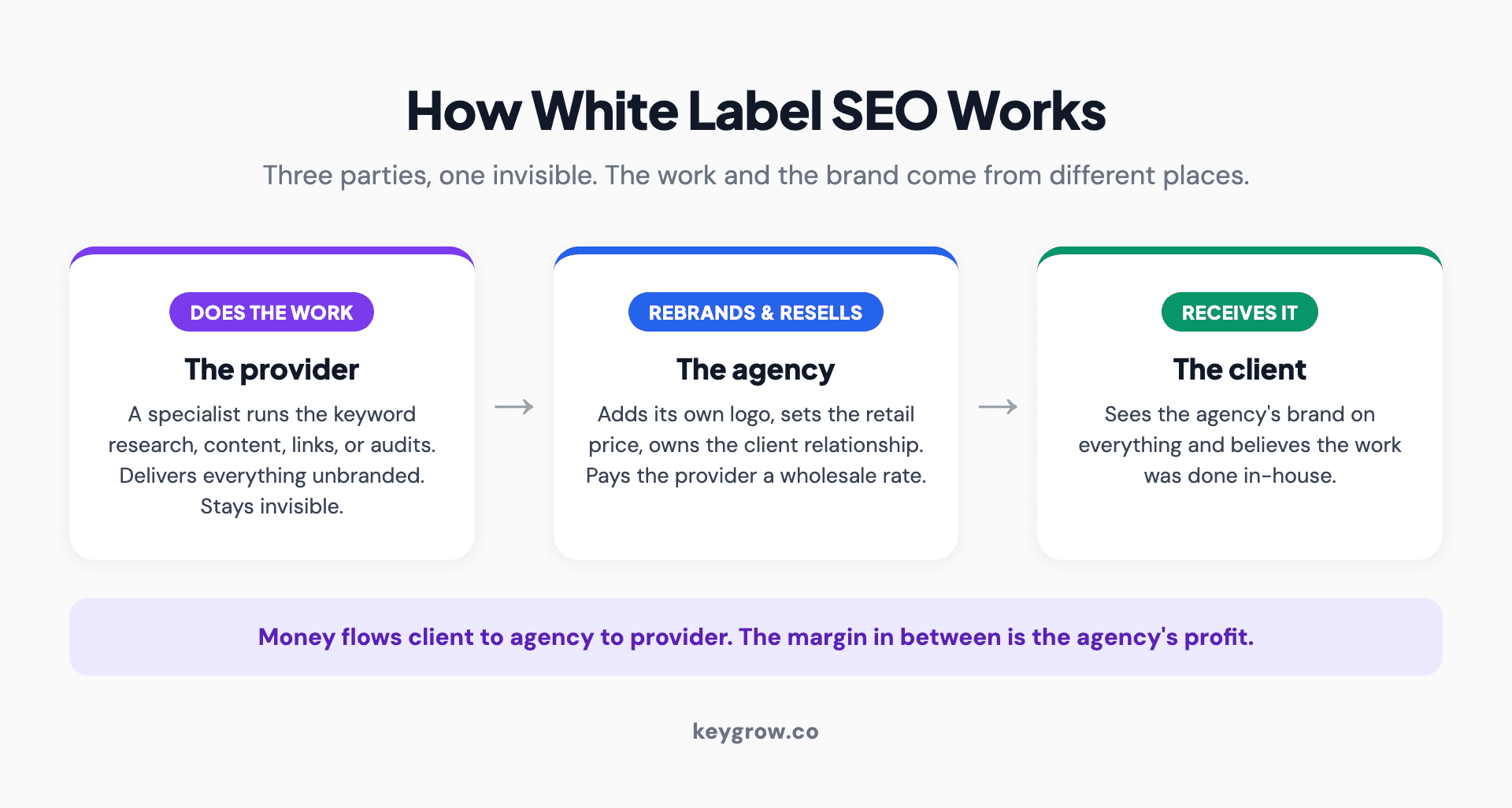
Flow infographic of the three-party white label SEO model: the white label provider does the work, the agency rebrands it and owns the client relationship, and the end client receives it as the agency's in-house service.
The agency signs the client and sets the retail price. It then pays the provider a wholesale rate to do some or all of the actual work. The provider delivers everything unbranded, reports, audits, content, so the agency can drop its own logo on top before passing it along. The client pays the agency, the agency pays the provider, and the margin in between is the agency's profit.
Communication usually runs through the agency, not directly between provider and client. Good arrangements have the provider available on calls as a "senior specialist" when needed; weaker ones leave the agency relaying messages it does not fully understand. That gap, between the people doing the work and the people explaining it, is where white label SEO either works quietly or falls apart.
White label vs reseller vs private label vs referral vs in-house
The difference is control. White label, reseller, and private label all hide the provider from the client; referral and in-house do not. Who owns the brand, the price, and the relationship is what separates them.
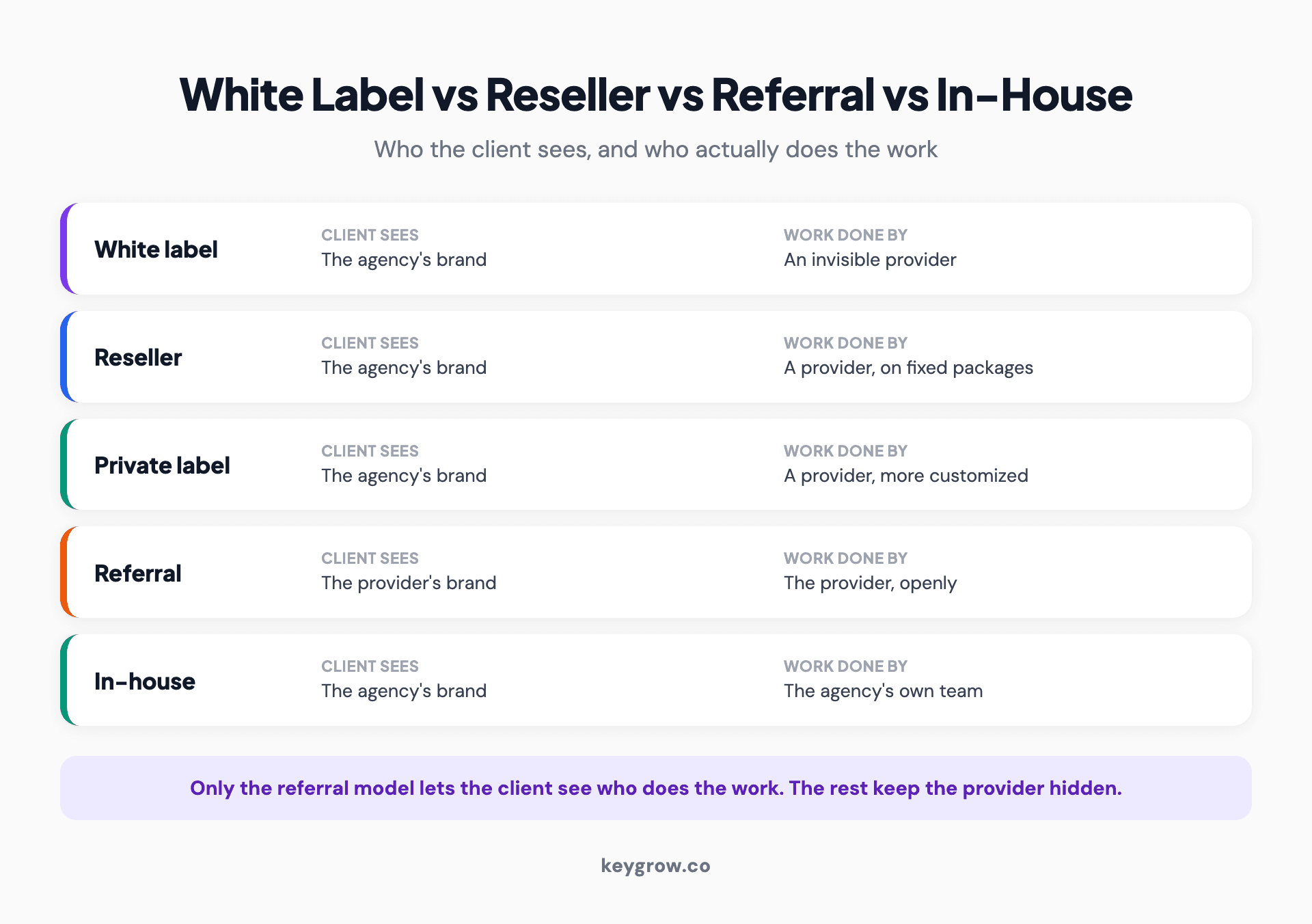
Five-card infographic comparing the SEO delivery models: white label, reseller, private label, referral partnership, and in-house, by who owns the client, who sets the price, and how much control the agency keeps.
| Model | Who the client sees | Who does the work | Agency control |
|---|---|---|---|
| White label | The agency's brand | An invisible provider | Owns price and relationship, not the work |
| Reseller | The agency's brand | A provider, on set packages | Less pricing freedom; buys fixed tiers |
| Private label | The agency's brand | A provider, often more customized | Similar to white label, deeper integration |
| Referral | The provider's brand | The provider | Hands off the client for a commission |
| In-house | The agency's brand | The agency's own team | Full control of work, price, and quality |
In practice "white label" and "reseller" are used loosely for the same thing. The sharp line is the referral model: there, you send the client to the provider and step back, so the client knows exactly who is doing the work. Every other model keeps the provider hidden.
Which SEO services get white-labeled?
Almost any deliverable can be outsourced: keyword research, content writing, link building, technical audits, on-page work, local SEO, and reporting. The judgment is which to hand off and which to keep close.
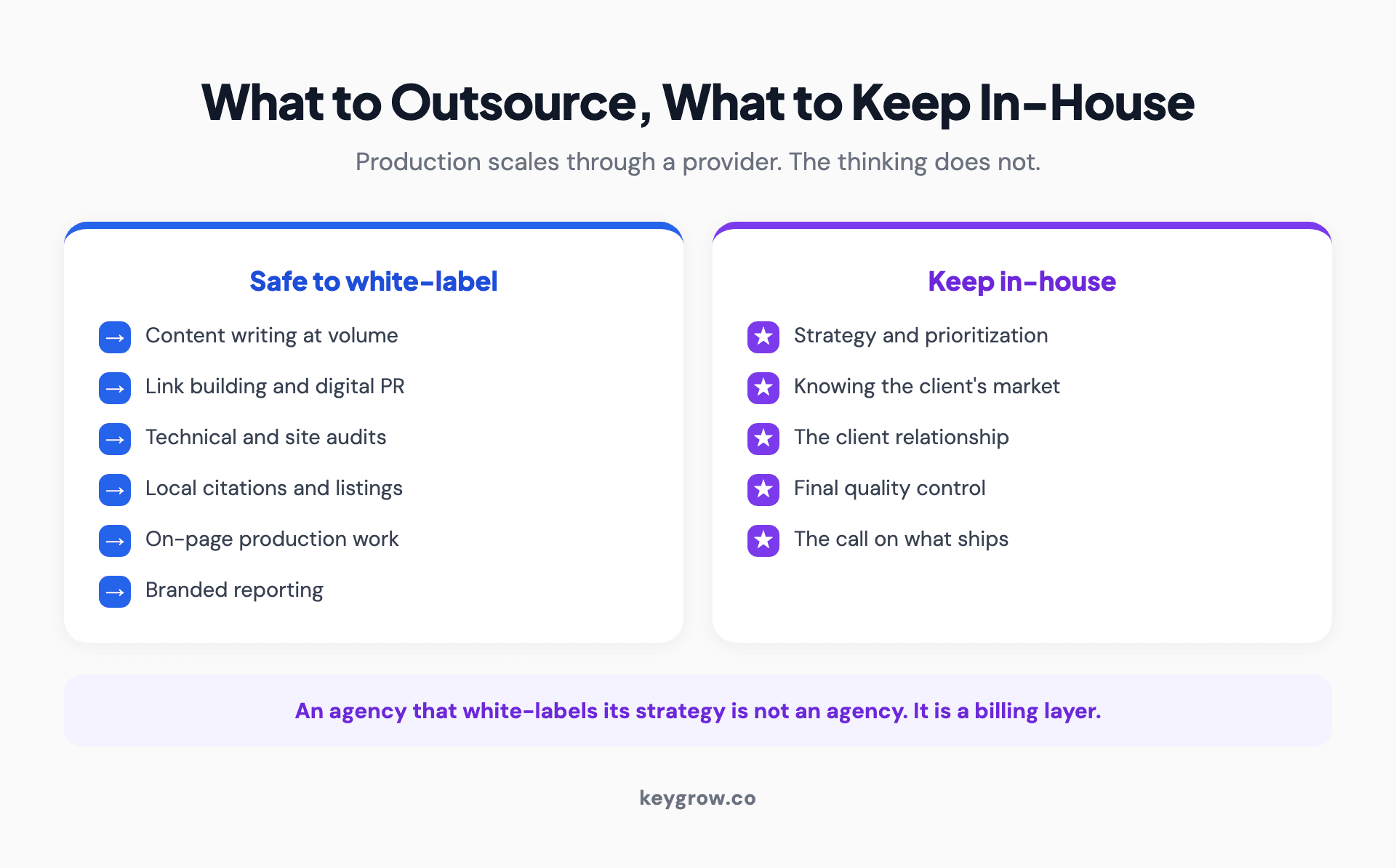
Two-column infographic of white label SEO: services commonly outsourced (content writing, link building, technical audits, local citations, reporting) versus what an agency should keep in-house (strategy, client communication, and final quality control).
The work that scales well through a provider is the production-heavy, repeatable kind: bulk content, link building, citation building, and audits. Newer providers also resell AI search work now, the answer engine optimization that gets a client cited in AI Overviews and ChatGPT, since few small agencies have that skill in-house yet.
What should not be outsourced is the thinking and the relationship: strategy, knowing the client's market, and the final read on whether a deliverable is good enough to ship. An agency that white-labels its strategy is no longer an agency. It is a billing layer.
What about AI search? The newest white-label category
AI search visibility is the fastest-growing thing being white-labeled right now, because demand for it outran most agencies' ability to do it. Getting a client cited in AI Overviews, ChatGPT, and Perplexity is a different skill from classic ranking, and providers that have it are reselling it hard.
This is a genuine reason an agency might white-label in 2026 rather than a lazy one. If your team has never structured a page for answer-engine citation or tracked whether a brand shows up in AI answers, partnering with a provider who has is more honest than guessing on a client's budget. The caveat is the same as everywhere else: you still own the strategy and the quality check. Reselling AI search monitoring you do not understand means you cannot tell your client whether it is working, which defeats the point of offering it.
The reporting matters more here too. AI visibility does not show up in a standard rankings dashboard, so the provider has to give you branded reports a client can read, showing citations and share of voice in AI answers, not just blue-link positions. If a provider reselling AI work cannot report on AI outcomes, they are selling the label without the substance.
How do agencies make money on white label SEO?
Markup. The agency buys at a wholesale rate and sells at retail, and the spread is the profit. Markups of roughly 100 percent are common, which works out to about a 50 percent margin.
| Example monthly numbers | |
|---|---|
| Agency charges the client | $2,000 |
| Agency pays the provider | $1,000 |
| Agency keeps | $1,000 (50 percent margin) |
That margin pays for the client relationship, the strategy, the account management, and the quality control the agency is supposed to add. When an agency adds all of that, the markup is fair: it is doing real work. When it adds none of it and just forwards the provider's report, the client is paying a 100 percent markup for a logo swap. The model is honest. The laziest version of it is a logo and an invoice.
If you run an agency yourself and want to see what those two numbers look like in practice, our white label SEO partner rates and the resale bands that go with them are published on the page rather than held back for a sales call.

Person presenting performance charts to colleagues, the branded reporting an agency hands a client whether the work was done in-house or by a white label provider.
There is a real market behind this. The global SEO services market was worth about $81.46 billion in 2024 and is projected to reach $171.77 billion by 2030 (MarkNtel Advisors), and a large share of it is delivered through arrangements the end client never sees.
How do you vet a white label provider?
Check their own results first, then their communication, turnaround, and contract terms. You are about to put your name on their work, so their quality becomes your reputation.
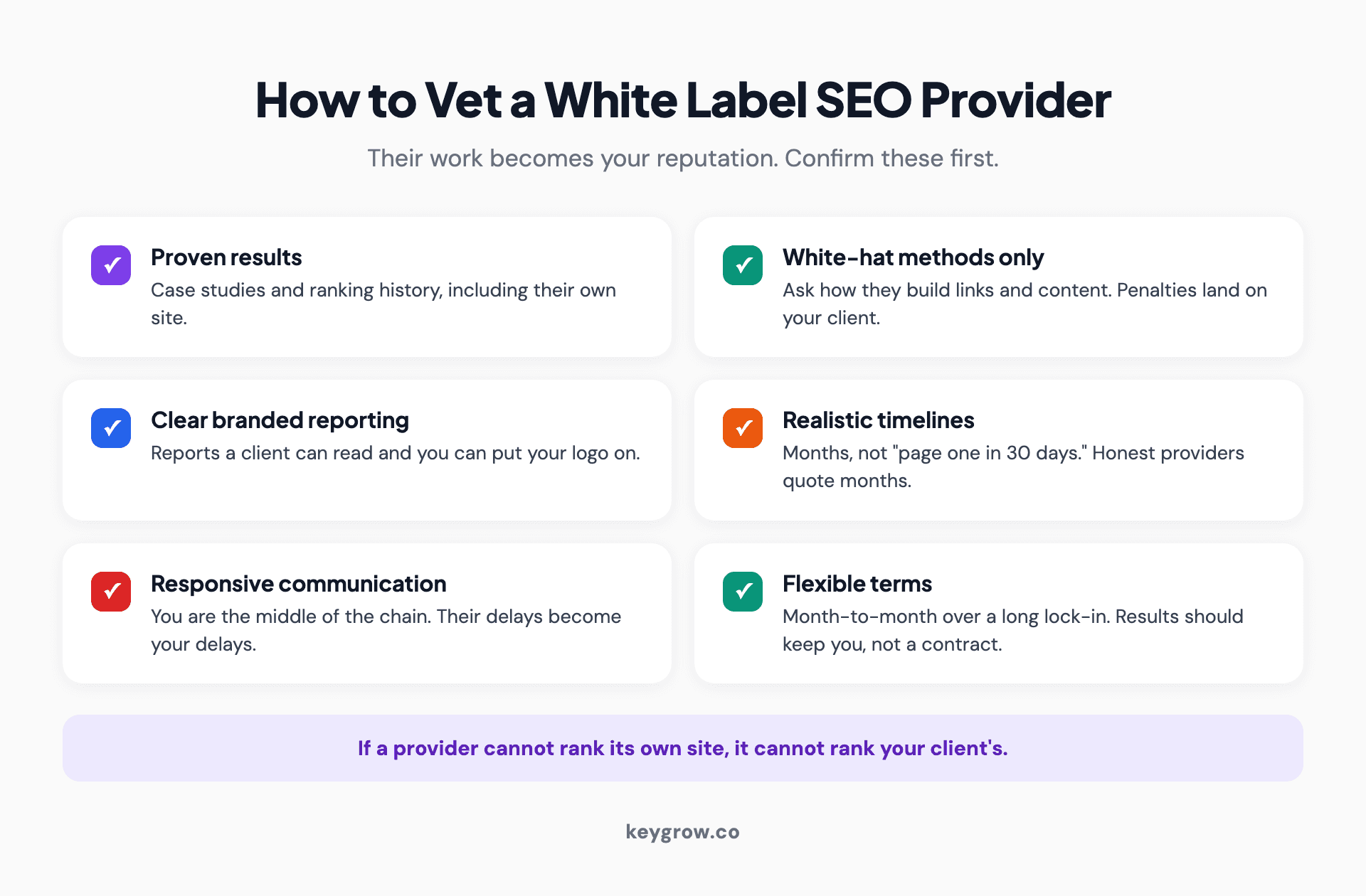
Checklist infographic for vetting a white label SEO provider: proven results on their own and client sites, white-hat methods, clear reporting, realistic timelines, responsive communication, and month-to-month contract terms.
Six things worth confirming before you resell anyone's work:
- Proven results. Ask for case studies and the ranking history of sites they have worked on, including their own. A provider that cannot rank its own site is a warning.
- White-hat methods only. Ask directly how they build links and content. Bought links and spun content can earn a penalty that lands on your client's site and your reputation.
- Clear, branded reporting. You need reports you can put your logo on that a client can understand, not a data dump.
- Realistic timelines. A provider promising page one in 30 days is one you will be apologizing for in 60. Honest providers quote months.
- Responsive communication. You are the middle of the chain. Slow replies from the provider become slow replies to your client.
- Flexible terms. Month-to-month beats a long lock-in. If the provider needs a year-long contract to keep your business, ask why their results do not.
Is white label SEO a problem for the business buying it?
Not by default, but it is worth knowing about. The risk is a middleman with no control reselling work it cannot see, judge, or fix.
If you run a single-location business and you only need the basics, a clean Google Business Profile and a handful of citations, you may not need an agency at all, let alone the white-label provider behind it. Do that yourself first and keep the markup.
Here is the honest question every business owner should ask any agency before signing: who actually does the work, and can I talk to them? A good agency answers plainly, whether the work is in-house or through a trusted partner. An agency that gets cagey is telling you it is a billing layer with a markup.
This is worth asking because outsourcing is the norm, not the exception. In one survey of small business leaders, marketing was the service they were most likely to hire out, sought by 27 percent (Clutch), and a chunk of that hired-out marketing is agencies quietly reselling each other's work. The odds that your "agency" is a layer over a provider are real, so the question is fair. You are not being rude. You are being a careful buyer of a channel BrightEdge measured at 53 percent of trackable traffic from organic search alone.
White label is fine when the agency adds genuine strategy, knows your market, and stands behind the work. It is a problem when the agency is a phone number forwarding a stranger's report. The model does not decide which one you got. The agency does.
What results should a white label arrangement produce?
The same results good SEO always produces, on the same timeline, because white label changes who does the work, not how search engines rank pages. Expect months, not weeks.
Resold or in-house, the honest markers are identical: indexation and impressions early, rankings and organic traffic over months, leads and revenue as the lagging proof. If you are an agency reselling SEO, you still have to defend the results to your client, which means knowing how to tell whether the SEO is working versus whether the provider is just busy. The fact that a third party did the work does not change what counts as working.
A real estate office we worked with reached more than 90 monthly phone calls in about seven months of local SEO, starting from almost none. A white-label provider could have done that same work, but nothing about outsourcing it would have made seven months into two. The timeline belongs to the search engines, not to whoever you hired.
FAQs
What is white label SEO in simple terms?
It is SEO done by one company and sold by another under its own brand. A specialist provider does the work, an agency puts its logo on it, and the end client believes the agency did it in-house. The provider stays invisible by design.
What is the difference between white label and reseller SEO?
In practice they describe the same hidden-provider model and are often used interchangeably. If there is a distinction, reseller usually means buying fixed packages at set prices, while white label can be more flexible. Both keep the provider invisible to the client, unlike a referral partnership, where the client knows who is doing the work.
How much does white label SEO cost and how much can an agency mark it up?
Wholesale rates vary widely by scope, and markups of around 100 percent are common, leaving the agency roughly a 50 percent margin. That margin is meant to pay for strategy, account management, and quality control. A markup with none of that added is just a logo swap the client overpays for.
What SEO services should stay in-house instead of being white-labeled?
Strategy, client communication, and final quality control. Production work like content, links, audits, and citations scales well through a provider, but the thinking and the relationship are what an agency is being paid for. Outsource those and the agency is just a markup.
Is white label SEO white hat and safe?
It can be, but only if the provider uses legitimate methods. Bought links, spun content, and manipulative tactics can trigger a Google penalty that lands on your client's site and your reputation. Always confirm how a provider builds links and content before reselling their work.
How do I know if my agency is white-labeling my SEO?
Ask directly: who does the work, and can I speak with them? Reselling is common and not inherently bad, so a good agency answers without hesitation. Vagueness is the signal that you are paying a markup for a middleman who may not control the quality.
The short version
The model does not decide whether you got a good deal. The agency does. White label SEO is fine when the agency adds real strategy and quality control on top of the markup, and it is overpriced theater when it does not. For business owners, that turns the whole question into one you can ask out loud before signing: who does the work here, and can I speak with them?
If you would rather work with a team that answers that question plainly and treats SEO as a months-long build, not a logo swap, our SEO service is built that way. Tell us about your business and we will tell you honestly what it will take.