


How can an AI search monitoring platform improve your SEO strategy? By showing you the half of search your rank tracker can't see: whether ChatGPT, Google's AI Overviews, and the other answer engines mention you, cite you, or hand your customers to a competitor. With that data you catch visibility losses early, learn the real questions buyers ask, and fix the exact pages AI reads but refuses to quote.
Here's the uncomfortable bit. Your rank tracker can say position 3 all year while your phone goes quiet, because a growing share of searches now end inside an AI answer that never sends a click. Both things can be true at once.
This guide explains what these platforms track, six specific ways the data sharpens your strategy, and an honest answer to whether you need a paid one yet.
What is an AI search monitoring platform?
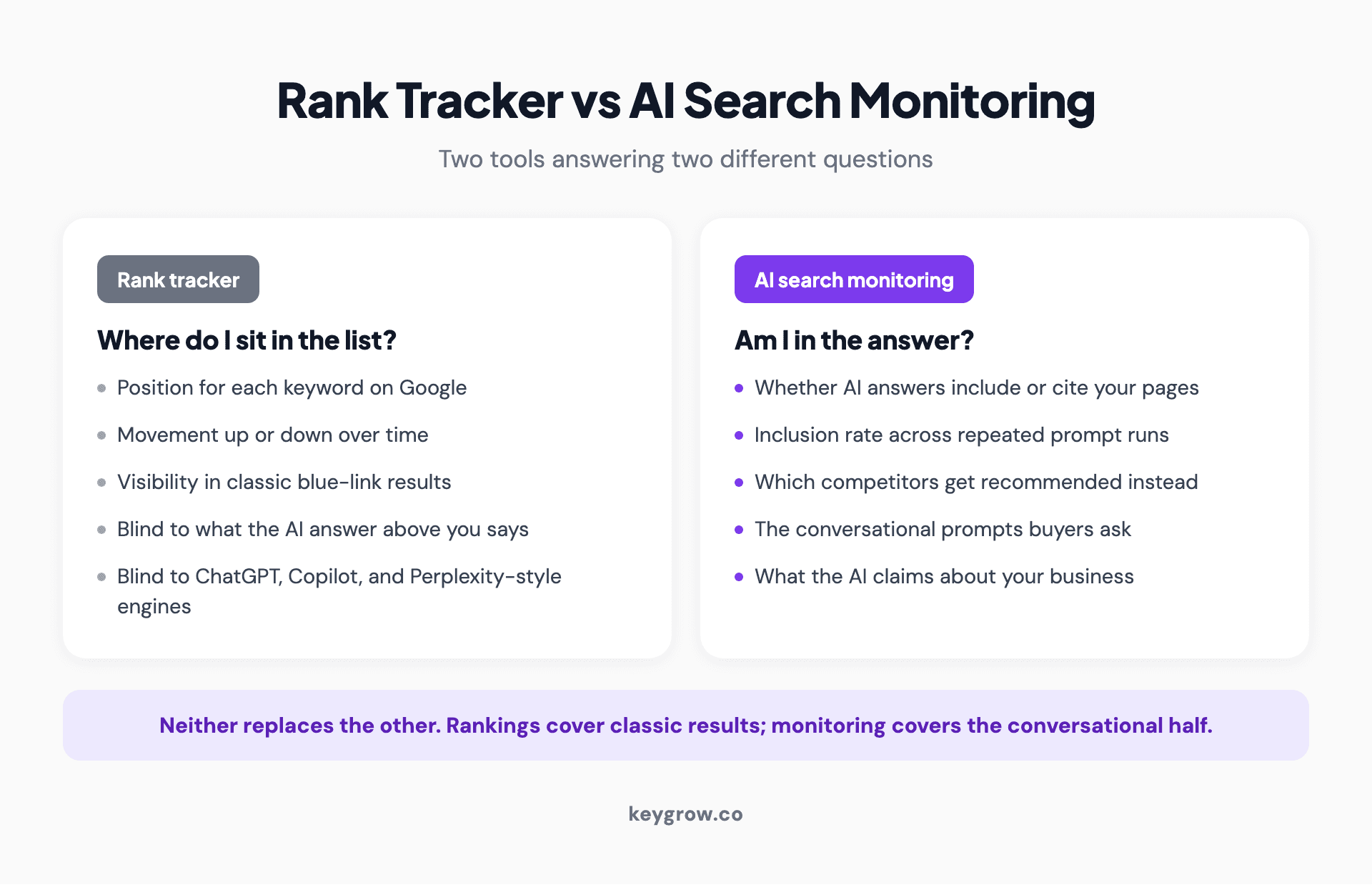
Comparison of a traditional rank tracker and an AI search monitoring platform across what they watch, measure, and miss.
An AI search monitoring platform tracks how AI-driven search surfaces, like ChatGPT, Google AI Overviews, Perplexity-style engines, and Copilot, mention and cite your brand across the prompts your customers ask.
A rank tracker answers one question: where does my page sit for this keyword on Google. An AI monitoring platform answers a different set: does the AI answer for this question include us, does it cite our page or just paraphrase it, who gets named instead of us, and is that changing week to week.
The two overlap less than you'd think:
| What you want to know | Rank tracker | AI search monitoring |
|---|---|---|
| Position for a keyword on Google | Yes | Sometimes |
| Whether an AI Overview answers the query before your listing | No | Yes |
| Whether ChatGPT cites you as a source | No | Yes |
| Which competitors AI engines recommend | No | Yes |
| Which prompts and follow-up questions buyers ask | No | Yes |
| Why a page gets read but never quoted | No | Partially (with analysis) |
Neither replaces the other. Rankings still matter where classic results still show. The monitoring platform covers the part of the journey that's gone conversational.
Why can't your rank tracker see AI search?

Computer monitor showing data and code, representing the AI search activity that traditional rank trackers cannot measure.
Because the answers aren't a ranked list anymore. An AI engine retrieves a pool of candidate pages, reads them, and synthesizes one reply that cites a handful of winners. ChatGPT cites only about 15 percent of the pages it retrieves. There is no position 7 to fall back on. You're quoted or you're invisible.
That creates a failure mode rank trackers were never built for: silent exclusion. Your rankings hold, your traffic erodes anyway, and nothing in your dashboard explains why, because the AI answer above the results is quietly satisfying the searcher, with or without you in it.
You can see the early symptoms today without any new software. Open Google Search Console and look at your informational queries: when impressions hold steady while click-through rate slides quarter after quarter, an AI answer is usually absorbing the clicks above you. Google's own documentation on how AI features appear in Search confirms the mechanics; what it doesn't show you is who the AI chose instead. That missing piece is the monitoring platform's job.
It gets worse across engines. ChatGPT search runs on Bing's index, overlapping Bing's top results roughly 73 to 87 percent of the time, so a site that ignored Bing has been invisible in a channel it never measured. Each engine pulls from different sources and updates at a different rhythm. One dashboard watching Google positions covers none of it.
What does an AI search monitoring platform track?
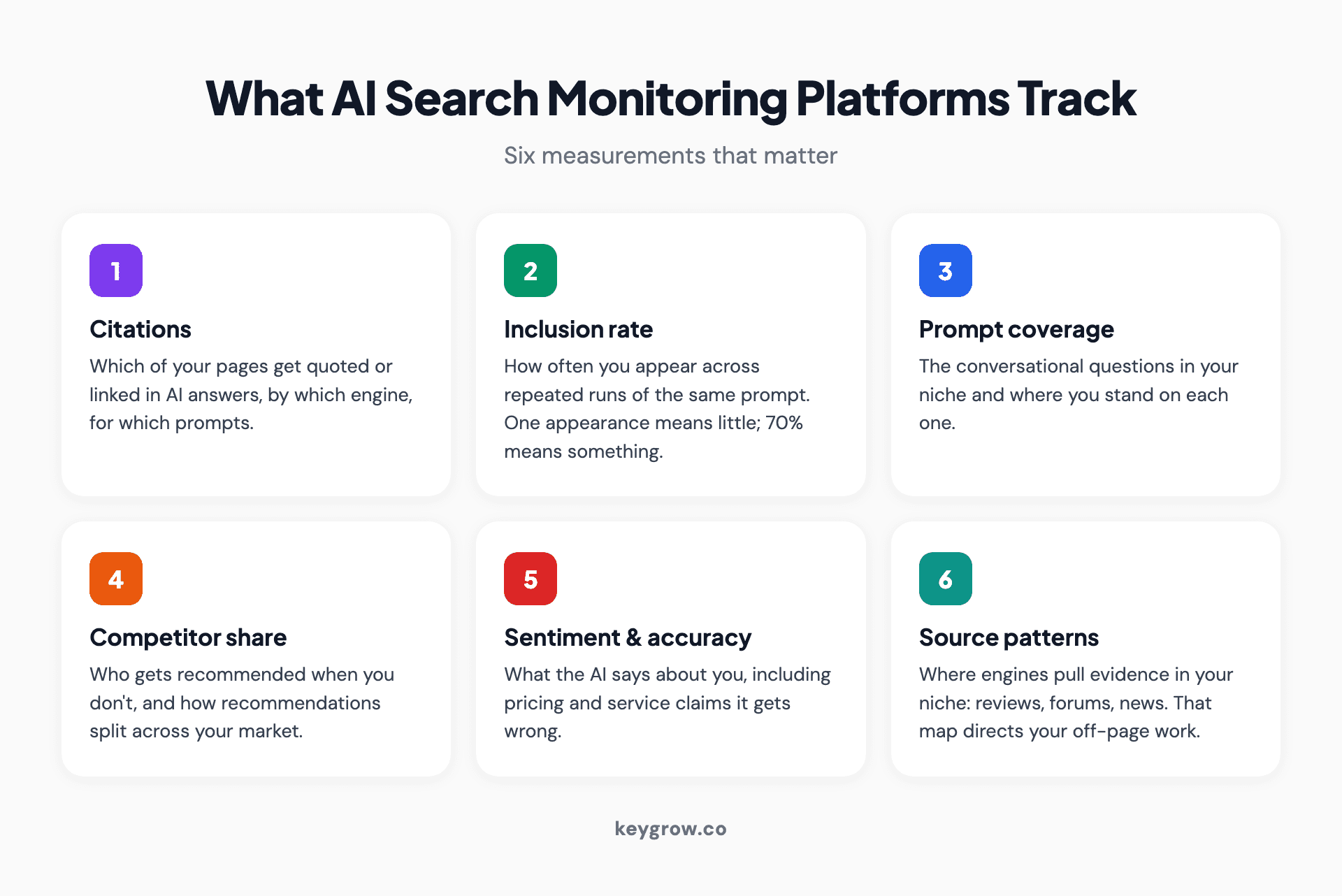
Icon grid of the six core metrics AI search monitoring platforms track: citations, inclusion rate, prompt coverage, competitor share, sentiment, and source patterns.
Under the hood, most platforms work the same way: they run a panel of prompts on a schedule, across several engines, multiple times per prompt, then log who appeared, who got cited, and how the answer was worded. The repetition matters. AI answers vary run to run, so a single check tells you almost nothing; a hundred runs tell you your odds.
The platforms vary, but the useful ones converge on six measurements:
- Citations. Which of your pages get quoted or linked in AI answers, by which engine, for which prompts.
- Inclusion rate. How often you appear across repeated runs of the same prompt. AI answers are probabilistic; one appearance means little, a 70 percent inclusion rate means something.
- Prompt coverage. The conversational questions in your niche ("who is the best junk removal company near me", "is SEO worth it for a small law firm") and where you stand on each.
- Competitor share. Who gets recommended when you don't, and how the share of recommendations splits across your market.
- Sentiment and accuracy. What the AI says about you when it does mention you, including pricing claims and service descriptions it gets wrong.
- Source patterns. Where the engines pull their evidence from in your niche: review platforms, forums, news, directories. This tells you where your off-page effort should go.
If a platform can't show you at least citations, inclusion rate, and competitor share, it's a novelty, not a monitoring tool.
6 ways the monitoring data improves your SEO strategy
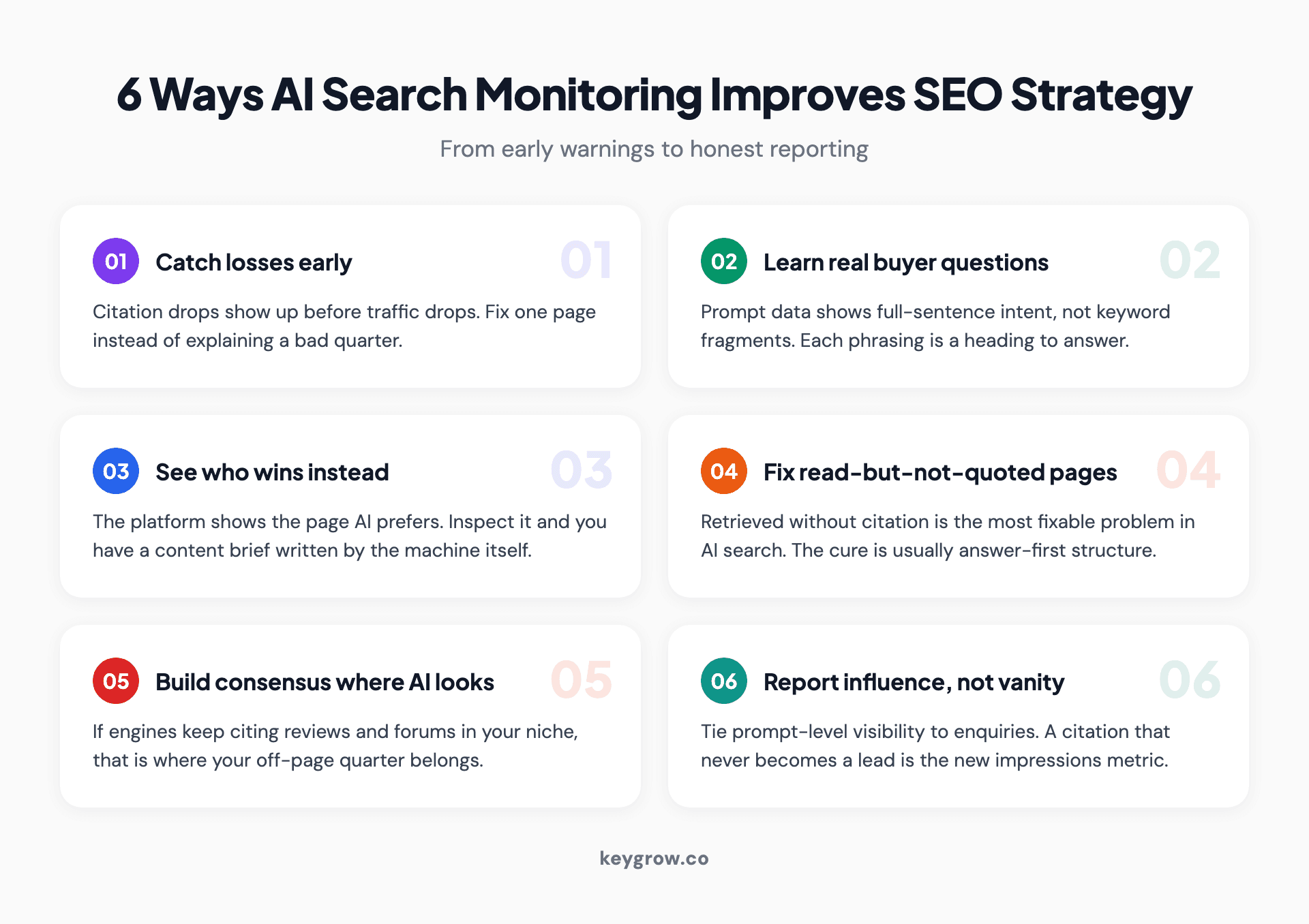
Six-card layout of the ways AI search monitoring data improves an SEO strategy, from early-warning signals to influence reporting.
1. You catch visibility loss before traffic loss. Citation drops show up days or weeks before the analytics dip, because inclusion erodes prompt by prompt. That head start is the difference between fixing one page and explaining a bad quarter.
2. You learn the questions customers actually ask. Keyword tools show fragments ("seo cost"). Prompt data shows intent in full sentences ("how much should a dentist pay for SEO each month"). Each phrasing your buyers use is a section heading your content should answer directly.
3. You see who gets cited instead of you, and why. When the same competitor keeps winning a prompt, the platform shows you the page the AI prefers. Usually the reason is visible on inspection: a cleaner direct answer, fresher numbers, or better-structured comparisons. A dental client asking why a rival owned "how much do veneers cost" prompts would find the rival's page opens with a price table dated this year. That's your content brief, written by the machine you're trying to convince.
4. You find pages AI reads but never quotes. Retrieval without citation is the most fixable problem in AI search. The page is in the pool; it's just losing the final cut. The fix is usually structural: put a 20-to-25-word direct answer under the heading, tighten sections, add the data tables AI loves to lift. Our guide to optimizing your website for ChatGPT walks through that structure.
5. You learn where the engines look for consensus, then build presence there. If the AI keeps citing review platforms and forum threads in your niche, that's where your next quarter of off-page work belongs. Most of those placements are nofollow links, and they still feed AI recommendations; we covered why in do nofollow links help SEO.
6. You report influence, not vanity numbers. Three of our local clients measure marketing in phone calls: 115+, 90+, and 50+ calls a month respectively after their campaigns matured. AI visibility deserves the same discipline. An AI citation count that never becomes an enquiry is the new impressions metric. Tie prompt-level visibility to the leads it produces, and the platform pays for itself or tells you it shouldn't exist.
How do you turn the data into fixes?
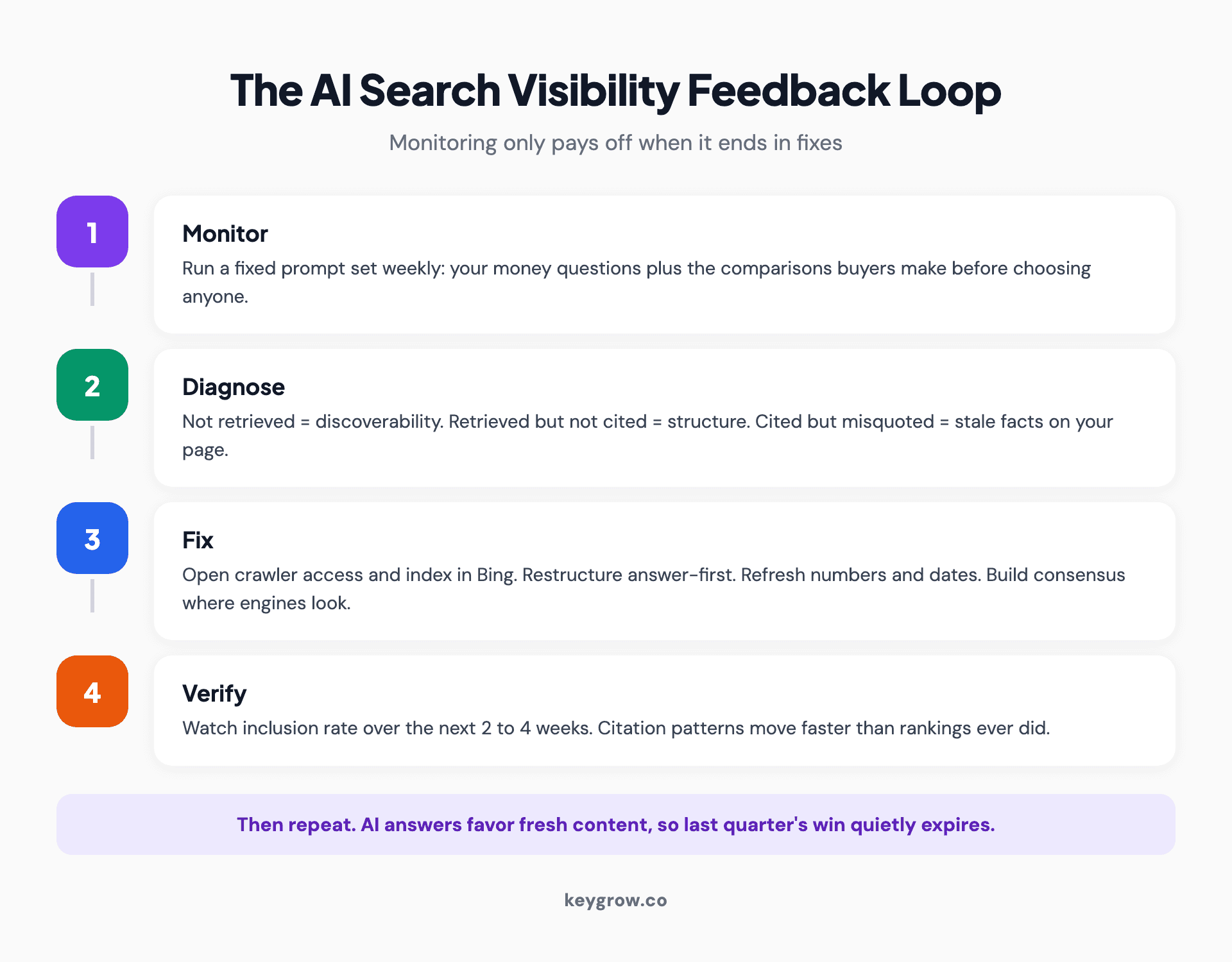
Four-step feedback loop for acting on AI search monitoring data: monitor prompts, diagnose losses, fix structure and consensus, verify inclusion improves.
Monitoring without action is an expensive scoreboard. The loop that works:
- Monitor a fixed prompt set weekly: your money questions, plus the comparisons buyers ask before choosing anyone.
- Diagnose each loss. Not retrieved at all means a discoverability problem (crawler access, Bing indexing, weak authority). Retrieved but not cited means structure. Cited but misquoted means stale or unclear facts on your page.
- Fix in that order: open the crawler gates and submit your sitemap through Bing Webmaster Tools; restructure with answer-first sections; refresh the numbers and dates; add an llms.txt file (our free llms.txt generator builds one in minutes); then build the off-page consensus the engines keep checking.
- Verify the inclusion rate over the next two to four weeks. Citation patterns move faster than rankings ever did, and research from Princeton and Georgia Tech found that adding clear statistics raised AI-answer visibility by around 40 percent, so wins are measurable quickly.
Then the loop repeats. AI answers lean fresh, roughly 25 percent fresher than classic results, so a page that won a prompt in January can lose it by June without anyone touching anything.
What mistakes should you avoid with AI search monitoring?
The tooling is new and the habits around it are worse. Four mistakes show up constantly:
- Calling one appearance a win. AI answers change between runs. If you checked once and you were cited, you know nothing yet. Judge inclusion rates over repeated runs, not screenshots.
- Monitoring without a fixed prompt set. Ad-hoc checking produces no baseline, and without a baseline there is no trend. Lock the prompt list first, then let it run untouched long enough to mean something.
- Paying to watch engines you've blocked. We've seen robots.txt files that block every AI crawler sitting next to an invoice for AI visibility software. If OAI-SearchBot can't read your site, the platform is just documenting your absence.
- Weighting every engine equally. A local service business lives and dies on Google's AI Overviews and ChatGPT. A developer tool might care more about other engines entirely. Monitor where your buyers are, not everything the dashboard offers.
Do you need a paid platform yet?
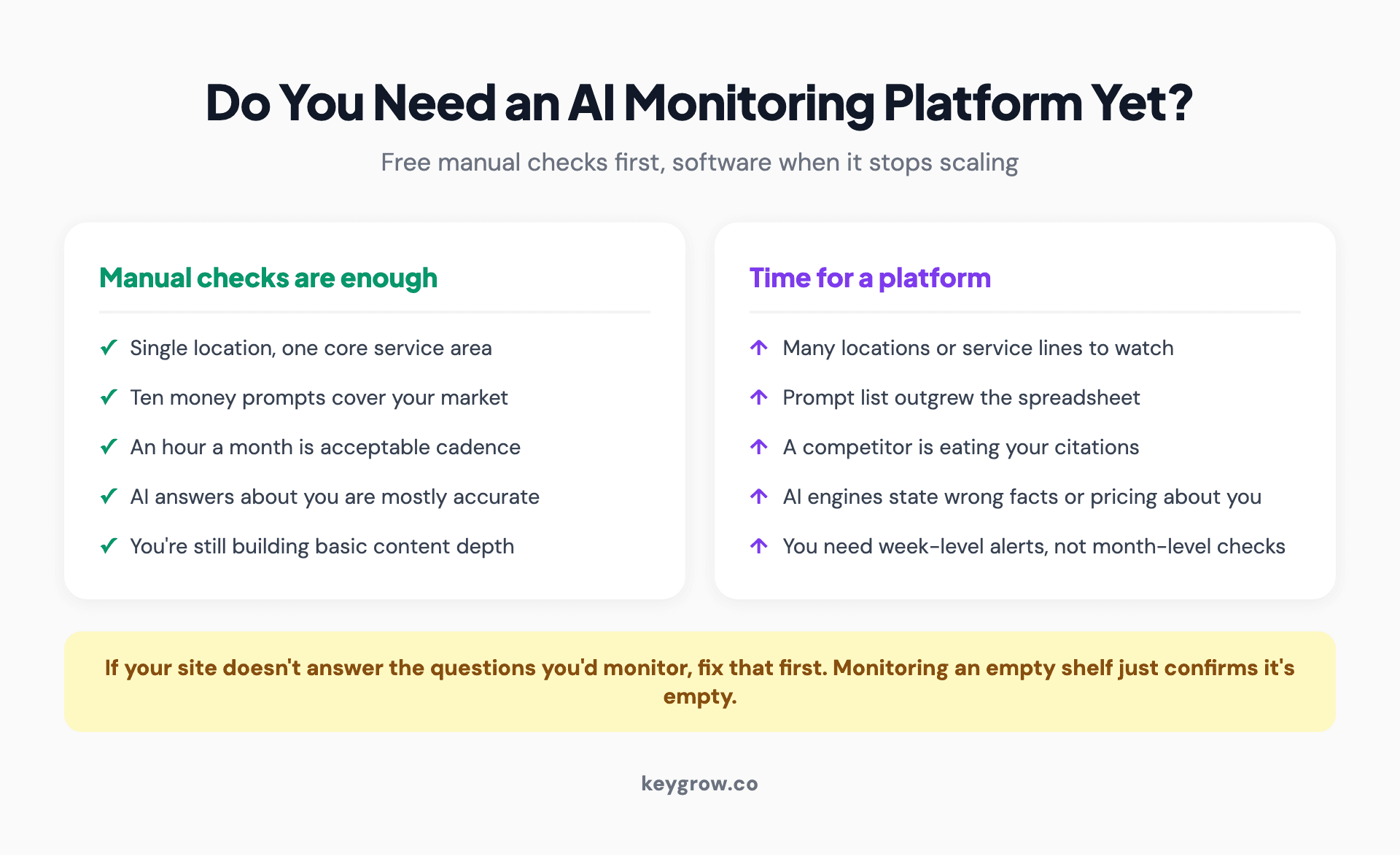
Checklist comparing when manual AI visibility checks are enough versus the signals that justify paying for an AI search monitoring platform.
Honest answer: maybe not yet. A single-location business can baseline AI visibility manually in an hour a month, free.
The manual version: write down the ten questions a customer would ask an AI before hiring you. For a junk removal company that looks like "who is the best junk removal company in [city]", "how much does it cost to clear a garage", "junk removal vs dumpster rental", and "is same-day junk removal worth it". Ask them in ChatGPT, Google (watch the AI Overview), and one more engine. Note who gets named, who gets cited, and whether anything said about you is wrong. Check Bing Webmaster Tools while you're at it, since ChatGPT search leans on Bing's index. Repeat monthly and you'll spot the big shifts.
Pay for a platform when the manual version stops scaling: you compete across many locations or service lines, the prompt list grows past what a spreadsheet handles, a competitor starts eating your citations, or AI answers are visibly wrong about your pricing and you need to catch it the week it happens rather than the month after.
And if your site doesn't yet answer the questions you'd be monitoring, fix that first. Monitoring an empty shelf just tells you it's empty, more precisely, every week.

Marketing team reviewing performance data in a meeting, deciding how to act on AI search visibility findings.
FAQs
What is an AI search monitoring platform?
Software that tracks whether AI search engines like ChatGPT, Google AI Overviews, and Copilot mention or cite your brand across the prompts your customers ask. It measures citations, inclusion rates, competitor share, and what the AI says about you when it answers.
How is it different from a rank tracker?
A rank tracker reports your position in a ranked list of results. AI engines don't produce ranked lists; they synthesize one answer and cite a few sources. Monitoring platforms measure whether you're in that answer, which is a different question requiring different data.
Can AI Overviews reduce my traffic even if my rankings hold?
Yes. When an AI Overview answers the query above the results, many searchers never scroll to the listings. Your position is unchanged while your clicks fall. That gap is exactly what AI monitoring exists to catch.
Which AI visibility metrics matter most?
Citation count, inclusion rate (how consistently you appear for a repeated prompt), and competitor share of recommendations. Sentiment and accuracy matter as a risk check: an AI answer that misstates your pricing costs you enquiries you never see.
Does AI search monitoring replace rank tracking?
No. Classic results still exist and still convert, so rankings remain worth watching. The monitoring platform covers the growing share of searches that end inside an AI answer. Serious teams run both and weight them by where their customers spend time.
Do small businesses need an AI monitoring platform?
Usually not at first. A monthly manual check of ten key prompts covers a single-location business fine. Upgrade when you have multiple locations, a competitive niche where citations swing weekly, or evidence that AI engines are getting facts about you wrong.
The bottom line on AI search monitoring
An AI search monitoring platform improves your SEO strategy the same way any good instrument improves a decision: it replaces guessing with seeing. You learn where you're invisible, who's winning instead, and which fix to make first, while your rank tracker keeps insisting everything is fine.
Start with the free manual baseline this month. If the results sting, that's what our answer engine optimization service is built for: we find the prompts that matter in your market, fix the pages losing them, and report it in enquiries, not impressions. Tell us about your business at keygrow.co/get-started and we'll tell you straight whether you need monitoring software or just better answers.