


How can I measure AEO success? With four instruments: a fixed library of prompts you test on a schedule, your citation rate across AI engines, AI referral traffic segmented in GA4, and one revenue proxy that connects citations to actual customers. The prompts you track come straight out of AEO keyword research. Setting up that ongoing monitoring is covered in how to track AEO. Everything else in AEO reporting is decoration on top of those four.
This post hands you the whole kit: the exact prompt-log columns, the current GA4 referrer list (most guides still teach a stale one), the variance rule that stops you from celebrating randomness, and the one attribution trick that closes the loop to revenue. Budget one to two hours a month. No paid tools required to start.
Why click metrics stopped telling the truth
The reason AEO needs its own measurement system: the searches that matter increasingly end without a click. In the first four months of 2026, 68 percent of US Google searches ended clickless, a share that climbed nearly 10 points in two years, per SparkToro's 2026 study. When an AI summary appears, only 8 percent of users click a traditional result, versus 15 percent without one, and just 1 percent click a source cited inside the summary, per Pew Research.
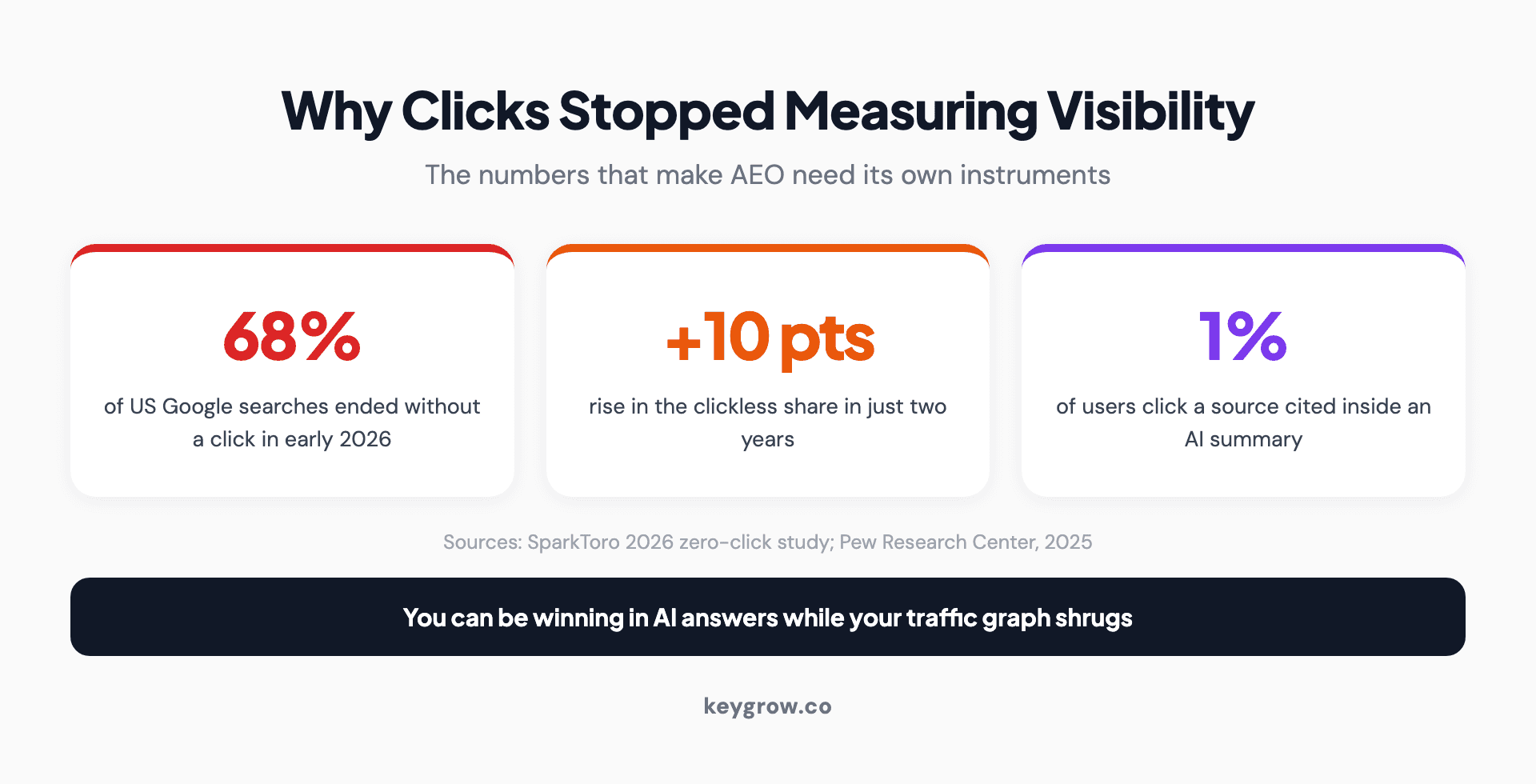
The zero-click reality behind AEO measurement: 68 percent of US Google searches ended without a click in early 2026, the clickless share climbed nearly 10 points in two years, and just 1 percent of users click a source cited inside an AI summary.
So a business can be winning in AI search while its organic traffic graph shrugs. Influence without clicks is real; it just needs different instruments to see. If AEO itself is new to you, start with our AI search guide and come back for the measurement layer.
The four instruments, in one view
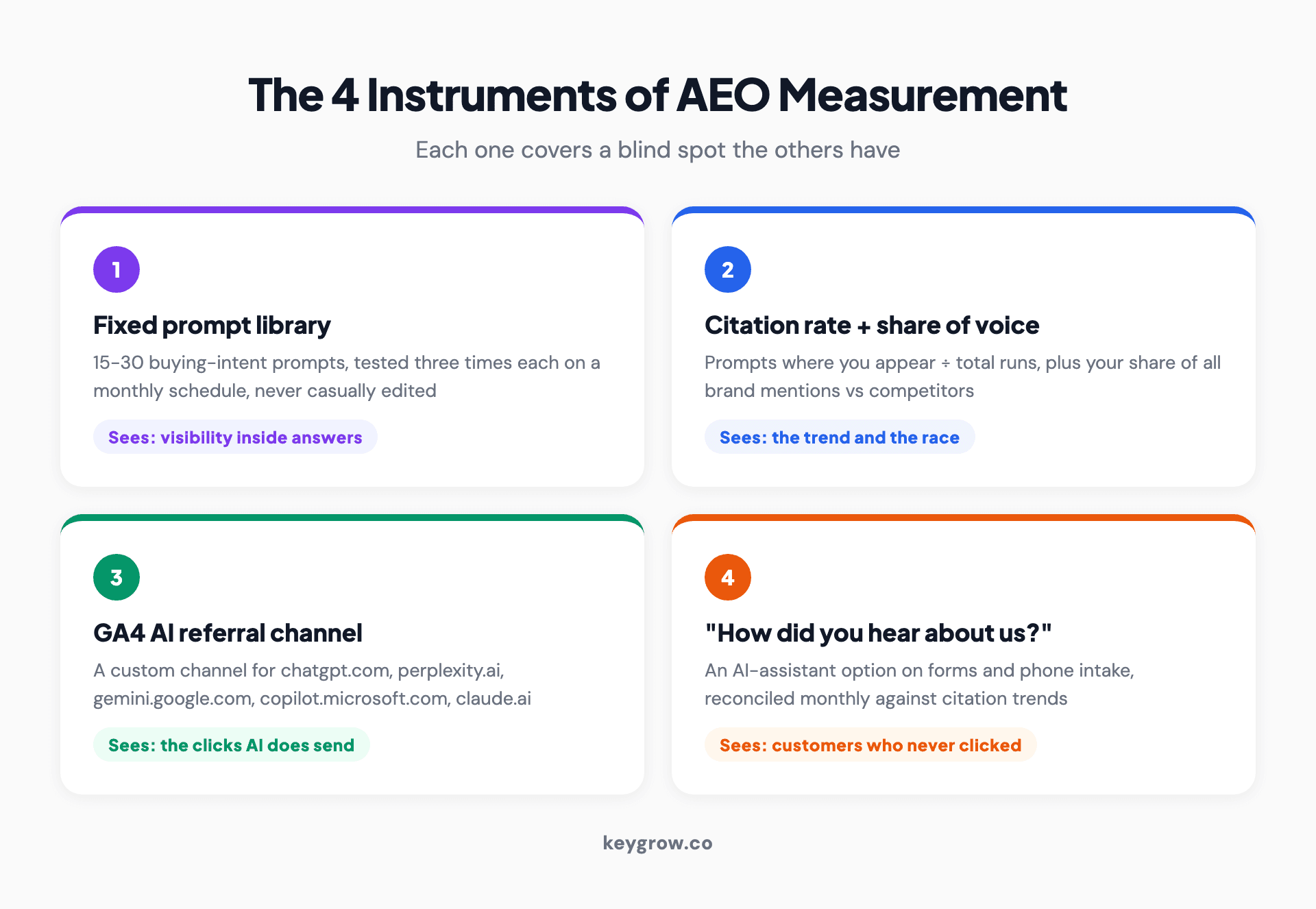
The four instruments for measuring AEO success: a fixed prompt library tested on a schedule, citation rate and share of voice across AI engines, AI referral traffic segmented in GA4, and a self-reported attribution question that ties citations to revenue.
Each instrument covers a blind spot the others have. The prompt library measures visibility you cannot see in analytics. Referral tracking measures the clicks AI does send. The attribution question catches the customers who never clicked anything. Together they turn "are we in the AI answers?" from a feeling into a monthly number.
Instrument 1: a fixed prompt library
Write 15 to 30 prompts a real customer would ask an assistant, weighted toward buying intent: "best junk removal company near Plano," "who should I hire to fix a burst pipe in Frisco," "is it worth paying for teeth whitening or doing it at home." Save them. Never edit them casually; a changed prompt resets that line of your history.
Then test them on a schedule against the engines your customers use: ChatGPT, Google's AI Overviews and AI Mode, Perplexity, Gemini, Copilot. Log every result in a sheet with these exact columns:
| Column | What goes in it |
|---|---|
| Prompt | the exact wording, never paraphrased |
| Engine | ChatGPT, AI Overviews, Perplexity, Gemini, Copilot |
| Date and run # | you will run each prompt more than once |
| Cited? | yes/no: were you mentioned or linked |
| Position | lead recommendation, listed among options, or footnote |
| Sentiment | 1-5: how accurately and favorably you were described |
| Competitors cited | who else showed up |
The variance rule most guides skip: AI answers are not deterministic. The same prompt can cite you Monday and skip you Wednesday. Run each prompt at least three times, on different days, in logged-out or private sessions, and score the citation rate across runs. A single-run change means nothing; a citation rate that moves more than about 10 points across a full three-run monthly cycle is signal.
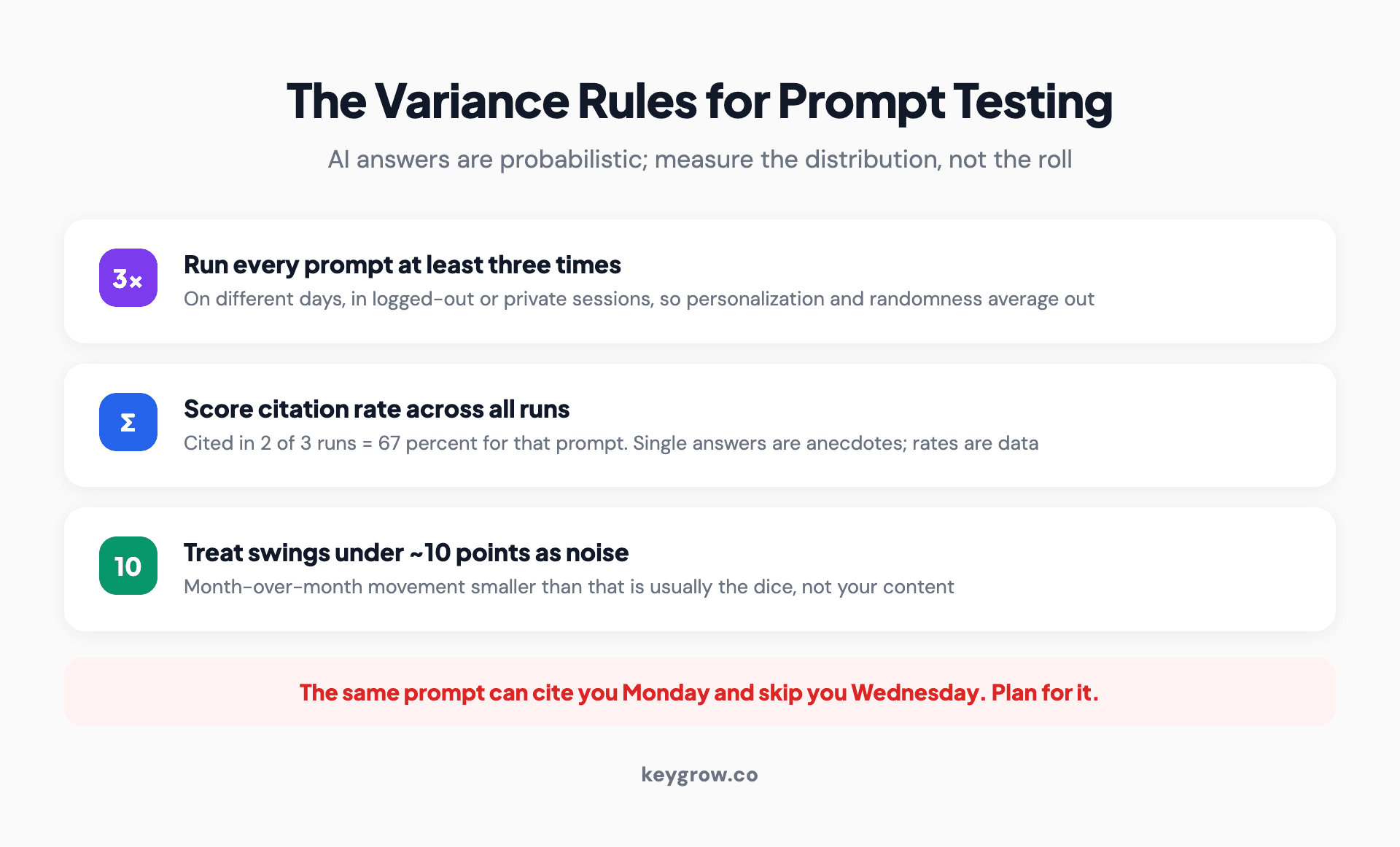
The prompt-testing variance rules for AEO measurement: run each prompt at least three times on different days in logged-out sessions, score citation rate across all runs rather than single answers, and treat a swing under roughly 10 points as noise.
Instrument 2: citation rate and share of voice
Citation rate is the core score: prompts where you appeared, divided by total prompt-runs, times 100. Track it monthly per engine. Share of voice is the competitive version: of all brand citations across your prompt library, what percentage were you versus each competitor.
Be skeptical of anyone selling you a universal benchmark; the honest answer is that "good" depends on your market's crowding. For scale, the most-cited US bank holds a 28.4 percent citation share across 31,500 banking prompts. In a local service market, being the lead recommendation in a third of your high-intent prompts usually means you are the market's answer, and most businesses start at or near zero.
Position and sentiment matter as much as the raw rate. Being the AI's first recommendation and being name-dropped twelfth in a list are different businesses. That is why the log has those columns.
The deeper play here is understanding what gets a page cited at all. The question changed from "how do I rank" to "how do I become the source." ChatGPT cites only about 15 percent of the pages it retrieves, and roughly 44 percent of citations come from the first third of a page, which is why answer-first structure is non-negotiable. We unpacked those mechanics in our ChatGPT optimization guide.
Instrument 3: AI referral traffic in GA4
AI engines do send clicks, and those clicks are unusually valuable: the average AI search visitor converts at 4.4 times the rate of a traditional organic visitor, per Semrush's traffic study. You just have to separate them from the noise.
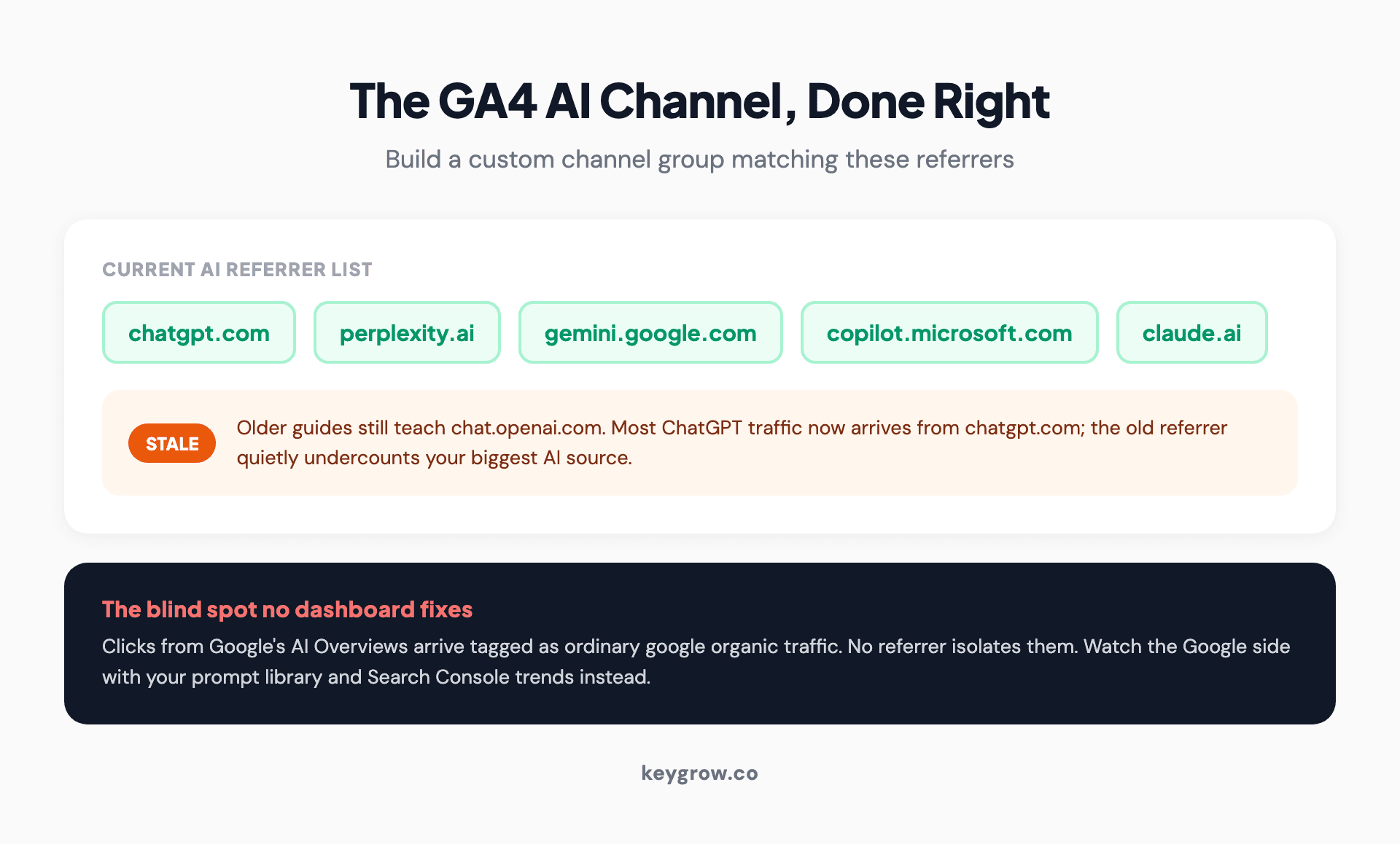
The current GA4 referrer list for tracking AI traffic: chatgpt.com, perplexity.ai, gemini.google.com, copilot.microsoft.com, and claude.ai, grouped into a custom AI channel, with the warning that older guides still list the stale chat.openai.com domain.
Build a custom channel group or exploration segment matching these referrers: chatgpt.com, perplexity.ai, gemini.google.com, copilot.microsoft.com, and claude.ai. Note the first one: most ChatGPT traffic now arrives from chatgpt.com, and guides still teaching the old chat.openai.com referrer quietly undercount the biggest AI source. Review the segment weekly; it takes five minutes.
Now the honest limitation, stated plainly because most articles will not: clicks from Google's AI Overviews arrive tagged as ordinary google organic traffic. There is no referrer that isolates them. Your GA4 AI channel measures chatbot referrals, not AI Overview influence; the prompt library and Search Console's impression trends are how you watch the Google side. More on that blind spot in our AI Overviews analysis.
Instrument 4: the revenue proxy nobody deploys
Add one option to the "How did you hear about us?" question on your forms and phone intake script: "ChatGPT or another AI assistant." That is the entire trick, and almost nobody does it.
It is imperfect, self-reported, and undercounted, and it is still the most direct line you will get between AI visibility and money, because it catches the customer who asked an assistant, got your name, and typed your URL without ever registering in a referral report. Reconcile it monthly against your citation-rate trend. When both climb together, you are looking at a channel, not a coincidence.
The monthly system, in one to two hours
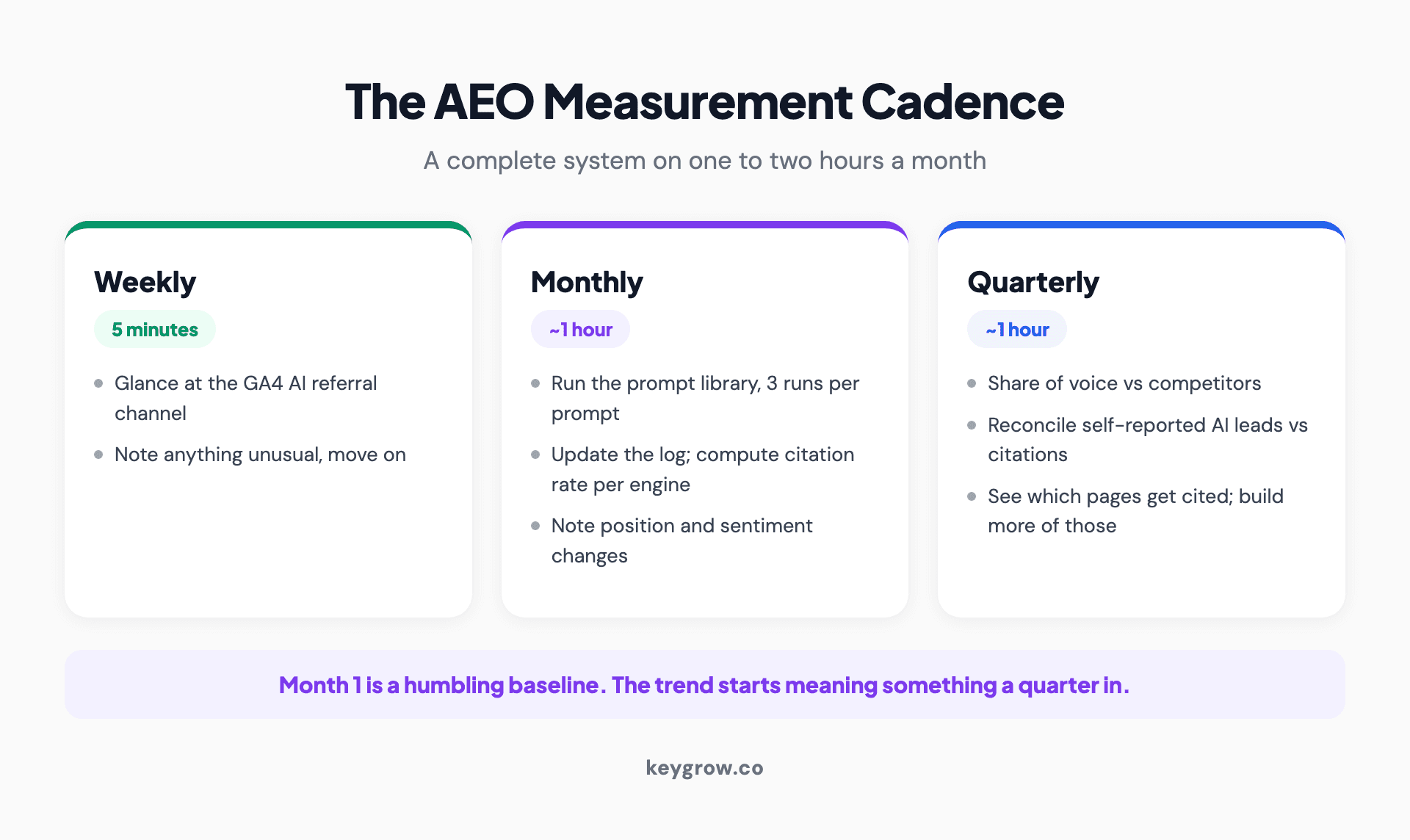
The monthly AEO measurement cadence: a five-minute weekly check of the GA4 AI channel, a monthly prompt-library audit of three runs per prompt with citation rate logged, and a quarterly review of trends, share of voice, and self-reported AI leads.
Weekly, glance at the GA4 AI channel: five minutes. Monthly, run the prompt library (three runs per prompt), update the log, compute citation rate per engine, and note position and sentiment changes: about an hour for a 20-prompt library. Quarterly, zoom out: share of voice against competitors, self-reported AI leads against citation trend, and which pages the engines actually cite, which tells you what to build next.
Set expectations by month. Month one is your baseline, and baselines are usually humbling. Months two and three show movement if you are actively publishing answer-first content and earning citations. A quarter in, the trend lines start meaning something. Structural work like an llms.txt file and answer-capsule formatting shows up in citations faster than traditional SEO shows up in rankings, but it is still a months game, not a days game.
You do not need an agency for any of this. A spreadsheet, GA4, and a disciplined hour a month builds the whole system. Where our AEO service earns its keep is on the other side of measurement: producing the answer-first content, entity signals, and citation-worthy pages that move the numbers you are now tracking.
What this system cannot see
Three limits, so your reporting stays honest. AI platforms publish no query logs, so your prompt library is a sample, not a census; make it a good sample and accept the error bars. Outputs are probabilistic, which the three-run rule manages but never eliminates. And AI Overview influence on Google clicks is structurally invisible in analytics, which is why branded search volume in Search Console (people who learned your name from an answer and searched it later) and AI crawler hits in your server logs (GPTBot, PerplexityBot, ClaudeBot) are worth watching as leading indicators.
A measurement system that admits what it cannot see is worth more than a dashboard that pretends. If a vendor's AEO report has no error bars and no blind-spot disclosure, apply the same skepticism you would to a report that leads with impressions.
FAQs
How do you measure AEO success?
Track four things: citation rate across a fixed library of 15 to 30 buying-intent prompts tested monthly, your position and sentiment inside those answers, AI referral traffic in a dedicated GA4 channel, and self-reported AI leads from a "How did you hear about us?" option. Together they cover visibility, traffic, and revenue.
What is a good AI citation rate?
There is no universal benchmark, and be wary of anyone selling one. Most businesses start near zero. In local service markets, appearing in a third of your high-intent prompts as a lead recommendation typically signals category leadership; at enterprise scale, the most-cited US bank holds about 28 percent citation share.
How do I track AEO in Google Analytics 4?
Build a custom channel group or segment for AI referrers: chatgpt.com, perplexity.ai, gemini.google.com, copilot.microsoft.com, and claude.ai. Older guides list chat.openai.com, which is stale and undercounts ChatGPT. Note that Google AI Overview clicks arrive as regular organic traffic and cannot be isolated in GA4.
How do you calculate AI share of voice?
Run your prompt library, count every brand citation across all answers, and divide your citations by the total. Repeat monthly with the same prompts and at least three runs per prompt, so the comparison is stable enough to trend against competitors.
How often should you check AI search visibility?
Weekly for the GA4 AI traffic segment, monthly for the full prompt-library audit, and quarterly for share of voice and revenue reconciliation. More frequent prompt testing mostly measures the randomness of AI outputs rather than real change.
How long does it take for AEO work to show up in measurements?
Faster than classic SEO, slower than ads. Expect a humbling month-one baseline, visible citation movement in months two and three if you are shipping answer-first content, and trend lines worth acting on after a full quarter of consistent measurement.
The kit, in one paragraph
Fifteen to thirty saved prompts, tested three times each on a monthly schedule, logged in a sheet with citation, position, and sentiment columns. A GA4 channel watching chatgpt.com, perplexity.ai, gemini.google.com, copilot.microsoft.com, and claude.ai. One new option on your intake form. One to two hours a month, free tools, honest error bars. If you are weighing whether to pay for help instead, we break down how much AEO costs.
If you would rather spend those hours running your business while someone else moves the citation rate, tell us about your business. Month-to-month, and the first thing we build is the measurement system above, so you can verify us with our own instruments.