

Ask any marketing forum whether SEO and GEO can work together and you will get two confident, opposite answers within a minute. So let us settle the real question, can SEO and GEO strategies work together for better results, plainly: yes, and most of GEO is built on the SEO you already do. The two are not rivals fighting over your budget. They run on the same foundation, and only a small slice of GEO is genuinely new work.
One thing first, because the search results for this exact question are a mess. GEO here means Generative Engine Optimization: getting your content cited and quoted by AI answer engines like Google AI Overviews, ChatGPT, and other chat-based search tools. It does not mean geofencing, geo-targeted ads, or neighborhood landing pages. A page currently ranking for this very query confuses GEO with geographic targeting and sends readers off in the wrong direction. We are talking about AI search, not maps.
Why does the question matter now and not in two years? Because the AI layer is already on top of normal search. Per BrightEdge, Google AI Overviews appeared on roughly 31% of tracked queries in February 2025 and about 48% by February 2026, a 58% year-over-year rise. Half of the searches your customers run now come with a machine-written summary at the top. If you sell anything that people research before they buy, you are already being judged by both systems at once.
So, do SEO and GEO actually compete for the same budget?
No. They draw on the same well. Spend on the SEO foundation and you fund most of your GEO results at the same time, because the signals overlap by roughly four-fifths.
Here is the cleaner way to think about it. Traditional SEO answers "how do I rank this page in the list of results." GEO answers "how do I become the source the AI quotes when it writes its answer." Those are two different finish lines, but you reach them down mostly the same road: crawlable pages, real expertise, links from credible sites, depth on a topic, clean structured data. Do that work badly and you lose on both surfaces. Do it well and you are in the running for both a ranking and a citation.
The mistake people make is treating GEO as a separate project with its own team, its own tools, and its own line in the budget. For most local and niche businesses, that is overkill. You do not need a second strategy. You need your existing SEO to be solid, then a handful of formatting habits layered on the same pages. We cover the full discipline in our guide to AI search optimization, but the short version is that GEO is a layer, not a department.
There is a budget question worth naming, though. The traffic AI search sends back to your site is small today, even when you get cited. So if you are choosing between fixing broken SEO basics and chasing AI citations, fix the basics first. The basics feed both. Chasing citations on a site the crawlers cannot read is spending on the roof before the foundation.
First, what does GEO actually mean? (And why it is not geofencing)
GEO is Generative Engine Optimization: structuring your content so AI answer engines find it, trust it, and cite it inside the answers they generate. The goal is being quoted in the AI response, not only appearing in the blue links below it.
The term gets tangled with two others, so let us separate them.
So when someone asks whether SEO and GEO can work together for better results, the honest answer depends on getting the definition right first. If GEO meant geofencing, the answer would be "sure, but they are barely related." Because GEO means AI citation, the answer is "yes, and they share most of the same machinery." That distinction is the whole post.

Marketer at a desk reviewing data charts and analytics on a laptop screen
The 80% that is shared: signals that feed both your rankings and your citations
Most of GEO is just good SEO. The same signals that help a page rank also help it get pulled into an AI answer, because the AI runs a live search, retrieves a set of pages, and writes from what it finds. If your page cannot be found and trusted by search, it cannot be retrieved and cited by the AI either.
These are the signals that do double duty. Invest in them once, collect on both surfaces.
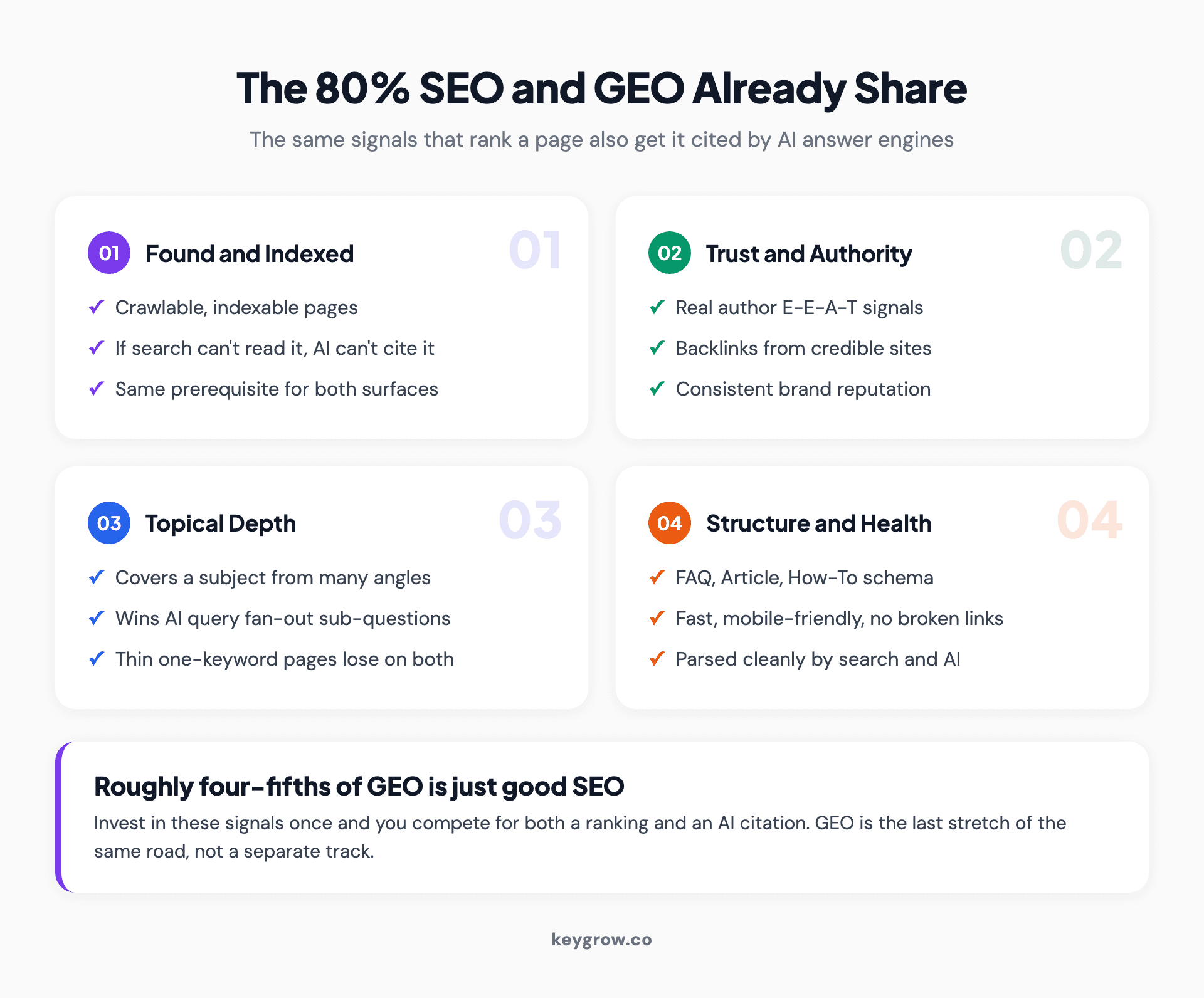
Infographic showing the roughly 80 percent of signals shared between SEO and GEO, including crawlability, E-E-A-T, backlinks, topical depth, structured data, and technical health, all feeding both rankings and AI citations
Notice what is on that list: nothing exotic. It is the same checklist a competent SEO has run for a decade. That is the core of the answer to whether SEO and GEO work together. They are not parallel tracks. The track is mostly shared, and GEO is the last stretch of it.
This is also why "Bing matters now" stopped being a niche opinion. Several AI search tools lean on Bing's index, so a site that ignores Bing is invisible to a chunk of AI search. We get into that in how SEO works in Bing, but the headline is simple: the same indexing work pays off across more surfaces than it used to.
The 20% that is genuinely GEO-specific
A handful of things are not standard SEO. They are the formatting and authority habits that nudge AI engines to pick your passage over an equally-ranked competitor. This is the part worth calling GEO, and it is smaller than the hype suggests.
Here is the genuinely GEO-specific list, as honestly as we can draw it.
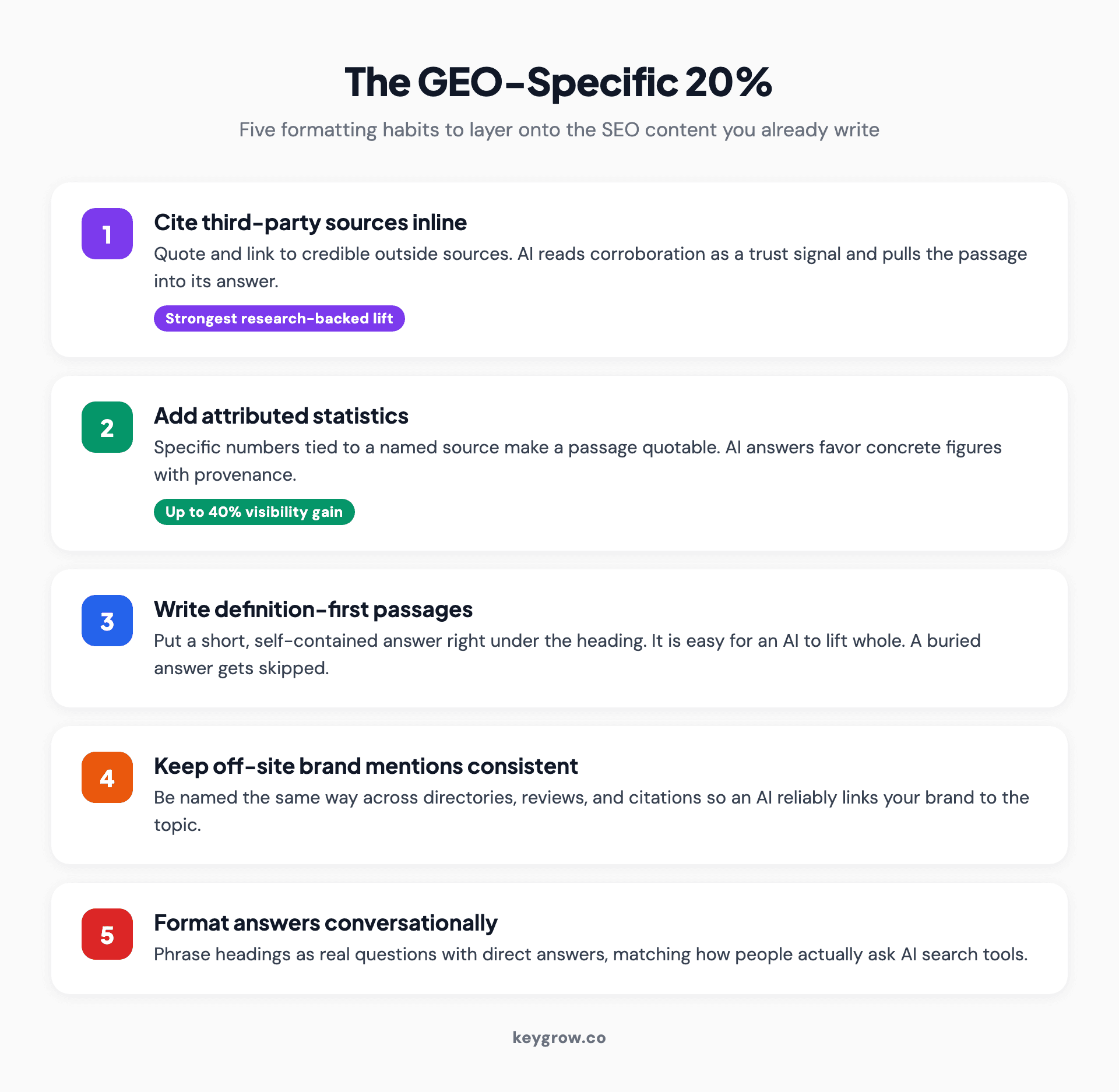
Numbered checklist infographic of the five GEO-specific tactics that go beyond standard SEO: cite sources inline, add attributed statistics, write definition-first passages, keep off-site brand mentions consistent, and format answers conversationally
That is the 20%. Five habits, layered onto the same content you already write for SEO. None of them requires a separate site, a separate team, or a separate budget. Most of them make the page better for human readers too, which is a useful tell that you are not doing anything weird.
Why those GEO tactics work: what the research actually shows
The GEO-specific tactics are not folk wisdom. They come from a real study. A Princeton-led research team ran controlled tests on what makes content show up in AI-generated answers, and the results explain exactly why the five habits above work.
The headline from the study, published as Aggarwal and colleagues at the KDD 2024 conference: their Generative Engine Optimization methods boosted a source's visibility in AI answers by up to 40%. The strongest lifts came from three things specifically: adding citations, adding quotations, and adding statistics. Not keyword tricks. Not stuffing. Citations, quotes, and numbers.
The detail is sharper than the headline. Summarizing the study, SEO.ai reported that for a page sitting in fifth position, the "cite sources" method produced up to a 115.1% increase in visibility inside generative-engine responses. Meanwhile keyword stuffing performed about 10% worse than doing nothing. Read that twice. The old ranking-era reflex, cram in keywords, actively hurt AI visibility in the study.
So when the GEO-specific list says "cite third-party sources" and "add attributed statistics," it is not a hunch. It is the two tactics the research found moved the needle most. That is the whole reason this post is dense with sourced numbers instead of confident assertions. We are practicing the thing we are describing.
One caution, because overclaiming AI mechanics is rampant. The study tested specific generative-engine setups, not every tool on the market, and AI systems change constantly. Treat "up to 40%" as a real, peer-reviewed signal of direction, not a guarantee for your exact page on your exact engine. The mechanism is sound. The exact multiplier is not a promise.
The catch nobody mentions: churn, tiny traffic, and instability
Here is the part the rest of the search results leave out. GEO has real downsides, and you should know them before you reorganize your content calendar around AI citations.
First, citation sources churn. Per Search Engine Land, somewhere between roughly 40% and 60% of the sources cited across AI platforms change month to month. A page cited this week can be dropped next week with no warning and no explanation. This is ongoing maintenance, not a one-time win you bank.
Second, the traffic is tiny, even when you are cited. Similarweb found that major publishers like Reuters and The Guardian receive less than 1% of their referral traffic from AI platforms, despite being cited constantly, per its 2026 GenAI Brand Visibility Index reported by Digiday. If your business case for GEO is "AI will become a major traffic source this year," the data does not support it yet. Being cited is mostly a brand and visibility play right now, not a volume play.
Third, the visibility is unstable in a way SEO rankings are not. Rankings move, but slowly and somewhat predictably. AI citations move fast and opaquely. You cannot file a reconsideration request with a chatbot.
Now the honest other side, because we are not here to talk you out of it either. The visitors who do click through from AI search are worth more. Semrush reports the average AI-search visitor is worth about 4.4 times a traditional organic visitor, and Digiday, citing The Washington Post, found AI-platform visitors converted at four to five times the rate of traditional search visitors. So the volume is small, but the quality is high. That is a real trade, just not the one the hype sells.
When GEO is not worth your time: if your SEO basics are broken, your site is slow or barely indexed, or you have no real expertise to demonstrate, do not chase AI citations yet. You will spend effort optimizing for a small, unstable channel while the large, stable one leaks. Fix the foundation first. GEO rewards sites that already deserve to rank. It does not rescue ones that do not.
Will optimizing for AI hurt my Google rankings?
Almost never, if you do it sanely. The GEO-specific tactics, citing sources, adding statistics, answering directly, are the same things that make a page better for readers and for traditional SEO. The risk is not GEO itself. The risk is doing it badly.
Three ways people manage to hurt their rankings while chasing AI:
The pattern is consistent: GEO done as an extension of good SEO helps both. GEO done as a frantic override of good SEO can quietly cost you the rankings you already have. For a fuller look at the ranking side of the AI shift, we wrote about how AI Overviews affect SEO in detail.
The strongest version of this opinion, backed by the number: keyword stuffing performed about 10% worse than baseline in the GEO study, which means the single most "SEO" reflex of the old era is now a measurable liability on the AI surface. The discipline you bring to GEO matters more than the tactics.
One workflow, two payoffs: the build order
You do not run two strategies. You run one, in this order, and it pays off twice. SEO foundation first, then layer the GEO-specific formatting onto the same pages. Here is the sequence so you know what to do Monday morning, not a vague claim that the two "complement" each other.
1. Get crawlable and indexed. Confirm search engines (and AI crawlers) can actually read your pages. If the foundation is broken, nothing downstream matters.
2. Build topical depth and E-E-A-T. Real author info, genuine expertise, content only your team could write. This feeds rankings and citations equally.
3. Earn authority. Links and consistent brand mentions across the wider web. Slow, compounding, and shared by both systems.
4. Add structured data. FAQ, Article, and How-To schema on the pages that warrant it.
5. Now layer the GEO-specific 20%. Open each key section with a definition-first answer capsule. Cite third-party sources inline. Add attributed statistics. Phrase headings as real questions. This is the only step that is "new" work, and it sits on top of everything above.
6. Monitor and maintain. Because citations churn, this is a loop, not a finish line. Check what you are cited for, refresh what slips.
Steps one through four are SEO you should be doing regardless. Step five is the actual GEO layer. Step six is the maintenance the hype skips. If you want help structuring the same content to win both surfaces, our work on how to optimize a website for ChatGPT walks through the formatting layer in practice.

Small team collaborating at a whiteboard while working on laptops to map out a workflow
We have watched this play out the slow way. A doctor's practice in Dubai committed to the SEO foundation for a full year. Months one through three looked unimpressive on the surface. By month twelve, organic traffic had grown 1,519% and the practice was taking 130+ patient calls a month. Same site, same client, no shortcuts. The point for GEO: the pages that now get pulled into AI answers are the ones that earned authority first. The foundation work was not separate from the AI work. It was the AI work, paid a year early.
How do you measure each when half the signals are invisible?
Measure them separately, because they answer different questions, and accept up front that GEO measurement is still immature. SEO has a decade of tooling. GEO has guesses and a few young platforms.
For traditional SEO, track what you always have:
For GEO, track a newer and rougher set:
The honest admission: GEO measurement is not solved. There is no Search Console for ChatGPT citations. The tools that try to track AI visibility are new, sample-based, and disagree with each other. So measure GEO directionally, not to two decimal places, and do not let a perfect dashboard become the reason you delay the actual work. If you want a structured approach to the tracking side, we compared the options in our piece on choosing an AI search monitoring platform.
The trap to avoid is the oldest one in this industry: reporting on vanity metrics because they are easy to count. "We got cited 40 times this month" means little if none of it reached a buyer. Tie GEO back to the same outcomes you measure for SEO, calls and revenue, or you are just admiring a number.
FAQs
Is GEO replacing SEO, or do I still need both?
You need both, and they are mostly the same work. GEO does not replace SEO; it sits on top of it. Roughly 80% of what gets you cited by AI is the same E-E-A-T, crawlability, backlinks, and topical depth that gets you ranked. Drop SEO and you lose the foundation GEO depends on.
What is the difference between GEO, AEO, and SEO?
SEO gets a page to rank in the list of search results. GEO (Generative Engine Optimization) gets your content cited inside AI-generated answers like AI Overviews and ChatGPT. AEO (Answer Engine Optimization) overlaps heavily with GEO and leans toward on-page structure for direct answers. Most people use GEO and AEO interchangeably. None of them means geofencing or geo-targeted ads.
Can optimizing for AI search hurt my traditional Google rankings?
Almost never, if you do it as an extension of good SEO rather than a replacement for it. The GEO tactics that work, citing sources, adding statistics, answering directly, also help human readers and traditional rankings. You can hurt yourself by stuffing citations, neglecting internal links, or diluting your keyword focus, but the tactics themselves are not the problem. Bad execution is.
How do I actually measure whether my GEO efforts are working?
Track citation share (how often AI answers name or quote you), brand mention frequency across the web, and AI-referral sessions in your analytics. Be honest that this is immature: there is no Search Console for AI citations yet, and the tracking tools are young and disagree. Measure directionally, and tie it back to calls and revenue rather than citation counts alone.
Which GEO tactics give the biggest lift for the least effort?
Citing third-party sources inline and adding attributed statistics. The Princeton-led GEO study found these produced the strongest visibility gains, up to a 40% lift overall and as much as a 115.1% increase for a fifth-ranked page using the cite-sources method. They are also low-effort because you are adding to content you already write, not building anything new.
How long does it take to start getting cited by AI engines?
It depends entirely on your SEO foundation. If your pages already rank well and are indexed, adding the GEO-specific formatting can earn citations within weeks. If your foundation is weak, expect months, because authority and indexing come first. There is no fixed timeline, and citations are unstable once you get them, with 40% to 60% of cited sources changing month to month.
Where to draw your own line
Settle the original question one more time: yes, SEO and GEO strategies work together for better results, because GEO is mostly SEO with five extra habits layered on the same pages. The line to draw is not between two strategies competing for budget. It is between the 80% you should already be doing and the 20% you add once the foundation holds.
Draw your own line honestly. If your SEO basics are solid, layer in the GEO formatting now, cite sources, add real statistics, lead every section with a clean answer, and accept that the payoff is high-quality but low-volume traffic that churns. If your basics are broken, fix those first and ignore the AI noise until they are not. GEO rewards sites that already deserve to rank. It is a multiplier on a foundation, not a substitute for one.
If you would rather have a team run both layers on the same content and report on calls and revenue instead of citation counts, that is what we do, month-to-month, cancel anytime. Start at /get-started and we will tell you honestly whether GEO is worth your effort yet, or whether your money is better spent on the foundation first.


