


AEO and traditional SEO chase two different wins. SEO works to rank your page in a list of blue links so someone clicks through to your site. AEO (answer engine optimization) works to make your content the answer an AI engine quotes, cites, or reads aloud, often without any click at all. The tactics overlap more than most people expect, but the goal, the surface, and the way you measure success are genuinely different.
The short version: SEO earns the ranking, AEO earns the citation. Here is what actually changes, what stays the same, and where to put your effort in 2026.
What each one is actually optimizing for
SEO optimizes to rank a page and win the click. AEO optimizes to be the extracted, cited answer inside an AI result, where being named is the win and a click is a bonus.
Traditional SEO grew up around a results page of ten links. You earned a position, and a good position earned clicks and traffic. The whole discipline (keywords, backlinks, titles, page speed) points at moving up that list.
AEO grew up around a different surface: Google's AI Overviews and AI Mode, ChatGPT, Gemini, Perplexity, and voice assistants that read one answer instead of showing ten links. Here the machine synthesizes a response and names a few sources. Your job is to be one of those sources. Increasingly, the reader gets the answer and never visits anyone. SparkToro measured US zero-click Google searches at 68 percent in early 2026, so the citation itself, not the click, is often the entire payoff.
How each one works under the hood
SEO is crawl, index, rank. AEO is retrieve, synthesize, cite. The first three steps are shared plumbing; the difference is what happens at the end.
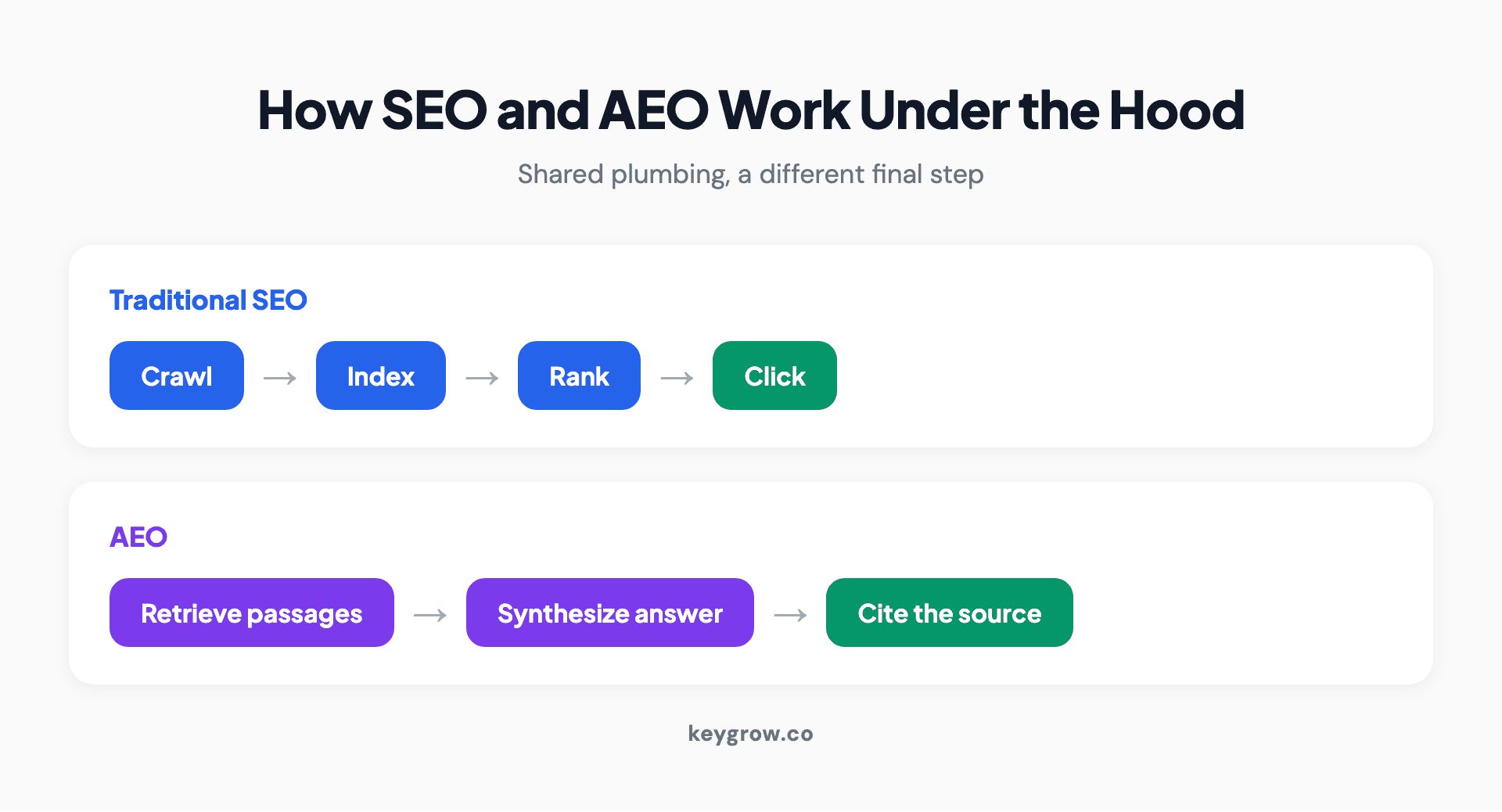
Two pipelines side by side: traditional SEO runs crawl, index, rank, then click; AEO runs retrieve, synthesize, then cite, sharing the crawl and index stages but ending in a quoted answer instead of a click.
Classic search crawls the web, indexes pages, and ranks them for a query so you can click one. Answer engines start from much of that same index, then do two extra things: they break content into passages and retrieve the most relevant chunks, and they synthesize those chunks into one written answer with a few citations. That is why a page can rank well and still never get quoted, and why a page outside the top 10 can get cited. Ahrefs found that only 38 percent of pages cited in Google's AI Overviews still rank in the top 10 for that query, down from about 76 percent since July 2025. The link between ranking and citation is loosening in real time.
The core differences at a glance
Here is the head-to-head. Same business goal underneath, different mechanics on top.
| Dimension | Traditional SEO | AEO |
|---|---|---|
| Primary goal | Rank the page, earn the click | Be the cited answer |
| Main surface | The list of organic links | AI Overviews, chatbots, voice, snippets |
| Query style | Keywords and phrases | Full natural-language questions |
| Content shape | Deep page that ranks as a whole | Self-contained answer passages |
| Authority signal | Backlinks and rankings | Citations, brand mentions, entities |
| Success metric | Rankings, traffic, clicks | Citations, mentions, share of answers |
| The win | A visit | A named source, click optional |
None of this makes SEO obsolete. It changes what a well-optimized page has to do once it is already ranking.
Where AEO and SEO are the same thing
Most of AEO runs on the SEO stack. Crawlability, indexing, structured data, internal links, site speed, and real topical authority feed both, because answer engines retrieve from the search index they inherit.
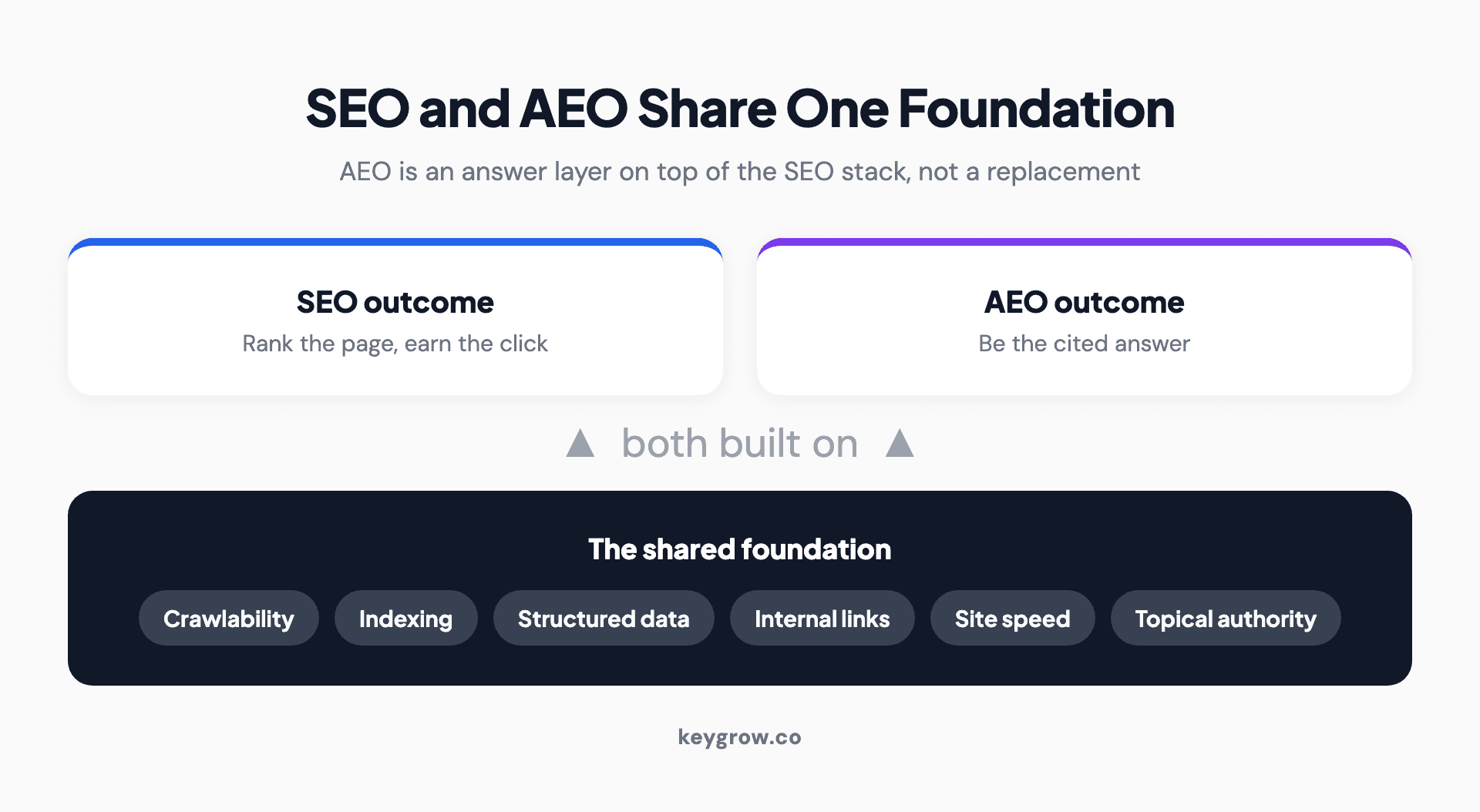
The shared foundation of SEO and AEO: crawlability, indexing, structured data, internal links, and authority sit at the base as the access layer, with ranking and answer citation as two outcomes built on top.
This is the part the versus-framing gets wrong. AEO is not a replacement discipline you bolt on after abandoning SEO. It is an answer layer sitting on top of the same foundation. If crawlers cannot reach your page, no engine ranks it or quotes it. If your site has no authority, it does not rank and it does not get cited. The technical fundamentals, the foundational SEO elements for AI, are shared. What AEO adds is a layer of answerability on top: answer-first structure, clear passages, named entities, and the schema that confirms them.
A doctor's practice in Dubai we worked with is a good example of the foundation paying off twice. A full year of technical fixes, content, and authority building grew organic traffic 1,519 percent and brought in 130+ patient calls a month. That same groundwork, the clean site and the earned authority, is exactly what makes a page eligible to be pulled into an AI answer now. The work compounds into both.
What AEO adds on top
AEO adds four habits SEO never required: answer-first structure, conversational and entity-based targeting, citable passages, and a new way to measure visibility.
The mechanics that are genuinely new:
- Answer-first, not build-up. Lead each section with a direct 40-to-60-word answer. Ranking-era habits like burying the answer and padding word count now actively hurt.
- Questions and entities, not just keywords. People ask engines full questions. You target the question and name the entities a complete answer must include, which is a different job than answer engine keyword research built on search volume.
- Passages, not just pages. Engines quote self-contained chunks, so how you structure a page for AEO decides whether any of it is quotable.
- A different scoreboard. You track citations, brand mentions, and share of answers, not just rankings and sessions.
How success is measured on each side
SEO measures rankings, organic traffic, click-through rate, and conversions. AEO measures citations, brand mentions in AI answers, and how often you are the named source, much of it invisible to standard analytics.
This is the hardest practical difference. Your analytics tool sees a click; it does not see the thousand times a chatbot summarized your content without sending anyone. Measuring AEO means checking the engines directly: run your target questions, log whether you are cited, and watch who gets named instead. It is closer to media monitoring than to a rankings report, and the tooling is still young. Our guide on measuring AEO success covers the metrics that are actually trackable today.
So which one should you invest in?
Do both, and let query type decide the lead. Transactional and local searches still reward classic SEO and clicks; informational, comparison, and how-to questions are where AEO visibility matters most.
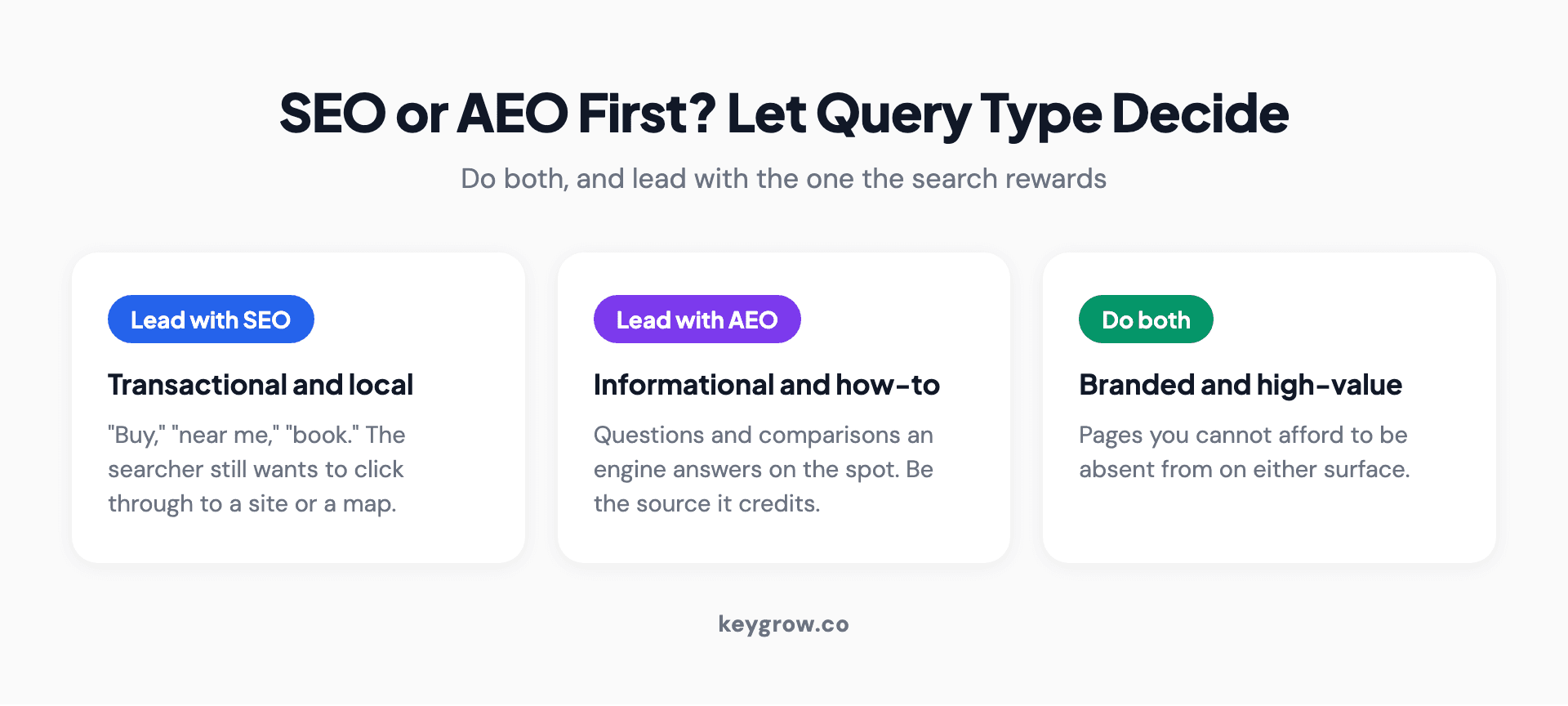
A decision guide for SEO versus AEO by query type: transactional and local queries lean SEO-first, informational and how-to and comparison queries lean AEO-first, with branded and navigational queries needing both.
A rough framework:
- Lead with SEO for transactional and local intent ("buy," "near me," "book"), where the searcher still wants to click through to a site or a map.
- Lead with AEO for informational, how-to, and comparison intent, where an engine is most likely to answer on the spot and you want to be the source it credits.
- Do both, deliberately, for branded and high-value pages, where you cannot afford to be absent from either surface.
The honest position: AEO does not replace SEO, it extends it. When you are ready to build one, our 90-day AEO strategy roadmap lays out the phases. Abandoning SEO to chase AI citations kicks out the foundation the citations are built on. The businesses that win in 2026 keep the technical and authority work that has always mattered and add the answer layer on top of it.
FAQs
Will AEO replace traditional SEO?
No. AEO is built on the same foundation as SEO. Answer engines retrieve from the search index, so crawlability, indexing, authority, and structured data still decide whether your content can be found and quoted. AEO adds answer-first structure and citation tracking on top of SEO; it does not remove the need for it.
What is the difference between SEO, AEO, and GEO?
SEO optimizes to rank pages in search results. AEO, answer engine optimization, optimizes to be the cited answer in AI results, voice assistants, and featured snippets. GEO, generative engine optimization, is a near-synonym for AEO focused specifically on generative AI answers. In practice AEO and GEO describe the same work, and both sit on top of SEO.
Can one page be optimized for both SEO and AEO?
Yes, and it should be. A page that ranks well and answers questions in clear, self-contained passages serves both. Keep the depth and authority that earn rankings, then restructure so each section leads with a direct answer an engine can lift. The two goals rarely conflict on the same page.
Do I still need backlinks for AEO?
Largely yes. Authority still matters for whether an engine trusts and cites you, and backlinks remain a real authority signal that carries over from SEO. AEO adds other signals, unlinked brand mentions and being recognized as an entity, but it does not make links irrelevant.
How do I measure AEO if my analytics do not show it?
Check the engines directly. Run your priority questions through AI Overviews, ChatGPT, Perplexity, and Gemini on a schedule and log whether you are cited and who is named instead. This citation tracking is separate from your traffic analytics, which only see the clicks, not the times you were summarized without a visit.
Is AEO worth it if most of my traffic is transactional?
It is lower priority for you than for an informational or comparison-heavy site, but not zero. Even transactional businesses get researched in AI answers before the buying query. Keep leading with SEO for the money pages, and make sure your informational and trust content is answer-ready so the engines describe you accurately.
The takeaway
SEO earns the ranking and AEO earns the citation, but they run on the same foundation. Keep doing the technical and authority work that has always mattered, then add answer-first structure, entity coverage, and citation tracking on top. Treat AEO as an extension of SEO, not a replacement for it.
If you want one team handling both the ranking and the answer layers rather than picking a side, that is how our answer engine optimization work sits alongside classic SEO. Bring your top questions to the get started page and we will show you where you rank, where you get cited, and the gap between the two.