


There is no single best tool for AEO keyword research. The work runs on a small stack of four tool types: question miners that surface what people actually ask, AI visibility trackers that show which prompts cite you, the answer engines themselves used as research tools, and classic keyword tools filtered down to questions. Master those four jobs and the specific brand names matter a lot less than the workflow you run them through.
The reason you need a different stack is that answer engine optimization asks a different question than search engine optimization ever did. Not "what has volume" but "what do people ask, and can we be the answer that gets quoted."
Why AEO keyword research is a different job
AEO keyword research hunts for questions you can answer better than anyone, not high-volume phrases you can rank for. The output is a list of answerable questions, mapped to entities, ready to become extractable content.
The old ranking playbook has stopped predicting AI visibility. Ahrefs found that only 38 percent of the pages cited in Google's AI Overviews still rank in the top 10 for that query, down from about 76 percent since July 2025, across a study of 863,000 keywords. Ranking first no longer buys you the citation. So chasing search volume, the metric that classic keyword tools are built around, points you at the wrong target.
The question changed from "how do I rank" to "how do I become the source." ChatGPT cites only about 15 percent of the pages it pulls in to build an answer, so the entire game is landing in that thin slice. Keyword research for AEO is really citation research: find the questions, confirm you can answer them in 40 to 60 words, and check whether the engines already cite someone (which means the door is open) or nobody (which means you can own it).
The four kinds of tools you actually need
Group your tools by the job they do, not by a ranked list. Four jobs cover the whole workflow, and most businesses can start with one tool per job.
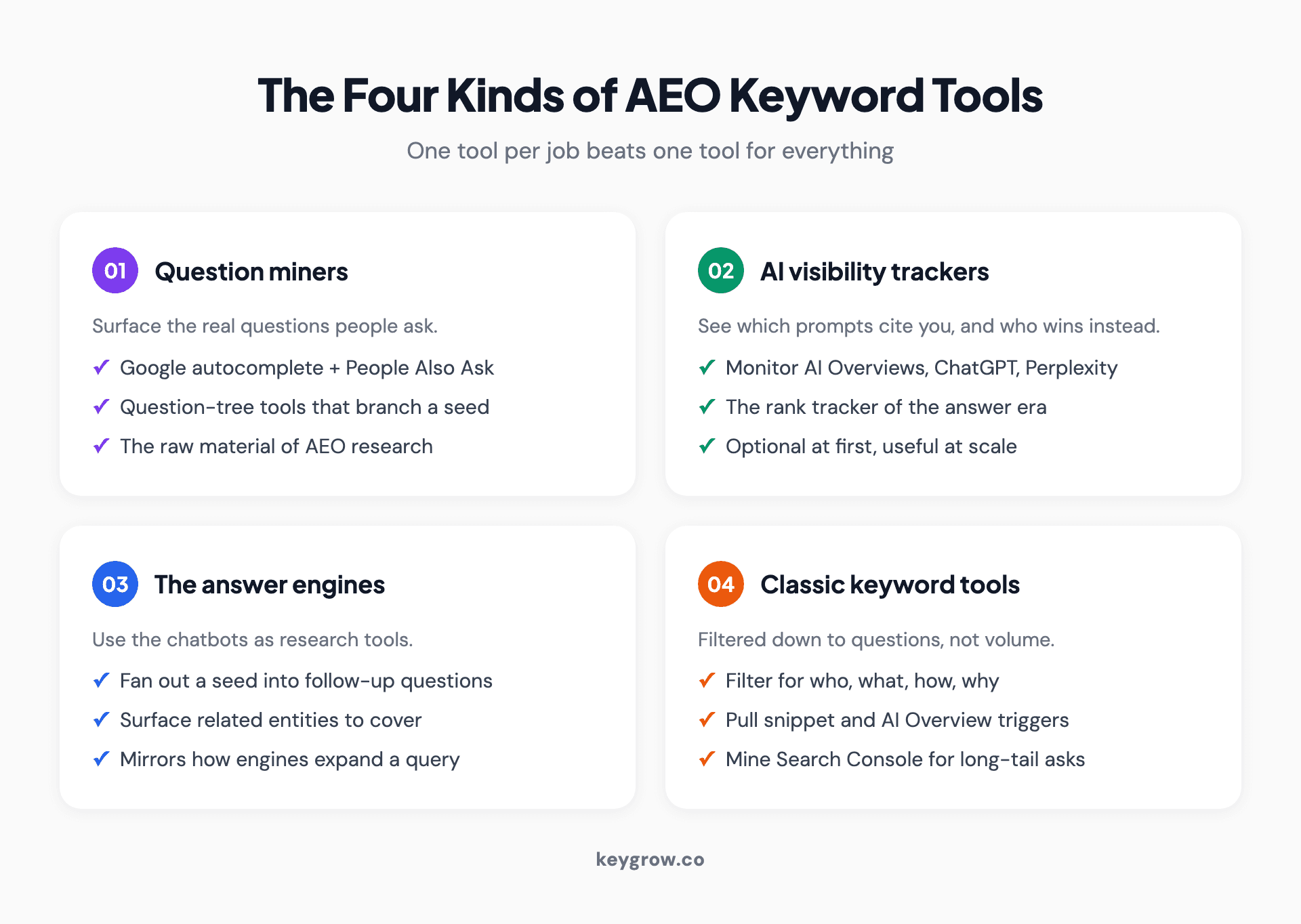
Four categories of AEO keyword research tools: question miners, AI visibility trackers, the answer engines themselves, and classic keyword tools repurposed for questions.
Question miners. These surface the real questions and phrasings people use. Google autocomplete and the People Also Ask box are free and live. Question-tree tools like AlsoAsked and AnswerThePublic map a seed term into the branching follow-up questions searchers ask around it. This is the raw material of AEO research.
AI visibility trackers. A newer category built specifically for answer engines. They monitor which prompts your brand appears in across AI Overviews, ChatGPT, Perplexity, and Gemini, and who gets cited instead of you. Named options in this space include Profound, Otterly, and Peec. Treat them as the AEO equivalent of a rank tracker: they tell you where you already show up and where a competitor owns the answer.
The answer engines themselves. ChatGPT, Perplexity, and Gemini are research tools, not just publishing targets. Ask one your seed question, then ask it what follow-up questions someone would ask next, what related entities matter, and what a complete answer must include. This "fan-out" mirrors how the engines expand a query internally, so it surfaces the sub-questions you need to cover.
Classic keyword tools, filtered to questions. Semrush, Ahrefs, and Google Search Console still earn their place, but you use them differently. Filter for question modifiers (who, what, how, why, when, where), pull the queries that already trigger a featured snippet or AI Overview, and mine Search Console for the long-tail questions you already get impressions for but do not answer well.
A free stack that covers most of it
You can do serious AEO keyword research for zero dollars. The paid trackers save time at scale, but the research itself does not require them.
A working free stack: Google autocomplete and People Also Ask for question discovery, Google Search Console for the questions you already rank near, community sites and Q&A forums for the exact language customers use, and the free tiers of the chatbots for fan-out and entity research. That combination surfaces more genuine questions than most teams can write content for in a quarter.
Paid tools are worth it when you are tracking dozens of prompts across multiple engines and need the monitoring automated, or when proving AEO impact to a client or a boss who wants a dashboard. If you are a single business owner testing the water, start free and add a tracker only once you have content live and want to measure it. That honesty is worth more than a tool recommendation: most small sites should do the fundamentals themselves before paying for software.
The workflow: from a seed question to an answer-ready brief
The tools are only useful inside a repeatable process. Run every seed topic through the same five steps.
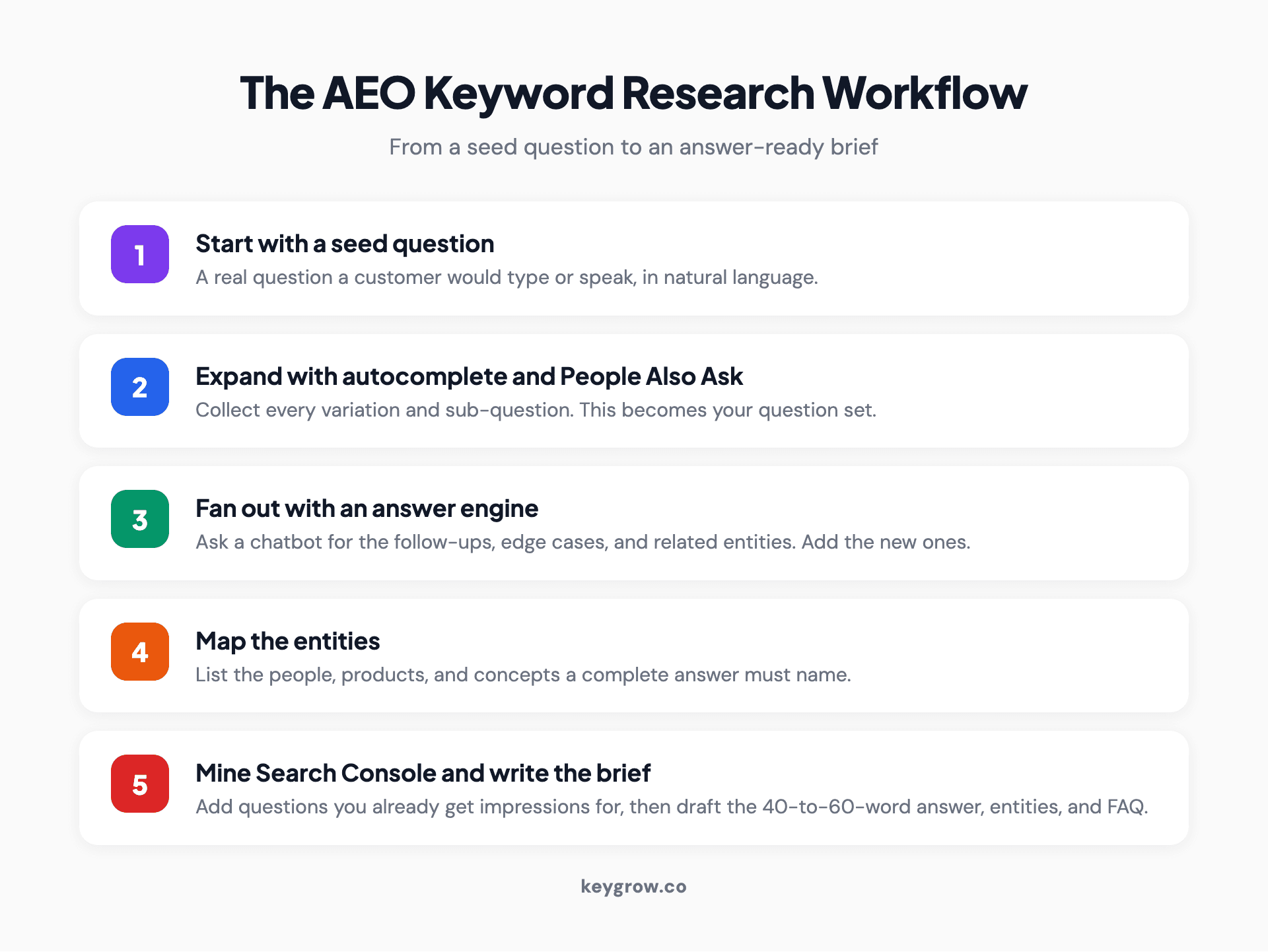
A five-step AEO keyword research workflow: seed question, autocomplete and People Also Ask expansion, LLM fan-out, entity mapping, then Search Console mining into a content brief.
- Start with a seed question a customer would actually type or speak, in natural language, not a two-word phrase.
- Expand with autocomplete and People Also Ask. Collect every real variation and sub-question. This is your question set.
- Fan out with an answer engine. Paste the seed and ask for the follow-up questions, edge cases, and related entities. Add the new ones to your set.
- Map the entities. List the people, products, places, and concepts a complete answer must name. Engines assemble answers from entities and relationships, so coverage here is what makes you quotable.
- Mine Search Console and write the brief. Find the questions you already get impressions for, then turn the top questions into a brief: the direct 40-to-60-word answer, the entities to name, the supporting data, and an FAQ block.
That brief is the real deliverable. A page built from it answers the question in the first breath, which is exactly what an answer-first structure for AEO is designed to do.
How to decide which questions to target first
Score each question instead of chasing the biggest number. A simple four-factor rubric sorts a long list into a build order.
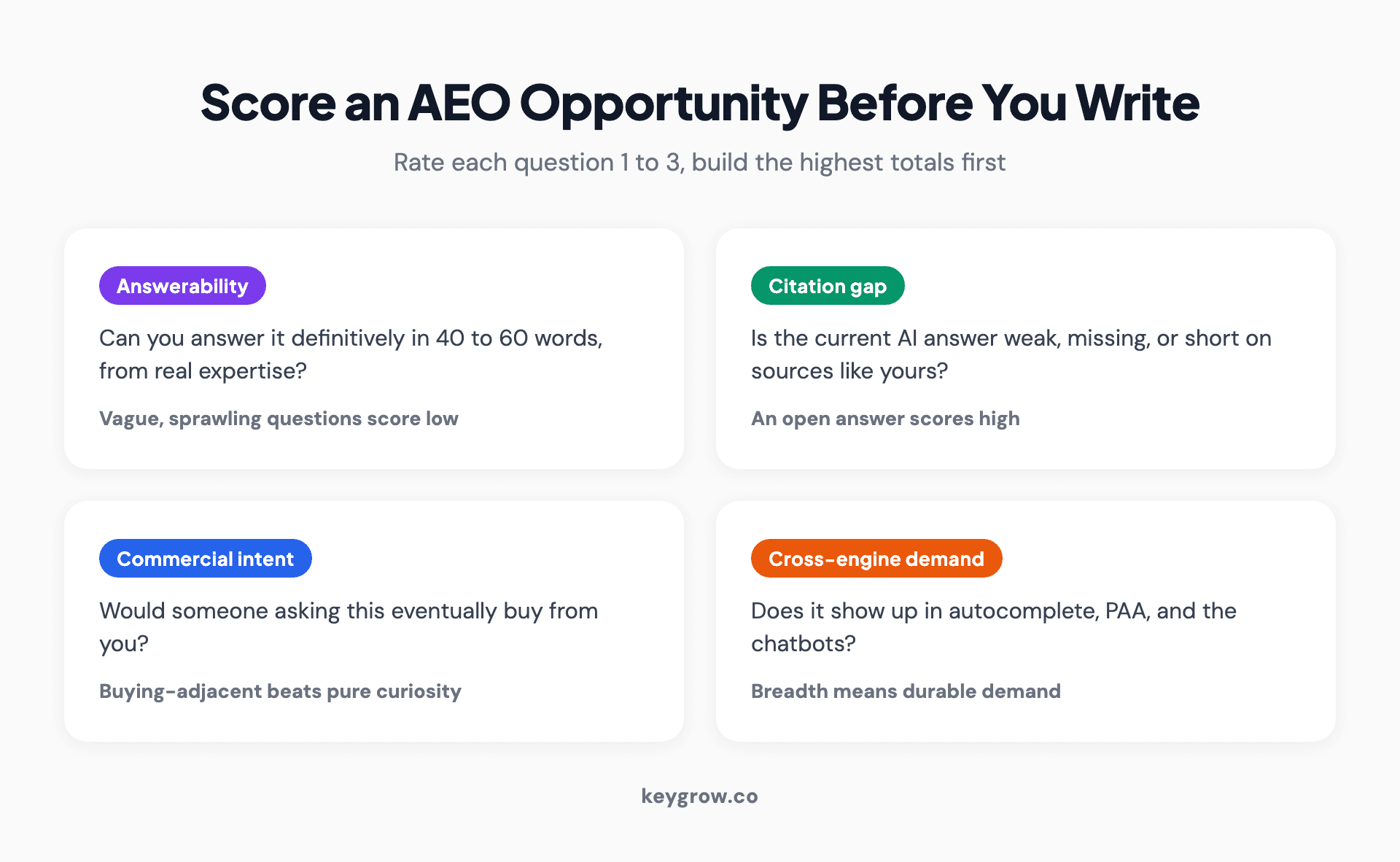
An AEO opportunity scoring rubric across four factors: answerability, citation gap, commercial intent, and cross-engine demand, each scored one to three.
Rate each question one to three on four factors, then start with the highest totals:
- Answerability. Can you answer it definitively in 40 to 60 words, from real expertise? Vague, sprawling questions score low.
- Citation gap. Does an AI answer already exist, and is it weak or missing your kind of source? An open or shallow answer scores high.
- Commercial intent. Would someone asking this eventually buy from you? A buying-adjacent question beats pure curiosity.
- Cross-engine demand. Does the question show up in more than one place (autocomplete, PAA, and the chatbots)? Breadth means durable demand.
This keeps you from pouring effort into a high-volume question you cannot answer better than the current cited source, which is the most common way AEO research gets wasted.
A prompt-tracking method that costs nothing
The paid trackers automate one simple task: checking, on a schedule, whether the engines cite you for the prompts you care about. You can do it by hand.
Build a sheet with one row per target prompt and one column per engine (AI Overviews, ChatGPT, Perplexity, Gemini). Once a week, run each prompt and log three things: are you cited, who is cited instead, and what does the winning source do that you do not. After a month you have a real map of where you win, where a competitor owns the answer, and what to fix. It is manual, but it is the same data a subscription sells you, and doing it by hand teaches you what "good" looks like in each engine.
The mistakes that waste AEO keyword research
Most AEO research goes wrong in predictable ways. Three account for the bulk of it.
Filtering by search volume alone is the big one, because volume tells you nothing about whether you can be the cited answer. Tunnel vision on a single engine is next: optimizing only for Google's AI Overviews while ChatGPT and Perplexity quietly send a growing share of considered-purchase traffic. And skipping the tracking step, so you publish answer content and never learn whether any engine picked it up. Research without a feedback loop is guessing with extra steps.
Which answer engine should you research first?
Start with the engine your customers actually use, then widen. For most local and service businesses that means Google's AI Overviews, since that is where the largest share of searches still happens.
Google holds roughly 90 percent of search, per StatCounter, so its AI Overviews are the highest-traffic answer surface for almost everyone, and a sensible first target. From there, the second engine depends on your audience. A considered B2B or software purchase gets researched heavily in ChatGPT and Perplexity, so those matter more than they do for a walk-in local service. The point of your prompt-tracking sheet is that you do not have to guess: run your priority questions across all the major engines once, see which ones your customers' questions actually trigger and where you already appear, and let that decide the order. Do not try to win every engine at once. Own the one that sends you the most, then expand to the next by evidence, not habit.
FAQs
How is AEO keyword research different from SEO keyword research?
SEO keyword research ranks phrases by search volume and difficulty so you can rank a page and earn a click. AEO keyword research finds questions you can answer definitively and be cited for inside an AI answer, where volume matters less than answerability and whether a citation gap exists. The inputs are questions and entities, not just head terms.
Is there one best tool for AEO keyword research?
No. The work spans four jobs, question mining, AI visibility tracking, fan-out research inside the answer engines, and classic keyword tools filtered to questions, and no single product does all four well. Pick one tool per job. Most businesses can start with free tools and add a paid tracker only when they need automated monitoring at scale.
Can I do AEO keyword research for free?
Yes. Google autocomplete, People Also Ask, Google Search Console, community forums for real customer language, and the free tiers of the chatbots cover most of the work. Paid trackers mainly save time and produce dashboards when you are monitoring many prompts across several engines.
Can I just use ChatGPT for AEO keyword research?
It is one of the best tools for the fan-out and entity steps, but not the whole job. A chatbot will not reliably tell you which questions already trigger AI answers, who currently gets cited, or what you already get impressions for. Pair it with autocomplete, People Also Ask, and Search Console.
How do I find questions that actually trigger AI answers?
Run your candidate questions through Google and note which ones return an AI Overview or a featured snippet, and ask the chatbots directly. Questions that already produce an AI answer are live AEO targets. If the current answer is weak or does not cite a source like yours, that is your opening.
How often should I refresh AEO keyword research?
Revisit your target prompts monthly to see whether citations have shifted, since AI answers change far faster than classic rankings. Do a deeper refresh each quarter to catch new questions your customers have started asking and new entities the engines have started naming.
Where this leaves you
Pick one tool for each of the four jobs, start with the free stack if budget is tight, and run every topic through the same seed-to-brief workflow. Score your questions before you write so you build the answerable, winnable ones first, and keep a simple sheet tracking which prompts cite you.
If you would rather have a team run the research, build the answer content, and track the citations for you, that is what our answer engine optimization service does. Bring your list of customer questions to the get started page and we will show you where the citation gaps are.