

Do keywords matter in SEO? Yes, keywords still matter in SEO, but not the way they did ten years ago. They are no longer a phrase you sprinkle across a page to trick Google into ranking you. They are the research that tells you what your customers search for, the intent you build a page to satisfy, and the language that helps both Google and AI engines understand what your page is about. The keyword has not died. The trick of stuffing it everywhere has. Those are two very different things, and most "keywords are dead" takes confuse them.
Here is the reality: a single optimized page does not win one keyword, it wins hundreds of related ones. So the modern job is to understand the demand behind the search and answer it better than anyone else. This guide covers what changed, what still works, and exactly how to use keywords in 2026, including for AI search.
Do keywords still matter in SEO?
Yes. Keywords still matter as the map of what people search and the intent behind it, but exact-match repetition no longer ranks pages. Modern search rewards content that satisfies a query.
The clearest proof that keywords still matter is also the clearest proof that single keywords are the wrong thing to obsess over. Ahrefs studied 3 million search queries and found the average page ranking number one for its main keyword also ranks in the top 10 for nearly 1,000 other relevant keywords, with a median of around 400. One page, hundreds of rankings. That breadth does not come from repeating one phrase. It comes from covering the topic so thoroughly that the page matches every way people phrase the same need.
So keywords matter enormously as research and direction. What stopped working is treating them as a density formula.
What people mean when they say "keywords are dead"
When someone says keywords no longer matter, they are usually describing tactics that genuinely died years ago. It is worth being precise about what is gone and what is very much alive, because conflating the two is how businesses talk themselves out of doing keyword research at all.
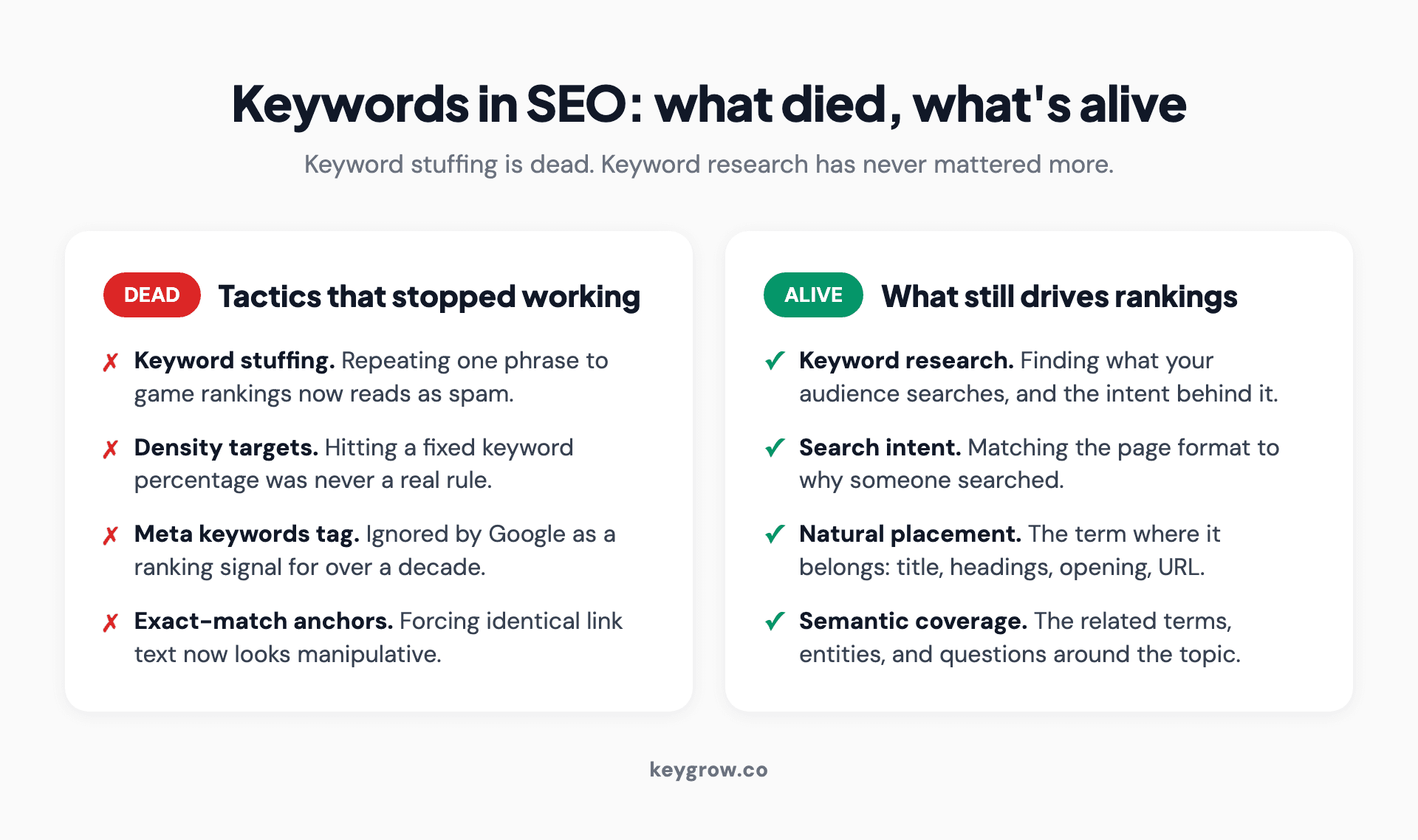
Infographic contrasting outdated keyword tactics that no longer work, including keyword stuffing, density targets, the meta keywords tag, and exact-match anchor text, against keyword practices that still drive SEO, including intent research, natural placement, topic coverage, and semantic terms.
The honest way to see it is as a swap. Each dead tactic has a living replacement that does the same job better.
| What's outdated | What replaced it |
|---|---|
| Keyword stuffing, repeating one phrase to rank | Writing for intent, so the page reads naturally and still ranks |
| Keyword density targets, hitting a fixed phrase percentage | Covering the topic fully, including the related terms and questions |
| The meta keywords tag, ignored by Google for over a decade | A strong title tag and meta description that earn the click |
| Over-optimized exact-match anchor text | Descriptive, varied anchors that explain where the link goes |
The line is simple. Keyword research is alive. Keyword manipulation is dead.
How Google uses keywords now
Google still reads the words on your page, it just interprets their meaning instead of matching them as strings. That is why a page can rank for a query that contains none of its words.
The old engine matched text. The current one understands it, which changes how keywords work without making them irrelevant. The turning point was natural language understanding. Google reported that its BERT update helped Search better understand one in ten English searches in the US by reading the context around words instead of the words in isolation. That is why a long, awkwardly worded question now returns the right answer even when the page never uses that exact phrasing.
This matters because of how much novelty Google handles. Search Engine Land reports that 15 percent of the searches Google sees every day are new, never searched before. No exact-match strategy can prepare for queries nobody has ever typed. Only understanding intent can.
So keywords are how you make your meaning legible. They are the signal that tells crawling, indexing, and ranking systems what your page covers. You are no longer matching strings for Google. The job now is to describe your topic clearly enough that its language models can place you.
One keyword, hundreds of rankings: a worked example
Target one keyword properly and you rank for the whole cluster of terms around it, because a single well-built page satisfies many phrasings of the same intent.
Say you run an emergency plumbing business and you want to rank for "emergency plumber." That head term has real volume and real intent: someone with a burst pipe at midnight. A page that just repeats "emergency plumber" forty times ranks for nothing. Build one that genuinely serves that midnight searcher, and you start ranking for the entire neighborhood of related, longer-tail queries.
| One target keyword | What the same page can also rank for |
|---|---|
| emergency plumber | 24 hour plumber near me, burst pipe repair, after hours plumber, weekend plumber, urgent plumbing repair, plumber open now |
This is the also-rank-for effect in practice. Remember the Ahrefs finding: the average number-one page also ranks for nearly 1,000 other keywords, a median of around 400. Most of those extra rankings are long-tail variants, the specific, lower-volume phrasings that are easier to win and often convert better because the intent is sharper. You picked one head keyword to guide the page. The page earned the long tail by answering the need behind it.
We saw this play out with a doctor's practice in Dubai. The goal was not one magic term. We researched the questions and conditions patients actually searched, built professional content that answered them, and let the practice rank across the whole cluster of patient queries. Over 12 months, organic traffic grew 1,519 percent, from 75 monthly visitors to 1,200, and the practice now takes more than 130 patient calls a month. Same site, no shortcuts, just keywords used as a research map instead of a chant.
Where keywords still belong on a page
Place your primary keyword where it clarifies the subject, the title, opening, a few headings, the URL, and image alt text, then write naturally and let related terms appear on their own.
Keywords still have a home on the page, you just place them like a writer, not a robot. The spots that still earn their keep:
The rule over all of it is to read naturally. If a sentence sounds awkward because you forced the phrase in, take it out. For the deeper mechanics of titles, descriptions, and tags, we wrote a full guide to SEO meta data. The placement has barely changed in years. What changed is that you stop after using the term where it belongs, instead of forcing it to a quota.
If you run a single location and have a few hours a month, you do not need an agency to do this. Free tools get you most of the way: Google autocomplete, the People Also Ask boxes, related searches at the bottom of the results, and Google Search Console showing what you already rank for. Do the basics yourself first. Hire help when the research and the volume outgrow the time you can give it.
Should you still track keyword rankings?
Track keywords as a diagnostic, not the scoreboard. Revenue, leads, and calls are the real result; rankings only explain the why behind them.
Rank tracking still has a place. It tells you whether your work is moving the right terms and where you are losing ground to a competitor. The mistake is treating position one as the goal in itself.
The reason is that a ranking no longer guarantees a visit. A SparkToro clickstream study of Datos panel data, covered by Search Engine Land, found 58.5 percent of US Google searches end without a click to the open web. That zero-click share includes searches that end on Google's own properties and query refinements, not only answers read off the results page. Either way, you can rank and still get no traffic, so the keywords you track should ladder up to a business metric. If a term ranks well but the phone stays quiet, it was the wrong term to chase. Vanity-metric reporting, where an agency leads with impressions and average position while nothing reaches your bottom line, is the oldest trick in the book.
Do keywords matter for AI search?
Yes, more than people expect. AI engines retrieve content by matching queries to pages, so what you cover decides whether an AI answer quotes you or a competitor.
This is where keywords get a second life. The question changed from how to rank to how to become the source the AI quotes, and keywords are still how an engine finds you to quote.
AI search is also a bigger slice of results than the headlines admit, and too big to ignore. A Semrush analysis of more than 10 million keywords, reported by Search Engine Land, found AI Overviews appeared on 6.5 percent of Google queries in January 2025, peaked at just under 25 percent in July, then fell back to under 16 percent by November. That is a large and volatile share of searches now answered by a summary the engine assembles from sources it picks.
How does it pick them? Through query fan-out. Google describes its AI Mode breaking a single question into subtopics and firing off many simultaneous sub-queries, with its deeper Deep Search mode issuing hundreds of searches behind one prompt. Each of those sub-queries behaves like a keyword, and the page that covers the topic broadly enough to satisfy several of them is the page that gets cited.
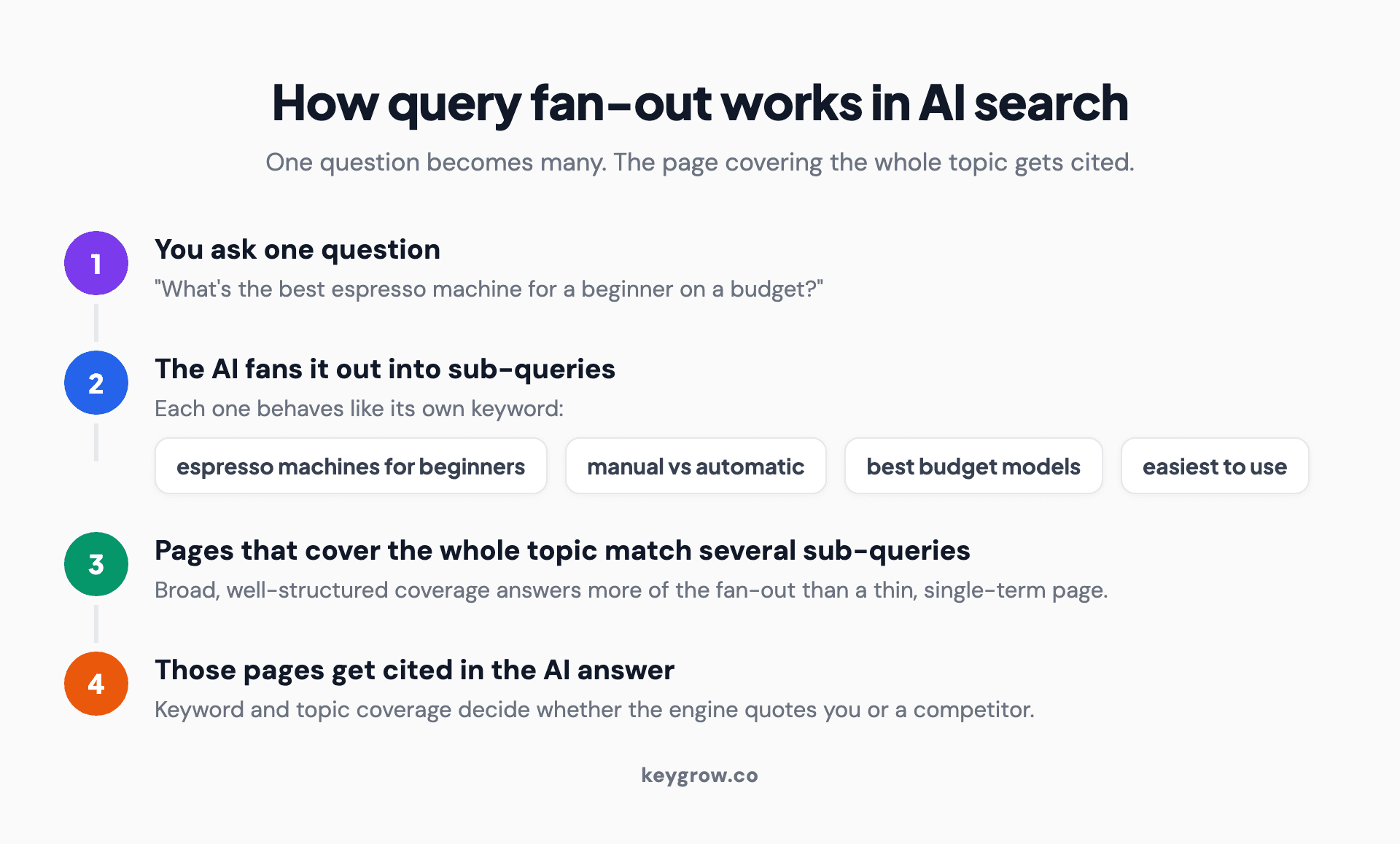
Infographic explaining query fan-out in AI search: one user question is broken into multiple sub-queries, each sub-query behaves like a keyword, and pages that cover the whole topic get pulled into the AI answer as cited sources.
This is exactly why topical coverage beats single-term targeting, a structure we lay out in our guide to building a topical map. Search is also getting more conversational, which makes intent matter even more than exact phrasing. Google's Year in Search reported that searches starting with "tell me about" rose 70 percent year over year in 2025 and "how do I" queries hit an all-time high. You answer questions like that. You do not stuff a keyword into them. For the full playbook on getting picked up by AI engines, see our guide to AI search optimization.
When do keywords matter less?
Keywords matter less in a few specific situations, and it is honest to name them. For breaking news, search demand spikes before any keyword tool can register it, so speed and authority beat research. For brand-new product categories, the words customers will use do not exist yet, so you are creating the language rather than chasing it. And for genuine brand searches, people already know your name, so you are defending a term, not discovering one.
Even here, keywords are not useless, they are just not the lever. The volume of search is enormous and constant. Backlinko estimates Google handles about 5.9 million searches a minute, which works out to roughly 8.5 billion a day. Most of what your business wants to be found for sits inside that demand, and keyword research is still how you map it.
FAQs
Do keywords still matter for SEO in 2026?
Yes. Keywords still matter as the research that reveals what your audience searches and the intent behind it. What no longer works is keyword stuffing, density targets, and the meta keywords tag. Modern search rewards pages that satisfy a query rather than pages that repeat it, so use keywords to guide what you create, then write naturally.
Can you rank without targeting a specific keyword?
You can rank for terms you never explicitly targeted, because one strong page ranks for hundreds of related queries. But you still need a target to guide the page's topic and intent. Think of the keyword as the center of a cluster you will rank across, not the only term you expect to win.
Where should you put keywords on a page for the best results?
Put your primary keyword in the title tag, the H1, the opening hundred words, the URL slug, a few relevant headings, and image alt text where it fits. Then write naturally and let related terms appear on their own. The rule is clarity, not quota. If forcing the phrase makes a sentence read badly, remove it.
Should you still track keyword rankings?
Track them as a diagnostic, not the goal. Rankings tell you whether your work is moving the right terms, but a high ranking no longer guarantees traffic, since most searches end without a click. Tie the keywords you track to a business outcome like leads, calls, or sales, and treat position as the explanation, not the win.
How many keywords should one page target?
Target one primary keyword and the cluster of closely related terms and questions around it. A focused page that fully answers one intent will naturally rank for many phrasings of that intent. Splitting one intent across several near-identical pages backfires, because the pages compete with each other instead of stacking authority.
Are meta keywords still used by Google?
No. Google stopped using the meta keywords tag as a ranking signal well over a decade ago and confirmed as much publicly. Filling it in does nothing for Google rankings and can hand your keyword list to competitors who view your source. Spend the effort on the title tag and meta description instead, which still matter.
Is keyword research still worth doing in 2026?
Very much so. Keyword research is how you learn what your market searches, in what volume, with what intent, before you spend time creating anything. It is the difference between writing what you assume people want and writing what they demonstrably look for. The tactic that died was stuffing, not research.
Do keywords still matter for AI Overviews and AI search?
Yes. AI engines retrieve content by matching a query to relevant pages, then break complex questions into many sub-queries through query fan-out. Each sub-query behaves like a keyword. Pages that cover a topic broadly and clearly are the ones AI answers pull from, so keyword and topic coverage still decide whether you are the source an AI quotes.
The short version
Stop counting how many times a phrase appears on the page. Start asking whether the page answers the search behind it. The tactics that earned keywords their bad reputation are genuinely dead, and what replaced them is better: understand the demand, build a page that satisfies it, and you rank for hundreds of related terms and earn citations in AI answers at the same time. Keywords decide what to make and how to frame it. The person searching decides everything after that.
If you would rather have a team handle the research, intent mapping, and content that ranks for the cluster instead of a single term, that is what our SEO service does. Tell us about your business and we will show you the keywords worth owning.


