

How do you complete a topical map for SEO? You pick one core topic you want to own, research every subtopic your audience searches for, group those subtopics into a few pillar pages with supporting cluster articles underneath, map each one to its search intent, connect them with internal links, and then fill the gaps and update the map as you publish. Done right, it turns a pile of random blog ideas into a deliberate plan that builds topical authority instead of scattered pages that rank for nothing.
That is the whole process, and this guide walks every step with a fully worked example you can copy. We will build a real topical map from scratch, lay out the pillar-and-cluster structure, give you a checklist to replicate it, and show why a topical map is now what gets you cited in AI answers, on top of ranking in classic search.
What a topical map is, and why it wins
A topical map is a structured plan of all the content needed to cover a subject completely, organized so search engines see your site as an authority on that subject rather than a site that occasionally mentions it. It is built around topical authority: the more thoroughly and interconnectedly you cover a topic, the more Google trusts you to answer queries within it.
The data backs this hard. Backlinko's analysis of 11.8 million search results found that content covering a topic in depth significantly outranked thin content, with each one-point gain in content depth roughly corresponding to a one-position ranking improvement. The structure matters as much as the depth: topic cluster experiments run by former HubSpot employees in 2016 found that the more they interlinked cluster content to a pillar page, the better their search placement, with impressions also rising as the number of links grew.
The flip side is what happens without a map. Ahrefs found that 96.55 percent of the pages in its index get zero traffic from Google, which is what scattered, structureless publishing produces. Here is the opinion that number earns: most businesses publish backwards, writing posts first and mapping the topic never, and it is a big reason so much content lands in that 96.55 percent. And because 94.74 percent of keywords get ten monthly searches or fewer, the only way to win real traffic is to cover a topic broadly enough to capture all that long-tail demand. A topical map is how you do that on purpose.
How to complete a topical map: the seven steps
To complete a topical map, choose a core topic, research its subtopics, group them into pillars and clusters, tag each by intent, audit existing pages, plan internal links, then build and update.
Here is the full process, start to finish. Follow it in order and you finish with a publishing plan you can act on, diagram included.
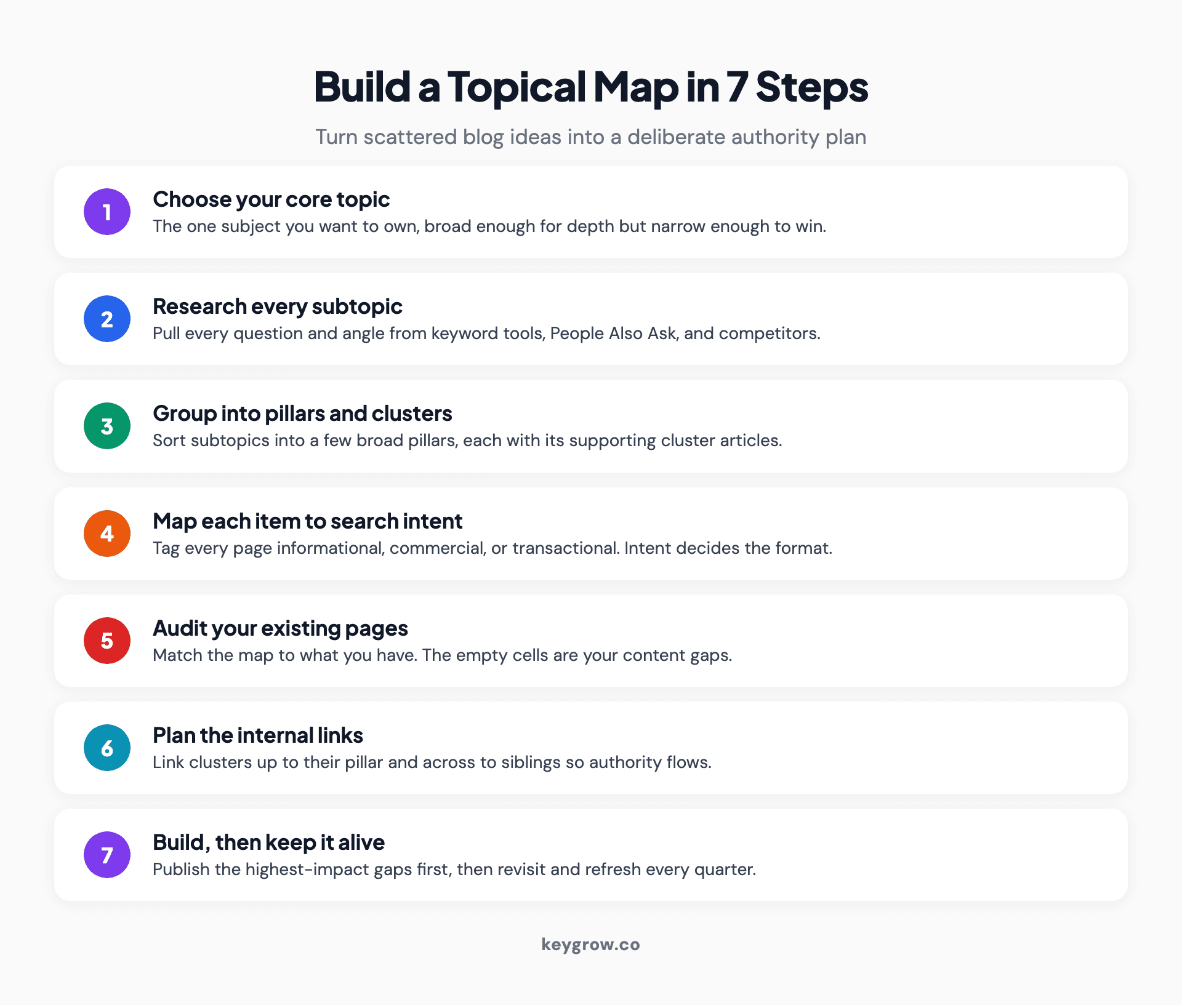
Infographic of the seven steps to build an SEO topical map: choose a core topic, research subtopics, group into pillars and clusters, map to search intent, audit existing pages, plan internal links, then build and update.
1. Choose your core topic. Pick the one subject you want to be known for, broad enough to have real depth but narrow enough to win. This becomes the center of the map and usually maps to your main service or product.
2. Research every subtopic. Use a keyword tool to pull every question, term, and angle around the core topic. Mine People Also Ask, related searches, and competitor coverage. The goal is breadth: every way someone might search the subject.
3. Group into pillars and clusters. Sort those subtopics into a few broad pillar themes, each with a set of specific supporting articles, the clusters. This hub-and-spoke shape is the skeleton of the map.
4. Map each item to search intent. Tag every page as informational, commercial, or transactional, so you know whether it should be a guide, a comparison, or a service page. Intent decides the format.
5. Audit your existing pages. Match the map against what you already have. Some clusters are covered, some need updating, and the empty cells are your content gaps, which is exactly where the opportunity sits.
6. Plan the internal links. Decide how clusters link up to their pillar and across to each other. This is not optional: Ahrefs, citing a Zyppy study, reports that pages with at least one exact-match internal anchor earned at least five times more traffic than pages without one.
7. Build, then keep it alive. Prioritize the highest-impact gaps, publish, and revisit the map every quarter to add new subtopics and refresh decaying pages. A topical map is a living document, not a one-time exercise.
A worked example: a topical map for home espresso
Steps are easy to nod along to and hard to picture, so here is a finished map for a real niche. Say you sell espresso gear and want to own "home espresso." Your core topic is exactly that, and it breaks into four pillars, each with its own cluster of articles.
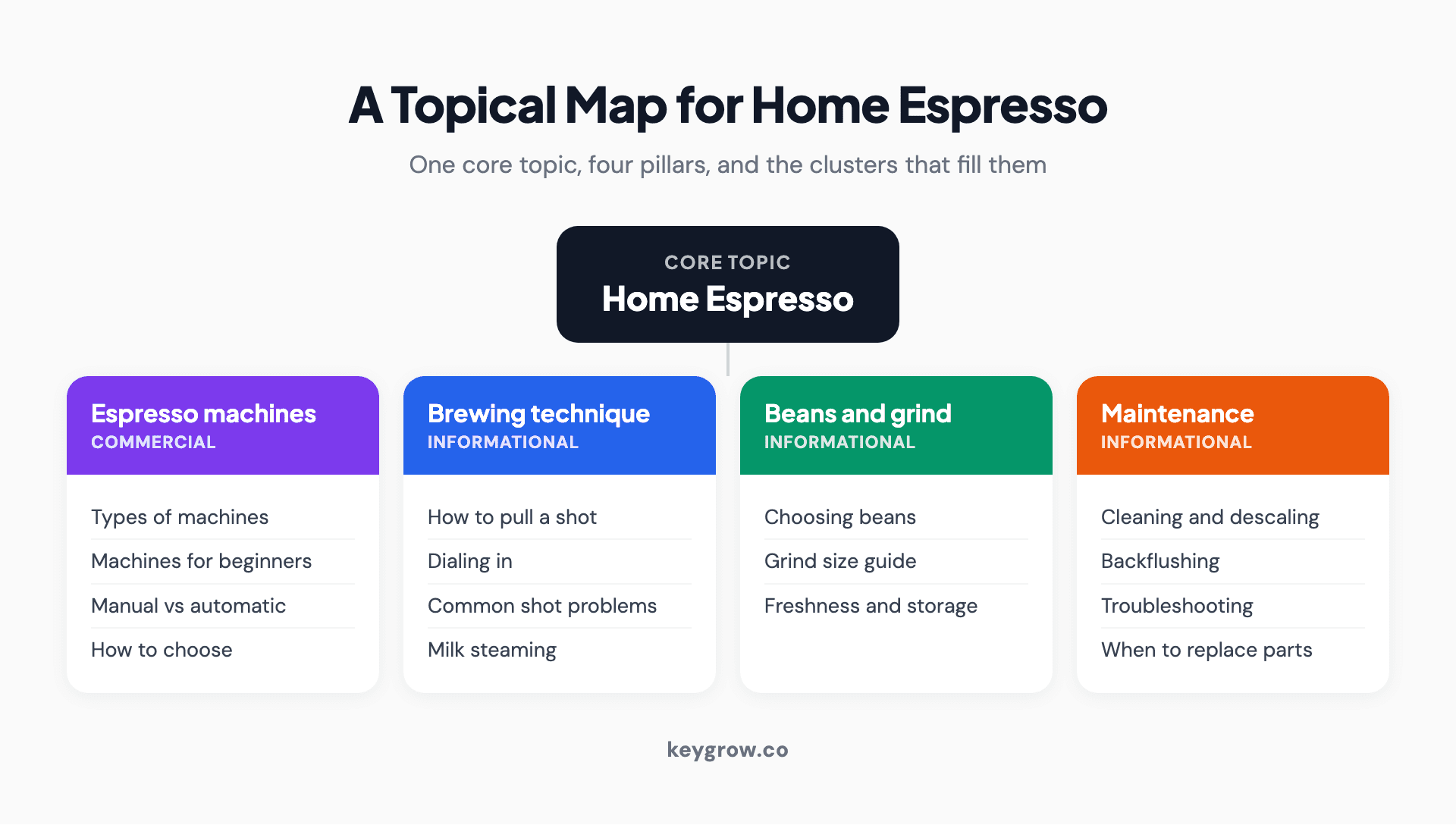
Infographic showing a topical map for home espresso: a central core topic feeding four pillar pages (machines, brewing technique, beans and grind, maintenance) with cluster subtopics under each.
| Pillar | Cluster articles | Primary intent |
|---|---|---|
| Espresso machines | Types of machines, machines for beginners, manual vs automatic, how to choose | Commercial |
| Brewing technique | How to pull a shot, dialing in, common shot problems, milk steaming | Informational |
| Beans and grind | Choosing beans for espresso, grind size guide, freshness and storage | Informational |
| Maintenance | Cleaning and descaling, backflushing, troubleshooting, when to replace parts | Informational |
A few things make this work. The pillars are broad enough to anchor a whole section but distinct from each other, so they do not compete. The clusters are specific, long-tail, and answer the real questions a buyer asks before and after a purchase. The intent column tells you the machines pillar should support product and comparison pages, while the rest are guides that build trust and pull in searchers early. Every cluster links up to its pillar and across to relevant siblings, so authority flows through the whole structure. That is a topical map: not a keyword list, a coverage plan.
One more reason to map before you write: it stops you creating two pages that target the same query and split your rankings against each other. The map gives every subtopic exactly one home.
Your topical map build checklist
You do not need expensive software to complete a topical map. A spreadsheet with columns for pillar, cluster topic, target keyword, search intent, existing URL, and status covers everything most businesses need. Run through this checklist and the map builds itself.
If you can fill in those columns, you have a topical map, and you did it for the price of a spreadsheet. The thinking is the hard part, and a spreadsheet holds it just fine.
If you run one location and have a few hours a month, you genuinely do not need an agency for this. The map is a spreadsheet and a habit. Where a team like ours earns its fee is at scale: dozens of clusters, competing priorities, and the research to keep the map ahead of a moving market.
Topical maps and AI search
A topical map makes you more citable in AI answers because AI assembles responses from sources that cover a whole topic, and broad, interconnected coverage is exactly what a map produces.
This is the part that has changed the stakes, and it is why topical maps matter more in 2026 than they did even two years ago. AI Overviews and LLM answers assemble a response from several sources that each show genuine, complete understanding of a topic, rather than crowning one best page. A topical map is how you become one of those sources.
The mechanism is query fan-out. When someone asks an AI a question, it silently breaks that question into many related sub-queries and pulls from pages that satisfy them. Surfer's analysis of the top results for 10,000 keywords found that, among the AI Overview citations that rank in organic search, 51.2 percent ranked for both the main query and at least one related fan-out query, versus only 19.6 percent that ranked for the main term alone, a gap Surfer frames as being 161 percent more likely to get cited when you also rank for fan-out queries. Broad, interconnected topic coverage is exactly what a topical map produces, which is why it doubles as an AI-visibility strategy. It also feeds the entity understanding behind modern search; Google's Knowledge Graph held more than 500 billion facts about five billion entities as of its 2020 figures, and complete topic coverage is how you connect your site to those entities.
This is the practical side of semantic SEO, which we cover more fully in our guide to how semantic SEO actually works. The short version: build the map, cover the topic completely, and you are optimizing for the classic results and the AI answers at the same time.
FAQs
What is a topical map in SEO?
A topical map is a structured plan of all the content needed to cover a subject completely, organized into a core topic, pillar pages, and supporting cluster articles connected by internal links. It works as a coverage plan rather than a simple keyword list, and its purpose is to build topical authority so search engines treat your site as an expert on the subject.
What is the difference between a topical map and a content cluster?
A content cluster is one group of related articles linked to a single pillar page. A topical map is the bigger picture: the full set of clusters, pillars, and their relationships that cover an entire subject. Think of clusters as the building blocks and the topical map as the complete blueprint that organizes all of them.
How many pillar pages and cluster articles should a topical map have?
There is no fixed number, but most topical maps have three to five pillars, each supporting roughly five to fifteen cluster articles, depending on how broad the topic is. Start with the pillars and the highest-impact clusters, then expand. Coverage and quality matter far more than hitting a specific count.
How do you build topical authority with a topical map?
You build it by covering a topic thoroughly and interlinking the pieces so the connections are clear to search engines. Publish the pillar and its clusters, link clusters up to the pillar and across to each other, and keep filling gaps over time. Authority comes from depth plus structure, not from a single long article.
Can you build a topical map for free in a spreadsheet?
Yes. A simple spreadsheet with columns for pillar, cluster topic, target keyword, search intent, existing URL, and status is all most businesses need. Paid tools speed up the keyword research and clustering, but the strategic work of structuring the map is something you can do for free.
How often should you update your topical map?
Review it about every quarter. Search demand shifts, new subtopics emerge, and existing pages decay, so a topical map is a living document. Each review is a chance to add fresh clusters, refresh underperforming pages, and reprioritize the gaps still worth filling.
What tools do you need to create a topical map?
At minimum, a keyword research tool to find subtopics and a spreadsheet to organize them. Many SEOs add a dedicated topical map or clustering tool to speed things up, plus Google Search Console to see what you already rank for. The tools help, but the thinking is the real work.
How do topical maps help you get cited in AI Overviews and LLM answers?
AI answers use query fan-out, breaking a question into many sub-queries and pulling from sources that cover the whole topic. Because a topical map produces broad, interconnected coverage, it makes your site more likely to satisfy those sub-queries and earn citations. Complete topic coverage is now one of the strongest signals for AI visibility.
The short version
Completing a topical map is a sequence, not a guess: choose one core topic, research every subtopic around it, group those into pillars and clusters, tag each by intent, audit what you already have, plan the internal links, then build the gaps and update quarterly. You can do the whole thing in a spreadsheet. The payoff is twofold, because the same thorough, interconnected coverage that builds topical authority in classic search is exactly what gets you cited in AI answers. Map the topic once, and you are writing with a plan instead of publishing into the void.
If you would rather have a team research, structure, and build out the topical map for your business, that is part of how our SEO service works. Tell us about your business and we will map the topic you should own.


