


How does Ben Stace do semantic SEO? The method attached to his name is real and well established: optimize for meaning and entities instead of keyword repetition, build topical authority through content clusters, and use schema so search engines understand your pages. That part is solid, and you can use it today.
The harder truth, which every page ranking for this question skips, is that we could not verify Ben Stace as the authority the internet says he is. So this guide does two things. It teaches the semantic SEO method the question is really asking about, the part that works no matter whose name is on it, then shows you how to check whether a claimed expert is the real thing, using this case as the worked example.
What is semantic SEO?
Semantic SEO is optimizing for the meaning behind a search rather than the exact words in it. Instead of repeating a keyword, you cover a topic completely, define the entities involved, and make the relationships between ideas clear to a search engine.

Person studying search results on a laptop, working out the meaning and intent behind a query.
The shift happened when Google moved from matching strings of text to understanding things. In 2012 it launched the Knowledge Graph with more than 500 million objects and more than 3.5 billion facts, described in Google's own words as "things, not strings." By its 2020 update, Google said it had amassed over 500 billion facts about five billion entities. Semantic SEO is simply writing for the search engine that graph created: one that knows a "jaguar" can be a cat, a car, or a team, and works out which from context.
How the semantic SEO method works, step by step
Six moves make up the method: map the topic, identify the entities, build pillar and cluster pages, write for intent, add schema, and link it all together. None of them is exotic. The discipline is doing all six on one subject.
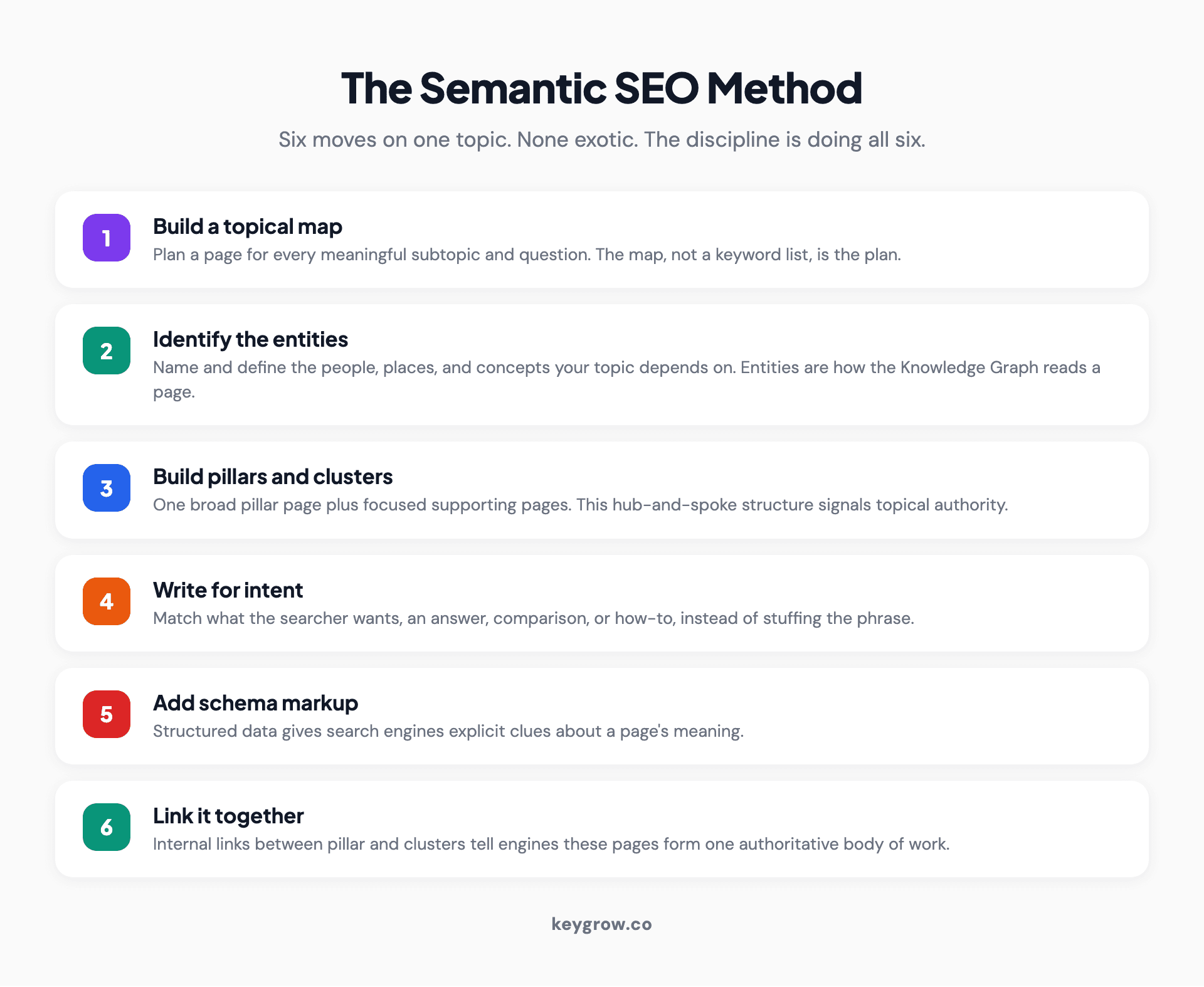
Six-step infographic of the semantic SEO method: build a topical map, identify entities, create pillar and cluster pages, write for search intent, add schema markup, and connect everything with internal links.
- Build a topical map. List every question and subtopic a person interested in your subject could have, then plan a page for each meaningful one. The map, not a keyword list, is the plan.
- Identify the entities. Find the people, places, concepts, and things your topic depends on, and make sure your content names and defines them. Entities are how the Knowledge Graph understands a page.
- Build pillars and clusters. Write one broad pillar page on the main topic and a set of focused supporting pages around it, each going deep on one subtopic. This hub-and-spoke structure is what signals topical authority.
- Write for intent. Match what the searcher wants, an answer, a comparison, a how-to, instead of stuffing the phrase. A page that fully satisfies the intent is the whole goal.
- Add schema markup. Structured data gives search engines explicit clues about the meaning of a page. Our free schema markup generator produces it without code.
- Link it together. Internal links between the pillar and its cluster pages tell search engines these pages form one authoritative body of work on the topic.
That is the entire "secret." It is the same semantic SEO that real practitioners and Google's own documentation describe, and it is what content marketing built around topics turns into rankings.
Semantic SEO vs traditional keyword SEO
The difference is the unit of optimization. Traditional SEO optimizes a page for a keyword. Semantic SEO optimizes a cluster of pages for a topic and the entities inside it.
| Traditional keyword SEO | Semantic SEO | |
|---|---|---|
| Optimizes for | A target keyword | A topic and its entities |
| Content unit | A single page per keyword | A pillar plus a cluster of pages |
| Success signal | Ranking for the phrase | Authority across the whole topic |
| Risk | Thin pages, keyword stuffing | Slower to build, needs real depth |
| Ages | Poorly as search gets smarter | Well, and feeds AI answers |
Neither is wrong, but the second matches how search works now. Backlinko's analysis of 11.8 million results found that content covering a topic in depth outperformed thin pages, while raw word count alone showed no correlation, the measurable version of "cover the topic, not the keyword."
Why entities and schema do the heavy lifting
Entities and structured data are how you translate your content into the language search engines index. They turn a page from text a machine guesses at into facts it can file with confidence.
Schema markup is no longer a nice-to-have. As of 2024, over 45 million domains use schema.org markup across more than 450 billion objects, and Google Research found 31.3 percent of a 10-billion-page sample carried schema, up from 22 percent a year earlier. Marking up your organization, articles, and products is table stakes, and it directly supports the rich results that come from schema. Entity clarity, consistent naming, and schema together are what let Google connect your site to the Knowledge Graph instead of treating it as anonymous text.
How does semantic SEO affect AI search?
This is where the method stops being optional. AI Overviews and answer engines are built to pull from content that is entity-rich and topically broad, which is exactly what semantic SEO produces.
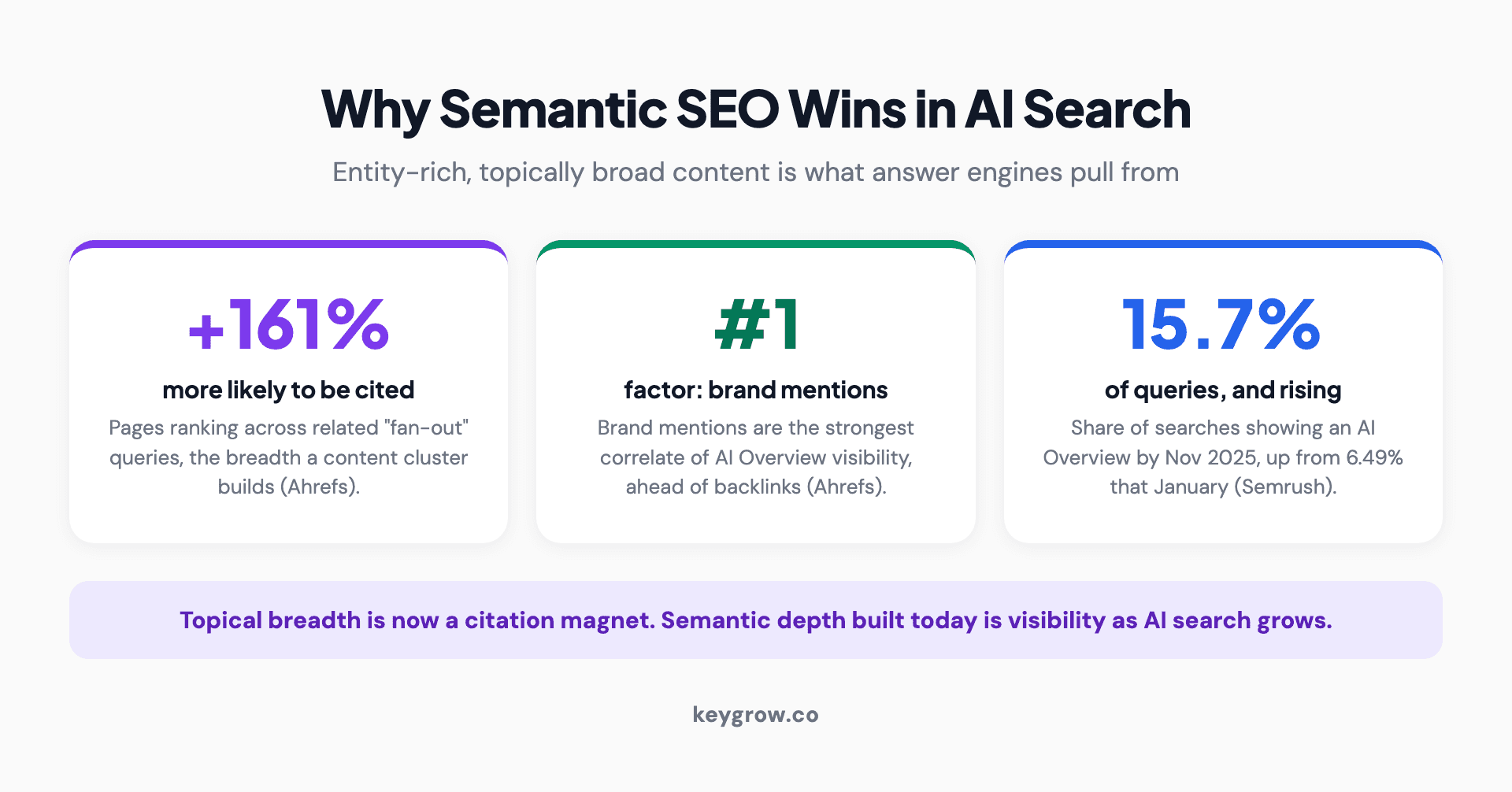
Stat infographic on semantic SEO and AI search: pages ranking across related fan-out queries are 161 percent more likely to be cited in AI Overviews, brand mentions are the top correlating factor, and AI Overviews appeared for 15.69 percent of queries by November 2025.
The data is direct. An Ahrefs study found pages ranking across related "fan-out" queries are 161 percent more likely to be cited in AI Overviews, and that brand-related signals are among the strongest correlates of AI Overview visibility. Topical breadth, the thing a content cluster builds, is now a citation magnet. And the surface is large and shifting: Semrush found AI Overview presence was volatile through 2025, climbing from 6.49 percent of queries in January to a peak of 24.61 percent in July before settling near 15.69 percent by November. Building semantic depth now is how you get cited as AI search expands, which is the core of answer engine optimization.
A note on the "Ben Stace" name: can you verify the expert?
Here is the part the other results will not tell you. We went looking for evidence that Ben Stace is the established semantic SEO authority the ranking pages describe, and we could not find it. The method is real. We could not find authoritative evidence supporting the credentials attached to this name.
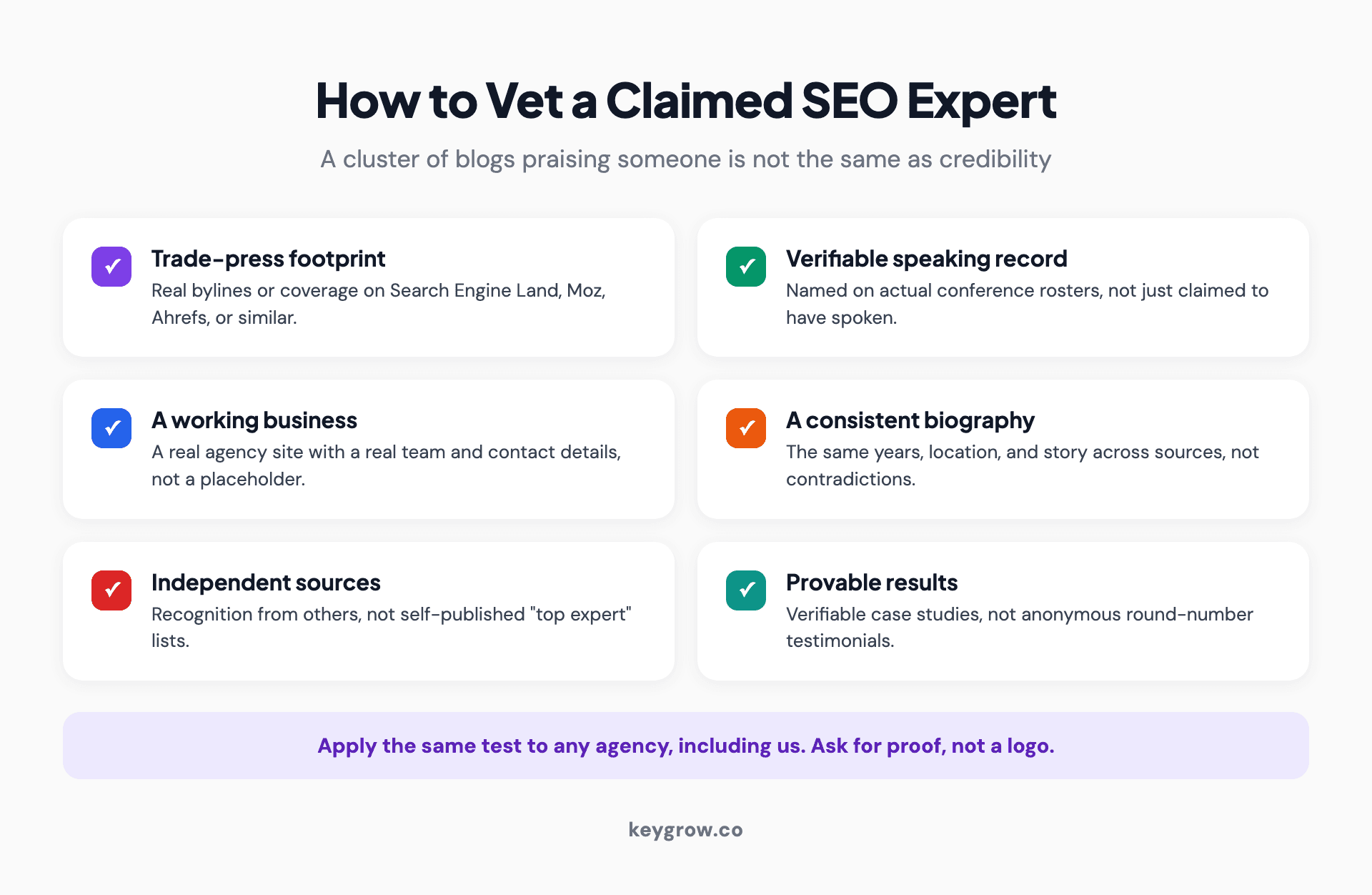
Checklist infographic for vetting a claimed SEO expert: look for a real presence on major SEO publications, verified conference appearances, a working agency with a real team, a consistent biography, and independent sources rather than self-referential ones.
What we found, as of mid-2026, stated plainly as what we could and could not verify:
- The flagship agency credited to him, "Eleven Bananas," loads as a near-empty placeholder with no team, no contact details, and a footer reading "Copyright testing," which is not what we would expect from an established consultancy's site.
- He does not appear on the published speaker roster for the 2024 Chiang Mai SEO Conference, despite claims that he spoke there.
- A search across Search Engine Land, Search Engine Journal, Moz, and Ahrefs, all of which cover semantic SEO heavily, returns nothing by or about him.
- The biography contradicts itself across the pages that promote him: in business "since 1998" in some, "over 15 years" in others, "UK-based" in most and "Melbourne-based" in at least one.
- The most authoritative-looking endorsement is a self-published "top experts" list whose author ranks himself one spot below the subject, which reads as reciprocal link-building rather than recognition.
We are not calling anyone a fraud, and a real person may well sit behind the name. What we are saying is that the evidence to support "internationally recognized semantic SEO expert" is not there, and a cluster of near-identical blog posts praising someone is not the same as credibility.
Here is the opinion that follows, and it applies far beyond one name: in SEO, when a claimed expert has no verifiable footprint, no bylines in the trade press, no conference record, and no agency you can confirm, what you are looking at is a marketing presence to be skeptical of, not a proven track record. The method outlives the persona. Learn the method; verify the person.
That makes this a useful drill. Before you trust any SEO "guru," check for a real presence in the industry press, a verifiable speaking or publishing record, a working business with actual people, and a story that stays consistent. Apply the same test to us. We would rather you ask for verifiable results than take a logo on faith, which is also the honest way to read whether any SEO work is actually working.
How long does semantic SEO take to work?
Months, like all SEO. Topical authority is a compounding asset: the first cluster pages get indexed in weeks, but the authority that lifts the whole topic builds over two or three quarters.
There is no shortcut here, and any "expert" promising fast topical authority is overselling, because real topical authority compounds slowly. Plan on the same realistic horizon as the rest of organic search, and measure it the same honest way: cluster coverage and entity diversity early, rankings and AI citations later.
FAQs
How does Ben Stace do semantic SEO, step by step?
The method attributed to him is standard semantic SEO: build a topical map, identify the entities in your subject, create pillar and cluster pages, write for search intent, add schema markup, and connect everything with internal links. It is a sound, widely-taught approach. It is not unique to any one person.
Is Ben Stace a real, verifiable SEO expert?
We could not verify the credentials. The flagship agency credited to him is an empty placeholder site, he is absent from the major SEO publications and the conference roster blogs say he spoke at, and his biography contradicts itself across the pages promoting him. A real person may exist behind the name, but the "recognized authority" claim is unsupported by independent evidence.
What is the difference between semantic SEO and traditional keyword SEO?
Traditional SEO optimizes one page for one keyword. Semantic SEO optimizes a cluster of pages for an entire topic and the entities within it, aiming for authority across the subject rather than a single ranking. Semantic SEO ages better and feeds AI answers, which reward topical depth.
What is a topical map and how do I build one?
A topical map is a plan of every subtopic and question around your subject, with a page assigned to each meaningful one. Build it by listing what someone interested in your topic needs to know, grouping those into a broad pillar and focused supporting pages, then covering each properly.
Why do entities and schema matter for rankings and AI Overviews?
Entities let search engines connect your content to the Knowledge Graph instead of treating it as anonymous text, and schema gives explicit clues about meaning. Both make your pages easier to understand, file, and cite, which matters more as AI Overviews favor entity-rich, topically broad content.
Can small businesses benefit from semantic SEO?
Yes, and a focused single-location business can usually build that tight cluster itself without hiring anyone. A small business does not need a hundred pages, it needs to cover its core topic well: the main service, the questions customers ask, and the local entities involved. A tight, well-linked cluster beats a pile of thin keyword pages at any size.
How do I tell whether semantic SEO is working versus an agency taking credit?
Watch leading indicators first: more pages indexed across the topic, rankings for a wider set of related queries, and appearances in SERP features or AI answers. Then watch traffic and leads. Anonymous testimonials and round-number case studies are not proof; query and entity coverage measured against a baseline is.
The short version
Whoever you credit it to, semantic SEO rewards the same thing: genuine, well-structured depth on a topic that both Google and AI engines can understand. The lesson worth keeping is the habit this question should leave you with. Take the method on its merits, and put every SEO expert, including the one in this title and including us, through the same test before you believe the headline.
If you want semantic SEO done by a team whose results and people you can actually verify, that is how our SEO service works. Tell us about your business and ask us to prove it.