

Yes, SEO services work, but that sentence is close to useless on its own, so let me be more honest. Do SEO services work the way they are usually sold (page one in 30 days, guaranteed rankings, traffic next month)? No. Done properly, SEO is a slow, compounding channel that earns real, trackable demand over many months, and there is hard data behind it: organic search drives 53 percent of all trackable website traffic, far ahead of paid. Done badly, or sold dishonestly, it can waste a year of your budget and occasionally damage your site. The difference is not luck. It is whether the work is real, and this post is about how to tell.
I am writing this for the reader who has been burned: six months paid, a monthly PDF full of impressions and "keyword movement," and a phone that never rang. That is common, and it does not mean SEO is a scam. It usually means you bought theater instead of work.
Do SEO services actually work? The honest answer
SEO works when the work is real and the timeline is realistic, and it fails when either is missing. It is one of the highest-return channels that exists, and also the easiest to fake, which is why so many people conclude it does not work.
Here is the proof point I trust most, because it is ours. A doctor's practice in Dubai committed to SEO for a full year. Months one through three looked unremarkable from the outside. By month twelve, organic traffic had grown 1,519 percent and the practice was fielding more than 130 patient calls a month. Same site, same client, no shortcuts, just consistent technical fixes, content, and authority building.
That is what working SEO looks like: quiet for a quarter, then compounding into something that pays rent. But notice the timeline. Anyone who promised that practice page one in 30 days would have been lying, so "does SEO work" and "does it work on the timeline you were sold" are two different questions. Most disappointment lives in the gap. The money side (whether the spend pays back) is a separate question we cover in whether SEO services are worth it. This post stays narrow: is the work real, and how would you know.

A person at a desk reviewing printed reports and paperwork with a calculator and phone, checking the numbers behind the work.
What real, working SEO looks like (and the proof to ask for)
Real SEO produces movement you can measure in your own analytics and your own phone log, not just in your agency's report. If the only place the results exist is a slide deck, be suspicious.
Working SEO leaves fingerprints. Rankings climb for terms that have buyers behind them, the phrases people type right before they spend money, not the easy ones nobody searches. Organic sessions rise in Google Analytics and Search Console, two tools you own. Then comes the part that actually matters: more people call, book, or fill a form because they found you. Our local clients measure this in calls: a phone repair shop reached 115 monthly calls in seven months, a junk removal company 50 monthly calls in six months. None had meaningful inbound calls before the work.
So when an agency says it is working, ask for proof you can verify yourself: Search Console impressions and clicks for your money keywords, the specific pages that gained traffic and the queries that drove them, and leads tied to organic rather than lumped in with everything else. We go deeper in how you can tell your SEO is working, but real work shows up in tools you control.
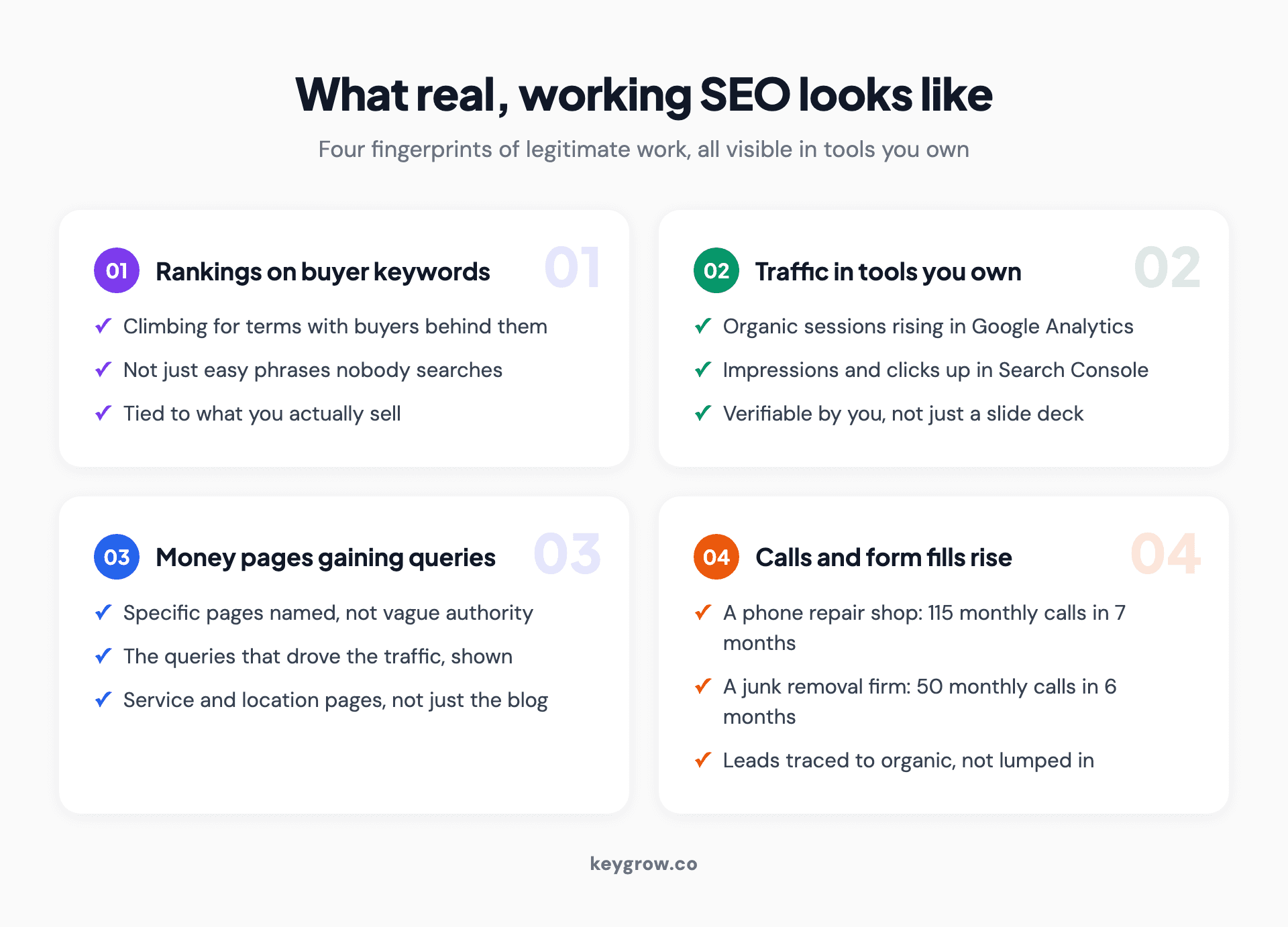
Four signals that real SEO work is happening: rankings on buyer keywords climbing, organic traffic rising in tools you own, money pages gaining queries, and calls or form fills increasing.
Why so much SEO does not work (and it is not always the agency)
A lot of SEO fails for reasons that have nothing to do with effort. Sometimes the agency is lazy or dishonest. Just as often the strategy was wrong, the timeline was unrealistic, or the business changed direction and reset the clock.
The patterns we see most: the campaign chased vanity keywords that rank easily but bring zero buyers, so traffic rose and the phone stayed silent. The client quit at month three, exactly when SEO is at its ugliest, paying for the hard part and leaving before the payout. The work was real but slow because the site started in a deep hole. Or the business kept changing its services and locations, which scatters the topical focus search engines need to trust you.
Here is my one strong opinion. Vanity-metric reporting is the single biggest reason people think SEO does not work. Impressions and "engagement" do not pay rent, and when a report opens with them instead of leads, that is usually a sign the leads are not there to report. For the timeline issue specifically, we wrote a whole piece on why SEO takes so long, because that is where most of these failures start.
When SEO does NOT work, no matter who you hire
Some businesses should not buy SEO at all, and no agency can change that. If there is no real search demand for what you sell, or you need customers this week, or your margins cannot survive a multi-month payback, SEO is the wrong tool and an honest agency will say so.
That last point is also where DIY beats hiring anyone. A single-location business with more time than money should claim its Google Business Profile, gather reviews, and fix the obvious site basics before paying a soul. The case for doing it yourself, and where it goes wrong, is in why DIY SEO can fail. We turn away businesses that fit these cases, because selling them SEO would be selling theater.

Two people in an honest consultation across a table with a laptop, the kind of conversation about whether SEO is the right fit.
How to tell legitimate SEO from snake oil
The fastest way to spot fake SEO is to listen for guarantees. Google states plainly that no one can guarantee a number one ranking, and it specifically warns to beware of anyone who promises rankings, claims a special relationship with Google, or sells a "priority submit." Those are the snake oil tells.
Take that seriously, because Google does. In its own guidance, Google warns that hiring an unethical SEO can cause a negative adjustment of your site's presence, or even removal from the index. So bad SEO is not just wasted money. It can actively harm you, and the Google guidance on hiring is worth ten minutes before you sign anything.
The pattern in practice: legitimate SEO sounds boring and specific, talking about your buyers, your conversions, and a realistic timeline, and reporting on outcomes you can verify. Snake oil sounds exciting and vague: guaranteed rankings, secret techniques, hundreds of backlinks for a flat fee, and reports thick with metrics that never connect to money.
One more tell worth its own line. An agency that locks you into a twelve-month contract is making a confession. If the results were doing the convincing, they would not need the paperwork. We are month-to-month and cancel anytime, because the work has to keep earning the relationship.
How long before you can tell if it is actually working?
You can usually tell whether SEO is on the right track within three to six months, and whether it is winning by month nine to twelve. Anyone promising clear proof in 30 days is either targeting keywords nobody searches or about to burn your domain.
The honest timeline has stages. Months one to three are leading indicators: technical issues fixed, new pages indexed, impressions starting to rise in Search Console, a few easy keywords beginning to move. Not revenue yet, but proof the work is real. Months four to six, traffic on real buyer keywords should climb and the first organic leads appear. By months nine to twelve, a sound strategy should be producing meaningful, trackable demand, the way that doctor's practice hit 1,519 percent growth at the twelve-month mark.
So the test is not "did I get results in 30 days." It is "am I seeing the right leading indicators on schedule." If three months in there is no movement in impressions, no new indexed pages, and no plan you can see, that is your early warning, long before the twelve-month verdict. The reason the wait is worth it, per the Search Engine Land data putting organic at 53 percent of trackable traffic, is that the payoff is large when the work is real.
A 10-minute test to check if your current SEO is real
If you already pay for SEO and are not sure it is real, run this five-step check. You need only Google Search Console access and your agency's last report. It separates real work from billable theater faster than any sales call.
1. Open Search Console yourself. Look at the last three to six months of impressions and clicks. A real campaign moves these on terms with buyers. Flat lines on money keywords after months is a problem.
2. Find the pages. Ask which specific pages gained traffic and which queries drove them. A real agency answers in minutes with screenshots. "Overall authority is improving" is a tell.
3. Trace one lead. Pick a recent customer and ask how organic contributed. If nobody can connect any lead to search after months, the work may not be reaching buyers.
4. Read the report for money words. Does it lead with cost per lead, calls, and revenue, or with impressions and "engagement." Vanity-first reporting is where you catch the problem.
5. Check for guarantees and lock-ins. Re-read your contract. Any guaranteed-ranking language or a multi-month lock-in is a red flag, per Google's own warnings.
Pass this test and keep going, you are in the slow-then-good part. Fail three or more and you are likely paying for theater, and it is time for a hard conversation or a new provider.
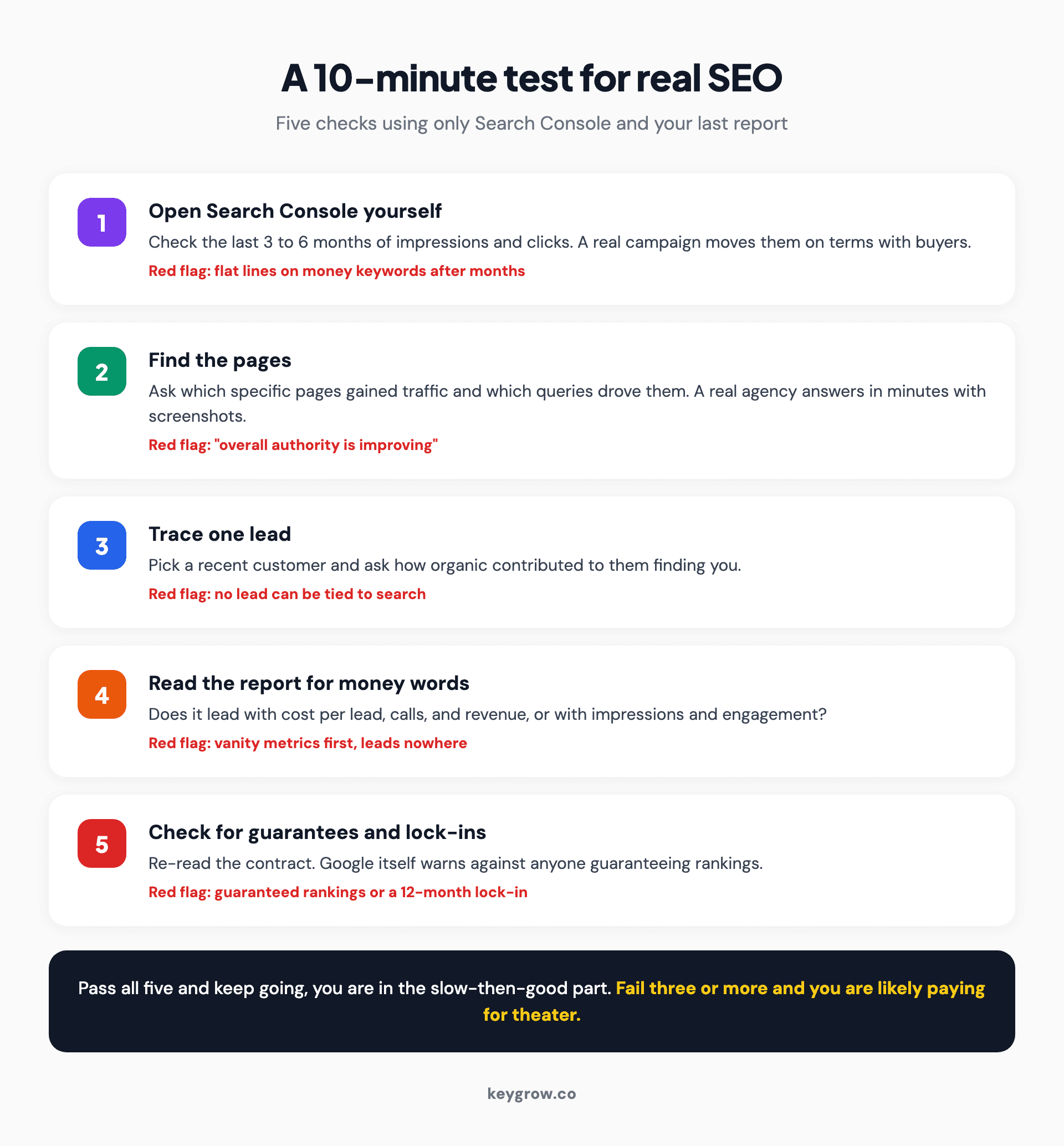
A ten-minute SEO reality test in five numbered steps: open Search Console, find the pages that gained traffic, trace one lead to organic, read the report for money words, and check the contract for guarantees and lock-ins.
FAQs
Is SEO a scam?
No, SEO itself is not a scam, but plenty of SEO selling is dishonest. Real SEO is a legitimate, slow, compounding channel that drives most trackable web traffic. The scam is when an agency promises fast guaranteed rankings and delivers vanity reports instead of leads. Judge the provider, not the channel.
How long does it take to see if SEO is working?
You can usually tell within three to six months whether SEO is on the right track, by watching leading indicators like indexed pages, rising impressions, and a few keywords starting to move. Clear revenue results typically take nine to twelve months; our strongest organic case took a full twelve months to reach 1,519 percent traffic growth.
Can anyone guarantee a number one ranking on Google?
No. Google states plainly that no one can guarantee a number one ranking and warns to beware of anyone who claims they can. Rankings depend on factors outside any agency's control, including competitors and Google's own changes. A guaranteed-ranking promise is one of the clearest red flags in the industry.
Why isn't my SEO working after months of paying for it?
The most common causes are chasing keywords with no buyers, an agency reporting vanity metrics instead of leads, or a timeline that was unrealistic from the start. Sometimes the work is real but slow because the site started from a weak position. Run the ten-minute reality test in this post to find out which it is.
Does SEO still work in 2026 with AI Overviews?
Yes, but the goal shifted from ranking to being the source the answer engines cite. AI Overviews and tools like ChatGPT pull short passages from pages they trust, so answer-first, well-structured content matters more than ever. Sites that bury the answer and pad word count are hurt by this shift, not helped.
How much do legitimate SEO services cost?
Costs vary widely by market, competition, and scope, so any single number would be misleading. What matters more than the sticker price is whether the engagement is outcome-focused and free of long lock-in contracts. We cover the value question, whether the spend pays back, in our separate post on whether SEO services are worth it.
What are the red flags of a bad SEO company?
Watch for guaranteed rankings, claims of a special relationship with Google, secret techniques, hundreds of cheap backlinks, and twelve-month lock-in contracts. Reports that open with impressions and engagement instead of leads and revenue are another big one. Google itself warns that unethical SEO can get your site penalized or removed from the index.
Can I tell if my SEO agency is actually doing anything?
Yes, and you do not need technical skill to do it. Open Google Search Console yourself, ask which specific pages gained traffic and which queries drove them, and check whether any real lead can be traced to organic. A legitimate agency answers these in minutes with verifiable proof. Vague answers are the tell.
Where this leaves you
SEO works, but only when the work is real and the timeline is honest, and most of the disappointment in the industry comes from one or both being missing. Real SEO is quiet for a quarter and compounding after a year, it shows up in tools you control, and it leads with leads, not impressions. Snake oil promises fast guaranteed rankings and reports on metrics that never reach your bank account.
If you take one thing from this, take the ten-minute test. Open Search Console, look for movement on keywords that have buyers, and ask your provider to connect their work to a real lead. The answer tells you most of what you need to know.
If you run that test and the picture is murky, that is the conversation we are good at. We are month-to-month, we will tell you honestly when SEO is the wrong tool, and we will show you proof in tools you own. Get started here and we will take a look with you.


