

Are SEO services worth it? For most businesses whose customers search Google before they buy, yes, because organic search is the largest single source of website traffic and the rankings you earn keep paying after you stop spending. But it is not worth it for everyone, and any honest answer depends on three things: whether people actually search for what you sell, whether you can wait a few months for the payoff, and whether you have the budget to do it properly rather than halfway.
That last part is where most "is SEO worth it" articles go quiet, because nearly all of them are written by SEO agencies that reach the same conclusion: yes, now hire us. This one is written by an agency too, so read it with that in mind. The difference is that we are going to tell you exactly when SEO is the wrong spend, give you the numbers to run the decision yourself, and let you reach your own verdict.
What you are paying for
When you buy SEO services, you are paying to rank higher in search results for the terms your customers type, and to keep ranking without paying for every click. That is the whole product. Everything else, the audits, the content, the link building, is just how you get there.
The reason it is worth paying for comes down to where attention goes. BrightEdge research has put organic search at 53 percent of all trackable website traffic, the single largest channel and more than three times the share paid search pulls. And within those results, position is everything: Backlinko's study of around 4 million results found the number one organic result earns a 27.6 percent click-through rate, the highest of any position. Buying SEO is buying a shot at that real estate.
The other half of the value is that it compounds. A paid ad stops the day you stop paying. A page you rank keeps bringing visitors next quarter at no extra cost per click, the authority you build makes the next page rank faster, and the traffic gets cheaper per visit the longer you hold it. SEO is slow to start for the same reason it lasts: you are buying an asset, not renting attention. If you want the full explanation of why that timeline runs in months, we wrote why SEO takes so long separately.
What SEO services cost
SEO typically costs from $500 a month for a freelancer or light local engagement to $10,000 and beyond for competitive national campaigns, sold as a monthly retainer, an hourly rate, or a per-project fee.
This is the number that decides "worth it" for most people, so here it is plainly.
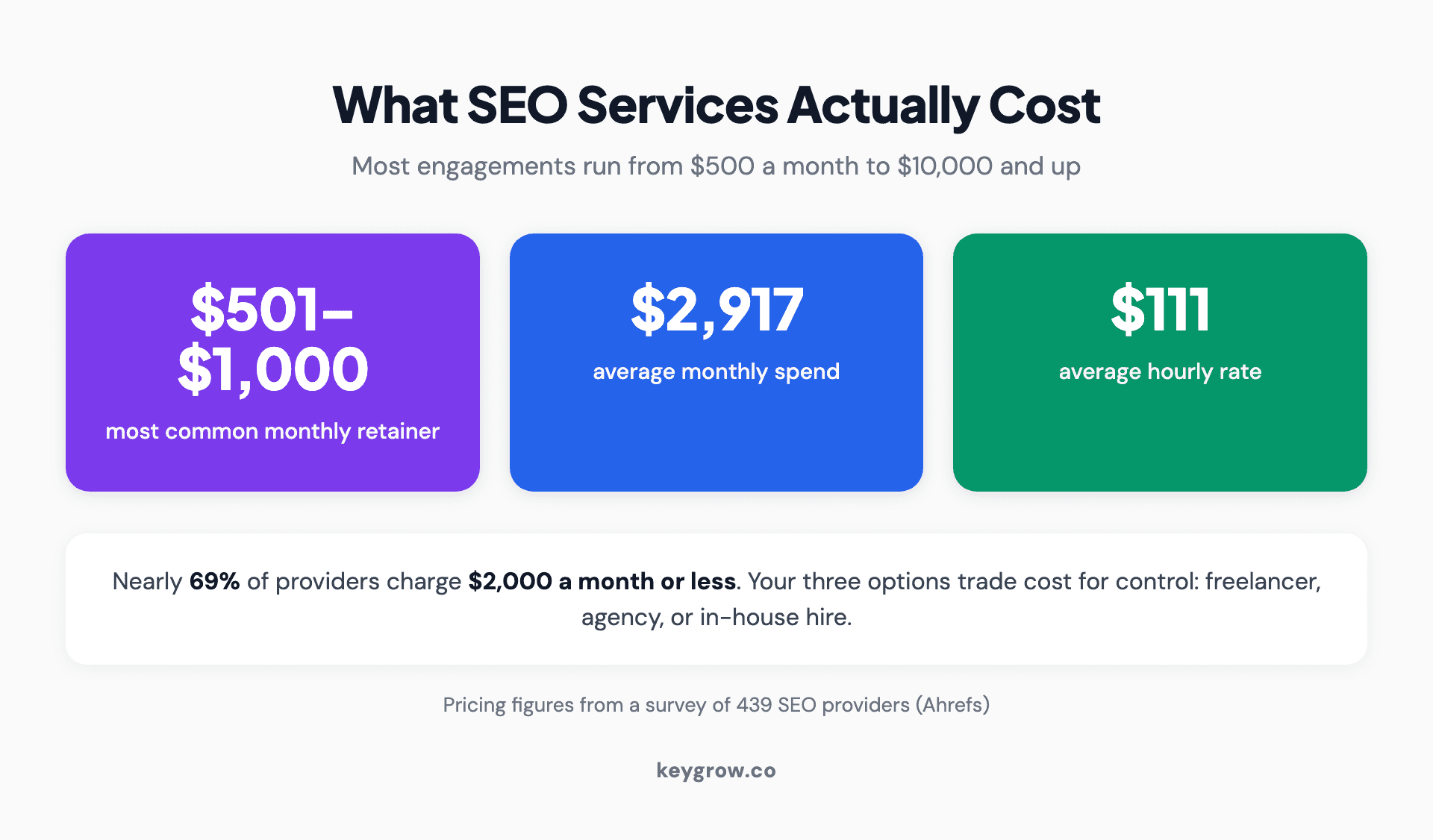
Infographic showing typical SEO pricing: most common monthly retainer of 501 to 1,000 dollars, average monthly spend of 2,917 dollars, and average hourly rate of 111 dollars.
Ahrefs' pricing survey of 439 providers found that 68.8 percent charge a monthly retainer of $2,000 or less, with $501 to $1,000 a month the single most common bracket. The average monthly spend across all respondents was $2,917, and the average hourly rate was $111. So the honest range is roughly $500 a month for a freelancer or light local engagement up to $10,000 and beyond for competitive national campaigns.
Your three buying options each trade cost against control. A freelancer is cheapest and fine for a single, focused need, but capacity is thin. An agency costs more and brings a team across technical, content, and links, which is what competitive niches need. An in-house hire only makes sense once SEO is core to your business, because one good SEO salary dwarfs most retainers. A common and sensible path is to test with a freelancer or agency before committing to a hire.
The ROI math you can run yourself
Forget the vague "great ROI" claims. Whether SEO is worth it for you is arithmetic you can do in five minutes, and you should do it before signing anything.
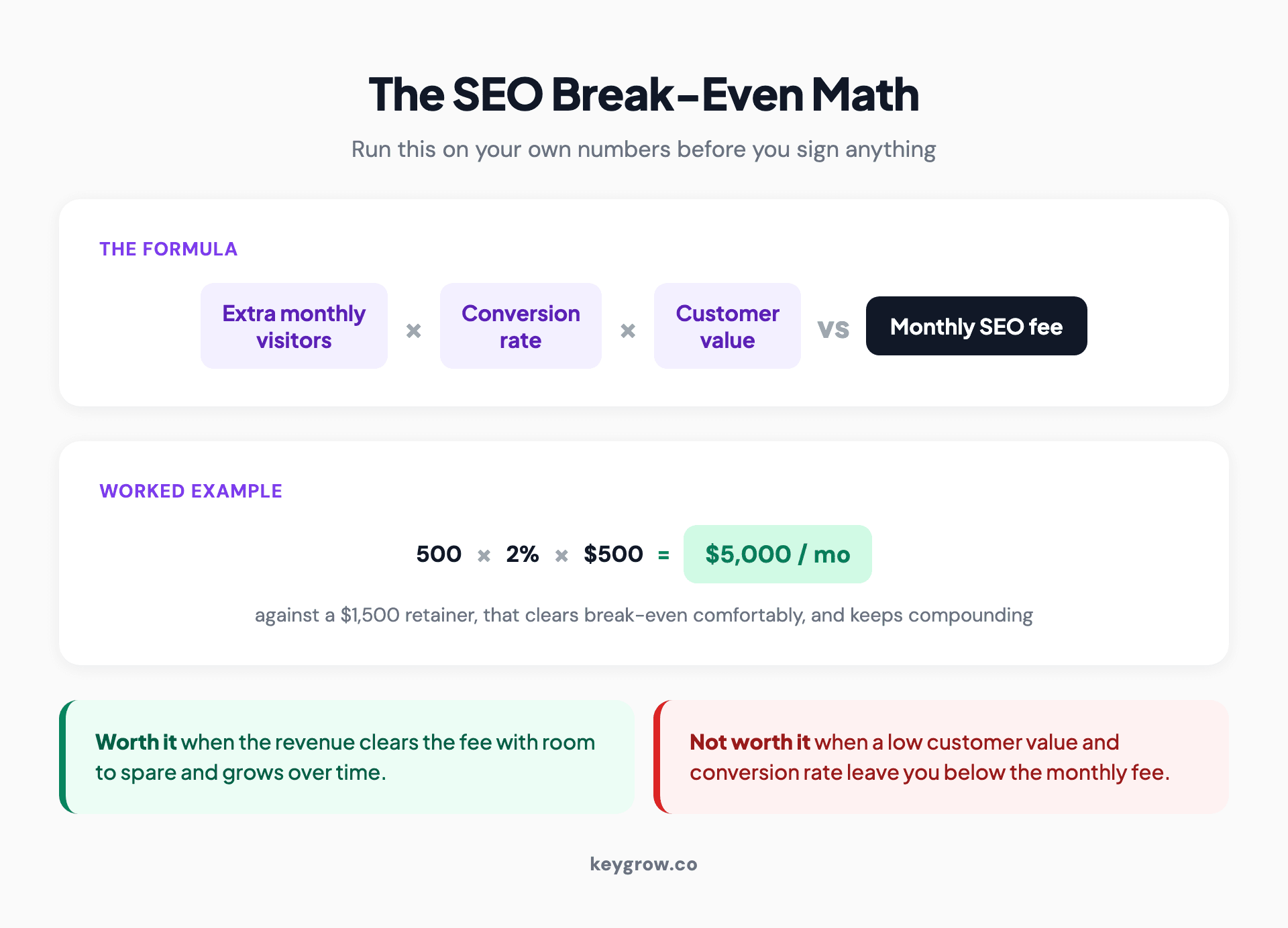
Infographic showing the SEO break-even formula: extra monthly visitors times conversion rate times average customer value, compared against monthly SEO spend, with a worked example.
Here is the formula. Take the extra monthly visitors SEO could realistically bring, multiply by your conversion rate, multiply by the average value of a customer. That is your added monthly revenue. Compare it to the monthly fee.
Here is a worked example: say SEO gets you 500 extra visitors a month within a year, and a 2 percent conversion rate turns that into 10 new customers. If a customer is worth $500 to you, that is $5,000 in new revenue a month against, say, a $1,500 retainer. That clears break-even comfortably, and it keeps compounding. Now run it with your own numbers. If your customer is worth $50 and converts at half a percent, the same traffic produces $125 a month and SEO is not worth it at that price. The math, not the salesperson, should decide.
This is also why measuring matters once you start. If you cannot tell whether the work is moving the numbers, you cannot tell whether it is worth it, which is why we wrote how to know your SEO is working.
Who SEO is worth it for
SEO pays off best for local services, e-commerce, B2B, and professional services, where customers search and a sale is worth waiting for. It rarely pays for no-budget startups or social-first products.
The verdict changes a lot by business type, mostly driven by one question: do your customers search for what you offer, and is a customer worth enough to justify the wait?
| Business type | Is SEO worth it? | Why |
|---|---|---|
| Local service business | Usually yes | High-intent local searches, low competition, a single call can pay for months |
| E-commerce | Often yes | Buyers search for products constantly, though margins and competition decide the math |
| B2B and professional services | Often yes | High customer value means even modest traffic pays back fast |
| SaaS and software | Yes, with patience | Big search demand but competitive, so it is a longer game |
| Brand-new startup, no budget runway | Often no | You need leads now and cannot wait two quarters for compounding |
| Social-first or impulse products | Frequently no | Demand lives on social feeds, not in the search bar |
If you land in the top half of that table, the question is not whether to do SEO but how well. If you land in the bottom half, read the next section before you spend a dollar.
When SEO is not worth it
SEO is the wrong spend when you need leads this month, you are running a one-off campaign, you have no budget runway, or nobody searches for what you sell.
Here is the part the agency articles skip. SEO is genuinely the wrong spend in several situations, and we will talk a business out of it when one applies, because selling SEO that cannot pay back is how agencies earn bad reviews.
Do not buy SEO if you need leads this month. It does not work that fast, full stop, and paid ads are the right tool for urgent demand. Do not buy it for a one-off event or a time-limited promotion, because the rankings will arrive after the event is over. Skip it if you are a pre-product-market-fit startup with no runway, since you cannot afford to wait two quarters to find out if the offer even works. And skip it if nobody searches for what you sell, whether because the product is brand new and has no search demand yet, or because your audience discovers things by scrolling a social feed rather than typing a query. In those cases, your money does more in ads or social, and a good agency will tell you so.
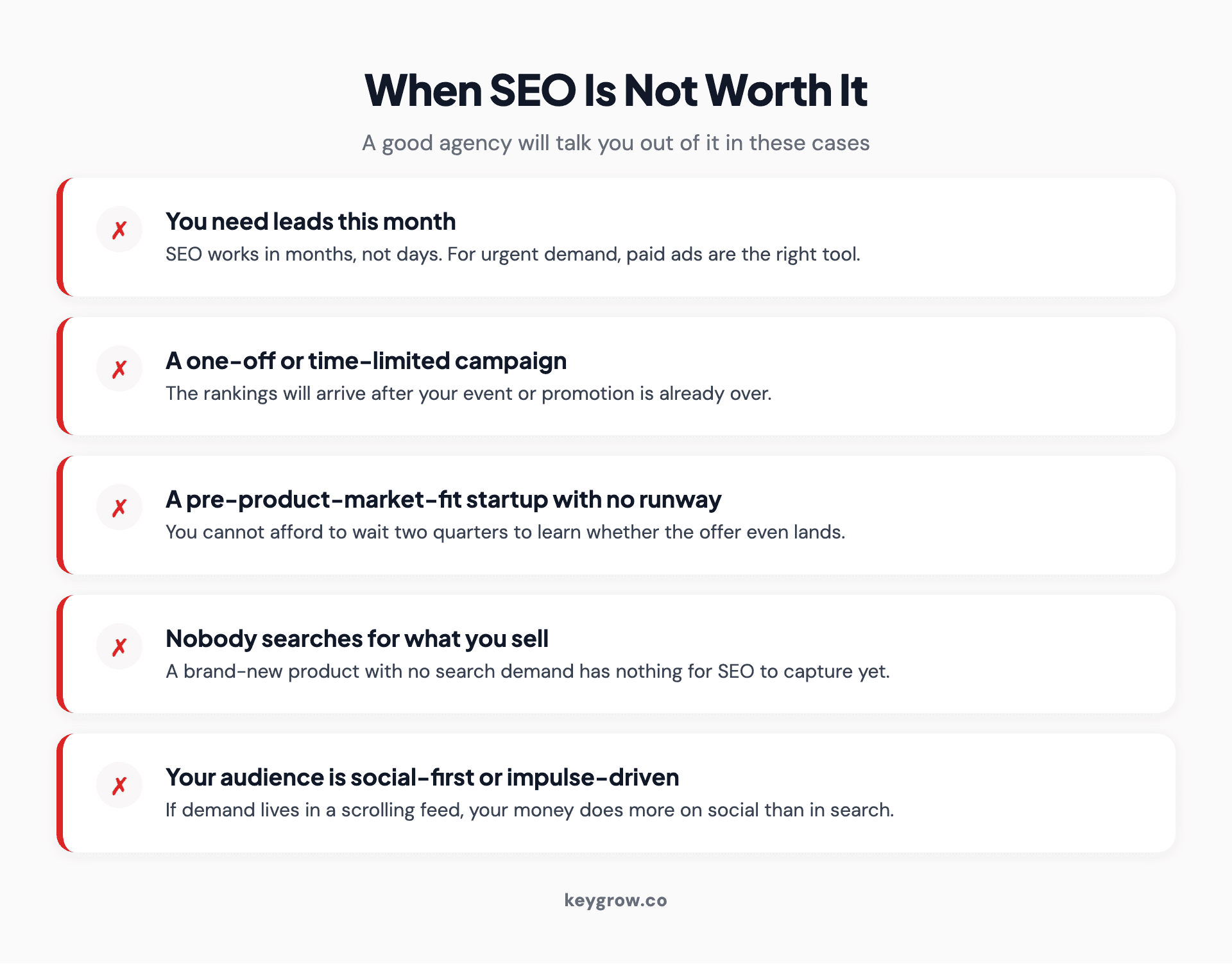
Infographic listing five situations when SEO is not worth it: needing leads this month, one-off event campaigns, pre-product-market-fit startups, products nobody searches for, and social-first audiences.
The thread running through all of these is the same: when the search demand, the patience, or the budget to do it right is missing, no agency can make SEO pay, and a good one will say so before taking your money.
Is SEO dead because of AI?
No. AI Overviews cite the pages that already rank, so strong organic SEO is what makes your page eligible to appear in AI answers. The work matters more, not less.
This is the objection of 2026, so let me settle it. SEO is changing shape rather than dying, and the businesses that adapt are pulling ahead of the ones waiting for it to "come back."
AI Overviews and answer engines do not replace organic search so much as sit on top of it, and they cite the pages that already rank. seoClarity found that 94 percent of AI Overviews include at least one URL from the top 20 organic results, and that 56 percent of all AI Overview citations come from pages ranking in the top 20. In other words, strong organic SEO is exactly what makes a page eligible to be quoted in an AI answer. The skill is broadening from ranking links to also earning citations, which we treat as its own discipline in AI search optimization, but the foundation is the same SEO work. Pulling your SEO budget because of AI is like pulling your foundations because you are worried about the roof.
Is SEO better than paid ads?
Neither wins outright. They run in sequence: ads deliver traffic today at a cost that never drops, while SEO takes months but then keeps delivering cheaper over time.
SEO and paid ads run in sequence rather than competition. Ads buy you traffic today at a cost that never drops; SEO earns it cheaper over time and keeps it. Most companies that get this right keep ads running for immediate leads while SEO compounds in the background, then let organic take over the cheap, durable traffic.
Are SEO agencies worth it, and how do you vet one?
A good agency is worth it; a bad one is worse than doing nothing, because you pay and lose months. Vet for proof, transparency, and ownership of your assets.
A good one is worth it, a bad one costs you the fee and the months. Vet hard. Be suspicious of anyone guaranteeing a specific ranking or "page one in 30 days," ask for case studies in your industry, and make sure you own your site, content, and analytics. If you are a single-location business with time to learn, some of this is genuinely DIY-able, and we laid out the honest trade-offs in why DIY SEO can fail.
We saw the worth-it case play out with HomeLink Properties, a home-buying company in Missouri that was invisible in local search. A focused local SEO push took them from around 120 organic visitors a month to 900, and to more than 90 seller calls a month, generating over $70,000 in business inside seven months. For a business where one closed deal is worth thousands, that math was never close. For a business where it would not have been, we would have said so.
FAQs
Are SEO services worth it for a small business in 2026?
For most small businesses whose customers search online, yes. Local service businesses in particular tend to see strong returns because local searches are high-intent and a single new customer can cover months of cost. It is not worth it if you need leads immediately, sell something nobody searches for, or cannot fund the work for at least six months. If the question is specifically whether to bring in an agency, our guide on [whether hiring an SEO company is worth it](/blog/is-hiring-an-seo-company-worth-it) runs the numbers.
How long does it take to see results from SEO?
Most businesses see meaningful results in four to twelve months, with new or competitive sites at the longer end. This is the main reason SEO is not suited to urgent needs. If you need leads this month, paid ads are the better tool while SEO builds in the background.
How much do SEO services cost per month?
A pricing survey of 439 providers found most charge $2,000 a month or less, with $501 to $1,000 the most common bracket and an average around $2,917. Freelancers and light local work sit at the lower end, while competitive national campaigns run into five figures.
Is SEO worth it compared to running paid ads?
They do different jobs. Ads deliver traffic instantly but stop the moment you stop paying. SEO takes months but keeps delivering afterward and gets cheaper per visit over time. For most businesses the answer is both: ads for now, SEO for later, rather than choosing one.
Is SEO still worth it now that AI answers questions directly?
Yes. AI Overviews cite the pages that already rank well, with studies finding the large majority of AI answers pull from the top organic results. Strong SEO is what makes your page eligible to be cited, so the work still matters, it just now also targets AI citations alongside rankings.
When is SEO not worth the money?
When you need leads immediately, when you are running a one-off or time-limited campaign, when you are a pre-product-market-fit startup with no runway, or when nobody searches for what you sell. In those cases the rankings arrive too late or never get the demand they need, and your budget works harder elsewhere.
How do I calculate the ROI of SEO for my own business?
Multiply the extra monthly visitors SEO could bring by your conversion rate, then by the average value of a customer. That is your added monthly revenue. Compare it to the monthly fee. If the revenue clears the cost with room to spare, SEO is worth it, and the gap only widens as it compounds.
Should I hire an SEO agency, a freelancer, or do it in-house?
A freelancer is cheapest and fine for a single focused need. An agency brings a full team and suits competitive niches. An in-house hire only pays off once SEO is core to your business, since the salary exceeds most retainers. Many businesses test a freelancer or agency first, then bring it in-house if SEO becomes central.
The short version
Run the break-even number on your own business before anything else. If a customer is worth real money to you and you can wait a couple of quarters for the payoff, the answer is almost always yes, and the returns compound in a way ads never do. If the math comes up short, no agency can bend it, and the honest move is to spend the money where it works harder. The arithmetic will tell you the truth faster than any sales call.
If you want a straight answer about whether SEO is worth it for your specific situation, that is a conversation we are happy to have, including talking you out of it if the numbers do not work. Our SEO service starts there. Tell us about your business and we will run the math with you.


