


AI search optimization is the practice of structuring your content, website, and brand so AI-powered search tools like Google AI Overviews, ChatGPT, Perplexity, and Claude can find, trust, and cite you in their answers. It builds on traditional SEO but adds a new goal: instead of just ranking a page in a list of blue links, you want to be the source the AI quotes when it answers a question.
This matters more every month. People now ask a chatbot or an AI summary instead of scrolling through ten results. The answer shows up at the top, sourced from a handful of pages. If your page is one of them, you win attention and trust. If it isn't, you're invisible on that query, even if you rank well in classic search.
This guide explains how AI search works, how AI search optimization differs from regular SEO, the tactics that actually move the needle, and how to measure whether any of it is working.
What is AI search optimization?
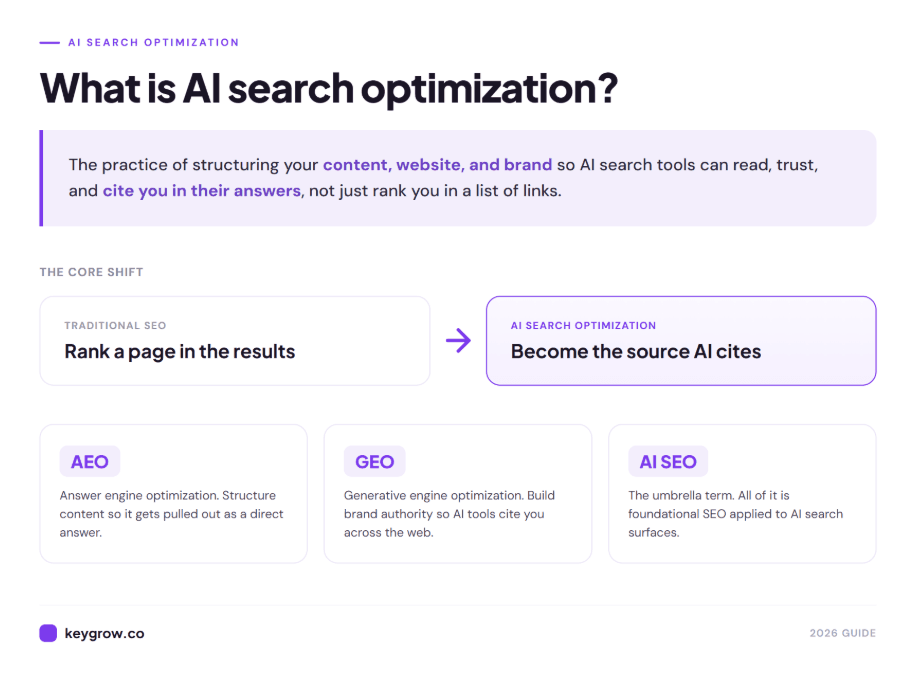
Infographic defining AI search optimization, showing the shift from ranking a page to becoming the source AI cites, with AEO, GEO, and AI SEO explained
AI search optimization is the work of making your content easy for AI search engines to read, extract, and cite. The aim is to get your brand named or linked inside AI-generated answers, not just listed on a results page.
It goes by a few names. You'll see it called AEO (answer engine optimization), GEO (generative engine optimization), and sometimes AI SEO or LLMO. The terms overlap heavily, and the differences are mostly about emphasis. AEO leans toward on-page structure and answering specific questions. For the full contrast, see how AEO differs from traditional SEO. GEO leans toward brand authority and getting cited across multiple AI tools. In practice, you do both at once.
Here's the simplest way to think about it. Traditional SEO answers the question, "How do I rank this page?" AI search optimization answers a different one: "How do I become the source an AI trusts enough to repeat?"
How AI search is different from traditional search
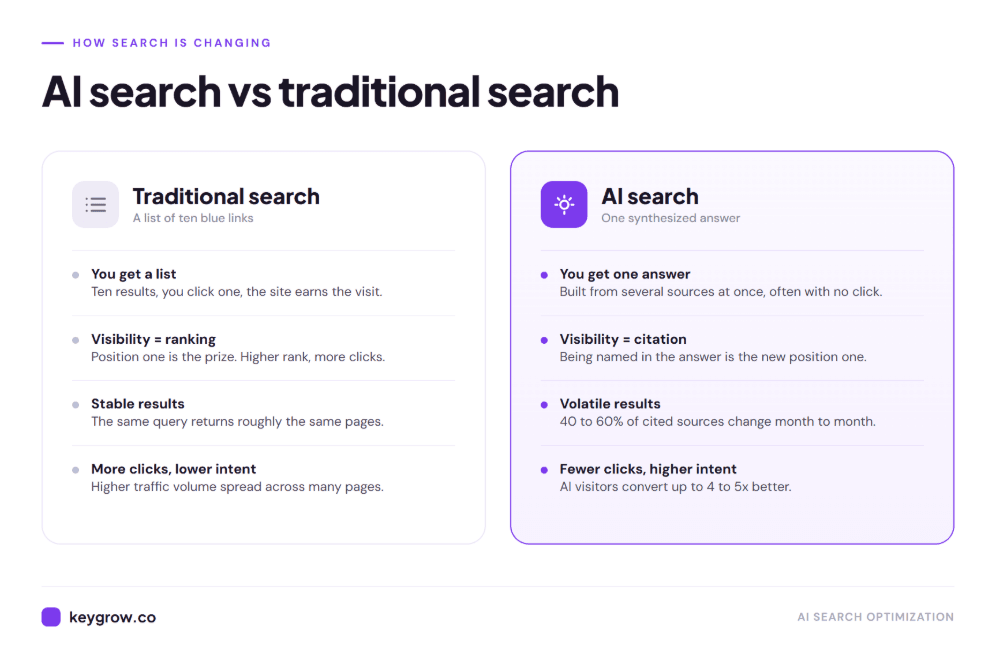
Side-by-side comparison of traditional search versus AI search across results format, visibility, stability, and click behavior
Classic Google search returns a list. You type a query, you get ten links, you click one. The website earns the visit, and you find your answer there.
AI search collapses that. Instead of a list, you get a synthesized answer built from several sources at once. The AI reads the web, pulls relevant facts, and writes a single response. It may cite the sources it used, often with small links, but the user frequently never clicks. Their answer is already on the screen.
This creates the "zero-click" problem. According to SparkToro's research, close to 58% of Google searches now end without any click to an external site. When Google's full AI Mode is active, that figure climbs far higher. The user gets what they need from the answer box and moves on.
Three things change because of this:
The unit of visibility shifts from ranking to citation. Being named inside an AI answer is the new position one. Data published by Digital Applied in March 2026 found that brands cited inside Google AI Overviews earned roughly 35% more organic clicks than competitors who weren't cited on the same query.
The traffic gets smaller but better. Fewer people click, but the ones who do tend to be further along. The Washington Post reported that visitors arriving from AI platforms converted to subscriptions at four to five times the rate of visitors from traditional search. Semrush found a similar pattern, with AI search visitors converting around 4.4 times better on average.
Visibility becomes less stable. AI answers change constantly. EMARKETER reported that somewhere between 40% and 60% of cited sources shift month to month across Google AI Mode and ChatGPT. A page cited today might be dropped next week, so this is ongoing work, not a one-time fix.
How AI search engines actually work
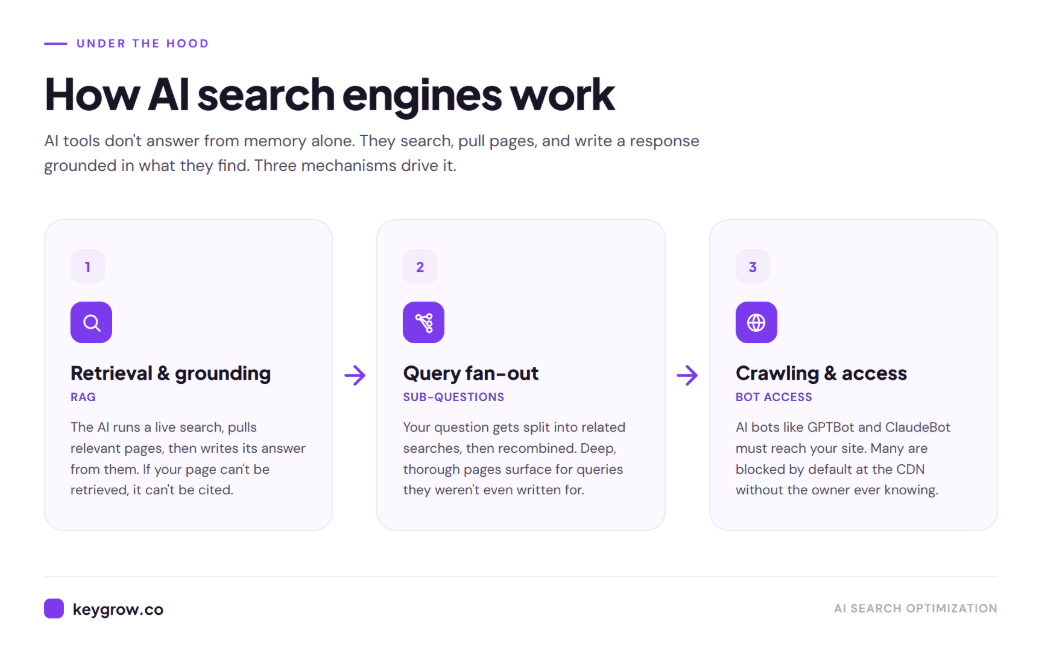
Three-step flow diagram showing how AI search engines work: retrieval and grounding (RAG), query fan-out, and crawling and access
To optimize for AI search, it helps to understand the machinery underneath. Most modern AI search tools share two core mechanisms.
Retrieval and grounding (RAG)
AI search engines don't answer purely from memory. They use a method called retrieval-augmented generation, or RAG, which Google also calls "grounding."
When you ask a question, the system runs a live search, pulls a set of relevant pages, and then writes its answer based on what it found. The language model is the writer, but the retrieved web content is the source material. This is why your page still needs to be indexed and findable. If the AI can't retrieve your content, it can't cite you, no matter how good the content is.
Query fan-out
The second mechanism is query fan-out. Instead of searching for your exact words, the AI breaks your question into several related sub-questions, searches each one, and combines the results.
Ask "best way to market a dental practice" and the system might quietly search for local SEO for dentists, Google Ads costs for dentists, patient review strategies, and more, then stitch the findings together. This has a useful side effect: a page can get surfaced for queries it was never directly written for, as long as it covers the topic with real depth. Thin pages that target one keyword tend to lose here. Thorough pages that cover a topic from several angles tend to win.
Crawling and access
Finally, AI tools have to be able to reach your site at all. They use their own crawlers, separate from Googlebot. And here's a problem many sites don't know they have: some hosting and CDN providers, including Cloudflare, started blocking AI crawlers by default. If your robots.txt or CDN settings block bots like GPTBot, ClaudeBot, or PerplexityBot, you can be completely invisible to those tools without realizing it.
The main AI search platforms in 2026
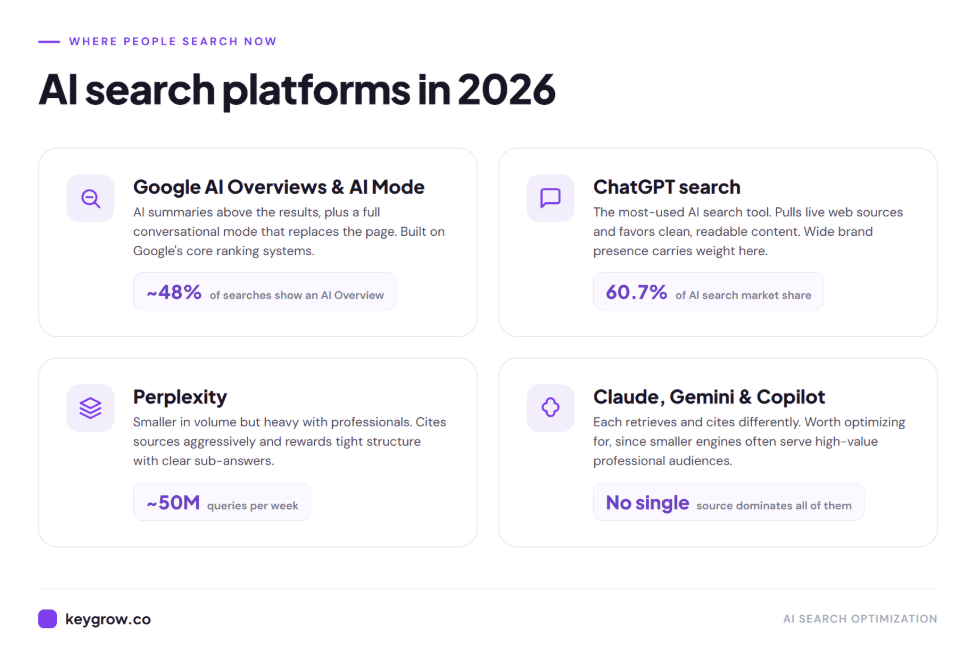
Grid of major AI search platforms in 2026: Google AI Overviews and AI Mode, ChatGPT, Perplexity, and Claude, Gemini and Copilot, each with a key usage statistic
AI search isn't one product. It's a handful of tools, each with its own habits. Optimizing well means understanding where they differ.
Google AI Overviews and AI Mode
Google AI Overviews are the AI summaries that sit above the regular search results. They launched in the US in May 2024 and have spread fast. Estimates of how often they appear vary widely by study, from around 18% of queries to roughly 50%, depending on the keyword set and method. BrightEdge tracked them at about 48% of searches by February 2026, up 58% year over year. Google's own disclosures put the figure near 50%.
AI Mode goes further. It replaces the results page entirely with a conversational, Gemini-powered interface. There are no blue links below the answer. In AI Mode, you are either cited or you get nothing. That makes citation the only form of visibility on those queries.
The good news: Google's AI features are built on top of its normal ranking systems. A page that's well indexed and ranks in classic search has a real shot at appearing in AI answers too.
ChatGPT search
ChatGPT leads the AI search market by usage. By January 2026 it held an estimated 60.7% of the AI search market share, ahead of Google Gemini at 15% and Microsoft Copilot at 13.2%. Its browsing feature pulls live web sources, and it tends to favor content that reads cleanly and answers directly. ChatGPT cites sources less consistently than Perplexity, so brand mentions across the wider web carry weight here.
Perplexity
Perplexity is smaller in volume, handling around 50 million queries a week, but it punches above its weight with researchers, analysts, and professionals. It cites sources aggressively. One analysis found it tied claims to a specific source in 78% of complex research questions, compared with 62% for ChatGPT. It rewards structured content with clear headers and direct answer paragraphs. If your audience includes professional or technical buyers, Perplexity visibility is worth chasing.
Claude, Gemini, and Copilot
Anthropic's Claude, Google's Gemini, and Microsoft's Copilot round out the field. Each retrieves and cites differently, and no single source dominates across all of them. For regulated or specialized industries, it's smart to optimize for the smaller engines too, since they often serve high-value professional audiences that the volume-focused tools overlook.
AEO vs SEO vs GEO: what's the difference?
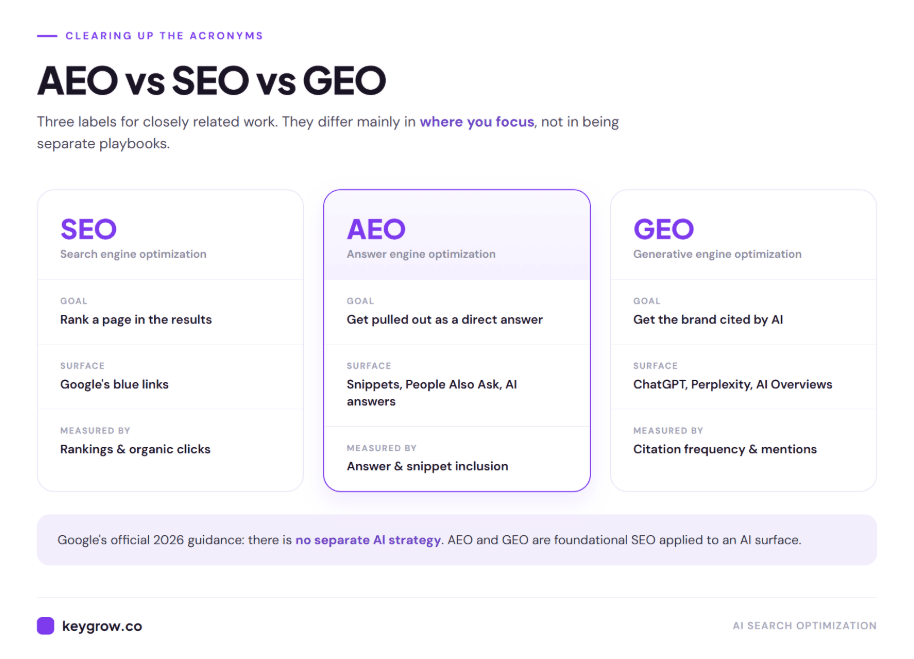
Three-card comparison of SEO, AEO, and GEO by goal, surface, and success metric, noting all three are foundational SEO applied to AI search
This is where a lot of confusion lives, so it's worth being precise. Here's a side-by-side look.
| Aspect | Traditional SEO | AEO (answer engine optimization) | GEO (generative engine optimization) |
|---|---|---|---|
| Main goal | Rank a page in search results | Get content extracted as a direct answer | Get the brand cited inside AI responses |
| Primary surface | Google's blue links | Featured snippets, People Also Ask, AI answers | ChatGPT, Perplexity, AI Overviews, Gemini |
| Core tactic | Keywords, backlinks, technical health | Clear structure, direct question answering, schema | On-page structure plus off-site brand authority |
| Success metric | Rankings and organic clicks | Snippet and answer inclusion | Citation frequency and brand mentions |
| Time horizon | Months to compound | Faster, tied to clear answers | Ongoing, less stable |
Now, here's the part that surprises people. On May 15, 2026, Google published its first official guide to optimizing for AI search. Its message was blunt: there's no separate strategy for AI. As Google put it, optimizing for generative AI search is still optimizing for the search experience, and thus still SEO. According to Google, AEO and GEO are just foundational SEO applied to an AI surface.
So why use the terms at all? Because they're useful labels for where you put your effort. AEO reminds you to structure content for extraction. GEO reminds you to build authority off your own site. But you don't need three separate playbooks. You need solid SEO, content only your team could write, and a few AI-specific habits layered on top.
If you want a deeper breakdown of where the disciplines meet, KeyGrow's answer engine optimization service page covers how the two fit together for real campaigns, and its standard SEO services form the foundation everything else sits on.
Why AI search optimization matters now
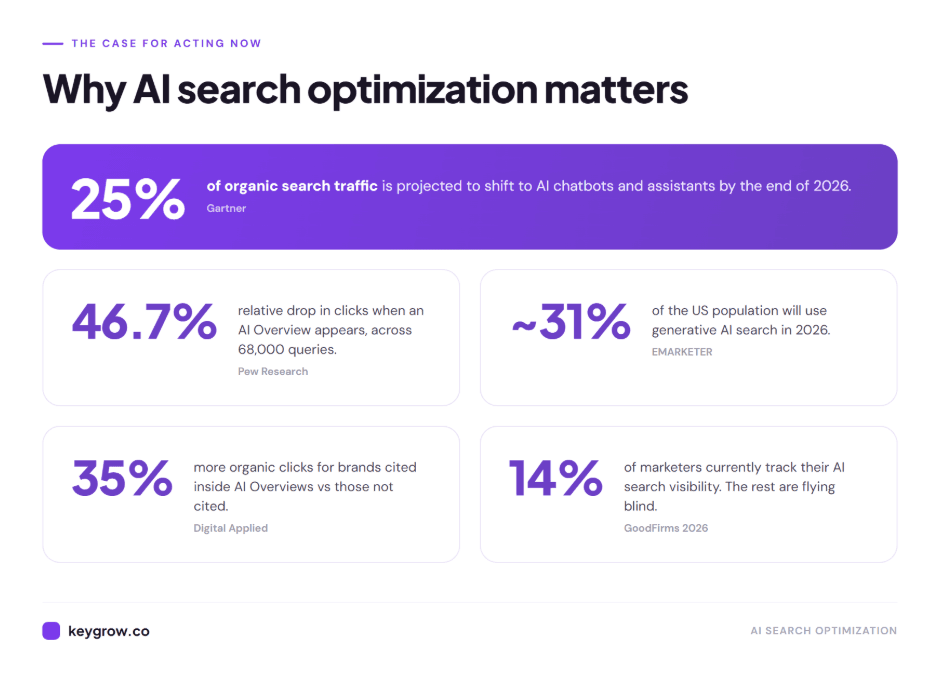
Statistics graphic on AI search impact in 2026: 25% traffic shift, 46.7% click-through drop, 31% adoption, 35% citation lift, and 14% of marketers tracking AI visibility
It's tempting to treat this as a future problem. It isn't. The shift is already here, and the numbers make the case.
Gartner projected that 25% of organic search traffic would shift away from traditional engines toward AI chatbots and assistants by the end of 2026. That's not a small slice. It's a quarter of the discovery that used to flow through ranked pages.
The click-through data is sharper still. Multiple studies confirm that AI Overviews cut organic clicks hard. Pew Research, in a controlled study of 68,000 queries, found a 46.7% relative drop in click rates when an AI Overview appeared. Seer Interactive measured a 61% decline on affected queries. Ahrefs put the hit to position-one content at around 34.5%. The exact figure depends on the study, but every one points the same direction.
Adoption is rising too. EMARKETER forecast that nearly a third of the US population (about 31%) would use generative AI search in 2026. These are buyers, patients, and clients asking AI tools the same questions they used to type into Google.
And here's the gap that creates the opportunity. A 2026 GoodFirms survey found only 14% of marketers were tracking their AI search visibility at all. Most businesses are flying blind on the fastest-growing search surface. Setting up even basic monitoring now puts you ahead of the large majority of competitors who haven't started.
The takeaway isn't "SEO is dead." It's that search is fragmenting. Google stays huge, but AI engines are taking a growing share of how people find and decide. The brands that optimize for both will hold their ground. The ones that ignore AI search will quietly lose visibility they can't easily win back.
How to optimize for AI search: the core tactics
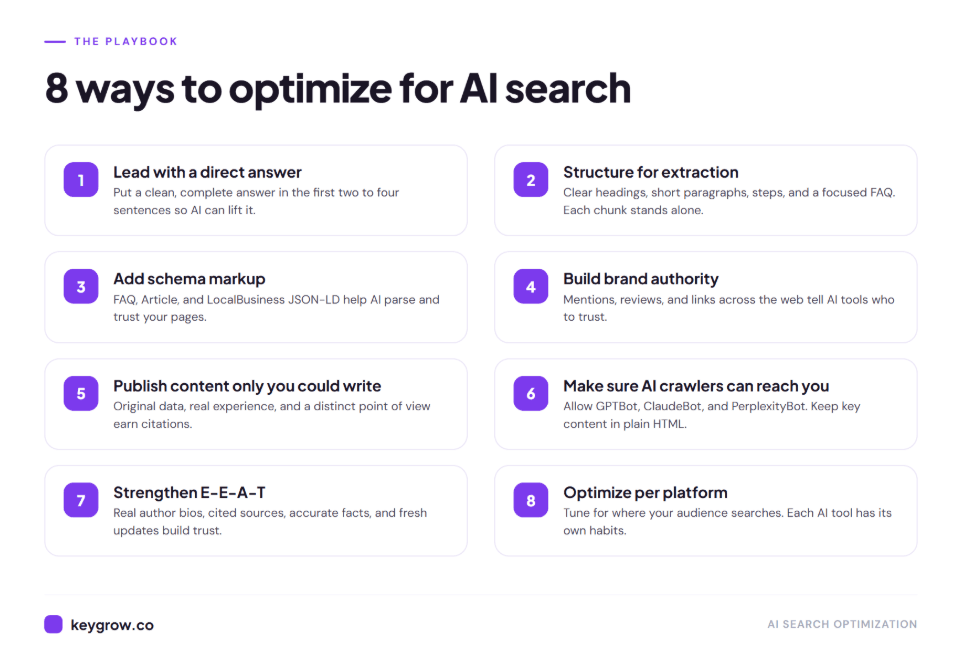
Numbered checklist of eight ways to optimize for AI search, from leading with a direct answer to optimizing per platform
Here's the practical part. These are the moves that actually help your content get cited, organized roughly in priority order.
1. Lead with a direct answer
AI tools extract answers. So give them a clean one. For any page targeting a question, put a clear, complete answer in the first paragraph, ideally in two to four sentences that make sense on their own.
Write it so the paragraph could be lifted out and dropped into an AI response without losing meaning. State the answer, then explain it below. This single habit, leading with the answer instead of burying it under introductions, is the highest-leverage change most pages can make.
2. Structure content for extraction
AI systems read structure as much as words. Help them by organizing content cleanly.
Use descriptive headings that match real questions people ask. Keep paragraphs short, two to four lines. Break processes into numbered steps and comparisons into tables. Add a focused FAQ section near the bottom with direct answers. Each chunk should stand alone, because the AI often pulls a single section rather than the whole page.
3. Add structured data (schema markup)
Schema markup is code that tells search engines what your content means, not just what it says. FAQ schema, Article schema, How-To schema, and LocalBusiness schema all help AI systems parse and trust your pages.
It won't carry weak content on its own, but it removes friction. When the markup matches the visible content, you make the AI's job easier, and easier-to-parse pages get cited more. You can generate valid JSON-LD for FAQs, articles, products, and local businesses with KeyGrow's free schema markup generator, which includes a validator and rich result preview.
4. Build brand authority off your own site
This is the GEO half of the job, and it's the one most teams neglect. AI systems decide who to trust partly by how often a brand shows up across the web, not just on its own pages.
That means mentions, reviews, citations, and links from credible sources. Reddit, LinkedIn, YouTube, and Wikipedia rank among the most-referenced domains by major AI models, so presence there carries real weight. Digital PR, guest contributions, getting quoted in industry articles, and earning genuine reviews all feed the authority signal AI tools lean on. A page can be perfectly structured and still lose to a brand the AI simply trusts more.
5. Publish content only you could write
Google's 2026 guide hammered this point harder than any other. Generic summaries that an AI could generate itself add no citation value. The AI doesn't need to cite a page that says what it already knows.
What earns inclusion is content that reflects genuine expertise: original research, real data, first-hand experience, a distinct point of view, case studies, and proprietary numbers. If your content could have been written by anyone, it probably won't get cited. If it contains something only your team has, it stands out. This is the single biggest differentiator in AI search, and it can't be faked.
6. Make sure AI crawlers can reach you
None of this works if the bots can't read your site. Check three things.
Your robots.txt should allow the AI crawlers you want, such as GPTBot, ClaudeBot, PerplexityBot, and Google-Extended, unless you have a specific reason to block them. Your CDN settings shouldn't be silently blocking them either (Cloudflare's default change caught a lot of sites off guard). And your important content should live in plain, crawlable HTML, not buried inside JavaScript or interactive widgets that crawlers can't parse.
Many sites also add an llms.txt file, a simple text file that maps your site for AI tools so they can understand your structure and key pages. You can build a spec-compliant one in minutes with KeyGrow's free llms.txt generator.
7. Strengthen E-E-A-T signals
E-E-A-T (experience, expertise, authoritativeness, trustworthiness) has become a trust filter for AI systems, not just human readers. AI tools look for signs that a source is credible before repeating it.
Show your work. Use real author bios with relevant credentials. Cite primary sources and link to them. Keep facts accurate and dated. Update content so it stays fresh, since AI answers favor current information. For regulated fields like health, law, and finance, these trust signals matter even more, because the AI is cautious about what it repeats on sensitive topics.
8. Optimize per platform, not just in general
Each AI tool has quirks worth tuning for. Perplexity rewards tight structure and clear sub-answers. ChatGPT favors clean, readable prose and responds to broad brand presence. Google AI Overviews still reward strong classic SEO and benefit from Google Business Profile and Merchant Center data for local and shopping queries. You don't need a separate strategy for each, but knowing where your audience searches tells you which signals to prioritize.
How to measure AI search visibility
You can't manage what you don't measure, and the old metrics only tell half the story now. Rankings and organic clicks still matter, but they miss the AI surface entirely.
Start by reading your Google Search Console data differently. If impressions are rising while clicks and click-through rate fall, that's the signature of AI Overviews absorbing your traffic. People are seeing your content inside answers but not clicking through. That's not necessarily a loss, but it changes what you should track.
Add AI-specific metrics on top:
Citation presence: how often your brand or pages appear inside AI answers across ChatGPT, Perplexity, Gemini, Claude, and AI Overviews. Several tools now check whether a given AI tool mentions your site.
Answer inclusion rate: the share of your target questions where your content gets pulled into the answer.
Share of voice in AI: how often you're cited versus your competitors on the same queries.
Conversion quality: since AI traffic converts better, watch what those visitors do once they arrive, not just how many come.
The shift in mindset is the hard part. Success in AI search isn't measured by ranking position. It's measured by how often you're chosen as a source and what happens when you are.
Common AI search optimization mistakes
A few errors come up again and again. Avoiding them puts you ahead of most.
Chasing hacks instead of fundamentals. Google was clear that most AI-specific "tricks" don't help and some carry risk. Solid SEO plus genuine expertise beats any shortcut.
Publishing generic content. If an AI could write it without you, it won't cite you. Commodity content is invisible in AI search.
Blocking AI crawlers by accident. Check your robots.txt and CDN before assuming your content is reachable. A surprising number of sites are locked out without knowing it.
Burying the answer. Long introductions push the real answer down the page where the AI is less likely to grab it. Lead with it.
Treating it as one-and-done. AI citations are volatile and rotate often. This is maintenance, not a single project.
Ignoring measurement. With only 14% of marketers tracking AI visibility, the teams that simply start watching the data gain a real edge.
Who should handle AI search optimization
AI search optimization sits at the intersection of technical SEO, content strategy, structured data, and brand building. Some teams have those skills in-house. Many don't, especially smaller businesses and practices where marketing is one person wearing several hats.
If you're handling it yourself, the tactics above are a complete starting checklist, and KeyGrow's free marketing tools hub includes a readability checker, schema generator, and llms.txt builder that cover much of the technical groundwork at no cost.
If you'd rather hand it off, agencies that specialize in this work can move faster. KeyGrow is a full-service digital marketing agency that has offered answer engine optimization alongside traditional SEO and PPC since well before AI search went mainstream. The team applies the same approach across the industries it serves, including healthcare and dental practices, law firms, and real estate, structuring content so it gets surfaced in AI answers rather than buried beneath them. For a sense of how that plays out in a specific vertical, its breakdown of the top AEO agencies for dentists shows what to look for when choosing a partner, and its case studies show measurable outcomes from past work.
Whether you do it yourself or get help, the important thing is to start now. The cost of waiting isn't a missed quarter. It's competitors compounding AI authority that gets harder to catch every month.
FAQs
What is AI search optimization?
AI search optimization is the practice of structuring your content, website, and brand so AI search tools like Google AI Overviews, ChatGPT, Perplexity, and Claude can read, trust, and cite you in their answers. It builds on traditional SEO but shifts the goal from ranking a page to becoming the source an AI quotes when answering a question.
Is AI search optimization different from SEO?
It overlaps heavily with SEO. Google's official 2026 guidance states there's no separate AI strategy, that optimizing for AI search is still SEO applied to a new surface. The difference is emphasis. AI search optimization adds habits like leading with direct answers, structuring content for extraction, and building brand authority across the web.
What is the difference between AEO and GEO?
AEO (answer engine optimization) focuses on structuring content so it gets pulled out as a direct answer, mainly through clear formatting and question matching. GEO (generative engine optimization) focuses on getting your brand cited inside AI responses by building authority off your own site. The two overlap so much that most teams treat them as one combined effort.
How do AI search engines decide what to cite?
They retrieve relevant pages from a live web search, then write an answer grounded in what they found. They favor content that answers questions directly, is well structured, comes from a trusted and authoritative source, and offers something a generic summary couldn't. Crawlability matters too, since a page the AI can't reach can't be cited.
Does AI search reduce my website traffic?
Often yes, at least in raw clicks. Studies show AI Overviews cut organic click-through rates anywhere from 15% to 60% on affected queries. But the traffic that still arrives tends to convert four to five times better than traditional search visitors, so fewer, higher-intent clicks can offset the loss in volume.
How do I know if AI tools can read my website?
Check your robots.txt file and confirm it allows AI crawlers like GPTBot, ClaudeBot, and PerplexityBot. Verify your CDN, such as Cloudflare, isn't blocking them by default. Make sure key content sits in plain HTML rather than JavaScript that crawlers can't parse. Adding an llms.txt file also helps AI tools map your site.
What is an llms.txt file and do I need one?
An llms.txt file is a simple text file that maps your website for AI tools, helping them understand your structure and most important pages. It's becoming a common practice for AI search optimization. It isn't strictly required, but it removes friction and signals that your site is set up to work with AI systems, so it's a low-effort, worthwhile addition.
How do I measure success in AI search?
Track citation presence (how often AI tools mention your brand), answer inclusion rate (how often your content gets pulled into answers), and share of voice against competitors. Also watch Google Search Console for rising impressions paired with falling clicks, which signals AI Overviews are using your content. Conversion quality matters more than click volume here.
How long does AI search optimization take to work?
It varies. Pages that lead with direct answers and clean structure can get picked up fairly quickly. Brand authority signals, which feed the GEO side, build over months. AI citations are also volatile and rotate often, so this is ongoing maintenance rather than a one-time project. Consistent work compounds over time.
Can small businesses compete in AI search?
Yes. In fact, small businesses often have an edge because AI tools reward genuine expertise and first-hand experience over generic content. A local practice with real case studies, honest reviews, and clearly written answers can get cited above larger competitors publishing commodity content. The key is publishing something only your business could write.