

Here is the answer most "benefits of local SEO" articles skip: how local SEO increases profits comes down to one boring fact about its math. It brings you customers who were already trying to spend money in your area, and once you rank, the cost of each new one keeps falling. Ads stop the day you stop paying. A ranking you earned keeps working while you sleep, so the same revenue costs you less to produce. That gap, between what a customer brings in and what you paid to reach them, is profit. Local SEO widens it.
Most coverage talks about visibility, traffic, and "being found." Those are inputs. Profit is the output, and the two are not the same thing. A business can double its traffic and make less money. So this guide is built around the unit economics: what a local customer costs to acquire, when the channel pays itself back, and the honest cases where it will not.
How local SEO increases profits, in plain math
Local SEO increases profits by lowering your cost to acquire each new local customer over time while sending you buyers who are close to a purchase, so more of every sale stays as margin.
Think about the path. Someone searches "emergency plumber near me," sees three local results, taps one, and calls. If that ranking is yours, the call cost you nothing per click. You paid once, in work, to earn the position, and it keeps producing calls month after month. The first call is expensive (all that earlier effort divided by one). The hundredth call is nearly free.
Compare that to ads. Every click is a fresh charge, and the calls stop the same day you pause the budget. Both channels can be profitable. Only one builds an asset that lowers your cost per customer as it matures. That is the whole reason local SEO shows up in your profit margin and not just on a traffic chart.

A customer completing a payment at a local business counter, the end point of a high-intent local search
Revenue is not profit: where local SEO changes the math
The place local SEO moves profit is the cost-per-acquired-customer line, not the revenue line. It can lift both, but the durable win is making each customer cheaper to win.
Run the numbers on a small service business. Say a job is worth 400 dollars, a paid click costs 5 dollars, and one in twenty clicks becomes a job. That is 100 dollars in ad spend per job, every job, forever. Now say local SEO earns you the map pack and an organic spot. Those clicks arrive at no per-click cost, and because your earlier investment is fixed, the cost spread across each job drops toward zero as call volume grows.
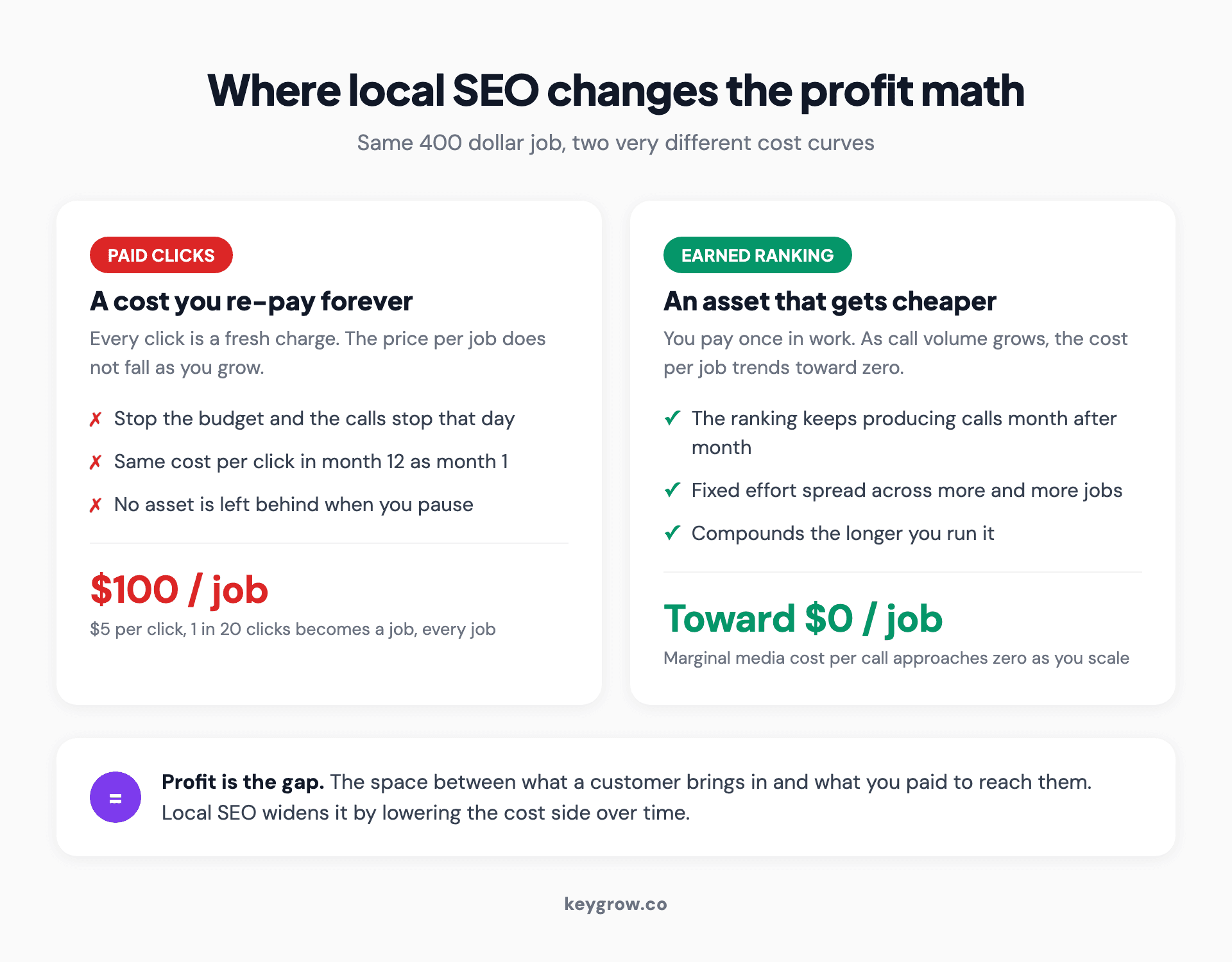
Two-card comparison of how local SEO changes the profit math: paid clicks charge a fresh cost per job forever while an earned ranking turns into a near-zero marginal cost as call volume grows
This is why a vanity-metric report is the industry's quiet scam. Impressions and traffic do not pay rent. A useful report leads with cost per lead, booked jobs, and revenue. We wrote a full piece on how to measure SEO ROI so you can tie rankings to dollars instead of guessing.
Local search intent is closer to a purchase than any other channel
Local search wins on profit partly because the searcher is already in buying mode. Someone typing a local query is usually minutes or hours from spending, not weeks of casual research.
The data backs the gut feeling. Per BrightLocal, citing Google, 46 percent of all Google searches have local intent. And per Think with Google, 76 percent of people who search for something nearby on their phone visit a business within a day, and 28 percent of those searches end in a purchase. That is not awareness traffic. That is foot traffic and phone calls with a wallet attached.
Backlinko adds scale: there are roughly 1.5 billion "near me" searches every month, and "near me" search has grown by more than 900 percent. High intent at that volume is why a local ranking converts at a rate paid awareness campaigns rarely touch, and why each conversion costs less to produce. The tighter your service geography, the stronger this advantage tends to be.
Why local SEO costs less per customer than ads (and compounds)
Local SEO costs less per customer than ads over time because the ranking is an asset you keep, while every ad click is a cost you re-pay. SEO starts slower and ends cheaper.
Here is the pattern in practice. In the first quarter, ads usually win: you can buy clicks on day one while your SEO is still being built. By the time the rankings mature, the math flips. The ad account still charges the same per click in month twelve as it did in month one, while the organic position is now producing calls at a marginal cost approaching zero.
This is the part I will plant a flag on, with a number behind it. SEO is a compounding asset, not a campaign. It looks unremarkable for the first quarter and embarrassingly good after a year. Our strongest organic result took a full 12 months to reach 1,519 percent traffic growth. Businesses that quit at month three pay for the hard part and walk away right before the payout. That is not a motivational line, it is the actual shape of the cost curve.
None of this means choosing one channel. Ads buy speed, SEO buys margin, and the smart play is often both. We laid out the trade-off in local PPC vs SEO for small businesses if you are deciding where this quarter's budget goes.
How reviews and Google Business Profile turn rankings into booked jobs
A ranking only earns money if the searcher trusts what they see, and that trust mostly comes from your Google Business Profile and your reviews. They are the step that turns a position into a paying customer.
The conversion happens in the gap between "found you" and "chose you." BrightLocal's consumer research finds that 97 percent of consumers read reviews for local businesses and 71 percent use Google to read them. The same research line shows 62 percent of consumers would avoid a business with incorrect online information. A wrong phone number or a thin review profile quietly leaks the profit your ranking worked to create.
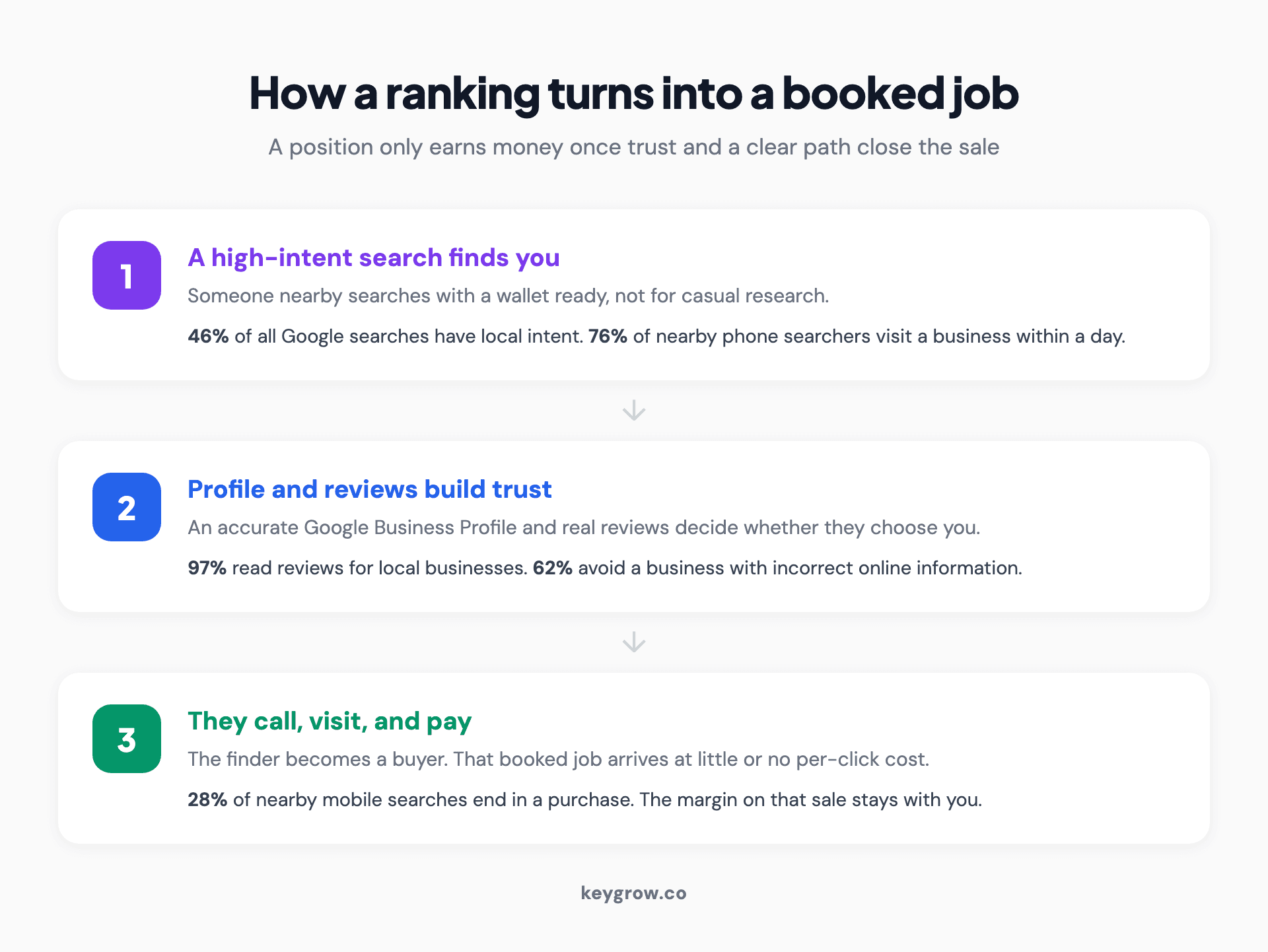
Three-card funnel of how a local search ranking becomes a booked job: high-intent search finds you, an accurate Google Business Profile and reviews build trust, the customer calls or visits and pays
So the profit work does not stop at the ranking. You also have to claim your profile, keep every detail accurate, and ask for reviews on a regular basis. We get into why the profile carries so much weight in does Google Business Profile help SEO. Both pieces move the same lever: the share of finders who become buyers.
What a real profit lift looks like (a client example)
A real local SEO profit lift looks like a steady climb that pays off late, not a spike. The clearest example we have is a doctor's practice in Dubai that committed to a full year.
Months one through three looked unimpressive on the surface, the way SEO almost always does. There was movement under the hood (technical fixes, content, authority building) but the call log barely changed. By month twelve, organic traffic had grown 1,519 percent and the practice was taking 130 or more patient calls a month. Same site, same client, no shortcuts.

Hands typing on a laptop next to a stethoscope, representing a medical practice that grew through local SEO
Notice what changed in profit terms. Those 130 monthly calls now arrive at essentially no per-call media cost. To buy that volume through ads every month, in a competitive medical market, would be a recurring five-figure bill. The practice paid once to build the channel and now keeps the margin on every booking. That is the difference between renting customers and owning the path to them.
How long before local SEO shows up in profit (not just traffic)
Local SEO usually shows up as traffic in three to six months and as real profit later, often around the six to twelve month mark, once rankings hold and reviews compound. Anyone promising faster is selling.
The order matters. Rankings come first, then traffic, then conversions, then profit, because trust and review volume take time to build behind the ranking. A page that hit position two last week has not yet earned the reviews that make a stranger call it. That maturation is exactly why the channel pays back late and then keeps paying.
"Page one in 30 days" is a red flag. Anyone promising page one in a month is either chasing keywords nobody searches or about to burn your domain with shortcuts. For a realistic timeline broken down by stage, read how long local SEO takes before you set any internal expectation.
When local SEO will not increase your profits
Local SEO will not increase your profits if nobody searches for what you sell, if your margins cannot absorb the wait, or if your basics are so simple you can do them yourself for free.
Here is the honest moment most agency content skips. If you run a single-location shop with more time than money, you may not need us at all. Claim your Google Business Profile, ask happy customers for reviews, fix your site basics, and you will capture most of the local profit on offer without a retainer. Hire help when the opportunity cost of your own time clearly beats the fee, not before.
A few other cases where the math does not work:
If you are weighing the spend honestly, are SEO services worth it walks through the cases for and against without a sales pitch.
Where this leaves you
Local SEO increases profit by lowering what each local customer costs you and by catching them when they are ready to buy. It pays back slowly, then compounds, and it only works when there is real local demand and a page worth landing on. If that describes your business, this is one of the few channels that gets cheaper the longer you run it. If you want a candid read on whether the math works for your market, our team is happy to look at the numbers with you over at /get-started.
FAQs
Is local SEO profitable for a small business?
Often yes, when there is genuine local search demand for what you sell. Local searchers convert at high rates because they are close to buying, and once you rank, the cost per new customer drops over time. It is least profitable for businesses with no local search volume or margins too thin to wait out the payback.
How does local SEO increase revenue?
It puts you in front of people already searching to buy in your area, then converts more of them through an accurate Google Business Profile and strong reviews. Because the intent is high, a larger share of that traffic turns into actual calls and bookings rather than browsing.
What is the ROI of local SEO?
ROI improves over time because the upfront work is fixed while the customers it produces keep coming at little extra cost. Early on the return can look flat, then as rankings hold and reviews build, cost per acquired customer falls and ROI climbs. Measure it on cost per lead and booked revenue, not on traffic or impressions.
How long does local SEO take to increase profits?
Expect traffic in three to six months and meaningful profit later, often around six to twelve months, once rankings stabilize and reviews accumulate. Our strongest organic case took a full year to reach 1,519 percent traffic growth. Any promise of page one in 30 days is a warning sign, not a timeline.
Is local SEO cheaper than Google Ads?
Over time, usually yes per customer, because a ranking is an asset you keep while every ad click is a cost you re-pay. Ads are faster to start and better for immediate demand, while SEO produces customers at a marginal cost that trends toward zero. Many local businesses run both: ads for speed, SEO for margin.
Can local SEO work without a physical storefront?
Yes. Service-area businesses that travel to customers, like plumbers, cleaners, or mobile detailers, can rank locally without a storefront by using a service-area Google Business Profile and location-specific pages. The intent advantage is the same: people searching "near me" still want a local provider.
How do reviews affect local SEO and sales?
Reviews influence both your ranking and whether a searcher actually chooses you. The vast majority of consumers read reviews before contacting a local business, so a thin or negative profile leaks customers your ranking earned. Gathering reviews steadily and responding to them lifts the share of finders who become buyers.
Is local SEO worth it in 2026 with AI search?
For most local businesses, yes. AI answers and map-style results still pull from the same trust signals, an accurate profile, real reviews, and clear local content, so the work that earns rankings also earns AI citations. Local demand has the same buying intent it always did, and the businesses that show up as the trusted local source win either way.


