

Paste your newest blog post into a newsletter, send it to 4,000 subscribers, watch a few hundred click through, then check your rankings the following Monday. Nothing moves. So when people ask how email marketing can help SEO, the honest first answer is that it does not move your Google rankings on its own. Email is not a ranking factor, and the clicks it sends are not a signal Google reads.
That sounds like the end of the post. It is actually the start of the useful part.
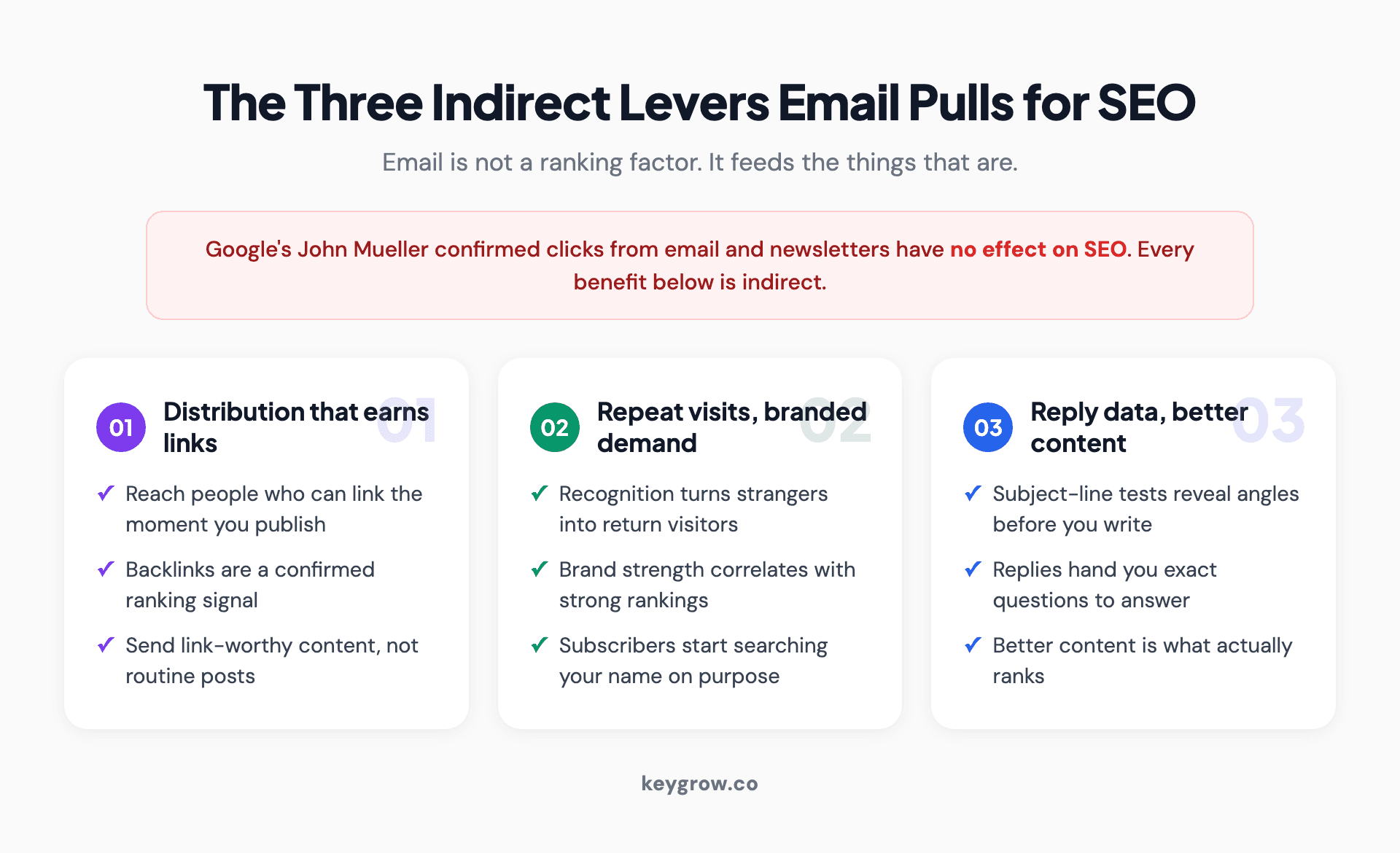
Most brands with a strong email program also have strong SEO. Not because Google watches their open rates, but because email pulls three indirect levers that organic search genuinely rewards. This post names each lever plainly, shows you the one Google has actually confirmed, and then teaches you how to measure whether email did anything at all, so you never double-count the same visitor twice.
Does email marketing directly improve your Google rankings?
No. Email marketing does not directly improve your Google rankings, because email clicks, opens, and newsletter traffic are not signals Google uses to rank pages. Email helps SEO only indirectly, by feeding the things Google does reward.
That distinction matters more than it sounds. Most articles on this topic say email "can boost your rankings" and leave you picturing Google quietly tallying your newsletter clicks. It does not work that way. An email blast that sends a surge of traffic to a page will show up in your analytics. It will not show up in your rankings, because the two systems are not connected.
What email can do is help you earn the things that are connected: links, brand demand, and better content. Those are slow, real, and worth the effort. The clicks themselves are not.
What Google has actually said about clicks, CTR, and engagement
Google has been unusually direct here, which is rare. The gist: clicks from email do not affect SEO, and click-through rate is not a ranking factor.
In 2021, Google's John Mueller was asked point-blank whether clicks received through email or newsletters could impact rankings. His answer, reported by Search Engine Roundtable, was that it has "no effect on SEO," and he said the same applies to clicks from ads and social media. There is no asterisk on that.
He has also repeatedly shot down the idea that click-through rate drives rankings at all. Mueller has argued that if CTR were what drove rankings, the results would fill up with clickbait, and he does not see that happening. So the engagement metrics email marketers love (opens, clicks, time on page) are not the dials that move organic.

A marketer working at a desk on a computer in a bright daylight office, reviewing campaign and analytics data
If you only remember one section, make it this one. Every "email boosts SEO" claim that implies Google reads your engagement is either wrong or sloppy. The real benefit lives one step removed.
Lever 1: distribution that earns the links and mentions SEO rewards
Email is a distribution channel, and distribution is how good content gets in front of the people who can link to it. This is the most direct of the three indirect paths, because backlinks are a confirmed ranking factor.
Backlinks remain one of Google's most heavily weighted signals, as cataloged in Backlinko's ranking factors roundup. The catch is that links do not appear because you published a page. They appear because the right people saw it. Your email list, especially if it includes journalists, partners, peers in your industry, or other site owners, is one of the few audiences you can reliably reach the moment you publish.
Here is the pattern in practice. You publish an original piece of research, a useful tool, or a genuinely strong guide. You email the segment of your list most likely to care. Some of them share it, cite it, or link to it from their own sites. Those links are what Google scores, not the email that triggered them. The email started the chain. The link is what counts.
This is also why the type of content matters. A run-of-the-mill blog post emailed to your list earns clicks and not much else. Something link-worthy emailed to the right list earns links. If you want the mechanics of why some content earns links and some does not, our piece on why unique content matters covers the difference, and our overview of content marketing and SEO maps where distribution fits in the wider system.
Lever 2: repeat visits and branded demand, the brand Google cannot ignore
Email's second lever is brand. Every time a subscriber opens, recognizes you, and comes back, you are building branded demand, and brand strength correlates with strong organic performance even though no single click is a ranking signal.
This is where the famous statistic gets misused, so let us handle it honestly. In 2017, SEMrush ran a machine-learning study across 600,000 keywords and found direct website traffic to be the single factor most correlated with high Google rankings, a finding covered by Campaign. Half the internet read that as "send people to your site directly and you will rank." That is not what it means.
Direct traffic is almost certainly a proxy for brand strength. Sites people type in by name, return to, and search for on purpose tend to be the sites Google already trusts. Email feeds that loop: it keeps you in front of people, drives repeat visits, and over months turns strangers into people who search for your name instead of a generic term. Correlation, not causation. Email helps you become the kind of brand the data describes; it does not let you fake the metric.
This compounding is slow and it is the reason SEO and email belong on the same plan. A subscriber who reads your emails for a year is far likelier to search your brand, click your result first, and link to you than a cold visitor who bounced once.
Three indirect ways email marketing supports SEO: distribution that earns backlinks, repeat visits that build branded demand, and reply data that improves the content you publish, with the honest note that email itself is not a Google ranking factor
Lever 3: reply data and subject-line tests that make your content rank better
The third lever is the quietest and the most underrated: your email audience tells you what to write, and better content is what actually ranks. Email is the fastest feedback loop you have.
Subject-line open rates tell you which angles people care about before you commit a month to ranking for them. Replies tell you the exact questions your audience asks, in their own words, which is gold for the answer-first sections AI search and Google both favor. A newsletter that consistently gets replies asking "but how do I measure this?" is handing you your next high-intent blog post for free.
Run the loop deliberately. Test two subject lines on a small slice of your list, see which framing wins, then build the long-form piece around the winner. The email tested the demand cheaply; the blog post captures it from search. If you are unsure whether long-form content is even worth it for your business, our take on whether blogs help SEO is the honest version, not the agency pitch.

Hands typing on a laptop with a cappuccino nearby in warm natural light, drafting an email newsletter
One strong opinion, backed by a number: vanity-metric reporting is the industry's biggest scam, and email is where it hides most easily. An agency that reports your campaign's "40,000 email impressions" as an SEO win is selling you the one metric Google has confirmed it ignores. Mueller said it plainly: clicks from email have no effect on SEO. Demand the link count, the branded-search trend, and the assisted conversions instead.
How to measure whether email actually helped your organic traffic
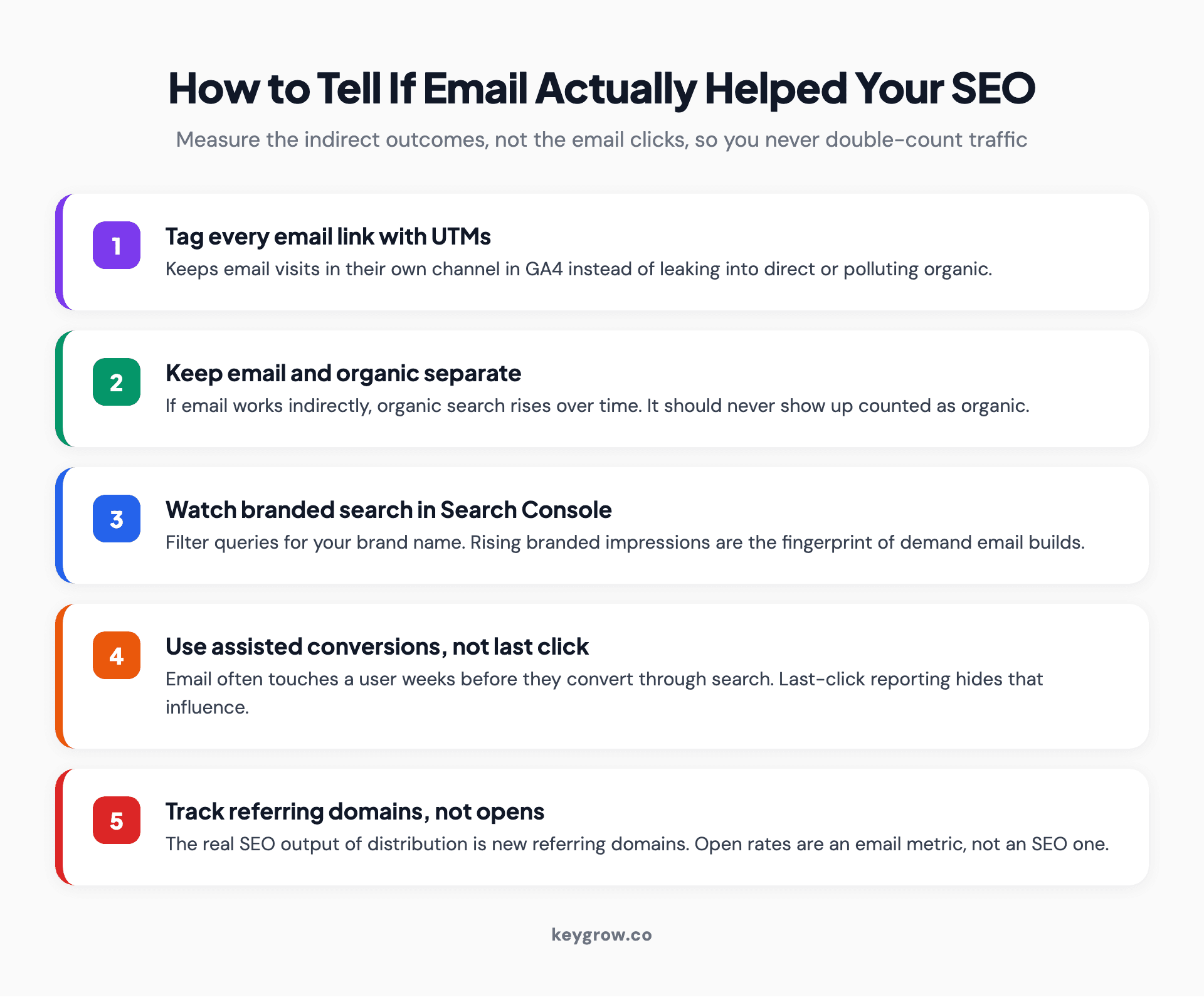
You measure email's SEO contribution by separating channels cleanly and watching the indirect outcomes, not the email clicks. The goal is to avoid crediting email for traffic that was already going to arrive.
Here is the practical setup.
1. Tag every email link with UTM parameters. This keeps email visits in their own channel in GA4 instead of leaking into "direct" or polluting your organic numbers. No UTMs means you cannot tell email traffic from anything else.
2. Keep email and organic in separate channel reports. In GA4, organic search and email are different default channels. If email is doing its job indirectly, you will see organic rise over time, not email traffic counted as organic.
3. Watch branded search in Search Console. Filter your queries for your brand name and track the trend over months. Rising branded impressions and clicks are the fingerprint of the demand email helps build.
4. Look at assisted conversions, not last click. Email often touches a user weeks before they convert through search. The assisted-conversion view shows that influence; last-click reporting hides it and makes email look useless.
5. Track links and mentions, not email opens. The real SEO output of distribution is new referring domains. Tools like Ahrefs or Semrush let you watch your referring-domain count over the months after a campaign.
A five-step checklist for measuring whether email marketing helped your SEO: tag email links with UTMs, keep email and organic channels separate in GA4, watch branded search in Search Console, use assisted conversions instead of last click, and track referring domains instead of email opens
The honest summary: if your branded search is climbing, your referring domains are growing after content sends, and your organic line is trending up while email sits in its own channel, email is helping. If only your email-click number is up, you have engagement, not SEO. For the full framework, our guide on measuring SEO ROI goes deeper than a paragraph can.
What NOT to do (the email-for-SEO advice you should ignore)
Plenty of widely repeated tips for "email-driven SEO" are either useless or actively harmful. Here is what to skip.
When email is NOT worth treating as an SEO play at all: if you have fewer than a few hundred engaged subscribers and a brand-new site with no content worth distributing, email will not meaningfully help your SEO yet. Spend that time on publishing genuinely link-worthy pages and claiming the basics. A list of 200 people who half-open your emails is not a distribution engine, and pretending it is wastes the months you should spend building the content first. Email becomes an SEO multiplier only once you have something worth sending and someone to send it to.
A 90-day way to wire email and SEO together
Treat the first quarter as plumbing plus one real test, not a campaign. Here is a realistic sequence that respects how slowly the indirect payoff compounds.
Days 1 to 30, fix the measurement. Add UTM tags to every email link, confirm email and organic sit in separate GA4 channels, and set a branded-search baseline in Search Console so you have something to compare against later. Authenticate your sending domain with SPF, DKIM, and DMARC; the 2024 Gmail and Yahoo bulk-sender rules now require it, and undelivered email distributes nothing.
Days 31 to 60, run the feedback loop. Use subject-line tests to find the angle your list actually wants, read your replies for the exact questions people ask, and turn the winners into long-form pages built to rank. This is where email earns its keep as research.
Days 61 to 90, distribute for links. Publish your strongest piece (original data, a tool, a genuinely better guide) and email the segment most likely to share or cite it. Then watch referring domains and branded search, not the email open rate. Expect movement in links and brand signals first; the organic-ranking payoff trails by months, because every confirmed lever here compounds slowly.
Set the expectation early, with yourself and anyone you report to: email's SEO benefit is not a switch you flip. It is a slow multiplier on content you were going to publish anyway.
FAQs
Is email marketing a Google ranking factor?
No. Email marketing is not a Google ranking factor. Google does not index your emails or score your open and click rates, and John Mueller has confirmed that newsletter clicks have no effect on SEO. Email helps SEO only indirectly, by driving links, brand demand, and better content.
Do clicks from email or newsletters help SEO?
Not directly. Google's John Mueller stated in 2021 that clicks received via email or newsletters have no effect on SEO, the same as clicks from ads or social media. A traffic surge from an email will appear in your analytics but will not lift your rankings. What helps is when that traffic leads to links or repeat brand visits.
How does email marketing indirectly improve SEO?
Email improves SEO through three indirect levers. It distributes content to people who can link to it (and links are a confirmed ranking factor), it drives repeat visits that build branded demand SEO rewards, and it gives you reply and open-rate data that makes the content you publish stronger and more likely to rank.
Can email marketing help you get backlinks?
Yes, this is email's strongest SEO contribution. Your list is one of the few audiences you can reach the instant you publish, so emailing link-worthy content to the right people (peers, partners, journalists, other site owners) puts it in front of those who can link to it. The links are what Google scores, not the email.
Should you put keywords in email subject lines for SEO?
No. Subject lines are never indexed or read by Google, so keywords in them do nothing for SEO. Write subject lines to earn opens from your subscribers, and put your keyword work into the pages that actually live in the search index.
How do you measure whether email marketing improved your organic rankings?
Separate the channels and watch the indirect outcomes. Tag email links with UTMs so email stays out of your organic numbers, track branded search in Google Search Console over months, monitor your referring-domain count after content sends, and use the assisted-conversion view to see email's influence on search conversions. If branded search and links rise while email sits in its own channel, email is helping.
Where email actually earns its keep for SEO
Email will not move your rankings, and any tool or agency that tells you otherwise is selling you a metric Google has confirmed it ignores. What email does is quieter and slower: it puts your best content in front of people who can link to it, it keeps you in front of an audience until they become the brand demand Google rewards, and it tells you what to write next. Those are real. They just take months, and they show up in your links and your branded search, not in your open rate.
If you want help wiring content, distribution, and organic search into one plan that actually compounds, our team works month-to-month with no lock-in, and you can get started here whenever the content is worth sending.


