

Do blogs help SEO? Yes, but not because blog posts magically rank. A blog helps because a steady stream of genuinely useful posts gives you more pages to rank, more long-tail queries to win, more internal links to pass authority around your site, and more content worth linking to. That is the real mechanism, and it is why blogging is one of the most reliable ways to grow organic traffic.
The catch is the part most articles skip. Volume alone does nothing. The web is full of blogs that publish constantly and get no traffic at all, and a thin or AI-churned blog can actively hurt you. So the honest answer is yes, a blog helps your SEO, as long as the posts are good and you keep at it. Here is why it works, where it fails, and when a blog is not worth your time.
Do blogs help SEO? The short answer
Yes. A consistent blog of genuinely useful posts helps SEO: it adds indexable pages, wins more long-tail searches, gives you internal links to place, and earns backlinks. But quality and consistency are the conditions. Publishing more low-value posts does not move rankings.
So this is not a simple yes. It is a yes with a job attached. A blog is a system for covering your topic thoroughly over time, and that system is what search engines reward. A pile of thin posts is not a system, and Google treats it like one.
Why a blog helps your SEO
A blog helps because each good post is a new way into your site. It adds an indexable page targeting a specific search, gives you somewhere to place internal links, and creates an asset other sites might link to. Do that consistently and the compounding is real.
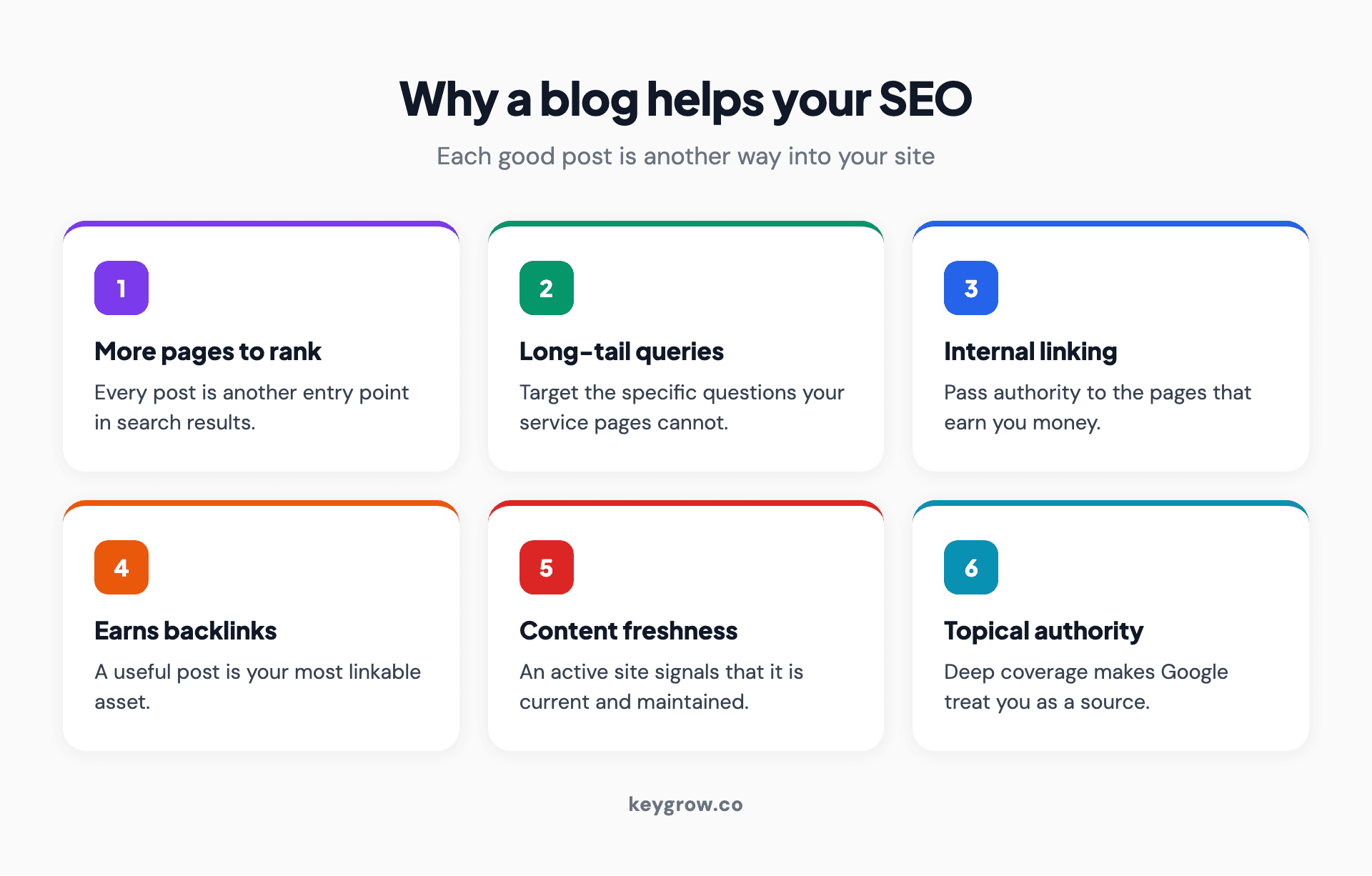
Infographic icon grid of the six ways a blog helps your SEO: more indexable pages to rank, coverage of long-tail keyword queries, internal links that pass authority around your site, backlinks earned by link-worthy posts, fresher and more current content, and topical authority built across a subject.
The mechanisms, in plain terms:
Frequency compounds this when the quality holds. Companies publishing 16 or more posts a month got almost 3.5 times more inbound traffic than those publishing four or fewer, per HubSpot. The number is not the point, though. Consistency of useful posts is.
The catch: volume alone does not work
More posts is not a strategy. Publishing for the sake of a number gets you nothing, because search engines reward useful content, not output. A thin or mass-produced blog can sit there for years earning no traffic.
The data is blunt. Ahrefs found that 96.55 percent of pages in its index get zero traffic from Google, and only 1.94 percent get even one to ten visits a month. Most of those pages are blog posts nobody needed. And the shortcut everyone is reaching for does not work either: a Semrush study of 20,000 keywords and 42,000 posts found purely AI-generated content ranked number one only 9 percent of the time, while human-written content held the top spot 80 percent of the time.
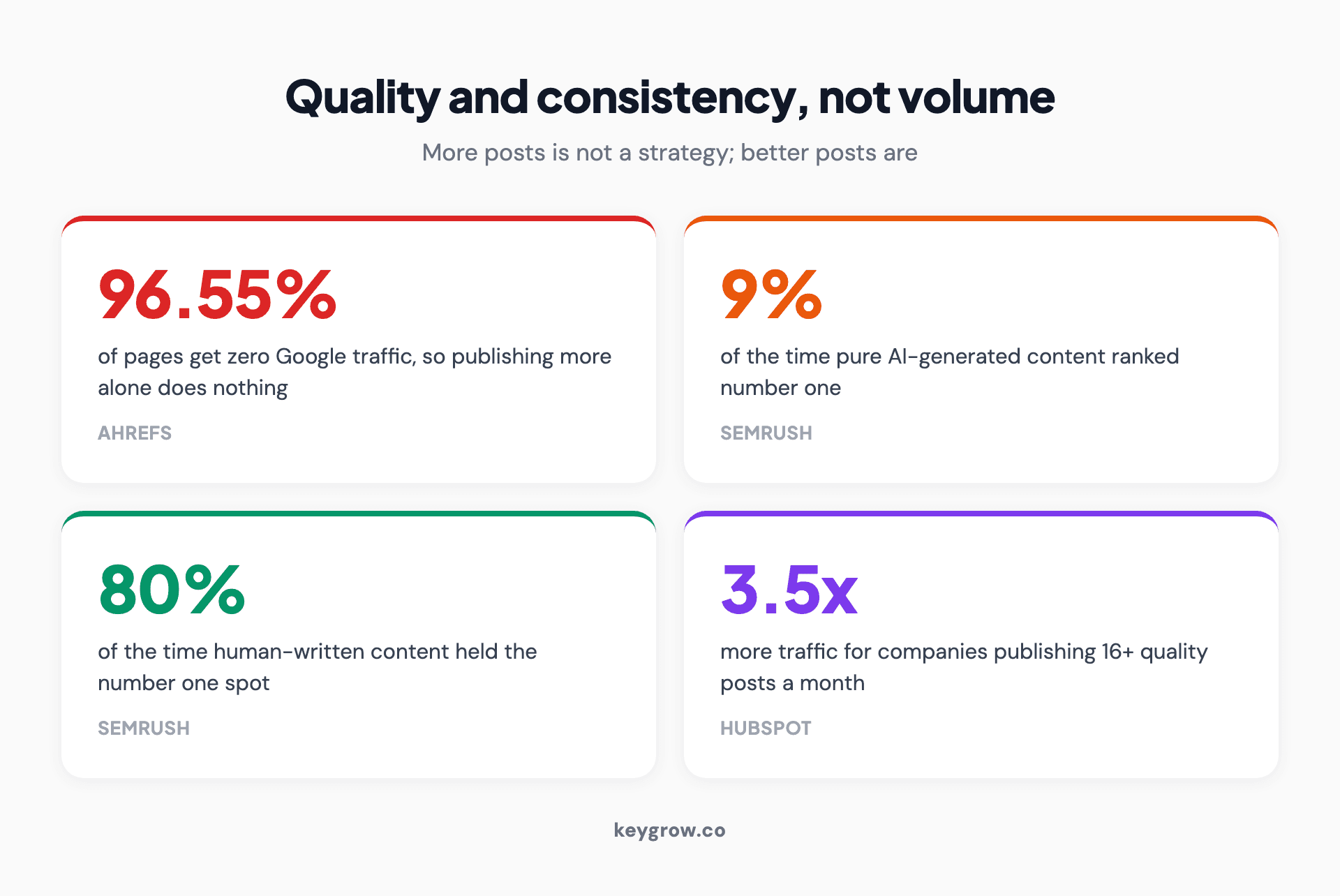
Infographic stat panel showing that quality and consistency matter more than volume for blog SEO: 96.55 percent of pages get zero Google traffic, purely AI-generated content ranked number one only 9 percent of the time versus 80 percent for human-written content, and companies publishing 16 or more quality posts a month got 3.5 times more traffic.
Here is the opinion worth keeping: publishing more is not a strategy, publishing things worth citing is. Google's own helpful content guidance makes the same point from the other side, telling creators to write people-first content and flagging volume-chasing as a warning sign, asking whether you are "producing lots of content on many different topics in hopes that some of it might perform well in search results." If that describes your blog plan, the plan is the problem.
How a blog builds topical authority
A blog is how you build topical authority, the depth of coverage that makes Google treat you as a credible source on a subject. You do that by filling out a topical map with connected posts, not by publishing whatever comes to mind.
This is the difference between a blog that ranks and one that does not. Random posts on unrelated topics scatter your signals. A blog that systematically covers every subtopic around your core subject, linked together, tells search engines you own that area. That is the entire idea behind a topical map, and a blog is the vehicle you use to fill one in, the same way our guide to building a topical map lays out. Each post should earn its place in that structure, which also keeps every post genuinely unique instead of overlapping the others.
How often should you publish?
Publish as often as you can keep the quality high, and consistently. For most small businesses that is one to four genuinely useful posts a month, done reliably, which beats a burst of ten followed by silence.
There is no universal number. Large content operations publish daily because they have the team to keep every post good. A local business does not need that, and chasing a frequency it cannot sustain at quality is how blogs turn thin. Pick a cadence you can hold for a year, because that is the timescale SEO works on, and protect the quality bar above all. A predictable rhythm of useful posts is worth far more than a sporadic flood.
How long until a blog helps your SEO?
A blog usually takes months to move rankings, not weeks. New posts need time to be crawled, indexed, and trusted, and topical authority builds slowly. Expect early signs in three to six months and real traction around a year.
This is where most blogs are abandoned, right before they would have paid off. A doctor's practice in Dubai committed to consistent, original content for a full year. The first quarter looked unremarkable. By month twelve, organic traffic had grown 1,519 percent and the practice was taking 130-plus patient calls a month. The posts did not rank overnight. They compounded, which is what a blog does when you let it.
Do blogs help local SEO?
Blogs help local SEO, but they are rarely the first thing a local business should fix. For local search, a complete Google Business Profile, strong service pages, and reviews usually move the needle faster than blogging does.
A blog still helps a local business: posts answering local questions can rank, build topical authority, and support your service-area pages. But the order matters. If your Business Profile is half-filled and you have no real service or location pages, start there. Blogging is the layer you add once the local fundamentals are in place, not the first move.
When a blog is not worth it
A blog is not worth it when you cannot commit to consistent quality, or when your fundamentals are not in place yet. A handful of thin posts published once in a while will not help, and the time is better spent elsewhere.
| If you are... | Fix first | Add a blog to... |
|---|---|---|
| A new local business | Business Profile, service pages, reviews | Answer local questions, build topical authority |
| Short on writing capacity | Your core service pages | Scale up once you can sustain the quality |
| Already solid on the basics | Nothing, you are ready | Win long-tail searches and earn links |
Be honest about capacity. If nobody can write a genuinely useful post on a steady schedule, do not start a blog to tick a box, because a thin one does nothing and can drag at your site quality. A one-location service business with a free afternoon should usually claim its Business Profile, sharpen its service pages, and gather reviews before writing a single post. You can absolutely run a blog yourself, and many businesses should, but only when you can clear the quality bar and keep clearing it. If you can, a blog is one of the best long-term SEO investments there is, which is the broader case our piece on content marketing for SEO makes, and the engine behind ranking nationally.
FAQs
Does blogging really help SEO in 2026?
Yes, when the posts are genuinely useful and consistent. Blogging is how you cover a topic thoroughly over time, which is exactly what Google's helpful-content systems reward. What does not help is volume for its own sake or AI-churned posts, which get pushed down. The blog helps, the thin content does not.
How long does it take for a blog to improve SEO?
Usually three to six months for early signs and around a year for real traction. New posts must be crawled, indexed, and trusted, and topical authority builds slowly. Anyone promising blog-driven rankings in weeks is not being straight with you. A blog is a compounding asset, not a quick fix.
How often should I publish blog posts for SEO?
As often as you can keep the quality high, consistently. For most small businesses that is one to four strong posts a month done reliably. A steady cadence beats a burst followed by silence. Never trade quality for a frequency target, since thin posts published often do nothing for SEO.
Can a blog alone drive significant traffic to my website?
It can, but only as part of a real strategy. A blog that systematically covers a topic, earns links, and links internally to your key pages can drive substantial organic traffic over time. A blog of scattered, thin posts cannot. The traffic comes from the quality and structure, not from the act of blogging.
Do blogs help local SEO for service businesses?
They help, but they are not the first priority. For local businesses, a complete Google Business Profile, strong service and location pages, and reviews usually move local rankings faster. A blog adds topical authority and answers local questions on top of those fundamentals. Get the local basics right first, then blog.
How long should a blog post be for SEO?
Long enough to answer the query fully and no longer. There is no magic word count, and padding hurts. Match the depth of what already ranks and add something they missed. A focused 800-word post that nails the intent beats a padded 2,500-word one that buries the answer.
Can blogging ever hurt your SEO?
Yes, if it is thin, unoriginal, or mass-produced. Low-value posts can dilute your site quality, and Google's helpful-content and spam systems target pages built for volume rather than people. A Semrush study found purely AI-generated content ranked number one only 9 percent of the time. Quality protects you; churn exposes you.
Do I need to update old blog posts for SEO?
Yes, updating is one of the highest-return blog tasks. Refreshing an existing post that has lost rankings, fixing outdated facts, and improving depth often beats publishing something new, because the page already has history and links. Build a refresh cadence into your plan, not just a publishing one.
The short version
Do blogs help SEO? Yes, when the posts are useful and you publish them consistently. A real blog covers your topic thoroughly over time, and that is what builds the authority Google trusts. What does not work is volume: 96.55 percent of pages in Ahrefs' index get no traffic, and AI-churned content rarely ranks. The blog is the asset; the quality is the condition.
So if you can write genuinely useful posts on a schedule you can hold for a year, a blog is one of the best SEO investments you can make. If you cannot, fix your fundamentals first and come back to it. If you want help building a blog that ranks instead of one that just exists, that is what our SEO team does. Tell us about your site and we will tell you whether a blog is your next move or your third.


