

What are SEO topical maps? An SEO topical map is a structured plan of all the content a website needs to cover a subject completely, organized as one core topic, a set of pillar pages, and the supporting cluster articles beneath them, all connected by internal links. It is the blueprint that turns a pile of keyword ideas into a deliberate plan for owning a subject in search. Instead of publishing scattered posts and hoping, you map the whole territory first, then fill it in.
The reason the concept matters now is topical authority. Search engines, and the AI systems built on top of them, reward sites that demonstrably cover a subject in depth and structure, not sites that mention it once. A topical map is how you build that coverage on purpose. This guide defines what a topical map is, how it differs from the things people confuse it with, and why it has become central to ranking in 2026.
What is an SEO topical map?
An SEO topical map is a structured content plan that organizes a subject into a core topic, pillar pages, and supporting cluster articles connected by internal links, so a site covers the topic completely.
The clearest way to picture a topical map is as three layers. At the center sits your core topic, the one subject you want to be known for. Branching from it are pillar pages, the broad themes within that subject. Beneath each pillar sits a cluster of specific supporting articles that answer the narrower questions people search. Internal links tie the clusters up to their pillar and across to each other, so the whole structure reads as one connected body of work rather than a scattering of posts.
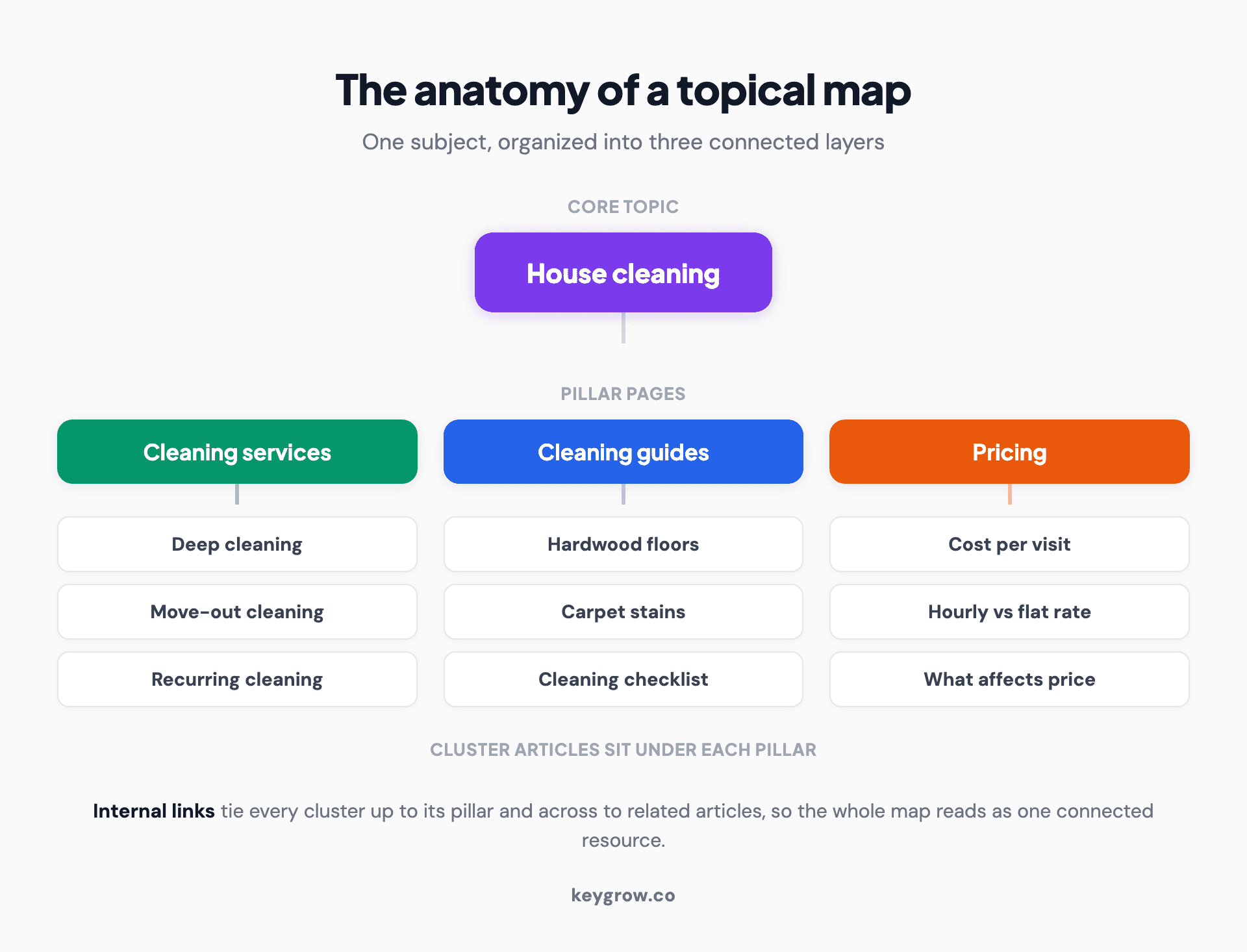
Infographic showing the anatomy of an SEO topical map as three connected layers: a central core topic in the middle, several pillar pages branching from it, and clusters of supporting articles beneath each pillar, all tied together with internal links pointing up to the pillars and across to related articles.
That structure is the whole idea: a hub-and-spoke architecture where the pillar is the hub and the cluster articles are the spokes. Build it well and a search engine can see, in one glance at your internal linking, that you have covered the subject thoroughly. That signal, that you are a complete resource rather than a one-off mention, is what a topical map exists to send.
How a topical map differs from the things people confuse it with
A topical map organizes a whole subject into pillar pages and supporting clusters connected by internal links. Keyword research, a content cluster, and a sitemap are each only one piece of it.
A topical map gets muddled with three other things constantly: keyword research, a content cluster, and a sitemap. They are related, but they are not the same, and the differences are the point.
| Thing | What it is | How it differs from a topical map |
|---|---|---|
| Keyword research | A list of terms people search, with volume and difficulty | Raw input. A topical map is the plan you build from it; a keyword list has no structure or intent grouping |
| A content cluster | One pillar page plus its group of linked supporting articles | A single building block. A topical map is the full set of clusters and pillars covering the whole subject |
| A sitemap | A technical list of your URLs for crawlers | A map of what exists. A topical map is a strategy for what should exist, organized by topic and intent |
The short version: keyword research feeds a topical map, a content cluster is one piece of a topical map, and a sitemap records the pages a topical map tells you to build. Keyword research without a map is where most content strategies quietly fall apart, which ties into whether keywords still matter in SEO at all. They do, but only once they are organized into a plan.
A quick example
Say you run a house cleaning service and want to own "house cleaning" in your market. Your core topic is house cleaning. Your pillars might be the services you offer, how-to cleaning guides, and pricing. Under the services pillar sit cluster articles like deep cleaning, move-out cleaning, and recurring cleaning. Under the guides pillar sit how to clean hardwood floors, how to remove carpet stains, and a cleaning checklist. Each cluster links up to its pillar and across to siblings, so a visitor reading a stain-removal guide finds your recurring-cleaning service two clicks away.
That is a topical map in miniature: a core topic, a few pillars, specific clusters under each, and internal links connecting them. The map is the plan. Turning it into published pages is the build, which we walk through step by step in our guide to completing a topical map.
Why topical maps matter: topical authority
Topical maps build topical authority, the trust a search engine places in a site that covers a subject thoroughly and connects the pieces, which is one of the strongest signals for ranking and being cited.
Here is the opinion worth stating plainly: a list of keywords is not a strategy, and a topical map is. Most businesses research keywords, publish a few posts, and wonder why nothing ranks. The structure is what they are missing. Ahrefs found that 96.55 percent of the pages in its index get zero traffic from Google, and scattered, structureless publishing is exactly what produces that result.
The data on structure is strong. HubSpot's topic-cluster experiments found that the more they interlinked cluster content, the better their search placement, with impressions rising as the number of links grew. Internal linking, the connective tissue of a topical map, is not decorative: Zyppy's study of 23 million internal links across 1,800 sites found that pages with at least one exact-match internal anchor had at least five times more traffic than pages without, though the study is careful to call that a correlation, not proof of cause.
A topical map also solves a problem it is easy to create accidentally: keyword cannibalization, where two of your own pages target the same query and split your rankings. By giving every subtopic exactly one home, a map keeps your pages from competing with each other, a problem we cover in our guide to duplicate content.
Topical maps and AI search
A topical map makes you more citable in AI answers, because AI assembles responses from sources that cover a whole topic, and broad, interconnected coverage is exactly what a map produces.
This is what has raised the stakes. AI Overviews and large language model answers do not crown one best page; they assemble a response from several sources that each show genuine, complete understanding of a topic. A topical map is how you become one of those sources.
The mechanism is query fan-out, where an AI breaks a question into many related sub-queries and pulls from pages that satisfy them. Search Engine Land, citing a Surfer study of 10,000 keywords, reported that pages ranking for those fan-out queries are 161 percent more likely to be cited in AI Overviews than pages ranking only for the main term. Broad, interconnected coverage is precisely what a topical map produces, which is why it doubles as an AI-visibility strategy. It also feeds the entity understanding behind modern search: Google's Knowledge Graph held more than 500 billion facts about five billion entities as of its 2020 figures, and complete topic coverage is how you connect your site to those entities. This is the practical core of semantic SEO, which we cover in our guide to how semantic SEO works.
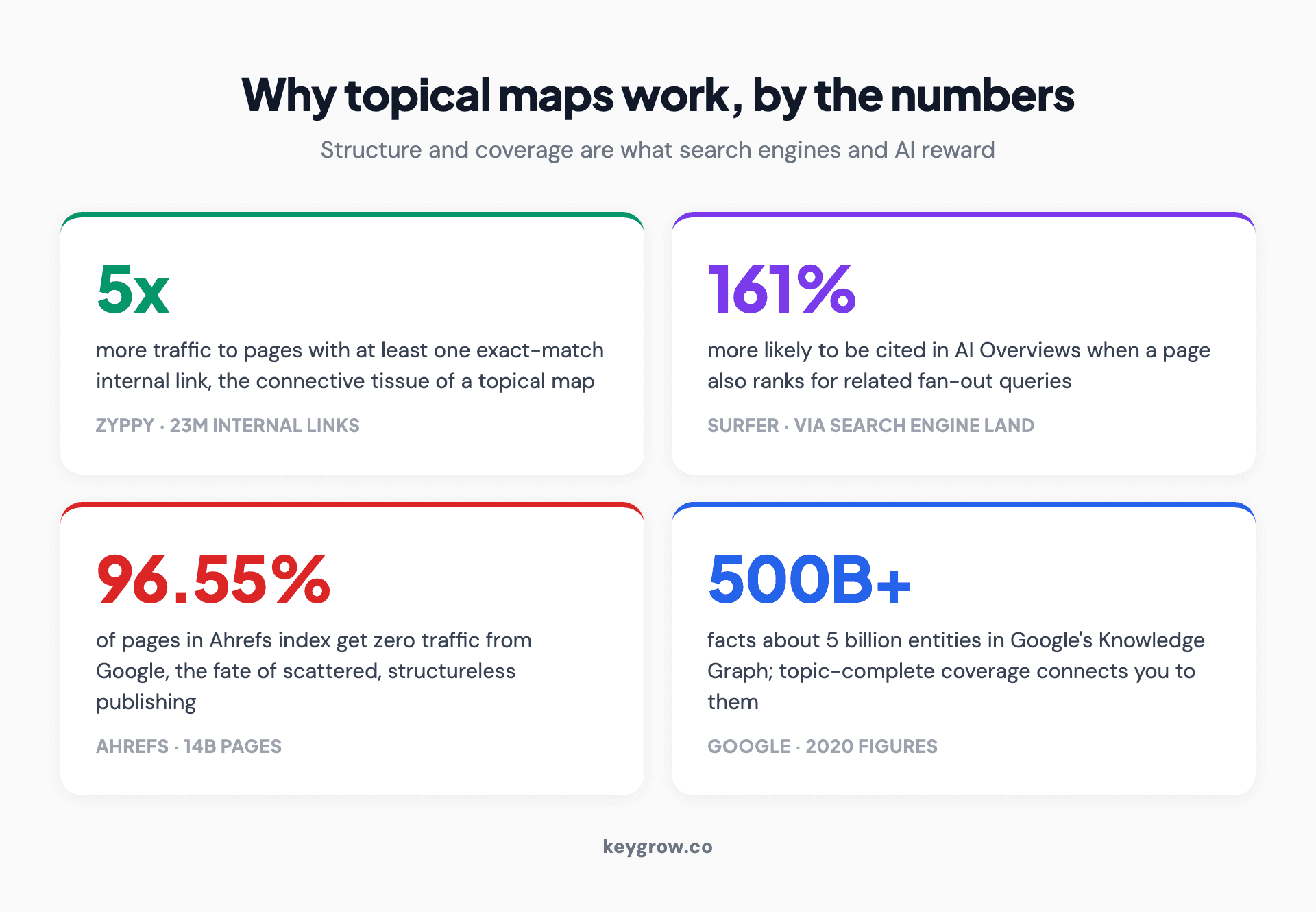
Infographic of four data points on why topical maps work for SEO: pages with an exact-match internal link earn at least 5 times more traffic (Zyppy), pages ranking for fan-out queries are 161 percent more likely to be cited in AI Overviews (Surfer), 96.55 percent of pages in Ahrefs index get zero traffic from Google (Ahrefs), and Google's Knowledge Graph holds over 500 billion facts about 5 billion entities (Google).
How do you build one?
You do not need expensive software to build a topical map. A spreadsheet with columns for pillar, cluster topic, target keyword, search intent, and status covers what most businesses need, and the thinking is the hard part, not the tool. Pick a core topic, group the subtopics into pillars and clusters, tag each by intent, and plan the internal links. We walk through the full seven-step process, with a worked example and a free checklist, in our guide to building a topical map.
If you run a single location and have a few hours a month, this is genuinely a do-it-yourself job. The map is a spreadsheet and a habit. Where a team like ours earns its fee is at scale: dozens of clusters, competing priorities, and the research to keep the map ahead of a moving market.
FAQs
What is an SEO topical map in simple terms?
It is a content plan that organizes everything you should publish about a subject into one core topic, a few broad pillar pages, and specific supporting articles beneath them, all connected by internal links. Think of it as a blueprint for covering a topic completely, so a search engine sees your site as an authority on it rather than a site that mentions it once.
How is a topical map different from keyword research?
Keyword research is the raw input: a list of terms people search, with volume and difficulty. A topical map is the structured plan you build from that list, grouping keywords into pillars and clusters by search intent and connecting them with internal links. Keyword research tells you what people search; a topical map tells you what to build and how it fits together.
What is the difference between a topical map and a sitemap?
A sitemap is a technical file that lists the URLs on your site so search engines can crawl them; it records what already exists. A topical map is a content strategy that defines what should exist, organized by topic and search intent. One is a crawl aid for pages you have; the other is a plan for the pages you need.
How does a topical map differ from a single content cluster?
A content cluster is one pillar page plus its group of linked supporting articles on a narrow theme. A topical map is the bigger picture: the full set of clusters and pillars that together cover an entire subject. A cluster is one building block; the topical map is the complete blueprint that organizes all of them.
How does a topical map help with topical authority and SEO?
It builds topical authority by covering a subject thoroughly and interlinking the pieces so the connections are clear to search engines. That structure signals you are a complete resource, which correlates with better rankings. It also prevents keyword cannibalization by giving each subtopic one home, and it spreads link equity through the site via internal links.
How many pages should a topical map have?
There is no fixed number. Most maps have three to five pillars, each supporting roughly five to fifteen cluster articles, scaled to how broad the subject is. Start with the pillars and the highest-impact clusters, then expand. Coverage and quality matter far more than hitting a particular page count.
Do topical maps work for brand-new websites?
Yes, and arguably they matter most there, because a new site has no authority to spend. Mapping the topic before you publish means every early article reinforces a deliberate structure instead of scattering effort. New sites still need time and links to rank, so a map sets the direction; it does not remove the wait.
Can a topical map improve visibility in AI Overviews and AI search?
Yes. AI answers use query fan-out, breaking a question into many sub-queries and pulling from sources that cover the whole topic. Because a topical map produces broad, interconnected coverage, it makes your site more likely to satisfy those sub-queries and earn citations. Complete topic coverage is now one of the strongest signals for AI visibility.
The short version
The payoff is the part worth remembering: thorough, connected coverage is what builds topical authority, keeps your pages from competing with each other, and earns you a place in AI answers, because the same complete coverage that ranks in classic search is what AI engines quote. The thinking fits in a spreadsheet, so a small business can start one this week and a team like ours mostly adds research and scale on top. Either way, decide which subject you want to own before you write the next post.
If you would rather have a team research and build the topical map your business should own, that is part of how our SEO service works. Tell us about your business and we will map the topic worth owning.


