


On February 19, 2016, Google confirmed it was removing text ads from the right side of desktop search results worldwide, replacing them with up to four ads above the organic listings on highly commercial queries. For organic SEO, the effect was immediate and physical: one more paid listing sitting on top of you, one fewer organic result above the fold, and the start of a ten-year squeeze on organic real estate that AI Overviews have now accelerated.
That is the short answer. The longer answer is more interesting, because almost everything written about this change was published in the panicked week it happened and never updated. A decade later, we know exactly which predictions came true, which did not, and what the whole episode teaches about surviving the next layout change. This post is that audit.
What exactly changed in February 2016
Google dropped right-rail text ads on desktop, added a fourth ad above organic results for highly commercial queries, and kept up to three ads at the bottom of the page.
The rollout was confirmed on Friday, February 19, 2016 and fully live by February 22, per Search Engine Land. The right rail did not go empty, though. Product Listing Ads (Shopping) and Knowledge Panels stayed, which mattered more than most coverage noticed at the time.
The arithmetic of the change:
| Before February 2016 | After |
|---|---|
| Up to 11 text ads per desktop SERP (3 top, 8 right rail) | Up to 7 (4 top, 3 bottom) |
| Right-side ads on roughly 40 percent of SERPs | Zero |
| Bottom-of-page ads on about 10 percent of SERPs | About 40 percent |
| Two organic results above the fold on a common 1366x768 laptop | Often one |
Right-side ads had been a fixture of Google's desktop results since 2000, so the removal ended a sixteen-year-old feature of the page overnight. Google never published its own numbers for why; it said only that the new layout performed better on highly commercial queries. Agency data filled the gap: iProspect found top-of-page ads pulling roughly 14 times the clickthrough rate of the same ad on the same keyword in the sidebar. And desktop was being redrawn to match mobile, which never had a right rail to begin with.
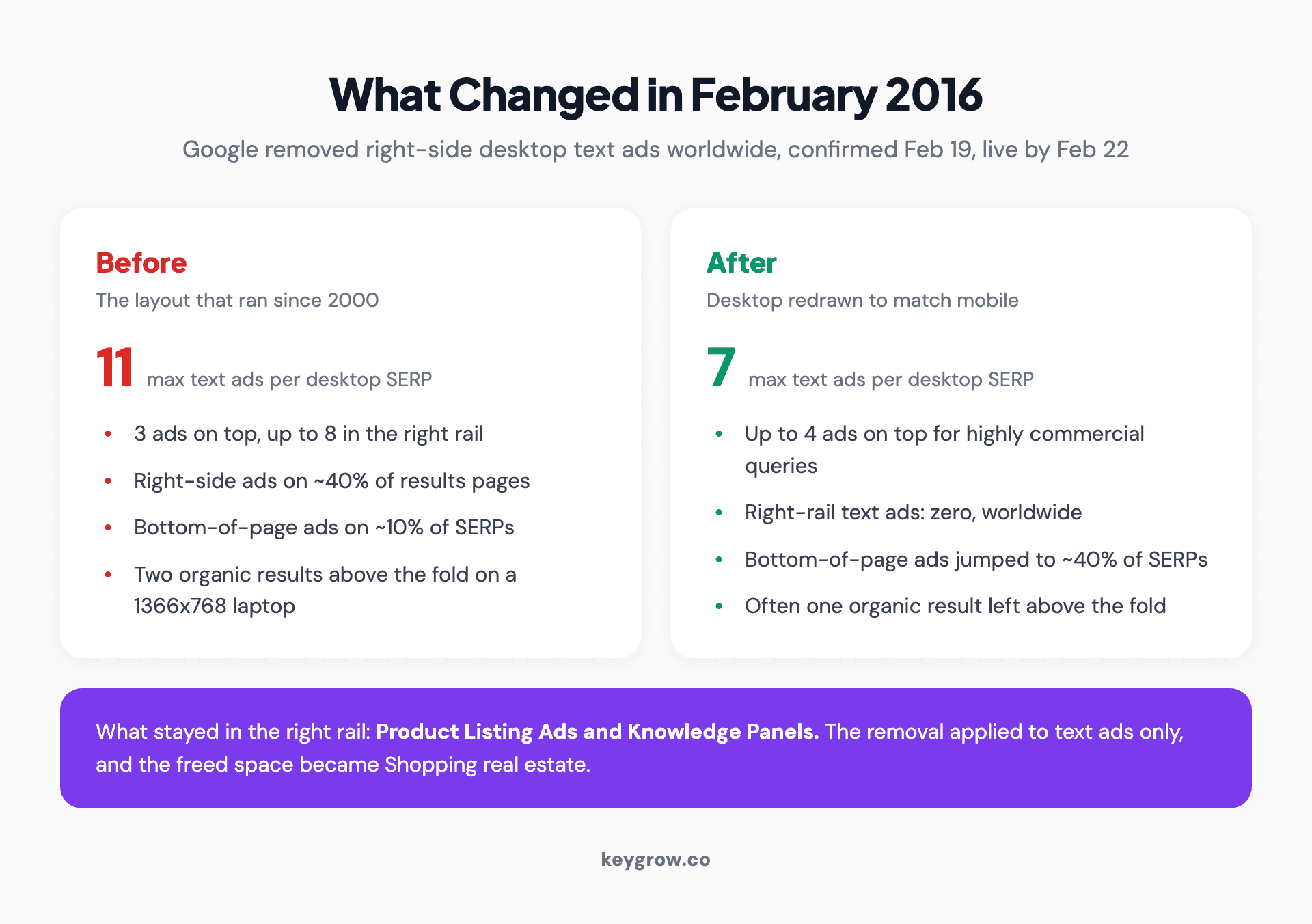
Before and after comparison of the February 2016 Google SERP change: eleven possible text ads with a right rail versus seven with four stacked on top.
The predicted apocalypse, audited
The 2016 predictions of soaring CPCs and collapsing organic traffic mostly did not happen. The measured damage hit paid impressions and sidebar advertisers, not organic rankings.
Every agency blog in February 2016 predicted some flavor of disaster: ad costs would spike as eleven slots collapsed to seven, and organic traffic would crater under the fourth ad. Here is what the measurement actually showed.
Total ads on the page really did fall. Moz tracked a 41.1 percent drop in total ads across 10,000 searches. The feared four-ad takeover started small: in the first days after rollout, Moz's SERP tracking (cited in WordStream's analysis) found four-ad blocks on just under 20 percent of pages carrying top ads, roughly doubling to about 36 percent in the months that followed. Still a minority. The CPC apocalypse did not materialize in the aggregate data either, and the loudest beneficiaries were the surviving positions: WordStream's data across 2,367 US accounts saw position 3's clickthrough rate double the day the change hit, with the lasting gain settling around 15 percent, the biggest boost of any position.
For organic, there was no documented collapse. The honest reading is that the change hurt sidebar advertisers, rewarded top-position advertisers, and pushed organic results one notch further down on commercial queries. Painful, but survivable. The 2016 doom pieces were wrong about the mechanism and the timeline. The real organic squeeze came later, and it came from a different direction.
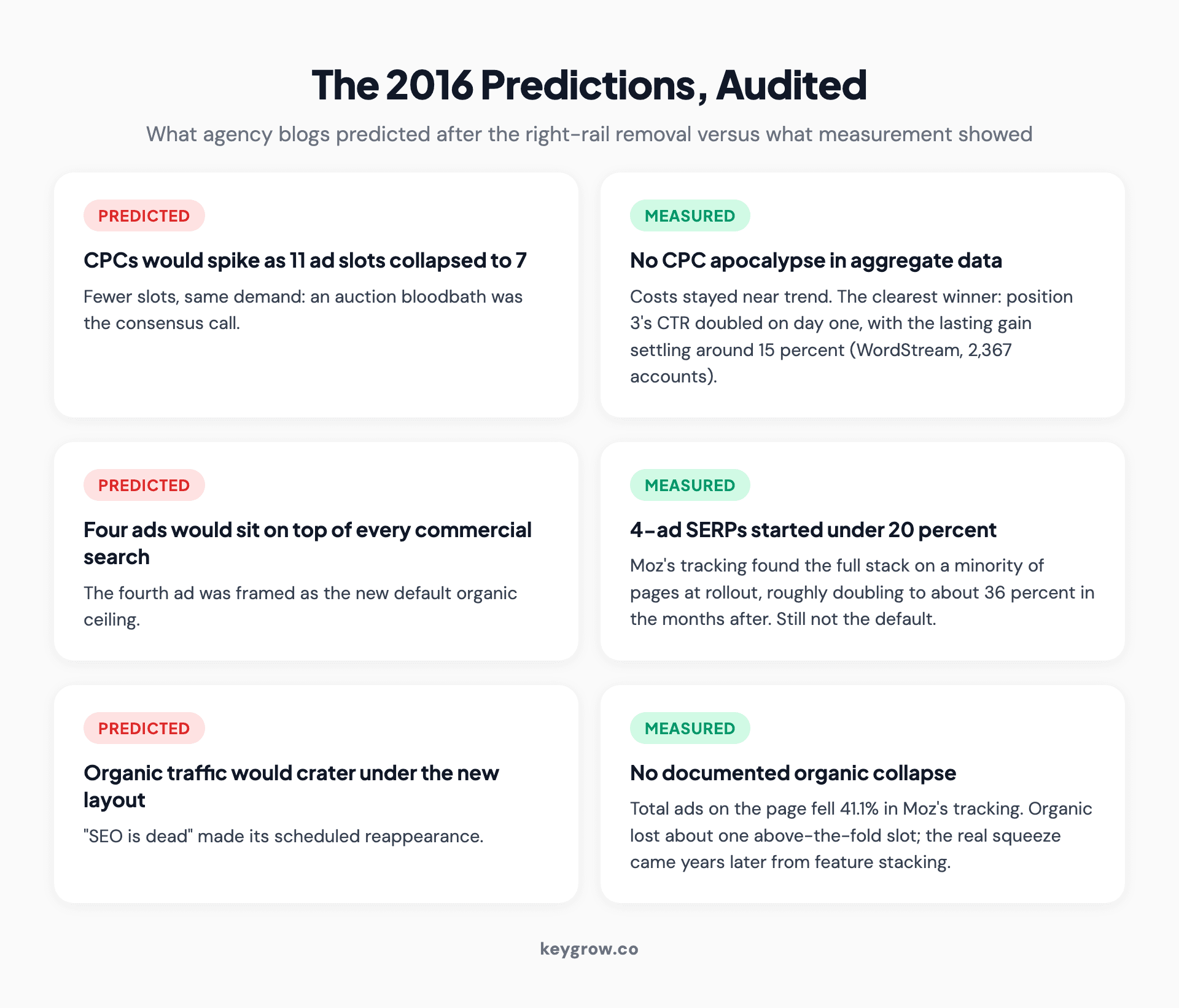
Cards comparing what was predicted after the 2016 right-rail removal against what measured data showed: no CPC spike, four-ad SERPs under 20 percent, no organic collapse.
The removal was a rehearsal, not the show
The lasting lesson of 2016 is not the fourth ad. It is that Google keeps stacking SERP features on top of organic, and each layer pushes the ten blue links further down.
Look at the sequence since. Shopping units expanded into the space the sidebar freed up. Features that had debuted earlier kept spreading: featured snippets (introduced in 2014) took over the top of informational queries, local packs and People Also Ask boxes (both from 2015) grabbed more room, and video carousels hit desktop in 2018. Then AI Overviews arrived in May 2024 and claimed the biggest slice yet.
The pixel data tells the story better than any opinion. By 2026, the median number-one organic result sits about 635 pixels from the top of the desktop page, and only 57 percent of number-one organic results appear above the fold on desktop at all, roughly 40 percent on mobile. On commercial queries, paid and shopping units occupy over 60 percent of above-the-fold space while organic gets about 16 percent. In 2016, SEOs worried about losing one of two above-the-fold organic spots. In 2026, the number-one ranking is frequently invisible without scrolling.
The clickthrough numbers follow the pixels. Ahrefs first measured position-one CTR dropping 34.5 percent when an AI Overview is present (April 2025, across 300,000 keywords), and its February 2026 re-run of the same study found the drop had widened to 58 percent. Meanwhile Pew Research found users clicked a traditional result in only 8 percent of visits with an AI summary versus 15 percent without one.
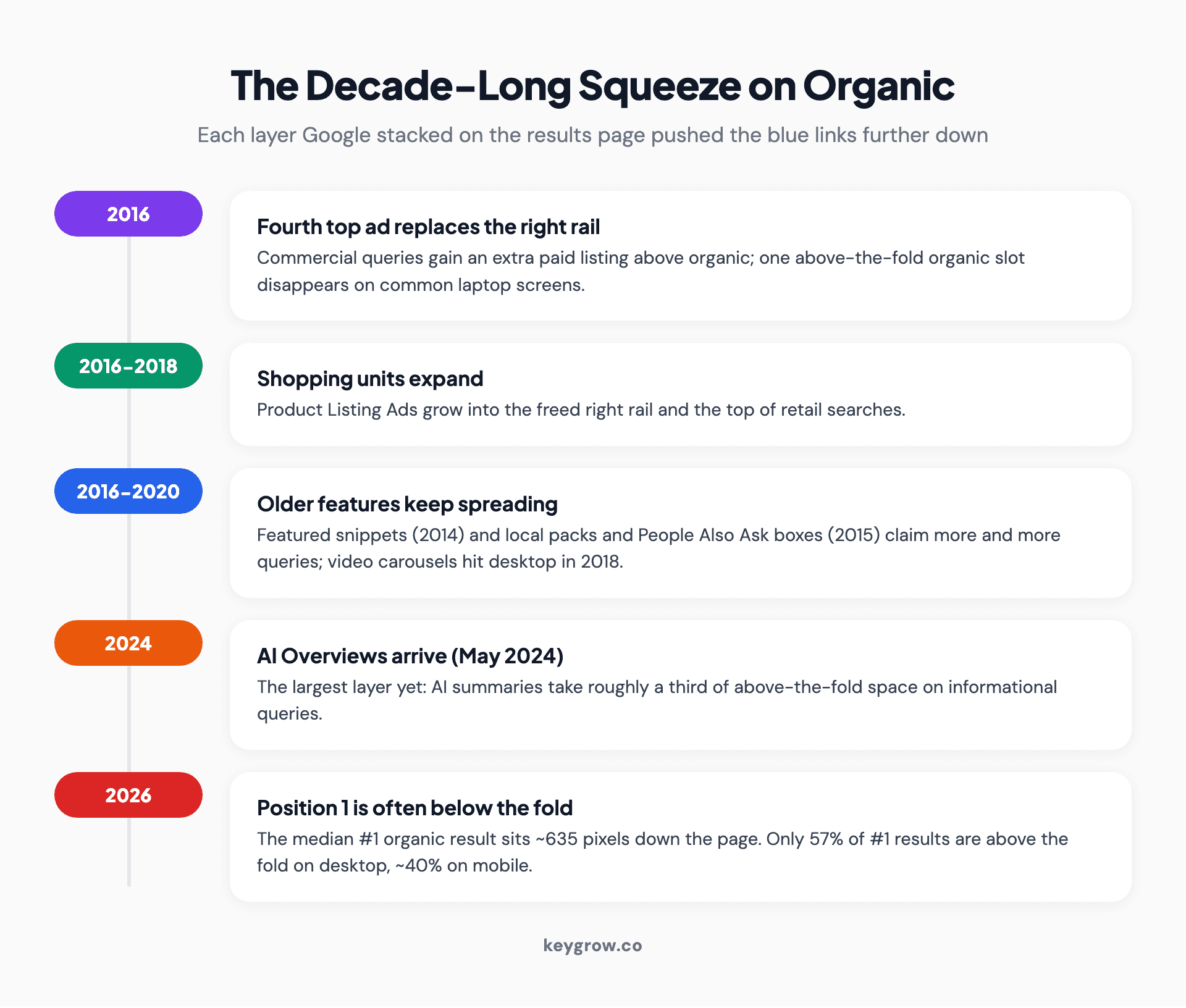
Timeline of Google SERP features stacking on top of organic results from 2016 to 2026: fourth top ad, shopping units, featured snippets, local packs, and AI Overviews.
2016 versus 2026: the same playbook still wins
In both eras, the winners stopped defending old positions and started occupying the new features. In 2016 that meant Shopping ads and snippets. In 2026 it means AI citations.
Notice what stayed on the page in 2016: Product Listing Ads kept the right rail. Ecommerce advertisers who leaned into Shopping got real estate everyone else had just lost. The SEOs who chased featured snippets got back above the fold without buying it. The feature always pays better than the position it displaced.
The same trade is on the table now. Seer Interactive's tracking found that being cited inside an AI Overview correlates with 35 percent higher organic CTR and 91 percent higher paid CTR on those queries. Here is the opinion we keep repeating to clients because the number backs it: the question changed from "how do I rank" to "how do I become the source." ChatGPT cites only about 15 percent of the pages it retrieves, and roughly 44 percent of ChatGPT citations come from the first third of a page. Ranking-era habits, like burying the answer to pad word count, actively hurt now. The foundational elements AI systems reward are the 2026 equivalent of grabbing the snippet in 2017.
What this means for your SEO in 2026
Track pixels and features instead of raw positions, structure pages so machines can lift answers, and treat paid and organic as one surface instead of rivals.
Practically, that breaks into four moves:
- Measure visibility, not rank alone. "Position 1" that starts 635 pixels down is not the position 1 your 2016 rank tracker imagined. Pixel-based tracking, or at minimum checking which SERP features sit above you, tells you what a ranking is actually worth.
- Write answer-first. Put the direct answer in the first 100 words of the page and under each heading. That is what earns snippet placements and AI citations, the two features that still put you above the fold for free.
- Own the features your queries trigger. Commercial queries: Shopping feeds and reviews. Local queries: your Google Business Profile. Informational queries: structured, liftable answers.
- Stop treating paid and organic as separate religions. The 2016 change and the AI era both punish that split. On commercial SERPs where paid and shopping units hold over 60 percent of the above-fold space, PPC and SEO working together is not a philosophy debate, it is coverage.
None of this requires an agency. A small business with one location can restructure its key pages answer-first in a weekend. Where professional SEO help earns its fee is doing that across hundreds of pages while the layout keeps shifting under you.
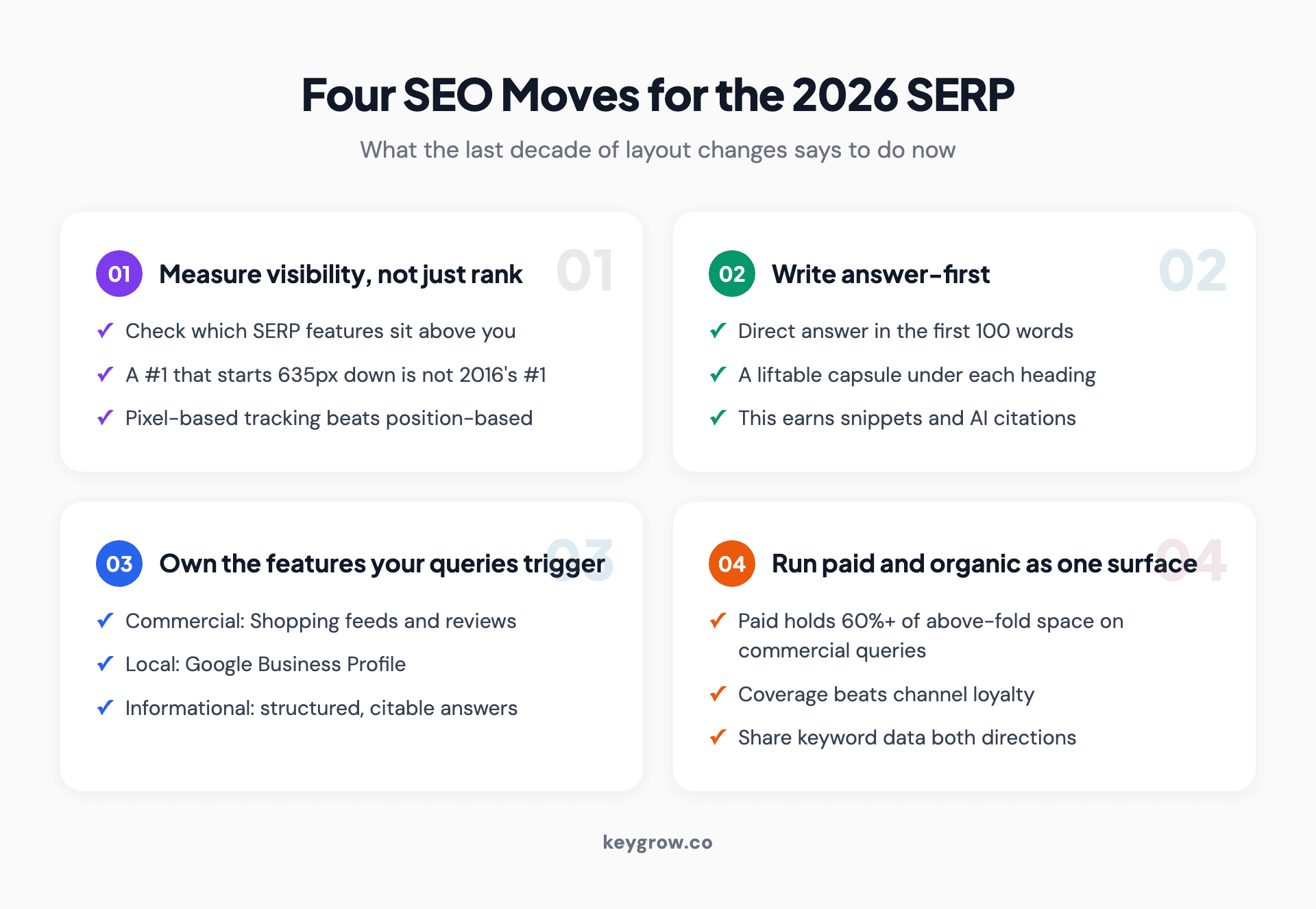
Checklist of four SEO moves for the 2026 SERP: track pixel visibility, write answer-first, win the features your queries trigger, and run paid with organic.
FAQs
Why did Google remove ads from the right side of search results?
Top-of-page ads earned roughly 14 times the clickthrough rate of sidebar ads in iProspect's advertiser data, so the right rail was low-value inventory. Removing it also made desktop match mobile, which never had sidebar ads, and freed the right side for Product Listing Ads and Knowledge Panels.
When did Google remove right-side ads from desktop search?
Google confirmed the change on February 19, 2016, and the rollout was complete worldwide by February 22, 2016. It applied to desktop text ads in all languages.
How many ads does Google show above organic results?
Up to four text ads can appear above organic results on highly commercial queries, a limit introduced with the 2016 change. Most searches show fewer; in the days after the 2016 rollout, Moz measured all four ads on under 20 percent of SERPs carrying top ads, a share that later grew to roughly a third.
Did removing right-side ads hurt organic SEO?
Not directly. Measured data showed the damage fell on paid impressions and sidebar advertisers, while organic results lost roughly one above-the-fold position on commercial queries. The larger organic decline came later from SERP features stacking on top, especially AI Overviews.
What still appears on the right side of Google search results?
Product Listing Ads (now part of Shopping) and Knowledge Panels kept the right rail in 2016 and remain there today. The removal applied only to text ads.
Do AI Overviews reduce organic clicks?
Yes, substantially. Ahrefs measured a 34.5 percent drop in position-one clickthrough when an AI Overview is present in April 2025, widening to 58 percent in its February 2026 re-run, and Pew Research found users click traditional results roughly half as often when an AI summary appears.
Is SEO still worth it when ads and AI Overviews dominate the page?
Yes, but the target moved. Pages built to be cited (answer-first structure, liftable sections, real data) still earn traffic through snippets and AI citations, and organic remains the only channel where the clicks do not stop when the budget does.
The pattern worth remembering
Google has redrawn its results page every few years for two decades, and each redraw transfers attention from whoever was renting the old layout to whoever adapts to the new one first. The 2016 right-rail removal looked like a crisis and turned out to be a rehearsal. AI Overviews are the show.
So borrow the 2016 winners' move: stop mourning the layout, audit which features now sit above you, and restructure your pages to occupy them. If you want a second set of eyes on where your pages stand in the 2026 layout, our SEO and AEO teams do that audit every day, month-to-month, no lock-in. The next redraw is already in testing somewhere.