

Pull up the data and the panic almost makes sense. When Google shows an AI summary, people click a normal search result only 8 percent of the time, versus 15 percent when no summary appears, per Pew Research. So is local SEO dead? No. The clicks are shrinking, the map pack is changing, and AI Overviews are eating informational queries. But the customer who taps Call or Directions never visited your website either, and they still walked in the door.
That is the whole confusion in one sentence. Local SEO is not dead. The version of it that meant "rank a page, harvest the clicks, count the sessions" is on life support. The version that means "be the obvious local choice at the moment someone needs you" is doing fine. This post keeps score honestly, with named data: what genuinely died, what still works, and what to measure now that the old scoreboard lies to you.
What people actually mean when they ask if local SEO is dead
When someone types "is local seo dead" into a search bar, they almost never mean it literally. They mean one of three things, and the answer is different for each.
The first is "my traffic dropped, should I quit." The second is "the map pack looks different and I am scared." The third is "should I keep paying my agency for this." Lump them together and you get the doom-posting that fills this topic. Separate them and you get a useful answer.
Here is the reality. Local search volume is not falling. What is falling is the share of that search that ends in a click to your website. Those are not the same thing, and conflating them is how a healthy channel gets declared dead by people staring at the wrong number.

A small business owner seated behind the counter of a well-stocked shop looking at a smartphone
The honest scoreboard: clicks are down, but are customers?
Clicks are measurably down. Customers are not, and that gap is the entire point.
Roughly 60 percent of searches now end without the user clicking through to a website, reported by Bain. For informational queries that trigger an AI Overview, organic click-through rate fell about 61 percent since mid-2024, per Search Engine Land. If your only metric is website sessions, yes, the floor is moving under you.
But a local search is not a content search. When someone searches "emergency electrician near me" and taps the Call button straight from your Google Business Profile, that is a customer who never loaded your site. Google Search Console will never count it as a website click, because it was not one. The job still got booked. The phone still rang.
So the honest scoreboard has two rows. Clicks to local websites: down, real, measurable. Customers reaching local businesses: not down in any data we can find, because the path moved off your website and onto the profile. If you are measuring the first row and ignoring the second, you will fire a channel that is still working.
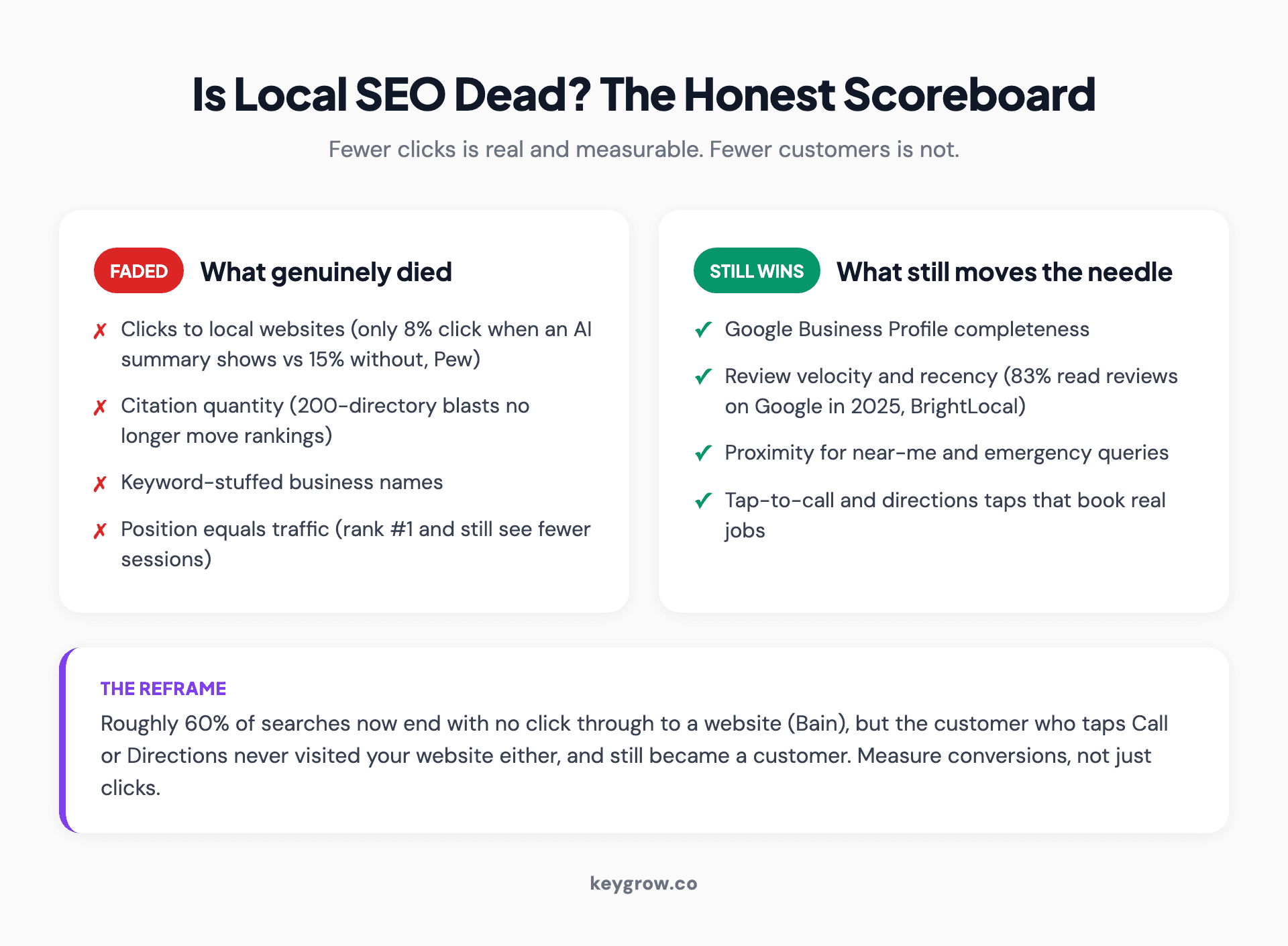
Two-row scoreboard infographic comparing what genuinely declined in local search, clicks to local websites and direct-to-site sessions, against what held steady, customer actions like tap-to-call, directions taps, and booked local jobs, showing that fewer clicks does not equal fewer customers
What genuinely faded, and you can stop doing
Some local SEO tactics really did die. Keeping them on the to-do list is wasted effort, so here is what to cut.
Citation quantity as a primary tactic. Blasting your business into 200 random directories used to move rankings. It does not anymore. A handful of accurate, authoritative listings (and consistent name, address, and phone across them) still matters. The 200-listing packages do not.
Keyword-stuffed business names. Renaming your profile to "Best Affordable Emergency Plumber Downtown" was always against Google's guidelines, and enforcement and competitor reporting have made it a liability rather than an edge.
Ranking position equals traffic. This is the big one. The assumption that moving from position three to position one delivers a predictable traffic bump broke when AI Overviews and the local pack started absorbing clicks above the organic results. You can rank number one and still see fewer sessions than you did at number three two years ago. Position still matters for visibility. It no longer maps cleanly to clicks.
Counting click-to-call volume in GSC. Not because calls stopped, but because the most valuable local conversions increasingly happen on surfaces Search Console was never built to report. The action moved. The measurement has not caught up, which is its own section below.
If your agency's monthly report still leads with citation counts and keyword rankings, that is a polite red flag. Vanity-metric reporting is the industry's most durable habit. Reports should open with calls, directions, and booked jobs, not impressions.
What still wins in 2026: profile, reviews, proximity
Three signals still move local results, and none of them are new or clever. They are completeness, reviews, and how close you are.
A complete, active Google Business Profile is still the single most valuable thing a local business owns. Categories, hours, photos, services, Q&A, regular posts. This is foundational enough that it is worth understanding whether GBP helps SEO before spending a dollar anywhere else.
Reviews still carry real weight, and the consumer behavior backs it. 83 percent of consumers used Google to read reviews in 2025, up from 81 percent in 2024, per BrightLocal. Velocity and recency matter more than a frozen pile of five-year-old five-stars. A steady drip of fresh reviews beats a one-time review-gathering sprint, because shoppers weigh whether the latest ones are recent before they trust the average.
Proximity is the quiet third leg. For "near me" and emergency queries, how physically close you are to the searcher is a heavy factor you cannot fully optimize away. A van-based service three suburbs over will struggle to outrank a storefront on the searcher's block, no matter how good the SEO. This is not a flaw to fix. It is a constraint to plan around (service-area pages, multiple verified locations if you genuinely operate there, and accurate service-area settings).
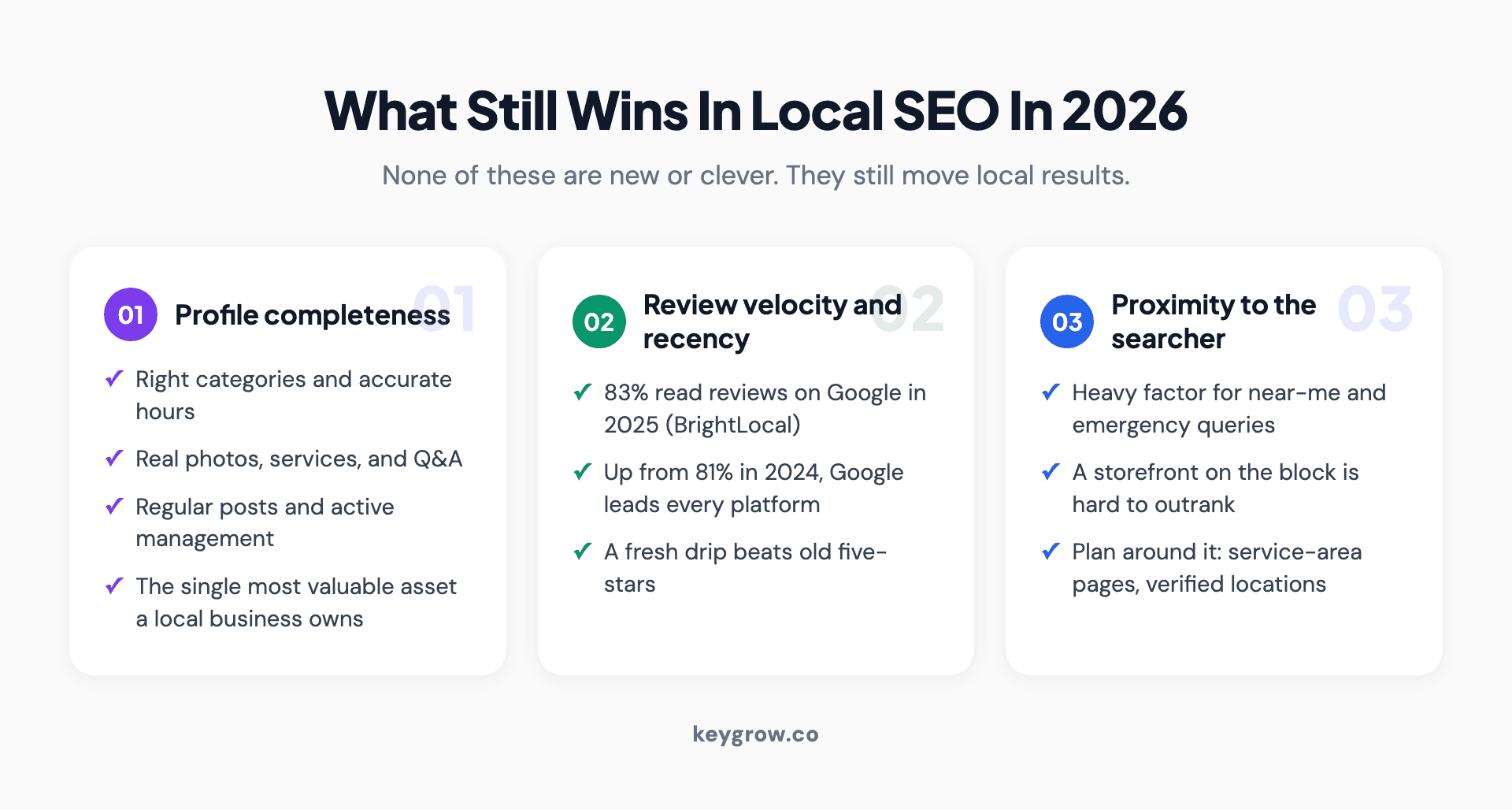
Three-card infographic of the local SEO signals that still win in 2026: Google Business Profile completeness with categories, hours, photos and posts; review velocity and recency with 83 percent of consumers reading reviews on Google per BrightLocal; and proximity to the searcher for near-me and emergency queries
How AI Overviews and AI packs changed who gets shown
AI is not deleting local search. It is narrowing the shelf, so fewer businesses get displayed for the same query.
Sterling Sky's 2026 analysis of ranking data found AI local packs featured 5,943 unique businesses versus 18,330 in regular 3-packs across the same tracked keywords, per Sterling Sky. In 88 percent of 322 analyzed markets, the AI pack showed fewer unique businesses than the traditional 3-pack. The shelf got shorter. The businesses already winning visibility are over-represented; the long tail gets squeezed out.
At the same time, paid placements moved into that shrinking space. Per Sterling Sky's tracking, ads inside the local 3-pack rose from about 1 percent of tracked queries in early 2025 to 22 percent by December 2025, and Local Services Ads visibility climbed from 11 percent to 31 percent. Read that together: organic local slots are getting scarcer while paid ones expand into the gap. That is not a coincidence, and it is why "is it dead" and "do I need to pay now" are really the same question for some businesses.
This shift hits search the same way AI Overviews hit broader results, which we broke down in our piece on how AI Overviews affect SEO. The local twist is that the squeeze happens inside the pack, not just above it.
Does getting cited by AI actually send you customers?
Mostly no, and anyone selling "get cited by AI" as a traffic strategy is overselling it.
Here is the uncomfortable number. When an AI summary appeared, only about 1 percent of users clicked a source cited inside it, per Pew Research. Being the cited source is visibility, not traffic. For a local business, the value of an AI citation is brand recall and trust, the same way a billboard works, not a measurable stream of clicks.
That does not make it worthless. If the AI summary names your business and a few competitors, you want to be on that list, because being absent is worse. But treat it as a presence play, not a lead channel. The customer still has to take a second action (search your name, open your profile, tap call) for the citation to turn into anything. If a vendor quotes you a "citations driving traffic" figure, ask exactly how they tracked the click. Usually they cannot, because Pew already showed it barely happens.
If you want the strategic version of this, we cover whether SEO and GEO work together rather than competing for the same effort.
Is your business type in the danger zone or the safe zone?
"Is local SEO dead" has a different answer depending on what you sell. The query type decides it.
The danger zone is informational and research queries. "What is a root canal," "how does bankruptcy work," "signs of a roof leak." These are exactly what AI Overviews answer in place, so the click that used to land on your blog post now lands nowhere. If your local traffic strategy leaned on educational content to pull top-of-funnel visitors, that funnel narrowed sharply.
The safe zone is transactional and emergency near-me intent. "Plumber near me open now," "DUI lawyer free consultation," "walk-in dentist Saturday." Someone searching that at the moment of need is not reading a 1,500-word explainer. They are picking a business and contacting it. AI cannot complete that job for them, so the local pack and the profile still own it.

A person standing outdoors at night in front of a tall building using a phone to search for a nearby service
The practical read: emergency services, walk-in trades, and bottom-of-funnel local intent are holding up well. B2B, considered purchases, and content-led local plays are taking the hardest hit. Most real businesses sit somewhere between, so audit your own query mix before deciding the sky is falling.
What to measure now instead of rankings and raw clicks
Stop opening the report with rankings. Start with the actions a customer actually takes. The metrics changed because the customer journey changed.
Here is the 2026 local measurement stack, in order of how much it tells you:
1. Google Business Profile actions. Calls, directions requests, website taps, and message starts, pulled from the profile's own performance view. This is where most local conversions now live, and it is the closest thing to a sales report local search gives you.
2. Branded versus non-branded queries. A rising share of branded search ("yourbusiness near me") usually means your visibility work is paying off even when raw clicks look flat, because people are now searching for you by name.
3. AI-referral traffic in your analytics. Filter GA4 for referral sources that are AI assistants. It will be small. Watching the trend still tells you whether you are appearing anywhere in those answers.
4. Conversions, not sessions. Calls booked, forms submitted, appointments set. A channel that sends 30 percent fewer sessions but the same number of booked jobs did not get worse. It got more efficient.
One honest caveat on tooling. Google Search Console does not report AI Overview traffic as a separate line, and it never counts a tap-to-call from the profile as a website click. So GSC will systematically under-report your real local performance. Pair it with the profile's own insights, or you will keep reading a half-empty dashboard and panicking. Because the journey is continuous and not a one-time project, treat this as ongoing SEO where the trend line matters more than any single week.
We have watched this play out. Three local service clients we worked with, a phone repair shop, a real estate office, and a junk removal company, reached 115+, 90+, and 50+ monthly phone calls respectively within six to seven months. None of those calls would show as a "click" in a website-only report. If we had measured them the old way, all three would have looked like SEO was barely working.
Where to put your effort if you have a small budget
A solo operator and a 12-location chain should not run the same playbook. Budget decides the order, so here is the honest split.
If you are a single-location business with more time than money, do the basics yourself before paying anyone. Claim and complete the profile, set the right categories, add real photos, and get a steady stream of reviews. That is most of the available win, and you do not need an agency for it. DIY is the right call more often than agencies admit. Hire help only when the opportunity cost of your own hours beats the fee.
If you run multiple locations or a competitive vertical (legal, medical, anything with high lead value), the calculus flips. Managing profiles at scale, keeping data consistent across locations, and deciding when paid placement is now compensating for organic loss is real work with real returns, and the lead value justifies it.
When local SEO is genuinely not worth it for you. If you serve customers nationally and have no physical proximity to anyone, local SEO is not your channel, and a local-focused agency should tell you that on the first call. If your margins cannot survive a months-long ramp, paid (Local Services Ads, pack ads) is the faster, if more expensive, route, and we would say so rather than sell you organic. The honest answer is sometimes "not this, at least not first." Note too that local SEO compounds slowly, so if you need leads this week, set realistic expectations on how long local SEO takes before you commit.
FAQs
Is local SEO still worth it in 2026?
Yes, for businesses that serve customers near a physical location or service area. The wins moved from website clicks to profile actions like calls and directions, so it is worth it if you measure those and not just sessions. It is not worth prioritizing for national-only businesses with no local proximity.
Will Google Maps and the local 3-pack disappear because of AI Overviews?
No, but the 3-pack is getting squeezed. Sterling Sky found AI local packs showed fewer unique businesses than traditional 3-packs in 88 percent of markets analyzed, and paid placements grew inside the pack through 2025. So Maps is not vanishing, but fewer businesses get shown, and more of the visible slots are now paid.
Do AI Overviews and AI assistants send local businesses any traffic?
Very little. Pew Research found only about 1 percent of users clicked a source cited inside an AI summary. Treat an AI citation as visibility and brand recall, similar to a billboard, not as a measurable traffic channel. Being listed still beats being absent, but do not budget for clicks that rarely come.
How do I show up in Google AI Overviews and AI local packs?
The same fundamentals that win the regular pack: a complete, active Google Business Profile, strong and recent reviews, accurate categories and service areas, and proximity to the searcher. AI packs are over-represented by businesses that already have strong local visibility, so there is no separate trick, just the established signals done well and kept current.
What local SEO tactics no longer work?
Mass citation building across hundreds of directories, keyword-stuffed business names, and treating ranking position as a reliable predictor of traffic. Counting only website clicks in Search Console also misleads, because the most valuable local actions now happen on the profile where GSC cannot see them. Cut those and redirect the effort to profile completeness and reviews.
How do I measure local SEO success now that clicks are dropping?
Lead with Google Business Profile actions (calls, directions, message starts), then track branded versus non-branded query share, AI-referral traffic in GA4, and actual conversions rather than sessions. Search Console under-reports local performance because it does not count profile calls as website clicks, so pair it with the profile insights. A channel that sends fewer sessions but the same booked jobs got more efficient, not weaker.
So, dead or just relocated?
Relocated. The customer did not leave; the click did. Local search still puts your business in front of someone at the exact moment they need it, but the win now lands on your profile (a call, a directions tap, a booked job) more often than on your website. The data says clicks are down. It does not say customers are down, and nobody has produced the number that would prove they are.
So measure the right row of the scoreboard, cut the tactics that genuinely died, keep your profile and reviews sharp, and be honest about whether your business type sits in the danger zone or the safe zone. If you want a clear-eyed read on whether local search is still your channel, and where paid now compensates for shrinking organic, tell us about your business. We will tell you if it is worth it, including when it is not.


