

Ask three SEO people how long does local SEO take and you will get three different numbers, all of them confident and none of them wrong. That is because the question hides two questions inside it. So here is the honest answer up front: showing up in the Google map pack can take 2 to 8 weeks, but ranking your actual website for local searches takes months, often the same 4 to 12 months a national campaign would. Local SEO has two clocks running at different speeds, and almost every article on this topic mashes them into one mushy "3 to 6 months" range that helps nobody.
This post separates the two clocks, gives you honest ranges by scenario, and hands you a way to forecast your own timeline instead of borrowing someone else's.
Why local SEO has two timelines, not one
Local SEO runs on two separate systems, and they move at very different speeds. The Google map pack (the three-business box with the map) has its own ranking algorithm and can change in weeks. Your website ranking in the regular blue links behaves like ordinary SEO and takes months.
When someone searches "emergency plumber near me", Google can show two things: a local pack pulled from Google Business Profiles, and standard organic results pulled from websites. These are scored differently. Google's own documentation says local results rank on relevance, distance, and prominence, and distance (how close you are to the searcher) is applied instantly. Google also states that more reviews and higher ratings can improve where you sit in local results.
That instant distance factor is why a brand-new, well-optimized profile can surface in the map pack within weeks, while the website behind it is still nowhere on page one. Same business, same effort, two completely different timelines. If you only remember one thing from this post, make it that.

A business owner standing at a glass display counter inside a shop, checking a handheld device in daylight
The fast clock: showing up in the Google map pack (2 to 8 weeks)
Map pack and Google Maps visibility is the fast clock, and a claimed, fully filled, verified profile in a market that is not brutally competitive can start appearing in 2 to 8 weeks.
Here is why this clock runs faster. Google ingests off-site signals (a verified profile, citations on directories, fresh reviews) much faster than it re-evaluates a thin new website. Whitespark's local search ranking factors put Google Business Profile signals at roughly 32 percent of local pack ranking weight, and in their 2026 report review signals carry close to 20 percent. That is nearly half the local pack riding on things you can fix in a week of work, not things that take Google a quarter to recrawl and trust.
The speed depends heavily on your starting point:
A Google Business Profile is the single most valuable thing a local business owns, and it is worth understanding whether GBP actually helps your SEO before you spend a dollar on anything else.
The slow clock: ranking your website for local searches (months)
Your website ranking for local terms on the standard blue links is the slow clock, and it follows the same curve as national SEO: think months, not weeks, with new pages slower to rank now than they were a few years ago.
The data here is blunt. An Ahrefs ranking study found only 1.74 percent of newly published pages reach Google's top 10 within a year, down from 5.7 percent in 2017. Of the pages that do rank within a year, 40.82 percent reach the top 10 within the first month. The same study found 72.9 percent of top-10 pages are more than three years old, and the average number-one page is five years old.
Read that twice. The thing competing for "plumber Austin" on the blue links is, on average, a five-year-old page from an established site. Your two-month-old service page is not beating it by Friday. This is the part that makes SEO take as long as it does, and it is the same physics whether you are going local or national.
The map pack lets you cheat the slow clock for the searches that trigger it. But "near me" and proximity-heavy queries are not every search. Plenty of local intent ("best estate planning attorney downtown", "24 hour locksmith reviews") leans on organic results too, and those obey the months-long curve.
Why local SEO can beat national SEO on speed
Local SEO often shows results faster than national SEO, and the reason is mechanical, not motivational. Three things work in local's favor that a national campaign never gets.
First, proximity is an instant ranking factor. Google applies distance to the searcher in real time. A national keyword has no proximity lever to pull, so it competes purely on relevance and authority, which take longer to build.
Second, the local pack has its own, lighter algorithm. It rewards a complete profile, consistent citations, and reviews, which are off-site signals Google can verify and apply quickly, faster than it re-scores a young domain.
Third, the competitive field is smaller. Ranking for "personal injury lawyer" nationally means fighting every firm in the country. Ranking for the same service in one suburb means fighting the handful that bothered to optimize. The bar is lower because most local competitors have a half-finished profile and three reviews from 2019.
That said, do not confuse "faster" with "fast". If your goal is the blue-link website rankings rather than the map pack, you are back on the slow clock and the national SEO timeline is your honest reference point.
Honest timeline ranges by scenario
There is no single answer because your starting point changes everything. Below are realistic ranges by scenario for first meaningful results, meaning real map-pack impressions and the first calls, not full top-three dominance.
| Scenario | Map pack visibility | Website (blue link) ranking |
|---|---|---|
| New GBP, small town, low-competition service | 2 to 6 weeks | 3 to 6 months |
| Claimed but neglected GBP, mid-size city | 3 to 8 weeks | 4 to 8 months |
| Competitive metro vertical (lawyer, dentist, HVAC) | 8 to 16 weeks for top three | 6 to 12+ months |
| Brand-new website, no domain history | 4 to 10 weeks (profile-led) | 8 to 12+ months |
The pattern is consistent: the map pack moves first, the website rankings follow, and the gap between them widens the more competitive your market is. A junk removal company in a small market will feel progress long before a dentist in a major metro does, even if both teams do identical work.
Our own results sit inside these ranges, not outside them. A junk removal client reached 50+ monthly phone calls in 6 months, a phone repair shop hit 115+ monthly calls in 7 months, and a real estate office reached 90+ monthly calls in 7 months. None of these were overnight. All of them were calls, not rankings, which is the distinction the next section is built on.
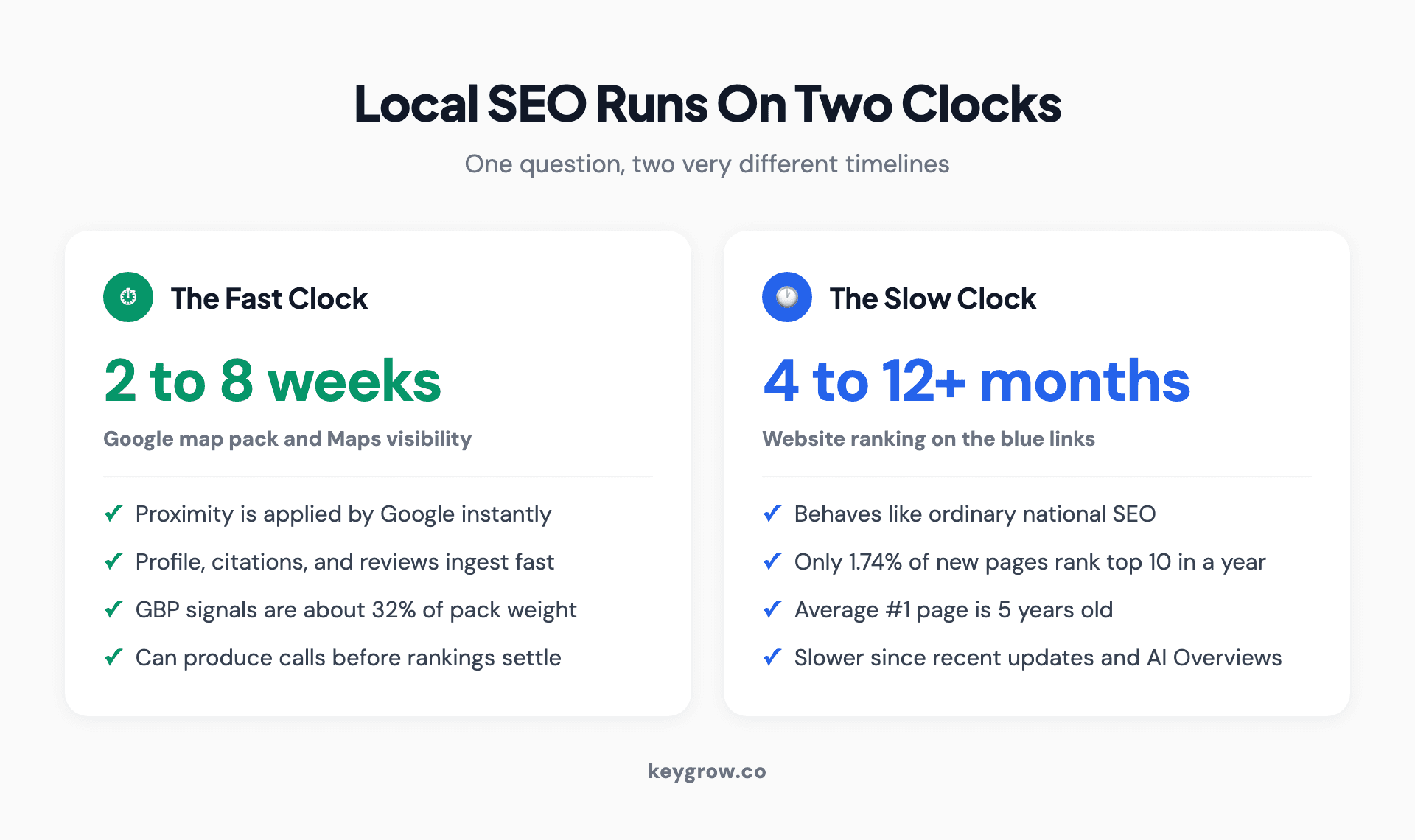
Two clocks of local SEO showing map pack visibility moving in 2 to 8 weeks versus website blue-link rankings taking 4 to 12 months
What actually moves the needle first
The fastest gains come from the off-site signals Google can verify quickly: a complete Google Business Profile, consistent business information across directories, and a steady stream of reviews. These are the levers that move the fast clock.
In rough order of speed and impact:
1. Claim and fully complete your Google Business Profile. Categories, services, hours, photos, description. This is the most productive hour you will spend.
2. Fix NAP consistency. Your name, address, and phone number must match exactly across your site and every directory. Mismatches confuse Google and stall the map pack.
3. Build and clean up citations. Listings on relevant directories reinforce that you exist and are legitimate.
4. Earn reviews steadily. Not 40 in one day, then silence. A consistent trickle signals an active, real business. The BrightLocal review survey found 71 percent of consumers regularly read reviews for local businesses, and 83 percent use Google to read them, so reviews are both a ranking signal and a conversion signal.
Notice what is not at the top of that list: blog posts, backlinks, and a homepage redesign. Those matter for the slow clock, the website rankings. They do almost nothing for next month's map-pack impressions. Sequencing matters.
Rankings versus results: you can get calls before you "rank"
You can start getting phone calls and direction requests before your rankings stabilize, because proximity-triggered map-pack impressions put you in front of nearby searchers even while your average position is still bouncing around.
This is the most misunderstood part of local SEO. A business owner watches their keyword rank position like a stock ticker and concludes nothing is working, while the phone is quietly ringing more than it did last month. The map pack shows different businesses to different people based on where they are standing. There is no single "rank" to watch. There are impressions, calls, and direction requests.
So measure the thing that pays rent. HubSpot data puts 46 percent of all Google searches on local intent, and notes that 88 percent of people who run a local search on a phone call or visit a business within 24 hours. The intent is immediate. If you are tracking only keyword positions, you are watching the slowest, least meaningful number on the dashboard. Here is how we think about measuring SEO by revenue, not rankings.

A staff member at a shop counter interacting with a customer over a phone in warm natural light
How to forecast your own timeline (a 6-input checklist)
You can estimate your own timeline by scoring six inputs honestly. The more of these that point "easy", the closer you are to the fast end of every range above.
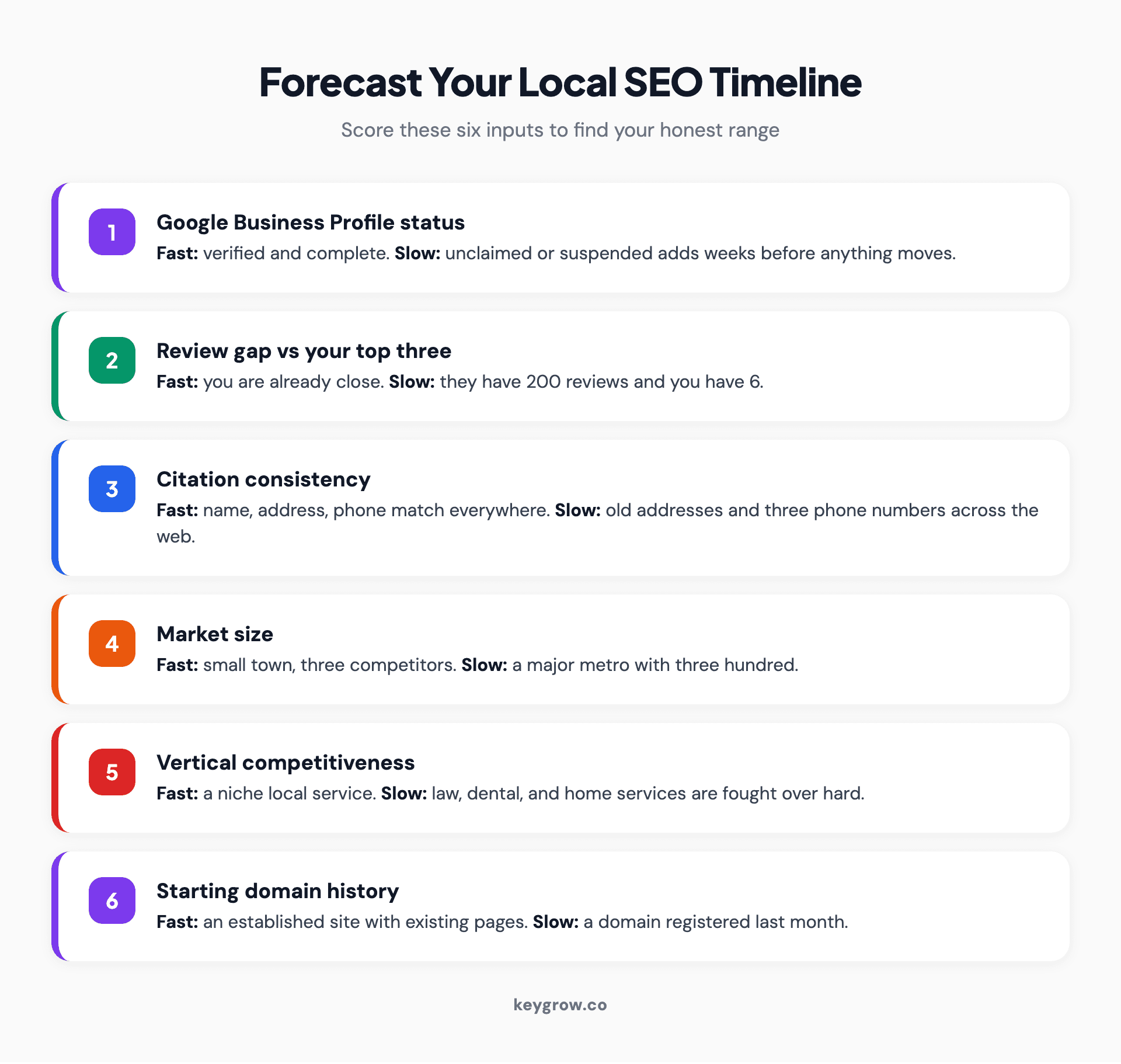
Six-input checklist for forecasting your local SEO timeline covering profile status, review gap, citations, market size, vertical competitiveness, and domain history
Score each one:
1. GBP status. Verified and complete is fast. Unclaimed or suspended adds weeks before anything moves.
2. Review gap versus your top three competitors. If they have 200 reviews and you have 6, closing that gap is months of consistent asking, not a weekend.
3. Citation consistency. Clean and consistent is fast. A trail of old addresses and three phone numbers across the web is drag.
4. Market size. A small town with three competitors moves faster than a metro with three hundred.
5. Vertical competitiveness. Lawyers, dentists, and home services are fought over hard. A niche service in the same town is easier.
6. Starting domain history. An established site with existing pages ranks new content faster than a domain registered last month.
Three or more inputs on the "easy" side, and you are likely in the fast lane on both clocks. Three or more on the "hard" side, and plan for the longer end and a bigger budget. This is also where some businesses should hear the honest version: see the next note.
When local SEO is not worth the wait
Local SEO is not the right first move for every business, and saying so is more useful than pretending otherwise.
If you need leads this week (you just signed a lease, payroll is due, the pipeline is empty), SEO is the wrong tool. It is a compounding asset, not an emergency channel. Paid search will get you in front of buyers tomorrow while SEO builds underneath. If you serve a single location with more time than money and your market is not competitive, you can probably do the basics yourself: claim the profile, fix NAP, ask for reviews. Do not pay an agency 1,200 dollars a month to do what an afternoon and a spreadsheet can handle.
And the strongest opinion in this post, backed by a number: "page one in 30 days" is a red flag, full stop. Real organic results compound slowly. The best case we have on record took a full 12 months to reach 1,519 percent organic traffic growth. Anyone promising the map pack and the blue links locked up in a month is either targeting keywords no one searches or about to do something to your profile you will regret. Slower and real beats fast and fake.
Your first 90 days: what to watch and when to worry
In the first 90 days, watch leading indicators in Google Business Profile, not keyword rankings, because the leading indicators move first and tell you the work is landing before positions settle.
When to worry: if you are 90 days into competent work and GBP impressions are flat, calls are flat, and discovery searches have not budged at all, something is wrong (a verification issue, a NAP mismatch, a thin or duplicate profile, or work that is not actually happening). Flat rankings at 90 days are normal. Flat impressions and zero calls at 90 days are not. Local SEO is one part of ongoing SEO that compounds over time, so the trend line matters more than any single week.
What 2024 to 2026 changed about local SEO timelines
Recent updates have made new pages slower to rank and have compressed organic clicks, which stretches the slow clock without changing the fast one much.
Two shifts matter. First, the documented collapse in how fast new pages rank: that 1.74 percent of new pages reaching top 10 within a year (versus 5.7 percent in 2017) per Ahrefs is the slow clock getting slower. Second, AI Overviews and AI-generated answers now sit above some organic results, taking clicks that used to flow to the blue links. The map pack, sitting in its own box on local-intent searches, is less exposed to that compression, which is one more reason the fast clock has held up better than the slow one.
The takeaway is not "give up on the website". It is sequencing. Get the map pack working first, because it is faster, less exposed to AI compression, and tied directly to calls. Build the website rankings underneath as the durable asset that keeps producing after the easy wins plateau.
FAQs
Can local SEO show results in one month?
Sometimes, but only on the fast clock. A claimed, complete, verified Google Business Profile in a low-competition market can start appearing in the map pack and generating a few calls within 2 to 4 weeks. Website rankings on the blue links will not move meaningfully in 30 days. If someone promises full local domination in a month, treat it as a red flag.
Is Google Business Profile optimization faster than ranking my website?
Yes, almost always. Google ingests profile signals, citations, and reviews faster than it re-evaluates and trusts a young website. Whitespark estimates GBP signals make up roughly 32 percent of local pack ranking weight, so optimizing the profile is the fastest-moving, highest-payoff work in local SEO.
Why does local SEO take less time than national SEO?
Three mechanical reasons. Proximity is a ranking factor Google applies instantly, the local pack runs on its own lighter algorithm that rewards off-site signals it can verify quickly, and your competitive field is smaller (a few local businesses, not the entire country). National SEO has no proximity lever and a far larger field, so it leans entirely on authority that takes months to build.
How long does it take to show up in the Google map pack?
For a verified, fully completed profile in a market that is not brutally competitive, 2 to 8 weeks is a realistic range for first visibility. Cracking the top three in a dense metro vertical like law or dentistry can take 8 to 16 weeks or longer. Unverified or suspended profiles add weeks before anything moves.
How long should I wait before deciding local SEO is not working?
Give it 90 days, but judge it by the right metric. Flat keyword rankings at 90 days are normal. Flat Google Business Profile impressions, zero new calls, and no movement in discovery searches at 90 days of competent work are not, and signal a real problem worth investigating.
Do more reviews speed up local SEO results?
Yes, on the fast clock. Google states more reviews and higher ratings can improve local ranking, and in Whitespark's 2026 report review signals carry close to 20 percent of local pack weight. Steady, genuine reviews also convert: BrightLocal found 71 percent of consumers regularly read reviews for local businesses. A consistent trickle beats a one-time pile.
Setting expectations you can actually hold us to
A good timeline estimate is not a single number. It is "the map pack should start producing calls by week six, the website rankings will take most of a year, and here is why for your specific situation." Anyone who answers "3 to 6 months" without asking about your profile, your reviews, or your market is guessing.
So ask for the specific version. Our team will look at your profile, your competitors, and your market, then tell you which clock will move first and roughly when. We work month-to-month, so the only thing keeping you around is the calls showing up. Get a straight answer on your timeline and we will tell you, honestly, including if you would be better off doing the basics yourself.


