

Ongoing SEO is the continuous work of maintaining and improving a site's search rankings after the initial setup is done. It covers publishing and refreshing content, fixing technical issues as they appear, earning new links, and tracking results, all on a repeating cycle rather than as a one-time project.
The reason it is ongoing is simple: search is not a finish line you cross once. Google changes how it ranks pages, your competitors keep publishing, and your own content slowly goes stale. Stop maintaining a site and its rankings drift down, the same way a storefront looks abandoned if nobody cleans the windows. This guide explains what ongoing SEO includes, what it should reasonably cost, and the cases where you genuinely do not need a monthly retainer.
What is ongoing SEO?
Ongoing SEO is recurring search optimization work done on a regular schedule to protect and grow your rankings, rather than a single project with an end date. Think maintenance and compounding, not setup.
A one-time SEO project gets your foundation right: site structure, the important pages, the obvious technical problems. That work matters, but it is the start. Ongoing SEO is everything that happens after, on a monthly rhythm. You publish new pages for queries you do not yet rank for, update the pages that have slipped, watch for technical errors, build authority, and read the data to decide what to do next month. The word "ongoing" is doing real work here. It means the job repeats because the conditions that decide your rankings keep changing.
Is SEO a one-time thing or an ongoing process?
SEO is an ongoing process, not a one-time fix. Three forces keep changing underneath you: Google's algorithm, your competitors, and the freshness of your own content. Each one erodes rankings you stop maintaining.
Start with the algorithm. Google does not sit still. In 2024 alone it rolled out seven confirmed updates, four core updates and three spam updates, according to Search Engine Land, and those are only the ones Google announced. Each update reshuffles results. A page that ranked fine in January can lose positions in March because the rules quietly shifted.
Then there are your competitors. They are not frozen while you coast. They publish, they update, they earn links. If you stop and they do not, they pass you. Search rankings are relative, so standing still is the same as moving backward.
Finally, your own content ages. Prices change, examples date, the advice that was current two years ago reads as old now. Google notices, and so do readers. This is why "set it and forget it" does not exist in search. The honest version of the answer is that SEO is less like building a wall and more like tending a garden. For the full picture on timelines, we wrote a separate piece on why SEO takes so long.
What does ongoing SEO include?
Ongoing SEO is usually a repeating mix of four things: content work, technical upkeep, authority building, and measurement. A fair retainer spends real hours on each, not just one.
Here is what a real ongoing scope looks like, and why each piece is there.
| Area | What happens monthly | Why it matters |
|---|---|---|
| Content | Publish new pages, refresh and prune old ones | Captures new queries and stops existing pages going stale |
| Technical | Audits, fix crawl errors, speed, broken links | Search engines cannot rank what they cannot crawl cleanly |
| Authority | Earn links and brand mentions, fix lost links | Authority is how you outrank older, established pages |
| Measurement | Track rankings, traffic, and conversions, then adjust | Tells you what is working so next month is not guesswork |
The content piece is usually the biggest. You are both adding pages and protecting the ones you already have, because refreshing a page that has slipped often beats writing a new one from scratch. The technical piece is smaller most months but spikes after a site change or a Google update. Authority building is slow and never really finishes. And measurement is the part that should drive everything else, which is why we treat tracking SEO as its own discipline rather than an afterthought.
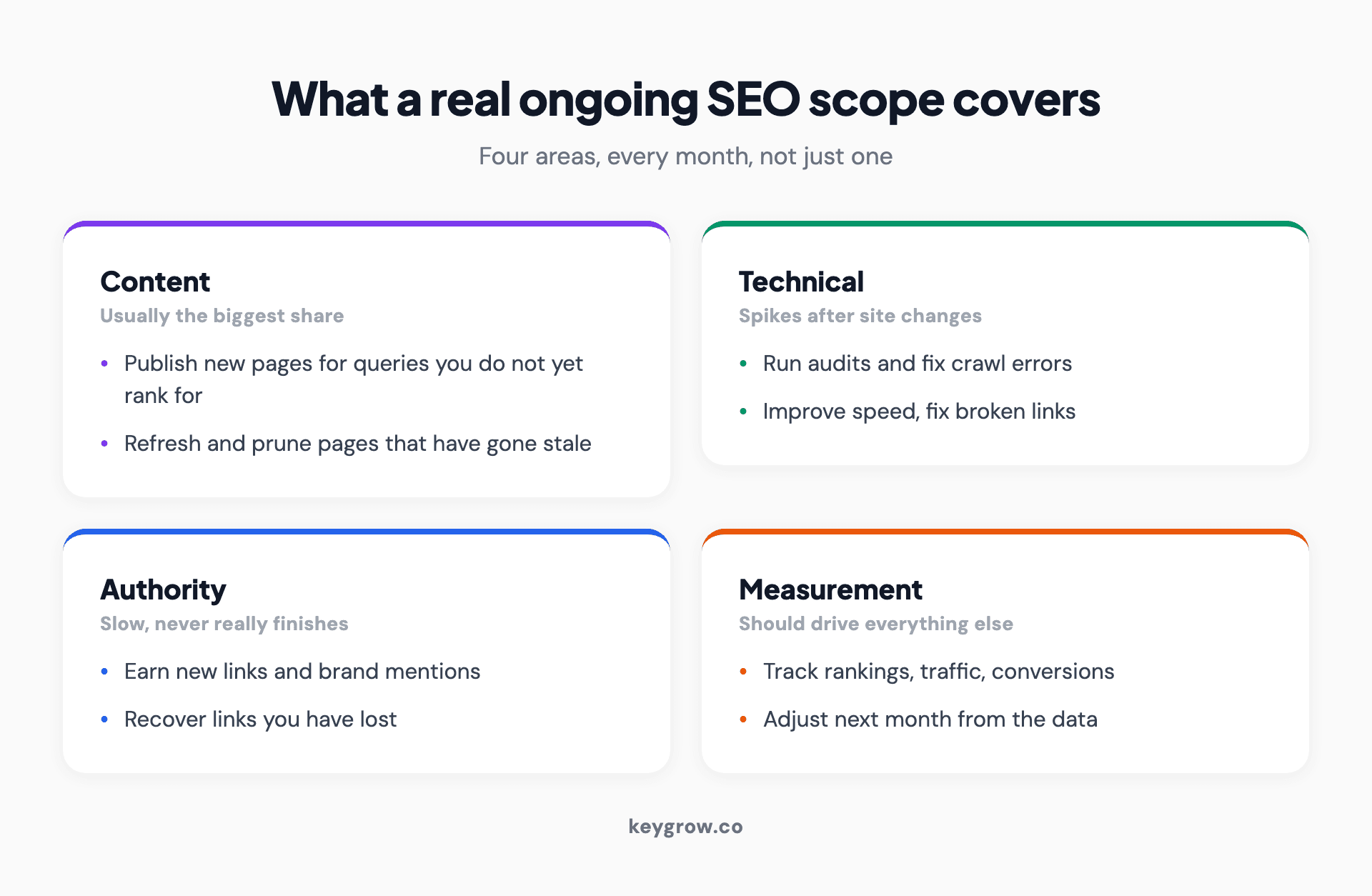
Infographic showing the four areas of an ongoing SEO scope arranged in a grid: Content (publish new pages, refresh and prune existing ones), Technical (audits, fix crawl errors, improve speed), Authority (earn links and brand mentions, recover lost links), and Measurement (track rankings, traffic, and conversions, then adjust the plan).
Why SEO behaves like an asset, not a campaign
Here is the opinion worth taking away: SEO is a compounding asset, not a campaign. A campaign runs and ends. An asset gains value the longer you hold it, and loses value the moment you stop maintaining it. The data on how pages rank backs this up plainly.
Look at how old the winners are. Ahrefs found that the average page ranking number one in Google is about five years old, and 72.9 percent of top-ten pages are more than three years old. New pages rarely break through fast. In the same study, only 1.74 percent of newly published pages reached the top ten within a year. Rankings are earned over time and compound, which is exactly how an asset behaves.
The flip side is brutal for anyone who quits early. Ahrefs' analysis of roughly 14 billion pages found that 96.55 percent of pages get zero traffic from Google. That is the default outcome. Ongoing SEO is the work of dragging a page out of that 96.55 percent and keeping it out, because the gravity always pulls back toward zero.
We watched this play out with a doctor's practice in Dubai. They committed to SEO for a full year. The first three months looked unimpressive, the kind of stretch where a nervous client wants to pull the plug. By month twelve, organic traffic had grown 1,519 percent and the practice was fielding 130 or more patient calls a month. Same site, same client, no shortcuts. The growth was not from one big push. It compounded.
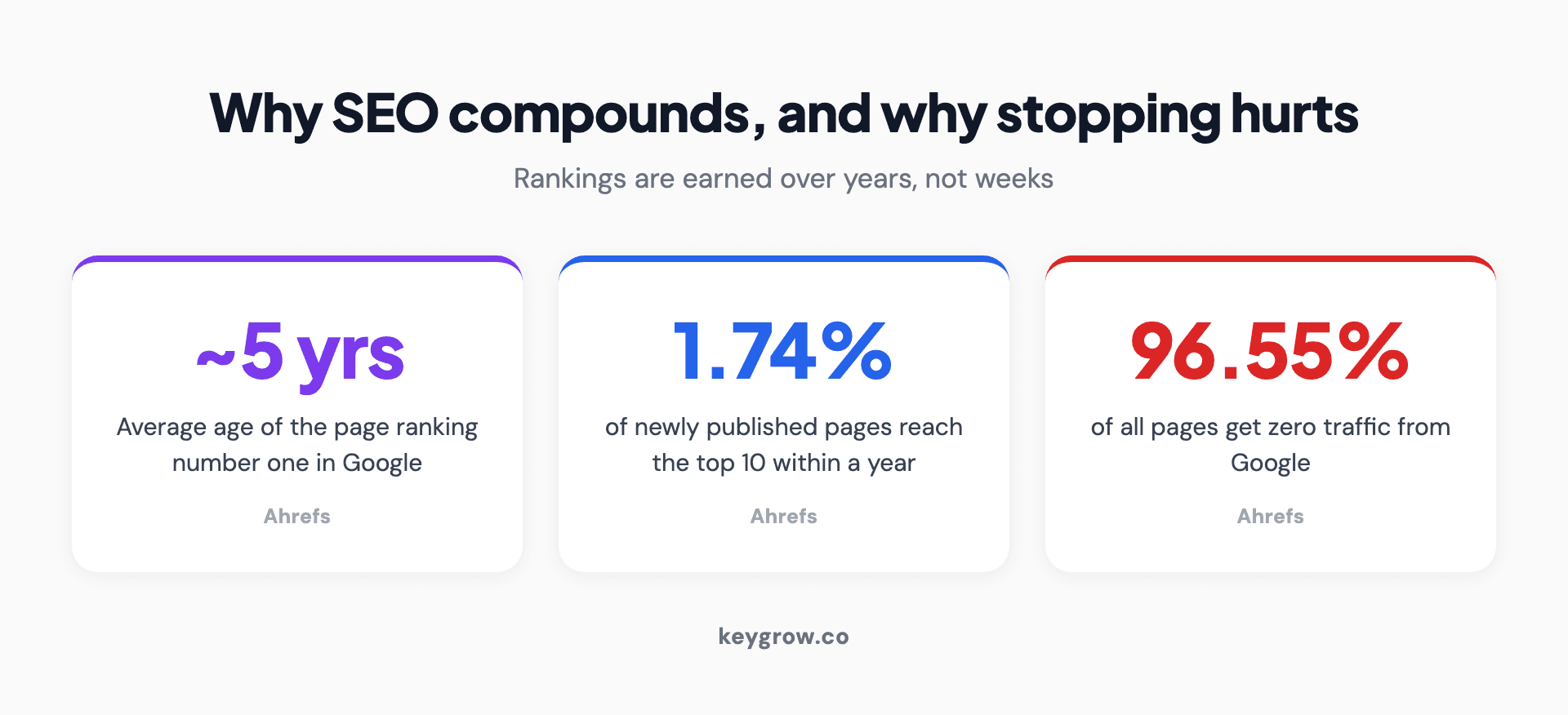
Infographic titled why SEO compounds, showing three verified statistics as a stat strip: the average number-one ranking page in Google is about 5 years old, only 1.74 percent of newly published pages reach the top 10 within a year, and 96.55 percent of all pages get zero traffic from Google. Source attributions to Ahrefs.
What happens if you stop doing SEO?
If you stop, rankings usually hold for a while, then erode. The decline is gradual rather than instant, which is what makes it dangerous: by the time the traffic drop is obvious, you have lost months of ground that takes longer to win back.
Nothing breaks the day you cancel. Your pages keep ranking on momentum for weeks, sometimes a couple of months. Then the three forces from earlier go to work. A core update shuffles results and you are not there to respond. A competitor refreshes the article that was beating yours. Your top page ages another year with no update. Position by position, you slide.
The cost is not just the rankings you lose. It is the gap between where you are and where you would have been. The slot you vacate gets filled, and because the top three results pull 54.4 percent of clicks according to Backlinko's analysis, slipping from third to sixth is not a small dip. It is most of your search traffic walking out the door. Winning those positions back means starting the climb again, often against the competitor who took your place.
How much should ongoing SEO cost?
Most monthly SEO retainers cluster in the hundreds to low thousands of dollars, depending on competitiveness and scope. The price matters less than what is actually in it. A cheap retainer full of busywork is more expensive than a fair one that moves the numbers.
For a benchmark, Ahrefs' survey of SEO providers found the most common monthly rate was 501 to 1,000 dollars, charged by about a fifth of respondents. Plenty charge more for competitive markets, and some charge far less for thin work. We do not publish flat pricing here because real scope depends on your market, but you can judge any quote by what it buys.
The thing to watch for is the busywork retainer. A red flag is a report that opens with impressions and "engagement" instead of leads, calls, or revenue. Vanity metrics are easy to grow and easy to hide behind. If you cannot connect the monthly fee to something that pays rent, you are probably renting activity, not buying results. We dug into how to read this in are SEO services worth it. Whatever you pay, the engagement should be month-to-month. An agency that needs a long lock-in to keep you is telling you something about its confidence in the results.
When you do not need ongoing SEO
Not every business needs a monthly retainer. If you have a small, stable site that already ranks for everything you need, in a market with little competition, paying for ongoing SEO can be spending money to solve a problem you do not have.
A few honest cases where you can skip or pause it:
Hire ongoing help when the math flips: when your market is competitive enough that standing still means losing, or when the opportunity cost of your own time spent on SEO beats the fee. Until then, doing the basics yourself is a perfectly good answer, and any honest agency will tell you so.
Does ongoing SEO matter for AI search?
Yes, arguably more than before. AI Overviews and answer engines pull from current, well-structured pages, and they update what they cite often. A page you stop maintaining falls out of those answers the same way it falls out of rankings.
The 2026 version of the question has the same shape as the classic one, just higher stakes. Answer engines favor pages that are fresh and clearly structured, so the ongoing habits that protect your rankings, updating content and keeping it clean, are the same ones that keep you cited. If anything, the pace is faster, because AI systems tend to pull fresher sources than traditional search does. The fundamentals that make you a citable source are covered in our guide to AI search optimization, and they reward maintenance, not abandonment.
FAQs
Is SEO a one-time thing or ongoing?
Ongoing. A one-time project can set your foundation, but it cannot hold rankings on its own. Google updates its algorithm, competitors keep working, and your content ages, so the optimization has to repeat. Stop, and rankings drift down over the following months. SEO is maintenance and growth, not a task you finish once.
What is included in ongoing SEO services?
A fair ongoing scope covers four areas every month: content (publishing new pages, refreshing and pruning old ones), technical upkeep (audits, crawl errors, speed), authority building (earning links and mentions), and measurement (tracking rankings, traffic, and conversions, then adjusting). Content work is usually the largest share. If a retainer only does one of these, you are not getting full ongoing SEO.
How much does ongoing SEO cost per month?
It varies widely by market and scope. A common benchmark from an Ahrefs survey put the most popular monthly rate at 501 to 1,000 dollars, though competitive markets run higher. Judge a quote by what it buys, not the number alone. A report that leads with leads, calls, or revenue is worth more than a cheaper one full of impressions and vanity metrics.
How long do you need to keep doing SEO?
For as long as you want the rankings and the traffic they bring. SEO typically takes three to six months to show meaningful results, and the gains compound after that, so most businesses treat it as a continuous channel rather than a fixed term. You can pause it once you are comfortably ahead and demand is steady, but expect a slow slide if you stop entirely.
Can I stop SEO once I reach number one?
Not safely. Rankings hold on momentum for a while, then erode as updates land, competitors push, and your content ages. The top three results take more than half of all clicks, so slipping even a couple of positions costs a large share of your traffic. Holding a top spot takes ongoing work, especially in a competitive market where rivals are actively trying to take it.
What is the difference between one-time SEO and ongoing SEO?
One-time SEO is a project: it fixes your site structure, key pages, and obvious technical issues, then ends. Ongoing SEO is the recurring work after that foundation is set: publishing, refreshing, link building, technical upkeep, and measurement on a monthly cycle. The first gets you to the starting line. The second is how you climb and hold positions over time.
How often does Google change its algorithm?
Constantly, with a handful of major confirmed updates each year. Google rolled out seven confirmed updates in 2024, four core and three spam, and makes many smaller unannounced changes throughout the year. This steady change is the main reason SEO cannot be a one-time job: the criteria you optimized for can shift underneath you at any time.
The short version
Ongoing SEO is the recurring work that keeps a site ranking after the initial setup: content, technical upkeep, authority, and measurement, repeating month after month. The work repeats because the conditions that decide your rankings never sit still. Treat SEO as an asset that compounds when maintained and decays when abandoned, because the data, from the five-year-old pages at the top to the 96.55 percent that get no traffic at all, says exactly that.
Just keep the expectations honest. You do not always need a monthly retainer, the results take months not weeks, and a fair scope is judged by leads and revenue, not impressions. If you want a straight read on whether ongoing SEO is worth it for your specific site, or whether you are better off doing the basics yourself, that is a conversation our SEO team is happy to have. Tell us about your business and we will tell you honestly which one you need.


