


Why does DIY SEO fail? Usually not because the business owner is not smart enough. It fails because SEO punishes part-time attention and rewards a patience most owners run out of, on a playbook that changes faster than anyone running it on the side can track. The work is not hard to understand. It is hard to sustain and keep current while you also run the business.
Here is the part the "you need an agency" pitches skip: DIY SEO works fine for plenty of businesses. The failure is predictable and specific. This guide names the patterns that sink DIY efforts, the honest cases where doing it yourself is the right call, and how to tell a slow-but-working campaign from a dead one.
When DIY SEO is the right call
If you run a single location, have more time than budget, and serve a market without much competition, do it yourself first. You will get most of the way there for free.
Claim and complete your Google Business Profile, gather reviews from real customers, fix the obvious technical problems, and write honest pages that answer what your customers ask. Those basics capture most of the easy local wins, and no agency does them better than an owner who knows the business. This is the position the all-or-nothing sales pitches forfeit: DIY is the right call more often than agencies admit. Hire help when the terms you need are competitive enough that part-time effort cannot move them, which in crowded markets is sooner than most owners expect.
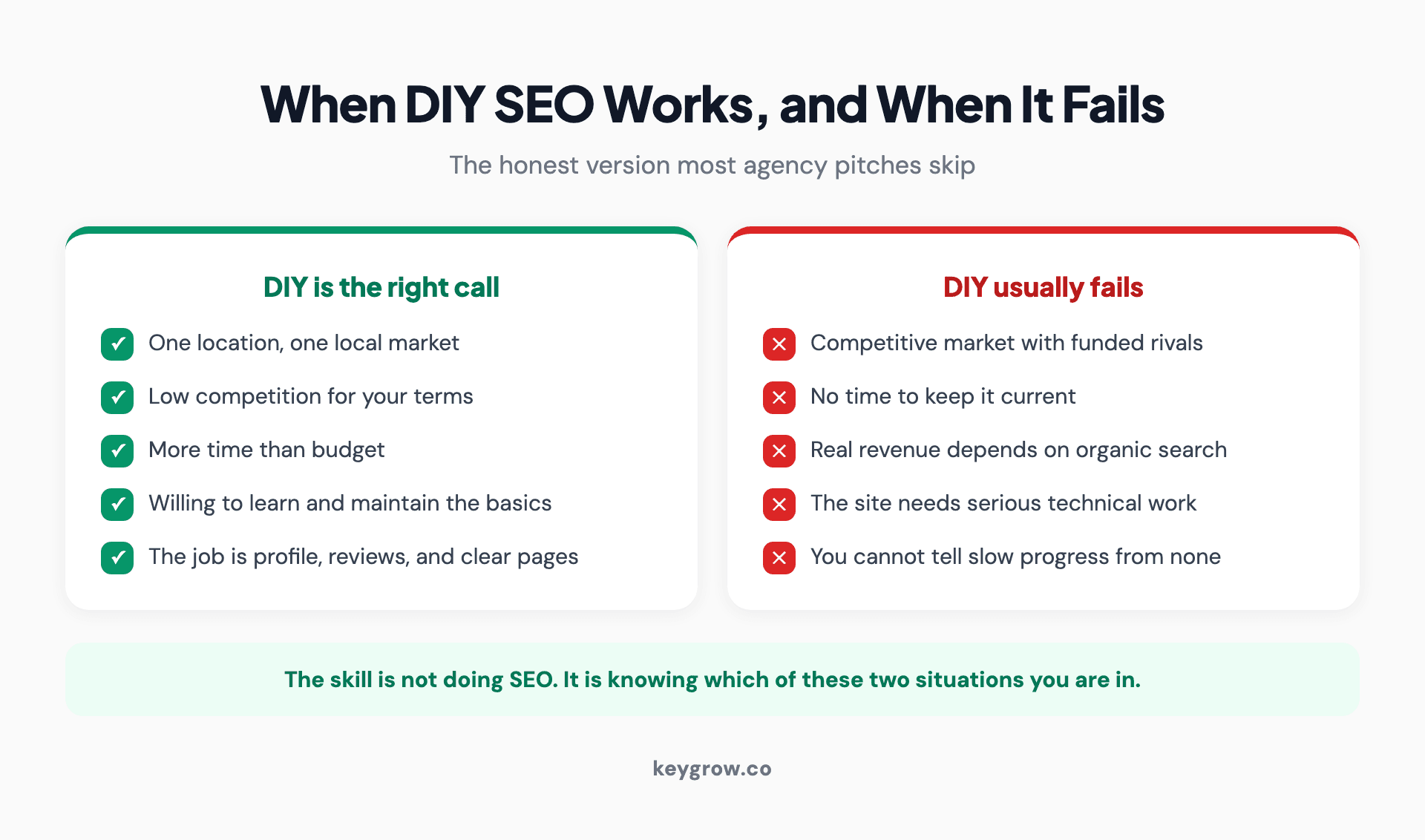
Two-column infographic comparing when DIY SEO is the right call (single location, low competition, more time than budget, willing to learn the basics) against when DIY SEO usually fails (competitive market, no time to maintain it, revenue depends on organic, needs technical work).
So this is not an argument that you cannot do SEO. It is a map of where the road washes out.
Why DIY SEO fails: eight patterns
Most DIY SEO fails for one of eight reasons, and they compound. A part-time effort against a constantly moving target, with no strategy to prioritize the work, tends to lose on all of them at once.
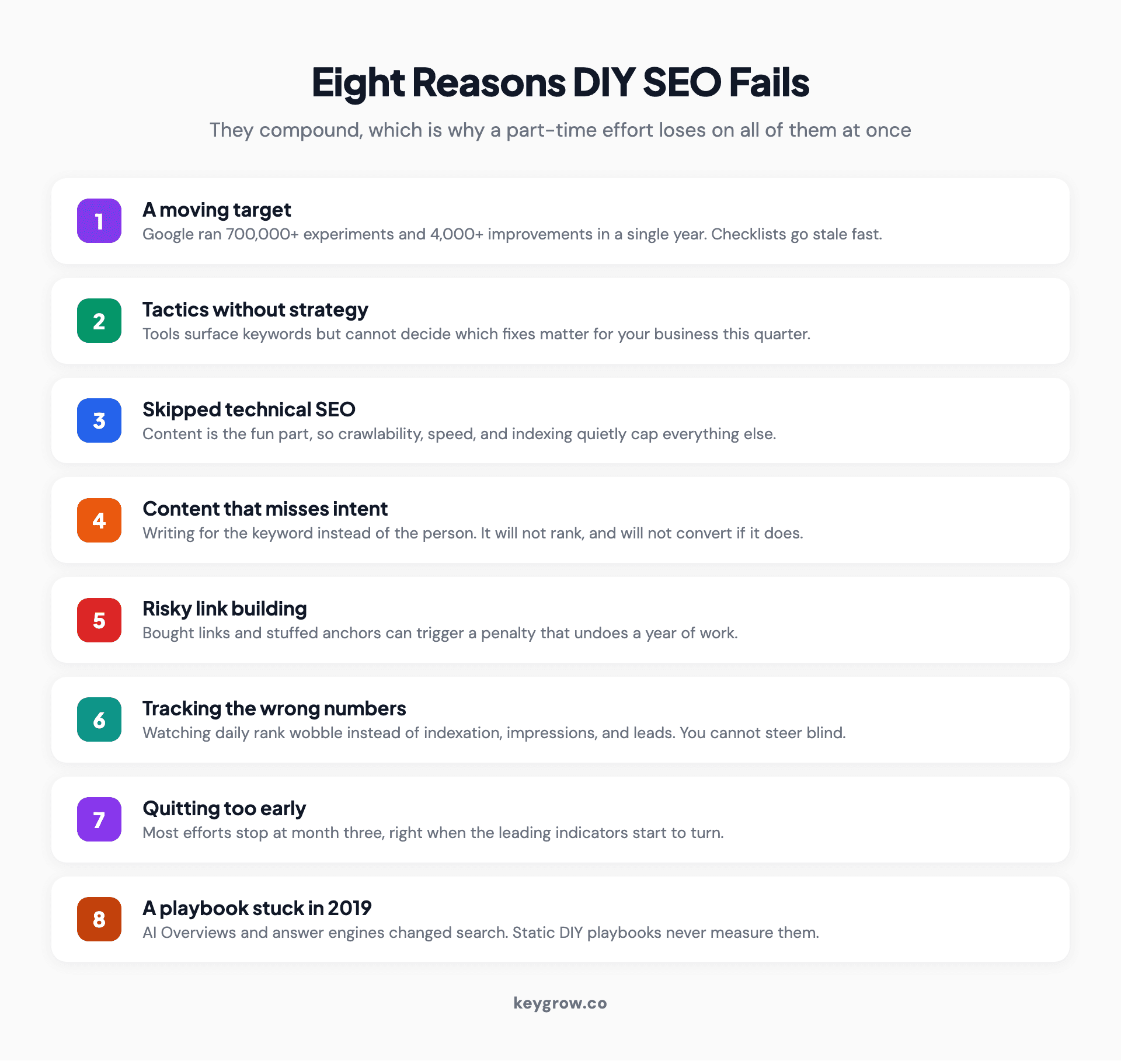
Numbered infographic of the eight reasons DIY SEO fails: a moving algorithm, tactics without strategy, skipped technical SEO, content that misses intent, risky link building, tracking the wrong numbers, quitting too early, and a playbook stuck in 2019.
1. Google moves faster than a part-time effort can track. This is the big one. Google's own testing ran more than 700,000 experiments and over 4,000 improvements to Search in 2023, plus several broad core updates a year. A practitioner who lives in this can adjust. Someone reading a checklist from two years ago is optimizing for a search engine that no longer exists.
2. Tactics without a strategy. Tools surface keywords, flag errors, and track rankings, but they cannot decide which fixes matter for your business this quarter. DIY SEO tends to become a pile of disconnected tactics, a meta tag here, a blog post there, with no thesis about which terms are worth winning. Early gains from the easy fixes fade, and nothing compounds because nothing was built to.
3. Technical SEO gets skipped. Content is the fun part, so the plumbing gets ignored. In an Ahrefs study of over a million domains, 72.9 percent of sites had missing or empty meta descriptions and 80.4 percent had images missing alt attributes. Slow pages, blocked crawling, and broken indexing quietly cap everything else you do. A page Google cannot crawl or render is a page that cannot rank, no matter how good the writing is.
4. Content that misses search intent. Writing for the keyword instead of the person is the classic DIY mistake. A page stuffed with "best dentist Phoenix" that never answers what someone choosing a dentist wants will not rank and will not convert if it does. Matching intent matters more than matching the phrase, which is most of why content marketing benefits SEO only when it is built around real searches.
5. Link building that invites penalties. This is where DIY moves from ineffective to actively dangerous. Buying links, swapping them in bulk, or stuffing exact-match anchors can earn a manual action that buries a site that was ranking fine. The downside is asymmetric: good links take time, bad links can undo a year of work in an afternoon.
6. Tracking the wrong numbers, or none. Watching daily rank wobble or raw traffic tells you almost nothing. The signals that matter early are indexation, impressions, and average position in Search Console; the ones that matter later are leads and conversions. DIY efforts tend to track vanity numbers or nothing at all, so they cannot tell whether the work is paying off.
7. Quitting before the compounding starts. SEO looks unimpressive for the first quarter and embarrassingly good after a year. Ahrefs reports SEO typically takes three to six months to show results, with no firm timeline and newer sites taking up to a year, and Ahrefs found only 1.74 percent of newly crawled pages reach the top 10 within a year, or 6.11 percent once you exclude junk and non-English pages. DIY efforts often stop at month three, right when the leading indicators are turning, because the owner cannot tell slow progress from no progress. Knowing how to read whether your SEO is working is what separates patience from stubbornness.
8. The playbook is stuck in 2019. Search changed. AI Overviews answer a growing share of queries on the results page, and ChatGPT and Perplexity now send real traffic to sites they cite. Static DIY playbooks optimize only for blue links and never measure whether they show up in AI answers at all. That blind spot is the whole reason we track AI search visibility as its own signal.
What does proper SEO look like instead?
Strategy first: decide which searches are worth winning, then build the technical foundation, content, and authority to win them. Tactics serve the plan.

Marketer mapping an SEO plan on a board, the strategy-first approach that separates structured SEO from scattered DIY tactics.
A junk removal company we worked with is the clean version of this. Rather than scatter blog posts, we built service pages mapped to the specific jobs people search for, structured so each one answered a single clear query. Six pages were built and ranking within six weeks, because the targets were low-competition local terms and the structure was right from the start. Low-competition local work can move that fast; competitive terms still take the months. The difference was a plan, not more effort.
That is the gap between DIY and done-right. Not access to secret tools, those are mostly the same ones you can buy, but a thesis about where to spend limited attention and the judgment to sequence it.
DIY, hybrid, or hire?
Three honest paths, and the right one depends on your market, your time, and how much of your revenue rides on organic search.
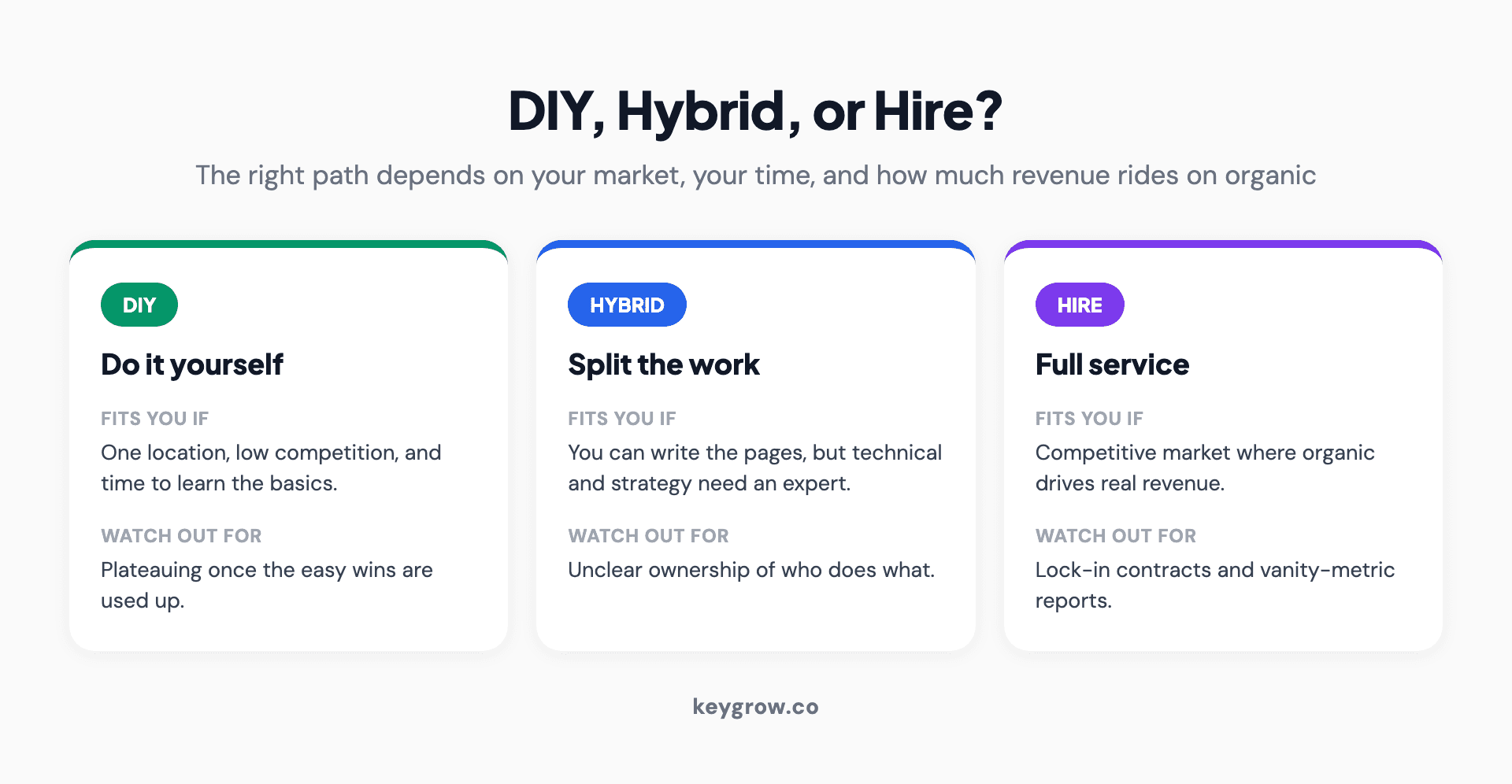
Decision-path infographic showing three SEO paths: DIY for low-competition single locations with time to learn, hybrid where the owner does content and an expert handles technical and strategy, and full service for competitive markets where organic drives revenue.
| Path | Fits you if | Watch out for |
|---|---|---|
| DIY | One location, low competition, time to learn | Plateauing once the easy wins are gone |
| Hybrid | You can write, but technical and strategy need help | Unclear ownership of who does what |
| Full service | Competitive market, organic drives real revenue | Lock-in contracts and vanity-metric reports |
Hybrid is the underrated middle. You know your customers and can write the pages; a professional handles the technical foundation, the strategy, and keeping up with the moving target. If you do go looking for help, the SEO work we do runs month-to-month, so you are not locked in while you find out whether it is working.
What DIY SEO really costs
DIY costs nothing in dollars but months of lost ground while a competitor with a plan ranks ahead of you. That bill can be steep.
BrightEdge found organic search drives about 53 percent of all trackable website traffic, so the visibility at stake is most of your potential pipeline, not a side channel. And with roughly half of small businesses closing within five years, months burned on a DIY approach that was never going to work in a competitive market is time a small business often does not have to spare. DIY is free in dollars and expensive in time. Whether that trade is worth it is the actual question, not whether you are capable of doing the work.
FAQs
Can DIY SEO work?
Yes, for the right business. A single-location company in a low-competition market, with time to learn and maintain the basics, can rank well on its own. DIY tends to fail in competitive markets, when nobody has time to keep it current, or when meaningful revenue depends on organic search.
How do I know if my DIY SEO is failing or just slow?
Watch the leading indicators rather than the lagging ones. If pages are getting indexed, impressions are rising in Search Console, and your average position is creeping up, it is working but slow. If nothing has moved after six months and pages are not even indexed, that is failing, not slow.
Is DIY SEO really cheaper than hiring help?
In dollars, yes. Once you count your time and the revenue lost while a competitor with a plan outranks you, often no. The honest comparison is not fee versus free, it is fee versus the opportunity cost of months spent learning on the job.
Will doing SEO myself risk a Google penalty?
The content and technical basics are low risk. The danger zone is link building: buying links, bulk link swaps, or stuffing exact-match anchor text can trigger a manual action that hurts more than having no links at all. When in doubt, earn links through useful content rather than buying them.
Do I still need SEO now that AI answers so many searches?
Yes, and arguably more. AI Overviews, ChatGPT, and Perplexity build their answers from pages that rank and carry authority. The work shifts from chasing only blue links to also being the source AI answers cite, which static DIY playbooks rarely measure.
When should I switch from DIY to professional help?
When your rankings plateau despite consistent effort, when the technical work is beyond what you can maintain, or when the terms you need are competitive enough that part-time effort cannot move them. Hybrid, where you keep the content and hand off strategy and technical, is often the right first step rather than a full handoff.
The short version
DIY SEO is not about whether you are capable. It is about whether the time it costs is time your market gives you. In a quiet local niche, it usually is. In a crowded one, the months you spend learning are months a funded competitor spends pulling ahead.
If you would rather have someone diagnose that honestly, the SEO team here will tell you plainly whether DIY is fine for your market or whether it is costing you. Tell us about your business and we will lead with the truth, including when the answer is to keep doing it yourself.