


Does content marketing benefit SEO? Yes, more than almost anything else you control. Search engines rank pages, and content marketing is the work of producing pages worth ranking. Every guide, service page, comparison, or case study you publish is another search you can show up for and another chance to earn a link.
There is a catch, and it belongs in the first paragraph rather than the fine print: content marketing benefits SEO when it is built around what people search for. Content published to hit a quota does nothing except age.
This guide covers the mechanisms, the numbers behind them, the situations where content fails to move rankings, and how long the payoff takes.
What counts as content marketing for SEO?
Any page built to satisfy a search counts: blog guides, service pages, comparison posts, case studies, and free tools. The format matters less than the demand behind it.
"Content marketing" usually conjures a company blog. For SEO purposes the definition is wider, and the blog is often the least valuable piece of it.
| Content type | The SEO job it does |
|---|---|
| Service and location pages | Rank for "service plus city" searches that turn into calls |
| Blog guides and answers | Capture question searches and feed AI answers |
| Comparison and cost pages | Reach buyers mid-decision, when intent peaks |
| Case studies | Turn rankings into trust once a visitor lands |
| Free tools and calculators | Earn backlinks and repeat visits for years |
A junk removal client of ours is the cleanest example we have. No blog, no newsletter. We built six service pages in six weeks, one per service line, each answering one specific search, and they were ranking inside that same window because the demand existed and no local competitor had bothered to answer it. Nothing about the project looked like "content" in the conference-talk sense. It was content marketing all the same.
How does content marketing benefit SEO?
Five mechanisms do most of the work: more pages that can rank, topical authority, earned backlinks, stronger engagement signals, and a site fresh enough to keep crawlers interested.
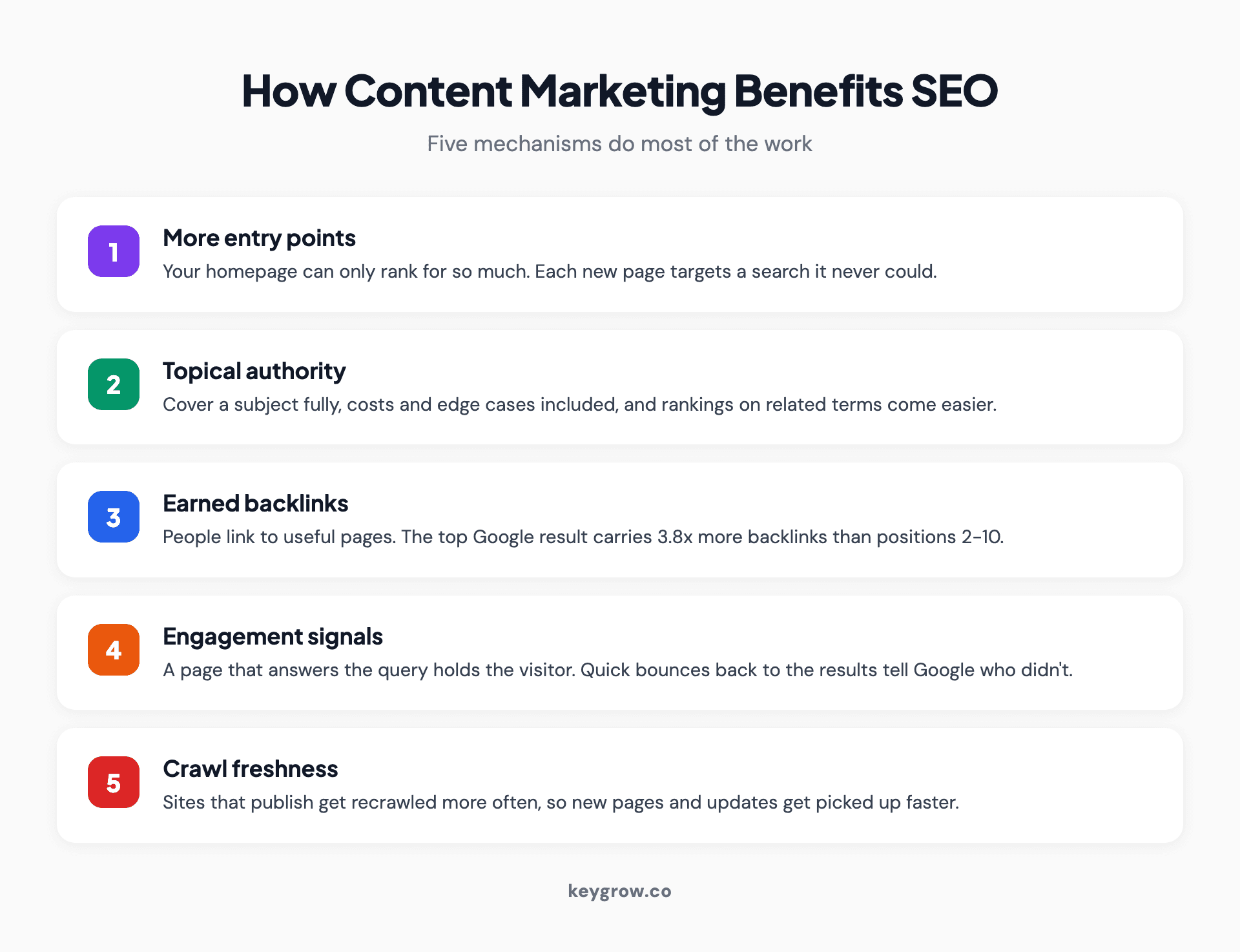
Five-card infographic of the ways content marketing benefits SEO: more ranking entry points, topical authority, earned backlinks, engagement signals, and crawl freshness.
More entry points. Your homepage can rank for your brand and a handful of head terms. Each new page targets a search the homepage never could. A site with forty strong pages is playing forty hands at once.
Topical authority. Cover a subject properly, including the costs, the comparisons, and the edge cases, and search engines start treating your site as a source on that subject. Rankings on related terms come easier after that.
Backlinks. People link to useful pages, almost never to homepages. Backlinko's analysis of 11.8 million search results found the top result carries 3.8 times more backlinks than positions two through ten, and content is what earns them. Even the nofollow ones carry more value than their reputation suggests.
Engagement. A page that answers the query holds the visitor. A page that doesn't sends them back to the results within seconds, and that pattern, repeated, tells Google which result deserved the click.
Freshness. Sites that publish get recrawled more often, so new pages and updates get picked up faster. Sites that went quiet in 2023 are coasting on momentum until it runs out.
There is an efficiency argument on top. Demand Metric's benchmark study put content marketing at about 62 percent lower cost than traditional marketing while generating roughly three times the leads. An average is not a promise, but the direction matches what we see in client accounts.
Content marketing now feeds AI search too
The pages that rank in Google are the same pages ChatGPT, Perplexity, and AI Overviews quote when someone asks a question in your niche. The bar is just higher: ChatGPT cites only about 15 percent of the pages it retrieves. Retrieval gets you considered. Being quotable gets you cited.

Person searching on a smartphone, where a growing share of questions now go to AI chat apps instead of the classic results page.
The Princeton and Georgia Tech GEO research measured what closes that gap: adding relevant statistics raised AI-answer visibility by about 40 percent, and quotable expert statements raised it by roughly 37 percent. Content built from real numbers and clear, liftable sentences earns citations that summaries of summaries never will.
We treat search and AI answers as one discipline now. Answer-first structure, sections that stand alone, and specifics instead of adjectives serve both, which is the thinking behind our answer engine optimization service. If you want to know how your brand currently shows up in AI answers, we covered how an AI search monitoring platform improves SEO strategy separately.
When does content marketing not help SEO?
When nobody searches for what you published, when the content says nothing original, or when it sits on an island with no links in or out. Volume fixes none of these.
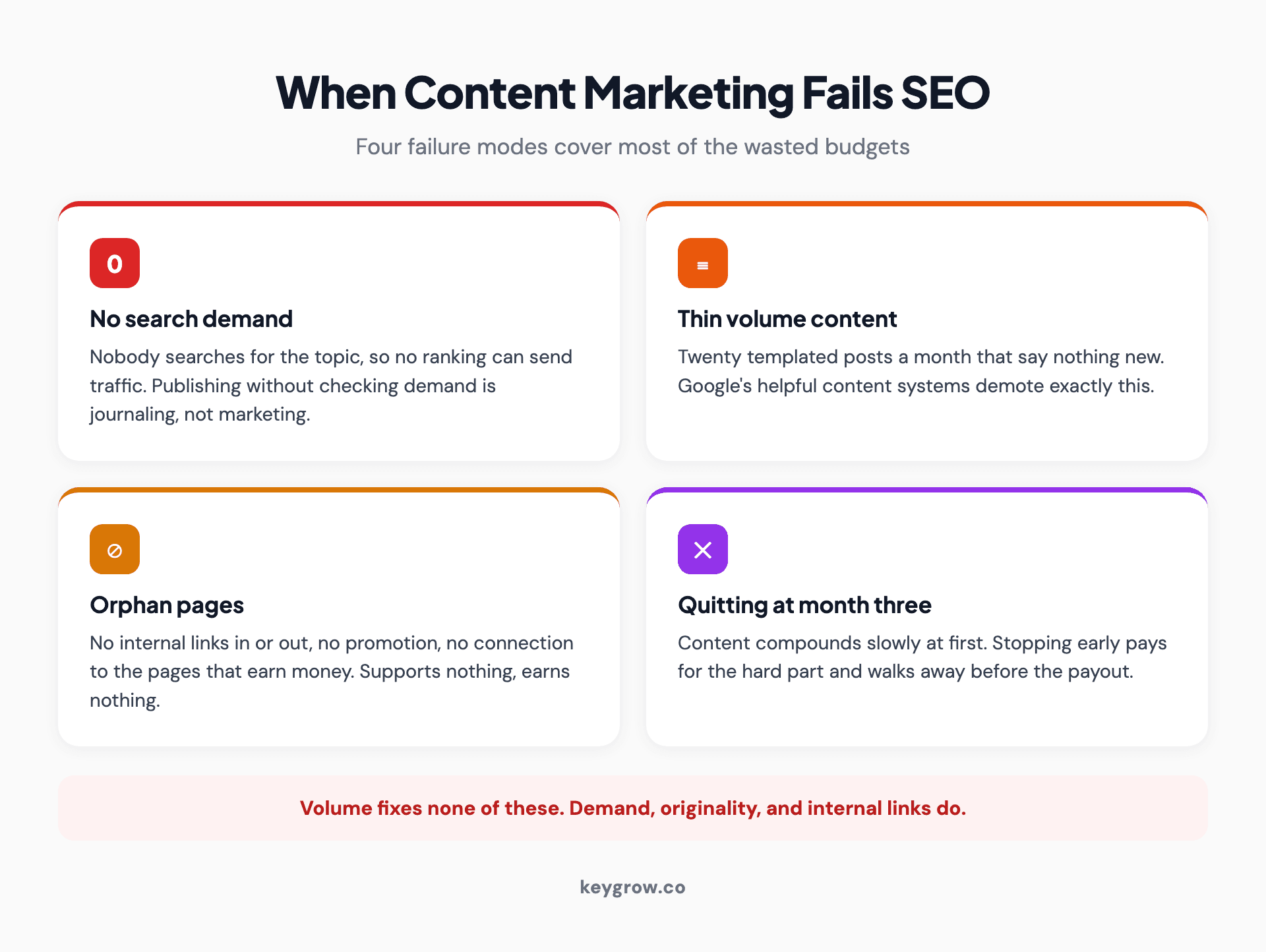
Four-card infographic of the ways content marketing fails to help SEO: no search demand, thin volume content, orphan pages with no links, and quitting before results compound.
The failure we audit most often is content with no search demand behind it. Publishing without checking demand first is journaling, not marketing. The internet did not ask for another 400-word post titled "Why Marketing Matters," and Google can measure that it didn't.
Close behind sits the volume play: twenty thin, templated posts a month, none saying anything the top results don't already say. Google's helpful content guidance is explicit that unoriginal, search-engine-first content is what its systems demote. Quality is not a tiebreaker. It is the entry fee.
Orphan pages round out the list: no internal links, no promotion, no relationship to the pages that earn money. And then there is quitting at month three, which deserves its own section.
How long until content marketing pays off?
Low-competition local pages can rank in weeks. Competitive informational terms take months. Authority-level results, the kind worth writing a case study about, tend to land around the one-year mark.
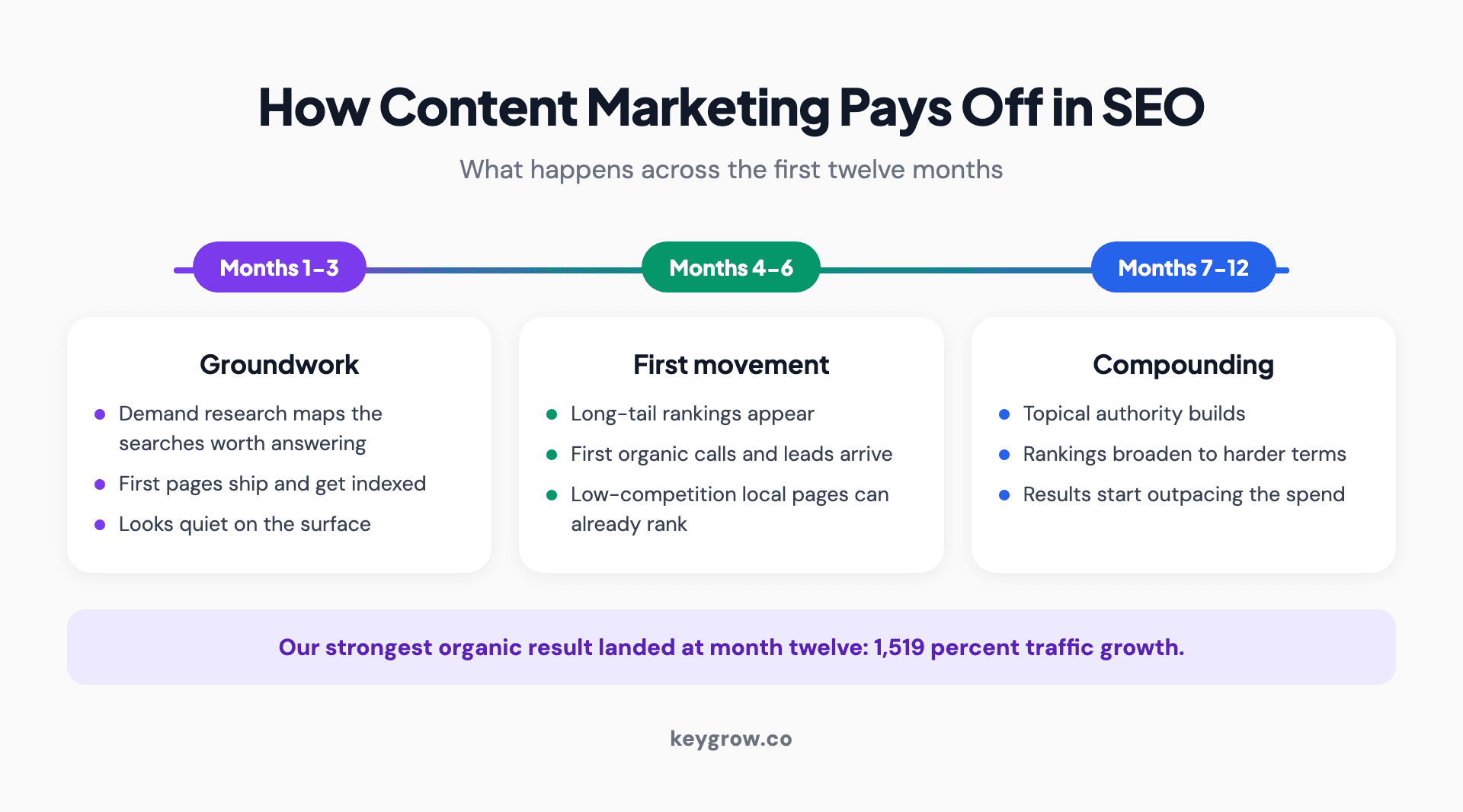
Timeline infographic of how content marketing pays off in SEO: months one to three indexing and baselines, months four to six first rankings and calls, months seven to twelve compounding authority.
Here is our position, and holding it costs us sales: content marketing is a compounding asset, not a campaign. It looks unimpressive for the first quarter and embarrassingly good after a year. Our strongest organic result took twelve months to reach 1,519 percent traffic growth, which is also why a "page one in 30 days" pitch reads as a red flag to us. Businesses that quit at month three pay for the hard part and leave before the payout.
How do you make content actually rank?
Start from demand, match the intent, answer early, link it into the site, then promote it. The order matters more than the effort.

Hand writing a content plan in a notebook beside a laptop, mapping pages to the searches customers run.
- Check demand before writing. A keyword tool, or even autocomplete and the People Also Ask box, beats guessing. If nothing suggests people search for it, write something else.
- Match the intent. If the top results are short checklists, a 3,000-word essay is not standing out. It is answering in a format nobody wanted.
- Answer in the first 100 words. Under each heading too. Roughly 44 percent of AI citations come from the first third of a page, and human skimmers behave the same way.
- Link it in. Every new piece should link to and from the pages that earn you money. Content that supports nothing earns nothing.
- Promote it. An email, a social post, a note to anyone you cited. Links rarely arrive uninvited.
If you run a single-location business with more time than money, do this yourself first. Write the ten pages that answer your customers' ten most common questions, run them through a readability checker, and you will be ahead of most local competitors before any agency invoice exists. Hire help when the opportunity cost of your time beats the fee, or when the terms you need are genuinely competitive. Our SEO service is built for the second situation, not the first.
FAQs
What is the difference between SEO and content marketing?
SEO makes a site findable through technical health, on-page optimization, and authority. Content marketing produces the material people are searching for in the first place. They overlap at the page level, and neither performs well alone.
How often should you publish content for SEO?
As often as you can publish something better than what currently ranks, and no more often than that. Two strong pieces a month outperform daily thin posts. Consistency across a year matters more than any single month's output.
How long does content marketing take to improve SEO?
Expect movement on low-competition terms within weeks and meaningful organic growth over months. Competitive terms and site-wide authority typically need six to twelve months of consistent work. Plan in quarters, not weeks.
Does AI-generated content hurt SEO?
Google evaluates helpfulness and originality, not the tool used to write. Unedited AI output tends to fail on both counts, and publishing it at scale risks falling under Google's spam policies. AI-assisted drafting with real expertise, editing, and original data added to it works.
Can content marketing replace link building?
It reduces the need rather than replacing it. Strong content earns links passively, which is the most durable way to get them. In competitive niches you still need promotion and outreach to put that content in front of people who can link to it.
Do small local businesses need content marketing for SEO?
They need service pages, location pages, and answers to their customers' common questions. They rarely need a publishing calendar. A plumber with ten excellent pages beats a plumber with a hundred mediocre blog posts.
The short version
Content marketing benefits SEO the way inventory benefits a store: it is the thing being found. Build pages around real searches, make each one the best available answer, link them into the site, and give them months to compound.
If you would rather have a team that does this every day, our SEO engagements run month-to-month, cancel anytime. Tell us about your business and we will say honestly whether content is your bottleneck or something else is.