


Do nofollow links help SEO? Yes, just not the way most people think. A nofollow link will not pass authority the way a standard link does, but it can still send you paying visitors, grow your branded searches, keep your link profile looking natural, and feed the brand signals AI search engines now lean on. Some nofollow links are worth more than the average dofollow link from a site nobody reads.
SEOs have argued about this since the nofollow attribute arrived in 2005, which in internet years is roughly the Bronze Age. The argument is mostly settled now. Google changed the rules in 2019, AI search changed the stakes over the last two years, and the practical answer for 2026 is clearer than the old debate suggests.
This guide covers what nofollow links actually do, what they don't, and which ones deserve your time.
What is a nofollow link?
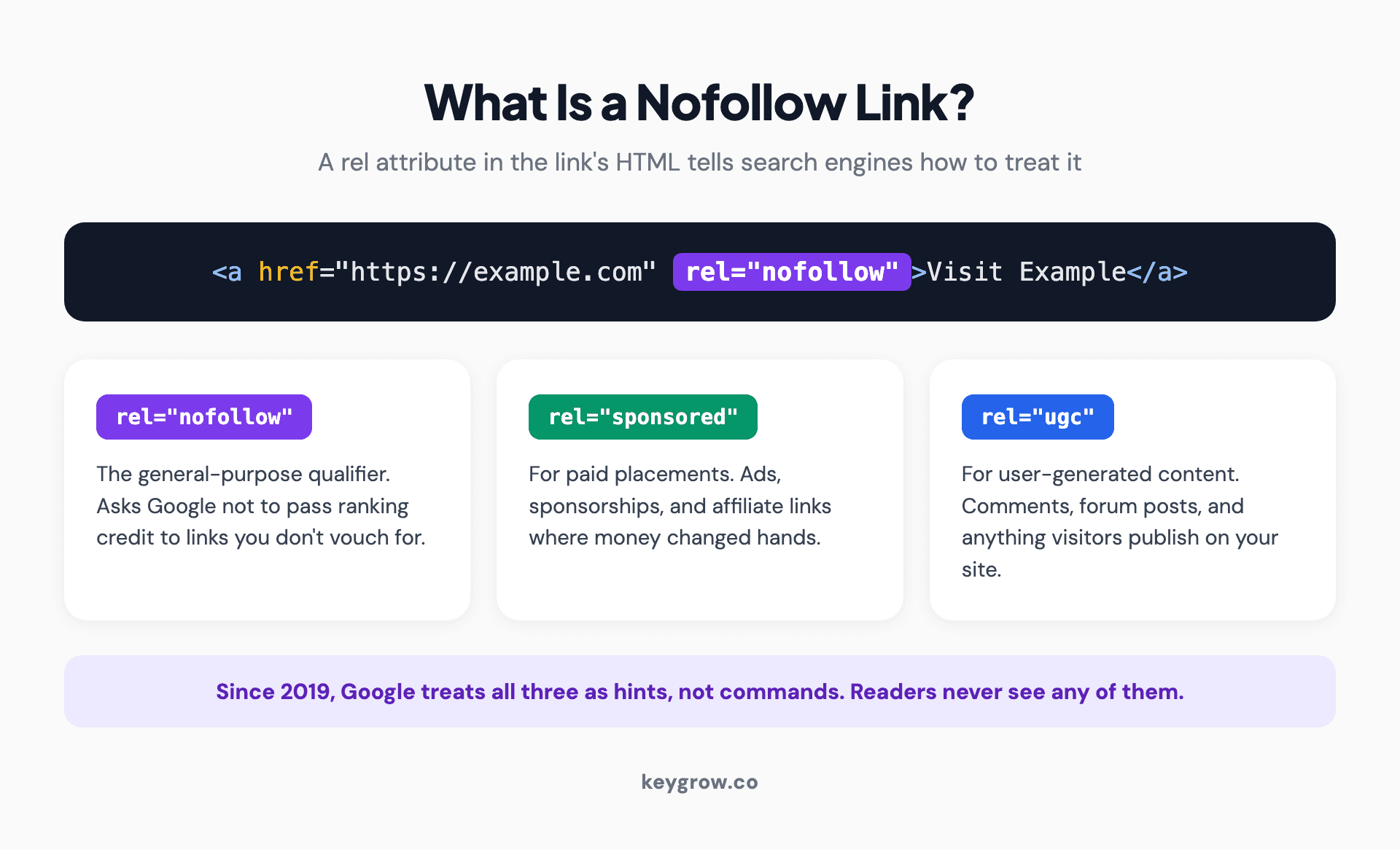
Anatomy of a nofollow link showing the rel attribute in HTML, with cards explaining the nofollow, sponsored, and ugc values and what each tells Google.
A nofollow link is a link carrying a rel="nofollow" attribute in its HTML. The attribute asks search engines not to pass ranking credit to the page being linked.
That's the whole mechanism. It sits in the code where readers never see it. Visitors can click a nofollow link like any other link, and most never know the difference.
Google introduced the attribute in 2005 to fight comment spam. In 2019 it added two relatives: rel="sponsored" for paid placements and rel="ugc" for user-generated content like comments and forum posts. All three tell Google the same basic thing: don't treat this link as a full editorial endorsement.
The practical differences:
| Factor | Standard (dofollow) link | Nofollow link |
|---|---|---|
| Passes authority | Yes | Not usually (treated as a hint) |
| Moves rankings directly | Yes, when relevant | Rarely, only if Google chooses |
| Sends referral traffic | Yes | Yes |
| Builds brand visibility | Yes | Yes |
| Counts toward a natural profile | Yes | Yes |
| Feeds AI search mentions | Yes | Yes |
How does Google treat nofollow links in 2026?
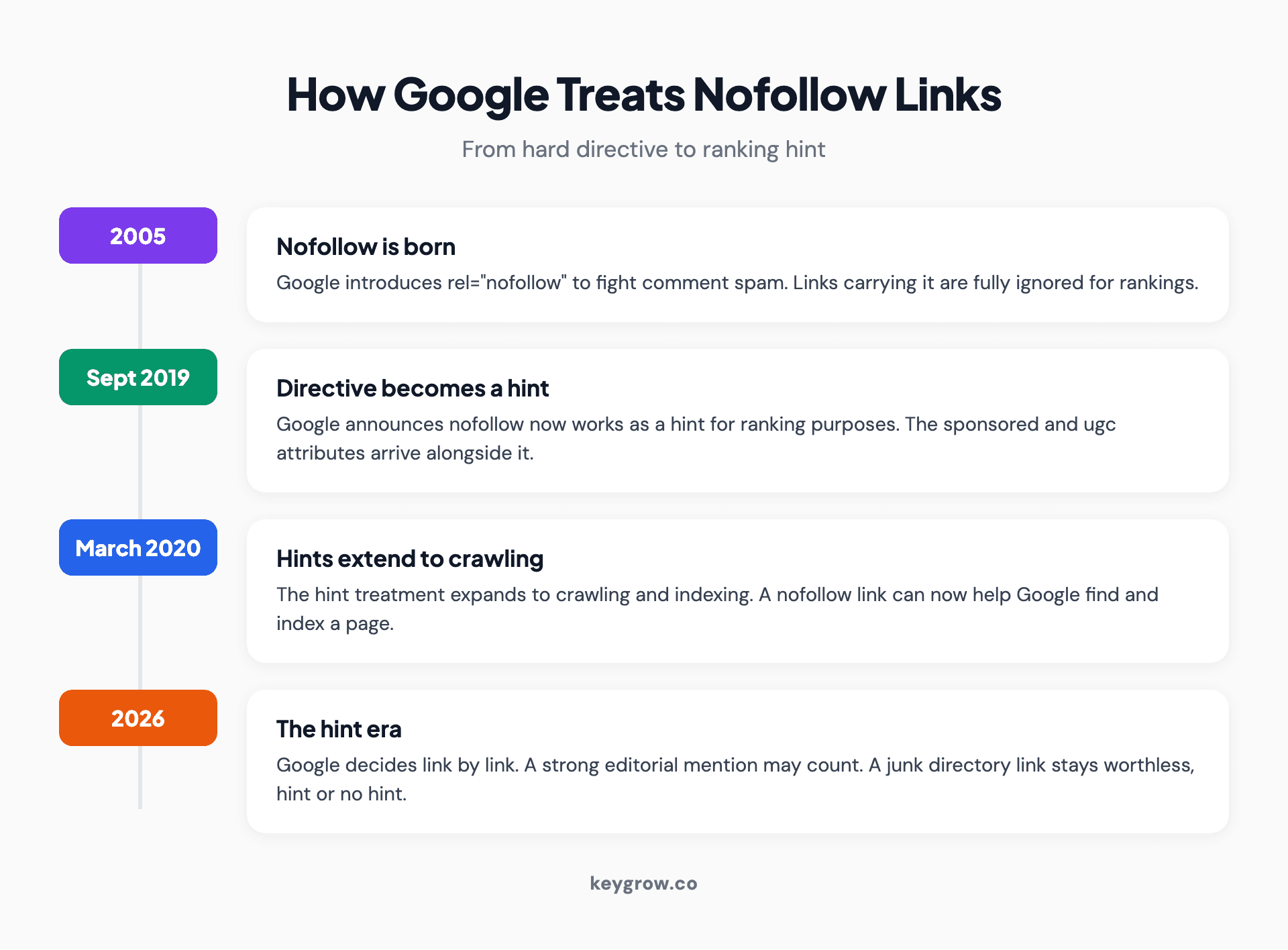
Timeline of how Google has treated nofollow links: 2005 directive era, September 2019 hint announcement with sponsored and ugc attributes, March 2020 hints for crawling and indexing, and the 2026 hint era.
Since March 2020, Google treats nofollow as a hint rather than a command. It can choose to count a nofollow link for ranking, crawling, and indexing.
For 14 years, nofollow was a hard directive. Google ignored those links completely. Then on September 10, 2019, Google announced a change: nofollow became a hint for ranking purposes, and the sponsored and ugc attributes arrived alongside it. On March 1, 2020, the hint treatment extended to crawling and indexing too.
A hint means Google decides. A nofollow link from a major news story about your business is exactly the kind of signal Google may choose to count. A nofollow link from a junk directory stays worthless, hint or no hint.
So don't build a strategy on hoping Google upgrades your links. Treat passed equity as a bonus, and value nofollow placements for what they reliably deliver, which is the rest of this article.
Do nofollow links directly improve rankings?

Person holding a phone with the Google logo in the background, representing how Google evaluates links for rankings.
Usually, no. A nofollow link rarely moves rankings on its own, and a profile made only of nofollow links will not rank for competitive terms.
If direct ranking power is the only thing you measure, standard links win and it isn't close. Authority still flows through followed, editorially earned links, which is why they remain the spine of any serious SEO campaign.
But "do they directly improve rankings" turns out to be the wrong question. Almost nobody earns nofollow links instead of dofollow links. You earn them alongside each other, from the same work, and the nofollow ones quietly do jobs the ranking-equity conversation ignores.
5 ways nofollow links help your SEO anyway
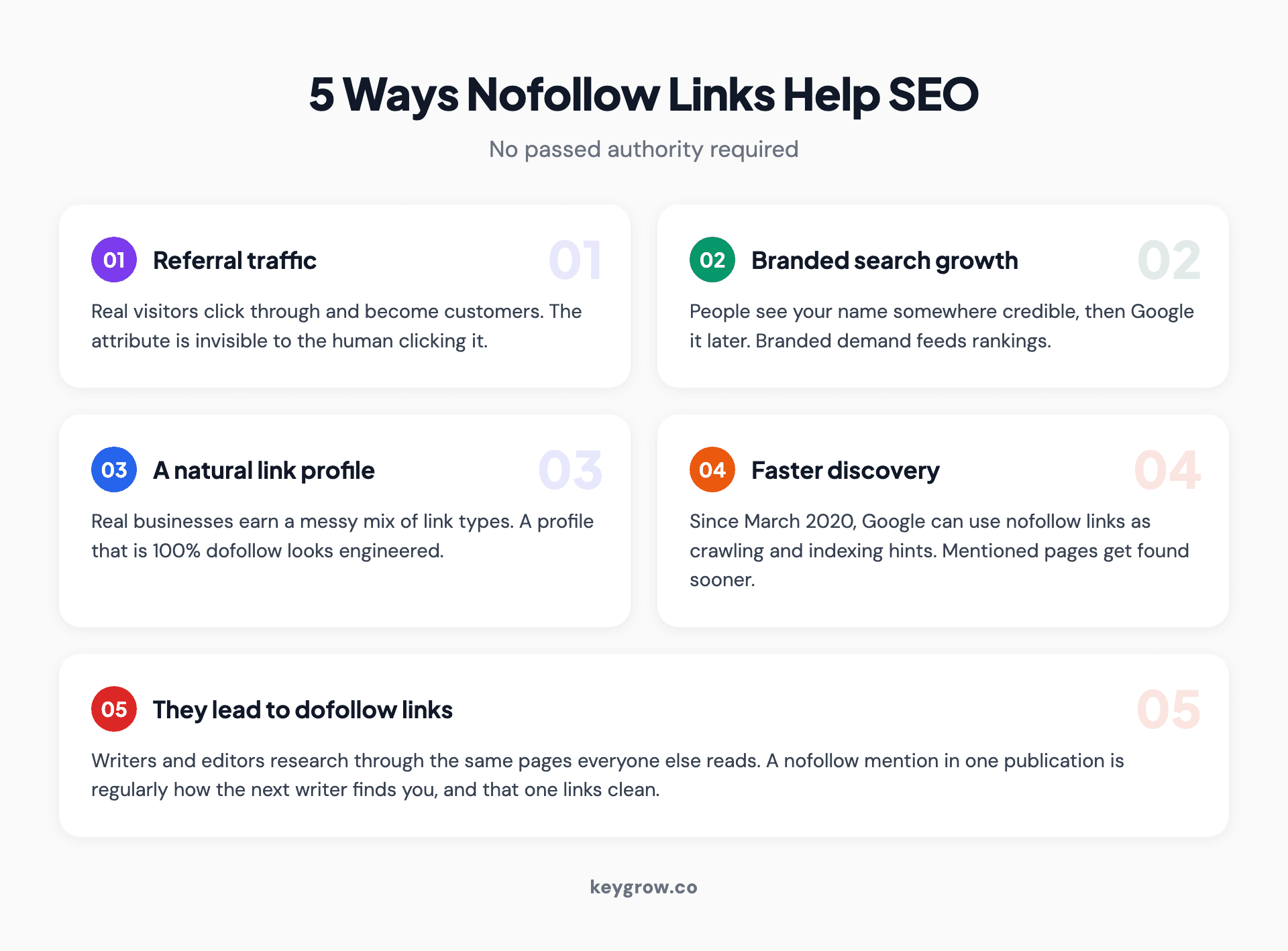
Five-card layout of the indirect SEO benefits of nofollow links: referral traffic, branded search growth, a natural link profile, faster discovery, and follow-on dofollow links.
1. Referral traffic that turns into customers. A nofollow link in front of the right audience sends real visitors. A junk removal company linked from a busy neighborhood forum thread gets calls from it. The attribute is invisible to the human clicking.
2. Branded search growth. People see your name somewhere credible, then search for it later. Growing branded search volume tells Google real demand exists for your business, and that feeds rankings through the front door.
3. A natural link profile. Real businesses earn a messy mix of link types. A profile that is 100 percent dofollow looks engineered, because it usually is. Nofollow links are part of what a clean, organic profile looks like to a search engine.
4. Faster discovery and indexing. Since the 2020 change, Google can use nofollow links as crawling and indexing hints. A new page that gets mentioned around the web gets found sooner.
5. The dofollow links that follow. Writers and editors research through the same pages everyone else reads. A nofollow mention in one publication is regularly how the next writer finds you, and that one links clean.
Nofollow links and AI search: the part most guides miss
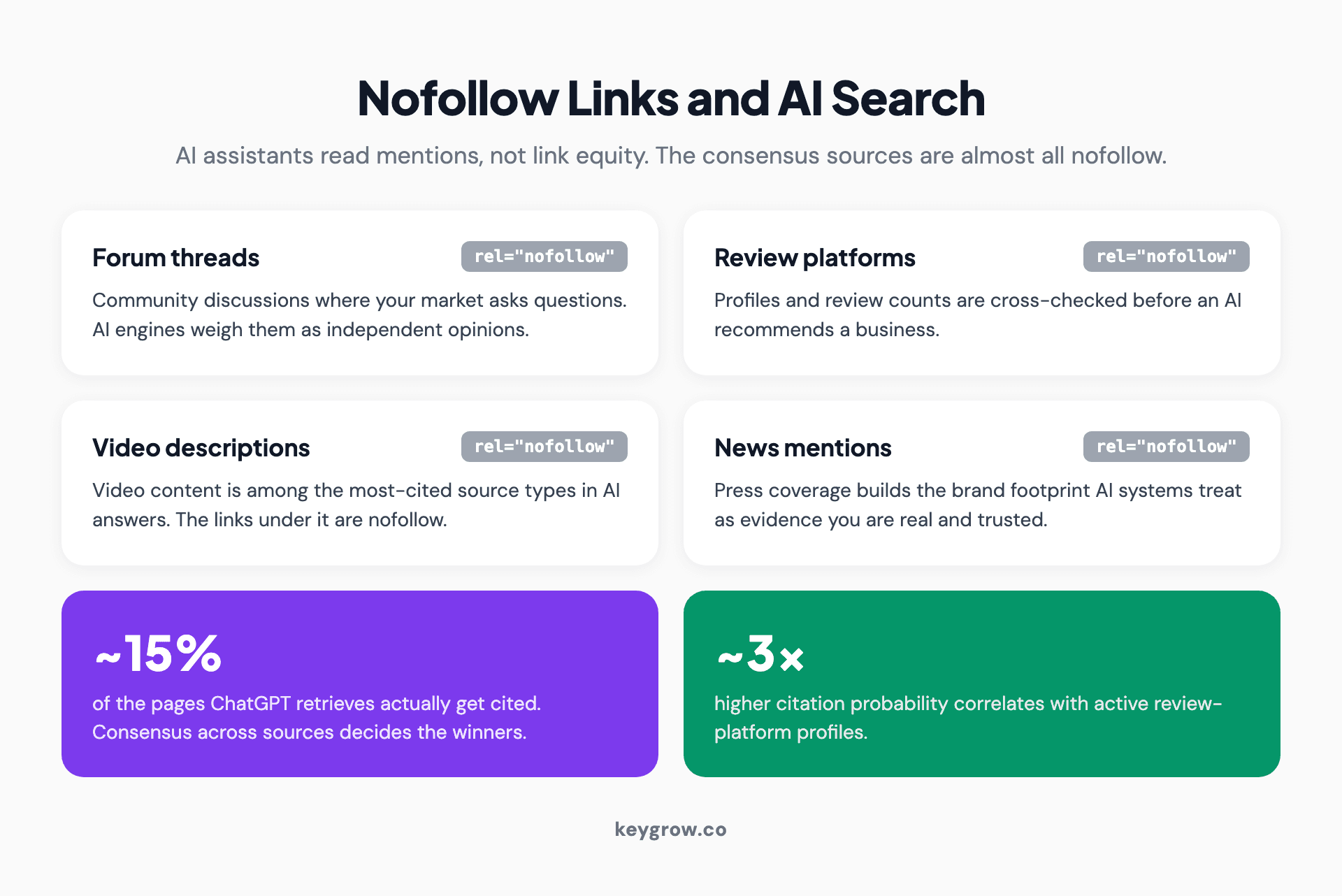
Diagram of the consensus signals AI search engines read, showing forum threads, review platforms, video descriptions, and news mentions, nearly all of which use nofollow links.
The question changed from "how do I rank" to "how do I become the source." On that question, nofollow links stopped being a side topic.
When an AI assistant decides whether to recommend your business, it cross-checks what the rest of the web says about you: forum threads, review platforms, video content, news coverage. It looks for agreement across independent sources before it trusts a claim. ChatGPT cites only about 15 percent of the pages it retrieves, and consensus across sources is one of the strongest selection signals we see.
Now look at where that consensus lives. Forum and community links: nofollow. Review platform profiles: nofollow. Video descriptions: nofollow. Social profiles: nofollow. The exact placements the PageRank era wrote off as worthless are the raw material of AI visibility, and active review profiles correlate with roughly 3x higher citation probability.
AI engines were never bound by the rel attribute the way PageRank was. They read mentions, not link equity. We cover the mechanics in our guides to optimizing your website for ChatGPT and AI search optimization, and it's the core of our answer engine optimization service. If your link strategy still sorts placements into "passes equity" and "ignore," you're optimizing for 2018.
Which nofollow links are actually worth getting?
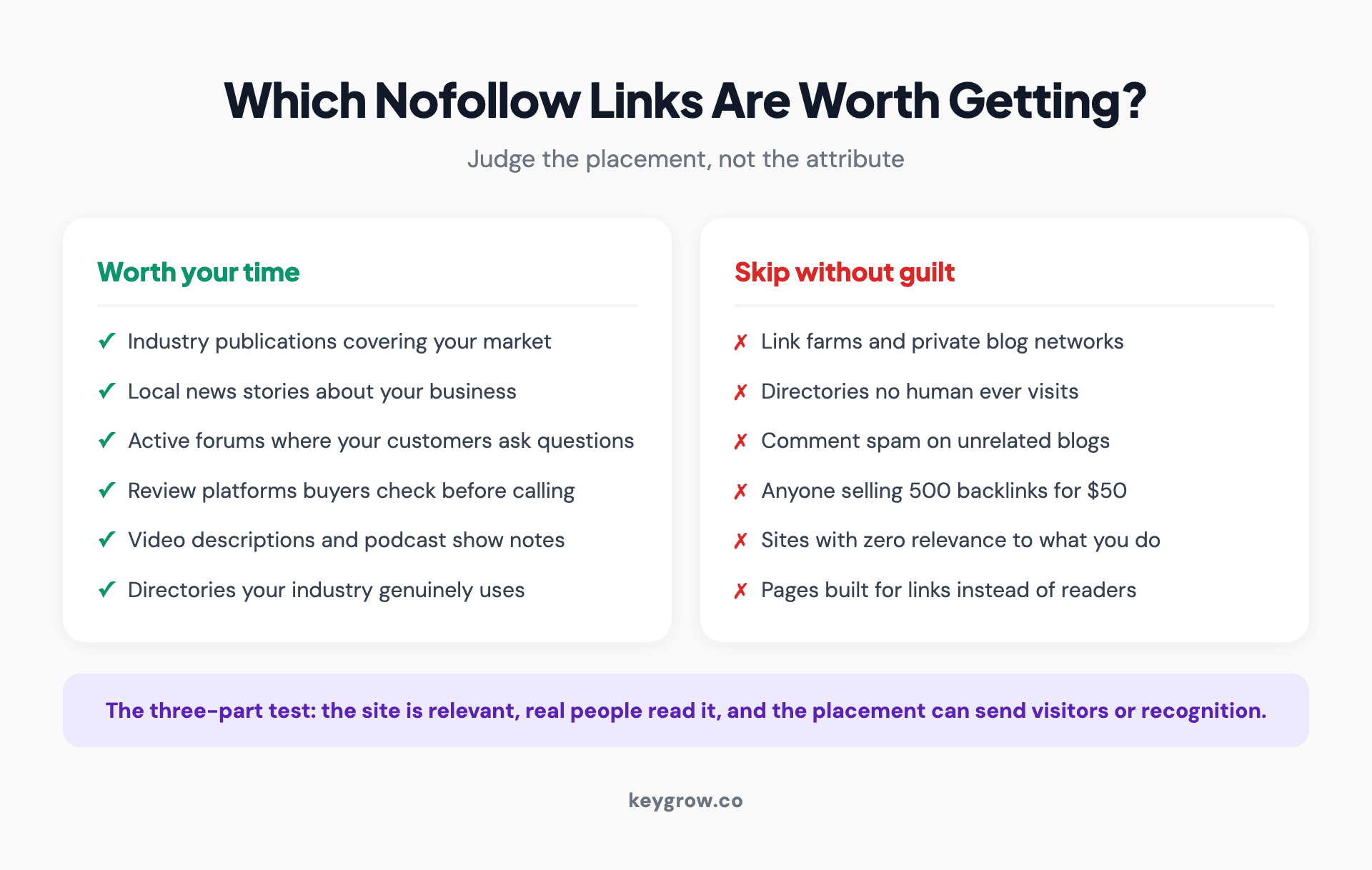
Checklist comparing nofollow links worth pursuing, such as relevant publications with real audiences, against ones to skip, such as link farms, irrelevant directories, and comment spam.
A nofollow link is worth getting when it passes three tests: the site is relevant to what you do, real people read it, and the placement can send you visitors or recognition.
Worth your time:
- Industry publications and local news covering your market
- Active forum and community threads where your customers ask questions
- Review platforms your buyers check before calling anyone
- Video descriptions and podcast show notes
- Established directories your industry genuinely uses
Skip without guilt: link farms, directories no human visits, comment spam, and anyone selling 500 backlinks for $50. A worthless site's link is worthless in every attribute.
One of our clients, a doctor's practice in Dubai, grew organic traffic 1,519 percent over 12 months. Mentions and links from real medical and local sources were one input among many, and none of it happened in a week. The full breakdown is in our case studies. Links compound the same way the rest of SEO does: slowly, then noticeably.
And an honest note before you spend money here: if your site is a few months old with ten pages of thin content, don't pay anyone for link building yet, us included. Publish something worth citing first. Links pointed at a site with nothing on it are scaffolding around an empty lot. If you do decide to go after links, our guide to building backlinks works through what each one actually costs.
When should you use nofollow on your own site?
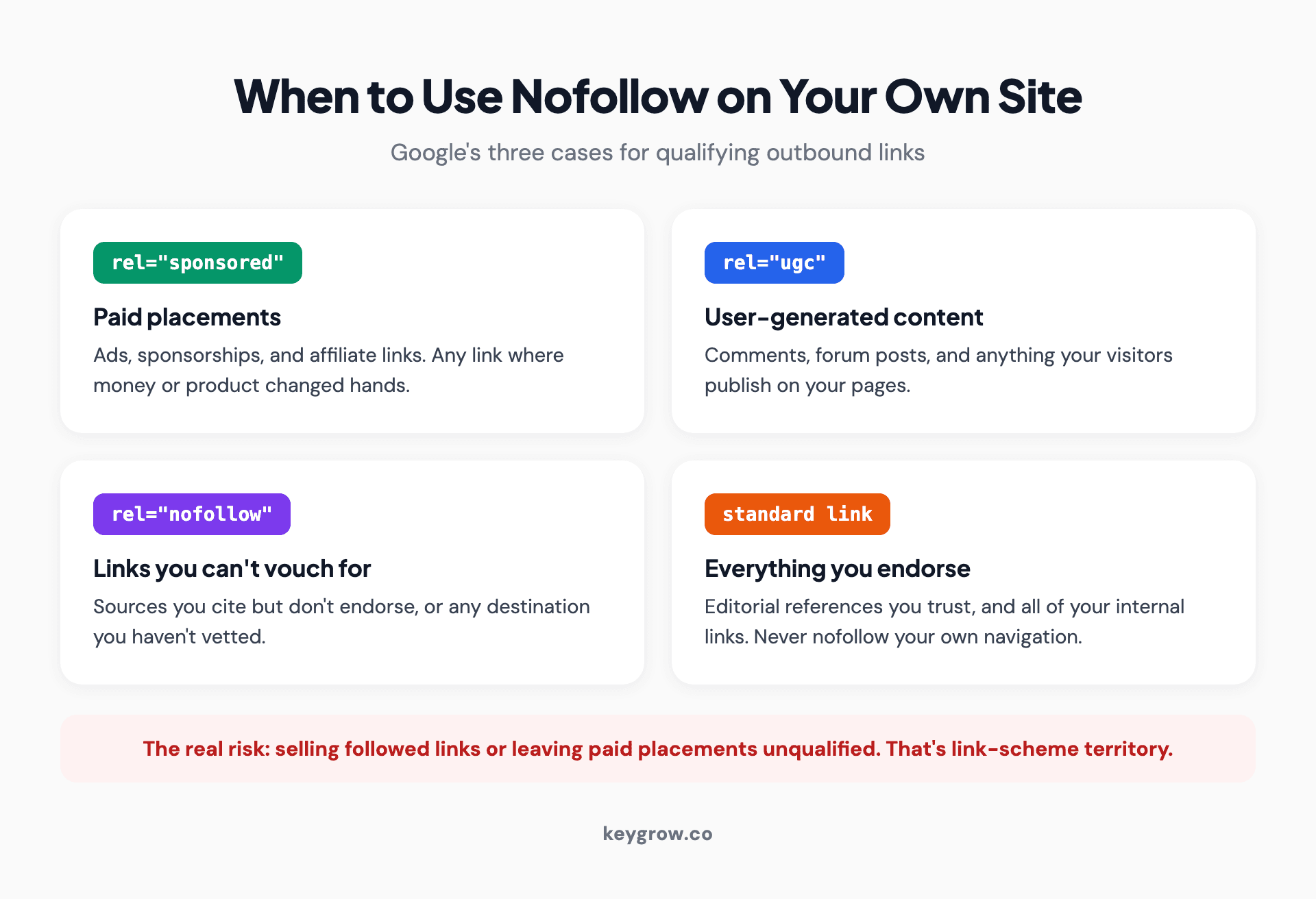
Four-card guide to qualifying outbound links on your own site: sponsored for paid links, ugc for user-generated content, nofollow for unvetted links, and standard links for everything you endorse.
Qualify a link any time money changed hands, the content isn't yours, or you can't vouch for the destination.
Google's guidance on qualifying outbound links breaks it into three cases. Paid or sponsored placements get rel="sponsored". Comments, forum posts, and anything user-generated get rel="ugc". Links you can't or won't endorse get rel="nofollow".
Affiliate links count as compensated, so mark them sponsored (nofollow also works). Your internal links should stay standard; nofollowing your own navigation only hides your pages from your own crawl equity.
This is the one place where getting attributes wrong genuinely hurts. Selling followed links, or running paid placements without qualifying them, is the behavior Google's link spam policies target. The attribute exists so you can take the money and stay clean.
How to check whether a link is nofollow

Lines of HTML code on a screen, where the rel attribute of a link reveals whether it is nofollow.
Right-click the link, choose Inspect, and read the anchor tag. If the rel attribute contains nofollow, sponsored, or ugc, it's a qualified link. No rel attribute, or a rel without those values, means it's a standard followed link.
On a page you don't control, you can also view the page source and search for the link text. Browser extensions that highlight nofollow links in color exist, but for spot checks, Inspect is faster than installing anything.
FAQs
Do nofollow links help my SEO rankings?
Not directly in most cases. Google treats nofollow as a hint and usually doesn't pass authority through it. The SEO value comes from referral traffic, branded search growth, a natural link profile, faster discovery, and the brand mentions AI search engines read.
Can a site rank using only nofollow links?
No. Competitive rankings still require followed, editorially earned links. A nofollow-only profile won't carry you, and a dofollow-only profile looks manufactured. Healthy sites earn both from the same work.
What is the difference between nofollow, sponsored, and UGC links?
All three qualify a link rather than endorse it. Sponsored marks paid placements, ugc marks user-generated content like comments and forum posts, and nofollow is the general-purpose option for links you don't vouch for. Google treats all three as hints.
Can nofollow links hurt my site?
Earning nofollow links can't hurt you; at worst a junk one does nothing. The risk runs the other way: taking payment for links on your site without marking them sponsored or nofollow violates Google's link spam policies.
Should affiliate links be nofollow or sponsored?
Google recommends rel="sponsored" for affiliate links because compensation is involved. Nofollow is an accepted alternative. What matters is that they're qualified one way or the other, not left as standard followed links.
How many nofollow links should a healthy link profile have?
There's no target ratio worth chasing. Earn links naturally and a meaningful share will be nofollow by default, because forums, review platforms, news sites, and social networks qualify their outbound links automatically. If literally everything pointing at you is dofollow, that's the profile that looks odd.
The bottom line on nofollow links
Nofollow links won't replace earned editorial links, and they were never supposed to. They send customers, build the brand demand Google measures, keep your profile believable, and feed the mention graph AI assistants trust. That's a lot of work for an attribute that supposedly does nothing.
If you'd rather have a link profile built for how search works now, both Google and the AI engines, that's what our SEO service does day to day. Tell us about your site at keygrow.co/get-started and we'll tell you honestly whether link building is even your next move.