


The median outreach campaign sends 292 emails to place one link.
That number should be at the top of every guide on how to build backlinks, and it never is. Instead you get a list of fifteen tactics, presented as though they all work about equally well, with no indication of what any of them costs in hours. So here is the honest version: link building is expensive, most of the published advice was written for content sites rather than businesses, and for a lot of companies reading this the correct number of outreach emails to send is zero.
The good news is that the links that move rankings for most businesses are not the ones the guides are about. They come from suppliers, associations, local press, and the things you were already doing. This post covers both: the free set worth collecting first, and the outreach worth doing after. For the paid, editorial end of that spectrum, see digital PR for SEO that, with real numbers on what each costs.
Start with the arithmetic
Before picking a tactic, price it. A backlink costs either money or hours, and the published figures for both are worse than most people expect.
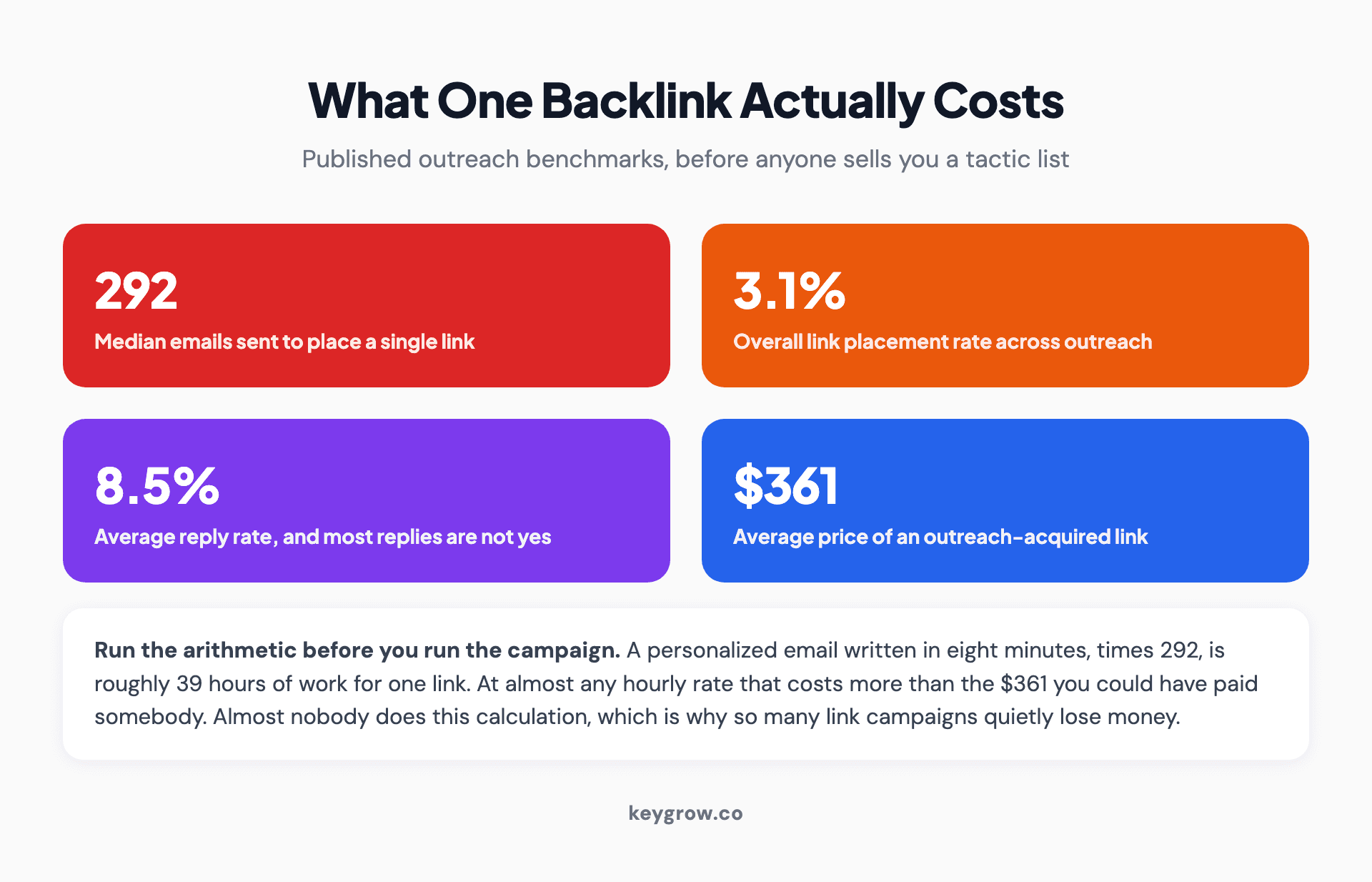
Stat panel showing the real cost of acquiring one backlink, including median emails sent per placed link, average outreach reply rate, placement rate and average paid cost per link.
The aggregate link building statistics tell a consistent story. Across analysed outreach, the median campaign sends 292 emails to secure one placed link, at an overall placement rate of about 3.1 percent. Reply rates average 8.5 percent, and most replies are not yes. When companies buy instead, outreach-acquired links average $361 each and guest post placements around $77.
Now price your own time.
Take the outreach route at face value. If you write a decent personalized email in eight minutes and you need 292 of them, that is roughly 39 hours of work for one link. Even at a modest hourly value, you have spent more than the $361 you could have paid somebody. That is the calculation that should decide whether you run an outreach campaign, and almost nobody runs it.
Ahrefs published their own outreach numbers from a campaign that did far better than the median, 19 links from 111 emails, and were candid that this is unusual and depends on having something genuinely worth linking to. Which is the actual lesson. The email is not the hard part. Having a reason for somebody to link is the hard part.
Links you can get this month without sending one email
Collect these before you consider outreach. Every one of them is legitimate, most businesses are missing several, and none of them requires convincing a stranger of anything.

A community events noticeboard covered in local club, charity and civic listings, the kind of local organizations a business already sponsors or belongs to.
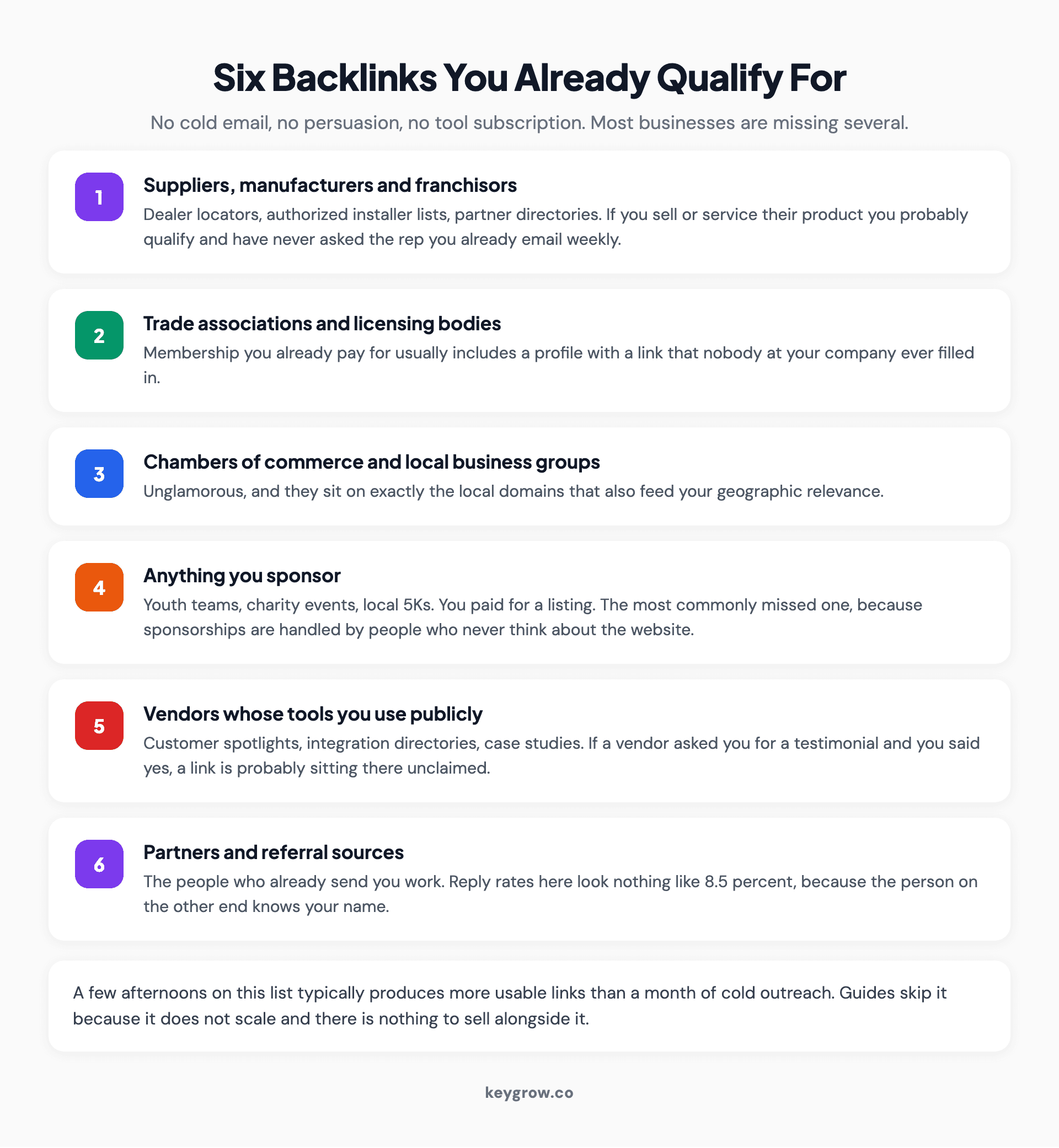
Checklist of backlinks a business can claim without outreach, including supplier and manufacturer listings, trade associations, chambers of commerce, local sponsorships and existing partner websites.
Suppliers, manufacturers, and franchisors. Most brands maintain a dealer locator, an authorized installer list, or a partner directory. If you sell, install, or service somebody's product, you probably qualify for a listing and have never asked. These are relevant, they come from established domains, and the request is an email to a rep you already talk to.
Trade associations and licensing bodies. Your industry body, your certification programs, your state licensing directory where one is public. Membership you are already paying for often includes a profile with a link that nobody at your company ever filled in.
Chambers of commerce and local business groups. Ordinary, unglamorous, and genuinely useful for a business that serves a geographic area, because they sit on the local domains that also feed your local relevance signals.
Anything you sponsor. A youth team, a 5K, a charity gala, a community event. If you gave money, you are almost certainly entitled to a listing. This is the most commonly missed one because the sponsorship is handled by somebody who does not think about the website.
Software and tools you use publicly. Vendor case studies, customer spotlights, integration directories, review platforms. If a vendor has ever asked you for a testimonial and you said yes without following up, there is a link sitting there.
Your own existing relationships. Partners, referral sources, vendors, the accountant who lists trusted local businesses, the two companies you refer work to. A short email asking to be added to a resource page you already belong on has a reply rate nothing like 8.5 percent, because the person knows you.
Working through that list is a few afternoons and typically produces more usable links than a month of cold outreach. It is also the part every "how to build backlinks" listicle skips, because it does not scale and there is nothing to sell alongside it.
What separates a link that helps from one that does nothing
Relevance and editorial intent. A link matters when a real person on a topically related site chose to point at you because your page was useful to their readers.
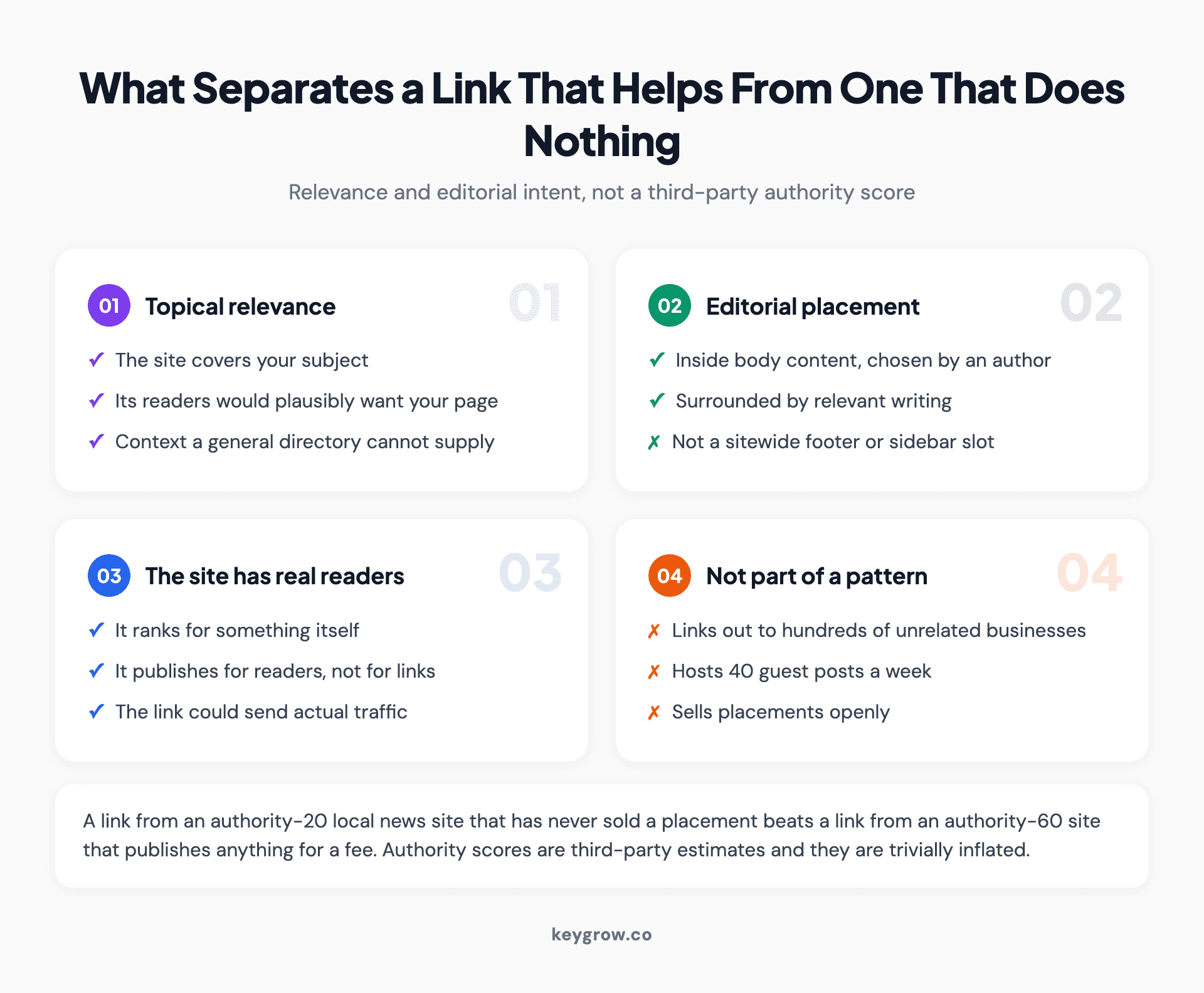
Icon grid defining what makes a backlink valuable, covering topical relevance, editorial placement in body content, real site traffic, and the difference from paid or automated placements.
The things that make a difference, roughly in order:
| Signal | Why it matters | How to check |
|---|---|---|
| Topical relevance | A link from a site about your subject carries context a random directory cannot | Would this site's readers plausibly want your page? |
| Editorial placement | In body content, chosen by an author, beats a footer or sidebar | Where on the page does the link sit? |
| Site actually gets traffic | A site nobody visits passes little of value | Does it rank for anything? Does it publish for readers or for links? |
| Link is followed | A nofollow link still has value, but not the same value | Check the rel attribute |
| Not part of a pattern | Sites that link to everybody are discounted | Does the site link out to hundreds of unrelated businesses? |
Domain authority scores are the wrong thing to optimize for. They are third-party estimates, they are trivially inflated, and a link from an authority-60 site that publishes 40 guest posts a week is worth less than a link from an authority-20 local news site that has never sold a placement. We wrote separately on where nofollow links fit into this, since the answer is more nuanced than the usual "they are worthless".
The outreach still worth doing
Two kinds, and both work because you have something the other side wants rather than because your email was well written.

A person typing on a laptop at a clean desk, working through outreach email one message at a time.
Being a source. Journalists and industry publications need people who actually do the work to explain things. If you can speak credibly about your field, respond to reporter queries, build relationships with two or three local outlets, and be genuinely available on deadline. The links are strong, the placements are relevant, and the reply rates bear no resemblance to cold outreach because they asked first.
Publishing something worth citing. Original data is the only content type that reliably earns links from people you never contacted. A survey of your customers, an analysis of your own anonymized job data, an annual price index for your market, a plain-language breakdown of a rule change that affects your industry. This is hard, which is why 96.6 percent of published content has no external links at all. It is also the only approach where one piece can keep earning for years.
What I would not spend time on: mass guest posting on sites that exist to host guest posts, "link insertion" outreach to random blogs, and the skyscraper technique, which by now means emailing people to tell them your article is longer than the one they linked to. Those all made sense when fewer people were doing them.
Tactics that stopped working, and one that never did
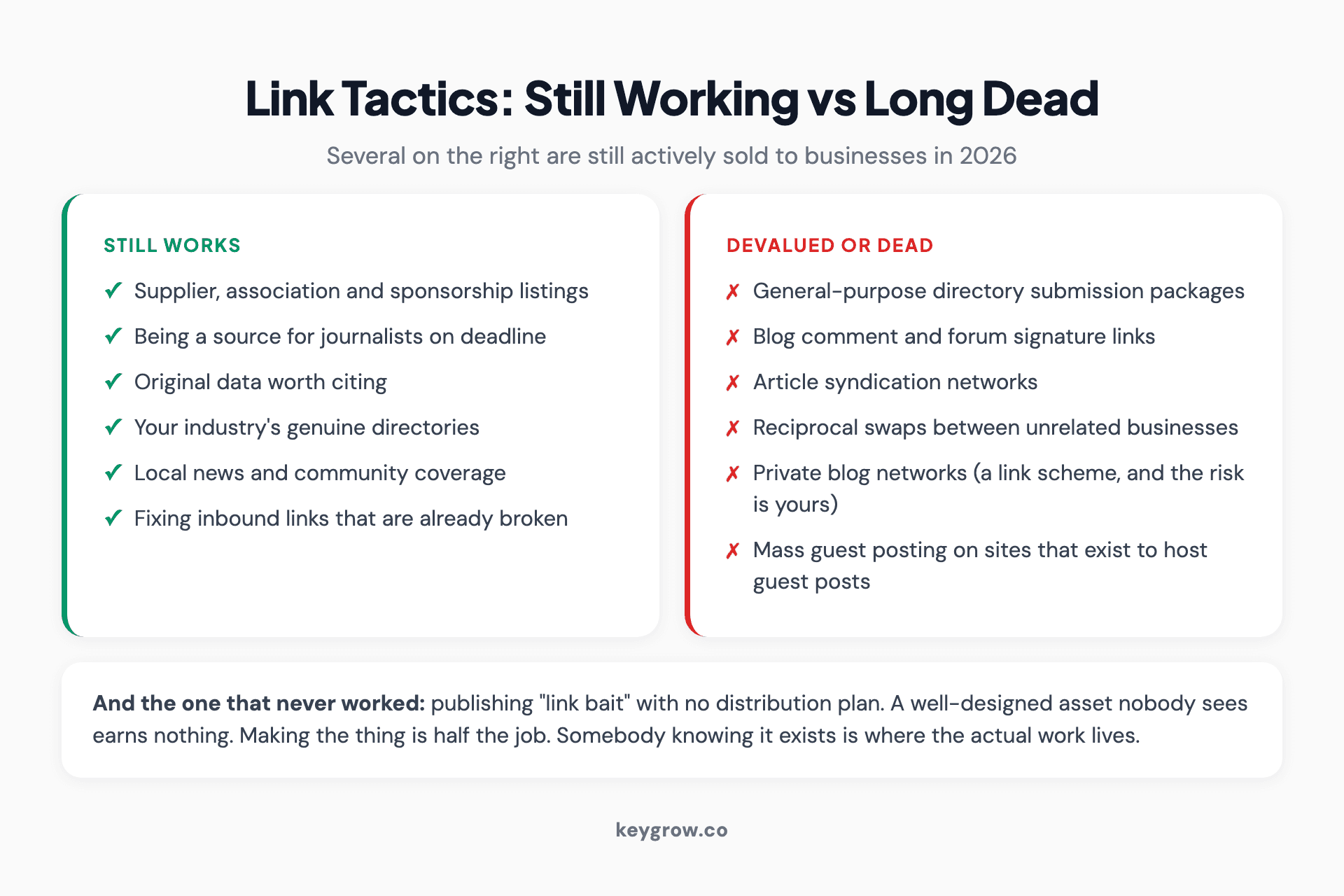
Two-column comparison of link building tactics that still work against tactics that have been devalued, including directory submissions, paid guest post networks, reciprocal links and comment links.
Directory submissions beyond the obvious ones are a waste of an afternoon. Your Google Business Profile, your industry's real directories, and the major local aggregators are worth having. The other 200 general-purpose directories are not, and buying a package of them is a way to acquire a footprint that looks exactly like every other site that bought the same package.
Blog comment links, forum signature links, and article syndication networks have not worked in over a decade, and they are still sold. Reciprocal link swaps between two unrelated businesses are visible, obvious, and pointless. Private blog networks are a link scheme under Google's spam policies and the risk sits entirely with you, not with the vendor who sold them.
The one that never worked, and still gets recommended: writing "link bait" with no distribution plan. A well-designed infographic that nobody sees earns nothing. The asset is half the job. Somebody knowing it exists is the other half, and that half is where the actual work lives.
Buying links, honestly
Paid links violate Google's guidelines, plenty of companies buy them anyway, and pretending otherwise in a blog post helps nobody.
So here is the position I would give a client. The risk is real but it is usually not a dramatic manual penalty. What normally happens is quieter: the links get discounted, your money buys nothing, and you have no way to tell the difference between a link that was ignored and one that helped. At $361 a link, that is an expensive uncertainty to carry.
There is a second problem, and it is structural. Bought links come from sites in the business of selling links, which means they sell to everybody, which means the site's outbound profile eventually looks like what it is. You are buying an asset whose value declines as the seller succeeds.
If you have a budget for links, spend it on the thing that produces links instead: original research, a tool worth using, or somebody whose job is getting you quoted. Slower, and the outcome compounds rather than decays.
How many do you actually need?
Enough to be competitive for your specific terms, which you find by looking rather than by guessing at a number.
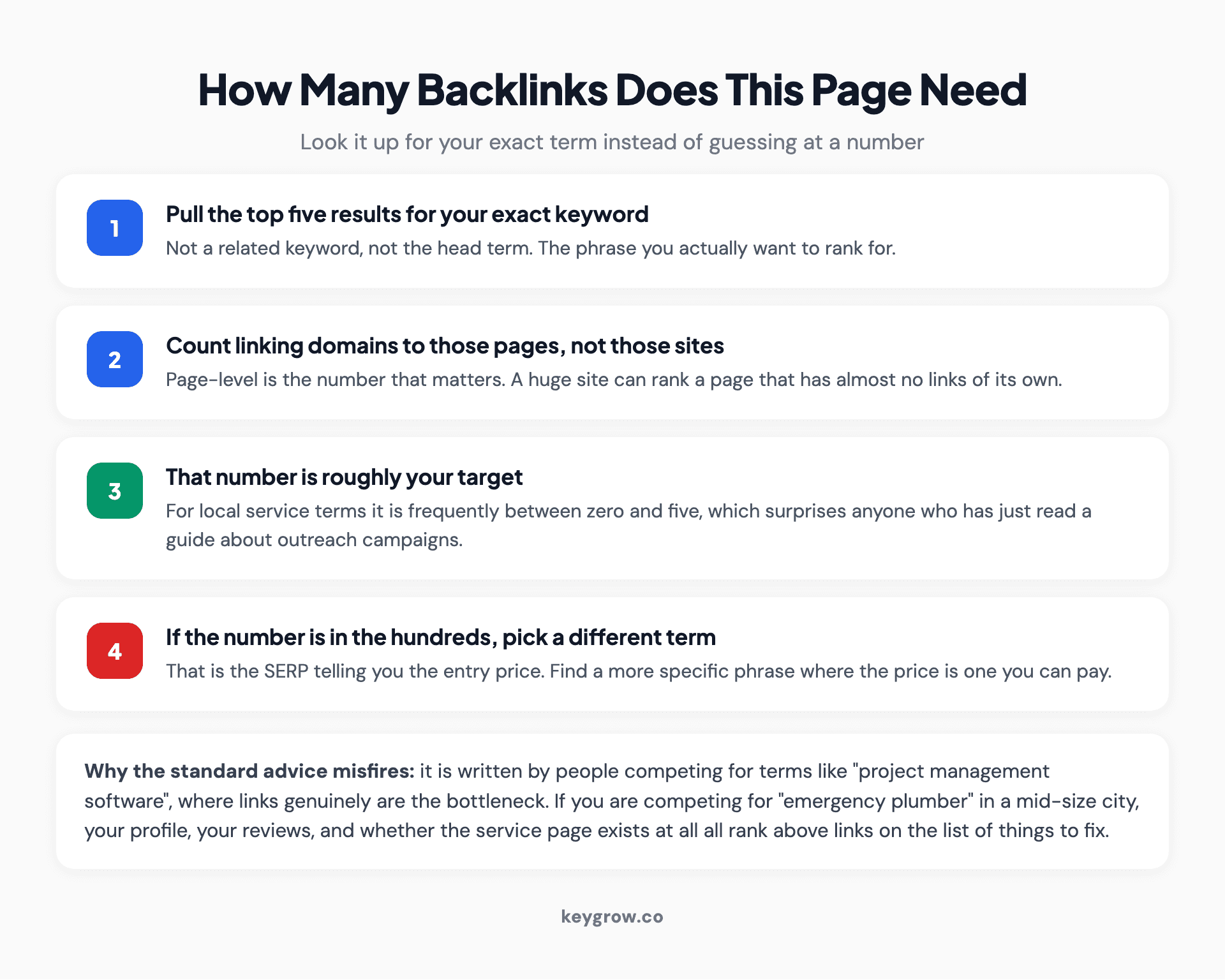
Decision flow for determining how many backlinks a page needs, starting from the pages currently ranking for the target term and their link profiles.
Go and look.
Pull the top five results for the term you want. Look at how many distinct domains link to those specific pages, not to the whole site. That number, roughly, is your target for that page. For a local service term it is often between zero and five, which surprises people who have just read a guide about outreach campaigns. For a competitive commercial term it can be in the hundreds, and that is the signal telling you to pick a different term.
This is why so much link building advice misfires. The advice is written by people competing for terms like "project management software", where links are genuinely the bottleneck. If you are competing for "emergency plumber" in a mid-size city, the bottleneck is your Google Business Profile, your review count, and whether you have a page for the service at all. Links are somewhere below all three. Our post on whether local SEO still works goes further into what actually moves the needle locally.
Give it a year before deciding it failed
Links do not work on the schedule anybody wants. A new link has to be crawled, the linking page has to be reassessed, and the effect on your rankings is gradual and mixed in with everything else changing at the same time.
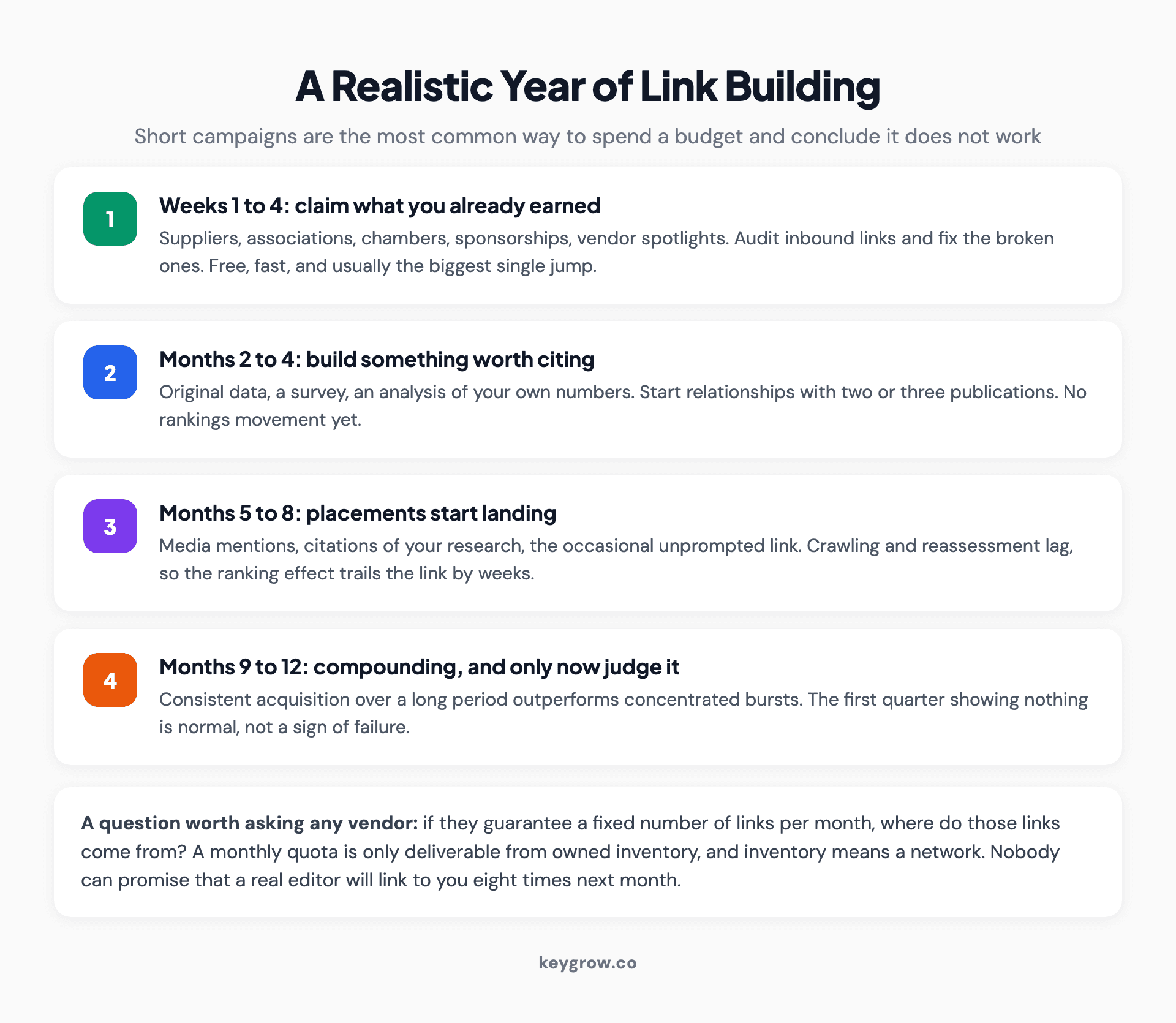
Timeline showing what to expect from a link building program across twelve months, from claiming existing listings through outreach to compounding authority.
Which makes this an area where the usual advice about patience is not merely reassurance. Consistent link acquisition over a long period outperforms concentrated bursts, and short campaigns are the most common way to spend a budget and conclude that link building does not work. If you are going to do it, plan on a year, and expect the first quarter to show nothing you can point at.
There is a related opinion I will state plainly, because it saves people money. If an agency is selling you a fixed number of links per month, ask where they come from. A guaranteed monthly quota is only deliverable from inventory, and inventory means a network. Nobody can guarantee that a real editor will link to you eight times next month. We work month to month partly because that kind of promise is what long contracts exist to protect.
When link building is the wrong thing to be working on
Most businesses reading this have something more valuable to fix first. Three signals that you are not ready:
Your pages are not built yet. If you have a homepage and a contact page, links are not the constraint. Build the pages that answer what people search for. A link to a page that does not exist helps nothing.
You have never checked what is already pointing at you. A surprising number of businesses have links they do not know about, including some from suppliers who spelled the domain wrong or pointed at a page that has since been deleted. Fixing broken inbound links is free and takes an hour.
You are local and under-optimized on the basics. Profile, reviews, service pages, city pages. All of them beat links for a business whose customers are within 20 miles. Get those right, and if you are still stuck after six months, look at links then.
There is also a real DIY case for the free list earlier in this post. Nothing on it requires an agency. If somebody at your company has a few afternoons and access to your vendor relationships, they will do it better than an outside team, because they know who to ask. Bring in help for the parts that need ongoing effort, like being a media source or producing research.
FAQs
How long does it take to build backlinks?
The free ones, from suppliers, associations, and sponsorships, can be claimed in a few afternoons. Outreach-based links take months, because the median campaign sends around 292 emails per placed link. Plan on twelve months before judging whether a link building program worked, and expect the first quarter to produce nothing measurable.
How many backlinks does a page need to rank?
It depends entirely on the term. Check how many unique domains link to the pages currently ranking in the top five for your exact keyword. For many local service terms that number is between zero and five. For competitive national commercial terms it can run into the hundreds, which is usually a sign to target something more specific.
Are paid backlinks safe?
They violate Google's guidelines, and the usual outcome is not a dramatic penalty but a quiet one: the links get discounted and the money buys nothing measurable. There is also a structural problem, because sites that sell links sell to everyone, so the value of what you bought declines over time. The same budget spent on original research or media relationships produces links that last.
Do nofollow links help SEO?
They are not worthless, but they do not carry the same weight as a followed link. A nofollow link from a publication people actually read still brings traffic, brand searches, and the kind of visibility that leads to followed links later. Judge a link by whether real people will see it, not only by the rel attribute.
What is the fastest way to get backlinks?
Claiming the ones you have already earned. Supplier and manufacturer directories, trade association profiles, chamber listings, sponsorship pages, and vendor case studies are all links you qualify for without persuading anybody. Most businesses have several sitting unclaimed, and collecting them takes days rather than months.
Should I use a link building service?
Be careful with any service that guarantees a set number of links per month, because that volume can only be delivered from owned inventory, which is a network. Services that get you quoted in publications, or that help you produce research worth citing, are a different proposition. Ask specifically where the links come from before signing anything.
Do internal links count as backlinks?
No. A backlink comes from a different website. Internal links between your own pages are still worth attention, because they tell search engines which of your pages matter most and pass value around your site, but they are a separate discipline from link building.
If you only do one thing
Open a document and list every organization you already pay, sponsor, sell for, belong to, or partner with. That list is your first link building campaign, and it will out-produce a month of cold outreach.
Then check what is already pointing at your site and fix anything broken. Both jobs are free, neither needs a tool subscription, and together they are more than most businesses ever get from a paid link campaign. Working out which of a competitor's links you could realistically earn, before you spend a month on outreach, is what a competitor backlink analysis is for.
If you want somebody to look at whether links are actually your constraint, or whether something cheaper is holding you back, that is a conversation our SEO team has most weeks, and the answer is often that you should spend the money elsewhere.