

Digital PR for SEO means earning coverage in real publications so that journalists link to you on their own, rather than buying or asking for links directly. It is the most effective link building there is, and it is also the most expensive. The average earned link costs about $597 and the average monthly contract runs $5,458.
Those two numbers are the reason this post opens with money instead of tactics. Almost every guide on this keyword saves the pricing for the end, if it mentions it at all, and a lot of readers get three thousand words into a strategy they were never going to be able to afford.
What it costs, since none of the guides lead with that
BuzzStream surveyed around 70 agency leaders and freelancers who sell digital PR and published the spread. It is the most honest pricing data available on this, so here it is up front.
| Service | Cost per link | Typical monthly retainer |
|---|---|---|
| Guest posting | $150 | $2,500 |
| Journalist request responses | $400 | $4,000 |
| Reactive and proactive PR | $625 | $6,000 |
| Hero content campaigns | $800 | $8,000 |
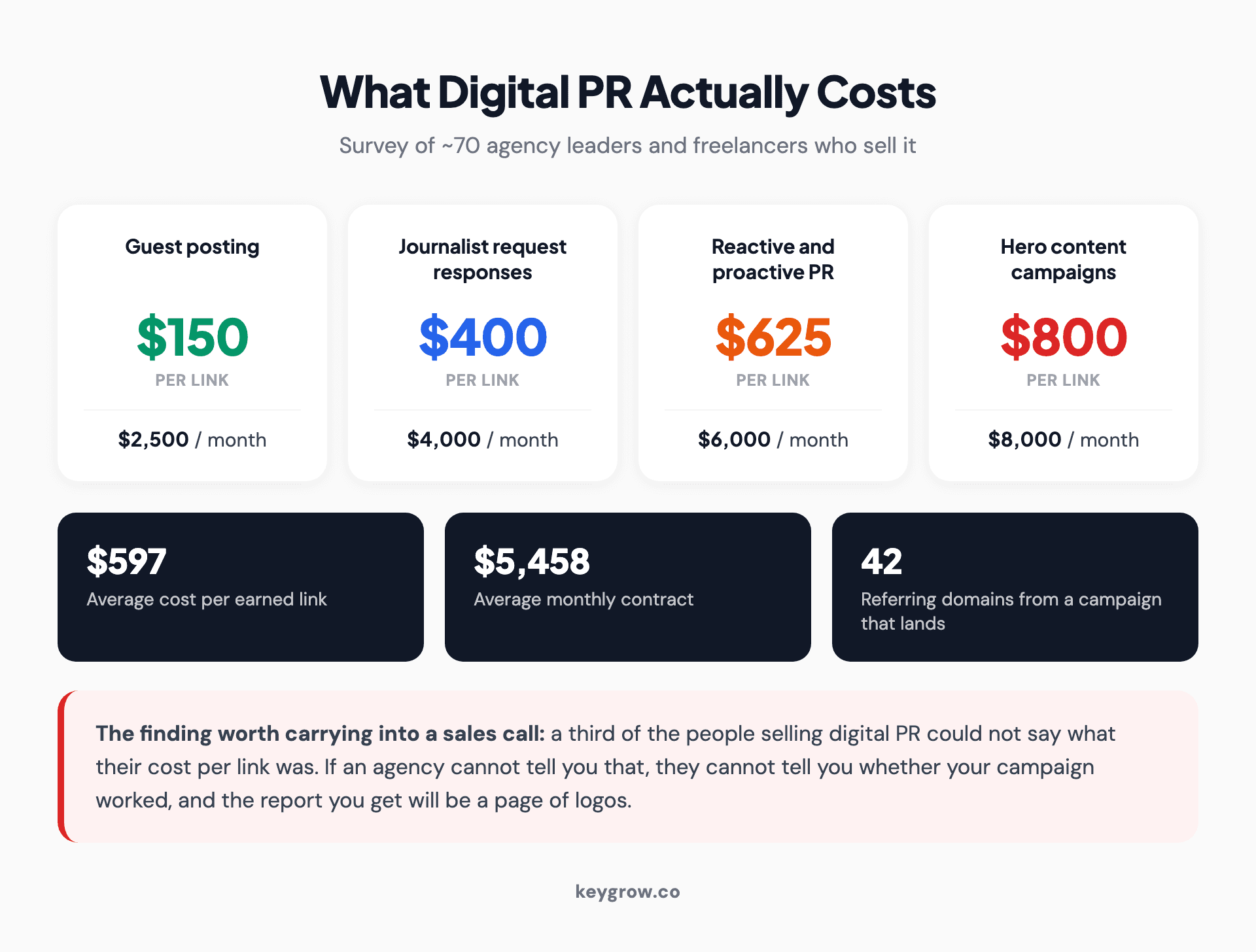
Digital PR pricing by service: guest posting at $150 per link and $2,500 a month, journalist request responses at $400 and $4,000, reactive and proactive PR at $625 and $6,000, hero content campaigns at $800 and $8,000, with an overall average of $597 per link.
Freelancers came in at $416 per link and $4,200 a month. Agencies came in at $663 and $6,357. The average across everyone was $597 per link on a $5,458 monthly contract.
One more finding from BuzzStream's survey deserves its own line: a third of the people selling digital PR could not say what their cost per link was.
That is the number to carry into any sales call. If an agency cannot tell you what a link costs them, they cannot tell you whether your campaign worked, and the report you get at the end will be a list of logos.
The four tactics, and which a small budget can reach
Digital PR is not one thing. It is four fairly different activities that get sold under one name, and they have wildly different price points.
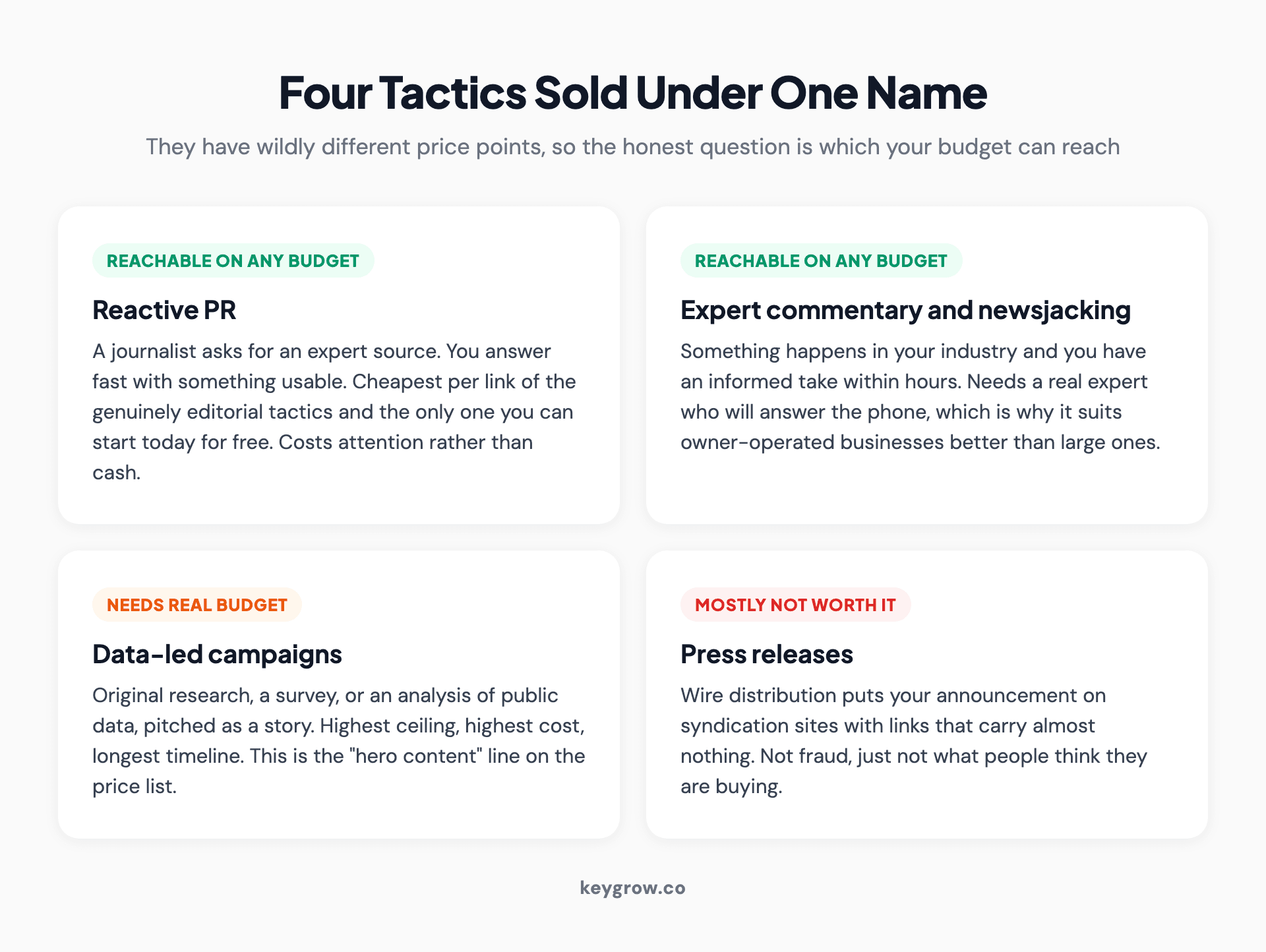
Reactive PR. A journalist puts out a request for an expert source. You answer it, fast, with something usable. If they run it, you get a quote and usually a link. Cheapest per link of the genuinely editorial tactics, and the only one you can start today for free.
Four digital PR tactics labelled by budget reachability: reactive PR and expert commentary are reachable on any budget, data-led campaigns need real budget, and press releases are mostly not worth it.
Data-led campaigns. You produce original research, a survey, an analysis of a public dataset, and pitch the finding as a story. Highest ceiling, highest cost, longest timeline. This is what "hero content" means on the price list above.
Expert commentary and newsjacking. Something happens in your industry and you are ready with an informed take within hours. Requires a genuine expert who will actually answer the phone, which is why it works better for owner-operated businesses than for large ones.
Press releases. Mostly a waste of money for SEO purposes. A wire distribution puts your announcement on a few dozen syndication sites with links that carry almost nothing. It is not fraud, it just is not what people think they are buying. If you want the real mechanics of what does carry weight, how to build backlinks covers the underlying rules.
If your budget is under a thousand dollars a month, the realistic list is reactive PR and expert commentary. Both run on your time rather than on production costs, which is the only reason they fit.
Reactive PR, and the tool that died and came back
This is where most guides are quietly out of date, including some published this year.
For fifteen years the default tool was HARO, Help A Reporter Out: a free email, three times a day, carrying journalist requests. Cision bought it, rebranded it to Connectively, added a subscription, and journalist participation fell. Cision discontinued it on 9 December 2024.
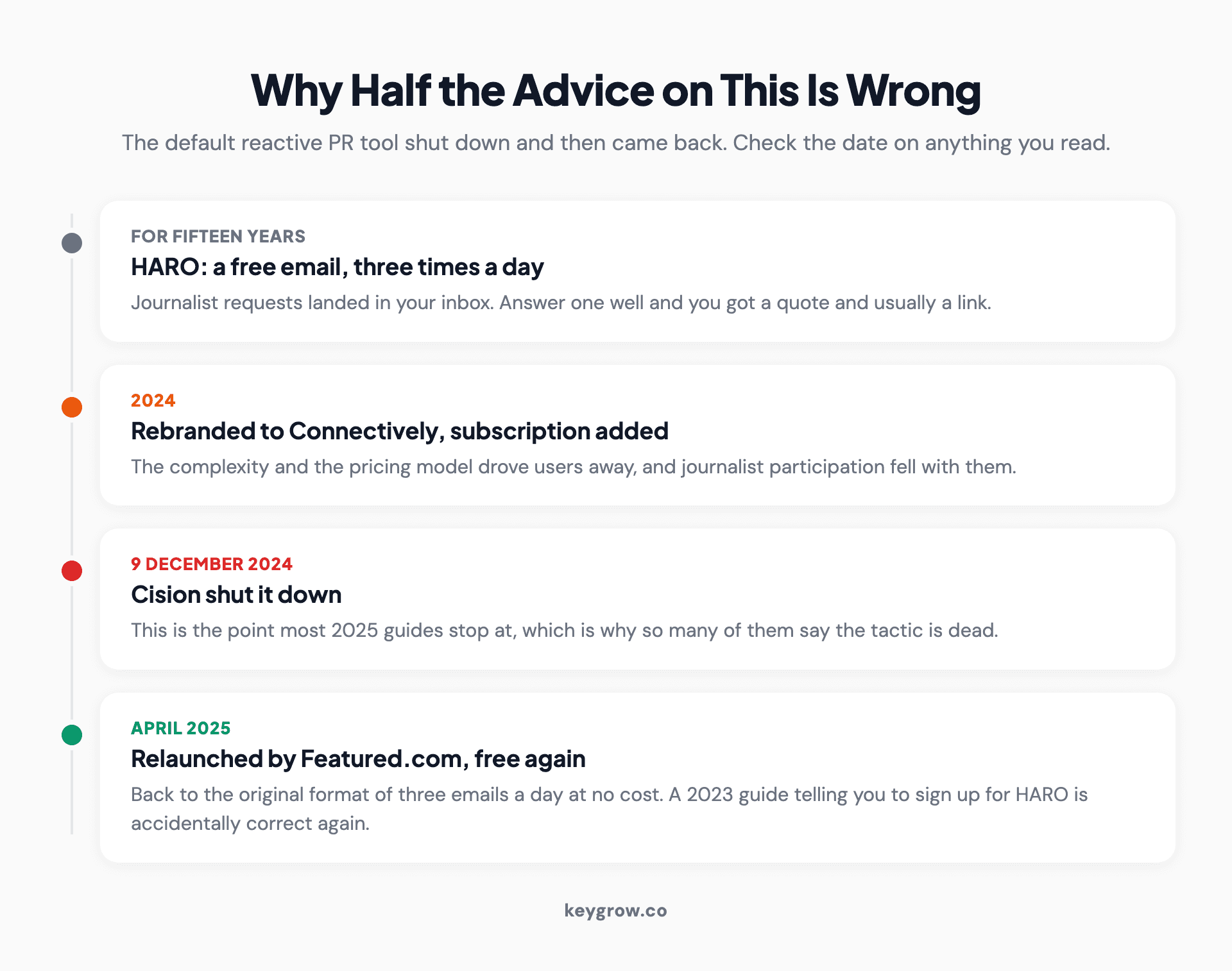
Timeline of the HARO journalist request platform: fifteen years as a free email, rebranded to Connectively with a subscription in 2024, shut down by Cision on 9 December 2024, and relaunched free by Featured.com in April 2025.
Then Featured.com acquired the HARO name and relaunched it in April 2025, back to the original free format of three emails a day. So a guide from 2023 that tells you to sign up for HARO is accidentally correct again, and a guide from early 2025 telling you HARO is dead is wrong. Check the date on anything you read about this.
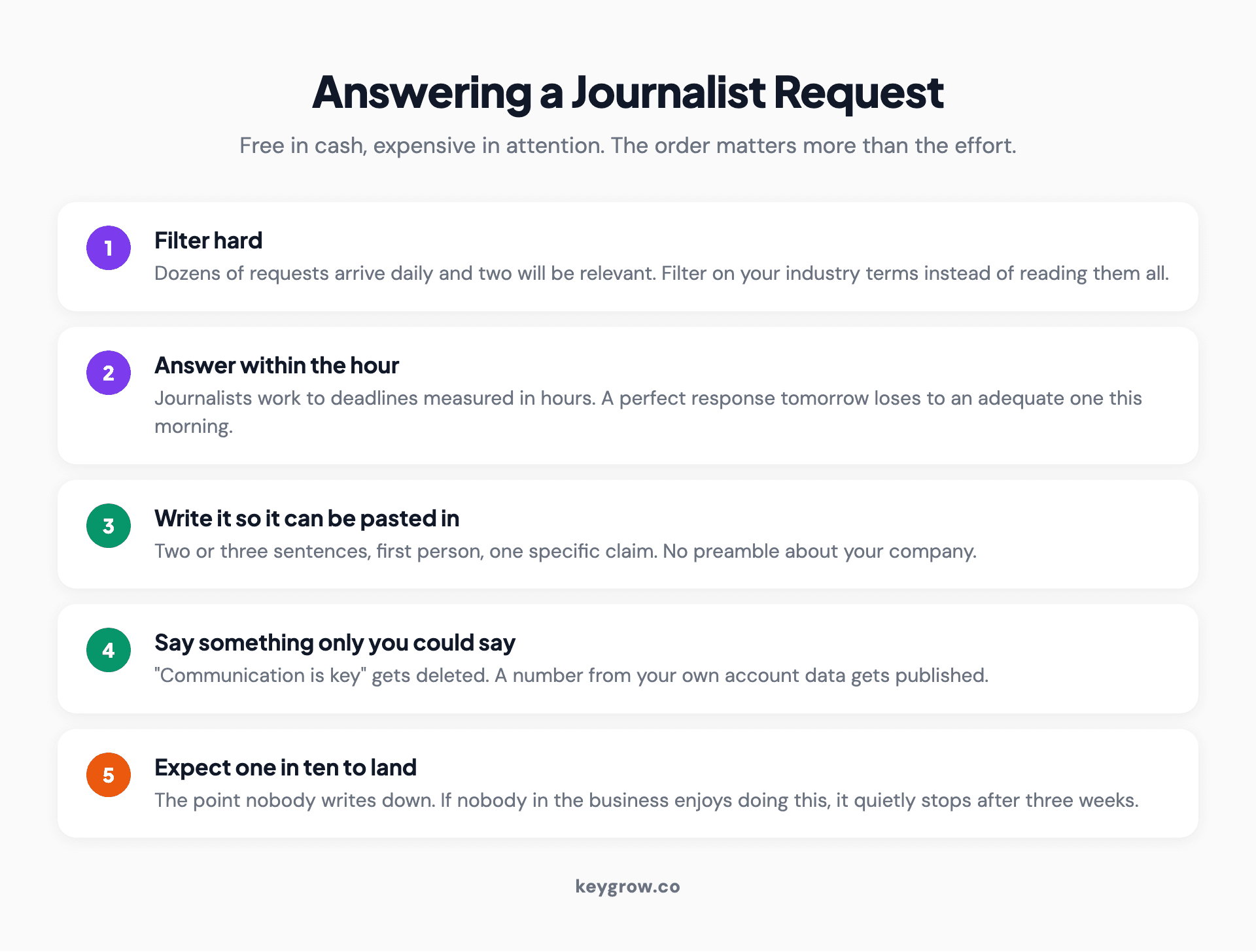
The practical version of reactive PR, whichever platform you use:
1. Filter hard. You will get dozens of requests a day and two will be relevant. Set up filters on your industry terms rather than reading them all.
2. Answer within the hour. Journalists work to deadlines measured in hours. A perfect response tomorrow loses to an adequate one this morning.
3. Write it so it can be pasted in. Two or three sentences, first person, with a specific claim in it. No preamble about your company, no "happy to discuss further".
4. Say something only you could say. "Communication is key" gets deleted. "We moved one client's ad traffic off their homepage and onto a booking page, and cost per booking went from $100 to $22" gets published.
5. Expect a low hit rate. One in ten is a reasonable target when you are new to it.
That last point is the one nobody writes down. Reactive PR is free in cash and expensive in attention, and if nobody in the business enjoys doing it, it will quietly stop after three weeks.
Five steps for answering a journalist request: filter hard, answer within the hour, write it so it can be pasted in, say something only you could say, and expect one in ten to land.
Two answers to the same journalist request
Here is the difference between a response that gets used and one that gets deleted. The request is real in shape: a reporter writing about small business marketing budgets asks for expert comment on where owners waste money.
The version that gets deleted:
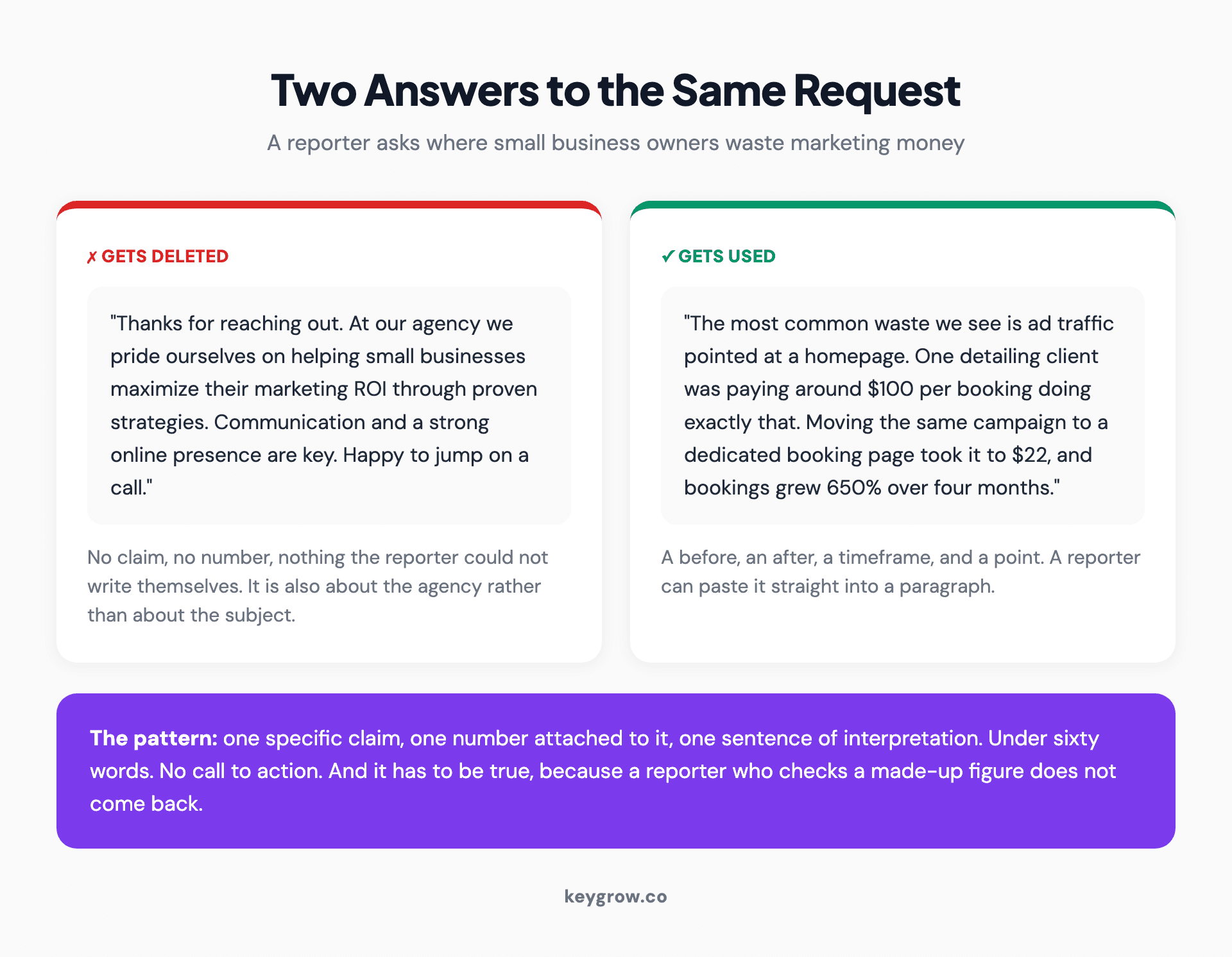
Two responses to the same journalist request side by side: a generic agency reply with no claim or number that gets deleted, and a specific reply citing a cost per booking falling from $100 to $22 that gets used.
"Thanks for reaching out. At our agency we pride ourselves on helping small businesses maximize their marketing ROI through proven strategies. Communication and a strong online presence are key. Happy to jump on a call to discuss further."
Nothing in there is quotable. It contains no claim, no number, and nothing the reporter could not write themselves. It is also about the agency rather than the subject.
The version that gets used:
"The most common waste we see is ad traffic pointed at a homepage. One detailing client was paying around $100 per booking doing exactly that. Moving the same campaign to a dedicated booking page took it to $22, and bookings grew 650% over four months. The ad was never the problem. The page was."
A reporter can paste that straight into a paragraph. It has a before, an after, a timeframe, and a point. It also happens to be true, which matters, because a reporter who checks and finds a made-up number will not come back.
The pattern generalizes: one specific claim, one number attached to it, one sentence of interpretation. Under sixty words. No call to action.
What makes a data-led campaign land
The mechanism is simple and the execution is not: give a journalist a number they can put in a headline.
The number has to be about something their readers already care about, it has to be new, and it has to come from data you can defend. A survey of 500 people is enough if the question is interesting. An analysis of public data is often better, because it is free and because nobody can accuse you of writing the questions to get the answer.
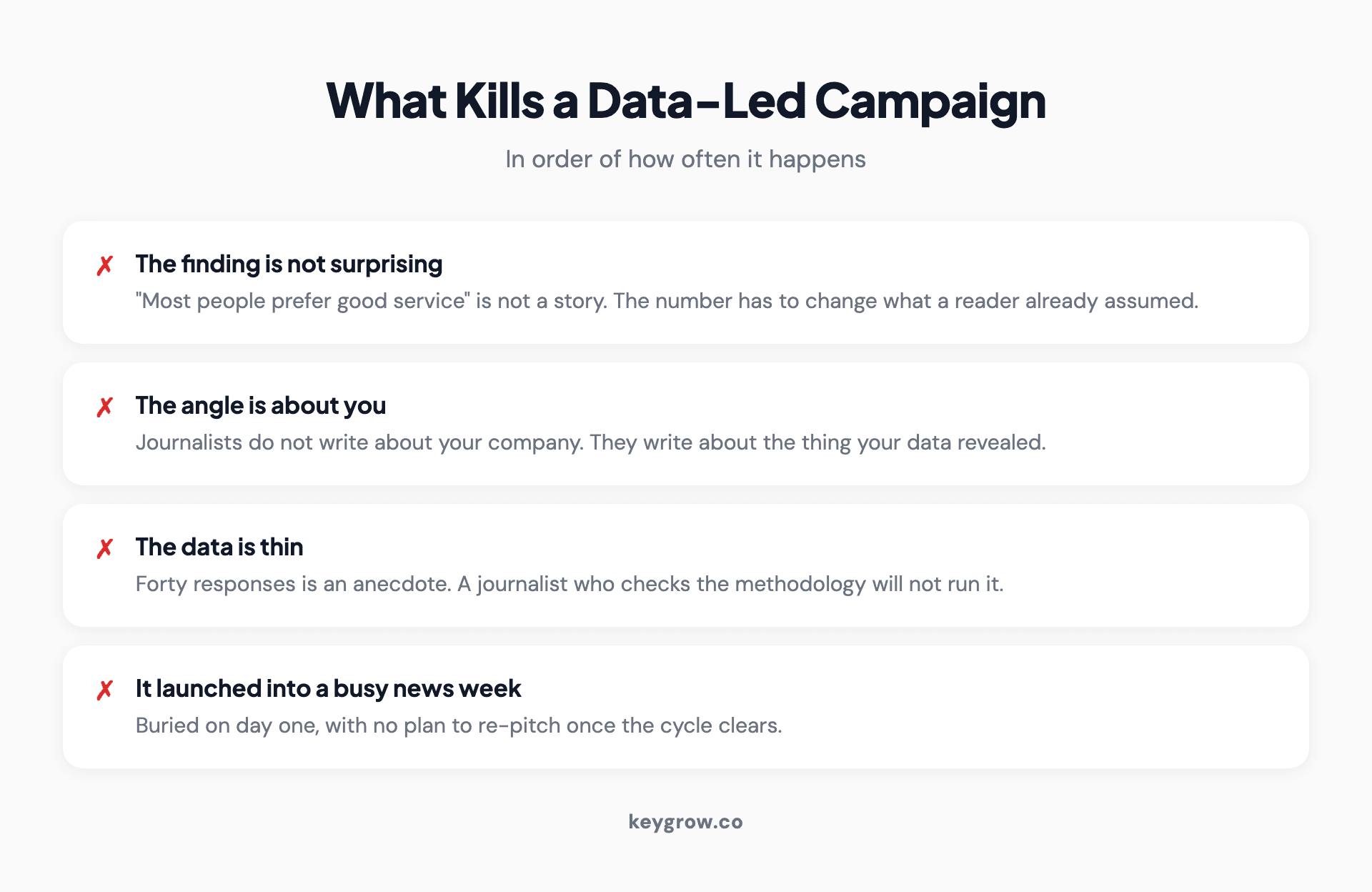
Four reasons data-led PR campaigns fail: the finding is not surprising, the angle is about the company rather than the data, the sample is too thin, and it launched into a busy news week with no plan to re-pitch.
What kills these campaigns, in order of frequency:
The average campaign that does land earns links from around 42 unique referring domains. That is the shape of the payoff: not one enormous placement, but a cluster of coverage that follows the first outlet in.
What you are actually buying in 2026
Two things, and the second one is newer than most of the pricing on this page.
Referring domains from sites that are hard to fake. A link from a national newspaper is not something a competitor can buy their way past. That is the classic argument for digital PR and it still holds.

A business newspaper article open on a desk.
Being the quoted source when an AI answers the question. The Princeton and Georgia Tech researchers behind the GEO paper measured which content changes lifted visibility inside AI-generated answers. The two biggest levers were adding relevant statistics, worth about 40 percent, and adding quotations from authoritative sources, worth roughly 37 percent.
Read that from the other direction. Every publisher optimizing for AI visibility now has a reason to include expert quotes and original statistics. Digital PR is how you become the expert being quoted and the source of the statistic. The link is still worth having. The citation may end up being worth more.
That is also why this pairs with the rest of an authority strategy rather than replacing it. Coverage plus a site that clearly belongs to a real, identifiable business is what branding does for SEO, and neither half works alone.
The pitch
Short. Specific. Sent to someone who covers this beat.
Journalists are not reading your email in a quiet room. Only about one in three pitches gets opened at all, and the ones that do get roughly the attention you give a subject line. Two percent of journalists want a pitch longer than 400 words, which means 98 percent of them are deleting the pitch you were about to write.

A person reading a newspaper at a table.
The version that works is four lines: what the finding is, why it matters to their readers, where the data came from, and an offer of the full dataset. Your company name belongs in the signature, not the first sentence.
Build the list by hand. Twenty journalists who cover your actual subject beat two thousand contacts from a database, and a database blast is also how your domain ends up with a deliverability problem.
Measuring it without fooling yourself
Coverage volume is a vanity metric and it is the one most digital PR reports lead with. A page of publication logos tells you the agency was busy. It does not tell you whether anything moved.
Track these instead:
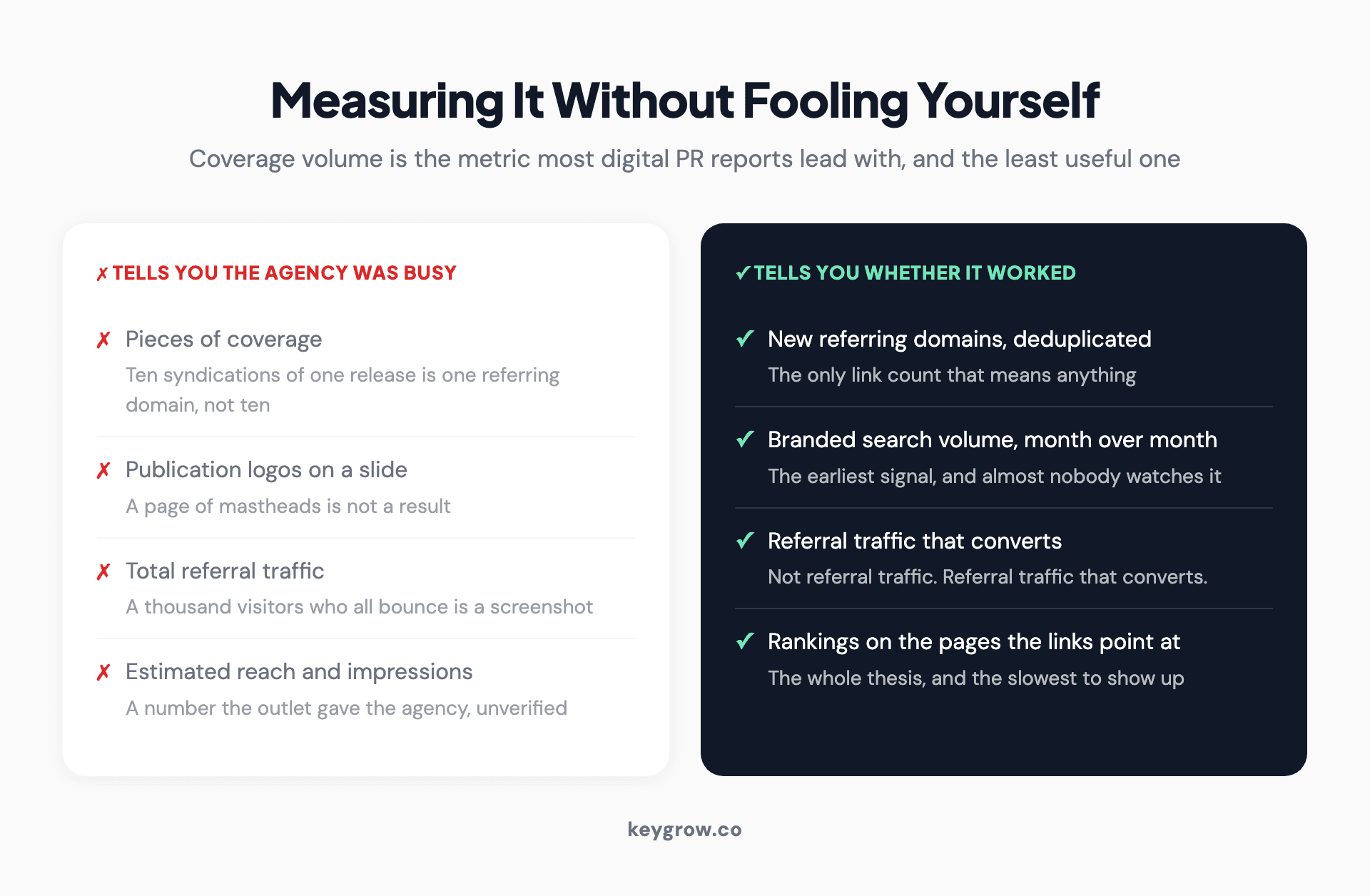
Two columns contrasting vanity digital PR metrics such as pieces of coverage, publication logos, total referral traffic and estimated reach, against metrics that show whether it worked: deduplicated referring domains, branded search volume, converting referral traffic, and rankings on the linked pages.
Worth knowing: some of the coverage you earn will be nofollowed, particularly from larger publishers with blanket policies. That is not a wasted placement. Nofollow links still carry value for discovery, referral traffic, and brand signals, and they count toward being the quoted source in an AI answer just the same.
The timeline, start to measurable
Setup and asset creation take two to four weeks. Outreach runs three to eight weeks. Ranking movement attributable to the links lands somewhere around eight to sixteen weeks, and that last window is optimistic if the site has other problems.
Anchor the expectation to how authority actually stacks up. We ran a full year of organic work for a doctor's practice in Dubai. Quarter one was quiet enough to be uncomfortable. By the twelve month mark the practice was at 1,519% traffic growth and fielding 130+ patient calls a month. None of that arrived in a week. Digital PR has the same shape: the coverage is an event, the payoff is an accumulation.
If someone quotes you a timeline where links turn into revenue inside a month, they are describing a link purchase and calling it PR.
Who should not do digital PR
Most local businesses, honestly.
If you run a single-location plumbing company, the searches that pay your invoices are people typing an emergency into their phone from three miles away. Those results are decided by your Google Business Profile, your reviews, and your proximity to the searcher. A link from a national magazine does not enter into it. At $597 a link, you would be buying authority for a fight that is not being scored on authority.

A stack of newspapers on a wooden table.
Spend that money on the profile, the reviews, and service pages that load fast. It is not a close call.
Digital PR earns its cost when you are competing nationally, when your market is genuinely link-driven, when someone in the business is a credible expert who will answer questions on deadline, or when you are trying to become the source AI systems quote in a category where nobody has claimed that yet.
And if you do hire for it, ask two questions before signing anything. What is your cost per link on accounts like mine, and can I see the referring domain list from your last three campaigns, deduplicated. A third of this industry cannot answer the first one. The ones who can are the ones worth talking to, and any of them worth hiring will also work month to month rather than asking you to commit for a year.
FAQs
Is digital PR the same as link building?
No, though they overlap. Link building covers any tactic aimed at acquiring links, including guest posting and outreach for placements. Digital PR earns coverage by giving journalists something worth writing about, and the link arrives as a byproduct of the story. The distinction matters mostly because the two have very different costs and very different risk profiles.
How much does digital PR cost?
Around $597 per earned link and $5,458 per month on average, based on a survey of about 70 agencies and freelancers. Guest posting sits at the cheap end near $150 a link, and hero content campaigns at the expensive end near $800. Freelancers generally charge less per link than agencies.
Does digital PR still work in 2026?
Yes, and it has picked up a second job. Editorially earned links from publications a competitor cannot buy into remain one of the strongest authority signals available. On top of that, being the quoted expert in published coverage now feeds how often AI systems cite you, which research on generative engine optimization measured as one of the two largest levers on AI visibility.
What is the best free digital PR tactic?
Responding to journalist requests. HARO relaunched in April 2025 under Featured.com, back to the free format of three emails a day, after Cision shut down its Connectively version in December 2024. It costs nothing but attention, and attention is the part most businesses run out of.
How many links should a digital PR campaign earn?
A campaign that lands typically earns links from around 42 unique referring domains, though the distribution is uneven and plenty of campaigns earn nothing at all. Judge a provider on deduplicated referring domains rather than on the number of pieces of coverage, because syndication inflates the second number without improving the first.
Do nofollow links from press coverage count?
They count for less than a followed link as a ranking signal, and they are still worth having. Large publishers frequently apply nofollow by policy across all outbound links. Those placements still drive referral traffic, still build brand recognition, and still make you the named source that AI systems can quote.
How long does digital PR take to affect rankings?
Roughly eight to sixteen weeks from campaign launch, with outreach itself running three to eight weeks before that. Authority builds slowly, and any timeline shorter than that usually describes buying links rather than earning coverage.
If you have a thousand dollars a month
You do not have a digital PR budget, and that is fine. Here is the version that fits.
Sign up for the free journalist request emails. Pick one person in the business who knows the subject and can write two coherent sentences under time pressure. Give them twenty minutes a day. Track two numbers only: new referring domains and branded search volume.
Do that for six months and you will know whether there is anything here for your business, for the price of the time. If it works, you will have real data to take into a conversation about a proper budget. If it does not, you have lost twenty minutes a day instead of thirty thousand dollars.
For businesses where authority genuinely is the bottleneck, our SEO service treats earned coverage as one input among several rather than as the whole plan, and it runs month to month.


