

Do affiliate links hurt SEO? No, not on their own. As long as you tag affiliate links correctly, with rel="sponsored" or rel="nofollow", and disclose them, they do not drag down your rankings. They simply pass no link equity, so they neither help nor hurt your SEO directly. What actually gets sites buried is thin affiliate content: pages that exist only to push links and add nothing a reader could not get from the merchant.
That is the distinction almost every article on this topic blurs. The link is not the problem. The page around it is. Here is what Google says, how to tag affiliate links so they stay safe, and the kind of thin content that has wiped out real sites.
Do affiliate links hurt SEO? The short answer
Affiliate links do not hurt SEO when they are tagged with rel="sponsored" or rel="nofollow" and properly disclosed. They carry no ranking power either way. The real risk is thin, unoriginal affiliate content, which Google's spam and quality systems do target.
So the honest answer has two halves. The mechanical half: a correctly tagged affiliate link is invisible to your rankings, no penalty, no boost. The content half: if the page holding those links is a copy of the merchant's description with nothing original added, that page is in real danger, and the links are just along for the ride.
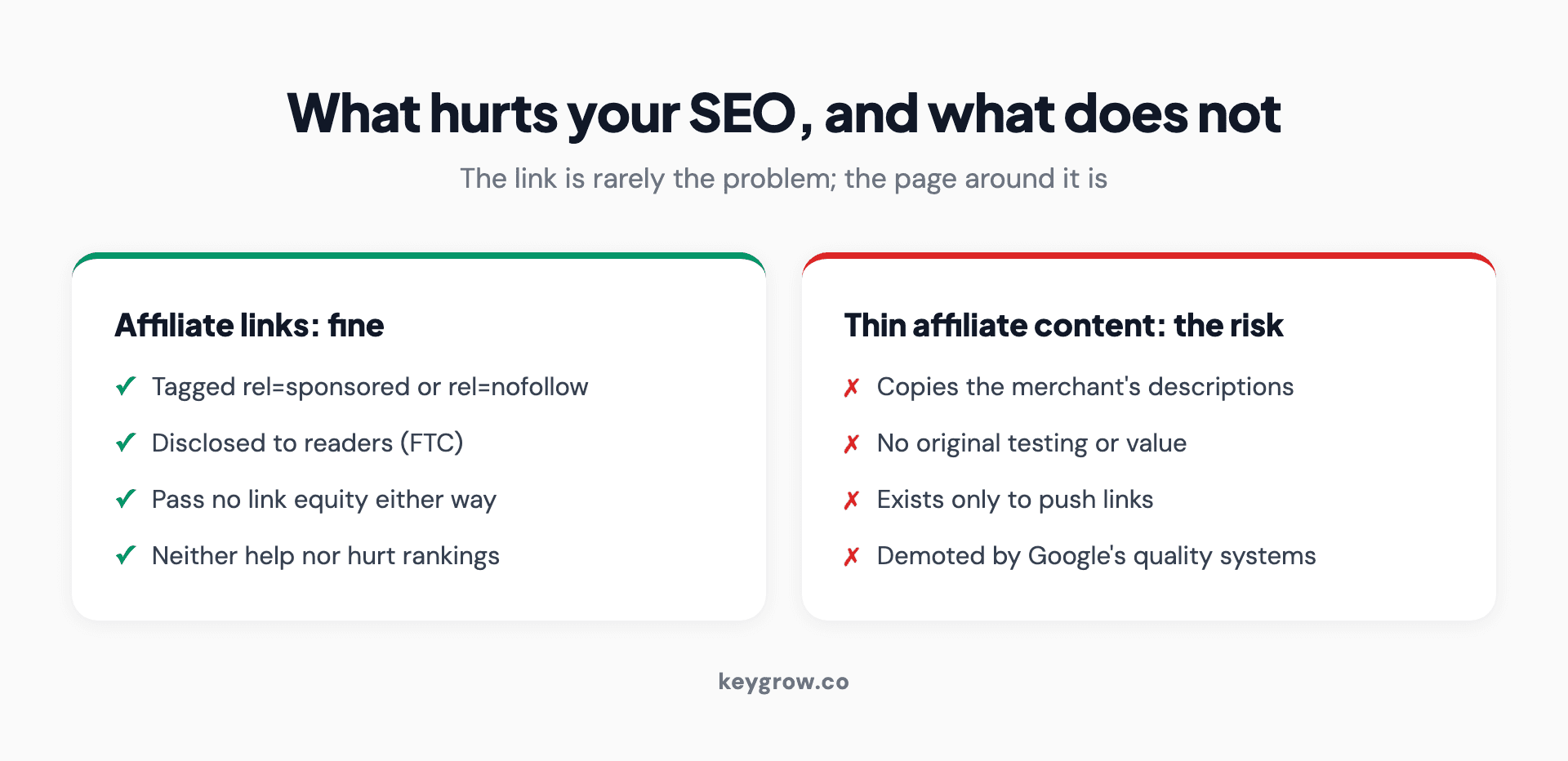
Infographic contrasting affiliate links, which are fine when tagged rel sponsored or nofollow and disclosed and pass no link equity either way, with thin affiliate content, the real SEO risk: pages that copy the merchant's descriptions, add no original testing or value, exist only to push links, and get demoted by Google's quality systems.
Why affiliate links do not hurt rankings on their own
A correctly tagged affiliate link passes no PageRank, so Google does not count it as a vote and does not penalize you for it. The tag tells Google the link is commercial, and Google simply ignores it for ranking purposes.
Google has been explicit about this. Its spam policies classify buying or selling links for ranking as link spam, but state plainly that it is "not a violation of our policies to have such links as long as they are qualified with a rel='nofollow' or rel='sponsored' attribute value." The tag is the whole difference between a normal affiliate link and a link-spam problem.
Google's John Mueller put the content side just as plainly: having affiliate links on a page "does not automatically make your pages unhelpful or bad," but "you need to make sure that your pages can stand on their own, that they're really useful and helpful." Read those two statements together and you have the entire answer. Tag the link, and earn the page.
How to tag affiliate links correctly
Tag every affiliate link with rel="sponsored". Google's link guidance says affiliate monetization is fine, but asks sites to qualify those links, and warns that when it finds sites failing to do so, "we may issue manual actions."
There are three attribute values, and picking the right one takes a few seconds:
| Attribute | Use it for | Passes ranking value |
|---|---|---|
| rel="sponsored" | Affiliate links, paid placements, ads | No |
| rel="nofollow" | Any link you do not want to vouch for | No |
| rel="ugc" | User-generated links (comments, forum posts) | No |
For affiliate links, rel="sponsored" is the precise choice, though rel="nofollow" is still accepted and treated the same way for ranking. In practice the markup looks like a normal link with the attribute added, for example a link with rel="sponsored" on it. If you run WordPress, most affiliate and link-management plugins add the attribute for you, and the block editor lets you mark a link as sponsored without touching code. The point is that this is a two-second job you can do yourself. You do not need an agency to add a rel attribute, and anyone who sells you a "link compliance package" for it is overcharging for a checkbox.
The real risk: thin affiliate content
What hurts your SEO is thin affiliate content: pages that copy the merchant's product descriptions, stack affiliate links, and add no original research, testing, or value. Google's systems target that content directly, and the links on it are not the reason it falls.
Google names this exact problem. Its spam policies define "thin affiliation" as pages where product descriptions and reviews "are copied directly from the original merchant without any original content or added value," and note that "good affiliate sites add value by offering meaningful content or features." The product reviews guidance reinforces it, rewarding reviews that "share in-depth research, rather than thin content that simply summarizes a bunch of products."
This is not theoretical, and the numbers are brutal. The independent air-purifier review site HouseFresh, which buys and tests the products it reviews, lost 91 percent of its Google traffic across Google's 2024 algorithm updates, a decline that began in October 2023 and deepened through the March 2024 core update, falling from around 4,000 daily visitors to about 200 as larger media brands flooded the results with affiliate content, per Search Engine Land. On the other side of that trade, Ahrefs found that across seven analyzed publishers the monthly organic traffic value fell by an average of $4,111,485 per publisher, with the worst-hit site losing about $26 million a month after its affiliate-section rankings dropped.
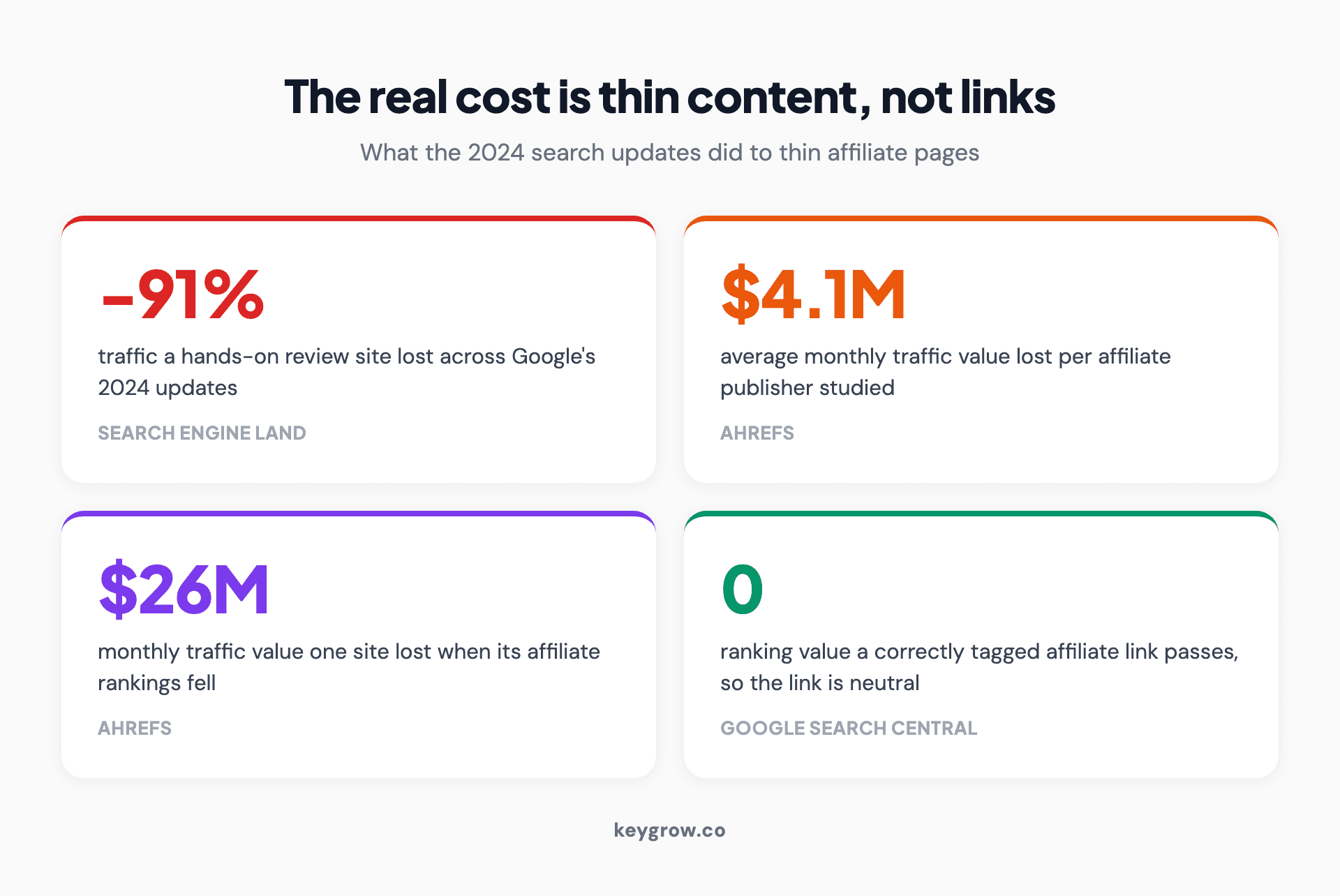
Infographic on the real cost of thin affiliate content, showing four figures: a hands-on review site lost 91 percent of its Google traffic across Google's 2024 updates, affiliate publishers lost an average of 4.1 million dollars in monthly traffic value each, one site lost 26 million dollars a month, while a correctly tagged affiliate link passes zero ranking value and is neutral.
Here is the opinion worth holding onto: Google does not punish affiliate links, it punishes thin content, and the 2024 updates proved it at the scale of millions of dollars in lost traffic. If your affiliate page would still be useful with every link removed, you are fine. If it would be an empty shell, the links were never your problem.
How many affiliate links is too many?
There is no magic number of affiliate links per page. Google has never published a ratio. What matters is whether the page delivers genuine value around the links, not how many it has.
A long, genuinely useful buying guide can carry a dozen affiliate links and rank fine, because the links sit inside real advice. A short page with three links and nothing else is in trouble, not because three is too many, but because there is nothing else. Stop counting links and start asking whether the page earns its place. If you stripped the monetization out, would anyone still want to read it? That is the only ratio that matters.
Affiliate links and disclosure
Disclosure is a legal requirement, not an SEO one, and you need it regardless of how you tag your links. The rel attribute is for Google; the disclosure is for your readers and the FTC.
In the United States, the FTC requires a clear and conspicuous disclosure when you earn a commission, placed where readers will see it, near the links rather than buried in a footer. This is separate from the rel="sponsored" tag and does not replace it: one tells search engines the link is commercial, the other tells humans. Beyond the legal duty, disclosure builds the trust that makes affiliate content work at all. A reader who feels misled does not come back, and Google's quality systems lean on the same signals of trustworthiness that an honest disclosure supports.
When affiliate links and content do hurt
Affiliate links cross from harmless to harmful when they are left unqualified, when they sit on thin pages with no original value, or when a whole site or section is built only to funnel commissions. Each of these is a content or compliance failure, not a property of the link itself.
The clear danger signs:
The fix for all four is the same, and it is the positive version of this whole post: add genuine value. Test the products and put your own data and photos on the page, then write the thing a reader cannot get from the merchant, which is the same standard our guide to unique content sets for any page. Tagging is the easy part, and it is also where this connects to the broader question of which links matter, covered in do nofollow links help SEO.
FAQs
Do affiliate links hurt your SEO rankings?
No, not by themselves. When affiliate links are tagged with rel="sponsored" or rel="nofollow" and disclosed, they pass no ranking value and carry no penalty. They are neutral for SEO. What can hurt your rankings is thin affiliate content, meaning pages that add no original value beyond the merchant's own description.
Do affiliate links pass link equity or count as backlinks?
No. A correctly tagged affiliate link uses rel="sponsored" or rel="nofollow", which tells Google not to pass ranking value through it. That is by design, since the link is commercial rather than an editorial vote. So affiliate links do not build your authority, and they do not count as backlinks to the sites they point to.
Do affiliate links need to be nofollow or sponsored?
Yes, you should qualify them. Google asks that affiliate links carry rel="sponsored", and rel="nofollow" is also accepted and treated the same way for ranking. Leaving large numbers of affiliate links unqualified can be read as participating in a link scheme, which Google says may trigger a manual action.
How many affiliate links are too many on one page?
There is no set limit. Google has never published a ratio of affiliate links to content. A useful guide can hold many links and rank well, while a thin page with a few links can struggle. The real test is whether the page would still be valuable if you removed the links, not how many it has.
Will Google penalize my site for using affiliate links?
Not for using them correctly. Affiliate monetization is explicitly fine when links are qualified and the content adds value. Penalties and traffic losses come from thin affiliation, copied merchant content, or unqualified links at scale, which violate Google's spam and quality policies. Tag your links, disclose them, and make the page genuinely useful, and you are within the rules.
What is thin affiliate content and why does Google target it?
Thin affiliate content is a page that just reprints the merchant's product copy and bolts links onto it, with no testing or original take of its own. Google names "thin affiliation" in its spam policies because it gives users nothing they could not get from the merchant directly. Its core, helpful-content, and product-reviews systems all push such pages down.
Do affiliate links need an FTC disclosure as well as a rel tag?
Yes, they are two separate requirements. The rel="sponsored" tag tells search engines the link is commercial. An FTC disclosure tells readers you earn a commission, and US law requires it to be clear and placed where people will see it, near the links. One is for Google, the other is for humans and the law, and you need both.
Can affiliate links ever help my SEO?
Not directly, since qualified affiliate links pass no ranking value. They can help indirectly: genuinely useful affiliate content earns links, shares, and return visits, and those signals support your SEO. So the help comes from the quality of the page, not from the affiliate links themselves.
The short version
Do affiliate links hurt SEO? Not when you tag them with rel="sponsored" or rel="nofollow" and disclose them. Tagged correctly, they pass no ranking value, so they are neutral. The damage people blame on affiliate links almost always comes from thin affiliate content, the copied, value-free pages that Google's spam and quality systems are built to demote, and that cost real sites most of their traffic in 2024.
So tag your links, add a clear disclosure, and then put your energy where it counts: making the page worth reading with every link removed. If you are not sure whether your content clears that bar, or your traffic dropped after a core update and you cannot tell why, that is what our SEO team diagnoses. Tell us what happened and we will tell you whether it was the content, not the links.


